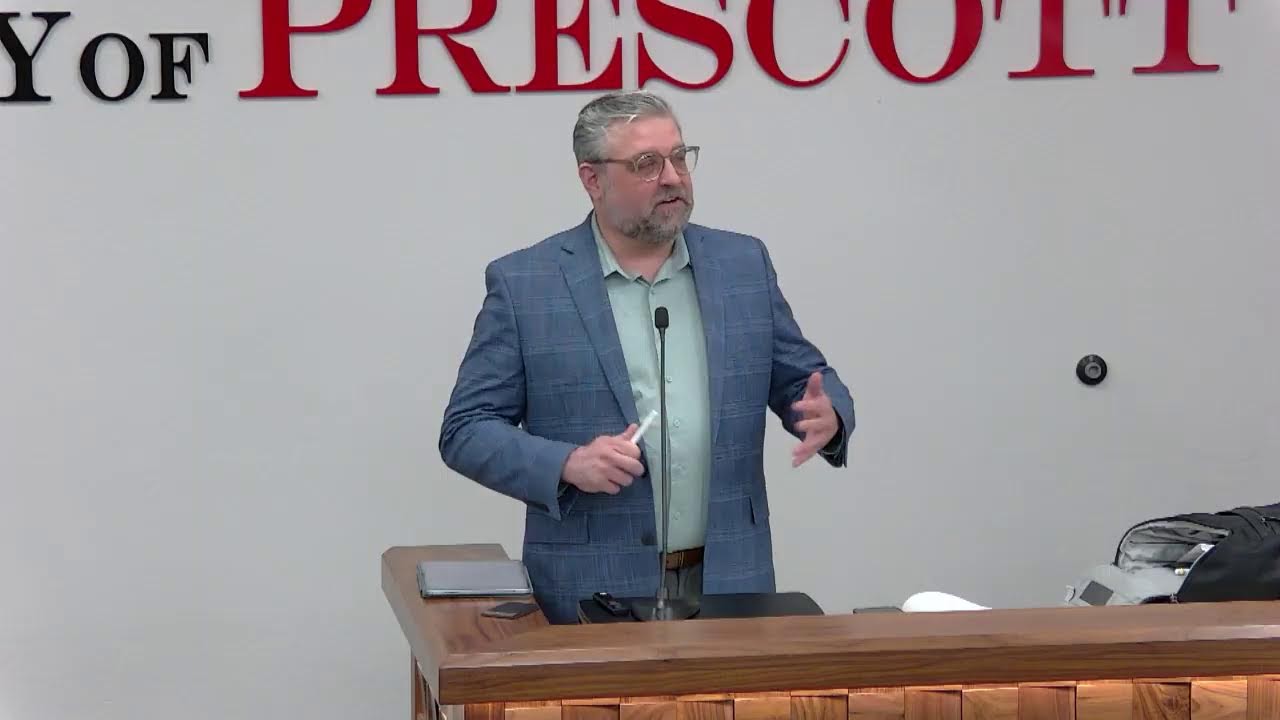
Prescott Subcommittee Approves Plan Framework but Punts Non-Discrimination Controversy to Full Council
Prescott City Council Subcommittee on General Plan Review approved reorganized plan structure and design while deferring substantive controversy over non-discrimination language and directing revisions to major/minor amendment definitions and goal language.
Prescott Subcommittee Approves Plan Framework but Punts Non-Discrimination Controversy to Full Council
On July 8, 2026, the Prescott City Council Subcommittee on General Plan Review unanimously approved three structural components of the city's major general plan update while deliberately tabling a heated, three-year community dispute over explicit non-discrimination language that had previously been voted into the draft but is now being softened by staff on federal compliance grounds.
The meeting—attended by Mayor Cathey Rusing, Council Member Mary Frederickson, and Council Member Patrick Grady—produced a 3-0 vote on the public participation plan and a September 3 public open house, a 3-0 approval of the reorganized table of contents with modifications (including an executive summary and state statute appendix), and a 3-0 approval of the redesigned template and visual branding. Yet beneath these procedural wins lay an unresolved and volatile question: whether the final plan will carry the June 2026 draft's affirmation that people of all races, national origins, sexual orientations, genders, religions, and disabilities can use Prescott's land without discrimination—or the softer alternative language emphasizing "shared quality of life" that staff has proposed.
The clash between these two phrasings, and the competing values they represent, dominated the latter half of the meeting and revealed significant tension between community activists, some council members, and consultants concerned about federal grant eligibility.
Timeline
- Agenda item 1 (May 27 minutes): Motion tabled to allow staff amendments to subcommittee minutes; passed 3-0.
- Agenda item 2 (Public Participation Plan presentation and vote): HR Green consultant Ed Boy presented engagement strategy; extended discussion of phase timeline, Labor Day conflict, September 3 open-house date confirmation, addition of February 2027 full-council study session. Vote: 3-0 approval.
- Agenda item 3 (Table of Contents reorganization): Discussion of state statute appendix vs. hyperlink, executive summary placement, acknowledgments section scope, exclusion of mayoral letter, subheadings in TOC, legible maps in appendices. Vote: 3-0 approval with modifications.
- Agenda item 4 (First three chapters—content review): Lengthy discussion of Prescott Road Map non-discrimination language, precipitation data accuracy, census data emphasis, parking code implications, goal/strategy language softening, and general editorial direction.
- Public comment: Five speakers on non-discrimination language (Pete V., Robert L. Shagog, Jim Heling, Dan Rearden, Rosemary Dixon).
- Agenda item 5 (Template and design presentation and vote): Discussion of portrait vs. landscape format, font sizes, color palette (blues/greens vs. gray/yellow), cover image objections, map legibility standards, color-blocking for goals/strategies. Vote: 3-0 approval with recommendations.
- Agenda item 6 (Plan administration—major/minor amendment definitions): Extended discussion of House Bill 2447 implications, very-low-density-to-medium-density zoning change marked as "minor," acreage thresholds, commercial-to-residential conversions, general plan binding authority, Stringfield Ranch annexation precedent. No vote; discussion only, with direction to revise and bring back.
Opposition to Revised Non-Discrimination Language
Number of speakers: 5 against softened language (all urging retention of original explicit language).
Main concerns:
-
Prescott's sundown-town history and ongoing racism: Multiple speakers noted Prescott's documented past as a sundown town and present-day racism, including white supremacist flag sightings and exclusionary treatment in local gun shops and retail establishments.
-
Explicit naming provides agency and clarity: Public commenters emphasized that specific language naming racial, sexual-orientation, gender, religious, and disability-based protections gives marginalized people assurance they are recognized and protected. Vague "quality of life" language omits those specifics.
-
Federal compliance claims are overstated: Speakers argued that 390+ U.S. communities and 11 Arizona communities have adopted similar explicit non-discrimination language without triggering federal grant loss, and that federal law itself (Civil Rights Act, Fair Housing Act) already protects these categories.
-
Prior approval by city council and Planning & Zoning was binding: Jim Heling noted the original language passed the General Plan Review Committee, two separate Planning & Zoning Commission hearings, and a 6-1 city council vote on March 11, 2025. He flagged that at least two council members who voted yes have since reversed position and said he would follow up with meeting requests to understand why.
-
Community engagement and lived experience matters: Dan Rearden (retired U.S. Postal Service, 30 years in Prescott) described Prescott as a place where he has heard exclusionary sentiment for decades, echoing the phrase "You ain't got no N-word here," and warned that removing explicit language sends a message that discrimination is acceptable.
-
Economic and cultural benefits of inclusion: Robert L. Shagog cited research showing cities with cultural diversity benefit economically in tourism, restaurant choice, education, and innovation. He also noted 130+ positive public comments on the original non-discrimination language during the prior comment period.
Most compelling arguments:
Rosemary Dixon's testimony cut closest to the bone: Prescott is not a generic American town. It has a reputation to repair—it was a sundown town, and she has witnessed white supremacist flags in the community. A retired JAG officer and close friend from Phoenix, who is Black, refuses to visit Prescott without a gun because she fears for her safety. Explicit non-discrimination language in the general plan, Dixon argued, would state clearly where the community stands.
Pete V., a martial artist and recent transplant who moved to Prescott to care for his wife's parents, personalized the debate: he was attacked by racists at age seven and spent a month in the hospital. At fifty-nine, he carries that trauma. He has experienced racism even in Prescott—ignored in gun shops despite carrying a 9mm pistol, treated as second-class. He recounted a young man yelling "White lives matter" at a prior meeting in the council chambers. Explicit language, he said, puts discrimination on the record so "everybody can see this."
Support for Revised Language
Number of speakers: 0. No speakers argued for the softened version during public comment.
Internal council position (from discussion):
Council Member Patrick Grady, though not directly endorsing the revision, steered the conversation toward acknowledging competing priorities. He noted that prior general plans failed to gain supermajority council support on two separate occasions, and emphasized the importance of "a city council that's all on the same page as we present a general plan to our voters." His comment implied that internal council alignment might require compromise on controversial language.
Ed Boy, the HR Green consultant, presented the softened alternative without strong advocacy, framing it as an attempt to find terminology "that tends to be a bit more um acceptable or non-confrontational with respect to some of the guidelines that are in place from federal level um grant and policy requirements." He noted that other communities handle similar content differently—some place it in housing or neighborhoods chapters rather than the front-end road map—and some do not include it at all. His tone suggested pragmatism rather than conviction.
Key Speeches
"I understand finances, the federal government, this changes. This is a new regulations and it's bound to change again. There's a lot of court um you know lawsuits trying to get this to be redone. So, please don't let that be something that pushes you to exclude this. Uh you talk about the possibilities of it getting voted down. Well, I can tell you right now that from what the meetings I've been into, they're not going to vote this agenda down because of this statement. They're voting it down because of uh the plans for the community, the water restrictions, the uh the requirements that you guys can put on us as land owners on what we can and cannot do on our own property." — Pete V., public commenter
"The non-discrimination language is a reflection of our values and what we would like to see in our community. It is never too late to do the right thing." — Robert L. Shagog, public commenter (co-chair, General Plan Review Committee)
"I know it's a difficult conversation to have, but I think it's one that needs to be had and I, you know, as we move forward because again, this is discussion only, we're highlighting the fact that there's probably a need to continue to work on that." — Council Member Patrick Grady, on whether the subcommittee should defer the non-discrimination language debate
"This is not your charter. This is kind of forecasting what you hope to do... this is kind of forecasting what you are looking to do, but ultimately any of those legal actions, annexation, anything like that is going to still be a council action." — City Attorney (unnamed), on the general plan's binding authority
"What is substantial? Whose definition? So whose definition it is the communities. So what is a major amendment and what is a minor amendment is an expression of what's important to you in this community as to when those thresholds of being substantial or not are being exceeded." — Ed Boy, HR Green, on statutory interpretation of major amendments
Project Details
- Case/Plan number: General Plan Update (2027 Adoption Target)
- City/Jurisdiction: City of Prescott, Arizona
- Consultant: HR Green, Inc. (Ed Boy, project lead)
- Mayor: Cathey Rusing
- Council Members on Subcommittee: Mary Frederickson, Patrick Grady
- Timeline: Public open house September 3, 2026 (evening, likely Adult Center at Rosser); February 2027 full City Council study session; 60-day public draft review spring 2027; Planning & Zoning public hearings May/June 2027 (two statutory hearings); City Council adoption June/July 2027; voter ratification ballot November 2027
- Current zoning/land use: N/A (this is a comprehensive plan update, not a zoning case)
- Scope: Reorganization and reformatting of the existing 2015 general plan; addition of new economic development chapter (Chapter 7); restructuring around land use and circulation as chapters 1-2 priority; addition of state statute compliance crosswalk and hyperlinked digital-first design
- Key new elements: Executive summary, state statute appendix (or hyperlink), redesigned template (portrait format, 14pt body font, 16pt headers, color-blocking for goals/strategies using hierarchical labeling (e.g., LU-2.1)), updated climate and census data, revised goal/strategy language to reflect "consider/study" rather than "support" where appropriate
Vote Breakdown
Vote 1 — Approval of Public Participation Plan (Item B):
- Final: 3-0
- Yes: Mayor Cathey Rusing, Council Member Mary Frederickson, Council Member Patrick Grady
Vote 2 — Approval of Table of Contents Reorganization (Item C):
- Final: 3-0
- Yes: Mayor Cathey Rusing, Council Member Mary Frederickson, Council Member Patrick Grady
- Modifications included: Subheadings in TOC; executive summary preceding Chapter 1; state statute in appendices (with hyperlink option); removal of optional mayoral/chair letter option; acknowledgment of all prior committees and councils; legible appendix maps
Vote 3 — Approval of Template and Design (Item E):
- Final: 3-0
- Yes: Mayor Cathey Rusing, Council Member Mary Frederickson, Council Member Patrick Grady
- Recommendations: Revision of color palette to blues and greens (vs. gray/yellow); selection of city-located cover photo (vs. Thumb Butte, which is Forest Service land); simplification of map labeling (arterials and main connectors only, not every side street); adoption of portrait format, larger fonts, two-column layout, white space, color-blocking for goals/strategies
Outcome & Next Steps
Non-Discrimination Language: Deferred for continued discussion. Cathey Rusing and Patrick Grady acknowledged the controversy but emphasized the need to weigh supermajority council support requirements (the prior general plan was rejected twice) against community values. The question will be addressed by the full City Council, not resolved by the subcommittee. Public commenters made clear this is not a settled issue; Jim Heling said he would follow up with individual council members to understand recent reversals on the original language.
Major/Minor Amendment Definitions: Directed to revision. Cathey Rusing pushed back hard on the chart showing commercial-to-very-low-density as "minor," and commercial-to-medium-density as "minor." She demanded acreage thresholds (e.g., small commercial to residential = minor; large commercial parcel to residential = major). Patrick Grady agreed and noted this needs clarification in the final chart. Ed Boy and the City Attorney acknowledged the statute defines "major" but not "minor," so the chart is an expression of community values on what constitutes "substantial alteration." Staff will return with a revised chart and rationale.
Climate Data: Directed to update. The existing plan lists 16 inches rain + 13 inches snow = 29 inches total, which reflects pre-drought normals. The 30-year average is now ~18 inches. Staff will incorporate both historical and recent 5-10 year data to illustrate the 30-year drought impact.
Census Data Emphasis: Directed to prioritize 2020 Census over 2000/2010 data. Staff will also add lifecycle housing analysis (assisted living, independent living, senior housing) to account for aging baby boomer population and eventual natural attrition.
Goal/Strategy Language: Directed to soften committed language. Examples: Goal LU-4 "support flexibility in parking requirements" should become "consider" or "study" (Cathey Rusing cited the downtown 50-room hotel with no on-site parking as a cautionary tale). Staff will review goals/strategies to reduce language implying pre-commitment.
Map Legibility: Directed to simplify. The 2025 truck system route map is unreadable ("looks like a pile of ants," per Patrick Grady). The 2015 circulation map was superior. Staff will work with GIS to label only arterials and main connectors in the print version; full detail in digital versions.
Cover Image: Directed to revise. The proposed Thumb Butte image (stormy, oppressive) and reference to Forest Service land outside city limits will be replaced with bright, city-located photography featuring blues and greens to reflect landscape and address drought consciousness.
Next Subcommittee Meeting: Scheduled for September 23, 2026 (following the September 3 public open house) to review public input and any updated draft materials.
Controversies & Context
Sundown-Town Legacy and Ongoing Racial Tensions: Prescott's history as a sundown town—a municipality where Black Americans and other minorities were discouraged or threatened to leave before nightfall—casts a long shadow. Multiple public commenters referenced this history and current manifestations: white supremacist flag sightings, exclusion in gun shops and retail, booing of Democrats at the July 4 parade, and anecdotal reports of residents explicitly seeking Prescott because it is "Trump country." Rosemary Dixon noted that a retired JAG officer and friend from Phoenix, who is Black, refuses to visit Prescott without a gun because she fears for her safety.
Three Years of Community Engagement and Prior Council Approval: The non-discrimination language has been through an extended community and governmental vetting process. Jim Heling, chair of the MLK Peace and Justice Committee, stated that he and Robert L. Shagog have attended approximately 15-16 meetings over three years. The original language passed the General Plan Review Committee, two separate Planning & Zoning Commission hearings, and a 6-1 city council vote on March 11, 2025. Yet the current staff revision represents a retreat from that approval. Heling flagged that at least two council members who voted yes in March 2025 have reversed position, and he announced he would seek meetings with individual council members to understand why.
Federal Grant Compliance and Regulatory Pressure: Ed Boy and the City Attorney alluded to federal guidelines and grant requirements that may disfavor explicit civil-rights-based language in planning documents. However, no speaker or staff member produced specific federal guidance, and public commenters disputed the claim that federal law penalizes such language. Robert L. Shagog cited 390+ U.S. communities and 11 Arizona communities with similar language, implying that federal resistance is overstated or nonexistent. The consultant acknowledged other communities place diversity language in different chapters (housing, neighborhoods, arts and culture) or omit it entirely, but made clear this is a local choice, not a federal mandate.
Supermajority Adoption Requirement and Prior Rejections: Patrick Grady repeatedly invoked the fact that city council has rejected the general plan on two prior occasions and that adoption requires a supermajority vote. This raises a strategic tension: retaining explicit non-discrimination language may energize some council members' opposition, making it harder to achieve the supermajority needed to pass the plan to voters. Yet softening the language alienates the community groups and council members (like Patrick Grady himself) who championed its inclusion. The subcommittee punted the decision to the full council, implicitly acknowledging that this is a governance choice that transcends planning technicality.
General Plan Binding Authority and Stringfield Ranch Precedent: Cathey Rusing raised a pointed question about whether the city council is obligated to adhere to general plan boundaries. She cited the Stringfield Ranch annexation, which was approved outside both the general plan boundary and the water service area boundary, and asked: "What is the city council's obligation to adhering to the general plan?" The City Attorney and consultant clarified that the general plan is forecasting and aspiration, not a legal mandate. Council retains annexation authority. However, Patrick Grady pressed further, asking whether staff, Planning & Zoning, and Council should document "consistency with general plan" findings in rezoning and annexation reviews to create a record of deliberate deviation. This generated discussion but no resolution—a sign that the relationship between the plan and actual municipal action remains unsettled.
Parking Code Relaxation and Developer Pressure: Cathey Rusing flagged a cautionary example: the city once relaxed downtown parking requirements to encourage pedestrian traffic and a planned parking garage. Instead, a 50-room hotel was later approved with no on-site parking, creating a parking crisis. She cited Goal LU-4 ("support flexibility in setbacks and parking requirements") as problematic language that implies pre-commitment rather than genuine deliberation. The subcommittee agreed to revise such language from "support" to "consider" or "study." This reflects concern that ambitious goal language can constrain future council discretion and embolden developers to cite the general plan as a mandate for relaxed requirements.
Major/Minor Amendment Thresholds and House Bill 2447: House Bill 2447 (recent Arizona legislation) has altered the timeline and review process for general plan amendments, removing the requirement that major amendments be batched and reviewed once per calendar year. Now both major and minor amendments come to council, but major amendments require a 2/3 supermajority and a 60-day public review period. The existing chart marking commercial-to-very-low-density as "minor" troubles Cathey Rusing: a change from, say, 20-50 acres of commercial to residential represents a 5-6x density increase (1 unit per 2 acres to 7 units per acre) and a massive shift in the city's economic and land-use character. Why should this be minor while some other changes are major? The statute defines "major" but leaves "minor" to local discretion. The subcommittee directed staff to revise the chart with acreage thresholds and a clear rationale reflecting Prescott's community values.
Duration
- This meeting: Approximately 3 hours 45 minutes (estimated from transcript depth and scope).
- Public comment on non-discrimination language: Approximately 18 minutes (5 speakers × 3-4 minutes each, with some exceeding the nominal 3-minute limit given the sensitivity).
Other Notable Items
Community Profile Demographics: Mary Frederickson advocated for greater emphasis on recent (2020) Census data vs. older 2000/2010 cohorts. She also raised the "blunt but real" observation that Prescott has an aging population (baby boomer bulge) that will not last forever—natural attrition will shrink the bulge. How should the plan account for lifecycle housing (assisted living, independent living for seniors) as the population ages and potentially declines? Ed Boy confirmed the consulting industry routinely analyzes population pyramids, housing preferences, and future assisted-living needs as part of demographic planning.
Climate Data Accuracy: Cathey Rusing identified outdated precipitation/snowfall data (16 in rain + 13 in snow = 29 in total, reflecting pre-1990 averages) as inconsistent with the current 30-year drought reality (~18 in total). The subcommittee directed staff to seek 30-year normals from NOAA/National Weather Service and to include both historical and recent 5-10 year data to illustrate the magnitude of the drought and its implications for land-use planning.
View source transcript ▼
Source: Council Subcommittee on General Plan Review - July 8th 2026 — July 8, 2026. Auto-generated YouTube transcript; may contain transcription errors.
Okay. Good afternoon. Today is July 8th, 2026 and this is the city of Prescuit City Council Subcommittee on the General Plan Review. Roll call, please. Mayor Rousing, here. Council member Frederickson, here. Council member Grady, here. All are present. Okay. First item, please. So, the first item is the approval of the May 27, 2026 subcommittee for general plan review minutes.
And mayor, if I may, staff um take took a look at those once the agenda was published and kind of found a few ministerial errors that we wanted to correct. So, if it's okay, uh, we recommend tableabling it and we can get some things cleaned up and then next subcommittee meeting we'll have two sets of minutes. Okay. I move that we um postpone approval of our minutes until uh they can be amended and brought back at the next meeting. Second. Please vote. I The motion passes. Thank you so much.
The next item is presentation and discussion regarding review and acceptance of the draft public participation plan. Go ahead. So we have uh with us today is u Mr. Ed Boy with HR Green who is the consultant as you all know helping us with the general plan update. Um and so staff broke it down. Um, HR Green provided us with kind of a memo of all the things to go over today and we wanted to just outline it a little bit in the memo.
And so starting with the public participation plan, working on at the table of contents, going over the reorganization plan, templates and design, discussing chapters 1, two, and three, and then the plan administration chapter. And so, um, at this time, we figured we could talk about the public participation plan. Um, if there's any comments or concerns or questions. Thank you, Alex. Mayor Pro, Mayor Prom, and Council Member, thank you for having me. Ed Boy with HR Green.
Um, it's good to be back here again today. And as Alex noted, the first thing I wanted to go through was the public participation plan. Um, but before I do that, I'm just going to give a quick little background um just to update what we're doing here today. So, uh, HR Green was brought on um our, uh, to assist with the general plan update. Our charge is to help reorganize, reformat the plan into a new um organization and layout.
Um retain a lot of the work that's been done previously and then also work to add additional elements that would be applicable once Prescuit reaches a population of 50,000 or greater. Instead of waiting for that 50,000 threshold, which will inevitably come, we're preemptively planning and moving forward with enhancing those elements and integrating it within all the work that's been done on the plan previously. So, part of that is that we've restructured and grouped a lot of the elements.
We talked about that at the last meeting. Um, we've integrated an economic development chapter and we're preserving the existing goals and strategies format and the way that the wording works since all that work has been put into this thus far. How this changes things for the plan is that with these new elements, we have that public participation plan that has additional public outreach that will be uh part of developing those elements.
We are targeting that administrative draft early in 2027 in a 60-day review draft again just like it's done previously um for uh the period in spring looking to get this approved through council uh by June to be on the ballot in November for ratification by the voters. So with um just giving that summary of where we are in the process, what we're doing, I'm going to jump right into that public participation plan. So the statute um for Arizona is pretty clear.
They want robust um public involvement throughout the process and as part of doing so there's the need to develop the public participation plan which describes the different methods, engagement methods, strategies, notifications, um touch points that would be made to keep make sure that the public is aware of the process and included as part of helping to develop the elements as part of the process. And again, this is building off of what was done previously.
So, it's really narrowed and targeted to the new elements that we are looking to integrate into the project uh the plan uh moving forward. So, the the plan includes those methods, the touch points. Uh there's a a need to have a public meeting sometime in August or September, maybe October, but we t we'll talk about that a little bit later in terms of scheduling and timing.
There'll be a second open house later once the 60-day public draft review is available where we can um allow the public to ask questions, learn more about the plan and how it's evolved um from their initial touch point in August or September of this year. Uh we will have an implementation schedule in this um public engagement plan which is part of the packet.
And there is an ability for us to do a little bit of individual stakeholder outreach to identified focus groups um or or stakeholders that are critical to moving these new elements forward. We don't want to retry old ground. We want to make sure we just target the new stuff. Um we're not going to change the what's been done previously. Oops, I went a little fast there.
So, in that in that uh table that's in the uh public participation plan, uh I just want to highlight some of the methods that we're using. Uh there's going to be a project website going to be reestablished uh made available, kept active throughout the process where all materials will be found for public review.
There will be social media news blasts that will work with the city's uh public information office and planning staff together to make sure the word gets out to as broad of a group of people as possible. Uh we will issue those press releases and notices of meetings through those social media eblast list and the city's website and other means and mechanisms as well. The first phase um as I noted is we're digesting the plan.
Some of the output of digesting the existing plan and the work put into it is being brought to you today to talk about the first three chapters. Uh that's what these subcommittee meetings are for. The phase we'll be moving into next will be all about the public getting involved for those new elements through uh the end of the year.
um through um the council subcommittee meetings like this um through a work session if necessary and it was kind of talked about if there might be a need to update council at large. There'll be that public meeting/openhouse that we're targeting for as well as a stakeholder interviews and then there'll also be um potentially a community survey for the new elements and other information on the website.
Um, and I don't um, have to go into the extreme detail on the remaining part of the schedule, but that's where we, as I stated before, come back to the public, show them where the plan has evolved to and the final look of that is, and then prepare for the adoption process as well. And all that's documented in the public engagement plan.
So the request for the public enga uh participation plan is one is there anything that seems to be missing or needs to be addressed in this uh is there any details that you have questions are there any details for any questions you might have about any elements and if so we want to make sure we get those adj addressed and documented in here as being our path forward. Mhm. Um I just have a question.
Uh under phase 2 fall of 2026 city council work session undetermined um through this whole uh the whole phases. I only see one of a city council work session and then the next one they we vote on it. City council adoption June July 2027. It seems to me we should have another work session kind of in more than one. Okay.
Um I don't know what the rest of the committee thinks about that because I I assume we'll be going to the open houses, but I think it's different if we, you know, we need to have the whole body here so that we can kind of see what direction it's going in and have some input from the city council as a whole. So, I would like to see something uh you know, we can put it on the agenda um during uh phase three um sometime in like maybe February of 2027 because we'll do one in the fall. Yeah.
To be like October, November, December, January, four more months later. and and that would be appropriate with the public engagement approach, which is get the new information, work that over, make sure that that's incorporated into the elements properly, and then come back to the public with the 60-day review draft, the public draft, and that that seems it would be um a a good tie-in for the full council to be updated along the along that same path. Yeah.
So, we'll we'll add on in phase three a city council um study session uh February. Okay. Does that sound good? Yeah. And I I our staff uh will work with the planning staff. Okay. To make sure that we um address that properly. Yeah. And then it goes before planning and zoning and phase 4 May sometime in May or June. And that's the public hearing statutory process. Okay. And then um Okay. And then the city council adopts it in June and July. Um I don't know.
Do you think maybe we should have planning and zoning review it a little sooner than because it seems like it theoretically, you know, they could review it in June and then we adopt it in, you know, two weeks later. So, uh, this is set up to be a little bit conservative, um, on when the final public draft might be ready. Okay. So, this is working backwards from the last possible date the council could approve it, which is early July of 2027, and that's why we gave a range of June or July. Okay?
There are two statutoily required planning and zoning hearings required and those can be scheduled one right after another backtoback. They can be scheduled weeks apart. There's no timing requirement through statute. You just have to have two at two different locations in the community, both as open public hearings. Yeah. So, the 60-day review kind of gets us tied down to a degree because that's a don't do anything period besides receive comment.
And then there's the 120day period before it goes on the ballot. That that cool down period before it can be voted on. So that's why that we the windows can be moved a little bit, but it you know it's not super flexible either unless we can find ways to compress the front end which that might um affect the ability for the plan to be robust. Only I only see one uh planning and zoning. We're yeah we're listing that as a single item but it's two hearing.
We know it's two hearings and they will occur per the schedule in the month of May or the month of May and June. Okay. Actually that that was a question I had as well just because of the way it's written up. It sound it looks like hearing or hearings plural. Okay. But but we know it's going to be two.
So we can make some minor changes to this along with that work session for council to make that clear so that it just is documented and everybody can use the same and that's statutory I understand two hearings for P&Z. Yes it is. And the statute does not is silent on the uh any kind of time frame between the two. You say that they could be backtoback. Yes. Okay. Yeah. As long as there's public notice in accordance with statute.
I mean, if PNZ has their first one and nothing very exciting comes out of it, they still need to have a second one. Absolutely. Okay. Council's under no such obligation. They just are only required to have one. This sounds silly, but I'm going to say it anyway.
I'm assuming this time this time frame that you've laid out for us includes everything that the statute requires and also a time frame that's going to get us where we need to go in order to get it approved on council in order to get it on the ballot for November. That's exactly right. Thank you, Patrick. Yeah, thank you, Mayor. Um, I'm looking at phase two and I just want to reaffirm my support for having that event in August.
Um, I think that's a really important time to, as you're pointing out in our schedule, to talk about those additional general plan elements and why we felt strongly as a subcommittee, how we needed to move forward on incorporating additional elements into this general plan. Okay. Sooner we get out to the public with that, I think the better. So, thanks.
So, I'm going to jump a little bit ahead because I was intending to come back to um identifying and determining days when we would have this open house and the next subcommittee meeting. And while we put August 2026 in here, the intention was always probably at the end of the month. after looking at schedules and the council scheduled u meeting, you know, standard meetings that'll be there.
Uh we we have worked with staff and and wanted to ask if September 2nd or that week seemed reasonable for the open house because it would give us a couple a week to prepare summary information to provide to you at the next subcommittee meeting at the end of September, September 23rd. And so there's always kind of the thought that that will be holiday, of course, Labor Day, and that might uh suppress turnout. Mhm. But frankly, we're heading into the holiday season.
There's no way to avoid the holidays. So, yeah. Uh I'm good with that first week of September but and and the first week of September is not Labor Day. That's the 7th, the following week. Thank you. Yeah. So, this this also avoids that potential 3-day weekend conflict. Great. Now that I'm looking at my calendar, if I had looked at it more closely, I could have avoided that goof on my part. But thank you for clarifying that for me. So, if uh if I may, hello. I'm over here now.
Um, so we we do think it's really important that the three of you are able to attend it. In fact, even other council members if they're also available. And so we were hoping to since we're kind of on the topic um get confirmation that if available that maybe that first week of September works. Uh we thought Wednesday cuz it's the middle of the week and kind of generally a good day.
there's no council that week or other BCC's so it's kind of a more mellow week if you will anyway and so just wanted some feedback on that week andor specifically Wednesday September second Alex do we have any kind of uh thinking or has the staff gone down this road yet as far as a location a venue that would be available at that time we would like to today ideally pin down a date and then really start to figure that out because it'll be here before we know it we want to get um the content created.
We want to get it out to the public in the paper and so we want to start doing these things and starts with the date. So that's why we thought it today was a good day to talk about it and figure out when that may work. I'll be out of town on the second. The third I'm third I'm available. Sorry. The third. The third could work. It's a Thursday. Does the third I'm good with that. Okay. And you'll be uh it'll be at the uh adult center on Roser. Is that where we're going to have it?
We we don't know quite yet. We got to figure out the date. And that's the adult center is a very high probability. If if they're available and open, that's where we'd like to do it. Um and we were thinking around like 5 5:30 to 7 or 7:30. So in the after, well, in the evening. So Okay. All right. That sounds good. Okay. Well, we'll keep you posted, but we'll shoot for the uh the evening of Thursday, September 3rd. So, thank you. Thank you very much.
All right, I'm going to move on to the next phase, which is talking about the updated table of contents. And you have seen this before, but we wanted to put it back in front of you to show you that we've incorporated the economic development chapters, chapter 7.
So the intention is that the the plan structure would follow um a pattern of going from some of the more important components which is land use and circulation um and then moving through the other elements that are important for the plan uh including the elective items.
And I'll just remind uh the subcommittee is that these chapters while they might be have it some names like land use and growth areas or economic development or community services and facilities within each of these chapters will be uh subheadings for each element that is statutoily required with a citation to that statute. So it's crystal clear that we are meeting that requirement.
In chapter one, the plan overview, there will also be that crosswalk information so that you can understand and everybody else who reads it that the statutory requirements have been addressed and this is where you find it. So it we we talked about that and discussed that at the last meeting. Well, then remind me if if that term was used last meeting, the crosswalk, are we speaking hyperlinks?
So, within the document itself, there can be hyperlinks so that you can just click it and then be directed directly to it much like a table of contents. So, in the in the digital format document, yes, we can do that. Um, we would plan on doing that just to make it easy. Okay, great. And I apologize. I just need to interrupt briefly. So, as far as um the agenda, it looks like we needed to move to approve with or without modifications um the drafted public participation uh plan.
So, I think we would need to do that before we get into a big discussion on the table of contents um to whatever extent that there is a motion to be made. I think we need to do that before we move on to the next. And thank you for pointing that out to us. I we kind of have it kind of rolled into one, but uh yeah, good point. So, do I hear a motion? So, moved, but I'll make that more specific. So, um yeah, recommend that we approve the uh draft public participation plan.
Um with the amendment modification. Yeah. Second, please vote. I I Thank you. Thank you. I'll move a little slower next time. So, as I just described the table of contents, um we're here to confirm that this is the plan structure and approach that you would like us to continue with. And if so, um I think the same applies here. We need a motion and a motion to approve. Um and if there's any changes with discussion, I'm happy to have it. Yeah, I'd like to make a comment.
Um, I I think you might have uh referred to it, but I want to see in the table of con contents that we actually have an actual copy of the state statute governing um the general plan to have it actually in the general plan at the beginning. Mayor, I would recommend it be an appendicy. An appendices. Yeah. And we can refer to it. Okay. And um so that the public can refer to it when they have a question like why why are we talking about bikes or why are we talking about dark skies or open space?
You know, the alternative is we could do a hyperlink in the beginning to state statute since that changes. And one thing that putting a snapshot of statutory requirements in the document might do is eventually show a misalignment as statute changes. So yeah, any any thoughts or Well, I think we could do both. Okay. And you know, the statute may change and the statute might not change.
So, at least we have a copy of something to uh answer questions that the public might have and to be defensible why we're doing what we're doing. Patrick, yes. Thank you. Um, one of the other pieces that we've talked about is having an executive summary. And I I think that should be highlighted somewhere here that that would likely precede chapter one. Okay. And then um you're going to have it maps as an exhibit or appendes in the back. Full-size maps. Yes. Are legible.
So throughout in the next sections of the presentation we will show you um that there can be legible maps inserted within the document and as part of the digital copy we can make those full size and have them seated where they are most relevant so that people see them where that content describes it that can alternatively we can do create an appendicy with the maps as a set of figures that they can refer to. Um, I like that because our 2015 plan is like that.
And I'm always um, you know, it has u maps that you can open up. They're large maps that are folded in. And you know, if I want to see the open space map, I don't have to go through the document. I can just There it is. All the maps all in that chapter, right? In the appendage. In the appendies just all the maps there so that people can refer to them. uh easily. Excellent. All right. So I hear that hear that clear. So one and I'll talk about this more in the next section.
So there is we haven't begun to discuss with staff the approach to redesigning the maps but we brought some information forward for discussing that as well. Okay. And we just need to have legible maps. Right. You mentioned earlier that within each of these chapters there are going to be subheadings uh for the various elements that might fall under a particular chapter.
Do you envision the table of contents to just be as you have it here or are the subheadings also going to be listed within the table of contents? If it if it's your preference, we can easily put those in there. Um it would make sense to do so in my opinion. I would be inclined to agree with that. We just wanted to bring the high level structure and get confirmation on that. Yeah, I appreciate that this is not a final document what you're showing us here today.
I just didn't know if you were already thinking down the road of having the table of contents include both the chapter name and the subheadings within particular chapter. It makes a lot of sense. It's certainly easy some to put and that would u that would help with the appendices as well. If under the appendices you have a listing of what you're going to find in the appendices, the statute, language, the maps, all those elements that people could just jump right to.
And then uh under acknowledgements uh you mentioned optional letter from the mayor or chair um or I mean a mayor or chair um or maybe the I'd like to include city manager and then you know you're going to have to recognize both councils you know because we've been through two city councils previous mayors um and then also the subcommittee and also the other uh the working committee of how many people? 15. I believe there were generally 11. Yeah.
And then uh and then city staff too that was involved. So we will absolutely um acknowledge everybody who's worked on the past plan since that's part of the content from the past plan and we will in we will bring forward the new content for the new people who have worked on this as well. Um the question would be do we prefer to have those letters? Not every plan includes them. Some communities like to do so.
Um yeah the previous our 2015 plan doesn't have a letter and I don't know I don't see any point in having a letter. Um I have no strong feelings one way or another on that. So usually usually these plans don't have letters. Most communities haven't have elected not to include those letters, but some like to make sure that they're there. Yeah, I I don't know. I I don't see a point having a letter kind of self-promotion, I guess. Okay. Well, I'll just jump in and say I agree.
I don't I think the letter is is doesn't add value to what the general plan is supposed to be. And I have to say if we end up acknowledging because there's been many committees, many subcommittees, many working groups, several councils, we're going the volume is going to get excessive in my view. Okay. So with those comments, okay, you got a final action. Any other any other comments? Do I hear a motion?
If I u may real quick, mayor, I do have some public comment cards, but um no one put an agenda item. It's probably because I didn't put agendas out for you, but I think that everyone said ag um general plan. So, I think it was content related, not for kind of the the items we're discussing now, but is that correct? Does anyone Are we all So, okay, because the next item is the first three chapters. And so, that's what I'm thinking the public comment cards are for.
I just wanted to make sure I wasn't skipping anyone. Okay, that sounds good. Okay, thank you. Well, then I'll move to approve the table of contents as uh as presented here with modifications with our modifications. Did we make any modifications? Mhm. To the extent of subheadings. Clarify that the subheadings be part of the the table of content. Well, then yes, with with the modifications as discussed. Yeah. Executive summary. Second. Yeah. No letter. Okay. Please vote. I I motion passes. Okay.
Next item. So the next item is item D presentation and discussion regarding review of the first three reorganized general plan chapters as follows. Chapter one um plan overview. Chapter 2 community profile and chapter 3 land use and growth areas. So, um, Mayor Mayor Prom and, uh, council member, uh, the intention here is to get discussion and yeah, I expect you to be able to read that very clearly.
Um we we were we understood that there was a need to simplify the layout um restructure it into a more of the portrait letter format. utilize colors that were aligned with the community's branding and public information office and try to avoid the use of heavy saturated colors or things that would you know be a heavy on the eyes whether it's for printing or anything else.
So what we've done is we've taken an effort to bring information from the existing draft, the June draft of the general plan, and reorganize it, reward it a little bit, reformat it to fit into these new chapters. As per our last discussion, there will be continued evolution of these chapters. This is not considered the final. These are for discussion. Um, we will be adding to each of these chapters as we do the public engagement and receiving additional comments. We will be adding photos.
We'll be adding illustrations, pictures, modifying the layout with like insets or callouts and things like that that make sense for the legibility and readability of the plan. But we wanted to make sure we brought it forward to you at this stage as we've reworked many things and said what do you think about this? So um some of the things that we wanted to highlight at least in because I think the next item is more into the theme and layout right? Yes. Okay.
So I I'm teeing that up for the next discussion. But right now in terms of the content that's available in here, we wanted to show some of the um minor changes that we've kind of looked at um for some of the content. And one of those sections was in in one referring to the vision um of the city of Prescat. And you can see that we were looking for terminology that we know can become um contentious when looking for grants at the federal level.
um and other um programs and opportunities that might exist, but still make sure that it captured the real meat essence and purpose of what was important through the first plan. So, some of those terminologies um those terms have been flagged. We looked at it. We were reworking it.
It doesn't mean this is the final solution and doesn't mean it's the right solution, but it's to say does the subcommittee see that this is on the right track or there should be additional changes or we have a different direction to move or do we just leave it alone?
And in this particular, you know, option that you see in front of you, we highlighted that an ethic of equality and respect for all community members and that's been changed to a welcoming community where every resident family um you know is treated with dignity and respect. So it's it's capturing the same essence and purpose using different terminology to get there. Yeah. So open up for discussion. Yeah.
What I'd like to point out is under our current uh 2015 general plan uh on page four there's a bullet point moderate growth and quality development. The next bullet point is citizen empowerment and involvement in government and community activities. And then the last bullet point is ethic of equity and respect for all community members. So that's been in our general plan for 10 years and no one ever turned a hair over it. Keep it. There was never any discussion. No one was upset about it.
And it's very simple. Ethic of equity and respect for all community members. So I I say we just continue what we've had. No problem. And uh that's that's what we currently have and we should continue that. Okay. Mayor, I have a Yes, Patrick comment. So, in both the the June draft as well as the March draft, there was a section called Prescuit's road map and in that road map um it had language and I believe it was the same language in both, but I didn't formally check that.
But in the copy and the version that we're currently working with, it had a statement. It is intended that people of all ages, races, national origins, sexual orientations, genders, religions, and disabilities can make use of Prescuit's land and amenities without facing discrimination or harassment. And I think that this needs continued discussion.
I know you're not asking for us to sign off on, you know, version A, version B, but I think I would like to hear more discussion from the community with respect to that particular clause. continue. Okay. I didn't know if it was being opened up for that discussion right now or not. Apologize for that.
So, referring directly to that um was the Prescuit road map that you had just read and the adjustment much like I described for the previous one was to identify um alternative wording that got you to the same point that still says that this is an open and inclusive community. um but utilizes um some more language that tends to be a bit more um acceptable or non-confrontational with respect to some of the guidelines that are in place from federal level um grant and policy requirements.
Doesn't mean one's right over the other, of course. and I can read. Would you like me to read the new one or I think we can read it, but if you want to read it, you know, go ahead. Sure. So the new version of the road map is written to say the Prescuit community values the shared quality of life among all its inhabitants. The city is home to people of many backgrounds, perspective, cultures, and walks of life.
And that variety of experience strengthens the community and enriches daily life for everyone who calls Prescat home. The plan carries that tradition forward, affirming that Prescuit's land, amenities, and opportunities are open open to all who live, work, and invest here. That sounds pretty good. And I don't think we'd uh run up against any uh problems with the uh federal guidelines that have been issued. I don't have them with me right now, but they're pretty clear. Right, Mayor? Yes, Patrick.
Thank you. Um, I recall those discussions. Um, and and I think I was on city council for the June version, but not for the earlier version. Um, and I've recognized it up here. The word you've used on the section below is below is finding a balance. And I think that's important, but I think it's important for this city council. um a new sitting council to look at this issue very closely.
There was significant community engagement um around that earlier language on the prescuit road map um that ultimately resulted in an affirmative vote from the general plan review committee and that language was also um approved by at two different planning and zoning commission meetings. So another set of citizens that were engaged in our process. So, I think it's appropriate to have some conversation today. Um, but ultimately, it's something that's going to have to go to city council.
And I know it's a difficult conversation to have, but I think it's one that needs to be had and I, you know, as we move forward because again, this is discussion only, we're highlighting the fact that there's probably a need to continue to work on that. Mhm.
The strategies that we kind of laid out for this way that we're looking at the terminology, is that appropriate for us to continue on that path knowing that we can make adjustments along the way or do you have any real consternation or issue with the way we approach this? Um, let me ask you this. When you were working on the Chino Valley um general plan, did you have any this kind of language in there? Uh, what did you have?
Chino Valley when they approached doing their plan, they were really focused on making sure that the vision um was describing the plan's character and how the goals and policies and strategies applied. So the vision was kind of seen as this overarching guideline for all that was within the plan.
there wasn't a lot of discussion that was identified to be needed in their plan to talk about um the different elements that were in the road map for Prescuit and it doesn't mean it's wrong to include it or right to dis to not include it uh because there you do have that flexibility to develop the plan in the way it's most meaningful for the community. So, Chino Valley just in their review did not find it as being something that need to be highlighted specifically.
Um, but the essence of that information is captured throughout the plan. Mhm. So, it was and it was uh passed by their town council and passed by the voters. Yes. That passed unanimously successfully and Okay. overwhelming by the voters. Okay. And uh have you had these uh phrases in all the other multitude of other general plans uh you know in other communities?
Do you have any it varies and and I say it varies different degrees of how they would like to incorporate or address these some of this information rather being in the front of the document in chapter one might be somewhere else like in housing or neighborhoods or in arts and culture. there's a variety of places it can live and it just depends on the strategy or the approach the community would like to take to emphasize or highlight those things.
So it's not again some do some do it at a very strong in a really strong way others do it in a lighter way some don't do it at all. And um have have you ever had any references to the Civil Rights Act of uh the Fair Housing Act? Do you ever throw that in or make a reference to it? I don't recall the Civil Rights Act personally in the the plans that I've worked on.
Um, we do um where the plans require or need to have the additional justification, make reference to different federal acts and programs that exist related to the guidelines, uh, the goals and the policies that are within that. Some of that's historical as if you as you referred to it and some of it would be more recent and active programs operated by like housing and urban development and things like that. Okay. All righty. Thank you. Continue, mayor. Oh, Patrick, just another question for you.
Um, we know that we have a number of citizens here that would like to speak to this issue. Are you thinking of doing that at the end of the meeting or No, not at the very end. I was thinking after we were done with this section. Okay. Um this is item D we're on. I'd like to make one other comment if I may and I know this is a difficult community decision.
Um irrespective of what side quote unquote one may be on with respect to that the proposed language in this document that or the that in the June version. Um, but I just need to remind everyone that, you know, this takes a supermajority vote of city council and city council turned down our last general plan on two different occasions.
And consequently, we need we need to weigh that because I think it's important to to have a a city council that's all on the same page as we present a general plan to our voters in November of 2027. So um most of the substantive discussion that we planned on for this item was related to these wording changes. I I can u tell you that in the chapter 2 and chapter 3 that's in front of you that's more demonstrating the reorganization of the information. So it's information you've seen before.
It's information that's been through the general plan committee. been through all that review. It's just reorganized and reformatted in this new format. I I do note that as I've said earlier, there will be changes to chapter 3, four, five, six, and so on as we re-engage with the community and add the new elements to the plan.
So while we're showing you a framework or a initial draft of reorganizing information from describing the history of Prescuit in chapter 2 through the demographics and the data that sets the foundation for how we move forward, we're going to add to that. You know, we're going to be adding additional data because it's relevant to the new elements, whatever that might be. Same thing with chapter 3.
We've outlined existing future land uses and covered the things that are in the existing plan, but there'll be a lot more robust information in there related to growth areas, um, related to the other elements that have applicability in that chapter, a little bit of housing.
It might not be all about housing because it will refer out to the housing chapter, but we're setting the table from um that there will be continued and elaborated discussion for those elements elsewhere, whether it's housing, affordable housing, neighborhoods revitalization economic development, all those things. So, there might be a little bit more added to the land use section. This is just the beginning. Yes, Patrick.
Yeah, thank you for making that point because one of the things that I'm going to be looking at is a number of comments that we've made um in nearly every chapter in in our review. And uh while it's hard to go back and and review all of that information, it's not all in the minutes, but yeah, I think there's some we've made some important substantive um additions, not just, you know, textual modest changes.
And I want to be sure that and some of those including um I submitted some different uh recommendations in writing. So there was some of that too with respect to goals and strategies. So I'm glad you you uh acknowledged that yeah this is this is not that version that we're that we need to go over page by page per se. Yeah. Thank you. You're welcome.
And and I want to I do want to um make sure I give uh staff credit for being pretty thorough at giving us all their notes and the information that you've provided to them as well so that we um were able to capture that. And as you noted, the minutes don't have every little detail in them.
So there probably is still a little bit of painstaking work that's necessary to go back and listen to those and document and identify every one of those changes that were discussed because there was a lot of detail and a lot of thought put into that. And we certainly don't want any of that to be discluded or excluded when it was meaningful and important to be done. Um, and we wanted we make sure it's retained.
So, the version you see here has a lot of that captured, but I'm I'm positive that there's some little details and nuance that still need to be added. And so with that, if we aren't asking for an action, but if there any final comments or any thoughts that you'd like to provide to us about guidance on how we've approached the restructure, um the reformatting at this point with regards to the content because next I'll go into more of the layout and design.
Well, I uh when I was reading um some of the details, I mean, we can talk about this later. Um the average annual pre precipitation, this is chapter two, um page one, um is 16 in of rain and 13 in of snow. So that's like 29 inches total which is not very realistic because we average uh basically have been averaging 18 in total uh in the last 30 years because of the drought. So I think that's an important something that we need to uh you know get that one right. Yeah. So that that's a good point.
It was something I flagged myself. Um un I wish it was 29 in. I uh you know I part of my background and is I nearly had a degree in meteorology as well. So when the climate stuff pops up in the weather I always I gravitate a little bit towards it. Um I do want to note that uh you know data or information like geographic context, climate context, weather, all that in the community profile.
Um, one of the ways we approach it is that if it's not important to the plan, should it really be part of this information package? Meaning, is it help you make the informed decisions that come later in the plan? Some of this can stay obviously, but I do think there's probably a little bit of refinement or adjustment to how it's organized or placed in there to explain why it's important that we understand those climatic conditions. Yeah.
because we definitely need to uh realize that, you know, we've had a third we we're in the midst of a 30-year drought, no end in sight, and that is shaping our land use planning. I mean, it's shaping the planning of this community. Mary, I can imagine uh whatever um source that you picked up the 16 ines of rain and 13 in of snow from it would be useful to have the range is this from 1920 to 2020.
And if that's the case, if it is a bigger time frame that incorporates a wetter time than we're in right now, maybe a uh a more recent bit of data, if you're going to include that data at all, I agree that if it's not uh helpful having the specifics of numbers, I don't know that that's necessary, but if we're going to include numbers like this, that might be including a bigger time frame that would get us to 16 and 13.
That may be in an additional data point that would say, but say the last five years, here's what the average has been. And to show exactly that, that we're in a drought. And maybe historically over a hundred years, we've had 16 and 13, but in the last 5 or 10 years, we've had, you know, 12 and 8, whatever it turns out to be. Yep. No. Uh, statistically, um, the 30-year average, you know, which is now been the drought period.
It's the new normal and it's 18 in has been our average, but we can research. Yeah. So, so the information you see right now is what's in the existing plan. Um, so we haven't made any adjustments or changes to it right now. what we what I what one of the strategies and approaches is to seek out that climatology climatological data from Noah National Weather Service and their most recent 30-year period being from 1990 through 2010.
I do like the idea of having both a a bigger time frame and then the more recent time frame just to hammer it into people's head that we're living in a dry period. Absolutely. This is not what we had 50 or 100 years ago. Excellent. Any other comments on the existing? Are we making general comments on the first three chapters? Yeah, I I think that's appropriate because this is this is these comments are going to help give us direction on what to focus on or the ways we approach the information.
So, I just want to say I thought your approach to land use planning and growth areas was excellent. Um, you had to borrow that from a number of different chapters of of the June version itself and I thought it flowed really well. I and I wanted to let you know that. I appreciate that. Thank you.
Um my comment on when you were doing the demographics, the census information, it seemed like you relied a lot on um um the 2000 census and the 2010 census and not too much on our latest census which was the 2020. So, uh, that was one of my comments is to, uh, maybe emphasize more the more recent data and not so much on the the 2010, uh, or the 2000 even um, census for like population. I don't know. I you can show that, but just more emphasis on the latest data.
Speaking speaking of demographics and and maybe I'm just asking you this from a your industry standpoint. Uh you often heard it heard it said that Prescott's got a lot of old people. I'm in that it's just a real category. So I feel free to be blunt. Exactly. Uh, but as people look at that looking forward, and again, this is blunt, but I'll just say it. The baby boom bulge is not going to last forever, and that bulge is going to be shrinking over time through natural attrition.
Do people in your industry look at that and think about the fact that okay there's a big wad of retirees now but those people are not going to live forever. I know I don't plan to and they'll be dropping off as the bulge moves along in time. Does your industry include that kind of absolutely thinking despite how blunt and maybe un uncomfortable it may be for some people to hear. Yes.
Um normally when we would perform a demographic analysis or existing conditions report, we would look at um housing styles, you know, uh we would look at your uh population pyramids. How are they changing over time? Um try to identify where those bubbles are, you know, like like the millennial bubble, the baby boomer bubble, and um also review real estate resources or other information that helps give us guidance on housing preferences, um housing needs.
You mentioned that the boomers won't be here forever. That true, but they are going to be changing their lifestyles. While they might be independent living now, they might need assisted living or senior living. Identifying that as they age and how that will either free up or change their housing situation in the community, but it invites a question about where do they go to stay in the community next.
And so there might be goals or strategies about making accommodations in the code or identifying areas that are appropriate for assisted living or to allow for people to have independent living where they aren't relying on their vehicle to get around for instance or have alternative transportation methods. So yes, it's something we look at and it's multiaceted.
Thank you for bringing that up because I was not only just had it in my head that the passage of the bulge, the baby boomer bulge, but there's also that aspect of it which is as people get older, not everybody, but there is the trend towards selling that, you know, 4,000 square foot house on the hill and moving into something that is easier to maintain when you're correct. 85 years old, right? Yeah.
And uh one thing I'd like to comment on is I like the way you referred to our strategic plan kind of dovetailed the strategic plan in with the general plan. So I I like that including being included. Um and then u one of my pet peeves here is relaxing our parking codes. Mhm. We have huge issues parking and the developers are always trying to build projects with less and less uh parking spaces and they're always um and it never works out. Mhm.
And they they always try to tell us seniors, you know, if it's a senior housing complex or they have part part of their development is for seniors, seniors don't apparently go anywhere and they don't need parking. And that's not true. because they have a lot of resources deliveries caretakers family, uh, you know, people, they probably have need more parking than anybody.
So, when I look at, uh, your goal LU-4 support flexibility in setbacks and parking requirements, and I I just think we just don't even want to we just don't want to go there. That's on page Yes. nine. So, mayor, if I could, what you guys This is straight out of That's straight out of the June version, correct? Yeah. That we're working from. So, yeah, we're we're we were trying to be very careful not to alter all the work that have been done.
We are open to restrategizing or reformatting or reinvisioning these goals and strategies in the rewrite. Mhm. So rather than using words like support this, um there is other ways to say what might be important without saying you're going to support it, such as study or explore. Um consider consider um and and and we'll have some recommendations on that.
If you want us to review certain goals and policies that have been gone through the process, we can provide you some suggested revisions to that language. because it came back to bite us.
Uh we relaxed our parking requirements for the downtown area, the downtown historical area to encourage people because we were going to have a parking garage and to encourage more pedestrian traffic uh in the, you know, cuz we had an entertainment overlay district and uh that came back to bite us and now we have a 50 room hotel plan downtown with no on-site parking. No parking. Okay. So, those changes have already been incorporated into plans, some of the parking adjustments then. Okay.
So, then there might be a need to revisit the goal all together and say, is it still applicable or is there a different way to approach it?
I'm not saying we should, but I do like this is not necessarily a statement across the board, but to the extent that there are certain goals or strategies, uh to have language that reflects that we are going to be looking at these items, considering them, discussing them without language that implies we've already signed off on whatever the goal or whatever the strategy is.
It's kind of in the same ballpark as various housing strategies that have been put forward to the extent that language that in infers acceptance like we are going to move on these ideas uh is can be troublesome for a lot of people who are thinking I'm not signing off on that. I don't want to relax parking or whatever the issue is.
So having language that uh the verb language that indicates that we are looking at it, we are con we are acknowledging this is an issue and we've got to think about it and make some decisions without inferring support for any particular one at this moment. Understand? And then under on going back to page eight on uh goal LU-1, you know, you talk about uh in residential support services.
Uh you're referring to annexation of land, residential support services, example, medical restaurants, and then you put in cleaners and child care. You know, those are pretty specific. Uh I assume you mean dry cleaners. Is that who you're talking about? That would that would be the intent and and merit this is the same language again. Yeah. Just making sure you know. Yeah. We're just bringing it forward. But I could see changing the cleaners to just services and groceries instead of child care.
Uh, could could I could I generalize and say that it sounds like the subcommittee would be encouraging us to re-examine the wording of these um to find them uh find ways to make them um either um a little less specific or less of a have a less of a commitment to them because they are policies and policy decisions. Is that is that fair to say? Yeah. Okay. No, I agree with that.
And yes, the the cleaners did kind of jump out at me because I tried to avoid dry cleaners at all costs, but but as some might notice, um, but changing that to just retail or retail and services, something that is a broader umbrella, but and and groceries because that that is huge um in a community is uh Yes. Yeah. Yeah. There might be a way to rewrite that entirely without having to give examples. Yeah. You know, which I really believe there is.
So, we can look at that though if you as part of our rewrite. Uh let's see. So, anyway, I I don't see anything else that jumps out on me. Do you have any comments, Alex? I do. The first public comment speaker is William Peter V. Pete. Okay. I was hoping he was going to go first. You lead the way. Okay. So, again, my name is Pete V. I'm uh co-owner of Full Moon Tai Chi. Uh my wife and I moved here um in 22 uh to help take care of her parents.
So um I'm here to speak about uh the Prescuit's road map. It's uh exclusion from the proposed. I do like the name uh our quality of life and character. However, uh what it says in the prescuit roadmap really speaks to people like me. uh to make you understand a little to help you understand when I was seven is when I first learned about racism. My siblings and myself were attacked and I spent over a month in the hospital. I spent over a month at home trying to recover.
When did where did this occur? This was in Virginia and Oh, in Virginia. Yeah. Now I'm 59 years old. I'm still dealing with this mental uh um stress of what happened over the years. My father was military. We moved every 6 months to a year. I got to find racist people everywhere I went and even here. Uh we like this place because well, one her parents right here. Um it's a great area. We love everything that goes on here.
And when we go into stores, we're treated with respect from the people that work there. However, not from the people that shop there or go there. Uh and and we found this to be okay until we started going into gun shops. And uh then in the gun shops, uh there you go, getting ignored again. uh even with a a 9 millimeter on my back, they they still treated me like I was second class um wouldn't talk to me, give me the time of the day.
The last time I was able to make this meeting, we were talking about this inclusion statement and as we were waiting outside, a young gentleman started yelling from the steps at us, "White lives matter." Right here in this very room, we are running across racist people. The only way to put an end to this is to put it in writing so everybody can see this. We need this. You know, I understand finances, the federal government, this changes. This is a new regulations and it's bound to change again.
There's a lot of court um you know lawsuits trying to get this to be redone. So, please don't let that be something that that pushes you to exclude this. Uh you talk about the possibilities of it getting voted down. Well, I can tell you right now that from what the meetings I've been into, they're not going to vote this agenda down because of this statement.
They're voting it down because of uh the plans for the community, the water restrictions, the uh the requirements that you guys can put on us as as land owners on what we can and cannot do on our own property. Those are the things that you have to watch out for. Parking is a big issue, right? This discrimin this this clause is not really going to be your big issue. And it is in the majority. We did a quick research. It is in the majority of the the council uh proclamations.
There is some sort of clause like this. And so I urge you to keep this. You voted on it already, passed it. There's a lot of people that would love to be here to speak up about it, but most of us have to work. So, I I hope that you put it back in. I mean, I I'm I'm expecting it to be in cuz you voted it. Uh but I really hope that you stick through. Uh as a martial artist, honor, integrity is everything.
And I hope that you honor your votes, your commitments to our community, not just the people of color, women, the LGBT u LGBTQ, all the communities, right? That you show us that you do care. Uh we need this. Thank you. Thank you. Uh everyone will have three minutes. Next speaker is Robert L. Shagog. Um, I'm here to speak in favor of the original version of the Prescuit road map. Uh, Jim Heling and myself, we've been working on this for over three years.
We've attended about 15 different meetings. uh and I've heard that no general plan had such language. So I did a AI search for cities across the United States and there's over 390 communities that have such language. 11 of them are in Arizona. This language is in line with federal and state laws. We just celebrated our 250th birthday of our country and in that document it said that all men are created equal. I think that that could be changed to all humans.
Humans of every color, men, women, children have the right to pursue happiness. Over the past 250 years, children have the right to be educated. Women have the right to have a career that's separate from being linked to a man's career. People have the right to marry outside of their race. This wasn't always true. And as of n of 2015, then same-sex marriages were acknowledged. All humans have the right to pursue happiness. Our happiness is not linked to one another. It's individual.
It's a personal thing. Also, we have the right to political freedom. Yet on the Fourth of July parade this year, the Yavapai Dims were marching and they were booed by audience adult spectators. Alongside some of these adult spectators were children. These children were being taught that dims are less than human.
This was reported in the Tuesday's courier and it was a a gentleman by the name of Steven Francis who just moved here two years ago and he felt that this needed to be called out and I agree with him and he states in this his letter to the editor that he was a conservative. I would assume that means he's Republican. That he likes to talk to people who are not of his same persuasion because by talking to them, he gets to understand them better.
He quotes Abraham Lincoln that we are not enemies but friends. We must not be enemies. We must need we must we need to do justice. We need to love mercy and walk humbly. The non-discrimination language is a reflection of our values and what we would like to see in our community. It is never too late to do the right thing. Thank you, Robert. Next is Jim Heling. So, hi. Hello. I'm Jim Heling. I'm the chair of the MLK Peace and Justice Committee.
And as Robert mentioned a minute ago that uh he and I have been in front of city committees over the last three years, by my count it's 16 times. Um and so part of what I'm going to do today is reiterate some of the points I made in the past. uh like uh the the state statute that governs general plans includes wording on community goals, open space, and equal housing that would be addressed through the inclusion of the non-discrimination statement.
Uh land as a land use document used primarily by developers and business owners. the general plan should be welcoming to all those who may be interested in doing business here and including a statement saying that we don't condone discrimination may open some doors that would otherwise be closed. Uh studies have shown that cities promote cultural diversity benefit economically in terms of tourism in terms of restaurant choice education and innovation.
And also we had over 130 positive comments relative to the original non-discrimination statement made during the general plan public comment period. And I'd also like to bring up the fact that on March 11th, 2025 in the city council chambers, uh, the city council voted 6 to1 to improve the the wording that is in the prescuit roadmap section that's shown on the screen.
Since that time, uh, I've become aware that at least two of the council members that voted, uh, to pass the plan no longer support the plan. So, no longer support the statement being in the plan. And so, I'd like to know why that is. Uh, so I'm going to follow up this meeting with email requests to council members asking that we meet and so we can find out more about why this there's been a reversal in the thought in terms of having that original statement in the plan.
The one thing that's in the statement original statement that's not in the proposed statement are all of the individual characteristics. And as Pete mentioned, that gives people that fall in those categories agency. They see that there and they say, "Oh, that's me.
That means that I am considered somebody that is not going to be discriminated against, that I'll be able to use the land without discrimination." So, I think that's really important that those characteristics be included in the statement uh non-discrimination statement that's included in the proposed plan. So, I I'll be sending out those meeting invitations. Hopefully, we can meet, find out more about why there's been a change in in heart and uh we can have some discussions.
Thank you for your time. Thank you, Jim. Daniel T. Rear Rearden Raren. Good afternoon. I'm Dan Rearen. I worked for the US Postal Service here in Prescuit from 1976 till 2006 and retired as a letter carrier. I think I've got a pretty good working knowledge of the history and the social and political environment of Prescuit. Some years ago, I I I'm going to start with a rhetorical question for you and I'm going to give you a couple vignettes that support my asking that question.
Why would any community in the land of the free and the home of the brave have a problem with explicit concise language about discrimination? The original statement is constitutional. The proposed statement is chamber of commerce political. Now, some years ago, trudging along North Mount Vernon Street, chatting with a young man, what brought you to Prescuit? This, that, and the other. You know what I like most about Prescuit? No. What's that? You ain't got no here.
Now, I heard a lot of that similar sentiment expressed over the years, not as oiferously and openly, but subtly and in many areas. What I hear today, people moving into my neighborhood, oh, we moved here cuz we found out on the internet that this is Trump country. I have to consider that to be a bit of a dog whistle for discrimination sympathy. Rosemary Dixon Hi everybody. Um, I want to talk about this discriminate discrimination language too because Prescuit is not like other towns.
We were a sundown town. We have a reputation we need to repair. Actually, um, I've seen white pride worldwide flags in this town. That is not okay. That is not okay at all. That is embarrassing for this town. Um, I've seen them on the holidays. I've seen it when in 2020 when we couldn't have a parade because of COVID. Sure enough, that was the flag in the parade, the homemade parade. Um, our reputation precedes us and the language here could re redeem our reputation.
On October 11th, 2020, there was an entire article written about racism in Prescuit from the I'm not sure who he wrote for a big paper down in the valley. And then I will tell you I have a dear friend in Phoenix who is a retired JAG, a retired police officer. She's a black woman and she won't come here without a gun because she's scared to be in Prescuit. So for me, I really care about all identities feeling safe here. I really I'm safe here.
I'm pretty good, you know, but I know that everybody doesn't feel safe. So for me, I think that language would state very clearly where we stand as a community. Thank you very much. That's all, mayor. Okay. Thank you. Next item. The next item is um presentation and discussion regarding a review of the reorganized plan template and design. So with the reorganized template and design, we were given a lot of direction about what was working and not working with the existing plan layout and design.
So, we took that back, met with staff, met with the public information office and accumulated um all the information we could about what meets Prescuits adopted or um preferred layout with fonts, colors, and so on so that we can make sure this plan was aligned with that. And this slide does illustrate a potential draft of the new cover um using that uh graphic interpreting uh interpreting off of the existing city logo using the red and blue colors and a little bit of that yellow.
Um we we believe that the new template in front of you um reflects that character, reflects your branding, improves the usability. It has ADA compliance with the fonts so they're readable. We've actually increased the size of the fonts within the document as well. I know it's diffic but you know we've used 14 point font for the not for your uh normal text instead of 12 or 11. Um some of the headings have 16 point font.
I mean so basically things have been enlarged but try to do it without making it so that it increased the substantially the number of pages in the document but still make it more legible and readable with a good font.
Uh we're looking to be a little bit more targeted with images and graphics throughout this so they're meaningful and support the text directly uh where they're used and then really focus on this document as we talked about earlier with hyperlinks and being a digital first document something that can be accessed on all the new on phones, tablets, computers, but then also can be printed easily without using up all the ink in your printer. And plus, you're um not going to use the landscape format.
You're going to go to the portrait. Correct. I like that. I think that's a lot more user friendly. Um I'd like to make a comment. I don't like this picture. It kind of looks like there's an impending uh firestorm coming upon Thumbute. Second of all, Thumbute isn't in the city limits. It's US Forest Service. Okay. Um I know it's a big symbol. We have it right there.
But um I think that uh we I I you ask about colors and I just like blues and greens and um just you know colors uh not the yellow and grays uh just you know nice pretty colors. Okay. to kind of maybe counteract the uh the drought that's been going on for 30 years, you know, but you know, blue for the sky, green for the for the earth. Any other comments?
Well, I have to say I uh as far as the uh picture that the mayor just put up, I don't get the sense that this is a picture that um your group is suggesting be part of the plan. Correct. Just a picture that you've provided for this presentation. Yes. So we we created a PowerPoint slide uh template and we used that as one of our transition photos. But you know we can update that so that we are using city located photos instead of you know the anchoring uh landscapes.
I do have to say this is a little oppressive just it looks like there's trouble coming on the left hand side of the it's traumatic maybe maybe it's uh forewarning us of something I don't know so so what I would direct to is what I have on the slide right now and um on the screen um I think it was also part of the packet no I do I do like that the picture you've have up on the screen I mean it does include Utmb which obviously even though it's in the county is a big part of what people imagine when they think of Prescuit but it's bright the colors are clear the sky is blue and not uh here comes the end times gray.
So, what I really would like to get um direction on from you is what we're showing is is a an accumulation of all those design considerations that we just talked about using big titles, bold titles, making it really clear. This is chapter 3, land use and growth areas. You know, have a good sequence and hierarchy so you understand what this is the introduction section. This is a drill down under introduction. You know, this is a two column layout for readability.
you don't have the big wall of text across that. The footers and headers have information on them that help you walk through the document and guide through the document. And all of this in this version is attempting to utilize the colors that are um used typically by the city in your materials, press releases, and documents um internally as part of the branding package for the community. So that's that's the question.
If we're taking forward this type of approach with the document using this two column layout, trying to put a little bit more white space and breathability in between different areas. Integrate photos where they help anchor or are useful for the concepts being discussed. Maybe not that picture specifically even though you like it. It's just proof of concept. Appreciate that. Then we move.
Is this something that we could utilize to move forward with or are there changes that should be made before we dive fully in and say this is our document? No, I I agree with mayor that uh portrait as part as opposed to landscape is the way to go. And I do like the different sizing of fonts based on whether or not it's a chapter heading or a subheading. Uh, I'll only say the I'm not sure where we picked up the colors, but this yellowish kind of color and the gray seem a little too light. Yeah.
Okay. They don't jump out like the darker, you know, on the far right of this presentation. Hearing that from the mayor that greens and things that take away from the drought would be um appropriate. We can do that. Um, we can start we can look at some of those fonts that like the gray the gray blue and maybe use a different font. Ultimately, we want to work that through, make sure it works with the the public information office and branding as well.
Um, and not deviate too far from the standard unless it's got a good purpose. Um, but I do like the the inclusion of whites space. It's just much easier on the eye than than pages that are crammed full. And while it's not necessarily illustrated in this presentation, um I thought we had it in there, but there there was some uh actually it might be in there. It is in there. It's just out of order for me. I'm I'm going to walk keep walking through some things. So, um this is another look at maps.
And this is kind of jumping around. Was this a separate item again, Alex, or was this part of the same? No, I think this is all No, because the last item is the um plan administration content and major minor zero. Okay, so I'm going to keep going on this. Um I like for instance the maps we've talked about map on the left is the map that was in the 2015 general plan for circulation.
uh the 2025 on the right with the truck system route map just because the circulation map wasn't in the 2025 draft at this time. So we understand that the 2015 maps were considered to be a lot more legible and useful and you would like whatever new maps come forward to maintain that level of legibility and readability rather than what you see on the on the on the right.
And we think that there's a lot we can do to help um work with staff in the GIS group to align this new layout and design and the colors with the maps as well so that it all works really nice together in in a legible fashion folded out if it's printed but then also full size in the digital copies so that you can really zoom in and see the detail if you choose to. And so that's what we were trying to show there. The other um item that you see on the screen is a draft.
And this doesn't have to be how we approach our goals and policies, but using uh color blocking to make the goals and policies very clear. You know, using certain colors, um drilling down with the strategies underneath that in an organized fashion, using a hierarchy. Um what I'm saying by that is labeling the goals and the strategies with um initials and a number so that you can track it through the plan and then see which strategies are related to which goals rather easily.
So in this case under LU2 promoting those land use strategies that achieve city economic development and so on all those strategies are listed as LU2.1. So you know it's the first strategy under two and as you're working through a document or staff's working through the document makes it very easy to understand where those goals and strategies live and why they live where they do. So that would be one of the reformatting things that we think is important for the document. Yeah.
And what I'd like to comment on this this map that you just had the the golden yes one uh urban wildland interface, you know, just label the arterials and the main uh the connectors. We don't need to label every single little side street because it looks like a pile of ants here and it's you just can't figure it out. Yes, we haven't even begun to look at how we could improve the maps yet, but hearing that that's that's the exact direction we were going to look at. Right.
I have to say I do like the color blocking to help you spot where the uh particular goals start and stop. I think that's a good use. Um Patrick. Yeah, me too. I I like that because it highlights uh the goal statement in a way that it'll draw right to the reader. Okay. Thank you. Okay. So, do I hear a motion? It's on E. Item E. I'll move to approve. And I don't know that we've made any changes, although we've suggested things we like maybe or don't like. I didn't hear any particular changes.
The changes that I was hearing were with regard to the maps as well as colors. You didn't like the gray colors or the yellowy. Thank you. Good thing um somebody's paying attention. Then I I will move to approve with the recommendations for some uh formatting type changes to the presented reorganization plan template and design. Second, please vote. I Okay, last item. Yes.
The last item is a presentation and discussion regarding a review of the plan administration content focusing on the major and minor plan amendment decision table and effect of House Bill 2447. Thank you. So what we've done is we took a look at the chart specifically in the plan administration section since that was highlighted at the last meeting as being difficult to understand, read or understand what what you know what am I looking at.
It was basically a kind of a question was brought forward and I just want to um first kind of walk through what we're going to include in the plan administration chapter as we develop it.
there will be um information that would be put in there to explain exactly what statute means by major and minor and what that and it's I think believe that's already in the document you know so that a twothirds majority is required for major amendments that they have to be completed within 12 months of receipt by the city which is different than how they used to be because statutory changes have taken place about major amendments minor amendments on the other hand um were always envisioned to be um handled when you received them.
So, I'm going to take a step back. So, originally when the Growing Smarter legislation was put into place for general plans, it established major amendments and minor amendments, it said that whatever a town city qualifies as a minor amendment, and there's no specifications on what that has to be. Whatever is a minor would be reviewed ex accepted, reviewed and processed under a normal course of business and then brought to council for approval at any point during the year.
So somebody submitted an MITER amendment in February and it took three months to process it. It could be reviewed and approved at council in May and that's no issue. people can submit them whenever they want and as long as they get through the process they can be approved. The original growing smarter legislation said the major amendments on the other hand are so significant whatever they might be that they have to be reviewed as a group how many however many you get um during one calendar year.
So throughout the year, developers, property owners, or the city itself may say, "I want we want major amendments made to the plan for various different things." Staff would conduct receive the application, review them, and then hold them until a public 60-day review period had completed. And then it went through what would be similar to the general plan adoption process for public hearings and and city council. That's how major amendments used to be handled.
And it had to be done all within one calendar year. So you didn't review a major amendment throughout the course of the year. You waited till the end of the year and every and you might have six different major amendments to consider in a December meeting, but they'd all come together in one shot. can't remember how many years ago. Some years ago, within the last five or six years, there's a change to statute that basically made major amendments and minor amendments almost indistinguishable.
They a major amendment now just has to be reviewed within 12 months, whenever it's received. So, if you receive a major amendment in June and it takes three months to go through review and be go through the hearing process, it can be approved after three months. It just can't take you 13 months to do that. But there's no calendar year requirement anymore for major amendments. So practically there's no difference um other than the 60-day review between a major and a minor.
It's it that still remains. It's just not tied to a calendar year anymore. Well, let me ask ask you this. A major plan amendment needs a supermajority vote, but a minor plan amendment is done administratively. No. Um, minor amendments also have to be approved by the council. Okay. Yeah. Any amendment to the plan has to go to the count to the approving body because to me this is a very critical part. This is the legal part of the general plan. Correct.
And so we have to be very I would like to really see this uh stressed and uh have like what you just said exclamate I know explanations. Mhm. Um because I was looking at our uh 2015 general plan and it it doesn't really have much of a chart but it does have some pretty good explanations to it.
uh it's chapter 13 and there's two pages but it's kind of a broad brush and then we had several versions of this chart and uh we added uh very low density but if you look at this chart you know when we do an annexation you know we do like a cost benefit analysis and the developer always has a big commercial section and that's part of an, you know, cost benefit.
You know, we go on the costbenefit analysis and it says, well, I'm going to produce sales taxes and jobs and give you a big economic boost. Annex me. So, we do. And then the next thing you know, that commercial section is been reszoned by city council to uh residential. And I was looking at this chart for example it says you know we have commercial and it's all minor. So according to this you could go from commercial to low density low medium density medium high density mixed use.
You know you could put in apartment complexes instead of commercial and that would just be a minor um amendment. And I don't think that makes sense. I would like to see this chart. If we do use the chart, you know, all the minors should be major, especially in view of House Bill 2447 where we don't get to see anything anymore. Mhm.
And I would like to see any amendment to the general plan has to come to city council and receive no matter how minor it is because it may seem minor superficially but maybe in the long run it's not minor so that we can discuss it and negotiate with the applicant you know some uh conditions because we we just can't do that any other way now. Mhm. Nothing nothing's brought before planning and zoning.
nothing's brought before city council and uh I know we get to look at zoning changes but um I don't know it's everything is minor and I just would like to see it major just change it to major everything's major okay so so I was just going to address a couple of things so both minor and major come to council uh major just has a few more requirements um as well as public notice and things like that um as far as major amendments ments.
Those are defined specifically within the statute what qualifies as a major amendment. So, that would be something that we can certainly look at and try to um maybe put in a in a tidier package or maybe just break it apart in a couple of different ways so that it's a little bit more uh manageable. But that's definitely something that we can can work with um staff with. Well, thank you.
because we kind of need to educate the public and our uh elected officials, you know, what we can and and cannot do. Another thing I'd like to ask is uh with the Stringfield Ranch, it was going to be annexed in the city even though it was outside of our general plan um boundaries and it was outside of our water service area boundaries. And so what is the city council's obligation to adhering to the general plan?
Can they just kind of do whatever they want, you know, and say, "Oh, the general plan is just a guideline or, you know, are we're should they have been bound to the general plan and said, I'm sorry, we can't annex Springfield in the first place because it's outside our general plan, you know, but we were going to annex it anyway." So, that's that's a question that I have. you know what how serious are we following our general plan.
So as to any amendments again both minor and major would come to council. Um but in terms of kind of the legality or the codification of things that are happening within the general plan that would be something that city council would do in on its own. It's not this is not a um how do I want to define it? This is not your charter. This is kind of forecasting what you hope to do.
We've kind of talked about that already as far as um goals and strategies of things that you are aspiring to do as a community. Um but this is not this is not specifically requiring you to do something that was potentially a strategy in 201. um that doesn't mean that you have to do it now. So, this is kind of forecasting what you are looking to do, but ultimately any of those legal actions, annexation, anything like that is going to still be a council action.
The the council that's taking that action is the one that's going to vote on that. Hey, Patrick, you have a related question. Thank you for bringing that up, Mayor.
Um, so is is is there something that a city can do and maybe you have some experience with this as well at is there something a city can do to ensure that either the PNZ body or even the city council body or staff has in fact signed off that's on major or minor plan amendments that say this is consistent or is not this is consistent with the general plan.
I don't know the relationship legally to the the dialogue that we're having currently about, you know, how flexible is that or or I think I'm also asking a pragmatic question which is does the city council staff planning commission do they actually make such statements as a part of their review process? I I that it's consistent with the general plan or it's not. That's typically a part of our review process.
So if we were doing a resoning, for example, that's a criteria we are analyzing as part of that. Um does is it consistent with the currently 2015 general plan and staff's analyzing that, but then that's what gets brought forth to planning and zoning and then council for final action. So just one. So actually then P&Z mayor they see what the staff report is but they don't have to appine on this is consistent with the general plan.
Um, it's normally I don't think you know in the case of a resoning it's typically pretty clear it is consistent and if it's not that's when a a couple of reasonzonings in the last year have been brought to you all that were tied with a minor general plan amendment because the reasonzoning itself was not consistent with the general plan and that's why we did the minor general plan amendment as part of that.
Um, and so it it if staff is making the recommendation that it is consistent, it's pretty clear that it is. And then if it's not consistent, that's when that minor general plan amendments kind of layered with that resoning and part of that review process that's also considered by planning and zoning and then city council. Does that answer your question? Okay. Uh, Mary, do you have any any thoughts?
Um, I would reiterate uh or join in on some confusion or some concerns that have already been expressed. But the one thing that I'll bring up that I've brought up every time I've looked at this chart is is the one square that goes from very low density to low medium density is marked off as a minor.
It's the one uh shining difference on the lower portion of this chart that disturbs me to the extent that if there is uh areas that are currently designated for use at very low density, which I think is essentially one unit per two acres or larger of land, one dwelling unit per acre, right? and for a minor amendment to be able to change that to up to medium density which I think is seven units per acre. That is a very significant change in my view.
I think about the lot that I'm my house is on, which is 0.85 acres. And the idea of squishing five or six houses onto my lot as opposed to the one house that's on it right now is pretty eyepopping to me. And so I'm not sure why of all the squares that are in the lower left of this chart, the one that is just an unaloyed minor amendment is that amendment going from very low density to up to medium density. And I don't know if staff can explain that to me.
What was the thinking behind segregating out that one situation to be a minor as opposed to many of the other blocks in that lower left corner that speak of um an acreage determination as to what is a major versus a minor. So, I'm not saying it should be major. Um, but I think there it should have like all those others uh a an element of acorage as to when it falls from minor into major. So, I've I've brought this up before and and every time I do people I I see some people nodding their heads.
Yeah, what about that? And then the next time it comes around it, there it is. it's still there as being a minor amendment. So maybe I just need education as to why that particular change from a very low density to a medium density can take place just as a minor amendment.
And I know that um over the course of a few years when it was in front of the subcommittee I know there were several meetings kind of on this and reformatting and getting getting kind of this layout to come to fruition as a result of all those conversations. So to pinpoint exactly why that one specifically is minor versus having the acreage breakout, I couldn't say for sure. It's something we could definitely like look into moving moving forward as we we modify the plan.
Um and so yeah, and then in terms of actually updating it too, I know I know you've made that comment before. Um, and even still at this point too, I don't think we're quite we're we're now I think after this meeting kind of getting into the the real changes that are going to be part of the plan, whereas kind of initially it was a reorganization of simil content just reorganized.
And so I think that kind of at this point um the direction being exactly that is the feedback needed to kind of help HR Green move forward and make those modifications because now we're starting to get into the the content changes. I appreciate that. And and I'll just point out in many of the other times when I've brought this up, I've gotten that which is, "Oh yeah, I see that. H we'll we'll look into that." And then nothing, you know, then there it is again next time around. Yeah.
If I might opine on that, some of this has to do with when we are looking at a general plan, the we kind of talked about the statute. The statute is what's governing um and we're going to put it in the plan and we're going to reference it in the plan. And the statute is what defines what a major plan amendment is. Interestingly enough, it doesn't define what a minor plan amendment is.
And so a major plan amendment, we have a definition, a minor plan amendment from what we can glean is anything that's not a major plan amendment. So then when you start trying to create a document, what we have is one definition. And then we have to fit all of these other potential issues into does it fit into that one definition that we have or would it be another. So it's something that we can certainly look at as it relates to that one specific block.
Um but I think that could be maybe some source of the confusion. It's just that the statute that we have that guides us on this uh the ARS statute defines one but doesn't define the other. So are are you saying that the u definition that's in the statute for a major plan amendment does not include the scenario where you go from very low density to medium density.
So it's defined in a couple of different places but um major amendment means a substantial alteration of the municipality's land use mixture or balance as established in the municipality's existing general planned land use element. That's what the major plan amendment is, right?
And and so I guess from that definition, because I've seen that before, um I don't perceive why, for example, from very low density to medium high density falls within that or at least depending on um an acreage split uh would be allowed to have that acreage split between major and minor. But from very low density to medium density does not fall within that definition.
So I I would appreciate a uh some bigger brains than mine either in the legal sense or from our consultant who has gone down this road I'm sure with many other municipalities to think about that. Yeah, we can definitely do that. And as to that specific block, I will look into that myself. Thanks. Um I have a question. Uh we have commercial and then commercial forward slash employment. What why do that seems to me to be a duplication? Uh what what's the difference?
And why do we have to have those two categories? Another confusing point for me as well. Thank you for that. And it's a point that I know you both have brought up previously and is something that um as part of the subcommittee meeting when we analyze the the June version that was brought up and flagged and that will be addressed as part of the kind of content edits and changes moving forward.
So we'll just have commercial instead of I don't know what that'll look like quite yet, but it's being looked at as as part of the the drafting. Seems kind of confusing. Um, I'm still not on board with everything being minor on this uh chart because if you have a commercial property and then you zone it to very low density or you know, you're basically going from commercial to all the other categories are residential except for mixed use. To me, that's a major change.
And why it says minor, I don't know. And the same with um you know mixed use because mixed use does have a business uh aspect to it that creates jobs and then you could actually change it call it a minor change to just have it residential. And you know, we're trying to do economic development and encourage more commercial uh uh and job related activities.
And so I'm I'm just not buying having everything minor because you know if you touch open space to change it you know that says that's a major you know that's a major change and I think I would like to see more uh more major changes uh categories on this because it is there is a difference between ma a major amendment and a minor amendment. Uh yes, and I I know you um we've we've talked about this table many of times. Um and it it's something that we'll continue to look at.
I think the the theme of why when you go from a less in a bigger intensity like a commercial to a less intensity like single family, it's minor. Um maybe largely in part because if you have a commercially zone property now, you could do a single family home. So, it does allow for those less intense uses on it. Um, versus when you have a single family zoning, you can't have a retail on there. It's going into more intensity, which is what triggers that major component.
Um, and so I think that thinking of the themes of kind of zoning in general, that's probably how it came to be a minor, but something certainly we hear you and can can look at how to modify these things moving forward. You know, it seems that we'd be able to incorporate some of that acreage split as a way to uh thread the needle for the two competing priorities.
uh where if it's a smaller property, a commercial property, but it's smaller, the idea of moving that to an apartment building or some other uh residential uh is less concerning than if it's a large commercial like in a developer agreement where they agree these 50 acres or 20 acres.
It's hard for me to envision what 20 or 50 acres is like, but a larger parcel that we the developer, we are going to put commercial in there and then they change their mind later and they want to build houses where if it was had some kind of acreage split where if you are commercial but you're a big parcel and you want to change it to some residential, you need to come and jump through addition the additional hoops related to a major amendment.
If it's a small parcel, a single commercial venture that wants to move into an little apartment building or some other residential, fine, make it a minor. But if it's a big parcel, you need to jump through the hoops. So, I can see the the acreage split as being a way of um addressing the two competing. We don't want to stifle some small business owner that thinks he can make more money or better use of his property to move to residential.
But the big guys, you know, who want to back away from their sales pitch of we're going to put in a big commercial, you know, place here within our development. And now we've decided that doesn't work for us anymore and we're going to put up rooftops. I think that's where it needs to be major. So, I think we can all agree that this uh needs a lot more work. I'd like to chime in a little bit.
Actually, um as the city attorney pointed out um correctly is that there there is a definition of a major amendment in statute, but the definition is pretty open-ended. You know, a substantial alteration to the land use mix. What's substantial? Sure. Whose definition? Yeah. Whose definition? So whose definition it is is the communities.
So what is a major amendment and what is a minor amendment is an expression of what's important to you in this community as to when those thresholds of being substantial or not are being exceeded. So a lot of the discussion I'm hearing is that discussion. What's our threshold? What's our value? When is it major? When's it minor? How can we slice and dice this? And communities have taken all kinds of different approaches.
You know, some communities that are fast growing in the valley have looked at it and said, "Well, a major amendment's only going to be things that involve a 100 acres or more. We don't care what it is, but if it involves 100 acres or more, it's major. Under that, we don't have time to deal with it as a major, you know, and that's an expression of their local understanding of a substantial change to their land use mix.
and it can work really well for them, but it's not a one-sizefits-all solution as relevant through this discussion. So, we can study this. We'll work with staff to help refine this and have a rationale that will be built into this plan administration section, not only about statute, but also what these major and minor amendments mean to prescuit as an expression of how you manage this plan.
so that there is some more meaning and understanding behind why the divisions are the way they are and and so so that's something we can take back and work for sure. Okay. Thank you. Um I don't think we do we have to vote on this. It's just for discussion. Okay. Any other comments? Okay. This meeting is adjourned. Thank you.