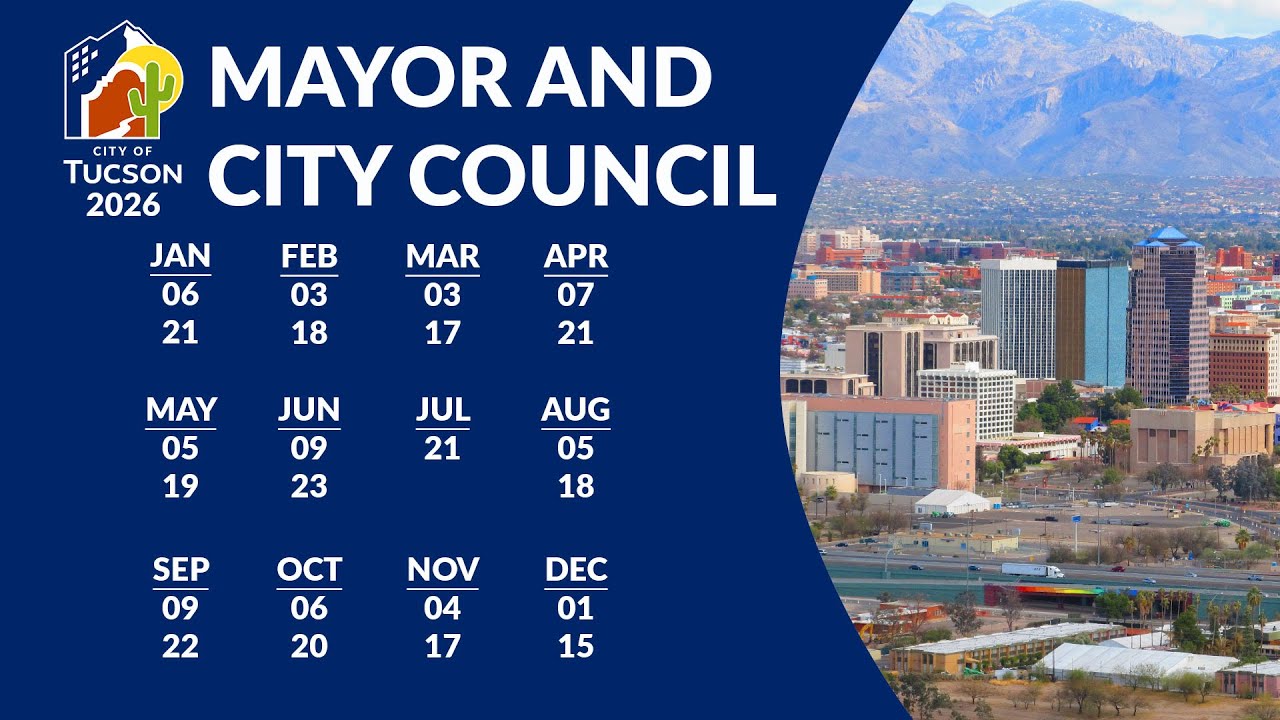
Tucson Approves $18M Employee Raises and Structural Overhaul as Transit Safety Debate Exposes Council Rifts
Tucson city council approved FY27 budget with $18M+ employee investments, created new Office of Community and Economic Impact consolidating equity/economic development functions, approved transit safety spending with revisions prioritizing operator safety, authorized police drone pilot program, and directed economic analysis of downtown mixed-use development incentive request.
Tucson Approves $18M Employee Raises and Structural Overhaul as Transit Safety Debate Exposes Council Rifts
Tucson city council and mayor completed a nine-study-session journey toward FY27 budget approval, cleared the creation of a new Office of Community and Economic Impact consolidating five city functions under Lane Mandal's leadership, and navigated sharp disagreement over how to spend $2.15 million annually on transit safety—with the approved motion emphasizing operator barriers and ambassador programs over expanded private security.
The study session revealed both consensus on fiscal priorities (employee compensation, public safety, affordable housing, voter-approved infrastructure) and deep tensions over implementation philosophy, particularly whether transit safety should prioritize enforcement-style deployments or prevention and service-connection models.
Key Speeches
"This budget is safeguarding the services and programs that residents rely on every single day. And this budget is focused on supporting working families and improving the quality of life for our families." — Mayor Regina Romero
"By unifying these functions, I believe we can improve coordination, reduce our duplication, strengthen accountability, and create greater impact from the resources we are already investing." — Lane Mandal, Director, Office of Community and Economic Impact
"We don't have a clear policy right now for drivers and operators to prevent those people from getting on. We also don't have a clear expulsion policy yet. In my opinion, these are lowhanging fruit and basic features of making a safe transit system." — Miranda Schubert, Ward 6
Timeline
FY27 Budget and Compensation Plan
- Study sessions: Nine prior sessions over several months, culminating in this study-session approval
- Presentation: City Manager Tim Tibor and CFO Anna Rosenberry highlighted $18M+ in employee market-pay and equity adjustments; 50 new police officers; funding for voter-approved infrastructure (Prop 101, 407, 411, RTA Next); continued KidCo support and free pool/splash-pad access; 1,200+ affordable housing units in pipeline
- Council discussion: Unanimous praise for team effort and fiscal responsibility; Lane Santa Cruz thanked staff for engagement and menu-of-options exercise; Paul Cunningham commended compensation plan balance; Kevin Dahl, Vasquez, Miranda Schubert, and Nikki Lee each affirmed robust core services and communication with constituents
- Vote: Unanimous approval on consent agenda (no formal roll-call recorded for study session item)
- Next step: Public hearing and final budget vote during regular session same evening
Office of Community and Economic Impact
- Presentation: City Manager Tibor introduced Lane Mandal (14 years in city manager's office, former chief of staff) as first director; outlined consolidation of economic development, equity, climate resilience, cultural affairs, and prosperity initiatives under one office reporting to city manager
- Rationale: Response to Bloomberg-Harvard City Leadership Program participation; integration of previously siloed work; focus on poverty reduction and economic mobility as core economic development goals (not just business attraction metrics); support for legacy businesses and small-business expansion
- Staffing: Budget-neutral reorganization using existing positions and two vacant FY27 slots (Chief Equity Officer, Chief Prosperity Officer) to be filled; interim leadership by existing staff (Sarah Sherman, Laura Sharp on equity; Lena Prell on housing/prosperity)
- Partners mentioned: Frankie Viegas (Director of Mexico Investment), Mike Chakowski (Attraction/Retention/Annexation), Fatima Maluna (Chief Resiliency Officer), Kelly Wei (Cultural Affairs Officer)
- Council discussion: Lane Santa Cruz praised integration of prosperity initiative; Kevin Dahl highlighted climate data (5°F warming since 1970) and business feedback from Ward 3 friends; Regina Romero and Kevin Dahl discussed climate-economic nexus (water scarcity, heat deaths affecting workers); Paul Cunningham asked for disability-advocacy inclusion
- Vote: No formal vote required; unanimous support implied; approved for immediate implementation
Transit Safety and Security (RTA Next Budget)
- Presentation: Deputy Director Andy Beimis (DTM) presented draft $2.15M annual budget funded from $43M available to Tucson over RTA Next program; outlined multi-stakeholder planning process (operators, Teamsters, TPD, community, transit advisory committee)
- Near-term actions completed: TPD special-duty deployments Monday-Saturday; 730 warnings, 127 arrests, 88 citations, 28 referrals for services, 15 deflections; bus-stop improvements; expanded private security hours; cleaning crews touching 275 of 2,200 stops daily
- Draft budget allocation: Transit ambassadors ($374K+); operator safety improvements including barrier testing ($25K seed funding); TPD special-duty extension; private security expansion; cleaning; repeat-offender tracking; operator deescalation training; bus-stop physical improvements
- Public comment: Transit Advisory Committee passed motion in support with desire to continue involvement; no formal public hearing scheduled in study session
- Council discussion (extensive):
- Nikki Lee questioned barrier adequacy (costs $3K–$10K per unit, full fleet retrofit would require substantial additional funding), timeline for full barrier replacement, and definition of ambassador roles; asked about measurements of success and data-driven evaluation
- Paul Cunningham expressed concern that $25K is insufficient for operator barriers; questioned private security ROI; raised undefined ambassador role (social worker vs. helper vs. safety officer) and tactical-gear concerns; called for integration of TPD, community outreach (CASHEW), and dedicated transit resources rather than general-purpose special duty; expressed uncertainty about plan but stated willingness to support motion
- Lane Santa Cruz noted that ridership data showed charging fares does not reduce transit crime; asked about panic-and-duress systems and operator-safety training; proposed emergency-alert infrastructure at stops; questioned off-duty vs. dedicated on-duty officers; requested metrics and flexibility
- Council Member Vasquez asked about initial $500K allocation tracking and outcomes; noted community tension around safety; proposed holistic community conversations (Safe City Connect format); asked about ambassador training and South Tucson coordination
- Miranda Schubert referenced 2015 Teamsters strike over 22 bus-driver assaults; noted current three-month deployments have not reduced office calls; emphasized evidence-based approach; highlighted Primavera pilot with promising results; called barriers secondary to repeat-offender policy, expulsion policy, code-of-conduct, and felony-assault notification; stressed 99.9% of transit users are normal; advocated for shade, benches, water fountains, accessibility improvements
- Regina Romero reiterated operator safety as first priority; directed staff to prioritize hotspot-area barrier improvements; confirmed support for ambassador program; called for holistic approach including police, community outreach, and transit resources; confirmed ongoing engagement with South Tucson and coordination with Mayor Valenzuela
- Vote: Motion by Lane Santa Cruz (5-2) approved with revisions to increase ambassador and operator-safety funding; include regular reporting to council, TTAC, and Safe City Task Force; direct staff to explore implementation options
21st Century Policing Technology (Informational)
- Presentation: Chief Monica Prietto (TPD) and Regina Romero (TPD Technical Lead) described Community Safety Awareness and Response Center (CESARC) integrating cameras, license-plate readers, line-of-sight drones; introduced Aerial Emergency Response (AER) pilot program using unmanned drones for emergency dispatch
- Safeguards: Azure GovCloud hosted (not shared with other agencies); audit logs; access controls; role-based permissions; encryption; 185-day retention (same as body-cam policy); no random surveillance or routine monitoring; every deployment tied to active call or investigation; IAPC and CPARB oversight; six-month pilot review with KPIs
- Council discussion:
- Nikki Lee directed public to city website ("City of Tucson technology policies") for disclosure of data retention and privacy policies; highlighted citizen oversight
- Miranda Schubert asked about contract language with Axon (DHS contract relationship); Regina Romero confirmed Azure GovCloud is city-owned, closed system, separate from Axon ecosystems; asked about post-pilot public input and evaluation; asked about UAS Governance Group (newly formed drone-oversight committee across city departments); raised IAPC vacancy concerns
- Vote: No vote required; informational presentation; pilot proceeding with six-month review
Tucson Inn and Marketplace (Economic Development Incentive)
- Presentation: Mike Jacowski (OCEI) requested direction to initiate independent economic analysis ($5K feasibility fee) of sight-specific sales-tax incentive for 40-year vacant downtown parcel proposed for mixed-use development (lodging, retail, public gathering)
- Miranda Schubert (Ward 6) expressed support for downtown walkability, street activation, pedestrian-oriented development; called for scrutiny of financial details and ROI; interested in job quality
- Council discussion: Paul Cunningham noted Rio Nuevo and county incentives total ~$9M; city's sight-specific sales tax capped at ~$1–1.5M collected after build (not upfront cash); early estimates $50–55M private investment (5-to-1 ratio); applicant chose 25-year partial incentive over higher-yield 7-year option (better for city); called for guardrails (city reacquisition rights if deal fails)
- Vote: Motion passed unanimously to direct staff to collect $5K and conduct independent economic analysis
Opposition
No organized opposition to budget, reorganization, or technology briefing in study session. Transit safety plan generated significant council division (not organized public opposition):
Transit Safety Concerns (Council Members):
- Barrier testing approach delays full-fleet protection without clear funding timeline for completion
- Ambassador role definition vague (social work vs. customer service vs. safety enforcement)
- Private security ROI unclear; expansion not evidenced as effective
- Risk of pushing problem users from bus stop to bus stop (spatial displacement)
- Enforcement-focused approach may increase fear among 99.9% of normal riders
- Lack of baseline metrics and data-driven evaluation before spending $2.15M annually
- South Tucson coordination gaps; regional consistency needed
Most Compelling Arguments Against (from Council):
- Miranda Schubert: "99.999% of transit users are normal people who don't assault bus drivers. We're talking about a very small group of people." Emphasized repeat-offender expulsion policy and rider code of conduct as "lowhanging fruit" missing before tactical infrastructure.
- Paul Cunningham: Concern that off-duty police officers spread across system resembles "whack-a-mole" and questioned private security expansion without evidence.
- Nikki Lee: Requested fuller definition of ambassador program, baseline data, and input from working group before expanding budget.
Organized Groups: None opposing items in study session.
Support
FY27 Budget:
- Speakers: Regina Romero, Lane Santa Cruz, Paul Cunningham, Kevin Dahl, Vasquez, Miranda Schubert, Nikki Lee
- Themes:
- Fiscal responsibility balancing investment with revenue constraints
- Employee compensation signaling to workforce that city "has their backs"
- Robust funding for core services (police, parks, planning, roads) and voter-approved infrastructure
- Affordability and quality-of-life investments (free pools, KidCo, transit, housing)
- Clear communication with constituents (one-pagers, pie charts, Jenga video praised by Miranda Schubert)
- Appreciation for team effort across nine study sessions
Office of Community and Economic Impact:
- Speakers: Regina Romero, Lane Santa Cruz, Kevin Dahl, Miranda Schubert
- Themes:
- Breaking down silos to integrate economic development, equity, climate, and prosperity
- Recognition of Lane Mandal's leadership and 14-year track record
- Connection between climate resilience and economic development (water scarcity, heat)
- Data-driven approach to poverty reduction and economic mobility
- Continuation of housing-community development partnership via Lena Prell
Transit Safety (Motion Supporters):
- Proponents: Lane Santa Cruz (motion maker), Council Members Vasquez, Miranda Schubert (qualified support), Regina Romero
- Themes:
- Operator and rider safety paramount
- Ambassadors as prevention/service-connection model (not enforcement-only)
- Data-driven evaluation with metrics and flexibility to adjust
- Inclusive, community-centered approach
- Coordination with South Tucson and multi-agency integration
- Recognition that 40-year-old barriers need updating
Police Technology (Informational):
- Speakers: Regina Romero, Nikki Lee, Miranda Schubert
- Support themes:
- Privacy safeguards and audit trails built in
- Citizen oversight via IAPC and CPARB
- Use-case restrictions (no random surveillance)
- Measurable outcomes before expansion
Project Details
Tucson Inn and Marketplace
- Applicant: Tucson in LLC
- Location: Downtown Tucson (Ward 6), 40-year vacant parcel
- Proposed use: Mixed-use development with lodging, small-scale retail, publicly accessible gathering spaces, event alley, marketplace
- Incentive requested: Sight-specific sales-tax incentive
- Other incentives in package: Rio Nuevo incentive; Pima County incentive (~$9M total estimated)
- Private investment estimate: $50–55M (early estimate)
- Incentive structure: 25-year partial GPL (applicant chose over higher-yield 7-year option, benefiting city)
- Status: Feasibility study directed (not approval stage)
- Next step: $5K analysis fee; independent economic impact study by staff; report back to council
Office of Community and Economic Impact
- Director: Lane Mandal
- Reporting: City Manager's office
- Functions consolidated: Economic development, equity initiatives, climate resilience, cultural affairs, prosperity initiatives
- Staffing: Budget-neutral; uses existing positions and FY27 vacancies; two officer positions to be filled (Chief Equity Officer, Chief Prosperity Officer)
- Key personnel:
- Frankie Viegas (Director of Mexico Investment)
- Mike Chakowski (Attraction/Retention/Annexation)
- Fatima Maluna (Chief Resiliency Officer)
- Kelly Wei (Cultural Affairs Officer)
- Lena Prell (HCD, housing/prosperity coordination)
- Sarah Sherman and Laura Sharp (interim equity leadership)
- Strategic plans integrated: Tucson Resilient Together, Somos Uno, Equity by Design, Prosperity Initiative, Comprehensive Economic Development Strategy
- Mayor's priority: Poverty reduction below state average by 2035; economic mobility for residents
FY27 General Fund Budget
- Total: Balanced (specific dollar amounts not stated in study session; referenced $18M+ employee compensation)
- Major allocations:
- Employee compensation: $18M+ (market pay + equity adjustments)
- Police: +50 officers; ongoing operations
- Parks and recreation: Robust funding; free pool/splash-pad access
- Planning and development services
- Tucson Water and Environmental Services
- Housing activities (1,200+ units in pipeline)
- Management and internal functions
- Revenue sources: General fund; special revenue funds (water, environmental services); Highway Users Revenue Fund (HURF); voter-approved bonds/taxes (Prop 101, 407, 411, RTA Next)
- Voter-approved programs: Prop 101 (transportation), Prop 407 (fire/police), Prop 411 (housing/neighborhoods), RTA Next (transit)
- Notable programs: KidCo (afterschool/summer care), Star Village and Wildcat Inn (low-barrier shelter), Viva (violence prevention/intervention), Multi-Agency Resource Manager (MARM), Community Courts, Safe City initiatives
RTA Next Transit Safety Draft Budget (FY27 Year 1)
- Total allocation: $2.15M annually (from $43M available to Tucson over 20-year RTA Next program; $51M regionwide)
- Line items:
- Transit ambassadors: $374K+
- Operator safety improvements (barrier testing): $25K seed
- TPD special-duty extension: ~$700K (off-duty officers)
- Private security expansion: ~$250K–$350K
- Cleaning crews: Additional crew
- Repeat-offender tracking: Amount not specified
- Operator deescalation training: Amount not specified
- Bus-stop physical improvements (lighting, shade): Amount not specified
- Status: Draft; subject to RTA eligibility confirmation and council refinement per motion
- Next steps: RTA meetings to confirm eligibility; KPI development; 185-day data retention (body-cam model); quarterly reporting to RTA CART committee and TTAC; public-facing dashboard; multi-stakeholder governance (TTAC, Advanced Technology Committee, UAS Governance Group, IAPC, city manager office)
Police Technology (Aerial Emergency Response Pilot)
- System: Sky-O platform (Axon-based) hosted on Azure GovCloud (city-owned, closed system)
- Coverage: Initial limitation due to FAA airspace restriction near airport (affecting Ward 5); waiver process to be explored
- Deployment criteria: Active emergency calls or investigations only; no routine surveillance
- Data retention: 185 days (same as body-camera policy)
- Access controls: Role-based; audit logs; encryption (end-to-end)
- Governance: Six-month pilot review; oversight by IAPC, CPARB, Advanced Technology Committee, UAS Governance Group, city attorney, OCEI, procurement
- KPIs: Being developed; include response time, outcome measures, public sentiment surveys
- Public transparency: Public-facing dashboard showing all flights; survey opportunities; quarterly public reporting
Vote Breakdown
FY27 Budget & Compensation Plan (Study Session)
- Outcome: Approved unanimously on consent agenda
- Roll-call details: Not required for study session item; noted as "no votes against" in Mayor's summary
Civil Service Commission Settlement ($47,000)
- Final: Unanimous
- Yes: All council members
- No: None
RTA Next Transit Safety & Security Budget (Motion)
- Final: 5–2
- Yes: Lane Santa Cruz (motion maker), Council Members Vasquez, Miranda Schubert, Kevin Dahl, Regina Romero
- No: Paul Cunningham, Nikki Lee
- Abstentions/absences: Nikki Lee participated electronically via Teams
Office of Community and Economic Impact (Reorganization)
- Outcome: Approved; not formally voted in study session but unanimous council support affirmed
- Implementation: Effective immediately; phased filling of vacancies
Tucson Inn and Marketplace Economic Analysis Direction
- Final: Unanimous
- Yes: All council members
- No: None
Police Technology (Informational)
- Outcome: No vote required; presentation received and proceeding with six-month pilot review
Outcome & Next Steps
FY27 Budget: Study session approved; full public hearing and final vote on regular session agenda same evening; no conditions noted; expected to pass unanimously based on study-session consensus.
Office of Community and Economic Impact: Approved for immediate operation under Lane Mandal; two officer positions (Chief Equity Officer, Chief Prosperity Officer) to be recruited and filled during FY27; interim leadership by existing staff; quarterly updates to council as office becomes operational.
Transit Safety: Motion approved 5–2 directing staff to:
- Increase funding for transit ambassadors and operator safety infrastructure (including barrier improvements, panic buttons)
- Provide regular updates to council, TTAC, and Safe City Task Force with outcomes and performance data
- Explore implementation options in collaboration with working group (Sunran, Teamsters, operators, community, TPD)
- Continue KPI development and public-facing metrics
- Coordinate with South Tucson Police and regional partners
- Test barrier systems before full-fleet rollout; return with additional funding request for completion
Police Technology: Six-month pilot proceeding with:
- Development of KPIs and public-sentiment surveys
- Public dashboard of all drone flights
- Stakeholder review by IAPC, CPARB, Advanced Technology Committee, UAS Governance Group
- FAA waiver exploration for Ward 5 airspace expansion
- Report to council after six months
Tucson Inn and Marketplace: Direction approved to collect $5K from applicant and initiate independent economic analysis incorporating Rio Nuevo and Pima County incentives; report findings to council before incentive decision; no timeline specified but expected within several months.
Desert Cove Substance-Use Treatment: Motion passed directing City Manager Tibor and Assistant City Manager Liz Morales to:
- Engage Pima County Administration (County Administrator John Leer), ROSAC committee, and public health (Dr. Cullen) to expedite funding allocation to Desert Cove
- Recommend current operator (Community Bridges) be retained for transition to medically assisted treatment/detox mission for at least one year
- Avoid 60–120 day gap from new operator recruitment and facility transition
- Report back to council on timeline
ADWR Well Permit Protest: Motion passed directing City Attorney and Tucson Water to file formal protest with Arizona Department of Water Resources regarding Bobcat Tucson (Beal-created entity) 96.5 acre-foot well permit near Project Blue; assess standing and potential legal challenges to protect city aquifer.
Controversies & Context
Transit Safety Debate — Enforcement vs. Service Philosophy:
The most contentious item revealed deep council division over whether transit safety spending should prioritize police deployments and operator barriers (enforcement focus) or ambassador programs and service-connection models (prevention/care focus). Nikki Lee and Paul Cunningham opposed the motion, citing unclear spending priorities and insufficient baseline data. Miranda Schubert acknowledged the ambassador pilot's success but criticized the draft budget for underweighting repeat-offender policy and basic code-of-conduct enforcement. Vice Mayor Santa Cruz's motion language ("increase funding for additional transit ambassadors and operator safety infrastructure") allowed both camps to claim victory, but the 5–2 vote underscored friction.
Operator Safety vs. Rider Experience:
Council members debated whether barriers, panic buttons, and enforcement create safety or whether visible police presence and tactical-gear-wearing ambassadors deter ridership by low-income, 99.9%-law-abiding users. Miranda Schubert emphasized shade, benches, water fountains, and accessibility as overlooked infrastructure that affects safety perception. The 40-year-old barrier system (unchanged since 2015 Teamsters strike over 22 assaults) drew criticism as inadequate, but $25K seed funding for testing provoked concern that full-fleet replacement would require future large appropriations.
South Tucson Coordination Gap:
Council Members Vasquez and Regina Romero highlighted need to include South Tucson Police Department in transit-safety planning, noting that funding is available through RTA Next for South Tucson as well. Regina Romero confirmed recent conversation with South Tucson Mayor Valenzuela and committed to adding South Tucson to working group.
Desert Cove Opioid-Treatment Urgency:
Regina Romero expressed frustration that regional opioid-settlement funding (ROSAC/Pima County control) moves slower than city priorities require. The gap between people released from jail with medically assisted treatment and lack of follow-up shelter/treatment beds creates a cycle. Paul Cunningham emphasized retaining current operator (Community Bridges) to avoid facility closure and re-opening delays, making the motion specific to operational continuity.
Climate and Economic Development Integration:
Kevin Dahl cited 5°F warming in Tucson since 1970 (2.78°C, above climate-scientist tipping point) and requested climate action be embedded in economic development strategy. Regina Romero affirmed: "Without water resources and 118–120 degree weather, climate and our sustainability is the possibility of survival, right? Without water, we don't survive as a city."
Data-Driven vs. Urgent-Action Tension:
Nikki Lee called for comprehensive baseline data before expanding transit-safety spending; Paul Cunningham requested clarity on private-security ROI. Council Member Vasquez pushed for immediate action given community frustration over visible disorder. Regina Romero and Miranda Schubert sought balance: data-informed approach but with flexibility to adapt in real time.
Police Technology and DHS Contract Concerns:
Miranda Schubert asked whether Axon's ongoing Department of Homeland Security contract posed risks to city data. Regina Romero (TPD) clarified that city's Azure GovCloud environment is closed, city-owned, and separate from Axon ecosystems, alleviating concern.
IAPC Vacancies:
Miranda Schubert raised concern that Independent Audit and Performance Commission has vacancies and may not be meeting quorum, yet it is designated to oversee police technology pilot. Regina Romero noted this oversight gap and implied action to fill IAPC seats.
State-Federal Budget Pressures:
City Manager Tibor noted difficult year revenue-wise but achieved $18M+ employee raises and maintained voter-approved programs. Lane Santa Cruz highlighted July follow-up conversations with state regarding UOVA (Arizona's other transportation authority) to revisit funding opportunities. Federal delegation secured community-project funding ($1.8M for Stone-Speedway housing, $850K for Fry apartments, $850K for S. 12th Ave. safety, $1.3M for fire ambulances), but still in appropriations process.
Duration
- Study session portion: ~3.5 hours (9 a.m. to ~12:30 p.m., with 30-minute executive-session recess)
- Item 1 (Executive Session): 30 minutes
- Items 2–3 (Budget Study): ~90 minutes
- Item 4 (OCEI Presentation): ~60 minutes
- Item 5 (Safe City/Transit Safety/Police Technology): ~120 minutes
- Item 6 (Tucson Inn Analysis Direction): ~15 minutes
- Items 7–8 (County and Federal Reports): ~30 minutes
- Total Study Session: ~3.5 hours
- Total Meeting (including Public Housing Authority Board meeting and Regular Session opening): ~5+ hours (meeting reconvened at 5:40 p.m. for regular session agenda)
Other Notable Items (Brief)
Civil Service Commission Settlement: $47,000 settlement approved unanimously; no details provided in transcript beyond motion and vote.
Public Housing Authority Quarterly Update: HCD Director Shaneka reported Housing Choice Voucher program served 10,000+ individuals with $19.4M rental assistance; Public Housing served 2,500+ individuals; 49 units renovated since January; 513 units received water-conservation upgrades; Tucson House 17% complete on construction; Kroft Towers awaiting funding gap closure. Resolutions on PHA flat-rent adoption, utility-allowance adjustments, and asset-repositioning budgets passed 7–0.
ADWR Well Protest: Kevin Dahl raised urgent concern about ADWR approval of 96.5 acre-foot (31M gallon/year) well for "Bobcat Tucson" entity (Beal-created shell company) near Project Blue. Motion to direct City Attorney and Tucson Water to file protest passed with Kevin Dahl contention that aquifer protection is more critical than any single development.
Taiwan Sister-City Agreement: Regina Romero announced successful economic-development trip to Taiwan with Pima County, University of Arizona, and Arizona Commerce Authority; memorandum of understanding signed with Gausan City (education exchange) and new sister-city agreement executed. Details deferred to public summary pending.
House Passes Budget Reconciliation: Federal report noted House passed $40B for ICE, $26B for CBP, $5B for DHS on narrow 214–212 party-line vote; pending Trump signature. House Transportation Committee advanced 5-year reauthorization including bus-rapid-transit competitive funding; House rejected administration amendment to disqualify fair-transit cities from federal funding (bipartisan rejection).
Arizona Legislature Week Ahead: State-level report indicated fiscal-year 2027 budget bills dropping imminently; legislature statutorily required to pass budget by June 30; SB 118 (middle housing and historic-preservation striker) compromised via Rep. Frankie Viegas to preserve local design-review authority for multifamily developments in historic districts; expected consideration of 24 legislative referrals for November ballot.
View source transcript ▼
Source: Tucson Mayor and City Council Meetings June 09, 2026 — June 9, 2026. Auto-generated YouTube transcript; may contain transcription errors.
Heat. Heat. Hey, hey hey. Hey, hey, hey. Hey, hey hey. that It is feel. Hey. Hey. Hey. Happy Tuesday. Um, for the record, I wanted to start the the meeting by stating that Councilman Lee will be participating electronically through Microsoft Teams. And our first item is going to be an executive session. So, item one, Miss Clerk, executive session, your appeal before the Civil Service Commission. May I have a motion to go into executive session? So moved. A second. There is a motion and a second.
Any further discussion on going into executive session? Hearing none. All those in favor, please signify by saying I. I. I. I. Anyone against? Motion carries. Mr. Attorney, how long will we take for this? Maybe 30 minutes. All righty. We'll be back in 30 minutes. Thank you, everyone. Hey. Heat. Heat. Heat. Hey hey hey. Hey, hey hey hey hey hey hey hey hey hey hey hey hey hey. Hey, hey hey. Happy days. Hey hey hey. Everything. Hey hey hey. Come down. Hey, hey hey. Heat. Heat. Thank you. Hey. Hey.
Hey. are all here. Just need a motion to return to study. So moved your honor. Second. There is a motion and a second to return to study. Any further discussion? Hearing none. All those in favor, please signify by saying I. I. I. I. Any against? Motion carries. What is the council's pleasure for item two?
Honorable mayor, the appropriate motion would be to move that the mayor and council authorize and direct the city attorneys to proceed as discussed in executive session to include the settlement of the subtle service appeal in the amount of $47,000. So move. Second. There is a motion and a second. Any further discussion hearing? None. All those in favor, please signify by saying I. I. Any against? Motion carries. All righty.
Item three, time has been set aside for discussion of the fiscal year 2027 final budget and compensation plan. Uh, Mr. Manager, thank you, honorable mayor and members of the council. Um, just a reminder, we're at the finish line on the FY27 budget and comp plan this evening. Tonight, you'll have on the consent agenda approval of the compensation plan that we've been reviewing with you the last several months.
And then we will also have a public hearing and special meeting with to consider the recommended budget. Uh the recommended budget has no uh changes from the tenative budget that you adopted last meeting. Some of the highlights are this budget has robust funding for core services of the general fund including public safety, parks, planning and development services and our management and internal functions.
It does provide for the sustainable operations of our special revenue funds like Tucson water environmental services, our housing activities and the highway users revenue fund, our roadways. It continues the delivery of voter improved programs that rebuild and expand our core infrastructure, including Prop 101, Prop 407, Prop 411, the existing regional transportation authority, and it includes the initiation of RTA Next as approved by the voters this past spring.
Even though it was a difficult budget year and revenues are tight, we did have some expansion of some of our core services, specifically funding 50 additional commission police officers and we were able to continue the development of a general fund capital fund by uh contributing to that fund for the second year. Most importantly to you at the table, it has significant additional investments in our employees to address market pay and pay equity totaling over $18 million across all funds.
And it continues our strong fiscal management of some of our long-term commitments, including our debt service, our public safety personnel retirement system, PSPRS, our Tucson supplemental retirement system, TSRS, and our health insurance and risk funds. In short, this budget we believe was developed in um in consult with you with uh compliance with your major policies and u and goals for the uh community and that it um sets us up for success in FY27 and moving forward.
With that, I would invite um our assistant city manager and chief financial officer, Anna Rosenberry, to add her commentary. Thank you. Thank you, mayor, and members of the council. Um, in particular, I do just want to offer some some words of appreciation to all of you. Um, I counted on the calendar. I think this is our ninth study session discussion in a row with you talking about the development of the fiscal year 27 budget.
I know that you have um read, indulged, considered um a lot of different solutions to the challenges that we've been discussing and been facing as an organization and as a community. So, I appreciate all of the work that you've helped us accomplish. There are additional people on our on our teams and our staff that I would like to give a shout out to in helping us get to a point where you've got a recommended budget, a balanced budget in front of you for consideration for the coming fiscal year.
Um that would be first in first on the list is our budget team led by our business services director Angel Ozalam and the deputy directors within business services. We had a new member of that team, a new budget manager this year, Robera Sullivan. Um, she did great work for us. I want to say thank you to that entire team. Um, as well as the team that put together the compensation plan. That's director Terry Train and the deputy directors in the human resources department.
We had um a new uh key team member for the compensation plan as well this year, Randall Moore, um, worked heavily on that plan. Um, I also a big thank you to all of our partners with our local labor representatives, our executive leadership team, and all of the community members that came out and had discussions with us, attended information sessions with us. Um, we all got here together.
And so, thank you for the opportunity and again, thank you for your careful consideration and what you what you helped us bring together for you tonight. Well, Mr. manager um and Miss Rosenberry, thank you so much for the incredible work that your teams have done to put together this balanced budget. This is what cities do, right? Uh mayor and councils and uh city managers and their teams put together a balanced budget.
We do not have the luxury um as the federal government to not have a balanced budget in front of our community at a a time when Tonins are facing tough decisions and feeling the consequences of disinvestment from our federal government and our state government. It was important for me as the mayor of Tucson to continue investing in offering our community uh affordability.
Um when it comes to the values and the priorities that our community, our residents want their mayor and council to invest in. I believe that this particular budget serves that, you know, providing the quality of life and the affordability that people need at a time when um there's so much pressure on their pocket books. So, this budget is safeguarding the services and programs that are residents rely on every single day.
And this budget is focused on supporting working families and improving the quality of life for our families. So we're making investments in our children by provided extended access to pools and splash pads and continuing our critical support of kidco programs which is our afterchool and summer program. uh you will not find uh an after-school program or a summer program that is um such a good quality program and costs less.
And so that particular child care is one of the biggest expenses that our families are having to face day in and day out. And kido for me has been something that the city of Tucson has been providing our community um for decades. And so it's important that we improve the program that we continue investing in it. And uh this year we're making access to uh to pools free.
um helping working families access safe, affordable child care, as I said, adding 50 additional officers uh to continue providing the safety that our citizens deserve. Um maintaining the support for Star Village and the Wildcat Inn, which provides low barrier uh entrylevel shelter to the most vulnerable communities amongst us.
We've hired key people in expanding the way we work with community to reduce violence within our Viva program, our violence prevention and intervention program, uh which helps navigate people to the resources that they need through housing first. Um the work uh with our multi- agency resource manager and the work to balance uh that with continued enforcement and accountability is important uh for our community.
We've invested in additional day trucks to our fire department, bringing video alternative to jail, to our safe city deployments, and expanded our community courts. We're making an additional $18 million investment in our employees, maintaining our commitment to make sure that everyone is placed correctly and taking important strides towards wage equity and cost of living adjustments.
the despite the f financially challenging times that we're living through and the cuts from the federal government and the state government will continue to invest in affordable housing and supporting projects that will become homes for seniors for working families for young professionals and the members of our unsheltered community.
We have more than 1,200 affordable housing units in the pipeline and some really good news coming from our congressional partners that I will be announcing later in terms of their commitment uh to continuing to invest in the city of Tucson. Uh this budget demonstrates that we can be fiscally responsible while continuing to move Tucson forward.
um that the vision that we've always held as a community and that I have as the mayor of the city of Tucson um that we continue to invest in uh the priorities that our residents want us to focus in and um that you know we're making the commitments for hopefully tonight when I we approve this budget with that any others Um any other uh vice mayor? Thank you, mayor.
I just also wanted to take the opportunity to thank um our city manager and our assistant city manager um Anna Rosenberry and the entire team um for your work on this budget. I know that the past couple of months felt like a roller coaster. Um uh I think I did appreciate the exercise of having a menu of options of what we would cut and not cut.
So I think it's always important to have those um difficult conversations and I think even leading up to the partnerships, I know there's going to be follow-up conversations in July with the state um and the UOVA um just kind of revisiting those those opportunities. So um thank you. I know it freaked out some of our members of our community. I don't think that was the intention, but it gave us an opportunity to open a door to continue dialogue.
Um, I appreciated also this past year, um, city manager, this something I've been asking since I've been on council about doing, um, engagement with the public around our budget year round and not just the very last month or two um, before we have to um, adopt the budget. And so, I appreciate that and I hope that continues um, to move forward in the future. Um and just uh really uh proud of the work that um this may council and city manager and team have put together. So thank you. Any others?
Council member Cunningham. The compensation plan is outstanding. It's been a very tough year financially for us, but to have a financial uh compensation plan that I think sends a good message that we want to send the message the best we can to our employees that we have their backs and uh that's a big piece to this. So for the the compensation plan piece, it's a job well done. I'll reserve a lot of my other comments about the budget for tonight.
Um, it is the what I'll say about it is is that the work that went into it by the employees is incredible work. Uh, you were given a significant amount number of parameters and requirements to dance through.
you did that masterfully and that uh while I have some questions about what we face going into 28 already and while we have some discussion about the onetime money we move we we were using uh to meet our budget requirements some of the stuff we frontloaded made a lot of sense so it's not the worst uh but this conversation is pretty much ongoing. Yeah, we're going to pass a budget tonight and come July 2nd, we're going to be working on another one.
So, uh let's enjoy the party while it lasts, the whole four days of it. In the meantime, uh I can't stress to you the number of compliments I've gotten about the compensation plan from different stakeholders. There was a there was just enough balance for everyone. there's still a few outliers and a few little things we need to clean up, but that's always the case, right? So, congratulations to your team, Tim. Um, a way to get it done, man.
Others, Council Member Dah, and then Council Member Baras. Ditto. Great job. Thanks, Council Member Vakas. Thank you, Mayor. Well, thank you, city manager, and to your team, mayor, all the city departments, members of the public, and my colleagues here at the table for your diligent work on this budget.
It has come a long way from our initial discussions a few months ago, and this budget better reflects the core funding priorities, including investments in public safety, parks and recreation, planning and development, and core city functions. Funding critical city services and maintaining our parks, fire stations, recre recreation centers, and other key city facilities is important for retaining and building trust in our city government.
Let's make sure to keep sharing with our community what their taxes and fees are funding and how we are leveraging additional resources as well. The robust conversations we've had at this table and with our community members have shown the need to keep telling our story and to keep communicating and to continue to listen to public feedback throughout the year as well as during our budget season.
Now we we are in a time of economic uncertainty with individuals and families in our community struggling with the loss of public benefits and rising costs along with reduced crossborder tourism and other revenue. And I know these challenges were factored into the projections for the coming year and I look forward to receiving updates on how our community is fairing amid these challenges along with hopefully positive news.
Um, with respect to invest investments in tourism, what are our plans to track bed tax receipts and hotel motel transcination, the Tucson rodeo grounds, a cultural and historic landmark that has been a cornerstone of Tucson's identity for more than a hundred years. As a home of one of the nation's longestr running rodeo traditions and annual rodeo parade, the rodeo ground attracts thousands of visitors each year while celebrating the region's rich western ranching and multicultural heritage.
So I would like to see um some of the rodeo grounds be in the next budget cycle and I look forward to advancing these collaborations with the relevant city of Tucson departments. uh visit Tucson, Tucson Rodeo Committee, Tucson Rodeo Parade over the coming year. And with tourism, you know, addition to the downtown area, we also can benefit from more investments around the Tucson International Airport and around the Kino Sports Complex and Mosaic Quarter.
So, these are areas that I would like to incorporate more into our tourism um discussion. Thank you. Thank you, Council Member Schubert. Uh just expressing my appreciation to city manager's office and to staff. Um I received feedback from constituents who are really appreciative of the one-pager and the pie chart. So I'm excited to move forward. I'm already ready to talk about the next cycle just because I think it feels good to be able to provide clear information to our constituents.
And I have to mention the Jenga video. The Jenga video was awesome. I watched all 20 minutes of it. Um, so I I love seeing this kind of um clear and transparent communication with our with our constituents. Thank you. And then uh Councilman Lee, I don't know if you wanted to jump in here since all of us uh jumped in, but we can always wait for later. Thank you, Mayor. No, I was also going to save my comments, but I will join in the love fest for our team because you all have done an amazing job.
Kudos to you all and to the extended team and I agree with everything that my colleagues have said and all the commentary that the city manager said at the very beginning and you mayor. There's just so many amazing elements of this budget. So I'm just grateful for all of the amazing work um and I'm really really grateful to everyone. So thank you. Thank you so much. It there's no direction in this item.
We're going to have a budget hearing and a vote on the budget today uh during the regular session. So, um thank you so much. Really appreciate the hard work. Thank you. We move on to item four, uh, safe city initiative, 21st century policing and draft RTA next transit safety and security budget. Oh, no, no. That's that's a Sorry. This is why you don't let me do this. Uh, introduction of office of community and economic impact. Uh, item four.
Time has been set aside at the request of the city manager to introduce and discuss the creation of the office of community and economic impact. Mr. Manager. Thank you, mayor, and members of the council. And please welcome to the table for the first time in her 14-year tenure with the city, uh, Lane Mandal. Um, Lane has agreed to take on um some tasking for the organization and for the community. More importantly, it's it's about the community and advancing your key policy initiatives.
And I'll be giving Lane a moment to to share her thoughts, but I I just want to give you a little bit of background on this. Um, this is an example of the fact that we actually do listen to you. Um, you you take votes, you set policy direction, you do a lot of things that are for the betterment of the community, and we often take each of those and we and we go running head first on that in that direction. And then we get another one and we run head first in that direction.
And what I think is important about this item is it's us also understanding how intersectional all that work is. And we're not discovering it for the first time. We are um hearing you when you talk about how important economic mobility is for Tonins within the context of what's right for Tucson from an equity perspective, prosperity perspective, sustainability perspective. So we've had guidance from you in the form of strategic and action plans in these areas.
What we have not done a good job of is driving that work holistically together. So it is my hope and belief that by forming this office which brings together folks from within the city manager's office who are already here and you'll note some vacancies we're going to fill. Those are all existing vacancies. This is not an addition of staff. This is a coalition and a collection of staff under a set of guiding principles as as as led by the mayor and council.
And I can't think of anybody better to take that um tasking forward than than Lane Mandal who until this moment has been serving as my chief of staff. She was Mr. Ortega's chief of staff. And I my running joke when I'm asked to talk about what's it like to be a city manager. I'm like get yourself a chief of staff. That that's like the magic. you just don't do anything else. Get yourself a chief of staff, specifically one like Lane Mandal.
And now I'm uh in the somewhat reluctant, somewhat pitchforked position of of offering up corrupt to the community at large. So with that, um you've seen an org chart. We have talked to most of those people on that org chart. Uh hopefully nobody woke up this morning and said, "Wait a minute." Um, and we have talked with with you all and and I especially want to take thank take a moment to thank the guy uh the guidance of the mayor.
Um we'll talk a bit about the Harvard Bloomberg uh journey we've taken over the past year, but also just the consistent policy setting and priority setting um from all of you and from our mayor has put us in a position where we believe this is the right way to go and the direction that we think will will bring great things for prosperity for Tonins and and at the end of the day that's what this is all about.
So with that, I would like to invite Lane Mandel to share a few thoughts about this journey. Honorable mayor, vice mayor, members of the council, I am thrilled to be here today to discuss the creation of under the city manager manager's leadership the office of community and economic impact or OCI.
This new division within the city manager's office represents an important evolution in how the city organizes the work of interrelated planning efforts to reflect community priorities and achieve improved long-term outcomes for those resilient members of our community most in need of economic security.
Several events over the course of the last year have brought me to the center of this conversation, but none more important than being part of the mayor's team for the Bloomberg Harvard City Leadership Program or BH9.
As you may remember from the BH9 presentation back in April, the mayor set the ambitious impactful mission or aim of working with Tucson partners and residents to reduce poverty below the state average by ensuring equitable access to economic security so that Tucson is a safe, affordable, and resilient city where everyone can prosper all by 2035. The team has spent almost nine months now creating innovative, scalable solutions that can do the work to chip away at poverty.
As this work has progressed, what's become clear is that to achieve an aim as ambitious as ours, we would need more than a couple of scalable ideas. We need to consider how we can best organize our work on various plans and programs to create an economic development strategy that leaves no one behind while protecting our natural environment. While discussing the best way to support this work, the city manager sketched the beginning of what you see here today.
While we innately understand the connection between climate action, economic development, equity initiatives, cultural affairs, and prosperity programs, this work has largely operated as separate efforts across the organization. While each of these areas has accomplished important work, by unifying these functions, I believe we can improve coordination, reduce our duplication, strengthen accountability, and create greater impact from the resources we are already investing.
With a renewed understanding of your vision and enthusiasm for what we can accomplish, I ask to be a part of this work. After more than 14 years in the city manager's office, I am thrilled by the challenge and opportunity before us with this office.
The backbone of the office of community and economic impact will be several of the city's major strategic plans and initiatives including Tucson Resilient Together, Somosuno, Equity by Design, the Prosperity Initiative, and the comprehensive economic development strategy. Rather than treating these plans as separate work programs, this office will focus on identifying the intersections among them and developing integrated solutions that advance multiple community goals simultaneously.
This approach will allow us to better align investments, use data to inform our decision-m, improve implementation, and strengthen partnerships with our educational institutions, businesses, nonprofit organizations, neighborhood leaders, and regional stakeholders. One area where this integrated approach is especially important is economic development. Historically, economic development efforts have focused primarily on business attraction, business retention, and foreign direct investment.
Those activities remain important and will continue under OCI. However, through our participation in BH9, as well as community engagement and consistent messaging from all of you, we understand that economic success must not be measured by the businesses we attract, but by the opportunities we create for Tonins. Through your leadership, we have identified poverty reduction, affordability, workforce opportunities, and access to good paying jobs as among the city's highest priorities.
In response, OCEI will expand our economic development framework to include strategies that connect residents directly to opportunity. This includes exploring new approaches to workforce development, micro business support, new partnerships, and continued small business support that helps our residents achieve long-term financial stability. Once in need of some e extra income myself, but not exactly out of entrepreneurial spirit. I along with my husband were both small business owners.
And I am excited to jump back into this work. When economic growth is broadly shared, communities are stronger. When we infuse our neighborhoods with art and green infrastructure, and when we celebrate our rich culture and history, Tucson becomes a more vibrant and resilient place. The Office of Community and Economic Impact will bring together staff members with rich and diverse talents, and we immediately will work to fill our vacancies, all of which are budgeted for FY27.
Frankie Viegas has had tremendous success standing up the small business business program and will look to leverage that success in the partnership she's built as she moves into the role of direct investment for Mexico. Mike Chakowski will lead our attraction, retention, and annexation efforts and an expansion of his current role.
Fatima Maluna and Kelly Wei are all doing tremendous work already as the chief resiliency officer and cultural affairs officer respectively and we'll be supporting their work and integrating it with prosperity and economic development efforts. We do this work best not in silos but as a team and I am ecstatic to lead this team. I appreciate the trust from Tim and from all of you.
We look forward to sharing additional implementation updates as the office becomes operational and strategic priorities as they are developed. And with that, mayor and council, I welcome your questions and feedback. Uh Lane, congratulations. I'm very excited that you will be leading um the um office of community and economic impact.
Um, I'm sorry, Tim, that you are losing Lane as a chief of staff, but she has proven herself uh to be very capable um and to lead your team um in the most wonderful ways that she does. So, congratulations, Lane. I am so excited about the work that we have been doing.
um as a team, right, mayor and council and the city manager and the team that we put together with the Bloomberg Harvard city leadership initiative that has been receiving a lot of technical support from Harvard and you know the the the city of Tucson, my main priority as I applied for the Bloomberg uh Harvard city leadership initiative because we had to compete as a city. We applied for it and my main priority was economic development and economic mobility for our residents.
And we approached that with looking at the numbers not of the jobs created but the opportunity for economic mobility for our residents and the opportunity to bring down poverty numbers in our city. And so we were put in the innovative track and uh we've been at this for about a year and so having you as part of that team and really think through in a very innovative way uh on how the vision that I have for economic development really became this office.
And in thinking about, you know, putting this office together and thinking about the work that I have been doing serving the residents of Tucson for 18 years, um, it really brings together all of the pieces of the work that I have been doing and many of you on the council have been doing to bring down the silos of that work. So bringing together economic development which I first started working on when I was a council member serving the residents of Ward One in the city.
Uh climate resilience which we had never worked on as a city equity, public health, workforce development. Um you know the the uh cultural affairs officer that we just created with the Somos Uno cultural heritage plan. the um uh comprehensive economic development strategy that I first pitched when I was a council member back in 2010.
Um all of these pieces put together from my career and my service to the community, but also with all of the investment of my colleagues here um and see it happen in this office. Right. I've always believed that bringing down silos, working together across departments, putting the right work in the right hands, being able to um really talk to each other and connect one thing to the other uh has been important.
So the creation of this office is is really uh exciting for me in putting together uh prosperity and the prosperity initiative to work that means so much uh to our community. I've always felt for a long time that our economic development strategy as a region has been siloed and dysfunctional. Now we have the opportunity to be able to work work amongst each other but also work with our partners, right?
Our partners in Puma County, with the University of Arizona, in the business community to be able to say, look, this is a vision that we should all hold hands. Economic mobility and economic prosperity for our residents is good for everyone. And so we should hold hands.
Uh, and I'll talk a little bit more about my trip to uh, Taiwan with the Arizona Commerce Authority and with Puma County and the University of Arizona, but that trip itself as well really kind of um, hit a we hit a reset button amongst all the partners to be able to get to the point where we need to uh, to create the highwage long-term jobs and the opportunity and quality of life that residents deserve.
And so I believe this office represents um that vision that we've been working on so hard um that will continue uh creating Tucson as a modern model of local government that is not afraid to innovate and move beyond the silos and work together internally and externally to be able to um face the challenges. that we have in this modern world uh and be able to find solutions together for the residents of Tucson. So, I'm really happy uh that you are leading this space.
I know that you will uh do great in working with the experts in every space from equity to prosperity to sustainability to economic development to small business to you know cultural and heritage strategy for our city. So uh thank you so much Mr. Tamir Lane. I am looking forward to this is just the beginning and that's exactly what I said um when I received my certificate from Harvard for the city leadership initiative.
this we have to make sure that we bring in uh we continue bringing in our colleagues on the council the community and uh there's a lot of work that we have to do in front of us but I'm uh I'm so ready and I'm so excited about the approach that we're taking uh with this office. So congratulations looking forward to working with you. Any questions, comments? Um all righty, Vice Mayor and then council member D. Uh thank you city manager and and mayor.
Um really seeing uh like your leadership come to fruition in this way. Um thank you for bringing this opportunity with Bloomberg for us to think outside the box and kind of connect the dots and it's you can totally see that in um in this effort. Um city manager, you're going to have to find another lane. Um, I'm just gonna I'm just going to pitch that you needed an excellent communicator that has emotional intelligence and cares about Tucson.
So, um, so thank you, Lane, for stepping up to the plate. Um, I'm I'm also thrilled, you know, to to see this uh this work under your leadership because I know that you'll really help, you know, develop all the the folks that'll be working with you plus, you know, working with our community partners. Um, I'm really thankful to see um the prosperity initiative like embedded um within this structure. I think that's a huge win for us.
Um we, you know, we talk a a lot about plans all the time and um part of our work has been how do we not just make plans that sit on a shelf, but this is really um keeping us accountable to the work that we said we were we were going to do to our community. Um as the mayor said, um putting um housing, you know, our work with housing, but then putting in equity, climate, economic development together reflects this integrated approach um that these issues deserve.
The explicit commitment to poverty reduction and economic mobility as core economic development goals are not just business and not just business attraction metrics is a meaningful shift. Um in ward one the support for legacy businesses as a name priority is really important to our constituents. Um especially on the the south side of Tucson. Um and I just wanted to to add something because I know we we talk you know most of the time we talk about opportunities and having more opportunities.
I I want to make sure we keep in mind that we also measure outcomes because that way we have a better gauge of whether those opportunities are actually getting people to where um they need to they need to be. I do see that we have two officer positions that are vacant and so I'm just curious um what the process is for for the hiring and what's the the in between as far as leadership in that area.
Um and then um I know with the prosperity initiative in the past it was uh living in HCD um how are we continuing to include um some of these other city departments that are important to our prosperity initiative goals. Thank you. Thank you. With that I vice mayor I would um answer um for the chief equity officer that one we we need to be looking for a chief equity officer that is now inheriting a program that's established.
You know, previously we were looking for somebody to come in and work from from nothing and try to bring something to fruition. Now we have an equity and inclusion action plan um as interrelated. So I think we're looking for somebody operational in that space. But that that is a um a recruitment that can go forward fairly quickly. I think we need to spend some time looking at developing that chief prosperity officer and and what should that job look like because it's it's a new function.
Uh, having said that, Lena Prell in HCD will remain a member of this team even though she remains in HCD. Um, there might be a promotional opportunity out there for you, Lena. Just pay attention. But, um, we're not going to lose that connection to housing and community development as as you've stated many times. That's that's a key connection for us. Um, and so we we Lane and I have talked a little bit about what some next steps would be.
So I would turn it to Lane to say uh how are you what what do you see as the next steps on filling those uh vacancies? So as I mentioned all those vacancies are funded as FY as part of FY27. So we'll get moving on them really quickly.
prosperity we will be a little more deliberative with because this is a new area for us and we want to make sure that we can provide the support necessary to keep the initiatives in there moving and create the necessary integration um both with HCD and with the programs under the new office as well. Um there's also some opportunities related to small business and e traditional economic initiatives and we'll look to fill those positions as well.
We'll look to fill a developer position in economic initiatives. That's somebody who can as a gap that Tim has identified where somebody can come in and help negotiate and close um different um deals that we are working on. And then really exciting work in small business. Um we'll count on Frankie to keep us moving on the programs that she's created. But then also we'll look to create some really new innovative programs.
And I think that's a place where we can really innovate and create um that is under prosperity and we'll look to create some new programs there and really some solution navigators that can go out in the community and listen to people and understand what can directly impact individuals um perhaps even beyond what we've normally done in small business. Maybe there's some micro business opportunities there um and some other opportunities.
So that's a place where we'll be really innovative and we'll look to fill those prosperity initiative positions and vacancies right away. And then to round out the the latter part of your question, what about in the interim as we're filling these positions? Um for the chief equity officer, we already have an office of equity, Sarah Sherman, Laura Sharp are excellent and well known to all of you. They will be continuing that work.
They've been working closely with Anna Rosenberry and now they'll be uh pivoting to working with Lane Mandal. So that work and we you recently adopted the equity by design. So we've got some clarity there and it's just all systems are go and on prosperity again as as Lane and I both mentioned we're going to explore that together but we do really plan to to rely on Lena Pll and the the team that's been bringing it forward so far. So we we hope to not lose any ground there.
In fact pick up some momentum and then really define who who's the right person to take that forward. Council member D. Thank you, Mayor, City Manager. This is brilliant. I look at this and it makes so much sense. And um a couple of things. One, I really appreciate the presentation where you're recognizing that we're moving up talent. I'm looking at Mike in the audience, Frankie, others um that can take on more. Sorry, Mike. Um and and bring their skills to um higher impact. Um, climate.
I want I want to mention climate. Um, I recently discovered a group that's non-biased scientists that do an analysis and share it with the media and with cities and stuff. The city of Tucson since 1970 to 2025 has an average temperature raise of 5 degrees Fahrenheit. Doesn't sound like much, but it's like 2.78 centigrades. 2 point centigrade rise was the tipping point that 97% of the climate scientists in the world say we got to bring it down. We got to bring it down.
Now this is us and other places are are lower. But anybody who's lived here understands that it's getting hotter and so there was an op-ed recently that chastised us for spending money on climate change.
um and a deeper dive into that the things we did for climate change benefited so many other things as well and I think we we need to not and I don't think I think this integration will help us do even more in climate change by the way that same period of time 20 uh 1970 to 2025 precipitation change as minus 2.7 in per year. Um these are this is a wakeup call and and it's long overdue wakeup call because 30 40 years ago people were warning us.
Um hey in ward three friends of w 3 is has embarked and I've mentioned this before in an interesting economic um uh initiatives project because the people involved in friends of w 3 are business people and they think there we could be doing more. Um, part of that project is establishing a baseline of the businesses and they're doing one-on-one surveys. It's not scientific, but each survey is deep. And I haven't done a deep dive into what we're finding out.
But one thing is clear is that many businesses um don't think Tucson's doing a very good job of supporting them. And this isn't just small businesses. This is a whole range of businesses.
and and I to some degree we're getting a bad rap but uh and and it may be a PR thing but in some in some things I think we can do improvements and I've already seen some improvements happening with some of our our new department heads um planning and community development great work in code enforcement making the permitting process easier and make more sense but I think I hope under this we'll look at some of more processes so that we're not asking businesses to jump over backwards and do somersaults all sorts of things.
We want businesses to be successful. Um because of the data center thing, I think people are, oh, they don't want anything, you know, we don't want big stupid businesses that use a lot of water and a lot of electricity. We want healthy businesses that hire local and are part of our community. Um finally, I and this because I saw a dashboard. Um Google, Mr. Google is my friend.
And whenever I want to find out something about the city, rather than asking Tim, well, sometimes I ask Tim, I go to Google and I f find a website that's out of date. Um, I think we need to be better communicating electronically with with our residents. Um, more Jenga uh videos, more more mayor dancing on TikTok, what whatever whatever it takes. Um, but again, congratulations. Uh, uh, this is truly a step forward. I'm thankful. Thank you, uh, Council Member Dala.
I I agree with you that, uh, our climate and sustainability should be working with the economic development office. As a matter of fact, um, without water resources and a 118 120 degree weather, climate and our sustainability is the possibility of survival, right? I mean, without water, we don't survive as a city. We don't thrive as a city. Uh and so uh climate the our climate work uh has everything to do with economic development. Uh heat deaths affect our community.
The possibility of having 118 degree heat um affects workers, affects construction affects um our community. So, um I agree with you. Being able to have the the uh sustainability office with economic development and working hand in hand is an important piece and that's why we wanted it there, right? Because uh we do want long-term highwage jobs in our community. Uh we do not want to put our resources of water on the line. uh for minimal uh jobs in our city.
So I agree the the I mean you talked a little bit you alluded to criticism on u mayor and council investing in sustainability and climate. Uh listen I'm not um I'm used to being criticized. Uh I've lived with that all my life. Uh but we keep on marching forward and we know what Tonins want. We know what they deserve and we know there's an innovative and different way of creating jobs in our community.
Um when I first ran for mayor, part of my platform was to work on climate and there are people that laughed at me. uh but now more than ever we see how expensive climate change in the billions because of climate uh emergencies and incidents that happen throughout um our world. So anyway, I just wanted to add to that council member. Well, thank you mayor.
I too am happy to know that this office will bring together climate action, cultural affairs, economic initiatives, prosperity and equity programs and I am excited about the addition of insight services mapping analysis engagement and innovation and I know this will help us level up our governance. So thank you and I'm looking forward to seeing you in action lane. Any others? I do have a question.
I think partnerships are going to be very important as we move forward in unsiloing where we're unsiloing ourselves but the partnerships with Puma County on economic development on our prosperity initiative on all of these uh pieces of the office uh with the University of Arizona with the philanthropy nonprofits and private sector are important for our economic development strategy as well as our prosperity initiative. and all the other pieces of this office.
Um, what opportunities do you see this office to strengthen those partnerships? Yeah, there are a lot of opportunities this office presents, but partnership is certainly one of them. Um, we will continue to look to your leadership, mayor, as you are the incredible convenor between our partners. Um, and um, staff has already started some of that work. Tomorrow, uh, our economic development team along with the county will meet and have a, um, have a summit together.
They're going to have a retreat together. So, that work has already begun. Um, you know, we've started that at over the past year with cultural affairs. Now that some is complete, Kelly Weey has been in the community making partnerships um with as many different um groups and and educational uh leaders out there that she can because those are those are relationships we've just not cultivated in the past.
By having folks um in these positions, we can begin to cultivate these these connections in ways that we haven't in a very long time. So, there's a lot of opportunity there for us and it'll be part of our strategic planning moving forward. Thank you, Council Member Cunningham. So, I have to be the not fun guy. Um, I just want to be sure, um, from what I understand was was reported to me, but I want to do this for the record. We're not adding any actual PCN's in this action.
We're taking a group of already existing offices and putting them in one in one group, which makes actual sense, but I want to just be sure for the record that we're not adding PCN's. Honorable mayor, council member Cunningham, that is correct. We are not adding any PCN's or labor costs. So, this this item is budget neutral. That is correct. Uh my second piece is um as we go through this, I I there's one group that's missing.
Um I'm hoping that we talk about that within the group of equity uh and as well as some of the other opportunities and that's uh disability advocacy. Uh I really hope that we engage our hearing hearing impaired visually impaired community as well as our parent paratransit community um in these efforts and take a look at what opportunities exist for them in our community. I think that's a big piece to this new office and I hope uh that that request isn't fallen on deaf ears. Any others? Alrighty.
Well, thank you so much. Congratulations, Lane. really excited about this and looking forward to the continued work. Thank you. All righty. Item five. Everyone's ready for safe city now. Okay. Sorry. They're moving in this direction. Safe city initiative update. 21st Century Policing and Draft RTA Next Transit Safety and Security Budget. All righty. This item uh is an item that I've requested that we have updates on.
Um we first initiated the Safe City Initiative under my request in October of 2025. Um and since then we have been having monthly updates. Um, when I first wrote the open letter to Tonins back in October, it was clear uh that our community and our residents uh were demanding a response to the concerns of uh community safety. And um I believe that my um responsibility and frankly my priority as mayor is making sure our residents are safe and making sure that uh we are responsive to our community.
So uh safe city we started uh unsiloing right uh the work uh and putting the right work on the right hands to make sure that it was more than just our police department that had the responsibility of safety and we've been able to create a safe city task force uh with um uh different stakeholders representative in the safe city task force We've been they've been very involved and one of the pieces of our safe city initiative is our transit safety and security action plan as well as all of the other pieces that we've been working on.
So, um I'm happy that we're here. We're going to receive an update uh from um both uh Tucson Police Department and their plans and piloting efforts uh to bring our um policing to the 21st century with additional technology. And then of course we're going to hear from our um Department of Transportation and Mobility about transit safety and security. So Mr. Manager, the floor is yours. Thank you, honorable mayor and members of the council.
And we have a team here to present on these two um specific aspects of the safe city initiative. Uh before I turn it over to the team, I want to um add my thanks to assistant city manager Liz Morales who has been tirelessly advancing the priorities under the safe city initiative and and being the glue to try to bring all of these things together and make sure we have good outcomes for the community. So, thank you Liz for your your tireless efforts there.
And um with that, we have deputy director of transportation mobility Andy Beimis here. We have many chiefs from the police department, including uh Stacy Shainer here at the table and our chief Monica Prietto will be um approaching either the table or the microphone and Luis from our uh TPD analysis division. So, without further ado, I think we're going to start with with Andy and Stacy here and we'll uh get you into our updates. Thank you, Mr. Manager, honorable mayor, members of the council.
Um, for a little background on the transit safety and security action plan, as the mayor noted, uh, over the course of the second part of last year on your direction, we developed the the plan, which was ultimately approved in December of 2025.
after several months of engagement with, you know, DTM staff, with our partners at TPD, our community safety, health and wellness team, um, Sunrand management, bus drivers, Teamsters leadership, um, the Tucson transit advisory community, and the general public at large. Um, we did provide an update on the progress of the immediate and near-term actions back on in April at a study session. Um, I'll share some additional progress today since then.
um but really try and focus on the draft RTA next transit safety and security funding plan you have attached here is attachment B um which is intended to further the long range recommendations from the plan. Um so briefly on the near-term items since March 9th we have been implementing the TPD uh special duty deployments on the transit system. Uh for a time it started out Monday, Wednesday and Friday.
Um we've been able to to redeploy in a way that within the existing resources we have a presence six days a week now. So actually Monday through Saturday at different times and on different priority corridors. Um to date those efforts have resulted in um 730 warnings, 127 arrests, 88 citations, 28 referrals for services, and 15 deflections. Um I'll defer to my TPD colleagues for further detail or questions on that.
Um, we've continued to uh implement uh improvements at bus stops in coordination with business owners, neighborhood leaders uh and bus operators and riders throughout the system. Um, we've improved our data management and tracking dashboards and have expanded our private contracted security hours as well. Um, so turning to the RTA next draft budget for the long range recommendations in the plan.
Um, so just as a reminder, the plan RTA Next included $51 million over 20 years for transit safety and security activities uh regionwide. Um, $43 million of that is uh expected to come to the city of Tucson, which results in about a $2.15 million annual budget target.
Um, in terms of the process, we're here seeking your feedback and input today and we've engaged the uh transit advisory committee as well um to make sure we're all aligned and then we will approach the RTA to confirm the eligibility of the activities that we you know we want to do um before you know moving forward and spending on them. Uh we did share this with TTAC uh the transit advisory committee last week. They passed a motion in in general support of the draft as shown.
Um there was some discussion and they have articulated an interest in continuing to be involved in developing the details of the transit ambassador program as that's propped up uh as well as to continue uh playing a role in reviewing the performance and developing metrics for success on on the implementing the plan. It is a standing item on the TTAC agendas. Um, and we're kind of simultaneously working to prepare a recruitment for transit ambassador program while we work with them.
And we've also uh on the details of of the of the program. We also have some interviews scheduled with other agencies who have transit ambassador programs to learn from some of their efforts. Um, okay. Note that this is a draft budget reflecting our priorities for just the first year of activity. Since a lot of these items are new, uh, and we're still learning what what interventions are the most effective. Um, there is a need for some flexibility across these categories.
Um, note that some of them are one-time expenditures and others are ongoing. So, there may be opportunities, the budget won't necessarily look the same every year. There may be opportunities to frontload expenditures if there's a need in some years and overspend, underspend in others, subject to the availability of RTA funding and their cash flow. Um so uh what's in the draft budget?
You will see an attachment B there funding for the transit ambassador program and there's an additional detail with all the kind of components of that included. It is uh proposed. I hate to interrupt, but I I think that it's important to uh talk about the transit safety and security action plan um for the public, but also to remind mayor and council the stakeholders that participating in in putting that transit action plan together.
um and why we're making why you're suggesting the investments that you're suggesting uh for the additional money that that the city of Tucson is receiving from RTA next fund. So, can you go just a little bit? You don't need to go deeply. Don't dive deeply but um update us in terms of or remind us uh in terms of the partnerships why we you have these recommendations and who the stakeholders are that you worked with to put together the transit safety action plan together. Thank you for that.
I'd be h happy to do that and I'll roll back into what's included. So um all these recommendations from the near immediate near-term and long-term recommendations in the plan we put together with a working group that included um several meetings with the transit operators themselves who understand what their needs are from a a safety perspective and what they're experiencing. U we met with their union stewards and their union leadership.
Um we partnered with TPD uh with our community safety health and wellness teams. We met several times with the transit advisory committee. Um we've when it comes to transit ambassadors or other programs, we've worked with our community safety, health and wellness uh team, with our housing and community development teams as well. Um we did several surveys uh of the general public also of operators that informed the recommendations that are in the plan. You did a good job. Go ahead.
Now tell us the budget that you put together for us. All right. So with that what you'll see in that that first year budget, there's some categories. So one is the are the transit ambassadors and you see the detail shown there.
The goal really of that program is that in addition to some of the enforcement and other efforts I'll talk about is to provide resources to connect people with services, people who are in need, people who are vulnerable using our transit system to get them connected with resources to help improve their lives, uh help them navigate the transit system, understand how to use the app, how to make a transfer, just generally supporting users of the transit system.
Um, I mentioned that we're still in the early stages of propping that up and there's opportunity to incorporate more feedback into how that what how that will look. Um, another big one are the operator safety improvements. So, one of the recommendations in the plan was to, you know, survey the operators, identify needs. Um, there's several that are already underway.
One we heard from them was a need to upgrade and replace the radio system, which we have other grant funding to do, and that is that is in progress right now outside of this funding effort. Um what we are going to rely on these funds for is to evaluate and upgrade the barrier systems in the buses. So all the buses in the fleet today have barriers in them. Those barriers were selected in partnership and in testing with operators themselves uh uh when they were selected.
Since there's newer technologies out there, there's other barriers. We want to make sure we're meeting the needs and and taking advantage of what's out there. You'll see seed funding in here. The amount you'll see is not to replace the entire fleet yet. that's intentional.
Uh it's enough to purchase several samples, put them on the buses, have the operators use them, test them, give us their feedback, understand what is the right barrier system so that then in a future year budget, you'll see that uh funds put in there to start retrofitting the fleet and incorporating those barriers into new bus purchases once we decide what's the best one. Um there are uh ongoing conversations. These are these are ongoing with the operators and with unions.
So for example, next week we're here first. I'll be uh attending their quarterly safety meetings where we meet with operators to present the same plan, continue to solicit their feedback on how we can improve it and and and move it forward. Um you'll see funding for extending the TPD special duty deployments that are currently happening with the one-time funding, uh local funding. We'll be continuing that effort or proposing to continue that effort with the RTA funds.
Um expanding the contracted security guard presence. um expanding the cleaning crews, so adding another cleaning crew to the Sunran team. And just to update on that, we're the crews are currently cleaning uh it's 275 stops every day. Uh out of the 200 or 2,200 in the whole system, all of which get touched at least once a week.
Um we'll be there's funding for propping up and and continuing to develop a repeat offender tracking and enforcement mechanism to keep, you know, repeat um bad actors off of the buses. Um funding for enhancing operator deescalation training and post incident support services. Uh and again to continue the bus stop physical improvements at bus stops adding lighting and and shade and other amenities. Um so it's it's not anticipated that we would spend exactly to the penny as shown here. Right?
This is a draft. This the the problem is evolving. The interventions are involving. Um the goals really were to make sure we're generally aligned, I think, on the priorities and the spending. Um and to also get confirmation from RTA that all those activities that we want to pursue are eligible uh and and available for reimbursement. Um so for for the next steps, uh we have meetings actually scheduled with RTA in the coming weeks to to do that once we receive your feedback.
um we'll seek pre-authorization from them so that once they say yes these items are eligible we can start doing them right immediately uh and getting reimbured for them at a future date when we have an IGA and a project charter in place with the RTA. Um we will continue developing KPIs and metrics for how to evaluate the success of each of these interventions and the plan as a whole. Um identify desired reporting um structure and metrics. We have this as a standing item at TTAC.
mentioned that um there will also be a quarterly report for the RTA citizens accountability for regional transportation with the cart committee um and then can um future updates to mayor and council. So I'll stop there and happy to answer any questions. Uh thank you so much Andy. Really appreciate um your update.
I um appreciate uh the all of the time that has been spent in making sure that the stakeholders uh both writers and operators as well as um our community and advisory and our safe city task force. All of them including Teamsters uh Suntran and others have spent time in really defining uh what the needs uh are for our community. I said it before and I'll say it again. As your mayor, the safety of our community is my number one priority.
And so mayor and council um really heard from our operators that there were concerns in terms of safety and immediately we started working on putting the safety and security action plan together um and actually put money half a million dollars of general fund into starting the process um with the passage of the RTA next.
Now, we can tap into $2.1 million or 48, you said 48, $43 million within the next 10 years uh to be able to institutionalize the work and the security that uh both our writers and our drivers deserve. Um I think that it's important that we talk about the um the draft budget that you have. Um for me it's important to be able to have immediate investment in operator safety.
And so I do see in the budget that you have uh funds for additional investment for the private security company that um we've been using for years now. I really don't see the value or the return on investment in additional dollars for that private security company right now. I would much rather spend those funds for additional oper operator security investments.
Um, and I would much rather see additional funds allocated for the ambassador program because the ambassador program besides helping riders get to where they need to get, the whole purpose of having a transit transit ambassador program as well is to try and connect the people that the trained eye of the ambassador will see need um, referral.
referrals to mental behavioral health substance use locations or even have be the eyes and ears for the drivers to say we need to call police in this situation. So hopefully the ambassadors will have access to ride on the buses as well. Um besides being at the transit centers and in hotspot locations um at the bus stops as well.
That's hopefully what um the definition of um of the ambassadors will be besides being you know people that can give information and can help connect people to where they need to go that they also are a connector to the individuals that need to be referred to treatment um and you know be the extra eyes and ears in terms of safety for uh for our operators and other writers. Um besides that, I'm want to hear from my colleagues on the council.
I think that it's important that um we don't confuse safety and security and the actions that we're taking with uh the value of offering uh free transit for our community. we've seen the numbers in terms of who's using our system and the numbers of workers that has grown um is really invaluable. And so uh let's make sure that now that we have additional funds that we put those funds to work immediately uh to uh make sure that there's uh safety that our people are feeling safe and secure.
You know, the city has made incredible strides in investing in uh the safety and security of our residents in reducing crime many times by double digits. Uh but I also understand that safety is more than just crime rates, right? We have the proof to show that crime is going down in Tucson. Um but it's also about how people feel.
And so, uh, being able to, uh, approach the services of providing transit for our community and providing safety everywhere, not just in our transit system, in our parks, in our neighborhoods, in our alleys, throughout the city of Tucson is something that we have to make sure that we continue working on and uh, that people need to understand um, that it is our priority to make sure that people have safety and security as uh a quality of life issue uh for for our residents.
So, want to extend um and open up for any questions that you all might have. I see Councilwoman Lee's hand up and then Council Member Cunningham. Thank you, Mayor. And I do have a total of 18 questions, but I'm not going to punish you all by going through those. Andy, I will work with you offline. Um, but I do want to ask a couple of the the more the more strategic questions today. Um, one is around the barriers. There's $25,000 listed in the potential spending plan for barriers.
And I've mentioned this in a couple different department level meetings, but I feel like there's a disconnect in what bus and and transit operators feel is an adequate barrier for their safety versus what exists today. Um, which is more like a sneeze guard at a buffet from what I'm told that we installed during COVID versus something that might be able to be a little more durable and provide a better level of safety. So, there's still a disconnect to me.
Um, I think we need to get on the same page about what is truly needed to ensure operator safety because that line item feels pretty small if I'm understanding um the sentiment from some of the folks who are operating the transit system. So, I would like to get some clarification and alignment on that. U mayor, you did ask one of the questions I had about who all was involved in creating the plan. I understand the working group and kind of the stakeholder composition for that.
My question for Andy and the team is did that same working group take a look at this plan and provide any feedback or was that just kind of developed and it went through the um advisory committee and then to us? Thank you um Mayor Council Member Lee on the first point. Um yeah, you're correct. $25,000 is not sufficient to retrofit the entire fleet with needed barrier enhancements. Um they we've been working closely with Sunran and a few different vendors of barriers.
The costs for those range from $3,000 to $10,000ish um each. So to retrofit the the entire fleet, we're we're looking at significantly more than that. Uh the goal here would be we we want to test out uh a variety of barriers with operators to understand which ones most effectively meet their needs u before we commit to a full fleetwide replacement.
So I I absolutely would expect that um sometime after we're you know later this year and next year we would be coming back with a additional uh line item for actually fully replacing the barriers fleetwide. Um on your second question um yes the there is a a smaller working group that meets bi-weekly uh to to flesh out all these items. U they've all been intimately involved in preparing the the draft budget.
We did share it with the transit advisory committee though I will say we've been trying to move fast so we didn't give them necessarily enough time to really digest it have several meetings to incorporate feedback we did share it at their last meeting again they they provided some initial you know support for the the concept with a desire to continue to be involved uh and and passed a motion to that effect um I will be returning to there are Suntran employees in involved in that working group who we've been working with and I will be returning to to meet Direct directly with operators and union representatives uh next week to to uh solicit for their feedback.
So this draft budget, okay, uh just to follow up, this draft budget will be discussed when there's a conversation with the Santran uh employees. That is correct. Go ahead, Councilwoman. Okay, thank you. Um uh thank you, Andy. I really like the iterative approach to testing out the best solutions for the barriers. So, thank you for the extra context on that. Um, you know, operators and and the union have repeatedly identified the onboard safety as a top concern.
And so, I'm curious about the data that we're using to measure onboard incidents specifically in operator safety as we go through this process and how the proposed spending directly addresses those concerns. And my second question slash comment um which is very much in alignment with this and you kind of touched on this Andy is before we you know approve 2.15 million annually for transit safety can we clearly understand how we're going to measure success one year from now. So you mentioned KPIs.
I think it's absolutely critical that every dollar we spend we have a metric and a way to evaluate whether that is moving the needle on our key priorities. And that's definitely something that I'm going to be looking for um as we roll these these different um mitigation steps out there. And also Andy, same thing about ensuring flexibility. I appreciate how you mentioned that this is year one. We have to be able to adapt as the conditions change and as we learn.
So appreciate your sentiment around that as well. Um so I think that's everything and then I will bother you all with the other 82 questions later. Thank you, Council Member Cunningham and then Vice Mayor All right, we just got a little bit of feedback. Um, I my concern right here, number one, is the operators. Um, so when we're thinking about the operators, I was think I was under the impression that the barriers were kind of first had to be first.
Uh, so we're going to test it out for a year and then we're going to come back, but then how are we going to be able to meet the cost of that? Because it sounds like it's really substantial. So to me, I don't think we actually have a plan to do that. Uh so that to me isn't really the direction I want to go. Uh I also got some feedback that the role of the ambassadors is a little undefined. It's a little vague. Sounds like in some cases they're social workers.
In some cases, they're helpful uh to people who are just riding in general and need help with the um bus book or how to navigate the system. Others says they'd be able one person in the uh meeting uh apparently was very concerned if they'd be wearing tactical gear and that would be off-putting and make people feel comfortable. So, we had different folks coming from different directions on what the ambassadors are doing.
Um, and I I don't quite frankly I actually think we need all three in all three roles. So the real question is is that how do we manage that and how do we do that with the budget that we have the 374,000 that we're putting into that. Uh finally, uh someone talked about how we have people that are going from one bus stop and we have a situation where we have a group of people engaging in behavior at a bus stop that's not intended for what a bus stop is.
And so they chase them away and that group of people walks down to the next bus stop. We can't have that. So, I want to figure out how we can try to integrate some of the efforts that Tucson Police is making, some of the efforts that uh our community outreach and cashew are making and how they kind of all intertwine here.
I feel like what we're doing is we're actually adding positions to those departments, but they would specifically work for the bus and maybe that would be a better or work would work directly in the transit realm and maybe that would be a better use of how we do that. I will say for the record that I'm not sure this is the best transit safety plan we can come up with.
Um though I also I'm also made it very clear that I believe that the best avenue to have a transit plan safety plan is to have some semblance of a pass for you to get onto the bus and use it some user expectation. So for me that's kind of where I'm hesitant about this. I don't want to be on record as voting against this transit safety plan. So if this is what we got, this is what we got.
But in in the meantime, I want to be I want to challenge you all to think about what we're the philosophy we're taking here. Um I think our number one concern should be our operators. If we don't have a person feeling safe operating the bus, then everyone else on the bus is at risk. So that's like bottom line number one. Everything else is kind of secondary. Then it comes to whether or not whether or not um the people riding on the bus also feel safe.
And I feel like we've I I think we have a mixed I think we have a mixed a mixed group of messages coming in about that. So that's kind of where I am on this. I'm I'm happy to vote for this safety plan. I hope it yields us some knowledge. Um, but I don't there's I think that there's other opportunities in there. Ideas are always welcome. Council member uh vice mayor and then council member Dar. Okay. Thank you, mayor.
Um, I just want to again share that charging fairs does not prevent transit crime. Um, cities with fair systems like LA, Phoenix, Valley, Metro, New York, Philly, um, a charge fairs and their systems are still dealing with assaults, drug use, trespassing, disorder, and writer fear. I think what matters is whether the agency has a real safety strategy, targeted deployment, operator protections lighting cameras outreach, enforcement, and datadriven hotspot response.
So, I appreciate all the the work that's gone into um this framework and the budget for transit safety improvements. Um what I um the questions that I have um because I I saw in the in the traffic safety security action plan that we highlight panic and duress systems and recommend evaluating current alert systems, operator familiarity maintenance testing and response protocols.
Um, these systems are intended to provide real-time assistance when operators or writers encounter threatening situations. I just don't see a dedicated line like budget line item for for this. So, just curious um um I guess what the plan is on that on that end. Um I was speaking to the city manager yesterday asking if we can explore emergency alert systems at transit stops.
Um, if rider safety is a priority, because I think it's both operators and the riders, um, we should explore emergency communication infrastructure at major transit centers and high incident stops. Um, at the UOVA, they have a blue light emergency phone system. That's just one example of how pedestrians can immediately connect with security personnel.
So, if there's an an opportunity to evaluate a similar model for our transit stops, um we have on the budget that we're proposing offduty officers rather than dedicated onduty transit assignments and that accounts for around 700,000. and um just wondering I'm just wanting to have a better understanding of the operational limitations that prevent the use of onduty officers on transit specific assignments or other um similar deployments.
Um I I thank you Andy for sharing how the budget priorities would be re-evaluated over time. I think that was something um that stood out to me that I wanted to make sure we had flexibility. So, as we're um uh building out this uh safety infrastructure, what's working and what's not and where do we need to pivot? So, thank you for uh including that.
And uh finally, um with metrics, uh the metrics that we're using to measure success, um I just want to have um just a better understanding of how the data that we're using to establish goals and how we evaluate it to make sure that these investments are working. Um, so are we measuring operator assaults, calls for service, writer perceptions of safety, repeat offenders, transit center incidents, onboard incidents, response times, writer retention, and wrership.
Um, and I know that we're working on all this hot spot mapping and coordinated reporter writer feedback. I just want to make sure that we are using these data points to communicate back to the community, you know, how we're being successful with this um, safety action plan. Finally, I was sharing um with the mayor and the city manager about a recent trip to Miami and riding the bus there.
And aside from the the shield, the barrier for the bus drivers, there's also a big sticker on there that lets the public know that any kind of assault on the operator is a felony charge. and curious if that's something in the state of Arizona that we currently have and if not is that something that we can explore just as another visible measure that um we take safety for our operators seriously. Thank you, Vice Mayor.
Just to your last point, yes, it is a felony to um to assault a transit worker here in the state of Arizona. So, is that something we could try, you know, to like visibly posted notices um for the public to know? So, and I didn't know if you wanted to answer my questions because then I have a motion. Yes, I'd be happy to. Um, thank you, mayor, vice mayor. Um, those are currently posted uh that it is a felony and uh to um assault a transit operator on the buses.
Um, so going through your other questions and look forward to the motion. Um there are the one of the reasons you don't see the line item in the budget for updated panic and duress system is my understanding there is a system in in place right now but it isn't well understood or well utilized. So there is a line item there for training uh on that and so that's that's one of the things uh it's something we we intend to further investigate is could it be more effective.
So right now my understanding is is it doesn't connect like the the button doesn't connect directly to TPD to let them know immediately that something's going on without some sort of a call. So something we can absolutely continue to focus on improve and if there's a a thing to purchase or install a technology that can be included in the future if it goes beyond just additional training on what's out there today. Um, are you on the the off duty, but there's a couple other I'll I'll just finish.
Um, uh, on the metrics and perceptions, yes, is the answer to all the uh items you described. Those are sources of data we're tracking and doing, frankly, a better job of it now in consistent dashboards with the one exception you mentioned of um, uh, community and and writer and operator perceptions. Uh, that's something we absolutely can do, should do. We don't have a survey tool developed right now or or a plan to do that beyond the the past survey we've done.
All the other metrics you mentioned are are already underway. Honorable mayor, Vice Mayor Santa Cruz, uh members of the council to speak on the offduty program um versus on dedicated onduty resources. Um just like any other special duty or offduty program, it is an enhancement of our ability to respond to uh safety needs within the city. So our on duty resources are obviously responding to calls for service through the 911 system.
They're engaging in proactive um efforts in based on different strategies we have like the uh problem oriented precision policing or hotspots policing initiatives uh viva strategies and that sort of thing. The idea is that the investment in offduty officers dedicates personnel that are solely responsible for um engaging with the transit corridors and with the intent of improving safety sentiment.
So it does go beyond um strictly enforcement which is why u we've directed our officers to engage in um contacts with all users of the transit system. We'd like to improve the safety sentiment of of all users. Um we'd like to refer people to services. we'd like to refer them to other uh city programs or community based providers. They can um offer deflection or pre-arrest deflection uh if they're in possession of personal use narcotics or paraphernalia.
And of course, they can use enforcement um when when necessary. And so what that does is it dedicates those officers to that problem without having to uh worry about what the call load is and the calls that are waiting and response times to people that have called into the 911 system.
So, and and I can tell you um from the patrol divisions, they do see it as as an enhancement of their ability to um address crime and safety concerns within their divisions um and helping with those those corridors. Yeah. Uh thank you for that clarification. Um so, with that, mayor, um I I want to move to approve the draft RTA next transit safety and security budget with the following revisions.
increase funding in this year's budget for additional transit ambassadors and operator safety infrastructure, including barrier improvements, panic buttons, and other measures that enhance the safety of transit operators and passengers.
include regular updates to Maring Council, Tucson Transit Advisory Committee, and the Safe City Task Force, including outcomes of strategies being implemented and relevant data to drive future decisionmaking, and direct staff to explore options to further enhance the implementation of the safe city initiative, which drives our investments in delivering safety to our residents. Second. So, there's a motion and a second. Any further discussion? Council member Dah. Thank you, Mayor.
This isn't on the motion. this but um and it's going to be short. I have a thought and I'm not sure if it's a good thought but I want to put it out there for further um review. Um when I first heard the term ambassadors I didn't understand that it was professional people who were offering resources to the people who need help who are on the bus and who may be causing a problem. I thought of dosent at the Arizona um desert museum friendly people who make the bus experience nice for everybody.
And I the dosent is is a non is our volunteers. A volunteer program can really extend resources. It takes a little bit of staffing to oversee. But my I have no idea if that makes sense in a transit setting. When you're exploring ambassador programs elsewhere, I wonder if if you could also explore whether other systems have used volunteers effectively and if that's a possibility that could happen here.
I know Tucson we have a lot of people who love to volunteer and perhaps the the the continued conversations with Suntran and the operators and teamsters and our safe city task force and our transit advisory committee could help inform what we want the city of Tucson, what we want our ambassadors to be. So, I I hope Andy that that's the um direction that we're moving in. Yes, ma'am. And thank you, Council Member, for the question. It is a good idea. It does exist in other communities.
We've we've discovered that there's volunteers, there's um community stipens, part-time work, a variety of ways that can exist. I think the sky's is the limit. We look forward to get well, maybe some budgets limit, but uh uh but volunteers sky's the limit. Um really yes basically we we will absolutely um investigate incorporating all opportunities to get people who want to contribute engaged in contributing to making transit safer. Council member Vahas. Yeah. Thank you mayor.
I want to discuss um the impacts of the initial preta next the 500,000 the allocation. Has that money already been spent and how were these investments tracked and any outcomes identified before we look into RTA next? And I have some other comments too. Thank you for the question. Um, mayor, council member Barahas, we I don't have the dollar amount today. I can follow up with you and show uh with how much has been spent to date. Um, so far, mostly what we have are what I call outputs. All right.
Uh, number of arrests, number of contacts, warnings, the stuff we mentioned earlier. Um, we do intend on evaluating more longer term outcomes. In that regard, we're looking at reductions in calls for service, reductions of incidents at bus stops and on buses and that sort of thing. You know, it it's only been a few months that they've been out there and that we've been making the changes at bus stops, too.
So, a lot of the um evaluation at this stage would be more observational or anecdotal, but that is absolutely something we intend on evaluating once we have a longer data set to to to look at. Well, I would like to see um a plan just implemented with urgency. You know, we can keep refining it as we go along, but tension in the community around transit safety is growing and people are experiencing real issues, safety issues on the bus and off the bus.
Um, and I would also like to see some type of layout with holistic community conversations. I do feel like there has been a lack of that in a in a safe space setting. So when this is executed, I would like to revisit some type of uh safe city connect format because when reviewing the notes that we had at the Al PBLO center the last safe city connect meeting, the main conversations were around public transit and public safety.
Um, so this could also be something with all the departments in the room when discussing the transit um, ambassador concept because I am really interested in this concept because it takes a proactive approach focused on people, service and prevention and if it is implemented thoughtfully, ambassadors can enhance the rider experience, support operators, connect vulnerable individuals with resources and reduce the need for enforcement intervention.
I want to ensure we establish clear goals, accountability, and community centered practices from the beginning so this program achieves the outcomes our residents expect. Um, I do have some questions around what the training of the ambassadors, what type of trainings will they receive?
And also when thinking of our hotspot areas and the hotspot mapping, are we coordinating with our neighbor community, city of South Tucson, because within that 1.2 square mile radius city, there is some hotspot zones and I want to make sure that we are coordinating efforts with South Tucson Police Department. Thank you. So, did you want to answer? Go ahead. I was going to bring up South Tucson and communication with South Tucson as well. So please Oh, go ahead. Okay.
I I I was going to bring it up so that you can answer. Okay, great. Um um in regard to South Tucson coordination, we've had some conversations with their their planning team. Um I don't believe TPD has been deployed there um to date uh or has jurisdiction there, but maybe that that is correct. We aren't currently deployed there, but we do dispatch for them. So we often times respond to assist uh based on the needs of the call.
What I would uh add is that there's uh additional funding beyond the $43 million coming to us. There's 51 for the region. So there's additional funding available through the RTA to support South Tucson and and other jurisdictions with the safety and security needs. Um also there's transit operation funding um for specifically earmarked for South Tucson in the RTA next plant.
So, there are definitely resources available to support needs in South Tucson and we're happy to share our lessons learned, you know, and support them as needed. Obviously, we service the area. Yes, I I would like to recommend that we start coordinating those efforts. Thank you.
Thank you, Council Member Vargas, for bringing that up because I've had conversations with Mayor Valenuela and uh they do want to cooperate um with the city of Tucson on transit safety and security and additional resources for transit. So, I think it would be smart for us to add South Tucson as one of the stakeholders in our working group um because they need to be able to uh request those funds for transit safety and security on their on their end and they more than anyone know the hotspots.
I know that we work with them and dispatch for them. uh so we are aware of their hot spots and their issues but I think it's important that they add their voice to to this working group. It's much better to have a unified strategy um that we can all different jurisdictions can work together on. And thank you vice mayor for for uh the motion. I 100% agree.
We absolutely in our budget as we look at it, we absolutely need to prioritize operator and writer safety um and their input in terms of uh what that operator and writer safety consists of, right? Um if it is about barrier improvements um I think that the priority areas are the hotspot areas based on the data that we currently have. Um I'm not thinking barriers for the entire fleet. I'm thinking priority areas are the hotspot areas and as much investment as we possibly can immediately.
Um, so appreciate your your motion, Vice Mayor. I I see the hand up for Councilwoman Lee. Councilwoman Lee. Thank you, Mayor. Um, I was wondering if the vice mayor could read the first component of the motion again for me, please. Uh number one is to increase funding in this year's budget for additional transit ambassadors and operator safety infrastructure, including barrier improvements, panic buttons, and other measures that enhance the safety of transit operators and passengers.
Okay, thank you for that. Um the piece that I'm I'm curious about is what that additional investment would look like and how other elements of the plan would then have less funding, if you know what I mean. if we're going to shift things around with a fixed budget, I'm curious about what is going to drop off of the list to put more transit ambassador funding in place.
So, that's a big question for me because I don't know how much we're talking about moving around and where those funds are going to come from within the budget. So, that's a big question to the long list of questions that I have. And I think for me, before I feel comfortable personally um moving this forward, I would like to make sure that the working group has a chance to chime in. And I would also like much more definition on what the transit ambassadors are actually going to do.
What's their roles and responsibilities going to look like? How are we going to capture a baseline for what we need to measure and map all of these different interventions to that? So we at least have a starting point. So for me, I still have way too many questions to support the motion. Um, but I appreciate the fact that we absolutely need to move quickly and we have already started that work with the half a million dollars.
So, those are my thoughts and that's the reason why I won't be supporting the motion, but absolutely support getting these interventions in place as quickly as we can. All righty, Council Member Schubert. Thank you, Madame Mayor, members of the council. Um, appreciate all the work that's been done on the transit safety and security action plan, which I've started calling in my head TAP, trying to make that happen.
Um I also just you know I went through the materials for this meeting even though I had already read the materials when I started engaging in discussions about transit four years ago um as a community organizer in reviewing the information from the 2022 study where we had extensive public input um about safety issues on the transit system um and what the nature of those interactions was.
Um, I was very interested to see that the current barriers in place were implemented in 2015 and that was the last time there was a Teamsters strike and they were striking over safety. They were striking over um feeling unsafe. Part of what they were responding to was that there were 22 assaults specifically on bus drivers and that was in 2015. We were still in Obama's America. It was a different time and here we are again talking about barriers again.
Um, we've been doing these deployments for three months. My anecdotal information from my office is that has not reduced the number of calls and complaints that we have received. I think it's important for us to focus first and foremost on driver and operator safety as well as writers and that we need to be paying attention to um evidence and data that tells us what works. Um, we have a starting point for the ambassador program. We ran a prima vera pilot with some really promising results.
So I do think that we have a starting point and we don't need to start from scratch. We also got feedback that that pilot enhanced people's feelings of safety and led to more people being connected to resources. And I think an important part of the data discussion is being proportional about our response. 99.999% of transit users are normal people who don't assault bus drivers or behave in these ways. We're talking about a very small group of people.
And um it makes sense to be proportional in that response. I don't think that uh two special duty um two two private security officers and eight special duty officers spread out through our entire system um presents the opportunity for prevention that just having more people on the buses will the ambassador program or the dosent program whatever you want to call it.
Um Albuquerque is running um an ambassador program right now that includes volunteers and those results have been incredibly promising. Um so a lot of great feedback from that as well. Um just to point out a couple specific things in the TAP. One is um the stuff about repeat offenders and in conversations that I have had with people who have been working closely on this issue um there are just a few bad actors.
We don't have a clear policy right now for drivers and operators to um prevent those people from getting on. Uh we also don't have a clear um expulsion policy yet. In my opinion, these are lowhanging fruit and and basic features of making a safe transit system.
And I I think that those are really important to tackle um before we go into anything fancy having to do with tracking people or charging money or trying to exclude people from a system when literally 99.9% of them are normal regular everyday people and over 70% um are lowincome. Um I think I agree with my colleagues a lot about more than I disagree. I think we need to use data.
I think we need to be closely monitoring and measuring the impacts of this spending and to be able to make um adjustments when necessary. But when we talk about things like um writer code of conduct um expectations, making sure people understand it's a felony to assault a bus driver, um these are areas where we still need to totally check the box and say that we've done that and we are doing it. We're in the process now.
I'm interested in being a part of ensuring that the public knows what efforts we are undertaking because we are listening very carefully and we're really concerned about enhancing the functionality of the system. Um so we have a starting point. We have bus stops that we know are the hot spot trouble areas and we have increased deployments to those areas. Um but an essential component of that as well um council member Cunningham mentioned people going from bus stop to bus stop.
They're going to keep doing it and they're going to go into the neighborhoods. They're going to go into the alleys. They're going to go into the parks until we find other places for people to go. This is not a bus or a transit issue. This is an issue of um social problems becoming more visible in public spaces. And when you think about the transit system and the bus stops, um I have I've been using the bus a lot more lately and so have other people in my office.
And uh what we what we have noticed um about the transit stops. Um oh my gosh, I totally lost my thought. Um no, I totally lost it. Um but all of that is to say that the system is here to connect people to resources. It's here to get people from A to B. Um and focusing solely on enforcement is not going to increase the safety of the system. I'll raise my hand if I think of the other point again. Thank you.
That's why the ambassador program I think is so important to be able to have that additional resource and I think that's how we all approach this including our um uh police officers, right? They um are part of a holistic approach to offering safety, security and services to our community. I truly believe that. you I think you about your I did because you were talking about your point. Thank you so much.
The other aspect of safety is how hot it's getting here in Tucson and how vulnerable people are. Um so we just we need more shade. We need more benches where people can sit. Um almost every time I'm on the bus I see at least one person who is using a wheelchair or a mobility device or um has different abilities that cause them to not be able to drive. Um, we need more water fountains.
We need more trash cans and just more attention on the system so that the people who are operating and using the system feel cared for and safe. And that's not going to happen from like 10 cops roving around the whole system. You know, it's like playing whack-a-ole, right? We need to make a safer system, safer system by addressing the root causes. Thank you. Uh, well, thank you so much. We've gone way over our time limit.
Um, we have a motion on the floor and so I think it's appropriate that we vote on the motion on the floor. Uh I think the city manager and our team has listened to you know continue a safe city um engagement approach that we've had before continuous reporting and then uh better definition in terms of the ambassadors but also I really want to reiterate this again and I want to be completely clear. My priority is making sure that our writers and operators are first in this budget.
And whether that's duress systems or um the additional lights in our bus stops and uh the ambassador putting more money into the ambassador program into uh making sure that you know we have the barriers protective barriers to make sure especially in the hotspot areas in those routes is the most important um for me and I know that you're going to continue getting input on on this um draft budget, but that's what I've heard. That is my priority.
Um with that, all those in favor of the motion, please signify by saying I. I. Any against? No. Okay. So, motion passes. Uh 52. I know that you have a second piece to the presentation. um more than happy to hear for this particular presentation. We do not need a motion. Um but we'd be more than happy to uh listen to the presentation and then just have you continue the work that you're all doing. Thank you, mayor, and members of the council. That's correct.
So, thank you to the team on transit safety and security. We'll be moving into the 21st century of policing, which we've been in that century for a while. Let's keep Yep. That's um we are short of Robocop but we're working on it today and u you are correct mayor for this next piece we don't need any further direction um but we are interested in your feedback on the activities that we're advancing. So I turn it over to our police chief Monica Pto.
Honorable mayor, members of council, good afternoon. the technology topic is incredibly important. So, I'm excited to be able to present on it um provide an overview of our current technology and then provide our next steps. So, our responsibility is to provide the community with the highest level of public public safety possible while being good stewards of public resources.
TBD is using technology as part of the safe city initiative to improve neighborhood safety, strengthen investigations, support crime prevention, and make better use of our city resources. Our community safety awareness and response center, who we affectionately call SESARC, is our real-time data and intelligence hub that assists first responders. It is an element of of our approach to the 21st century policing.
CESART brings real-time information into one coordinated community safety environment which allows police to work more effectively with other departments and public partners, public safety partners such as fire, comma, water, and IT. This inter agency initiative means better collaboration on emergency events and daily operations.
Seesark integrates technologies such as community safety cameras, license plate reader capability, line of sight drones, as well as the upcoming aerial emergency response pilot program, which will help provide a more informed and coordinated response model. Having a real-time information supports responses to active calls, follow follow-up investigations, quality of life concerns, problem solving around high demand locations, and coordination with broader safe city efforts.
These technologies are force multipliers that enable better informed, safer, and faster decision-making to help us achieve our mission in ensuring a safe city. Cameras and license plate readers help provide objective evidence during criminal investigations, identify vehicles involved in crimes, develop leads that can significantly reduce investigative time, and increase our clearance rates to help bring resolution to those victims of crimes.
We believe strongly that additional cameras will increase the safe city outcomes we all strive for. While camera technology has been used effectively for some time, I would like to discuss our aerial emergency response, what we call AER, our pilot program, which will allow us to expand our emergency response model with the use of drone technology. AER is the next evolution of Tucson's safe city initiative and the 21st century policing strategy.
Our goal is faster information, better decision-making, and safer responses for both the public and for first responders. Drones will be invaluable and often arrive on scene significantly faster than ground units. We approximate AER drones will arrive in about 2 to 3 minutes. And that's faster than our ground units can 90 91% of the time. Aerial information provides critical situation awareness to our first responders before they arrive on scene.
Early information helps improve resource development, identifies hazards, supports deescalation, and enhances responder safety and decision-making. Drones help with locating missing people, fleeing suspects, and individuals in crisis more quickly and safely. And I can't stress enough how important drones have been to keeping my officers safe and the community safe.
One example of that is a is a homicide suspect that patrol was able to to locate using the drone and arrest him safely and recover evidence of that homicide during an active homicide scene. The AER pilot program supports both Tucson police and Tucson fire operations and will be operated out of Seesark. The pilot program is designed to evaluate outcomes before any future expansion decisions are made.
We believe AER and all our community safety tool investments are powerful, but we also understand that the success of these technologies depends on public trust. Privacy, accountability, and public trust are built into the program from the beginning. Access to collected data is limited to authorized personnel for legitimate law enforcement purposes. Every AER deployment will be tied to an active public safety incident and approved use case.
There are no random controls, passive surveillance, or routine monitoring of the public. Strong safeguards and oversight mechanisms include audit logs, access controls, retention requirements, compliance reviews, and transparency reporting. Community trust and oversight continue to be essential when implementing technology.
The Independent Audit and Performance Commission, the IAPC, and the Community Police Advisory Review Board, CPARB, provide important community review and accountability functions. The bottom line is this. Tucson Police were investing in technology to improve emergency response, first responder safety, investigative support, and community safety outcomes. The AER pilot program will be a measured and transparent evaluation of a promising public safety capability.
The city will assess operational value, privacy protections, public feedback, and governance compliance before making any long-term decisions. Our purpose is to improve public safety outcomes while keeping strong policy in place for privacy access retention oversight and accountability. Public safety technology is not a replacement for police officers or firefighters or community partnerships.
It is a tool that allows us to provide more effectively, respond more effectively, solve crimes more efficiently, improve officer safety and and community safety, and use taxpayer resources responsibly. Our goal is to leverage these tools in a manner that is transparent, accountable, and respectful of the rights and the expectations of the community that we serve. All righty. First and foremost, thank you so much for the presentation.
I am supportive of mo modernizing our police department and all of the programs in supporting to in support of keeping our community safe. I know that there are plenty of examples that we have recently where we've used either license plate readers or cameras or drones to keep our officers safe or even to find out um you know the the perpetrators of crime. And so um I am very very supportive of us being able to use technology to enhance the services that we have for our community.
I think most importantly I think people are have questions about how we use the information and data and I know that we have a very tight approach to uh to that. Can you explain it uh for the record? I brought administrator Luis Romero with me to help me with some of the technical questions. Thank you, Honorable Mayor, Vice Mayor, Council members. Uh again, the uh the use of the technology is always going to be tied to any type of investigation or a calls for service.
Uh in specific when we're dealing with the AER pilot, uh we're going to be using very specific use cases. Uh all are going to be tied to calls for service or any type of a investigative measure.
Um so and we're also going to ensure that everything that's done within these systems are audit are able to be audited uh and ensuring that we're doing these audit reports uh in a you know quarterly basis to ensure compliance with that and then for any of the data related to uh data retention unlike a lot of the recordings that will follow the exact same rules that we have today for body warn cameras for non-evident entry uh type of um recordings as well as for our current line of sight drones.
So that would be 185 days. Thank you. Any questions or comments on this uh piece of the presentation? Councilman Lee. Thank you, mayor, and thank you to the team and Luis. You've done an amazing job of briefing us and really getting to the weeds, especially with me on exactly what the mayor just brought up. And I just wanted to direct the community to the city's website.
If you just Google City of Tucson technology policies, it's a front-facing public-f facing website that TPD and it help put together to really disclose the policies, how we use the data, how we retain and protect the data.
Um, and I think that that's absolutely critical in this day and age to understand um, that we do have internal policies, auditing, and citizen oversight, which to me is the most important thing to make sure that the community is at the table in helping oversee how the city is using technology and the associated data. So, I just wanted to add that to the conversation. Thank you, Mayor. Thank you, Councilwoman. Any other council colleagues? Council member Schubert. Thank you so much.
And we already touched on this a little bit, but you know, we have really interested constituents. So, um, just want to make sure that I can answer the questions that come to our office. So, W 6 has had conversations with both TPD and CESARKC on this topic. We have been so appreciative of the communication um, the accountability that is built into this approach.
Um, it's my understanding that safeguards are incorporated to prioritize safety while protecting the privacy as we were just discussing. um such as AER only being used when there's a deployment related to a call for service or an investigation. Um I'm curious how the contract is written um with the company that's providing this. Um the company providing it is SkyO Axonbased product. We're asking because Axon does have an ongoing contract with the Department of Homeland Security.
Um so just are you able to talk a little bit more about our closed system and what safeguards that we might have in place? And then I have more questions after that. Honorable mayor, council member Schubert. Yes, we so Axon is the same system that we use for our body warn camera system. um in terms of contract and and information and language in there. I'll I'll have Louise answer that if if you're willing to answer that. Honorable mayor, Council Member Schubert.
Uh regarding the current contract language that we're looking at for this AER uh pilot, uh this will be uh hosted in an Azure GovCloud environment that's going to be uh owned and operated, you know, by the uh by the city, meaning this is not a shared ecosystem with any other agencies. This is solely for the city of Tucson and in specific for the Tucson Police Department uh for for the use case of this SkyO platform that we'll be uh piloting for uh for the next year.
Uh in addition to that, I'm like all the uh drone technology does meet all the requirements from an encryption perspective to ensure uh the privacy of any information that's being captured uh end to end.
uh as well as we have role-based access controls in place currently in our axon environment but also for the skyio platform we'll be piloting uh that would be the same so only authorized users uh and administrators will be able to access said system and um again I want to very strongly uh kind of state this that this is these are not shared ecosystems the this is a its own separate cloud-based technology that is only associated as our own private cloud for the city of Tucson in specific with the Tucson Police Department.
And then just um following the pilot, I'm pretty curious to know uh during the pilot the opportunities for um public input and then how we will consider the pilot once it's closed and how we're going to move forward. Honorable may council member Schuert again.
So as we're looking at we are establishing certain KPIs for the success and the measurement of you know how we're using uh the technology uh when it comes to uh public sentiment uh currently right now uh anyone that calls 911 uh they do get something from our spider tech uh text stack which anytime anytime somebody calls 911 they would get a message similar to you know what our partners over at Pima County uh or any of the other uh jurisdictions that would provide a survey uh for them to be able to fill out.
But we're also looking at other different types of strategy as we're looking to expand the transparency page that will be available as well. So all of the flights that will be actually being done for this pilot are going to be available for the public to see as well and a public facing forward uh dashboard.
Uh and we're we're going we're going to look at different opportunities to be able to put surveys out there, being able to collate that data and be able to present that back after uh we look and see how we can keep this productional um if the pilot seems to be very successful. Sorry, just one more question. Um on page six of the memo, there's a note for a six-month review path. Um there's six groups listed as stakeholders um for review on the pilot.
um the advanced technology committee, the information technology committee, city manager office, procurement, um independent audit and performance commission. Um there's also the UAS governance group and I was just kind of curious to know more about them. And then I just have a question about vacancies on the IAPC. Uh honorable mayor, uh Council Member Schubert.
Uh so uh regarding the different governance uh and the oversight uh groups that are going to be part of the evaluation of the AER uh the the city uh through partnerships with the IT department as well as with the advanced technology committee and the city manager's office there is a very rigorous uh process for any IT or any technology related um projects to to move forward.
So we will be putting this pilot after the six months through that process which is our idea to completion process which will include like members of city attorney's office uh city city of Tucson's equity office or now the uh the uh community the community and economic I should have been paying attention uh apologies for that uh but again the the art is formerly known as the city of Tucson's equity office uh as well as uh the IAPC as we mentioned earlier uh but also uh due to the newly published uh administrative directive uh for UAS and drones uh for the city of Tucson there's there's an established uh AES governance committee that's going to be uh formed.
So that would be any department that currently operates any uh drone operations uh for city business. Uh currently we have folks from our department at the Tucson Police Department, uh our Tucson Fire Department, uh the water department, uh as well as real estate and some and some others that I don't know off the top of my head right now, but they uh they have representatives that will also be providing feedback on the overall uh the overall performance of this pilot.
And then all of those findings will make it up to the city manager's office for approvals. pass. Then from there we'll continue on through the IDC process which consists of many uh gates for final approval and Luis could you for the public define what UAS stands for? Uh so that it's sorry I know it's hard for a tech guy unmanned aerial support. So that's the new group. Yeah. Yes, I'm cool. Okay, that's why I haven't heard of it. Yes. Yes.
No, it's a it's it's a new AAD that that was put out there. Um and again, I'm like a that's the proper terminology in the in the tech sector and the tech sector we love our acronyms. So I'm like but overall it's a drone governance committee. And then just my final thing is that um we were surprised to find that we at the W 6 office had a vacancy on the IAPC and I understand that they're going to play an important role in this pilot.
So, um just want to know if um if the APC and this might be city clerk question if they are currently making quorum and if um we have any current vacancies. And that's my last question. Thank you. Independent um audit commission. I'm afraid that I don't know that information offhand, but I may be able to look it up for you.
there's vacancies and we need to make sure that we put that we I'll just remind all of us let's make sure that we appoint uh to the IAPC to make sure that they do meet quorum and that we do the work that our departments need us to do. Council member Vajas and then we need to wrap this item up and I will give us a little bit of a break in between and then come back to item six. Council member Vahas, I just have one question. Well, thank you, Chief, and thank you, Luis, for the detailed report.
Um, I know that there's that AR is currently limited in the areas surrounding the airport, which includes a lot of Ward 5. Do you have a sense of how long the waiver process would take from FAA or other amplical agencies? Honorable mayor uh uh council member Brahas.
Uh so regarding that, we are looking at once we kick off the pilot, we are looking at working with the uh SkyO team to be able to engage with the FAA uh more importantly with our partners over at Davis Mountain uh as well as the uh airport authority to be able to uh figure out uh different pathways to be able to at least have some level of ceiling or uh permissions or you know some type of u schedule where we'll be able to use these drones in unrestricted airspace. Alrighty.
Thank you all so much for the update. Really appreciate uh the report. Looking forward to um continued improvement in our in our technology and and making sure that we, you know, keep our both our officers and our community safe. Uh looking forward to hearing more of what you're all doing. We are done with this item. We're like half an hour over.
So, what I'm going to do is I'm going to give us a little bit of a recess, stretch our legs, use the restroom, and then come back uh to finish the study. Thank you all. Mhm. beep. Hey Heat. Heat. back. Thank you for allowing me that little bit of a break. We will move on to item six, consideration of sight specific sales tax economic development incentive for Tucson in LLC. All righty.
Um, I think it's really important to remind everyone that the item before us tonight is not whether to approve an incentive. The question before us is whether this proposal merits additional analysis so that mayor and council can make a fully informed decision based on independent data. So, we are just starting the process. Um and so this direction that we will give will be to start a process to get the data to um uh to make an informed decision for mayor and council.
So what stands out to me is that this represents a substantial private investment in downtown Tucson. And over the last decade, we have worked hard to create the conditions um for more uh development, more housing, more small businesses, uh more private investment in our urban core and creating density is something that's very very good. um to create transit oriented development in the city of Tucson to create additional tax revenue to create additional property tax revenue all of it is good.
So um before we have to make any future decision on incentives this particular item is to start a process to take uh to collect the data. So with that Mr. manager. Thank you, honorable mayor and members of the council. Uh, that introduction covers this topic very well. So, with that, I will turn it over to a member of our office of community and economic impact, Mike Jacowski. Thanks. I'm not sure what to say now. I'll just keep it brief.
Mayor, as you mentioned, mayor, members of the council, this is the initial step in the sight specific sales tax incentive. So, what we are requesting direction on is just to move forward, collect a check for $5,000 from the applicant and initiate the independent economic analysis, which will be brought to mayor and council uh for discussion to show what the actual impact is for the city of Tucson based on that sales tax.
I do also want to mention that that will also incorporate all of the other items that are included, the Rio Noeo incentive, the Pima County, all of that. So it will be a holistic economic analysis for the council's review as we're working on all all of these together. Righty. So this is an item that is in W six. So I usually like to give the council rep uh council person representing the area the opportunity to ask questions and uh introduce the item. Thank you, Madame Mayor.
Um, yeah, I'm excited about this because this is a parcel that's been empty for 40 years, right in the middle of downtown. Um, I'm generally cautious when it comes to the use of public incentives for private development. Um, I believe each request needs to be evaluated individually on its own merits. Um, that being said, uh, one aspect of the proposed Tucson Inn and Marketplace that I find encouraging is its emphasis on creating more active and walkable, uh, downtown environment.
Much like you were saying, Madame Mayor, by introducing a mix of lodging, small-scale retail, and publicly accessible gathering spaces on a currently vacant parcel, the project has the potential to generate additional pedestrian activity through the day and evening.
That aspect of the project is really important to me, the publicly accessible part where um everybody uh who's downtown benefits from this project, not just people who are um buying things um and providing more connection to different places downtown. The proposed event alley and marketplace concept appear designed to encourage people to spend time on foot, visit multiple destinations, engage in local businesses.
Um, in a downtown we've invested significantly in transit, streetscape improvements, and public spaces. Projects that help create more continuous pedestrian experience can provide community benefits beyond the project site itself.
While I would encourage continued to scrutiny of the financial details and public return on investment associated with any GPL request, I believe the city the project's contribution to downtown walkability, street activation, pedestrian oriented development are factors worthy of consideration as part of the overall evaluation.
Um, and I'll add to that that um, I'm also really interested in the types of jobs that this project will eventually provide and that those will be good jobs for local tonins to have. and you know raise their families and support their loved ones on. Thank you so much. So um council member I think that it would be great to do the motion to approve. All right. So with that being said I would like to move um to uh initiate the economic analysis um for this uh for this project. Second.
So there's a motion and a second. Any further discussion on this item? Council member Cunningham. So I think Rianeo's end with the county allin is about 9 million. Our sight specific sales tax would come after the build at no more than a million million and a half anyway and that's after the fact on what we collect. So we're not laying out actual cash on it. Um this also represents I think the estim early estimates are 5055 million.
So, that's a 5 to1 ratio on the just the construction investment, not to mention the long-term effects. Uh, I'm the the other thing is they probably could have gone for a seven-year higher yield glet. So, they're taking the 25-year partial GPL, which is a better actually a better deal for us. So, I'm happy to second the motion, and it it uh it looks like this could be a good deal. Um, I do have one concern I want to put on the record now, which is we've got to have some guard rails later on.
So, if the bottom falls out of the boat and the deal goes south or they don't build, um there's an opportunity for the county or the city to reacquire the properties. That's the only piece I always ask for that every single one of these, but I think it's just important to say it now for the record because I'm pretty confident the economic analysis is going to be favorable uh to granting these incentives. Thanks. Any other comments, questions? All righty.
All those in favor of the motion, please indicate by saying I. I. I. I any against? Motion carries. Thank you so much, Mike. Thank you so much. Can I just say on this item, I love that they are calling it the Tucson Inn. That is just connects so well um with all of us. So, thank you so much. Really appreciate it. All righty.
With that, we are moving on to item seven, discussion and direction relating to matters that are pending in front of the Puma County Board of Supervisors and other regional jurisdictions. All righty, Mr. Manager. Honorable mayor, members of the council, joining us as always are Stephanie Zamora and Laura Dent from our intergovernmental relations team. And we will handle item seven and then at your pleasure item eight as well. With that, I turn it over to the team.
Good afternoon, honorable mayor, members of the council. Um, my report included updates from the Pima County Board of Supervisors um regarding regional heat preparedness efforts. It also included um information from Rio Novo on their approved funding for the Gibson food hall project which is expected to come in the coming weeks.
Um and then we also included some information about um tribal leaders, local local elected officials and members of Arizona's congressional delegation expressing concerns about a proposal to consolidate the Tucson Indian Health Service area into Phoenix. That's included in our report. And with that, Mayor, I'll hand it over. Thank you so much. Before we start the other pieces of the of the item, um I just wanted to ask um Assistant City Manager Liz Morales, I know that you uh had some concerns.
The last time we talked, we met, you had concerns about um a project uh that the city of Tucson uh pitched to the opioid settlement committee uh that you were concerned did not move forward. So, can you give us an update on on the Desert Cove project? Yes. That that we had in front of Rosac and where we are in the uh process and uh if you need additional direction from mayor and council. Yes. Thank you, mayor and members of council.
Um when at the last meeting I shared um the proposal that I um presented to the regional opioid settlement committee advisory committee um also referred to as ROSAC. Um at that after that conversation they opted to um uh put them funding out for an RFP. After the last meeting, I met with um Puma County officials um from the health department and the county administration's office and um had a a positive discussion.
Um they're looking at alternative uh options for us to um understanding our concerns. Um that is not been decided yet, but um I'm hopeful that we can find a way to fund Desert Cove.
Um, and so, mayor, I let it's up to you and and the council if you want further direction, but I think it further um with the work we're doing around the IG to ask to open that up and provide a little bit more governance structure um where mayor and council can provide some input if you would like to provide any input that both u for both county leadership and roat committee for them to understand the the position of mayor and council on Desert Cove.
I think um Miss Morales, we don't have enough time. Yes. Uh the last time that ROSAC went out for requests for proposals, it took about 8 to nine months for them to go from start to finish through the process. And um my concern is that right now without Desert Cove and that particular pilot, we are seeing people one of the biggest gaps that we have in terms of substance use disorders and and people that are affected by fentinel use.
One of the biggest gaps that we have is that people are being arrested and treated medically assisted treatment in jail. Um, and when they're let out 3, five days later, they go out into the street and then they go back into the use of fentinyl or other opioids or other really strong drugs. And so we're investing a lot of money in them in jail to deliver medically assisted treatment, which is the right thing to do, but then losing all that investment when they have nowhere to go to recover.
Yeah, they go to the transition center, but the transition center doesn't have a place to refer them to. The same thing is happening with the safer center. You know, we are referring people.
were very successful as referring people to the safer center and they spend in 96 hours there um with medically assisted treatment trying to recover but 4 days 5 days is not enough and so the biggest gaps in the uh in the system I would say is people leaving safer people leaving jail and having no place to go recover and so in in my perspective I don't know my colleagues on the council.
The biggest load of calls that we all receive in our offices are people that are unsheltered and are openingly using drugs and many others maybe are not unsheltered but are um have substance use disorders that they really need serious investment in and connections to. And so I do not want to spend another year trying to figure out an intergovernmental agreement or a request for proposals when the urgency is now. And so I don't know, Liz, I'm relying on you.
You're the one that's having conversations with Rosac. You're the one that's having conversation with Steve Holmes and Dr. Cullen. Um what is your recommendation that we do as mayor and council? because I think that you've had separate conversations with my colleagues on the council about the idea of Desert Cove. Uh how do we proceed? Thank you, mayor. Um I would love to be able to utilize Desert Cove immediately with funding. That would be the preferred recommendation.
Um understanding that it does still the decision still needs to come from ROSAC and from the board of supervisors. um any urgency that they could put and put funding on it um sooner than later I think is imperative and I agree with the gaps that this would fill. Um Mr. Tamir and then I would have some requests for my colleagues on the council to add urgency in uh the decision making between mayor and council and the board of supervisors on this. Mr. Tamir, thank you, Madam Mayor.
And in support of what Assistant City Manager Morales said, we will um engage with the administrative side of the county. I'll reach out to County Administrator Leer to express the urgency as well and we'll work all angles from our end to expedite getting this uh service up and running. This is my dilemma before I go to my council colleagues.
My dilemma is that the opioid settlement funds if if we would have we mayor and council in the city of Tucson control of those funds which some of those funds rightly were directed at the city of Tucson.
we could put those opioid settlement funds to work immediately in the places where we believe we have the needs and in the spirit of collaboration and cooperation and partnership, mayor and council uh went into an agreement with Puma County to do this together to compile all of the money, the money that would come to the city of Tucson. We put it in a in a in a pot.
the money that would come to Pima County would put it in a pot and then we would in together we would decide where we have the investments. There are absolute urgencies in the city of Tucson and we hear about it every day and so it just seems to me as though ROSAC or the board of supervisors don't have that same urgency. I would really want to get direction from my colleagues on the council uh to um have Liz go back and have a conversation and as well as Mr.
Tamir uh have a conversation with John Leer with Steve Holmes with Dr. call in about the urgency of our requests so that we can cover this huge gap that we know, right? It's not just the city of Tucson, it's service providers, it's nonprofits, it's the community, everybody knows there's this huge gap in terms of providing services.
Um, so I would like for my council colleagues to consider making a motion that we direct the city manager and assistant city manager Mor Morales that we add uh urgency to the request from the city of Tucson for Desert Cove uh for the funds um to be allocated for Desert Cove. So move mayor. So there is a motion. Is there consideration for a second? I second the motion. There's a motion and a second. Council member Cunningham.
The way I understand it is we already have an operator at that site, not providing the providing a different service, but that operator can provide that same the service that we want without having them to leave. So we'd have continuous handover. That's really what the discussion is. And I think it's okay to be transparent about that. I think it's okay to say that the operator we have should get the I I wanted to make a different motion.
I wanted to make a motion that basically said I wanted to get in the weeds. They always say don't get in the weeds. I totally disagree. I wanted to get into the weeds and make a completely different motion and say that we instruct them to recommend from the council that the current operator stays in the facility. moves to their new mission for at least one year and then Rosac can figure out who the new operator or if they want to use the same operator and go through their process.
But at least we don't have a vacant building for a year. And I think that's a very reasonable request from us. So when I when we just say urgency, they're going to say, "Well, I don't know what that is." If we say to them, this is what you need to do. You need to allow the current operator to retain their management of the facility, adopt the new mission of detox, and then Rosac can go through their process to see if there's a better operator. But we can't miss a beat.
So that's I I if we can clarify that that's what the spirit of this motion is, I'm more than happy to support it and lead the parade. Yeah, I I think that's the spirit of the motion. Most importantly for me is getting the money immediately so that we can transition into the new mission. And of course um the operator that is there currently servicing um the individuals that are at Desert Cove uh should be considered, right? Is there anyone else that provides recovery services in um in the county?
I'm I'm not sure. But yes, the the I would say in on my end the um the spirit of the motion is to have that um logistically if we have to get a new operator, we have to have the the current operator hand in keys. The place needs to be rekeyed, the place gets shut down, then we have to go back in and order another CFO and all of a sudden we've lost 60, 90, 120 days. That doesn't make sense. Let's go. So my thing is is that specifically we use this operator and they handle that mission.
They they Let me let me ask uh Liz and and Tim. Liz, I I know that that is the the suggested that you have in writing, right? That's that's what you suggested to mayor and council. We do mayor uh and council member Cunningham. That is one of the big issues is transition to a new operator would be very time consuming. And so I think um continuing with community bridges um they have the model, they have the the service model and and can do the work that we're asking them to do.
Um and and so that would be the most exped expeditious um going forward. Yeah. Tim, mayor, I'll just add that that is actually what our initial request was. Fund it with the current operator. So this is totally in alignment with how we would efficiently have done it from the get-go. I just want to make sure that the motion maker feels Yeah, I feel I feel good with that.
I think um the only thing I wanted to add to the conversation and this is what I've shared with some of our colleagues on the board of supervisors is that we're under a different pressure than they are as a county or even ROSAC. We're we're the facing public facing um where the community thinks we're not doing anything right. like the mayor allows for public drug use, the council doesn't care. And so we, like you said, that is the number one thing we hear from our constituents.
And so we know we can't incarcerate our way out of, you know, the this um epidemic that we're in, but we're creating real long-term solutions um to the folks that are ready to take that step into sobriety. And so I just want to continue to put in front that you um we are the front-facing um part of this uh uh frustration, you know, from the public and we need the county and Rosac to um uh maybe be a little more sensitive to that and see why we have uh urgency around this issue.
Um so I support the amendments to the motion and do we ask the second if they do as well? Yeah, I second. Okay. Um I think we're all on the same page. Um would you like to call the question, council member? Okay. Um all those in favor of the motion, please signify by saying I I. Any against? Motion carries. I just wanted to make sure that we got to that, Liz, because it's an important piece that needs we need to move expeditiously on that. All righty.
With that, did you have anything else, Stephanie, to add on the county report? Yep. Okay, go ahead. Sorry, I got off this because I was researching CBI, who's a good operator of that of Desert Cove, by the way. Um, all right. It's been brought to my attention that on May 25th or thereabouts, ADWR uh approved a 96.5 acre foot well. That's 31 million gallons a year uh for a company called Bobcat Tucson, which isn't even a company.
It's a company that got made up by Beal, which is why I didn't like those guys in the first place, to drill wells out where Project Blue is. And AD, they're claiming that they had rights to do that. And even though it is technically out of our service area, I feel to some degree that the aquifer that they're drawing that from could adversely affect our aquifer.
And I think groundwater is too serious a discussion point when you're all of a sudden just handing out brand new 31 million gallon oil permits. I want to know if we are allowed to protest this and if it is within our purview to protest the approval of this well to AWR. And if we are allowed to protest this well, I move that we instruct uh the the city the city attorney's office or Tucson water attorney to file that formal protest. All righty, Mr. Manager.
Thank you, honorable mayor, members of the council. We do have standing that we can um research and file appropriate objections andor actions against these wells. I can't guarantee what the outcome would be, but I certainly um between the city attorney's office and my office, we could pursue um whatever direction the mayor and council would provide.
Um, I would ask that you do give us that direction because you gave us very clear direction to have no involvement with this project previously, which we've done. Uh, but in this case, we we we absolutely here to do whatever you feel is the most prudent thing. And if um you would like us to insert ourselves into this process of the water service uh to that and the drilling of those wells, we're happy to follow your direction. I move that we instruct you to do that. A second. Second.
Uh there's a motion and a second. Any further discussion on this item hearing? None. All those in favor indicate by saying I. I. Any against? Motion carries. Uh, all righty. Anything else on the county matters? Uh, hearing none. Um, I think it's important that we go into our federal report and then we can talk about state. Um, lots of things going on, but I do have some good news though. I do have some good news um that uh are promising.
I'd like to thank Congresswoman Adelita Griva for securing house support for several city of Tucson priorities through the community project funding process um in the annual appropriations bill. $1.8 million uh was one of her projects selected by the congresswoman. $1.8 $8 million for the Stone and Speedway housing development. Uh $850,000 for the Fry apartment rehabilitation. $850,000 for South 12th Avenue corridor safety and complete streets project.
Um you know, at a time that we're expanding and preserving affordable housing as a top priority of the city of Tucson, these investments would help us do just that. Um, I also want to thank Senators U. Mark Kelly and Ruben Ago for advancing to some priorities in the Senate appropriations process. They're supporting the same projects as the congresswoman, but they're also um appropriating uh three uh $1.3 million for ambulances and peak volume and emergency trucks for Tucson Fire Department.
So they still have to go through the process of appropriations. So it's good news, but we haven't reached the finish line uh with this particular issue. So, I'm happy that it passed this particular threshold and um want to thank Congresswoman Grihalva, Senators Kelly and Ggo on behalf of Tucson uh for their work in moving uh these appropriations forward. And with that, I'm going to uh pass it over to Miss Dent for her report. Thank you, Mayor, members of the council. Yes, indeed.
fantastic um news and an important first step in the congressionally directed spending project process. Um so we'll continue with federal updates. Uh Congress continues to focus on the budget reconciliation package just about an hour ago. The House passed um this package which includes approximately $40 billion for ICE, 26 billion for CBP and 5 billion for the Secretary of Homeland Security.
Um, this is a reconciliation package that has been in limbo for some time at the federal level and it was passed on a 2014 to 2012 or two thou 214 to 212 party line vote. So, it shows how narrow and high the stakes are at the federal level. In the House, it is now going to President Trump for signature. Um, additionally, the House Appropriations Committee has approved its fiscal year 27 transportation, housing, and urban development appropriations bill.
Um, this bill preserves funding for the CDBG CDBG program. Um, but it does include some reductions to home and other including important housing um, projects uh, and programs for the community. Um, and this is where our community um, project funding uh, is folded in. So, we're grateful for that. And final funding levels will be negotiated late in the year.
Um, and lastly on the federal front, the House Transportation and Infrastructure Committee advanced its 5-year transportation reauthorization bill. Um, this includes a program intended to make it easier for bus rapid transit and other smaller transit projects to compete for federal funding. So, that's good news and it leaves us well positioned for our BRT um proposal and project uh paired with the fact that uh Tucson residents and regional residents supported RTA next. Um, so that's good news.
And the House also rejected an amendment you may have heard about and I think I um we've discussed with several members of the council uh an amendment related to fair free transit systems. There was some effort by the administration to um disqualify communities that offer fair transit. That amendment was rejected. So, this truly was a bipartisan package that is moving forward at the federal level. Um at the state level, lawmakers are expected to consider a state budget this week.
The bills may be dropping right now as we speak. We should expect those to be moving at any moment and will likely be heard in appropriations tomorrow. So, we don't have complete details. We've heard some um chatter on what that is, but I'll be happy to provide a more official report to you all once we get those um read in. Um we also expect lawmakers after approving a budget traditionally is the timeline to consider 24 legislative referrals that are in the hopper essentially at the finish line.
Um and we will see how many of those get uh moved forward to the ballot in November. So the legislature is statutoily obligated to uh pass a budget by June 30th. So, um, the clock is ticking and we should expect lawmakers to be very busy this week. So, that concludes my report. All righty. Any questions or comments? Vice Mayor? Yeah, I um was talking to um Laura Dent right now and just trying to give um our representative Viegas um sunshine.
Um and I was asking about SB118, which is a striker um amendment on the middle housing and historic preservation. and uh Representative Beie was able to get us to uh a compromise where we continued to give, you know, local cities the authority to design review process for metal housing developments and national um register historic districts and disincentivize the demolition of historic buildings.
Um and I know that this bill started from a lot of the politicking that happens in Maricopa County and Phoenix. Um but I just wanted to say we've been doing both. you know, we approved middle housing citywide and have continued to um disincentivize demolition of historic buildings. And so, I just wanted to to give her some props.
I know at the beginning of um before this became a strike everything um amendment, uh we weren't um taking a position, but since uh we have and again, just wanted to give some um some love to repos for getting us there. Any others? Any questions? All righty. Thank you so much. It has been an exciting year in the legislature. I hope that you know um the city of Tucson doesn't come out too beaten up uh on the budget space with the state legislature and rooting for our delegation up there.
So, thank you Miss Dent. Thank you Stephanie. Really appreciate it. Um, I am going to save um my report to the mayor and council on uh my economic development mission trip to Taiwan for the summary of current events so that I rec I can also report to the public. It was a very successful, very busy um uh trip uh in partnership with Pima County, the University of Arizona and the Arizona Common Authority. really important time for all of us, all our partners to gather and be on the same page.
Um, we had uh we signed a memorandum of understanding for educational exch exchange between the education bureau of Gausan city government, Pima County, and the city of Tucson. And we also signed a sister city agreement which was amazing. So I'll tell you all about it and the summary of current events so that I can report to the community. Uh with that if we don't have any more item any more uh commentary on this item we are moving on to item nine. Mayor and council discussion of regular agenda.
Does anyone have any items to remove from the consent agenda for today's meeting? Council member Schubert. Yes. The TE uh rate case. just to say a few words. Any others? And that's item I think it's H on the consent. G on the consent. Okay. Your honor, I was Can I chime in on that one? Sure. Any chance we can remove H? And I don't know if the clerk and the the the attorney need to chime in. I mean G the T discussion and have it right before we have the discussion about the undergrounding.
It's a different item but um we could do consent and and consider this separately. Okay, I tried. Um all righty. Any others? If there's no others, we move on to item 10. Mayor and council discussion of future agendas. Does anyone have any items for future agendas? Roy, sorry, your honor, I was a little too late. Um I I the manager we're just talking um the uh I think we had maybe discussed bringing the TE public hearing item forward in the agenda.
I don't know if that's something you wanted after after your consent. I mean, we I know that there's going to be people here, so we could we could consider something like that. Yeah. And that way it would be right after that, right? That's all. All righty. Agenda item 12 to consent and then 12 right after G is the proposed. So move agenda item 122 right after the consent. Okay. Thank you. So we'll start the regular with that. Um all righty. Anyone else hearing? None. Let me see.
We are adjourned and we will be back at 5:40 so that we can start the meeting. Thank you all. Hey hey hey. Down. Hey, hey hey. Damn. Hey. Heat. Heat. Heat. Hey hey hey. I'm a Hey. Hey. Hey. Hey. Heat. Hey. Hey. Hey. Good evening everyone. Thank you all so much for coming. I appreciate uh everyone in attendance uh for whatever the reason that you're here. Thank you so much for joining us uh to the mayor and council meeting.
But first, we are going to start with the Tucson Public Housing Authority Board of Commissioners meeting. So, I'm going to have to um call um this session to order. Um Miss Clerk, I think we I believe we need a roll call. Roll call. Council member Cunningham. here. Here. Council member Lee here. Council member here. Council member Schubert here. Vice Mayor Santa Cruz here. Mayor Romero here. Um and our commissioner, Commissioner Hawkins.
Sorry, we're all commissioners, not council members in this meeting. Our commissioner is absent, excused. Thank you. All righty. Item two, quarterly public housing authority update. City manager PHA communication number 10 dated June 9th is received into and made part of the record. Is there a motion to approve? Well, we need an actual update before we do a motion to approve the update. Uh I know that you included a memo in your in your material.
I just wanted to see if you wanted to do a a very short update. Good evening, Chair Romero and members of the board. One of housing and community development's priorities is to provide meaningful and consistent information to you, our public housing authority board of commissioners. As you know, we provide a monthly memorandum to each of you and then we meet in person about quarterly. During those in-person meetings, we are committed to giving a very short update.
And so, this update covers January through April of this year. The Housing Choice voucher has provided rental and utility assistance benefiting over 10,000 low-income individuals throughout our community and has distributed more than 19.4 million in rental assistance payments to local property owners. In addition to housing assistance, the program has continued advancing self-sufficiency initiatives, providing supportive services to 104 participating households.
HCD is preparing to host a landlord appreciation event later in June to recognize participating voucher property owners and managers for their continued partnership in providing affordable housing opportunities for our public housing. We've provided housing assistance to over 2500 low-income individuals. I should note that number's a little lower than it used to be because Tucson House is no longer public housing, but as you know, Tucson House is still an important part of our housing portfolio.
Speaking of Tucson House, our housing, our HCD resident services team continues to provide important support. Since January, 266 participant households received case management and wraparound supportive services. Public housing authority staff have also continued focusing on property improvements. Since January, 49 units of public housing have been approved.
Additionally, water conservation features have been installed at 513 units through a funding partnership with Tucson Water and the Water Infrastructure Finance Authority of Arizona. Thanks, city manager, for securing that funding for us. Given the lack of funding for public housing, the public housing authority continues advancing several key projects under the public housing financial stability plan or what HUD calls asset repositioning.
At Tucson House, construction activities are currently underway and we are at about 17% complete. Progress also continues at Kroft Towers where volume cap financing has been secured and an equity investor has been identified. However, there is still a funding gap on that project we need to close in order to move that forward.
And so in closing, the public housing authority remains committed to strengthening housing stability, improving operational performance, modernizing systems and infrastructure, and expanding supportive services for our residents and clients. Staff appreciate the continued support and guidance of the board of commissioners and look forward to continued progress throughout the remainder of the year. Thank you. Thank you for the update, Director Shaneka.
hearing that um update if you have any questions or if I um can get a motion to approve the update. So moved. Second. There's a motion and a second. Any further discussion? Hearing none. All those in favor, please signify. I against motion carries. Item three, public housing authority write off uncollectible tenant account receivable approval. City Manager's PHA communication number seven dated June 9th is received into and made part of the record.
Madame Clerk, you are requested to read resolution PHA 2026-52 by number and title only. Resolution number PHA 2026-52 relating to public housing authority authorizing the write off of $119,694.76 of certain uncollectible tenant accounts receivable and declaring an emergency. What is the board's pleasure? So move second. There is a motion to uh pass and adopt resolution PHA 2026-52. Um if there's is there any further discussion hearing? None. We do have to go to a roll call vote.
Commissioner Santa Cruz I. Commissioner Dah I. Commissioner I. Commissioner Lee I. Commissioner Barahas. I Commissioner Schubert I Commissioner Hawin Chair Romero I the motion to approve resolution PHA 2026-52 passes by a vote of 70 item four public housing authority public housing program flat rent adoption city manager PHA communication number eight dated June 9th is received into part of the record madame clerk you are requested to read resolution PHA2 2026-53 by number and title only.
Resolution number PHA 2026-53 relating to the public housing authority authorizing the adoption of the flat rent for the public housing program and setting an effective date. May I have a motion please? So move here I move to pass and adopt PHA 2026-53. Second. There is a motion and a second. Any further discussion on this motion hearing? None. Let's go to roll call. Commissioner Lee. I. Commissioner Cunningham. I. Commissioner Dah. Hi. Commissioner Santa Cruz. I. Commissioner Schubert. I.
Commissioner. I. Chair Romero. I. The motion to approve resolution PHA 2026-53 passes by a vote of 70. Item five, public housing program utility allowance adoption. City manager PHA communication number 11 dated June 9th is received into and mid part of the record. Madame clerk, you are requested to read resolution PHA 2026-54 by number and title only. Resolution number PHA 2026-54 relating to public housing.
Resolution adopting and approving the city of Tucson revised utility allowance schedule effective July 1, 2026 and declaring an emergency. What is the board's pleasure? I move to approve and adopt resolution PHA 2026-54. I second. There is a motion and a second. Any further discussion? Hearing none, let's go to roll call. Commissioner Schubert. I I Commissioner D. I Commissioner Santa Cruz. I Commissioner Lee. I Commissioner Cunningham. I, Chip Romero, I.
The motion to approve resolution PHA 2026-54 passes by a vote of 70. Item six, fiscal year 2027 public housing authority budget approval. City managers PHA communication number nine dated June 9th is received into and made part of the record. Madame clerk, you are requested to read resolution PHA 2026-55 by number and title only.
Resolution number PHA 226-55 relating to the housing and community development department reviewing and approving the public housing asset management budget project budgets developed for the city of Tucson as required by the US Department of Housing and Urban Development for HUD fiscal year 2027. Authorizing execution delivery of HUD form 52574 and declaring an emergency. What is the board's pleasure? So moved. There is a motion and a second to pass and adopt resolution PHA 2026-55.
Um is there any further discussion on this item? Hearing none, let's go to roll call. Commissioner D. I. Commissioner Schubert. I. Commissioner Lee I. Commissioner Cunningham. Hi. Commissioner Barahas. I. Commissioner Santa Cruz. I. Chair Romero. I. The motion to approve resolution PHA 2026-55 passes by a vote of 70. Item seven, approval of minutes. City manager PHA communication number 12 dated June 9th is received into and made part of the record.
Is there a motion to approve the minutes of the April 7th, 2026 meeting? So moved. Second. There's a motion and a second. All those in favor of the motion, please signify by saying I. I. Any against? Motion carries. And item eight. Adjournment. The meeting of the board of commissioners is now adjourned. The mayor and council will now convene our regular meeting. Heat. Hey, Heat. All righty. Uh, now we are reconvening for the regular meeting of the mayor and council.
For the record, I forgot to say this with the PHA meeting. For the record, Councilwoman Lee will be participating electronically through Microsoft Teams. Council will stand in session. Let's go to roll call. Council member Cunningham here. Council member Dah here. Council member Lee here. Council member Barahas here. Council member Sh here. Vice Mayor Santa Cruz here. Mayor Romero here. Before we go to item two, the city attorney will go over the rules of decorum for mayor and council meetings.
Mr. attorney. Thank you, Honorable Mayor. Arizona's open meeting laws provide that members of the public may attend and listen to the proceedings during tonight's public meeting of the mayor and council. Arizona law also allows the mayor and council to enforce rules and procedures for public attendance of the meetings to ensure orderly behavior and to prevent unnecessary interference with the public meeting. Here are the rules that apply.
The rules are required to quorum and orderly conduct by the members of the audience. No person attending the meeting shall engage in conduct that disrupts or otherwise impedes the orderly conduct of the meeting, including any statements or conduct that interrupts the persons who might be addressing the mayor and council or that disrupts the discussions of the mayor and council. The mayor has the authority to ensure compliance with the rules of orderly conduct.
If disorderly or disruptive conduct continues after a warning, and this is that first warning, the mayor may direct the removal of persons from the chambers and or recess the meeting itself. If disruptive behavior makes it necessary to clear the chambers, the persons who disrupted the meeting will not be allowed to return to the chambers for the remainder of tonight's meeting.
As a final note, please be aware that interfering with or preventing this lawful public meeting from being carried out in an orderly manner not only violates the rules of participation, but also violates Title 13 of the Arizona Revised Statutes. All righty. Let's see if we move on to item two. invocation, pledge of allegiance, and appointments to boards, committees, and commissions. All righty.
So, we will have we will start today with a land acknowledgement and then move to the pledge of allegiance. Let us begin by grounding ourselves and acknowledging these lands. The city of Tucson is on the lands that have been stewarded by the Tahona Otam since time and memorial and the Pasuayaki people who have lived in the Sonoran Desert for thousands of years. We acknowledge the history of this land in order for us to move forward uh representing the people that this land belongs to.
Please rise for the pledge of allegiance. I aliance to the flag of the United States of America and to the republic for it stands. One nation under God, indivisible, with liberty and justice for all. Uh yes, I'm sorry. We'll now move on to item 2 C which is the presentations. Um, we have two proclamations today.
Um, we have a proclamation um that I'd like to invite forward uh many community members that are with us today who have dedicated themselves to reducing gun violence and supporting survivors in our community. Whether through advocacy, public safety, health care, prevention programs, or sharing their own stories, these individuals remind us that behind every statistic is a human life. Their work challenges us to build a Tucson where every person can feel safe, supported, and free from violence.
Um, let me see. I think I have a list of individuals that will um uh join us. Our guests are Aul Navarete Valera and Isak Viegas Durgen from the city of Tucson's Viva Violence Interruption Vitalization Action Program. Graduates from the 2026 Viva Community Safety Leadership Institute. Britney Peterson, our very own TPD Violence Reduction Coordinator. representatives from Gfords, Ellie Raspet and Danielle Garcia.
Um, these next two teams are partnered together with Arizona's first hospital link violence intervention program. Banner UMC level one trauma center, Alisa Mikall, trauma center program manager, Dr. Colin Stewart, trauma medical director, and Dr.
Caitlyn Sed Goodwill of Southern Arizona, the village program, Lance Meeks, vice president of community engagement, Carlos Ramirez, FA McCory, Michael Lopez Miner, Andres Medina, and let me see if we have more um advocates and survivors of gun violence shootings in our community. Lisa Kissner, associate clinical professor at the University of Arizona and survivor of the nursing school shooting. Katie Woodall, survivor of Las Vegas shooting.
Pat Ma message, survivor of the uh January 8th shooting. Pam Simon, Linda Patterson Vargas, Sarah Roberts, and Robert Valera. Mike Humphrey, gun violence prevention advocate in Puma County Medical Board. Sandra Gutierrez, Moms Demand Action, and Lisa Deea from Puma Prevention Partnership.
If you can join me, those that are here and present up in the um uh front so that we can go through the proclamation and then we have a second proclamation and I'll invite all all of our guests for that when when we reach that. I would like to invite my colleagues on the council to join me if you would want. trying to make room. Yeah, for those of you please, please join us up here at front. There's plenty of room over here. Um, make yourselves at home. You could join us here.
Yes, please squish in. Come on in. I like all of the orange t-shirts. Yeah, please join us. Please join us. Thank you all so much. Yes, join us. Please stand stand here and and gather with us. First, let me thank you all for making the time to be able to join us. uh for this proclamation. Uh the work that you all do to um affect the lives of our community and not just Tucson and Arizona, but nationwide is very meaningful and very important for me as the mayor of our beautiful city.
And so your work is valued by all of us. And uh we all know we need to do additional work, but we don't do it alone. We do it together. and there's so much power in solidarity and holding hands as a community for the benefit of our residents. So, thank you all so much for making this time and for your important work for all of us. Um, all righty. So, on behalf of the office of the mayor and the city of Tucson, um, I'd like to read this important proclamation.
Whereas every day nearly 130 people in the United States are killed by gun violence and more than 200 are shot and wounded with an average of more than 19,000 gun homicides every year. And whereas Arizona has an average of 1,383 gun deaths per year with a rate of 18.1 deaths per 100,000 people. a crisis that costs the state 15.9 billion each year, of which 253.2 million is paid by taxpayers, Arizona has the 17th highest rate of gun deaths in the US.
And whereas cities across the nation, including in Tucson, are working to end the senseless violence with evidence-based solutions. And whereas in January 13, 2013, Hadia Pendleton was tragically shot and killed at age 15. And on June 5th, 2026, to recognize the 29th birthday of Hadia Pendleton, born June 5th, June 2nd, 1997, people across the United States will recognize National Gun Violence Awareness Day and wear orange.
And whereas in collaboration with law enforcement, community organizations, and engaging in dialogue with our neighbors, we renew our commitment to reduce gun violence and pledge to do all we can to keep firearms out of the hands of people who should not have access to them and encourage responsible gun ownership to help keep our families and community safe.
And whereas the city of Tucson's violence interruption and vitalization action viva program is a holistic datadriven and evidenceinformed approach to address gun violence at specific locations across the city that have experienced high levels of gun rellated violence. And whereas since implementing this work, three of the Viva sites have seen a reduction of gun violence by 80% on Grant and Albernon, 77% on Prudence and 22nd, and 75% on Campbell and Vilby and Bilby.
Now therefore, I, Raa Romero, mayor of the city of Tucson, Arizona, declare the first Friday in June 2026 to be National Gun Violence Awareness Day in this community and encourage residents to support local efforts to prevent the tragic effects of gun violence to honor and value human lives. In witness whereof, I have here unto set my hand and cost the seal of the city of Tucson, Arizona to be affixed this 9th day of June, 2026. Thank you all for your incredible work.
And I would be remiss if I do not ask our guests um at least a few representatives, not all, to speak to all of us with your message. So I would love to invite a representative of the village program, either Banner or Goodwill, to speak to us. The village program like it takes a village. Yeah. I'm not going to do YMCA, but you know, we've been coming and I appreciate the support of the mayor's office and the recognition of this every year.
You know, we come and I look forward to the day that we don't have to do this. You know, we see these people come in in the worst of uh times in the hospital. And while we continue to work to reduce gun violence in the coordination with all of our partners in the city and the various community uh agencies, we're not there yet. We still have a long way to go. And like I said, I just look forward to the day then we don't have to recognize this day because gun violence isn't a problem anymore.
Thank you. Lance Meeks representing Goodwill. Thank you, Mayor and Council. Um on behalf of Goodwill Southern Arizona, we are um thankful to be able to partner with so many agencies and organizations um in this room. Uh I've hugged so many people, shake so many hands. Um so the love is definitely here. Uh we know that there's some urgency to do this work and we are committed as an organization to working with all in our community.
Um I would like to definitely give a shout out to the folks on our front line. um Carlos Ramirez, FA McCory, Andy Medina, and Michael Lopez Miner. Um without these opportunities, with the um support of the city of Tucson, Tucson Police Department, and so many of you in this room, um we could not do what we do on a daily basis. So, it does take a village. Thank you, Mayor. Appreciate you. I'd also like to invite Sandra Gutierrez. If it's okay, I will be brief, but I wrote a speech.
Um, good evening, Mayor Romero and members of city council. My name is Sandra Gutierrez, and I'm here tonight on behalf of Mom's Demand Action for Guns in America. First, I want to extend our gratitude to Mayor Romero and the council for officially proclaiming June as gun violence awareness month in Tucson. Thank you for your continued leadership and for standing with survivors, families, and advocates who refuse to let gun violence define our community.
This proclamation is not a piece of paper. It is a public commitment. Gun violence is a public health crisis. In Arizona, on average of 1,383 people lose their lives to firearms every year. And across our nation, firearms remain a leading cause of death for our children. Every number represents a Tucson neighbor, a student, a friend, or an empty seat at a family dinner table. But as moms, we know that awareness must drive action.
That is why we are proud to stand alongside a city that doesn't just talk about change, but it invests in it. When we wear orange this month, we do it to honor those that we've lost. But we also wear it as a promise to keep fighting for secure gun storage, common sense safety laws, and a future where every child in Tucson can play in their neighborhood without fear. Thank you, mayor and council, for seeing us, partnering with us, and working to keep Tucson safe.
We look forward to continuing this vital work together. And I would love to invite a graduate of the Viva Community Safety Leadership Institute. Anyone? All righty. Come on over. Thank you. My name is Susie Jacobs with a Z Y. I heard about this program from Kevin Dah's newsletter. So I was really grateful to be a part of it. We learned how to stop the bleed. We learned how to apply Narcan.
We learned the different programs and opportunities with small business with the goodwill who is part of our class, one of the speakers and then a victim. And we brought all different kinds of people together because government is good. And when government comes together and works with people in nonprofits and in the public who care, nothing stops except gun violence. So, thank you. Thank you. And now we're going to take a big group family photo. So, squish in. We like each other. Move in. Yes.
There you go. Don't be afraid. All righty. Thank you. Thank you. Thank you. Is it yours? Does he give it or is it his? It's yours. It's yours. Yes. Thank you guys. Alrighty. So, thank you all so much for your incredible work. And we have a second proclamation. Um, so we're going to as we confront the realities of, you know, gun violence and the work that is being done in our community by pretty incredible people. We are going to finish with the pride proclamation.
We're going to bring some joy as we present another proclamation. So, we're joined by many incredible advocates, business owners, and leaders who help Tucson uh become a more welcoming, inclusive, and vibrant city for all. Um, I especially want to thank the LGBTQ chamber and the LGBTQ plusowned businesses and highlight their work this year.
As entrepreneurs and community leaders, they continue to create jobs, build community, and provide welcoming spaces while navigating an uncertain economy and a challenging climate for LGBTQ plus communities across the country. So, I'm going to invite our guests for this proclamation tonight. The Tucson LGBT uh chamber and member businesses, Ombberto Rivera Garcia on behalf of LGBT Chamber President uh Dantes Cilerio. Tori Dwen, owner of Monsoon Mystics, as I call your name, come up here.
Join us. Colette Barahas, owner of Sentra Realy. Alana Solis, owner of Dirty Tea Tamarindo, which has delicious delicious uh snacks. Uh Yavel Garcia, owner of La Bikini Bruha. Uh let me see, and other chamber members and LGBTQowned businesses joining us today. Mario Donahghue, executive director of Southern Arizona Senior Pride, which I had the great honor to marry with her wife.
My go my good friend Himeadeo, Carlos Hernandez, CEO at SAFE, Southern Arizona AIDS Foundation and esteemed staff, Christopher David and Edi, the fabulous Jana Das um or Jana Divas, Mr. WV, City of Tucson LGBTQ commissioner member, uh, Jose Romero, Erna Rosen, Kyle Snowden, Gail Brickard, um, Albertton, and any other who would like to join us here up front, we have another extra proclamation if you all want to hold it because the diva here has one. All righty.
So, um, so happy every we're all here. We can squish in. Thank you all so much for joining us. Really appreciate, uh, you being here with us. Your work is significant and so important uh to continue making the city of Tucson the inclusive, beautiful city that we are. So on behalf of the city of Tucson in the office of the mayor, I would like to read this proclamation.
Whereas the uprising at New York City Stonewall Inn in June of 1969 sparked a liberation movement, a call to action that continues to inspire us to live up to our nation's promise of equality, liberty, and justice for all. Sorry. Um whereas in the 55 years since the Stonewall riots, Pride has been recognized as a time to uplift and celebrate the lesbian, gay, bisexual, trans transgender, and queer community.
to recall the trials this community has endured and to rejoice in the Trumps and trailblazing individuals who have bravely fought and continue to fight for full equality.
And whereas Pride Month is also a call to action and a reminder that many LGBTQ plus people, especially transgender people, queer and trans plus people of color, indigenous twospirit relatives, immigrants, people with disabilities and youth continue to face discrimination and violence amid anti-LGBTQ plus legislation, attacks on gender affirming healthcare, and efforts to erase these two spirit lesbian, gay, bisexual, trans plus and queer people from public life.
And whereas Tucson's first pride event was held in Himl Park on June 28th, 1977, one year after the murder of Richard J. Hein Jr. in a parking lot outside of Tucson's Stonewall Tavern on North 1st Avenue. And whereas also in 1977, the city of Tucson was among the first US cities to pass an anti-discrimination ordinance protecting the gay, lesbian, bisexual, and queer people.
And whereas in February 1999, this the city council passed an amendment to the human relations ordinance banning discrimination in employment, housing, and public accommodations based on gender gender identity. And whereas on November 2025, the Tucson City Council passed a resolution reaffirming the unwavering commitment to the rights, dignity, and safety of transgender and gender diverse people in the city of Tucson.
And whereas the current city of Tucson mayor and counsel, the city officials that have served before this mayor and council have taken positions in opposition to legislation that would limit freedom of expression, reproductive freedom, and that would harm our LGBTQIA+ community. And whereas LGBTQ plus tonins strengthen our community through their leadership culture creativity and resilience.
And Pride Month celebrates the histories and contributions of lesbian gay bisexual transgender queer two-spirit interex asexual and gender diverse people in our community.
And whereas the city of Tucson acknowledges that we must continue to be vigilant and tireless work to honor, support, and defend these civil rights and freedoms granted not only for LGBTQIA plus community, but for all of our residents as we seek seek positive change to eliminate sexism, racism, bigotry, and prejudice of any and all types.
And I promise this is the last whereas and whereas we will continue to strive towards progress on being a more just, equitable and welcoming community where all people no matter their sexual orient orientation, gender identity or gender expression are able to enjoy affirming lives in Tucson.
Now therefore, I, Raa Romero, mayor of the city of Tucson, Arizona, do hereby proclaim the month of June 2026 to be LGBTQ plus pride month in this community and call all to support our LGBTQIA plus friends, family members, and neighbors in building an inclusive community where everyone can prosper and thrive in witness Whereof I have I have here unto set my hand and cause the seal of the city of Tucson, Arizona to be affixed this 9th day of June, 2025.
Congratulations and thank you all for the work that you do. And I know we still have to do so much work especially in the face of renewed efforts to silence us. So, I do want to invite some of you. I'm not going to let you all go without speaking. So, um I would like to invite some of you to come and say a couple of words. Ombberto Ria Garcia is our first guest. Hello everyone. Good evening to Mayor Raa Romero and the council.
Thank you for extending your invitation to this beautiful proclamation. I'm Ombberto Rivera Garcia and I'm representing Flux as a board member and a volunteer. Flux empowers LGBT, LGBTQ plus communities with a special focus on queer, trans, black, indigenous, and people of color or cutie bipok for those that are familiar through arts activism and mutual aid.
In the span of 20 plus years, we've created a safe space uh pardon me, we've created safe and inclusive spaces via 13 yearround programs and community events and fundraisers, including our upcoming Desert Pride Tucson community celebration in 2027 that all celebrate diversity, amplify marginalized voices, and inspire social change, fostering collective liberation and community resilience.
Thank you to Mayor Seol Caldesa, Rahina Romero, and the city of Tucson for their continued support to the LGBTQ plus community and their improvement of Tucson as a whole. Thank you everyone. All righty, Colette Baras, thank you for having us here. Um, I can't believe it's uh 43 years ago I opened the first lesbian bar in Tucson, Arizona. Just as we were saying, to provide a safe space for women to meet other women and to show our love and who we are to um the city.
We had a large marquee on Speedway and we did a lot of education through that. I have always found Tucson is a welcoming um city for businesses, especially minority. You know, being a Latino woman, a lesbian, owning the first women's bar, um I had the privilege of the police being very supportive and um helping. We had some challenges from time to time, but we continued to collectively communicate and prove that we were all one and that we all belonged here.
And after closing the uh bar, I decided to open a real estate company really to focus on um trans and to educate associate businesses on the differences of same-sex couples and the challenges that we have in housing. So, I just want to thank the city of Tucson and everyone that I've had the privilege of working with for over 40 almost 50 years in establishing and having successful businesses because of all of your support and of the community in which I live.
And I can't thank enough everyone who has held me up and supported me in over 45 years. Thank you. the diva herself, Jana Divas. I have to pull my notes up. God made me pretty but not fast. Okay. Good evening everybody. Mayor Romero, Council Selena, and Vice Mayor and Council members. My name is Armando and many people know me as Jana Dvas from Diva's illusion show. I'll hold for the applause. Thank you. and I am also part of Ward 5.
Standing here today as a proud Latino member of the LGBTQ plus community is an honor I do not take lightly. When I was when I think about pride, I don't just think about celebration. I think about community. Because the truth is there was a time in my life when I wasn't sure where I belonged. Like many people, I spent years trying to figure out who I was, where I fit in, and whether there was space for someone like me. What I discovered was something beautiful.
Community has the power to change a life. Not because it solves every problem, but because it reminds us that we don't have to go through those problems alone. As Latinos, we are taught the importance of family, love, resilience, and showing up for one another. Pride has taught me that family can be both the one you are born into and the one you build along the way.
Through my work in our community, I've had the privilege of creating spaces where strangers become friends, friends become family, and people feel safe enough to be exactly who they are. And that's what pride means to me. It's not just about being seen. It's about making sure that others feel seen, too. Tonight, I want every person who may be questioning whether they belong to hear this. There is a place for you. There is a community for you. There is nothing wrong with you.
You do not have to choose between your culture and your identity. You do not have to make yourself smaller so others feel comfortable. You deserve to be loved exactly as you are. For the kid I used to be and for every person still searching for whether they belong, I want you to know this. You belong here in this city in this community with us. Thank you, mayor. Thank you to the city of Tucson for recognizing Pride Month and celebrating people who make our community stronger every day.
Happy Pride. All righty. Uh, and then we're gonna finish off with Carlos Ernnandez, CEO of SAFE. Carlos, good evening everyone. I'll keep it short and sweet. Uh, thank you for inviting us here today. Thank you for this beautiful proclamation. We are really happy that we are becoming a much more progressive society and we're just excited to share the this beautiful moment with you. So, thank you very much. And before everyone parts, we're going to take a nice family picture.
I can't stand behind the Won't be seen. The higher the hair, the closer to God. Ready? Beautiful. Yes. appointments. All righty. Thank you all so much for letting us uh have that special time and um that celebration. So item 2D, appointments to boards, committees, and commissions. City manager's communication number 166 stated June 9th is received into and made part of the record. May I have a motion to approve the appointments in the report, please? So moved. Second.
There is a motion and a second to appoint. I'm going to say I'm going to do it right now. Um to appoint Val Little to the Environmental Services Advisory Committee. Uh Trevor Led Better to the Environmental Services Advisory Committee. and to appoint Charles P. Tu Thruo to the self-insured risk trust fund. So, um, any discussion to this motion? Hearing none, I would like to thank all of the appointees for your willingness to serve the city of Tucson.
All those in favor of the motion, please signify by saying I. I. I. Any against? Motion carries. Are there any personal appointments to be made at this time? Hearing none, we move on to item three. Mayor and council report, summary of current events. City manager communication number 167 dated June 9th is received into and made part of the record. This time has been scheduled to allow members of the mayor and council to report on current events.
These are to be current events of activities within the community, not position statements on policy issues. I know that uh our colleagues have um reports and I would like if to take this time. I usually let you all do your thing and then I do it at the end, but I did want to talk about um my historic trip uh economic development trip to Taiwan to represent the city of Tucson.
I went along with our partners at the Arizona Commerce Authority, Pima County, and the University of Arizona, as well as the city of Tucson. During our trip, we met government leaders, university representatives researchers and technology companies. And I'm really proud to announce two major outcomes. The first, and I have some proof here. I have some proof to show. I have props says council member Daldos.
Um the first significant step that the city of Tucson took was that the city of Gaoang, city of Tucson and Pima County signed a sister cities agreement. And um second, and if I'll do showand tell as well, you can take a look at it.
Second is that we signed a memorandum of understanding for educational exchange between the education bureau of gawang city government county and the city of Tucson and this is how it's defined right these agreements build upon the six party memorandum of understanding on semiconductor ecosystems and global talent partnership signed in Tucson on earlier this year by Gaoang City Mayor Chi Mai Chen, National Suns Yatsen University, the University of Arizona, the city of Tucson, Pima County, and the Arizona Commerce Authority.
These partnerships create opportunities for student exchange, workforce development, scientific co co collaboration, economic cooperation, and most importantly, job creation. This is the sister city uh signature. Um our meetings uh were many. They kept us really really busy. uh and we met with important companies in Taiwan focused on semiconductors, microchip manufacturing, optics, photonics, advanced packaging, supply chain development, and workforce training.
As Arizona's technology economy grows, Tucson has an opportunity to support innovation, highquality jobs, water stewardship, renewable energy, and sustainable development, all at the same time as creating jobs for our economy. We also strengthen partnerships with National Senate Sand University, a leader in semiconductor Silicon Photonics and Optics Research.
Together with the University of Arizona, um they will help advance research collaboration and help develop the skilled workforce these industries need. One of the b biggest lessons from Taiwan was seeing how universities, manufacturers, suppliers, workforce programs, and government work together as a connected technology ecosystem.
Arizona is building a similar model with semiconductor manufacturing growing in the Phoenix region and Tucson contributing leadership in opt optics, photonix engineering, water innovation and research commercialization. The interest from companies and universities in partnering with Tucson and Southern Arizona was abundantly clear. As Taiwan looks to Arizona for opportunities connected to the technologies powering solar panels, computers, artificial intelligence, and electric vehicles.
Now is the time to build on our region's advanced manufacturing momentum and create highquality, water efficient jobs that can help transform our economy. I come back very enthusiastic from our economic development mission trip and look forward to continuing the relationship building that we signed into our memorandum of understanding and our sister city agreement. So, thank you all for allowing me the space and the time. I know that many of you serve to represent me.
Vice Mayor, thank you so much for taking over on so many events and activities to allow me the time to be able to travel to Taiwan on behalf of the residents of the city of Tucson and really look for high wage, long-term jobs and economic opportunities for our city. Thank you. And that's my report. Um I'd like to invite my colleagues to present at um any current events. All righty. We're going to start with Council Member Schubert and then go go down the line. Thank you, Madame Mayor.
Um, my current event report today, we'll start with an update about traffic violence that has occurred since our last mayor and council meeting, which was on May 19th. Um, and this is just an effort to keep these people at the forefront of our mind as we move forward with leveraging investments and safety here in Tucson. Um, and I hope some sometime when we have this meeting, I don't have any any deaths or injuries to report. On May 22nd, two men died in a road road rage related shooting.
A 21-year-old and a 41-year-old got into a confrontation while they were driving. They pulled over and then they fatally shot each other. On May 24th, a 21-year-old was killed and a 24year-old passenger suffered life-threatening injuries in a high-speed single vehicle crash. That same day, a motorcycle driver was taken to the hospital in a separate crash with serious injuries. On June 3rd, one person suffered life-threatening injuries in a crash.
That same day, there was also a two vehicle crash that killed a 34 year old. On June 5th, traffic was diverted for hours after a two vehicle crash with injuries. On June 6th, the 22-year-old motorcyclist was killed in an early morning crash. And on June 7th, there was a fatal crash. Um, and I'm only reporting on incidents that happened in Tucson. Uh, moving on to current events. Just want to um shout out that June, in addition to being Pride Month, um is also National Aphasia Awareness Month.
wanted to shout out the friends of Aphasia who meets regularly at the W 6 office and brought that to our attention. Um we also wanted to um I'm I'm excited to announce to you uh a fun summer project that we have been working on in the W 6 office. One of our guiding values at the W 6 office is love and love for Tucson is behind our new effort which is called the W 6 summer stampede. That's stamp with all caps.
Launching the week of June 22nd, the summer stampede is a screen-free analog adventure inspired by Japan's eky stamp tradition. The program highlights special locations throughout W 6 where unique carved rubber stamps are hidden in plain sight, celebrating local flora, small businesses, parks, artists, and city services like where the recycling is while encouraging exploration and discovery.
Uh, so you can stop by the W 6 office during the week of June 22nd, um, or starting during the week of June 22nd to pick up a stamp passport and map. There's a map with all the locations and then you can head out to find stamps and place the stamps in your booklet as a summer keepsake. Uh, we're also brainstorming prizes to give out to folks who participate. So keep an eye out for updates throughout our weekly newsletter and social media.
Um, and we're going to have a couple of special interns who will will be helping with this project over the summer. We are bringing on two teenage interns um to the W 6 office and they're getting onboarded this week. And then finally, just a quick update about the W 6 chill space, which is the cooling center uh that we have opened at the W 6 office. Um we converted our kitchen um to the cooling center so that we can maintain use of our community rooms for um community groups and neighborhoods.
Um we've been open for 2 weeks. Uh 60 people have been served in the first two weeks and 22 of them have taken showers. Um because our um offices used to be a police station and a fire station, there's showers and lockers which is a great resource for us to be able to offer. Um this week um we're starting to host agency partners with additional resources including health checks, recovery resources, and housing navigation.
And um there's also plans to offer hair haircuts and bike tune-ups later that summer. Um Empire Beauty School is nearby, so they always need people to practice on. Um and if you are looking to help out, we can use donations of disposable razors, women's underwear, all sizes, and men's boxers, all sizes, snacks like chips and granola bars, ramen noodle cups, juice boxes, and single serve flavored water. Um single serve water flavor water packets like the electrolyte kind.
um trial size sunscreen and trial size insect repellent. Um so I'll continue to provide updates. Feel free to reach out to the W six office if you want the donation list and we'll also include updates in our Friday newsletter. Okay, thank you. That concludes my report. Thank you, council member. Council member Vargas. Thank you, mayor. Hello everyone. I would like to begin by sharing that last week our heat loia night at the W 5 office was a tremendous success.
We were proud to partner with the city of Tucson climate action team to host this community event focused on heat preparedness and safety. I would also like to recognize and thank Elma Alvarez who's here in the chambers, our civic and family engagement adviser and the entire Ward 5 team for their hard work in making this event a success. Thank you, Elma.
Their efforts included canvasing nearby mobile home communities, conducting community outreach, and ensuring residents were aware of the resources and information available to help them stay safe during the summer heat. More than 60 community members joined us for an evening of learning, conversation, and fun. We were joined by W 5 commissioners, informationformational resource booths, nonprofit partners, and residents from across W 5.
Thank you to everyone who attended, participated, and of course, congratulations to all of our Loia winners, some here in the room. Events like these help ensure our neighbors have access to critical information and resources as we enter the hottest months of the year. And speaking of summer heat, I would like to remind our residents that the city of Tucson's cooling centers are now open.
From June through September, six city operated cooling centers will provide safe air conditioned spaces for residents seeking relief from extreme temperatures. I am grateful that the Al PBLO Center located at 101 West Irvington uh Ro Road in Ward 5, that's a little tongue twister is serving as one of these locations. All cooling centers are accessible by Sunran routes and will operate daily from noon to 4 p.m.
I encourage anyone in need or anyone who knows someone who may be vulnerable to the heat to take advantage of this important resource. This past weekend, I had the honor of serving as a speaker at the Iota Fi Lambda Sority, Inc. 97th Founders Day lunchon and awards. My sincere thanks to Sierra Connorly, president of the Tucson chapter for the invitation.
It was an honor to participate in and to celebrate Arizona Statewide Founders Day along such dedicated leaders and community members and to see sisterhood in action. I am pleased to share some exciting news for our W five families. The new playground at Bristol Park is now officially open. This project was made possible through Tucson delivers Proposition 407 bond funding approved by voters to improve parks, public spaces, and neighborhood amenities throughout our city.
The new playground provides another welcoming place for children and families to gather, to play, and to enjoy time together outdoors. Thank you to everyone who helped make this investment possible. I encourage residents to stop by and to enjoy this wonderful addition in the Bio Centro neighborhood. You are all invited to join me and our W 5 team for our next lunch meetup this Friday, June 12th, from 12 to 1:30 p.m. at Nico's Mexican Food located at 1616 East 22nd Street.
These meetups provide an opportunity for our neighbors to connect with our office, share concerns and ideas, and support local five local W5 businesses navigating construction impacts in the area. We hope to see many of you there. I am looking forward to attending the 56th annual Junth Festival on Saturday, June 20th from 6:00 to 10:00 p.m. at the Kino Sports Complex as we come together to honor freedom, heritage, and community.
I would like to invite the community to a special event later this month honoring the life and legacy of coach Don Coulstrike. The Jet Sports Foundation and Southside community will gather to celebrate the late Sunnyside wrestling coach whose leadership helped establish a tradition of excellence and championship success that continues throughout the Sunnyside District today.
The event will also recognize Sunnyside and Desert View alumni who who were state championship who were on state championship teams and also runner-up teams. I am honored to provide welcoming remarks and I encourage anyone who's listening that has participated in any sports, families, neighbors to come and attend. The event will be held at the Tucson Convention Center on June 27th.
I would also like to wish a happy 21st birthday to our parks and public space fellow Cassandra Chavaria who who celebrated her birthday last week as well as happy birthday to our communications and civic engagement fellow Jack Ericson who will be celebrating his birthday in a few days. If you're here Jack happy birthday. We are grateful for their contributions to Ward 5 in our community.
Lastly, I would like to offer my heartfelt condolences on the passing of a community leader and community champion, Julie Ggo Gonzalez. Julie's loss is deeply felt by many in our community, and my thoughts are with her family, friends, and loved ones during this difficult time. She passed away yesterday afternoon. And in February, we here in the chambers had the honor of recognizing Julie for her incredible work and the lasting impact she made through the founding of Viva Dance Studio.
For the past 40 years, through her leadership and dedication, she created a space that not only celebrated dance and culture, but also inspired a whole community of youth, families, and brought the community together year after year through the arts and through her faith. Her legacy will continue to live on in the students she mentored, in the many lives she touched. May her family find comfort in the memories they shared and in the enduring impact she leaves behind. Thank you.
Thank you, Council Member. Councilwoman Lee, I don't know if you wanted to jump in with a summary of current events. Thank you, Mayor. No announcements tonight. Thank you, Council Member D. Thank you, Mayor. One announcement. Congratulations to Tucson Parks and Recre for working with neighbors to improve a sweet little neighborhood park located at 245 East Glenn, the Keeling Desert Park. It needed some love.
Um, and thanks to funding uh from the voter approved Proposition 407 bond and a grant from the Dawn Autumn Nation, the park will be a safer and a more playful place for kids to play. For the youngsters, there's new cement animals. I hope you can see these. If you can't come to the park, we're doing a ribbon cutting Thursday, June 11th. The mayor will be there 9:00 a.m. Also a grasshopper. And not pictured is Mr. Tortoise. There's improved lighting.
We lowered masonry walls at the beginning that were providing um hideyholes for folks that shouldn't be in the park and improved and enlarged masonry walls at the back to shield neighbors from the noise because there will be some noise because there's now a halfcourt basketball court for the older kids to enjoy playing there. Um, there's also a new kiosk and um maybe see some of you Thursday morning when we cut the ribbon. Council member Cunningham. All right, I'm going to try to go fast.
I've got six announcements. Sorry about that. Uh, want to thank everybody about uh Palivvery Park. Uh, we had two ribbon cutings in Palvery Park last week. One for improvements to the park. This included an LED new softball field, upgraded irrigation system, a new shaded playground with accessible uh features on it so that par uh paratransit and disabled children could use. Uh the two what used to be the tennis court was actually converted into two full-size basketball courts.
I'll talk about that in a second. And then the uh former basketball court is now three pickle ball courts and all of them are now lighted so they can be used. Um, we also added 101 trees into the park. We replanted 101 trees uh uh with 42 going on the Langley parcel which is across the street and added acreage to the to the existing park. Um, the bulk of it was paid for by 4071 uh bond fees and uh excuse me for prop 407 bond funds and impact fees.
We also cut the ribbon though the next day across the same in the same park to the Judith Mama Blair courts. It's a modern covered two fullcourt, 94 ft long NBA size basketball courts. It's the only one in Tucson with all three international women's basketball, men's basketball, uh, three-point lines painted on. Um, and the work was done mainly because I was approached by my friend Joseph Blair, who works for the Houston Rockets.
Uh, he used to be on the University of Arizona Wildcat basketball team and spent 12 years as a professional basketball player. and he actually came back here every year while he was still a player and did a free camp for children for two weeks. Uh, and we had a lot of kids come out who had attended those camps over the years. So, it was a really neat community thing and we dedicated the court to his mother uh Judith Blair.
Mama Blair uh was a volunt was one of the few people that was an uh she was a volunteer organ donor later in life and helped someone survive. She uh organized uh the Salvation Army um fashion show every year when she was here in Tucson and most people who met her would describe her uh as a force of nature. Uh much of the cost to cover this court came from donors in the community and from Joseph himself. Uh this Friday is the Fort LOL commissary uh ribbon cutting.
the the public is invited to celebrate the restoration and preservation of the four hole little commissary in Donaldson house. Uh the work was funded also out of 407 bonds and some state uh parks heritage and trails grant. We've taken a very big interest in the commissary property which was constructed we believe in about 1873 as part of Fort LOL Park. So it's one of the oldest structures east of Swan in Tucson right down the street from Dr. Swan's original house. So, there's that.
Um, anyway, uh, my staff and, uh, some of my staff even went out and we helped reseal some of the doors and work on some of the preservation ourselves. And that, uh, celebration is June 12th, 8:30 in the morning located at 5477 East Fort W. We also celebrated the opening of the East Side Puma Animal Care, East Side Pet Adoption Center this week. Uh we had I think there was maybe 40 or 50 dogs that were uh adopted that day. That's located at 7225 East Broadway and it's open 7 days a week.
Um now this is an interesting one so bear with me. The United States capital flies about three or four flags a day. Every single day. And every year people make requests to receive those flags that actually flew at the capital. And thanks to Congresswoman Grahalva, our office received the one that was flown on May 1st, International Workers Day.
So for all of our labor union folks in the room, we have the workers day flag that was flown at the capital and that'll be flying every day for the next year from sundown sun up to sun down at W 2. And I really want to thank uh my team for arranging that with Congresswoman Graala's office. It's a really, really cool thing to have. All right. Um I'm going as fast as I can. Sorry everybody. Uh the last two are fresh off the presses and they are kind of um business related.
The first one is I want to let everyone know that from 700 p.m. to 6:00 a.m. on Sunday, June 14th overnight, we have to shut down the uh intersection of Speedway and Harrison over in Wu. and we're doing that to do some road work and that way we don't have to obstruct traffic as much through the week as we complete that road repair.
And so I thought that was a I thought it was worth it to do some of that work overnight so that we don't have to have people come in and out of one lane for two two three four five days in one week. We just get it all done in in overnight. And in that same road, I have an update on the uh construction at at Tankervery Road. Tankervery Road had a permit pulled in December by a developer to improve sewage lines.
And they got two permits, uh, one to improve the sewage and one to block traffic while they improve sewage. And we went down at one point to two lanes on each side of the road. It's been quite the burden to the folks living way out out east. Um, and that permit's now been extended twice, 60 days twice. So, it's it's still going. And their final permit expired today, and we were we recommended out of our office not to renew that permit. We said that's unacceptable.
You can't block the road for 6 months. So, uh, we met with a developer and they actually told us they were about a week and a half away. and our streets department said, "Look, if we shut them down, it's still going to take us 2 or 3 weeks to clean up what they did before we were able to open traffic anyway." They said they're almost done. So, we granted them an additional 30 days, but we have a couple requirements for them.
One, they need to move to a six or seven day a week working model so they do a little more they, you know, get moved along a little bit. And also, we are requiring them to have a neighborhood meeting. We want them to explain to everyone the burden they took on with the community. And I'll be honest with you, it's one of the main reasons we voted for some of the recent fees with uh traffic block when when when people pull permits to block traffic. This is one of the reasons we need to do that.
So, uh the meeting will be on Thursday, this Thursday at 6 p.m. at W 2, which is 7820 East Broadway. And for those of you who are interested, you can talk to the developer and the contractor of this project and one vent your frustrations, but two, let them know, let at least have an open mind to listen about their explanation on all the holdups. Sorry for taking so much time, but thank you, Vice Mayor. Right. Thank you, mayor.
Um, I recently had the opportunity to attend a new American leaders conference in uh training in Miami where I joined other uh city electeds and county electeds from across the country to discuss land use, transportation, climate resilience, and community development. One of the most impactful parts of the trip was visiting Little Haiti, where residents are actively organizing against climate driven displacement while preserving their culture and identity in their neighborhoods.
I also had the opportunity to learn about their transit system, the Everglades environmental challenges and the fragile water ecosystem in South Florida. Um, and getting to hear from uh passionate uh community organizations and elected leaders on the approaches that they're taking to um their public infrastructure. I came away with uh valuable ideas and connections and I look forward to um sharing some of that with my with my colleagues.
I my my office is excited to announce the completion of our fourth cycle budget de laente our participatory budgeting program that puts public dollars directly into community hands. After months of idea sharing proposal development and outreach, we had over 1500 votes that were casted by people who live, work, or learn in Ward One.
and we selected 20 community uh well the the voters selected 20 community-driven projects each receiving $10,000 for a total of 200,000 winning projects range from an emergency fund to help prevent eviction monthly food and toiletry distribution neighborhood literacy events to senior lunches that were impacted by the loss of federal funding and also support for annual fiesta de May before re before reaching the ballot.
Each proposal was shaped with support from community volunteers, Ward One youth interns who also help spread the word and encourage broad community participation through our voting process. Um if to find out more information on the selected projects, you can go to lane Santa Cruz tu1.com um to get more information and just want to extend a congratulations to the budget de laente awardees.
Uh last week I had the opportunity to join Congresswoman Alita Grihalva at a press conference opposing the elimination of the Indian Health Services Center for their Tucson location. Um, I also joined uh our local Tohona Atam and Pascoyaki tribal leaders, public health officials, community advocates, and our federal representatives to voice opposition to the closure and the relocation from the Tucson area Indian Health Service office to Phoenix.
This decision was made without consultation with the Honatam Nation, Pascalyaki Tribe, and other impacted indigenous communities. The Tucson office provides critical public health, environmental health, and administrative services that support tribal nations and the broader region.
And I stand with our tribal partners in calling for a pause to this closure and for a consultation process that respects the tribal sovereignty and addresses the significant impacts this decision would have on southern Arizona. Um for uh events coming up in W one, Saturday, June 13th at 9:00 am, join Pima County Public Library for the Richard Elias Mission Library Grand Reopening. The celebration begins with a dedication and ribbon cutting at 9:00 a.m.
followed by a full day of activities for people of all ages from 10:00 a.m. to 5:00 p.m. Enjoy performances by Mariachi L de Luna and Bal Balet Floric Patio children's crafts team maker space activities and book giveaways. There will be pandulce and refreshments. And this is located at 3770 South Mission Road. And then also on Saturday, June 13 from 9 to 1 pm, join Reeneration Tucson in the Southwest Folk Life Alliance for the second community land trust symposium at Louis Market.
This bilingual community event will explore how community land trusts can support affordable housing and community ownership through workshops, discussions on governance and legal considerations, and a community policy conversation. There will be free food um and a frescas will be provided. Louis Market is located at 401 South 12th Avenue. And then this Sunday, 8 a.m., join Fuga and my office for our annual BCM Burrough Pride Ride.
Bring your family, your friends, your flags, and your pride as we roll together in celebration of our LGBTQ plus community. We ride for love, visibility, and freedom to be ourselves. And like Council Member Schubert said, people should be extra nice to the queers in the month of June. Um, so finally, I want to wish a happy birthday to Council Member Schubert, um, who celebrated a birthday this past Sunday. Um, love my 1984 babies.
Um, so I hope you had a good time and just wish you well this coming year. Thank you. That's awesome. All righty. Well, thank you ever uh, everyone for your reports and summary of events. Uh, this is what we're going to do. We do uh have a request from Councilwoman Lee that we move things around a little bit only because she is uh on on East Coast time. And so I just wanted to make sure that I made some time for her to be able to vote on our budget and also on item 12.
So, what I we're going to do before we go to item four is that we're going to go through our liquor license applications and then um we're going to do consent agenda, consider item G separately. Um move item 12 for consideration before other items and then move the budget so that we can vote on it and then return to call to the audience. Um, and um, yeah, we're going to do city manager report after. So, I I do need to check in with you to see if um, that would be acceptable to all. I'm good.
Everyone, I think we need to make sure that we have your um, as long as Yeah. No objections to that. So, we'd be delaying call to audience to a little bit later. Until a little later. How many people do we have signed up? Um, we have a good number of people around 10 people. Yeah. But otherwise, council council member Lee wouldn't be able to weigh in if we didn't move it. Right. Right. She is time limited. It's pretty important for all the members of council. So, I'm okay with that. Okay.
So, if there's no objection, we're going to move on to item four, which is a city manager reports uh summary of current events. Thank you, mayor. Just one for this evening. City of Tucson Housing and Community Development Department is accepting grant applications from eligible commercial property and storefront owner owners for the Thrive storefront renovation project, a facade improvement program within the Thrive in the '05 area.
HCD will award up to $500,000 in construction funding for up to three exterior improvement projects that enhance commercial corridors, attract customers, and support economic vitality. An additional historic preservation grant of up to $50,000 is available for eligible properties in the historic Miracle Mile District. Submission deadlines and more information can be found at tucsonaz.gov. Thank you, mayor. Thank you, Mr. City Manager. And I just have to make sure that we put it into the record.
So, city manager, communication accepted. Um, number 168 dated June 9th is received into and made part of the record. So, we move on to we said liquor license agenda. Item five, uh, liquor license applications. Uh, your honor, on this evening's agenda, we have two applications for new licenses, two applications for a personal and location transfer, four applications for a special event, and one acquisition of control.
All applications are in compliance with city requirements, and an appropriate motion would be to forward items 5B 1-4, 5C 1-4, and item 5D1 to the state liquor board with the recommendation of approval. So moved. So there is a motion and a second. And I just want to make sure that I read the communication number. So city manager communication number 169 dated June 9th is received into part of the record. There is a motion and a second. Any discussion on this item hearing? None.
All those in favor please signify by saying I. I. Any against? Motion carries. All righty. We are moving on to consent agenda items. Item seven, consent agenda, reports from the city manager on the consent agenda received into and made part of the record. Madame clerk, you are requested to read the consent agenda. Uh, upon no objection for mayor and council, item G will be removed from the consent agenda and adjust separately. Consent agenda 7 A, approval of minutes.
Item 7B, approval of FY2027 classification compensation plan. Item 7 C, third amendment to the intergovernmental agreement with Puma County and the city of Tucson for occupancy and operation of low barrier shelter at nights in. Item 7D, title 6, equity analysis and public outreach report for major service changes to Suntran routes 489, 102X, 104X, 108X, and new 124X and Sun on demand zone 3.
Item 7E, intergovernmental agreement with Puma County Health Department for Tucson Parks and Recreation Department for free learn to swim lessons at City of Tucson pools. Item 7F, Arizona State Parks outdoor recreation grant at Pablo Park. And item G is held over. May I have a motion please? So moved. Second. There's a motion and a second. Any further discussion on this item or this list? Hearing none, let's go to roll call. Uh, council member Barahas. Hi, Council Member D.
I um, Council Member Cunningham. Hi, Council Member Lee. I, Council Member Schubert, I. Vice Mayor Santa Cruz, I. Mayor Romero, I. The items on the consent agenda are approved by a vote of 70 and we're going to consider item G separately. Item G, City of Tucson opposition TE request for 14% rate increase and annual rate adjustment mechanism. All righty. Thank you. I appreciate it, Miss Clerk. Yeah. Can you read the resolution, please? Uh, read the resolution by name and title.
Resolution number 24135 relating to the mayor and council and the city of Tucson's opposition to the Tucson electric powers request for 14% rate increase and annual adjustable rate mechanism and declaring an emergency. Thank you, Miss Clerk.
Um, I just want to make sure that we start uh with this particular item uh by thanking council member Schubert for making sure that we added to um the city of Tucson's um back in September of 2025, I requested that mayor and council vote formally to intervene the Tucson electric power case. And so, mayor and council back in September of last year voted to intervene and add our voice as a city uh to um our attorney general's um intervention uh of the case for TE's 14% rate increase.
Um I just wanted to remind the community that we have taken a position on this as mayor and council. Um, we all feel as though 14% rate increase is significant. When a time at a time when families are struggling with housing costs, groceries, inter insurance, gas, and other expenses, we have an obligation as a mayor and council to ask whether the magnitude of this request is reasonable and fully justified.
This issue is particularly important because the impact extend beyond individual households. The city itself would experience more than a $2 million in addition annual electric costs. Those ultimately affect the services we provide to taxpayers who fund them. I'm also concerned about the proposed annual rate adjustment mechanism. Residents deserve meaningful opportunities to understand proposed increases, ask questions, and participate in the process.
Any mechanism that reduces the public visibility or limits the stakeholders participation deserves scrutiny. We can work together with TP on energy resiliency, reliability, and clean energy initiatives while still expecting transparency, strong oversight, and reasonable rates for people of Tucson. So ultimately, this resolution sends a simple message. Affordability matters, transparency matters, and Tucson residents deserve both.
We also have a responsibility to stand up for Tucson residents, small businesses, and taxpayers when affordability is at stake. Um, I really think it's important for residents to understand um that supporting TP through initiatives like our energy collaboration agreement does not mean giving up our responsibility as mayor and council to advocate for affordability and advocate to for Tucson residents. So, I just wanted to open up with that and and throw it over to Council Member Schubert.
Thank you, Madame Mayor. Um, I want to thank my colleagues for the unified voice in moving forward on this resolution during our last meeting and to staff for their efforts in crafting it. This resolution builds off the work that council member Cunningham and the mayor and council initiated last fall when they directed our city attorney and city manager to intervene in the Tucson Electric Power rate case before the Arizona Corporation Commission.
Uh today's resolution formalizes our opposition to the annual rate adjustment mechanism, also known as ARAM, which is a proposed regulatory framework that allows TE to adjust customer rates every year to account for changing business, fuel, and infrastructure costs rather than waiting for a formal rate case. Uh, it also clarifies our formal position in support of Attorney General May's recommendation of limiting customer rate increases to 4%. That was a result of her independent analysis.
And just a reminder that T has asked for the rate increase to go into effect in September before the Arizona Corporation Commission and the Tucson Franchise Agreement elections. It's imperative that we act quickly and with one loud unified voice so there's no daylight in where Tucson stands in this case.
I appreciate the opportunity to move this resolution forward and to reaffirm our commitment to protect our community members from unjust costs, processes, and environmental compromises as much as we can. Thank you. Would you like to move the item? Yeah. So moved. Second. There's a motion and a second. Any further discussion? We need a roll call. Yes. Council member Schubert. I. Council member Cunningham. Hi. Council member Lee I. Council member Dah I. Council member Barahas I.
Vice Mayor Santa Cruz I. Mayor Romero I. Item passes with a 70 vote. Thank you so much. Really appreciate it. Thank you. All righty. Now we are going to move to item 12. And let me make sure that I have the language for that item. Okay. Item 12, public hearing, appeal of zoning examiner special exception land use decision TPN ent00021 TP Vine substation Vine Avenue R2. City manager communication number 159 dated June 9th is received into and made part of the record.
Ladies and gentlemen, this is the time and place legally advertised for a public hearing on an appeal of the zoning examiner's decision in case number TP- NT-1025-000021, the TP Vine substation. The city attorney will first summarize the issues presented in this case. Honorable mayor, members of council, thank you very much.
Um this appeal this appeal of the zoning examiner's uh special exception uh that granted the relief requested by the applicant Tucson Electric Power for the Vine substation um uh will is to resolve the issues presented by the uh the appellant. Uh the appellants are underground coalition and underground Arizona.
uh those uh appellants have requested uh the mayor and council to decide whether or not the ising examiner correctly reach the or reach the correct result uh by reviewing the findings required by the UN univer unified development code including 3.4.5 4.5 as well as uh the conditions placed upon the zoning examiner's uh uh grant of the relief requested uh and the conditions uh including uh under UDC 3.4.6.
Uh the findings required for the grant of a special exception in this case includes meeting the standards expressly applied by all adopted by all codes and regulations for that type of land use for the land use class applicable to the proposed use. Uh this is this proposed use is for a uh substation electrical substation uh to be used as part of its transmission system in the Midtown reliability project.
Additionally uh the uh required findings are does not adversely affect the adjacent land uses or the surrounding neighborhood or that such adverse effects can be substantially mitigated through the use of additional conditions as provided in 3 section 3.4.6 Six provides for adequate and efficient vehicle vehicular and pedestrian access and circ circulation vehicular parking can be adequately and efficiently served by public facilities and services such as water, storm water, drainage, fire and police protection and complies with the general plan in any applicable subreional area or neighborhood plans.
The uh testimony before the zoning examiner in this case uh was provided in January and February of this year. that uh testimony was uh reviewed by the zoning examiner. The zoning examiner found that the appropriate uh finding was to grant the special exception given that the the parcel uh in in under consideration was uh appropriately uh consistent with the uh UDC.
Uh the appellence uh argument is uh related to the requirement uh or a requirement that the transmission lines connected to the substation not existing on the parcel be completely undergrounded. Um and the zoning examiner in in finding that the special exception was appropriate found that that was not an appropriate condition given that uh the uh parcel itself complied with the UDC.
Um in uh the uh in today's proceeding uh what will occur is that the appellant will uh provide their presentations first uh and they can reserve time for uh rebuttal if they wish to. The uh appellant uh the applicant will then uh apply reply and have their own presentation again having a rebuttal if they wish to and then we'll have the public hearing which will last more no longer than an hour. All righty. Um, so did you want to add anything, madame clerk?
I think that the city attorney covered it well as long as there are no questions about the order of appeal and related public hearing. All righty. So, the applicant is going to present and then um the appellent appellent. Yeah. Yeah. The appellent. Yeah. the appellent, I'm sorry, is going to present and then um we're going to have time to rebut, right? And then we're going to open up the public hearing. Correct, honorable mayor.
So, it'll be the appellant, the applicant, and then if the appellent wish to reserve time for a rebuttal of the applicant, they can do that. Okay. All righty. So, is the appellant present? All righty. Please, I know that there's two. So uh if can our first appellant uh come forward? Their time is combined for 15 minutes. According to the city clerk, your time is combined uh for 15 minutes. Okay. So I'm going to go. Can you Is this on? Can you hear me? Okay. So I'm going to go as fast as I can.
I don't want to go so fast, but I don't have a choice. Good evening, Mayor and Council. My name is Daniel Dempsey with Underground Arizona. Uh, so like I said, I'm going to go pretty fast here, so for details, please review the written record. There's an extensive written record that you should review.
We are appealing the zoning examiner's decision to approve the Vine substation special exception permit without mitigating the impact of new onsite or offsite 95- ft tall high voltage transmission lines to adjacent property or the university area. Undergrounding new utility lines has been preferred or required by the UDC in special exceptions for decades. This boils down to two issues. One, what is required by UDC 3.4.5 to grant a special exception permit?
And two, what conditions are allowed to be placed upon a special exception permit by UDC 3.4.6? UDC 3.4.5 requires that you look beyond the strict paral boundaries in determining a project's impact. Clearly, two zoning examiners have had different takes on this issue. One an attorney and the other not an attorney. The attorney took the position that you must look beyond the parcel boundaries at transmission line impacts and denied TE's application.
The non- attorney did not and invented new TE requested limits on his authority. It is our opinion that these limits are arbitrary and erroneous. If you are not allowed to look beyond the parcel boundaries, then you could not, for example, create requirements to mitigate the impact of new traffic from a large building by requiring new turning lanes or crosswalks or speed bumps or other traffic calming. We disagree.
You absolutely have the requirement and authority to assess and mitigate the full impact of a project and not merely what is within the parcel boundaries. Clearly, city staff and TE not even a year ago agreed with us because special exception conditions on the two intersections of this very same project went well beyond the paral boundaries to require distribution undergrounding and the removal of substations.
Logically, one must consider impacts beyond paral boundaries to create conditions mitigating those impacts. In fact, until this application, TE has always included transmission lines as part of its substation applications. As the record shows, this is the only application where T went so far as to not just exclude the transmission lines, but say they could not be reviewed. At a minimum, TE cannot be permitted to get approval by omission of material facts.
That all being said, we can set aside UDC 3.4.5 4.5 requirements because even we're undergrounding new electric lines not required by law. You can make following plans a condition under UD UDC 3.4.6 which allows you to protect the general welfare of the community.
It is inescapable that if you read the university area plan, plan Tucson 2025, the West University HPZ, or any other policy directives formally issued to guide City of Tucson development, that the city's goal is gradual aesthetic improvement, not decline. Encircling the University of Arizona in 95t tall transmission lines, two to three times taller than any existing lines in the area, is contrary to all city plans and directives. Why?
Because new economic development does not occur in cities that do not care about or protect their viewsheds. Developers don't want to build new highdensity infill development mere feet from or looking at transmission lines. Nobody wants to live under transmission lines. Why would we put new overhead transmission lines through the densest part of the city by inventing some contrived technicality for TE? It is not T's job to protect Tucson's interests.
It is not the city staff's job to protect Tucson's interest. It is your job as the elected representatives of the people. In 2020, T on its own accord eliminated the Uklid route because of conflicts with adjacent land uses. Then on September 1st, 2021, when Uklid surfaced again as a route, you unanimously told TE and city staff in a special meeting and a written directive that Uklid must be rejected and T needed to underground on Campbell. The facts have not substantively changed since then.
In fact, we fought to keep Campbell as a route before the ACC because we expected this very situation. T has belligerently plowed forward, including suing the city and losing, and including having the ACC adopt a policy statement banning undergrounding and losing on appeal. To put TE's belligerance in perspective, Central Phoenix has for over 14 miles of underground transmission lines. Tempe and ASU have over eight miles of underground transmission lines. Chandler has over seven miles.
APS has over 60 miles of underground transmission lines. TE and Tucson have zero. Not because we can't, but because T doesn't want to. So, it fabricates all these excuses as to why it cannot do it and tries to pit neighborhoods against each other. But TP not wanting to do it does not make the law optional. As the record shows, cost is a non-issue. APS's costs are not substantively different than TEP's. There will be no rate increases because of undergrounding two miles of transmission lines.
In fact, TP has already spent more money fighting city plans and ordinances than following them would have cost. You have to disincentivize such wasteful behavior to protect rateayers because T admitted in its rate case that it earns money on delays.
In closing, you have the legal power to condition the Vine substation special exception permit on TE undergrounding its new transmission lines within the university area plan as section 6 policy C6 of that plan has directed since 1989 and as guideline A25 of plan Tucson 2025 has directed since 2025. We believe such a decision is required by UDC 3.4.5 and precedent. But even if you disagree, you can create such a condition anyways.
UDC 3.4.6 gives you broad authority to protect the city and enforce your policy directives. After all, what is the purpose of these policy directives if not this very process? T must not be allowed to keep treating Tucson as a secondass city. By enforcing plans now, you can sidestep a lot of other subsequent issues that will cause further delay, especially in areas with narrow rights of way as T and the city identified over 5 years ago.
Finally, if you are still undecided, I ask that you defer to the preferences you stated on the record in 2021 and defer to the preferences of Ward 6 and W 3. There is no good reason to break precedent to deliver damage to our community on behalf of TE. Thank you for your time. Thank you, Mr. Dempsey. All righty. Uh we are taking time away from our second speaker. Please. Uh, thank you. Thank you.
Thank I'm John Schwarz, a member of the steering committee of the Tucson Neighborhood Undergrounding Coalition. We're comprised of 14 neighborhoods and business organizations representing between 25 to 30,000 Tonins. half directly affected by the project around half not directly affected but deeply concerned about the adverse effects for the entire Tucson community.
TE opposes our appeal of the zoning examiner's decision to grant TE a special exception for the Vine substation with no condition for undergrounding the transmission lines to and from it. We vehemently disagree and apparently the Unified Development Code disagrees too. In fact, it contains a section devoted solely to requests for special exceptions. A section specifically addressing the issue of adverse effects of special exceptions both off-site private property and on public rights of way.
I'm referring to 3.4.6 of the UDC. It directly states, paraphrasing here, quote, "In approving an application for a zoning exception, the zoning examiner or mayor and counsel may impose such reasonable and appropriate conditions and safeguards as are necessary to ensure in compliance with the criteria for approval. I'm still quoting.
Conditions and safeguards may also be imposed to reduce or minimize any potentially injurious effects on adjacent properties, the character of the neighborhood, or the health, safety, or general welfare of the community. D contends that uh the UDC has no jurisdiction whatsoever over following the ordinances and area plans or the city's special exception process for off-site uh properties which what I've said clearly disputes. We also just heard from Mr.
Dempsey that prior zoning examiners such as uh zoning examiner's ruling on the Vine substation reszoning also opposed the reasoning of TE and the current zoning examiner's decision about offsite effects. And Mr. Dempsey mentioned too uh TE itself disagrees that uh agrees, excuse me, that the UDC does apply to it as regards setting conditions to mitigate adverse effects effects on off-site private property and public rights of way.
It did so when it concurred in the city's decision last fall to construct the same project underground as TEP's at TE's expense across the Broadway Uklid intersection. In our written submissions to you, we have described the multitude of harmful historic economic safety and aesthetic impacts of overhead transmission lines imposed on the directly affected neighborhoods and also on the community of Tucson at large.
UDC 3.4.6 Six gives you authority to insert conditions on the bine resoning um exception to mitigate each of these effects. The numerous harmful impacts of overheaded utilities in fact is precisely why the city's university area plan includes a specific provision stating that utilities be placed under ground wherever possible. This 5.2 2 square mile area in Tucson encompasses every income and socioeconomic level of the community. It is one of the most economically diverse areas in the city.
I emphasize this because some people may think that undergrounding only serves wealthy areas. a couple uh one example of uh in the University area of a a lower income area uh is uh Jefferson Park neighborhood which borders on the Vine substation. It has a median household income of $42,000 well below the $57,000 median in Tucson and the metropolitan area median of about $73,000. The same would be true for Feldman neighborhood and other neighborhoods along the route.
Stringing dozens of massive 100 foot industrial overhead pylons and lines looming over everything else along the route in this area does not comport with the university area plan and so opposes this legal requirement of the UDC. meaning that under the UDC a zoning exception cannot be granted in this case unless conditioned on undergrounding.
With all this in mind, I respectfully ask you to permit the vine substation exception only on condition that the transmission lines to and from the substation are placed underground at least within the area bounded by the university area plan. As UDC 3.4.5 4.5 requires as UDC 3.4.6 invites you to do and in line with what mayor and council voted unanimously to do several years ago when you ruled Uklid Avenue out as a route. Thank you for your consideration.
We hope that you will grant us a few minutes to respond to TP's presentation in the same manner as you gave uh to TP to respond at the last uh hearing on the intersections. Thank you so much. Thank you, sir. Is is the applicant present? Can you please come forward? Thank you. Good evening, honorable mayor and council members. Thank you for the opportunity to speak with you this evening. For the record, my name is Steven Eddie.
I am the director of public affairs for Tucson Electric Power, 88 East Broadway. We appreciate your time, your leadership, and your continued engagement on issues that are critical to Tucson's future. Tonight, I'd like to do two things. First, provide context on the Midtown reliability project and the extensive public and policy process that has already occurred. And second, explain the Vine substation, its benefits, and why the zoning examiner's decision should be upheld throughout.
I want to emphasize one central theme, collaboration. That is how these series of projects have been shaped, albeit challenging and contentious at times, but also how we continue to work with the city to ensure we are meeting the needs of our community, not just by providing an essential service to our customers, but also working with our community stakeholders.
The city of Tucson and TEP have recently entered into a historic energy collaboration agreement reflecting a shared commitment to work together in service of the community. That agreement establishes a framework for ongoing coordination focused on energy reliability affordability resilience and long-term community priorities.
Importantly, it recognizes that significant infrastructure investments like the previously decided Midtown reliability project transmission line require early consistent collaboration between the city and TEP to ensure they are planned thoughtfully and serve the broader community interest.
While Midtown Reliability Project and the present Vine substation predate the agreement, it reflects exactly the kind of deep coordination, engagement, and partnership that the ECA is designed to formalize and strengthen moving forward. So, let me address the Midtown Reliability Project, a process that has been thoroughly decided. Mayor and councel, the project before you today did not start here.
The Midtown Reliability Project has been the subject of years of public process, legal review, and collaboration. The project began in 2019 and resulted in a state approved approval of the transmission line route in September 2024. try to go to the next slide if possible. I think you have to point behind you. Okay, perfect. The city played a direct role throughout the siding process, not only as a stakeholder, but as an intervenor in the case.
Underground Arizona was also a key stakeholder and an intervenor in that case. Additionally, the city has also established a policy relating to transmission lines in its jurisdiction by establishing the gateway corridor special exception process, which has already been utilized as part of this project. Through that process, Underground Arizona was an active stakeholder offering arguments largely similar to the arguments before you today.
The mayor and council approved two crossings as overhead and required one crossing at Broadway and Uklid to be undergrounded, reflecting a balanced policy decision. These decisions are final and reflect a robust and transparent public process. One in which Underground Arizona, the appellant, fully participated both in the ACC line sighting proceeding and in the city's gateway corridor special exception process where undergrounding was specifically addressed and resolved.
Having been a party of those proceedings, they cannot relitigate those same issues in this appeal. I think my attorney friend uh would call that collateral estoppel. This appeal has nothing to do with the special exception land use permit for Vine substation but entirely on continued opposition to the transmission line which we recognize. To that end, I want to be clear about the broader Midtown Reliability Project transmission line.
This line has already received a certificate of environmental compatibility from the ACC and authorization from mayor council to cross the three gateway intersections that I referenced before. All requirements for constructing the line have been stat satisfied. More importantly, it delivers important systemwide benefits including strengthening reliability and supporting growth throughout the region including Kino substation in Ward 5.
And for that reason, TE will move forward with the construction of the Midtown Reliability Project to deliver on those benefits. Let me address Vine substation and the benefits and community values it brings. The Vine Substation is fundamentally about one thing, ensuring reliable, resilient electric service for Midtown Tucson, both today and for decades to come.
By connecting into the Midtown Reliability Project, the Vine substation allows the Midtown area to fully realize the benefits of a modern, more reliable and resilient electric grid. It supports key community assets including the University of Arizona, Banner UMC, and the surrounding neighborhoods.
And importantly, it helps serve the core of the city city's community corridors areas, particularly in Ward 6, where Tucson is prioritizing infill development, housing, and walkability and transit oriented growth. We can see this throughout the Midtown area and around the UOVA, including at the corner of Campbell and Speedway, a stones throw from Vine substation. And importantly, this project is not just about adding infrastructure. It's about modernizing it.
It enables the retirement of aging substations, reduces overhead infrastructure, and significantly expands underground distribution, resulting in long-term benefits for the community. Midtown is currently served by infrastructure built generations ago at a time when energy use looked much different. Today, swamp coolers are replaced by ACs. Homes now have battery storage systems and solar panels. EVs are proliferating throughout Midtown. And more connected devices rely on reliable energy.
These changes combined with an aging 46 KV infrastructure nearing capacity require system upgrades. And in fact, Vine substation will enable further proliferation of those technologies like solar, like storage, like EVs and resiliency within our community. So, let's talk about strengthening reliability in Midtown.
The Vine substation and mo enables a modern redundant system that prevents outages, provides multiple delivery paths of energy, supports critical inst institutions like the UOVA and MA uh UMC and meets current and future med uh energy demand. It's also a system upgrade that reduces reduces infrastructure over time. I reference collaboration as part of the Midtown reliability project. It's also about compromise.
As a result of the extensive public process that that project for that project, there are specific conditions in the CEC that address undergrounding and reduction of overhead infrastructure. 100% of the distribution lines along the project route, as noted in this map here, will be placed underground. That is approximately 6.3 miles of distribution lines and over 20 miles of that lowhanging cable that we all see.
Approximately 19 miles of overhead infrastructure will be removed, which includes the 46 KV system that this 138 system will replace. It results in long-term reduction in above ground infrastructure and improved neighborhood conditions.
While this is many years ahead, the Vine substation will also allow the retirement of up to eight substations, again as identified in this map, throughout Midtown, which creates an opportunity for infield development, including affordable housing and strengthens collaboration between TE and the city for those efforts. Let me talk about site selection. The site was selected after evaluating 15 different locations.
It meets key critical criteria including proximity to demand, compatibility with surrounding uses, and adjacency to existing utility infrastructure. It happens to also be located adjacent to an existing substation, the exact use that we want to replace it it with it around the bounds of this parcel. Let me talk about compatibility with residential areas.
The project has been carefully designed to be compatible with its surroundings, incorporating architectural treatments, landscaping, public art, along with a 20ft buffer along Vine Avenue. This was considered in the design review board as well as specific conditions placed by the exo zoning examiner to ensure that there is compatibility with the adjacent uses. Additionally, TEP operates multiple substations near residential areas throughout its service territory.
This facility or these facilit facilities operate safely and reliably. The Vine substation ensures Midtown Tucson will have a modern, reliable energy system that supports future growth and community needs. So, in closing, I want to recognize the process that has brought us here. TE appreciates the zoning examiner's careful and thorough evaluation of the Vine substation special exception land use permit and the deliberative process that led to the February 17th decision. His findings are clear.
I encourage you to read through them. I don't have time to address his findings entirely, but it is clear. It is subject to the parcel. The permit is subject to the parcel that we are considering for the Vine substation. That decision reflects a clear understanding of the scope and purpose of the project, the applicable provisions of the UDC, and the distinct legal proceedings that have already resolved the sighting and construction of the associated transmission facilities.
We also want to acknowledge staff for their thoughtful and comprehensive review of this application. Staff's recommendation for approval together with the conditions ultimately imposed by the zoning examiner demonstrate a balanced and thorough consideration of land use sta standards, neighborhood context, and community concerns. Importantly, the appeal before you does not identify any deficiencies with the Vine substation's compliance with UDC or the special exception findings.
Instead, it raises issues about the transmission line that are outside the scope of the zoning review beyond the zoning examiner's authority and are not appropriate given the prior proceedings. This has been a long journey and we appreciate the steps that we have gotten to where we are today. It has not been easy. We understand the concerns, but we feel we have gotten to the right place, the right site, and this is the right use for this site.
We appreciate your consideration, and we respect respectfully request that you deny the appeal and uphold the zoning examiner's approval. Thank you. Thank you. I have been informed by the clerk that the time remaining, the applicant and the appellant have time for rebuttal. We've both landed at 1 minute 30 seconds for rebuttal. Um, so I'm going to invite the applicant appellant. I'm sorry I keep confusing this uh appellant for a 1 minute 30 second report. I have some procedural questions first.
Um so in August when we had an appeal, the public spoke first because they might address some of the things that we would address and then we could rebut after the public speaks. And then T also had another 15 minutes after it spoke. It spoke for 30 minutes in the August appeal. So, I just want to make sure that we're having some consistent treatment here. All righty. Um, Mr.
Attorney, if I may, Honorable Barrett, the mayor and council may proceed with the public hearing first and then ask questions of the or reserve the minute and 30 left uh for the applicant and the appellant in your discretion. So, we do have the possibility opening the public hearing and then having some additional time for rebuttal. Okay. So, what we're going to do, let's see, is open up the public hearing. Uh, so this public hearing is scheduled to last for no more than an hour.
Speakers are limited to five minute presentations. We don't have many speakers. We have three cards uh for the public hearing. So, um when I call your name, please come forward and make your presentation. I apologize, honorable mayor. I it occurred to me that that neither of the party discussed what the actual special exception request was. So, I thought it might be helpful before we get to the public hearing to um to to describe what that was for the mayor and council.
Uh the actual act application requested uh from tap requested a uh a relief from 20 foot setbacks from the north, south, and east sections of the property as well as an increase from the 10t allowed 10-ft wall allowed to 13.5 ft. That was just the requested relief from TE which the zoning examiner granted. Okay. So, we can start the public hearing. Okay. So, uh we're starting the public hearing.
Um please come forward when I call your name, make your presentation, state your name, whether or not you live in the city of Tucson, whom you are representing, and whether or not you are a paid speaker. The first person that I have is Rosemary. I think BSA Bza. Yes, I'm Rosemary Pulsa. My last name is spelled B as in Bravo, O L. Z as in zebra A. I live at 1432 East Lester Street. Um, I am not a paid speaker.
I live within one block of the substation and I have a concern, a safety concern because Banner um the hospital is right there and it's the only trauma one center in southern Arizona and helicopters come from all over. They're not all familiar with the hospital or the landing pad. And I see them flying in I and sometimes circling and the last thing we need is poles with these high volume voltage transmission lines.
the the helicopter pilots are bringing seriously injured people and they are having to um navigate by line of sight and they we do not need any other hazards for them to navigate. Also, the um university has a gas powered electric generating plant that's as close to the hospital as you are to the door outside. And this to me is a real hazard without the poles and these highowered lines. But th this adds another layer of hazard.
If a helicopter crashes into the gas powered electric generating plant, it would do it would disable Banner and we have nowhere to take those patients. And I um had some pictures that I wasn't uh allowed to put on the screen.
Um, but I would ask you to think hard about this and if I would really want people to come and actually walk through this and see it because we we life is precious and we have to look for the safest way to build our infrastructure and having the high voltage lines above ground. They are they are uh more vulnerable to vandalism, to drones, to all of this technology now that people can use to cause harm.
And so I ask that you require, if you approve the substation, that you require that to be undergrounded in this this very important place for the entire community. Thank you. Thank you, Miss Bosa. Our next speaker is Randy Hutchin Hutchinson maybe. I think he Randy Hutchkins. I think you I think it's Hutchkins. I can't read the writing so I'm so sorry. Randy Okay. And our next speaker is Betsy Larson. Hello, my name is Betsy Larson.
I'm president of the West University neighborhood which includes Main Gate Square for the last seven years. Oh, it's a long time. TEP has done a great job of pitting neighborhoods and causes against one another. So, I'd like to address the wards not directly impacted by this special specific exemption tonight. How can tonight's decision help your wards? Why should you care and hold TE accountable for the infrastructure they build?
President Tonight will help lay the legal pathway for all neighborhoods. No home or school in any ward should live under high power transmission lines. If we are successful, then we are going to look towards the future. How can we replicate undergrounding and responsible TE infrastructure for your wards? Neighborhood plans, creating more zoning overlays, and strengthening existing laws are some of these ways. These are grassroot tools that we can expand and strengthen upon.
All of us volunteers here tonight are fighting to make the road map for you, for your neighborhoods, and for your community spaces. TE has fought a ridiculous amount of time for a mere two miles of undergrounding. Why? For a billion dollar international corporation, this project is a mere drop in their vast bucket of wealth. So what's the real reason? They're afraid of our community waking up to the possibilities ahead. They're afraid of new expectations and accountability.
So again, why does this matter to your ward infill? There's a reason Phoenix, Tempe, and other dense cities require miles of transmission line undergrounding. Infill and density are not compatible with high power transmission lines at obnoxiously large poles in tight right ofways. West University is actively experiencing rapid increases of density and infill. We intimately understand the challenges of accommodating new infill and infrastructure failures.
Adding 100 foot power high power lines into the mix is counterproductive and dangerous. So, I ask you tonight, reverse and modify TEP's Vine special exemption. Underground the lines according to multiple zoning overlays and general plan. Help us empower all neighborhoods. Give them the precedent and the tools that they need to fight corporate greed. Thank you very much for hearing us tonight. Is there anyone else wishing to be heard on this public hearing? Yes. My apologies.
I thought we only had 30 minutes. I didn't know it was open to the public. Uh um it is a public hearing and you do have the right to I'm sorry. Was this gentleman first? No, you can go ahead. So I'll give you my card later. My name is Kathy Mclofflin. I live at 2739 East Cart Circle. I have been part of this fight for nearly seven years and the disingenuousness of Mr. Eddie just makes me furious.
TEP has done nothing but put barrier after barrier after barrier after excuse throughout this whole process. I am an architect and a planner. What I care about what Tucson looks like. I've been on the billboard review committee since 1985 and what used to be about 930 billboards in this city has been reduced to less than 270. But what has happened is TEP has taken over the uglification of our streets.
If it's okay with you what they've done on Grant Road and on Broadway and at almost every intersection that there is, then vote in their favor. But if you don't like what this is looking like, give them what they want, but make them put it underground. We don't have any um fight about needing up-to-date technology. We do have a fight with putting it on a 100 foot poles straight down the heart of our city through historic and and dense neighborhoods. Please consider the aesthetics of this city.
That's what made Tucson on the map to begin with. Tourism. Tourists are going to go elsewhere. The the these poles are just going to take over in terms of what you see. You're going to miss the mountains. You're already missing them along Grant. So, I would encourage you to please give TE what they want, but make them put it underground because you have the right to do that. I would also like to point out that I was in a meeting in October of 2019 held at Puma College where Mr.
Ed Beck who I think preceded Mr. Eddie told the group a lot of lies. And when I pointed out to him that I thought Kino and Campbell were a scenic route and I didn't think his poles were going to be allowed to go up there, he dismissed me. He said I was wrong. And then John Schwarz found the ordinance. You have every right as our mayor and council, as our leaders, to require them to underground their their utility on our property, city of Tucson property.
You have every right to require that and I'm asking you that you do. Thank you. Thank you, Miss Mclofflin. Mr. Salvatra. My name is Jonathan Salvatira. I'm not a retained speaker. I'm a native Tonan. and I've gone over uh a number of video about uh journalism and and uh social uh issues uh with the Tucson area and how the council and the and the board of supervisors have dealt with our immediate interests, our safety, our health, uh the quality of our neighborhoods.
And it seems like there's there's a some mistake like the the provider is going to do everything in their possible effort to uh appease the public and that's so far from the truth. when you negotiate with them uh with their uh non-disclosure agreements and everything is already in line within the uh executive sessions that you take. There is nothing but a rubber stamp that precedes it and it's a it's the tail wagging the dog again.
And I don't know if you want to act like you're just representing uh stakeholders or whether you really feel any intrinsic desire to represent the public. That is the question here. Now I see every time there's a there's a pole above ground, if any tornatic event affects it, we pay Tucson Electric 12% over the cost of replacing and repairing that pole. So why are we doing all these stupid redundant things?
Why are we allowing TEP Foris as a foreign proxy to dictate everything that goes on in this city? The 47 years of 47 KV that have been under underrated and abused the the situation that we enjoy. Uh it's it's implausible that anything that that comes up from TEP is going to benefit the public. Their interest is totally separate and given their stakeholders interests. So why would I why would I say this? The last I've done this for over two years now.
I came to this council two years and better in October of 24 and and it's just like we repeat the same things and and this this council hears but they don't listen. So what's up with that? Do you care about us?
Is this really an issue or or is it just another rubber stamp because TEP has given their consent and control in in their non-disclosure agreements and all their contracts are already laid in place and all you have to do is be nice and comfortable and and just act like oh we we're just following our direction within the limited scope of our authority. No, no, this is not right.
And I'm saying this because it's really frustrating and aggravating to see the people that I love and and appreciate sitting at this sport that that have so much more to offer their constituency. Uh 138 KV. Gee, isn't that the same KV that uh Sarita is is going to be uh requesting and supporting uh for Copper World? Is this a backup system?
Uh why why aren't we doing something that plans a future master plan for everything that goes on electrically and and through the utilities, the Commonwealth utility uh cooperative that includes Arizona for the the transmission, the counties and the cities that that create their own bond issues to support the takeover of TEP. There's no more having the tail wag the dog. Why are we doing this over and over again? It doesn't benefit us. We're not independent.
We're interdependent on on TEP's little token gifts. Oh, here's $2 million. Oh, take it and use it. You know, we we just out of our largus, you know, we're going to help you. This is Thank you, Mr. Salvat. abysmal and I appreciate your time. Thank you for listening. Anyone else wishing to be heard on this item? Okay. If not, um may I have a motion to close the public hearing, please? So move. Second. There's a motion to close the public hearing and a second.
Any further discussion on closing the public hearing? Uh seeing or hearing none. All those in favor of closing the public hearing by saying that I I. Any against? Public clearing. Public hearing is closed. All righty. We do have an hour, a minute, and 30 seconds to um rebut. So I believe the applicant appellant appellent uh can do it first. Uh, okay. So, just there's a lot of things that Mr. Eddie said that were incorrect. It's too much for me to address, but it's addressed in our writings.
Um, first of all, uh, replacing 30-foot poles with 90 foot poles is not an improvement by any reasonable definition. Um, and TP has no control over the joint use attachers. So, when TP takes down a distribution pole, you still have the cable and the fiber and all those guys. They don't have to underground. It's it's up to them. So there's no improvement to uh its undergrounding some distribution lines. Um and the he seemed to imply that the ACC controls how something is constructed.
That's not how it works. The ACC controls routes. How something is constructed is up to you guys and it's up to our plans. And our plans have been very specific for a long time. It's, you know, whether or not you agree with it, whether it's required. You absolutely should be in enforcing the spirit of those plans. All righty. Is the applicant wishing? Oh, still still. Yeah, Mr. Schwarz, I just want to say that Mr.
Eddie talked about a balanced decision with the um intersections um because one of the three of them were done underground. We're asking in essence for a balanced decision on the undergrounding. The route is 7 to eight miles long. We're asking that approximately two miles be placed underground in conformance with the U unified development code. And finally, virtually everything that Mr.
Eddie said, praising the project is diversionary in the sense that it will also be achieved if the transmission line is underground as we believe it should be. Thank you. Thank you, Mr. insurance. Is the applicant wanting to rebut?
Honorable mayor, council members, I I I think the closing statement that I provided earlier makes it very clear in terms of uh where we are at in this process and the authority granted by the zoning examiner with respect to this special exception land use permit for the substation. The transmission line obviously we've heard has been contentious. It has been settled. that route has been decided.
Mayor and council weighed in on the underground crossings uh that have been considered uh and today we are considering the Vine substation. Uh I will though take one moment to address one of the concerns around UMC and I will state that they have been an active stakeholder in this process.
Uh in fact they should have uh submitted a letter of support uh as part of this uh uh as part of this hearing and uh we have ensured that their safety um has been applied to uh the sighting of this substation but even previously as part of the line sighting decision their concerns were addressed as part of that decision. So thank you uh and uh obviously if we get to any questions happy to address those. Thank you. All righty.
Um, does council have any questions for the appellant or the applicant or other persons who may have relevant information in order to establish the reasons for affirming, reversing or modifying the zoning examiner's decision. And this is for the time of discussion. This is for council. Yes. For questions. Yes.
For questions for the appellent, applicant or other persons that might have relevant information in order to establish the reasons for affirming, reserving, reversing, or modifying the zoning examiner's decision. Does that include questions for staff? Yes. Do we have to close the I'm going to defer to six, five, and three first. All righty. Um I guess if there's no questions, I think this is the time and place for you all to have your questions.
This includes for the applicant, the appellant, the city attorney, the city manager. I guess my question would be um can we ask questions to the zoning examiner? If if the zoning examiner is present. Yes, he is. He is he is here. So we can ask questions to the zoning examiner as well. So vice mayor. All right. Uh thank you, mayor. I have a couple of questions. Um, and uh, I'm not sure if these will all be to the city attorney or to other staff, so I'm just ask them.
First, if the mayor and council were to uphold the appeal and require undergrounding, what is the strongest legal basis for doing so, and what litigation risk would the city face?
Uh, honorable mayor, vice mayor, uh, the strongest legal argument for, uh, a for granting the undergrounding for um, I think the it's hard for me to speak for the appellant, but I think the appellant would say that the strongest legal argument would be to uphold the or to to apply the uh, university area plan uh, in uh to in in UDC 3.4.5. Uh the litigation risk, there's a couple uh and I'll I'll go go through them just so they're so that's clear.
One is that we would be exceeding the authority the granted under UDC 3.4.6. Um and that that can that can happen in two point two ways.
uh in under the code itself, I I think uh it there would be no surprise that TAP would likely want to litigate the that authority under 3.4.6 and whether or not it was appropriately applied in this case given the request uh from the applica or the request from the applicant was to get relief from a 20ft setback and to get uh relief from wall to an increased wall height.
those two requests uh if granted with a condition would lead to a relatively expensive uh construction project for them uh where we grant those sort sorts of um that we grant that kind of relief all the time without requiring anything off-site or anything like that. Um the other issue uh related to is the basis for the basis for that grant of the uh uh uh those conditions.
Uh the basis in this case the strongest legal argument I just described uh would also be treating the UN University area plan and other area plans like it uh as uh uh regulation versus policy documents.
That's an argument that we've already uh the city has uh in prior litigation uh won against uh because we are we we argued and Arizona state law uh sort of uh is on our side with that is that the pol while they're policy documents and they're appropriate to consider in re things like resonings and things like that they're not the same as actual legislative action like the UDC which the UDC is a regulation that can be applied and can be applied with spec specificity.
If we were to go into court and then reverse that argument, uh I think the court would look unkindly on that. Uh additionally, the other concern that the condition rate that condition would raise is that in number uh the third issue would be that while the condition may be appropriate uh or may not, the condition doesn't include how to pay for it. Uh there's two ways to that it could be paid for.
One is either through rate payers if TP wishes to you know put that into the rate rate base or they could invoke the uh the franchise which even though it expired in April of this year it's still um under its own terms it's still in effect and for one year uh from that April date uh the concern would be that uh they could invoke uh section 21 of that franchise which would then require us the city to pay for that undergrounding, not the rateayers, but the city.
Um, and then finally, the the the other concern would be that it could be seen by the court as an illegal exaction under ARS9- 9.500-12. Uh the the concern there would be is it it's similar to a taking which uh we're all familiar with a regulatory taking which basically says that we are taking property from a property owner or diminishing its value and if uh the court finds that that is true we could be required to pay for that the city. Okay.
Um, I appreciate you, um, bringing up the interpretation of neighborhood, um, and area plans, um, because that is something that concerns me. So, are you saying that that would establish a precedent that treats those plans as regulatory documents rather than guiding policy documents? That could be the interpretation by the court and could create its own precedent in that way.
uh which would also require uh in in other cases where we use uh resonings or special exceptions uh the concern could be that we would not be able to do the kinds of things that I think have been discussed in in the proceeding today like urban infill where we use the flexible lot development for example um to uh give relief for uh zoning regulations or or or things like that in order to create more affordable housing. causing more uh urban infill those kinds of things. Okay.
Um so I heard from a lot of the speakers today and so I want to better understand um why um we see more substantial undergrounding of utility infrastructure in the Phoenix metropolitan area than we do in Tucson. Um is that uh driven by different development patterns, different utility requirements, different regulatory structures? Um any combination of those factors? and what lessons, if anything, should Tucson be learning from those communities?
Um, I'll answer for the legal/experiential to the extent I know. Um, I lived in Phoenix uh for about 10 years and Phoenix infrastructure is much newer. Um, a lot of the houses built there and the structures that were built there were built in the '9s as opposed to here in Tucson where we go back to the, you know, 50s and 60s, especially in the downtown area. Uh in addition in terms of the legal uh structures I think there are um different um uh codes different uh applications of those co codes.
We have a gateway corridor. They don't necessarily have one that's that's similar like that. Um so it it's just a sort of community preference as far as I understand. Okay. Um, and then my final question is like we we hear um this uh this debate, you know, since the time I've been on on council that we've been um talking about undergrounding. Could mayor and council consider a potential policy for a citywide um undergrounding framework.
Um I'd be in interested in understanding if if there's such a policy or regulatory um infrastructure that we could um implement here in the city so that we're um more we have more of a consistent standard rather than addressing these on project by project basis. I think that's absolutely within the mayor and council's purview.
Um the obviously the mayor council has already taken the steps to designate the gateway corridors and the scenic corridors within the city as requiring underground and and we've been successful in in holding TP to to those requirements. uh even though you know even through litigation if we need to.
Um if the mayor and council and again this goes to the difference between the policies and the regulation if the mayor and council really want to do that they can p they can pass uh through the the planning commission and the and the uh adoption process of new codes uh or land use codes that would accomplish that result. That's all mayor. Thank you Councilman Lee. Thank you Mayor. Um, I have a question for the city attorney.
And city attorney, you mentioned this two separate times, but I just want to clarify because there's been a lot of components in the conversation tonight. For the special exception, am I understanding correctly that it's really two components? TE is asking to be able to go to 13 1/2 ft for a block wall. That's one component versus 10 ft. And have an exception from 20 foot setbacks so they can have shorter setbacks. in English. Is that the two components of what they're asking for relief for?
Uh, honorable mayor, council member Lee, that is correct. That is the request that TAP was making uh in its application for a special exception. Okay. I just wanted to kind of reenter myself uh to make sure I was understanding the scope of what we're considering tonight, what's in scope and what's out of scope. So, I just wanted to make sure I was understanding that correctly. That's my only question. Mayor, thank you. Council, any others? Council member D follow-up question to that.
Um there there was an earlier attempt to get a special exemption for this substation. Um and the ruling was that um undergrounding of the lines would have to occur. Is that correct? And if that's correct, um what was the special exemption being applied for then? Was it the same thing? Uh, honorable mayor, council member Dah. U, um, I don't believe, and I correct me if I'm speaking about this, the the wrong special except, there have been two special exceptions processes related to this line.
The first was the original line special exception request which was denied because the line hadn't been determined at that point. Uh, and then there's also a second special exception process which actually involved three separate special exceptions. Those three special exceptions were for the intersections crossing gateway corridors. I'm asking about something else. Um and I think the applicant was the one who talked about the and maybe they can answer the question appellent I was doing. Okay.
Daniel, can you answer that question? Appellent and then may maybe Steve you can see if he got it right. So uh ask the question again. I'm sorry. there there was a previous special exemption uh effort at the Vine substation. What were they asking for and did that um you you said that it was denied, right?
So, uh my understanding is they were asking for the same thing and and what Roy leaves out is that he denied it because we didn't have a route determined, but the reason why he denied it was because the route wasn't determined because he couldn't determine where the transmission lines would be. Right? There's no reason to deny it if you're not tying it to the transmission lines because the ACC only has jurisdiction over the routing of transmission lines.
That's what doesn't make sense about what Roy just said. Um, and then something else that he spoke on on our behalf. Uh, so a special exception, you don't have to grant an a special exception, right? A special exception is for uh to be allowed to build something you are not otherwise allowed to build.
So whether it's a big thing or a little thing you you you're not allowed to build it and when you ask for it you can create conditions and we think uh we also disagree and we so you can create a condition that you underground the transmission lines right uh the other thing is that uh he mentioned um the uh the requirements so again this is really confusing because uh the the UDC 3.4.5 4.5 requires that you comply with the area plans. It's not a suggestion, it's a requirement.
So the idea that that under and Roy has told me this before in the past. So if it's a special exception, they're required. If it's not a special exception, yeah, they're just suggestions, but this is a special exception, so they're required. So again, there's a couple things there that didn't make any sense to me. Uh, and I'm happy to answer any other questions. Thanks. I'd just like to add one thing.
uh because the route wasn't decided, they didn't the special the examiner didn't know whether the um whether in the end it would comply with the UDC uh um uh excuse me with the university area plan. Uh and so he was really saying it had to comply with the university area plan before it could be approved. Thank you. Can I do a um can I do a follow-up question to the current special examiner? Sure. Yes.
And and kind of following up that um why did you do something different than was done before or do you disagree with that analysis? And hi by the way. Yeah. Good evening. Jim Zako and I'm the current zoning examiner. So in this particular case, it had to do with a substation and the line had been established and there was a lot of the testimony. I heard two believe six hours of testimony and a lot of that testimony had to do with the laying of the transmission line underground or above ground.
I only had and what I had to focus in on was this single property at Vine Avenue. Did it comply? And I looked at it and I listened to the um testimony. I looked at all the materials and I made my decision on that. I could not make a decision on whether the transmission line should go above ground or below ground because they're in the rightway. There's a part of the zoning code, section 1.4.2G, says zoning applies to private properties except right-ofways. So, I applied to the property.
I couldn't jump into the right ofways and start regulating those. You have a document that regulates the right ofways. That's the franchise agreement. Franchise agreement handles right ofways. Zoning code handles substations. That's just how it's written. So I handled the substation as a single property and I applied the university plan the and the general plan to make it fit into that sit situation because a a substation is only permitted in industrial zones.
It's a special exception in commercial zones and residential zones. So you have to have special conditions to make it fit. So, we looked at noise. We looked at light. We looked at the gases they used. We looked at the size of the wall. Was an industrial wall. That's what it's going to be 13.5 ft because that would mitigate some of the federal concerns of the property. But we said, okay, if you have a 13.5 ft wall, it can't look like an industrial wall when it's in a neighborhood.
You have to put public art on the wall. So, that's how we fit it together. And that's why ours is different because in the one case with the gateway that does apply to right ofways, but it it has a specific part of the zoning code that talks about transmission lines. It's called A13. That part of the US specific standards. A13 isn't in the US specific standards for substations. So we couldn't use that as a as a criteria to evaluate this property. So that's the reason. And as far as Mr.
Urino's, he he's he basically said there's no line, so I'm not going to approve the substation. Well, in my case, there was a line that was approved. So I couldn't use that argument. I I just looked at the substation and I made my decision from the zoning code and the use specific standards and looking at the general plan and university area plan which policies fit to make this substation fit into this particular situation and that's how I made my decision. Any other questions? Any questions?
Uh, council memberingham. Um, so I'm just trying to figure out when you made that decision on the uh on the zoning code, uh did were we granting a special ex we granted a special exception when we allowed the substation to go by the hospital? Because I don't remember that being a special exception. That's that's what this is all about because that property is in the R2 zone. It can only be allowed as a substation as a special exception.
So you what you're voting on is is is appealing my decision where I'm saying a special ex I understand all that. I'm just I was thinking that when when I'm going back to when we didn't have a line established. So that was when the special exception got denied. Correct. In the first place was because the the line wasn't established. And when we had the vote on the new special exception, was there consensus on where the line was going at that point? Well, this is marginal consensus.
Now, now what you're talking about this current case, correct? Yes. So, there's two special exceptions. There was the previous one and this one. That's the only ones. So, the one in front of you now, there is a line that has been approved. Okay. That that that that helps. Okay. For me, my question is might be legal or zoning examiner.
Um would we even if we were to um approve the appeal, would we as a mayor and council be able to request in this particular case the undergrounding of the lines um moving into the substation? So, uh, Madame Mayor, members of council, the I I think what you're asking is is that the if you were to um affirm the zoning examiner's decision, but add conditions to that decision. Is that what you're Is that what you're asking? Yes. Um, whether you can do that or not, I've explained.
I think the I I I can't say you can't do that. What I what I would say is that those significant litigation risks that I just described are are would be the concern that I would have in doing that. So on the litigation risk that you have um you've said that you are concerned about the city of Tucson getting into a position that we would support but have argued against. Correct.
So the the concern first is that that precedent where we you we start to use um pol policy documents the area plans as regulations that aren't adopted through the normal UDC process as regulation uh would then create a precedent where we would be limited in applying things like the flexible lot development or other uh tools that we use to create infill development. That would be one of the concerns.
In addition, the other concern is who would pay for that undergrounding because I think there's a real risk that we would be required to do that under our current franchise agreement. Is there a possibility and I think the vice mayor asked this as well. Is there any other way of as a mayor and council creating land use codes that would um require undergrounding throughout the city of Tucson? Absolutely.
the mayor and council have the ability to legislate as they always have in terms of uh creating additional codes or expanding the use of the major streets and routes plan uh which which creates the gateway corridor and the scenic corridor and they could do that in other way in any way in many ways would going into a lawsuit if we were to we're assuming right if we were to um deny the exception Would it tie our hands as mayor and council to go against any particular pieces of neighborhood plans or area plans?
It could based on that president I would just described earlier. Yes. Mhm. So, I'm just thinking about the time here that I've been on the council and I think we've done a few things and um one of the instances is the mountain enclave example that Marian council voted against a particular piece of a neighborhood plans. Um and that that action um was consistent with the general plan and resulted in a s significant increase of density in a particular area.
So, we went against the neighborhood plan, a piece of it, but it was uh consistent with the general plan approved by voters. Um, and it created cons uh lots of density. The other piece I'm thinking about is that mayor and council uh took a position against I'm sorry West University but we took a position against West University to create the density around just outside the university the main gate um because the neighborhood plan had just a three floor um high requirement. Correct. Yeah.
Um density. Mhm. uh restriction and so the mayor and council voted against that particular piece of the neighborhood plan and we were able to create transit oriented development in that piece and that piece alone. Would it limit something like that?
It it could uh your your honor just because that that precedent especially if we were in litigation obviously the mayor and council can can do things in differently in different uh proposals but uh once once we get the courts involved they create precedent.
So if that litigation were to say that, you know, the area plans have the weight of of planning code in the same way that the UDC does, uh, that could limit what we could and could not do, especially on those projects you described, uh, which create those infill sort of developments that you're you're talking about. Any other questions? Council member Dah and then Council Member Baras.
So Roy, my understanding of area plans was that they they were to um make recommendations for actions that are done by the planning commission and by mayor and council. So I'm not they're recommending to us and it was done a long time ago that we correct that we don't have big overhead lines in fact all utilities should be undergrounded. That was the wish for the whole university area. Um, so I don't see how that's a president saying that we're using that to regulate.
I think we're taking advice from this plan and we have our own um we make our own actions. We make our own decisions on this. Um, so that would be my non-awyer pretending to be Perry Mason um review of the situation. Um, now it occurs to me that we if we if we want TE to under underground, and I do want you to underground this, I it's going to look nicer. Um, Tucson will benefit. It's not tremendously expensive in the scheme of things, and I think it would be a great thing for D to do.
Um, but we have two, if we don't want the overhead lines, and there's a lot of people who live in W three and W six who don't want them, we have two choices tonight, and tell me if I'm wrong. One is we just deny this this this special exemption. Now, what's the legal risk if we just deny it? Um because we don't want a 3 and 1/2t wall for whatever reason. We don't even have to express a reason. It's a special exemption. There's asking for something special. We can deny it. Correct.
But that is there potential litigation from that. There's potential litigation from that. It's a little bit different uh in terms of what the outcome might be. Um, but I think it's still the the risk of litigation is similar.
Um, and I think in that litigation, there's still the opportunity for either side to argue that uh the reason why because of the discussion here at at Maring Council and with the public hearing that the reason why you did decline to uh affirm that special exception was because of the area plans and that litigation could lead to a similar result. Not exactly the same, but it's possible. And in that court, I would argue, what's the use of area plans if you can never use their recommendations?
I mean, that doesn't make any sense going through that process. So, but thank thanks for the answers. It this is an incredibly complicated thing, isn't it? Council member Barakas. Thank you, Mayor. Well, I just I guess need a little bit more clarity in terms of the rightway and infrastructure impacts. How would this affect our existing road improvements? And we we still don't have clarity, right, of who will cover that cost. Honorable mayor, council member Brahass, that's correct.
Um so, uh to your first question, the impacts are pretty significant.
um if you're undergrounding a transmission line that takes a quite a bit and and I don't I don't want to take away from T so they'll hopefully they'll correct me if I'm wrong and I encourage you to ask them about this but u my recollection from our uh ACC uh uh power line sighting committee uh hearing uh they presented testimony and evidence that the the way you have to underground a transmission line includes sort of tearing up basically a lane at a time.
Um, and so however long that uh transmission line is, you basically are taking out a an entire lane of traffic. Um, for what however long it takes to do that, that can be, you know, a significant undertaking. Um, so you know, you're talking about taking out a lane of traffic for, I don't know, a couple months. Um, but again, I'm not the expert. That that'd be more TV. And then I'm sorry your la the qu the other question was how we pay for it.
Again the the concern is that the um the T could invoke that section 21 of the franchise which would require us to pay for it andor it would be paid for paid through rates. Any other questions? Council member Cunningham. I've got I've got some things I just want to clarify. Um and forgive me it it's been a minute. Um, I'm trying to figure this out. I remember that part of this includes some distribution lines being undergrounded. Is that correct?
So, there's undergrounding of distribution lines only on the route. And then the transmission lines that don't currently exist go where the distribution lines would be. That's am I essentially saying that correctly? Then we had some exemptions that we voted for or I voted against actually about four months ago with the three intersection thing.
So my hang-up on this whole process back then was that all right all right transmission lines if we don't underground them we risk the rateayers we risk prices going up we risk litigation we all that all that rig and that may be true maybe not true whatever but if we're going to approve the exemption then why don't we get something else because I still have that same thing in my mind about Oral Valley and Scottsdale and Paradise Valley and Chandler and Gilbert and oh the 18 other jurisdictions that have underground distribution and we can't get a little extra underground distribution in other areas or in neighborhoods nearby or a couple extra easements.
At least we get something extra. I mean if we've got to build that the transmission lines are really expensive and undergrounding transmission lines are really expensive. Can we get something extra to underground? So that was kind of my thought process back then. So it's really an interesting situation we have here that we have a 3 and 1/2t foot variance on a wall and the setbacks where the poles already exist. But what I don't know if that's what we're talking about.
What I think we're talking about is whether or not the rules applied that there was an expectation for undergrounding prior to this application. So, did we have a requirement? Did we have a requirement for them to underground transmission lines when they submitted this? Uh when are you talking about in this area? Uh I'm sorry, council member. I'm talking about in general. Yes, we already adapted our transmission line undergrounding requirement when this application was set forth. Correct.
So, so if I understand your question correctly, um, Council Member Cunningham, um, the requirement that we have in the city of Tucson is to uh require that all overhead lines be undergrounded in the areas of the Gateway Corridor and the Scenic Corridor. In this in this area, that is not a requirement under the UDC. Any other questions? What is the council's pleasure? Council member Schubert.
Thank you, Madame Mayor, members of the council, and everybody who's here tonight spending the time on this issue and for everybody who's been spending time on this issue for the past seven years. I've been following this issue since well before I was elected as a candidate for this seat, which isn't too hard since I've only been in for six months. Um, I'll be honest, I did not really take this issue very seriously at first.
I thought that this was about privileged homeowners wanting undergrounding in their neighborhoods. And I didn't understand because I grew up in Las Vegas where they gave up on stuff like that a long time ago. Neighbors don't organize for things like that because they know they're not going to be listened to. I thought it was a specific niche uh of people, a very specific issue that didn't affect everybody in the city.
But I took the time to meet with the organizers and with the neighbors uh who wanted to tell me about this topic. Um and in the bigger picture, what ended up selling me was the precedent was the precedent that is set by this case. I have been told by members of the underground coalition that they do not see this as an issue that affects only them. And you heard from John um that the split of people who are directly affected by this and the split of people who are not is pretty even.
Um the sense that that I have that I was given that really sold me was when um when I was told if if this particular discussion over the vine substation um does not go in the direction of the neighbors then the neighbors feel that that's a that's probably the precedent and there's no need to argue anymore about undergrounding. I feel optimistic about what I've heard here at the deis tonight.
I do think that this is a yes and situation where we need to look at a broad citywide policy around undergrounding so that we don't have to keep doing this. It's well past my bedtime. Um and the neighbors are really unified about this. Um I was elected to represent and to serve the community. Uh like council member Dah, I also am not a lawyer. I don't even pretend to be one. I feel it is my duty to use the discretion that has been granted to me as an elected official and to use my authority.
I understand that neighborhood plans and area plans are not regulatory and that the unified development code, the UDC is regulatory. I understand the legal risks. Um, but from where I'm sitting thinking about seven years of organizing, I I think that we're going to face litigation whether we uphold the zoning examiner's decision or not. Um, so the legal risk is is there on both sides. Um, I'm not a lawyer, so I'm scared when I hear about all the risks, but I heard a lot of coulds.
I didn't hear anything that was 100% definitely we have no shot. And to me, that means we still have a chance. Um, at the end of the day, I was elected to um to represent people and not just when it's not risky.
So, I move to modify the zoning examiner's decision um by approving the spe special exception land use permit subject to the zoning examiner's conditions and adding the following condition requiring any currently planned or future connecting transmission lines in the university area plan and in any residential neighborhoods to be placed underground in accordance with the duly adopted directives of the university area plan and in accordance with our own uh voter co-created and adopted General Plan Plan Tucson.
Thank you. That's my motion. Second. There is a motion and a second. Any further discussion on the motion? Can I just add one more thing? There was another point I forgot to make and it was about the neighborhood plans and the president because a lot of the stuff that the city of Tucson has done to encourage density, flexible lot development, all that is awesome. I think it's really great neighborhood plans.
I think that we should have the purview to pick and choose the things that we want to enforce. Um because we've done it in the past. We have used pieces of the neighborhood plan to make our arguments. I don't think it's an all or nothing. And I also think we need to look at neighborhood plans if they're that counter to what the city's goals are. Um, but in this case, I would like to pick apart the plan and say I want to use the part that tells us that we need to underground.
And that's my motion. Thank you. Any other questions by the council colleagues? Council member Cunningham. I just need clarification. Does the undergrounding that you're adding uh apply to this project? Yes. Uh, so just to be clear, I haven't heard from any constituents that they have any trouble with the setback relief or the wall height or anything like that. They've been very clear. They're concerned about the lines that are going to connect the substation to the rest of the grid. All righty.
Um, Mr. attorney. I I just have a question about the authority that we have in front of us uh to be able to um add the additional requirements as stated by council member Schubert. Mayor, council member Schuert and uh council members, I I I think the author I think the argument would be that the authority was exceeded in 3.4.6 and could be an exaction because it's unrelated to the request the the requested relief.
It far out outweighs and the court would look at that and say that uh it is greatly exceeded by what the relief requested is. I'm really concerned. I'm I'm I am so concerned and torn here because um you know there was an accusation by one of the public hearing speakers that we're just sitting here not caring you know with a decision already made and that can that can't be further from the truth.
Um, I make my decisions on evidence and um, my concerns with this particular motion is that we are we know if that is your intention that you know we're going to go into litigation. Um my concern is that we are going to spend time and money um to get to a point where we're all going to lose. I want to make sure that we look at undergrounding in Tucson as a whole. And uh for me it is um irresponsible to say that this mayor and council have don't care about this. This is something we want.
Um we've been fighting for the um you know the gateway corridors. We've been fighting for this the rights of our neighborhoods um throughout this process. I mean, I don't know. It's been seven years. Um, and uh, we've gone to court. We've pushed back on TP. It concerns me where we are today because um, mayor and council need to be able to make decisions based on our land use codes and our voter approved general plan. The general plan that we have right now look very very different.
It looks very different than many of the neighborhood and area plans. Why? Because some of these neighborhood and area plans have not been updated in decades. And so I mentioned um the mayoring council I don't know how many years ago it was um moving against the West University neighborhood plan. one piece of it, which was the density um and the and the size of um or the amount of floors that we could add to um to development next to and in the West University area.
And because we did take a position as mayor and council to um go against that particular piece of the neighborhood plan, we've been able to develop density in the university, which by the way really helped with pushing back uh against many dorm development in our neighborhoods. And so it concerns me we would go to court and argue against our ability as a city to push back against maybe antiquated um neighborhood plans or area plans.
And so I'm not completely convinced that um we should move in the direction of the motion and and I'm very dor because I wish we could say yes, let's underground everything. I am to I think a urban planner and architect um spoke at the public hearing. I too am about aesthetics and how our city looks. Um, I'm concerned how this particular case, um, can get us into a rabbit hole and not solve what we want, which is continued undergrounding. Vice Mayor, uh, thank you, mayor.
Um, I I think that, you know, what what I'm sitting with tonight is that the question before us is whether the zoning examiner errored in approving the special exemption and whether this appeal should be granted.
Um, and what has been presented to us by the zoning examiner was that he conducted extensive review, held multiple hearings, requested additional information, considered testimony from both supporters and opponents, and ultimately determined that the project complies with the applicable standards for this location. Um, and so I um am also concerned about the precedent that we could be establishing in granting this appeal.
um and that I um want to continue to use neighborhood and area plans as important planning tools that help guide our decision- making and express our community values. Um, and I am concerned about using um this appeal for undergrounding um and kind of putting that together and like I think that's the the legal uh that that could have legal um ramifications for us as well because I think at the end of the day we all um want to see undergrounding throughout our the city of Tucson.
on and I definitely want to um from this conversation, how do we move to um updating our our uh UDC um so that it it uh it mirrors, you know, what the community is asking from us. So I I echo your sentiment about feeling torn. I just I don't feel like this is the mechanism for accomplishing that. Um, but I also do, um, think, you know, what the what these what the neighborhoods, what the what the community is asking for us is to have a more robust citywide policy on undergrounding.
Um, so I think that we can accomplish both. Thank you, Council Member D. Yeah, I don't think the city the the community, at least not in um this area, is asking for a citywide plan. the community is asking for us to protect them from these overhead lines that will ruin the character of these neighborhoods. Um, I want to say Roy, you've done a really good job. I'm going to tell you something.
I told Adam, the attorney from TEP, recently in another matter, you're doing a great job of being a riskaverse advisor. Sometimes we need to take risk. Um and and it also it occurred to me that that if we go the way of oh we won't do it this time but we're going to do it citywide soon then TE has won the battle but lost the war.
It's going to cost you a lot of money to underground everyone because I think if we don't do this there's going to be a movement to force us to do what you're saying we're going to do um and do undergrounding everywhere.
So in this case, I think we should do um and recognizing that that it is complicated and everybody has um a perspective on this, but in talking to to my W three neighbors who are so concerned about these going into an established neighborhood, um I think the right thing to do is to um pass the most motion my colleague has put before us. But I won't be mad at anybody who goes the other way. We will I count on everybody else. Thank you, mayor. Well, you know, I am concerned.
I do feel like we do need a comprehensive citywide plan because a lot of the neighborhoods that are the most vulnerable do not have neighborhood plans and they won't be here at mayor and council meeting past 9:00 because of work and other issues. So, I do think we need to create a process for a long-term policy based on what's before us today. And I don't feel I can support this proposed modification by Council Member Schubert.
Additionally, within the narrow scope of the special exception, I think we have to have a solid reason to deny. So, with all that said, I support approval of the special exception, but would support a long-term process to explore underground undergrounding citywide. Are you making that in the form of a substitute motion? I would like to do a substitute motion to propose a citywide policy for undergrounding citywide already. So that's a that's a process motion. Is there second that? Okay.
There's a motion and a second. And you also ask that we approve the city manager recommendation because I heard you would. Yes. Okay. So there is a substitute motion and a second. Any discussion on that? Council member Lee. Thank you, Mayor. I just want to confirm that I'm tracking Council Member Barahas. We are essentially the motion is to deny the appeal. Right. That's the language that I have in my brain.
Deny the appeal and then give direction to start a process of exploring a citywide undergrounding policy. Am I tracking, Selena, what you're looking for? Okay. Thank you for the clarification. Any other questions? Council member uh Cunningham. All right. Couple things. One is I'm still thinking about the actual setback. I'm still back at the 13 1/2 ft wall.
I'm trying to figure out whether or not they I thought if you go over 8 ft on a wall in a residential, you're required an additional setback. Was that considered when they did the wall? Yeah Jim. Um, honorable mayor, council member Cunningham, they picked that number because that would make it consistent with the wall that's already there. And so otherwise, you're going to have this wall that has one height here and one height there.
So, it was to make it consistent with the university wall that they had. So, the university wall does the was the university wall grandfathered in? Does it have a variance? Is it Yeah, I'm sure it's it's to code. Um so that that was the point of that having that higher wall. So they went on the continuous wall at 13 and a half ft which is even with the existing university wall. Am I did I say that correctly? Yeah. Okay. And is there a required setback when they build that wall?
The setback where they're requesting setbacks. There's no non there's only non-residential uses. The side that has a residential they're setting back 20 feet and putting in a a landscape buffer yard there. And is that in compliance with our existing code or is that basically the exception piece? Uh the 20 ft is required and the landscape buffer buffer yard. I assume that's part of our landscaping code, but I can't say for sure, but I they're there it's going to be landscaped, too.
And that's where they're going to have public art along the wall. Did did they also have you also said they had to have a setback the 20 the 20ft setback I thought but that was for a different place that's not for where the substation is it's for the substation and normally it would be on all sides of the substation but there are three sides of the substation that's part of it is facing an alleyway by the hospital and the other parts are by non-residential uses on both sides.
So, three sides are non-residential. It's up against industrial-like uses. Then, one side is facing the residents. So, the the sides that are not facing residences weren't it was your interpretation they weren't subject to the setback requirements. They they got a waiver from that. There's a provision in the um special exception that you can ask for a waiver of one of the youth specific standards. And that when we said, "Okay, that makes sense." But we also want you to do these other things.
Did I'm assuming that Banner owned those adjacent properties? I think so. Where they got the waiver? I think so. So, the property owner has to grant the waiver. No. Well, the the waiver is granted as part of the special exception unless the property owner protests the waiver. If they came here and they were protesting that, but they're not. They're writing a letter of of support. And then on the place that there's an alley, is that our easement or is that a private easement?
The place where there's an alleyway, that's that's a little road between uh this this property and the hospital, the back of the hospital. Is but is it city or is it the hospital owns it? You know, the hospital. All right. Um, thank you very much. All righty. So, we're going to have to vote on the substitute motion, but but this is this is what I'm concerned about. There's so many different things. This is such a complex issue.
We've been at it for more than seven years, and um we absolutely understand that the neighbors in this area uh want to see undergrounding. What I'm concerned about besides the issues that I've already talked about is that there's a big question mark about who is going to pay for this. Okay. And this conversation happened initially when the when the issue about undergrounding first happened.
I don't know if you all remember, we had put together a really complex and complicated franchise agreement that would find a way to underground this and added to the rateayer and the rateayer would pay for um the undergrounding.
the franchise agreement had a lot um but what I heard a lot from the community is that why are we in other other people that live in other places that are not going to see the benefit of undergrounding have to pay for that and so one of the things that we've heard time and time again in our sustain sustainability town halls especially the Spanish-sp speakaking town halls was that afford affordability was a huge issue for them that they needed relief in terms of pay and that was one of the main issues that they brought up over and over and over again.
I feel as though two things. One, that in whatever way if we get sued one way or the other, our residents are going to feel the pain of uh wherever we go, whoever decides to sue us. Um two, I'm concerned about that language in the surviving franchise agreement that could possibly make the city of Tucson pay. again the residents stand to pay for that.
And then the other piece that I have in my mind as well is that it really would cement mayor and councils or there would be an inability for mayor and council to be able to differentiate with pieces of neighborhood uh plans that we don't agree with that possibly have been passed by the voters.
in the general plan that two of those don't jive and that could get us into further unintended consequences that I do not want to get ourselves into or get any other future mayor and council from being able to have the flexibility to use. Um, this is not about wanting good aesthetics for our neighborhoods and our city. It's about getting to a place where we can put together a um code that will be beneficial for everyone.
And so um I'm going to call the question and um go to roll call on the substitute motion. Thank you. Council member Brahas I. Council member Cunningham. Nay. Council member Dah. Nay. Council member Lee. I. Council member Schubert. Nay. Vice Mayor Santa Cruz. I. Mayor Romero. I. Substitute motion passes. Um, so I think the motion was if we are going to uh have the substitute motion as the main motion and so now if you would like to pass the the substitute motion you would vote on that. Okay.
We voted on the substitute motion. So in Robert's rules of order this is treated as an amendment. Okay. So, so you have you have you have decided so you you had decided if you were substituting the motion. So, you voted to substitute the motion. Now, we vote on the substitute motion if there's no further discussion. Yes. To clarify, the substitute motion is to look for a citywide policy and to um uphold the zoning examiner's decision and deny the appeal.
Is that the motion that we're about to vote on? That is my understanding. Okay. Thank you. Okay. Yes. You're welcome. Council member Brahas. I. Council member Cunningham. Nope. Council member Dah. Nay. Council member Lee. I. Council member Schubert. Nay. Council me. Vice Mayor Santa Cruz. I. Mayor Romero. I. Substitute motion passes. Okay. And the original motion dice. Yes. Okay. All righty. Um, we're uh closing argument 12. We're going to call to the Oh, no. We're going to budget item eight.
Item eight. Okay. So, we go on to item eight, public hearing, fiscal year 2027, budget as tentatively adopted on May 19th, 2026 and property tax levy. All righty. Let me see. City manager communication number 177 dated June 9th is received into and made part of the record. This is the time and place legally advertised for a public hearing regarding fiscal year's 2027 budget as tentatively adopted May 19, 2025 and property tax levy. Will staff be making a brief presentation?
Honorable mayor, no presentation for tonight. Okay. Go ahead, Mr. Tamir. Uh, no presentation for tonight, Mayor. Okay. Um, we are going to open for a public hearing. I don't know if we have a a speakers for the public hearing. Speakers are limited to five minute presentations. We do have three speakers. Um, please come forward when I call your name and make your presentation. State your name, whether you live in the city, whom you are representing, and whether or not you are a paid speaker.
Our first speaker is Richard Mayor. Richard, I don't know. I hate Yes, he's here. This is short. Okay. Bus ridership before and after p pandemic and it it applies to the budget 2025 trip numbers compared to 2019.
remember that the at that time our our bus ridership was trending down um nationwide 2025 trips 83% of 2019 nationwide Tucson Sunran 2025 trips 116% of 2019 trips um this is only this is the bus only doesn't include the street car street car came way up Um, if we included the street car in the numbers that it would be higher than 116%. Street car currently about 20% lower than this time last year because we're missing two cars, 103 and 105. They were in an accident.
They haven't come back online. Um, and this the street car is not keeping its headways. It's not very frequent. um Phoenix bus 25 2025 trips equal 69% of um 2019 that's bus only for all modes it's 72% but what we're talking about here are um oh I can't think of the it's it's it's buses it's it's it's per hour per vehicle Um and Phoenix is a much larger larger city that Tucson is actually outperforming Phoenix is kind of amazing in terms of the other in terms of the numbers.
Um Phoenix street car is 30 and Phoenix light rail 42. Tucson's street car is 66. The reason I'm talking about this as I drop my paper on the floor is I think Sunran is um kind of exceptional. It's it's it's better than average. Um it's exceeding expectations. It's an important part of the budget. I hope you consider that when you think about the budget.
Um, and the free fairs are such a benefit to so many people and I understand we having we're having problems with people feeling not safe on the bus. I I get that. I think we need to work on that, but I really think we need to keep fairs free for as long as we can. Thank you. Thank you, Mr. Meyer. Um artismus. Hello. Thank you. I would like to I'm speaking on behalf of myself tonight and I am an unpaid speaker tonight.
I would like to thank mayor and council for moving forward with a budget that does not assume a resumption of fairs. Um, as a someone who depend as someone who lives in Tucson without a car and depends on the public transit system, the fair free program has been uh, to put it selfishly very beneficial. Um, so this is just a simple thank you to the uh Marin Council's continued support for fair free transit.
And um in particular, I'd like to thank Vice Mayor Lane Santa Cruz for a comment that was made earlier today in study session, noting that when the debate of safety comes up, there are many uh transit systems that are see more incidents um than Tucson in terms of shootings and drug use, but do have fairs. And so I would also like to thank the mayor and council for start uh for starting to move in a plan towards a uh structured safety response. Thank you. Thank you Suzanne Schaefer.
I'm Suzanne Schaefer. Tucson resident, not a paid speaker, speaking on behalf of myself. Thank you for the time, mayor and council members. Um, I feel a heavy responsibility to keep you awake. Um, we are in really challenging times, obviously, needless to say, but I'm coming tonight from a place of gratitude. My favorite cause is public transportation. It's equity, sustainability, and community all rolled into one core values sandwich with geography for dessert.
Um, so I'm grateful because even though this place from its 20th century history is way too autoentric for someone who refuses to be car dependent, the people governing this city long-term have cared enough to build and maintain a transit system sufficiently robust to carry a higher number of riders per capita than any city in Arizona other than Flagstaff, more than twice as high as Phoenix, and nothing else even comes close far higher than just about every southwestern city.
So for all that I want our system to be bigger and better, it goes a very long way toward meeting the needs of this community and we can be proud of it. And through all the economic ups and downs, we have had the foresight and the values to do what it takes to keep it functioning, not shrinking and even incrementally improving.
That defies the pattern that many car centric cities followed during the pandemic and many of them are now struggling to come back from having minimized their offerings and left a lot of people stranded or economically burdened with the need for a car. And in the state of Arizona, doing what it takes has not been easy. What it has taken is to recognize public transportation as a core service of the city of Tucson.
For the past 15 years or so, and I don't know the numbers as well before that, we've invested 2 and a half to 3% of our overall city expenditures to operate it. I don't honestly think most tonins object to that. Most of the people riding probably think it should be more. Many of the people not riding say that they're waiting for it to be bigger and better so that they can hop aboard.
People's well-being depends on mobility and research is showing that beyond a certain point that we are well past more automobile travel actually leads to lower productivity within a developed region. It's called the mobility productivity par paradox. Look it up. It turns out that it's not a good use of space resources or of people's time. So focusing on making driving easier not only fails to fix congestion, but it actually causes economic harm.
Whereas if we work to design our community for less car dependence, we're not restricting people. We're allowing more people to choose safer, far healthier modes of travel at a time when ever more of us are joining the categories of people that don't drive. So all that means we don't want to make our transit system smaller. fairs would do that. Not taking care of the workforce would do that. It's a downward spiral if we do. So, we do have a lot of work to do.
Most of the deficits of our transit system really have to do with the environment that it sits in. That is the appalling pedestrian environment. And that's a quote from Jared Walker when he came here. And the road designs that make it tough to be a bus rider. I believe this community will invest both in remedying those issues and in funding more service.
Fortunately, like I said, research is showing that in urban areas, policies that liberate people to move around the region without driving actually increase economic pro productivity, all the while giving us more safety, better health, and more freedom of choice. So, thank you for holding the line in this budget because mobility for all uplifts us all. Thank you. Thank you, Miss Schaefer. I don't have any additional cards for the public hearing.
Are there any speakers wishing to be heard um on this particular item? This is for the budget. Come on up. I have no idea what and when I'm supposed to come on up. This is this is for the public hearing on the budget. Did you sign up for the call to the audience? I signed up for number 16 about parks and w that hasn't come up. Any others wishing to be heard on the public hearing for our budget? Okay, I don't see any.
Is there If there's no one else, may I request uh the council close the public hearing? So moved. Second. Second. There's a motion in a second to close the public hearing. Um any additional discussion on that hearing? None. All those in favor of closing the public hearing signify. I I Any against motion uh carries. The public hearing is closed. At this time, the regular meeting will recess and the special meeting will be called to order to adopt the budget.
We're just going to resess the regular and go right into the special meeting. Nobody's going to take a break right now. Um, and going to the special meeting. This is according to the charter. We need to make sure that we do the uh the special meeting just to approve the budget. So, council will stand in session and let's go to roll call. Council member Cunningham here. Council member Dah here. Here. Council member Baros here. Council member Schubert here. Vice Mayor Santa Cruz here.
Mayor Romero here. Item two, special meeting of the mayor and council required by ARS42-17105 printth A, adoption of fiscal year 2027 budget. City manager communication number 174 dated June 9th is received into and made part of the record. Madame clerk, you are requested to read resolution 24129 by number and title only. Resolution number 24129 relating to finance.
Finally, determining and adopting estimates of proposed expenditures by the city of Tucson for the fiscal year beginning July 1, 2026, ending June 30th, 2027, declaring that together set expenditure shall constitute the budget of the city of Tucson for such fiscal year and declaring that the 5-year capital improvement program has been approved for the first year of the CIP being adopted as part of the aforementioned budget. Thank you. What is the council's pleasure on this item? I need a motion.
I move to approve and adopt resolution number 24129. Second. There's a motion to pass and adopt resolution 24129. Uh and a second. Any further discussion on this item, Council Member Cunningham. And then Councilwoman Lee. I've uh this is I think my 15th budget and um since my first budget, I've actually been uh voting for the budget a lot of times based on there were programs that I wanted to have passed that were included in the budget and I was happy that we were balanced.
my first and second budget, especially my first one, we ran a I think $67 million deficit, it included budget furloss. It was really, really unpopular. It was probably one of the toughest budget cycles we ever had. Um, at that point, we'd already spent down our entire fund balance. um we were this close to doing layoffs and taking extremely drastic situations at the beginning of this fiscal year.
It looked like we were in that same situation and we avoided for furlows some of the fiscal respons some of the fiscal decisions we made years back saved us allowed us some cushion with the fund balance. There's some stuff on this budget that isn't perfect, but it isn't a reason for me at this time to vote against it. Um, I do have some concerns about the onetime money we're using.
We're using $39 million of fund balance uh to cover costs this year, and a lot of that is single costs, but 21 million of it is going to carry over to next year. So, we walk into next year at 21 million million down. I also estimate there's another $30 million of improvements we need for service delivery. So, we have another 50 million to go to get us to a level that I'm comfortable with as far as our service delivery goes.
That includes uh increases to our emergency response, social workers on the street, transit security, uh police response, um even some absolute additions to some of the program we do in parks and wreck. And to meet those service delivery needs, my estimates we're probably going to need find another 30 million on top of the 21 we have.
And unfortunately, the other piece is is that I think we probably could have banked another 10 or $15 million this year uh in one time money and it wouldn't be such a bite next year. That being said, no one's perfect. That being said, it's a pretty amazing job that you did to get us where we are. we meet all of the same service delivery we did last year as well as finish up some projects that were a long time standing as far as capital needs.
So for me, I'm in good I'm I'm in a good place with this, but I wanted to make sure I exercise my concerns because I know there's a lot of people that um interpret voting for a $2.5 billion budget. There's c there's all kind there's I don't know 2700 line items in it and if there's one you don't like then you're for you're against it or there's one you do like then you're for it and I try to pigeon hole one vote on an entire budget as a whole. This budget is a statement of values of our city.
We still try to do the service delivery as we best we can. All seven of my colleagues have done a really good job in helping this manager and his team shape this budget and I'm proud to vote for it. Coun Councilman Lee. Thank you, Mayor. Um, I want to begin first by using a phrase that many of us use at the table over time, and that's that two things can be true at the same time.
First, I want to acknowledge and thank each of my colleagues, the city manager, the executive leadership team, staff, the community members who engaged in the budget conversation, and everyone involved in this budget process. Bringing the city from a $67 million projected deficit to a balanced budget required an incredible amount of hard work and there are many investments and priorities within this budget that I strongly support.
However, there's one fundamental structural issue that remains unresolved and it's the reason that I cannot support this budget tonight. Last fiscal year, the city transferred approximately $65 million from the general fund to subsidize transit. that represents roughly 9% of the general fund and it's significantly higher than what we see in peer jurisdictions across Arizona and throughout the country. Most are between 0% of their general fund or maybe up to 2.7 or 3%.
I've consistently raised concerns about how out of balance that number is and have advocated for a community engagement conversation about long-term sustainable transit funding. I'm encouraged that this year's general fund transfer has been reduced to approximately $60 million through RTA next funding, operational changes, and efficiency measures. That represents progress and a roughly $5 million reduction from the prior year. However, there is still a long way to go.
To be clear, my goal is not to reduce access to transit. My goal is to reduce the general fund dependency on subsidizing transit and identify sustainable funding sources that can alleviate pressure on the general fund. Doing so would allow us to direct more resources toward road maintenance, public safety, parks and recreation, which are our core services that our residents rely upon and our charter requires us to provide.
While I appreciate the progress reflected in this year's budget, I do not believe we have yet made significant and sufficient progress to address the underlying structural issue. As a result, I cannot support this budget and I will be voting no tonight. But that said, I remain committed to working collaboratively with the mayor, my colleagues, staff, and the community to move this conversation forward.
And my hope is that when we're sitting here a year from now, we can point to measurable progress in reducing the general fund dependency and establishing a long-term funding strategy for transit. I intend to continue advocating for that discussion and for a robust community engagement so we can identify solutions together. So again, I want to thank everyone involved in this budget process and I want to acknowledge the many investments included in this budget that I wholeheartedly support.
For those reasons I've outlined tonight, though, I will respectfully be voting no. Thank you, council member. Any other of my colleagues have any um input or comments? I I do. I I want to add a a huge thank you to my colleagues on the council. I know that you we all um burned a lot of time and energy to making sure that we found solutions. uh each and every one of you added your voice to this process and I appreciate it.
To the city manager, thank you so much for bringing us a balanced budget uh that reflects the um the really the ethic and the values that um mayor and council hold dear and the community holds dear, right? um as a person that has been sitting at this table for about 18 years, I think it's going to be 19 this November as a servant of the residents of Tucson.
Um we've had incredibly difficult um budget seasons and um it really hurt the investments that at the time I got elected in November of 2007 and walked into the economic crash of 2008, 2009, 2010, 2011 harsh years. Um, and so I really, as hard and difficult as this year was, um, it wasn't as tragic as what we saw then. Um, those budgets were yearly $50 million hits and deficits that hurt our employees, that hurt the condition of our roads, uh, the condition of our parks, our neighborhoods.
it we are still recovering to this day. Um and you know I would say that decades before that economic crash there were no no commitments to um invest serious funds um into parks and roads. Um this particular budget accomplishes free pools. We have an incredible uh resources in terms of splash pads. It gives an an opportunity for our children uh to be able to cool down and learn how to swim. Thanks to Puma County, we have free swim classes. Um we are giving an $18 million investment.
Uh I would say for the sixth year in a row to our employees, a market rate investment in our employees as well as a cost of living adjustment. This year alone, it signifies $18 million in investment in working families that work for the city of Tucson. We are hiring 50 additional officers. Um we are um investing in new um fire trucks. We are keeping our um uh fire stations open.
We've started conversations with the University of Arizona and the state uh corrections department uh to make sure that they understand that the services we provide and some of these fire stations uh they should have a responsibility to contribute just like others um other public private partnerships that we have. Um we are keeping investments in affordable housing and housing first. Um we've actually expanded it are continuing to fund our VIVA site uh sites, our violence interruption sites.
We talk about guidance vi gun violence reduction to the tune of 80% in some of these viva sites. Um, we are now, thanks to the RTA, making sure that we're investing in uh, transit safety and security and when putting that action plan to work. There's so many things that we accomplished with this budget. And of course, um, we must continue to find long-term solutions for the needs that this community has. um um specifically for the reasons that councilwoman Lee says, right?
We need to make sure that we are adding um dedicated funding sources uh that will help alleviate the general fund. If we compare ourselves to Phoenix or Mesa or Tempe, they have incredible amounts of dedicated funding sources for their transit, for police and fire, uh for their roads.
etc., etc., etc., in order for the city of Tucson to remain competitive, to improve our economic uh stability and mobility, um, and to improve our aesthetics, we need to make sure that we continue finding long-term solutions to invest in ourselves. So, um, lots that we've accomplished, lots to work on. Um, but I have full confidence that we, our community, mayor and council and our city of Tucson team will continue to move in uh the right direction. Any others? All righty.
Hearing none, we have a motion uh to approve uh the budget, which is resolution 24129. Uh we do need to go to roll call. Council member Schubert. I. Council member Cunningham. Hi. Council member Baraha. I. Council member Dah. I. Council member Lee. No. Vice Mayor Santa Cruz. I. Mayor Romero. I. Resolution 24129 passes by a vote of 61. This special meeting is adjourned at this time. We will reconvene our regular meeting. Thank you all so much. Really appreciate it.
Mayor, could we do a quick bathroom break? Yes, bathroom break. Five minutes and then we'll come and finish the um call to the audience and the rest of the of the items. Five minutes everyone. Sorry for the delay. Hey hey hey. Heat. Heat. Hey. Hey. Hey. Uh for the record, um Council Member Lee, uh has dropped off from the Teams, Microsoft Teams. We're going back to uh call to the audience which is item six. I'm sorry again everyone for the delay.
Um we just wanted we have a lot of things to do today. So um madame clerk please read the announcement and then we'll start immediately with those that are still left here. At this time any member of the public is allowed to address the mayor and council on any issue except for items scheduled for public hearing at the meeting. Call to the audience will last for 30 minutes and speakers are limited to three minute presentations. The green light will turn on when you're called to speak.
It will turn yellow when you have 30 seconds remaining. And then we'll turn red and beep when your time is up. At that time, please conclude your comments. All righty. Our um first speaker, I think it's Jesus Hawthorne Clinger. Lesie. Oh my god. I'm so sorry. It is so far off. Lesie. Leslie Hawthorne Clinger. I'm sorry, Leslie. Maybe it's the voice of Jesus. Maybe it's the time of night. Good evening, Mayor Romero and members of the council. My name is Leslie Hawthorne Clingler.
I'm a Tucson resident and the coordinator of the very hearty volunteer group, Friends of Santaorita Park. Thank you. Santaita Park is a few blocks from my home. After a century of serving the community, those 22 acres became the picture of urban neglect and every use of the park disappeared except for frequent charity services to growing numbers of unhoused people there. I remember walking through the park when I was new to the neighborhood.
I was determined to be undaunted, no matter the feces, the needles, the loose dogs, the people moving erratically through the space. No one harmed me, but several people yelled at me, and the comments were unsettling. My second time through was quieter, but I had to pick my way through litter left behind after a meal was served there. That was my last walk through Santaita Park. Last April, the park closed for an $8 million renovation.
With new ball fields, a splash pad, and a playground, it's set to reopen later this summer. The investment makes the city's intent clear. It's a place for recreation, not part of the muchneeded response to Tucson's addiction and homelessness challenges. But without enforced policy, that new infrastructure will become a senseless investment in property once again marred by pollution, violence, and drug use.
Still, we've been encouraged by how Councilwoman Selena Barahas, the Tucson Police Department, and Parks and Wreck have partnered with Friends of Santaita. Thank you. They've walked alongside us as we work to attract regular activities and events, and they've taken our safety concerns seriously. But it isn't enough for this park to thrive. It needs to be protected. And that takes the leadership of this mayor and council. So tonight, I ask for three things before Santaita reopens.
First, a published plan for park care and safety that the community can count on with protocols for action when problems arise. TPD Captain Aaron Weine gave us a good start with a plan for multiple daily patrols and ongoing presence during park activities, especially those involving children. Second, we wholeheartedly support meeting the basic needs of our unhoused neighbors, and we ask the city to work with charities to move feeding programs to places equipped for them.
Many underutilized spaces nearby could be activated without risking everything that we've put into this park. Third, if food distribution continues, we request it be limited to an area and frequency that don't deter others from using the space. We ask that those serving food help ensure a positive social environment and conclude each event with thorough cleanup. We want to fill this park with people and life.
We urge you to protect your 8 million investment and the many people who are eager to benefit from it. Working together, we can make Santa Rita a beacon for hope for our city. Thank you. Thank you very much. Thank you so much. Really appreciate it. John Moreno. Did he leave? Okay. So, I'm sorry about that. Um Melissa Corddero. All righty. Um, Isabel Mariscal. Hello, city council and mayor. My name is Isabelle Mariscal. I am a resident of Tucson, Arizona. I am not being paid to speak.
I came here today not only to speak on my family's behalf, but every family who has lost their loved ones to gun violence. I lost my brother Joshua Mariscal to gun violence on December 27th, 2025. Since my brother has passed, there has been a homicide every single month. There has been a homicide every single month of last year as well. 90% of those homicides were committed by teens. About 70% of those lives lost were also teens.
I come here today to ask you, what are you doing to stop gun violence? Although I do know of Viva violence interruption and violization action and its approach to target garlets to target gun violence in areas that are believed to be the highest area of concern throughout our town. I do not believe gun violence should only be approached at parts of our city. I believe it should be all.
I know that you all are aware of gun violence going on in our city, but I do not believe you understand the severity of this. Gun violence in Tucson has gotten worse within the years and will continue to rise and happen unless someone starts enforcing the law to the full extent. Too many killers have gotten slap on the wrist or little to no jail time. I believe because of that, homicides and gun violence keep happening.
Killers do as they please because they know they will not face serious consequences. Our judges and public attorneys are too lenient on these killers. The police make arrest and these the police make arrest and the attorneys just let the alleged killers go. I have firsthand experienced this. I got a call in April that one of the defendants on my brother's case was being released. Not because he wasn't there or because he was innocent, but because the state felt that they needed more evidence.
When I reached out to the detective on this case, he had told me he had just heard this information and was not sure why this was happening. He told me he had provided all the necessary evidence and that there was nothing more he could do. When I told the victim advocates I feared for my life and my family's life, all I was told was that I had to be more attentive. I know you believe that you are making a difference and trying to fight for gun violence, but respectfully, you are not.
You have not I have never seen or heard anything about any council member or the mayor coming and talking about anything that has happened cons involving gun violence. I have never seen you guys send condolences or express any type of sorrow for the countless homicides that have happened throughout these past years. Although it is not necessary to make any statements, it would show our community that you do see what's happening, that you feel for us, and that you care.
I come here today to ask you to beg you, help me spread more awareness about gun violence. Please help our city and these senseless murders. Please consider a meeting with our district attorneys, with our judges, and with our police departments. A conversation needs to be had. This cannot keep happening and we will no longer stay silent. My brother's death was not his life. Thank you, miss. And I'm so sorry for your loss.
It would be good to have uh your any type of contact information so that we can have a conversation with you and your family. All righty. Can we make sure that we get your before you? Yeah. Thank you. Thank you so much. Um, Brooke Brock Lynch. Brock Lynch. Uh, your honor, I'm actually here in support of the uh bid proposal, the the DTP bid. So, I don't know if you want to push my time back or if you could speak at that item. It'll be next. Yeah, no problem. We'll make we'll make it really quick.
We'll put you to the side for the DTP item. Uh Tony Zenman, all righty. Uh Doug Levy. Um Hassan Clement. Ham Clement. Okay, there's no more requests to speak at call to the audience. Uh, thank you so much for the patience for those that you that did stay for the item. Item seven. Oh, item seven.
We did item nine, public hearing, hearing and passing on any written objections to the fiscal year 2027 assessment on the property within the downtown Tucson Enhanced Municipal Services Improvement District, the bid, and authorizing and approving the assessments. City manager communication number 172 dated June 9th is received into made part of the record.
This is the time and place legally advertised for a public hearing regarding hearing and passing on any written objections to the fiscal year 2027 assessment on the property within downtown Tucson Enhanced Municipal Services Improvement District the bid and authorizing and approving the assessments. This public hearing is scheduled to last for no more than an hour. Speakers are limited to five-minute presentations. Please come forward when I call your name and make your presentation.
State your name, whether you live in the city, whom you are representing, and whether or not you are a paid speaker. I do have three speakers, right? Is that correct? I have three speakers for this item. And our first speaker is Elizabeth Johnson. Mayor and City Council, thank you for having us talk to you about the bid. My name is Elizabeth Johnson. I manage One South Church, which is the tallest building in downtown Tucson. I have benefited directly from having the bid.
Downtown Tucson Partnership has assisted us in so many different ways. They help keep the area clean. They're willing to work with us when we have security issues going on with homeless people. And they have always been there when we've needed them. We've seen them at events. We've seen them around downtown. They're willing to help people. They provide us a lot of information. And I highly, highly recommend the bid be approved today. Thank you, ma'am. Our next speaker is I can't read.
I think it's more Morai. Yeah, I'm sorry. Okay. I'm sorry, Morai. You said it good. My name is Morai Thomas. I'm here tonight on behalf of more than 450 residential units in downtown Tucson through my position as a property manager for Avenue 5 Residential. I want to express our support for the continued funding and operation of the business improvement district and the work of the downtown Tucson partnership. Every day, our residents see the impact of these services.
The ambassadors, clean teams, outreach staff, and safety personnel help create the downtown environment where people feel welcome, comfortable, and secure. For many residents, these efforts are the most visible and consistent presence addressing quality of life concerns. When issues arise, whether it's litter, graffiti, encampment concerns, damage infrastructure, or individuals in crisis, the downtown partnership often responds quickly and effectively.
In many cases, residents experience a level of responsiveness that exceeds what traditional public safety resources can realistically provide given competing demands across the city. The result is cleaner streets, safer public spaces, stronger businesses, and greater confidence in downtown as a place to live, work, and invest. As someone who works closely with downtown residents every day, I can tell you these services matter.
They improve the daily lives of hundreds of thousands and help sustain the m the the momentum we have built in our urban core. I respectfully encourage mayor and council to continue supporting the business improvement district and the downtown partnership efforts. The return on investment is visible, measurable, and appreciated by the residents reserve. Thank you for your time and consideration. Thank you. Um Brock Lynch. Good evening, Mayor, Vice Mayor, and members of the council.
My name is Brock Lynch, and I'm the founder and one of the managing partners of Open Container Hospitality Group. My partners and I are currently investing in the redevelopment of the historic Hotel Arizona building downtown where we are opening Lucky Penny Barbecue, Bonanza Coffee Company, and a 15 room boutique hotel. I am here tonight to express my strong support of the downtown Tucson partnership and the important role they play in the continued growth and success of downtown Tucson.
Before moving to Tucson, I spent much of my career operating restaurants and hospitality businesses in Seattle. During that time, I saw firsthand how difficult it can be for a downtown district to maintain momentum when challenges related to public perception, cleanliness, safety, and economic activity begin to take hold. One lesson I learned is that vibrant downtowns do not happen by accident. They require constant stewardship, collaboration, and investment.
What has impressed me most about Tucson is the proactive approach to being taken to support downtown before the challenge becomes entrenched. From my perspective as a business owner, the DTP has been an incredibly valuable partner. Their team is accessible, responsive, and genuinely invested in the success of local businesses.
They have made a point of building relationships with merchants, property owners, and entrepreneurs, creating a level of collaboration that is critical to a healthy downtown environment. Whether connecting stakeholders, sharing resources, or helping address challenges, they consistently demonstrate a willingness and help move projects forward. I've also been impressed by their commitment to creating a safe, clean, and welcoming downtown.
Their ambassador program, beautifification efforts, outreach initiatives, and visible presence contribute, excuse me, to an environment where residents, visitors, and business owners feel comfortable spending time and investing their resources. Businesses can choose to invest in many different places. My partners and I chose downtown Tucson because we believe in its future. We believe downtown Tucson can continue to become one of the most vibrant urban centers in the southwest.
Organizations like the Downtown Tucson Partnership help create the conditions that give entrepreneurs, investors, and small business owners the confidence to make those investments. As someone who has operated businesses in multiple cities, I can tell you that organizations like DTP are often invisible when they are doing their job well.
But the relationships they build, the problems they solve, and the confidence they create for businesses and investors have a real impact on whether people choose to invest in downtown or not. Downtown Tucson has tremendous momentum. We see historic buildings. We are seeing historic buildings being revitalized, new businesses opening their doors, and more people choosing to spend their time downtown.
The downtown Tucson partnership has been an important contributor to that progress and I believe their continued work will be critical to ensuring that momentum continues for years to come. Thank you for your time, your service, and your commitment to the future of downtown Tucson. Thank you. Thank you. I don't have any more um requests to speak. Is there anyone out there wishing to be heard on this item? Seeing none, may I have a motion to close the public hearing? So moved. Second.
There's a motion and a second to close the public hearing. Any further discussion on this hearing? None. All those in favor of closing the public hearing signify by saying I I um any against? Motion carries. Madame clerk, you are requested to read resolution 24134 by number and title only. Resolution number 24134 relating to the downtown Tucson Enhanced Municipal Services Improvement District.
the bid hearing and passing on objections to assessments for fiscal year 2027 and adopting assessments on property within the bid. What is the council's pleasure? Your honor, I move to approve and adopt resolution number 24134. Second. There's a motion in a second. Any further discussion? I'm not hearing none. Let's go to roll call. Council member Schuert I. Council member D. I. Council member Braas I. Council member Cunningham I. Vice Mayor Santa Cruz I. Mayor Romero I.
Resolution 24134 passes by a vote of 6. Thank you so much for those of you that were here and waited until the end. Really appreciate your support and the motion passes. Thank you. We move on to item 10. Public hearing bingo license application American Legion Auxiliary unit 7330 West Franklin Street. City managers communication number 176 dated June 9th is received into and made part of the record.
This is the time and place legally advertised for a public hearing regarding regarding bingo license um application American Legion Auxiliary unit 7 330 West Franklin Street. This public hearing is scheduled to last for more no more than an hour. Speakers are limited to five minute presentations. Please, we don't have any. All righty. We have no speakers. Anyone here wishing to be heard on this item? If there's not, we do need a motion to close the public. So, move your honor. Second.
There's a motion and a second to close the public hearing. Uh, all those in favor of the closing the public hearing by saying I I I. Any against? Motion carries. Madame clerk, you are requested to read resolution 24136 by number and title only. Resolution number 24136 relating to city clerk approval of bingo license application for American Legion auxiliary unit 7. What is the council's pleasure? Mayor, I move that we pass and adopt resolution 24137. Oh, wait, sorry, 24136. Second.
There's a motion in a second. Any further discussion? Hearing none, we do have to go to roll call. Vice Mayor Santa Cruz. I. Council member Cunningham. Hi. Council member I. Council member D. I. Council member Schubert. I. Mayor Romero. I. Resolution 24136 passes by a vote of 6. Item 11. Public hearing. Bingo license application. Vagabondo Inc. DBA Eddie's Cocktails 8150 East 22nd Street. City managers communication number 178 dated June 9th is received into part of the record.
This is the time and place legally advertised for a public hearing regarding bingo license application Babundo Inc. DBA Eddies Cocktails 8150 East 22nd Street. This no speakers. All righty. So we do not have any speakers. We move to close the public hearing second. There's a motion and a second to close the public hearing. Um, all those in favor of the motion, please signify by saying I. I. I. Any against? Public hearing is closed.
Madame clerk, you are requested to read resolution 24137 by number and title only. Resolution number 24137 relating to city clerk approval of bingo license application to Vagabundo Inc. DBA Eddies Cocktails. What is the council's pleasure? Your honor, I move we pass 24137. Second. There's a motion in a second. Any further discussion hearing? None. Yes.
Just because I'm a little slap Just because I'm a little slap happy at this hour, I want to note for the public record that I once played on a softball team known as the Vag Vagabondos. I don't think that this is a uh any reason to recuse myself. No, no, I could tell you that one. Thank you. All righty. So, if there's no additional discussion, uh, we should go to roll call. Council member Cunningham. Hi. Council member Schubert. I. Council member Dah. I. Council member Braus. I.
Vice Mayor Santa Cruz. I. Mayor Romero. I. Resolution 24137 passes by a vote of 6. We move on to item 13. Public hearing August 2026. Major service changes to Suntran routes 489, 102X, 104X, 108X, and new 124X, and Suntran on demand zone 3. City manager communication number 160 dated June 9th is received into and made part of the record.
This is the time and place legally advertised for a public hearing regarding allowing public input and the mayor and council to deliberate on recommended major bus service changes for Sunran routes 489 102X 104X 108X and a new 124X and Sun on Demand zone 3 to go into effect August 2026. Do we have any people wanting to speak already? So, can I have a motion to close the public hearing? So, move. Second. There's a motion and a second to close the public hearing.
Um, all those in favor, please signify by saying I. I. Public hearing is closed. Madame clerk, you are requested to read resolution 24130.
Resolution number 24130 relating to transportation and public transit adopting the service changes the suntan bus routes 14 excuse me routes 8 routes 489 102x 104x 108x and a new 124x and sun on demand zone 3 effective on Sunday August 16th 2026 and declaring an emergency what is the council's pleasure your honor I move to approve and adopt resolution number 241 132 24130. Second. There's a motion and a second. Any discussion? Uh, Council Member Dah. Thank you, Mayor.
I just want to uh for the record uh say that I'm a little disappointed with the um uh group nine changes as far as the regularity. And I hope that we can keep an eye on that. And I think the demand is there for it, especially once Grant Road gets fixed, for it to go back to something um more regular. Thank you. Thank you, council member. Any others? Cunningham. Yes, your honor. There's a couple tweaks that I foresee in the future, but for now, the package is very solid. All right. Any others?
Seeing none, we do need to go to roll call. Council member Schubert. I. Council member Cunningham. Hi. Council member Dah I. Council member Barahus I. Vice Mayor Santa Cruz I. Mayor Rome Romero I. Resolution 24130 passes by a vote of 6. Item 14. Public hearing amendment to 12th Avenue Valencia Road area plan TP AMD 10250000001. Amendment to conceptual land use map section 3 of3 to allow adult daycare and office land uses.
City Manager's communication number 162 dated June 9th is received into and made part of the record. This is the time and place legally advertised for a public hearing regarding amending the 12th Avenue Valencia Road area plan conceptual land use map. Um section 3 of three to change the land use designation on the subject parcels from low density residential to office 01 or O2 to allow adult daycare and administrative and professional office uses. Do we have anyone wishing to speak?
Uh may I get a motion to close the public hearing? Second. There's a motion and a second to close the public hearing. All those in favor, please signify by saying I. I I any against public hearing is closed. Um madame clerk, you are requested to read resolution 24131 by number and title only.
Resolution number 24131 relating to the planning and zoning amending the 12th Avenue Valencia area plan in case TP AMD 1025000000001 for two contiguous properties located at the northwest corner of Medina Road and Lendy Avenue approximately 340 ft east of 12th Avenue to amend the conceptual land use plan section 30 of three to change the land use designation on the subject parcels from lowdensity residential to office 01. 1 or 02 and setting an effective date. What is the council's pleasure?
Mayor, I move that we pass and adopt resolution 24131. Second. There's a motion in a second. Any further discussion? Seeing none, let's go to roll call. Vice Mayor Santa Cruz. I. Council member D. I. Council member Cunningham. Hi. I. Council member Brahas. Hi. Council member Schubert. Hi. Mayor Romero. I. Resolution 24131 passes by a vote of 6.
Item 15, public hearing reszoning major change to preliminary development plan and change of conditions ordinance adoption TPOD Campbell and Drexel multifamily 2000 East Drexel Road C2. City manager communication number 164 dated June 9th is received into and made part of the record.
This is the time and place legally advertised for a public hearing regarding a request by the planning center on behalf of the property owner family housing resources to modify the last approved preliminary development plan and resoning conditions of C9-09-4 which were previously modified in case TP- MOD-1123- 000027. Um, is there anyone wishing to speak? None. Let's close the public hearing, please. Second. There's a motion and a second to close the public hearing.
All those in favor, please indicate by saying I. I. Any against? Public hearing is closed. Um, madame clerk, you are requested to read ordinance 12257 by number and title only. Ordinance number 12257 relating to zoning remaining. Ordinance 11215 relating to zoning conditions in the area located at the southeast corner of Campbell Avenue and Drexel Road in KTP MOD0226 Drexal multif family apartment C2 and setting an effective date. What is the council's pleasure?
I move to approve and adopt ordinance number 12257. Second. There's a motion and a second. Any further discussion? Hearing none, let's go to roll call. Council member Barahus I. Vice Mayor Santa Cruz I. Council member Schubert I. Council member Dah I. Council member Cunningham. Mayor Romero I. Ordinance 12257 passes by a vote of 6. Item 16 public hearing revisions and introductions of fees and updated discount program for Tucson Parks and Recreation along with amendment to chapter 21.
City managers communication number 175 dated June 9th is received into and made part of the record. This is the time and place legally advertised for a public hearing. Proposed revisions to existing and adoption of new fees charged with the Tucson Parks and Recreation Department, including a new discount program. The fees are for different services and programs identified below by the activity or program and in response to cost of service.
In revising and adopting these fees, there is also proposed amendment to chapter 21 regarding non city resident rates. Do we have anyone willing to speak on this item? All righty, it's your time. Miss Sarah Smith. I'm really loud. Is it okay if I don't get real close to this? So that does allow the people online to hear you though. So the people in the So if you want to just like directionally in your way, it doesn't just put it down directionally. You can put it down. There you go.
There you go. Okay. Thanks. Um my name is Sarah Smith. I'm from here. I live here now. No one's paying me. I'm speaking on behalf of me and perhaps someone else might be helped. So, um 440. Okay. Um there are so many variables to this and um there's uh that you know that I don't I don't know if everyone's been able to look at everything. um and I have an anxiety disorder. So I just want to put that out there.
And um so um one thing I don't um one thing that is not I don't think it's very helpful is that um and I might be wrong because there's been changes and and things are different in different places. So I know this person over here is like the head of Yeah. So she'll be able to tell.
Um but uh I I noticed that only certain programs are um using the um sliding scale like only like four of them or something and um I don't think that is very um fair and um and I and I've always wondered when you have a sliding scale And you you pay less the more poor you are and you pay more the less poor you are. Why don't you slide the other way and why don't you pay more the more rich you are? Okay. So, um that's just an aside.
Um but you know I had different things to say and um you know uh there's a lot of money and a lot of fundraising sunk into the zoo this thing millions of dollars. Guess who one of the donors is t you know so um that's interesting.
Um and uh there's um uh I g go swimming so that's my thing and um after COVID I graduated from the outside lap pool to the inside old people's therapy pool because my arthritis had just really um really got uh advanced And um as a matter of fact, we were talking about moving, but we live right by um the Edith Ball where the the aquatic center that has the therapy pool in it. That was a reason why we didn't move.
That was like one of the top reasons, you know, the this is a this is a a golden thing that this place has. And uh and it's kind of funny if you were to go there and you and you watch us all in the therapy pool and you know people are walking their things and and some of us are swimming and everything and then everybody gets out you know it's like kind of like cocoon I guess.
Um but anyways, um I would like for the I would I would like for the there to be more funding for this being like how we want our community to be. You know, we want people to be healthy. We want people to be happy. Um we want people to have connections. Um and um uh I um so I am hoping that I mean uh I'm not sure what's going on because it it said that one of the changes was that there was no more therapy pool pass, but I don't know what's been put in place in instead of it.
Um and um I don't understand the um lap pool. There's like you can get like a daily pass or a monthly pass and then you can like pay by hour by laps and it's really confusing. Um the last thing I want to say is that um you know it was a really great thing when at the beginning of this evening when when you guys stood up for the citizens because you thought that a 4% hike a 4% hike was that was as much for for people.
We're talking we're talking for for um for kids um going for like these after school programs and I I will end with this that that the the math for that um the math for that is um like um they do have you know if uh low income sliding scale for KidCo, but you know, it's a federal poverty line, you know, so it's it goes by percentages and if you don't fit into that, you're going to go you're trying to take your kid there and you're doing Kidco summer camp and it's $30 now and January it's going to be um it's going to uh 6750 and then the next year.
God. Well, my point is it's going up like 50%. It's going up over 100%. Um 150% even like 200%. You know, these programs for kids you the five minutes did okay. Sorry. expired a long time ago, but since you you waited for so many hours, I I decided to give you some more time. It's not 4%. It's over 100% for kids down there. But I I do want to since you're here, I think it would be appropriate for us to um give you some information in terms of the therapy pools.
I don't know if Lara you wanted to clarify some of these concerns. Thank you. Yeah, of course. Yeah. Thank you, Mayor. While uh while Erica comes up, she'll confirm that actually the we did instate institute some things for lap swimming, but we did pull the therapy pool, the indoor pool that you're referring to out of that fee structure and there is no fee. Go ahead and verify that for Thank you, mayor and council and city manager. Um that's correct.
There will so the current existing usage of the therapy pool which people call they make a reservation and they come for free that will remain. So there is no modification or a different plan when it comes to the therapy pool. Um the uh lab swim pass will apply to pools that actually offer lap swim. The outdoor pool at the Edith Ball um adaptive recreation center does offer lap swim. So that's where that would come into play at that particular location.
The indoor pool's free and the indoor uh pool is free for general use for families as are all of our pools are free for access. The only Go ahead, sir. And then just for clarification, Kidco fees have not gone up in how many years? We have not adjusted Kidco fees since 2010? 16 years. 16 years. Okay. Not um just wanted to make sure. Did you hear anything else there that you wanted to clarify? Um no. I think that that addresses the concerns that were brought up.
I don't know the exact percentage increase, but Kidco after school right now is $50 a month. It's going to 67.50. And then um Kidco summer camp is 3250 per week and it's going to $50 per week. All righty. I just wanted to make sure that you had a little bit more information since you did stay here um and have been with us for at least five hours. Um anyone else wishing to be heard on this item? I move we close the public hearing. Second. There's a motion and a second to close the public hearing.
All those in favor of the motion, please signify by saying I. I. Any against? Public hearing is closed. Uh, madame clerk, you are requested to read ordinance 1225A by number and title only. Ordinance number 12258 relating to parks and recreation authorizing and approving certain new and adjusted parks and recreation fees and amending the Tucson code chapter 21 through 15. What is the council's pleasure? Your honor, I'm going to move effective date of July 1, 2026.
Sorry, I Your honor, I'm going to move that we pass and adopt resolution uh 12258. If we do get a second and have discussion, I have a couple comments. Second. Second. So, there's a motion and a second. Any further discussion hearing? None. Let's go to roll call. Council member Cunningham. Oh, had a couple of I wanted to talk. Oh, sorry. Um, can we give them two minutes? I actually wrote I actually wrote it down. I actually wrote it down if I can get there. Come on, Ted.
There are a number of reasons. There are a number of reasons why people could be conflicted with this. And at first sight, they're going to see some sticker shock. Some of them are from fees that we haven't raised in 16 years. Actually, I wrote this in the thing. Um, but there's some things we need to think about with KidCo. One of the things is right now we're only serving about 800 families.
If we can tweak our fees just a little bit, uh, Kidco could potentially be available to 5 to 6,000 families in the next 3 years. Um, the other piece is about the uh league fees and the lights. We're probably going to see some of the baseball teams and uh soccer teams have some sticker shock with the lights, but we're what we're doing in that fee structure is eliminating some of the fraudulent reservations we get from different leagues and coaches.
we may want to be able to have some latitude for board offices to approach parks and wreck and help cover some of those league fees just this year. Uh if and and that dialogue can be ongoing and I think that's something that we should think about. But I do I do believe in this motion and I do appreciate the work that parks and wreck did to get us to this point. Thank you. Any others? Hearing none. Uh, we do need to go to roll call. Council member Cunningham here. Council, Council Member D.
I, Council Member Schubert. I, Council Member Baras, I, Vice Mayor Santa Cruz, I, Mayor Romero, I, ordinance 12258 passes by a vote of 6. Item 17, special exception ordinance adoption TPPN 10, excuse me, 01260000001, Ponderosa Expansion East Black Drive, C2 Marijuana Dispensary. City manager communication number 165 dated June 9th is received into part of the record.
This is a request for ordinance adoption for approval of a mayor and council special exception land use code to allow the expansion of an existing marijuana dispensary. The pro project site is 83 acres located at the northeast corner of Northstone Avenue and East Black Ledge Drive. Specifically at 25 East Black Ledge Drive. The city manager and zoning examiner recommend approval of the resoning request. Is the applicant or representative of the applicant present?
Uh, your honor, uh, mayor, members of the city council, I apologize. I didn't know you were going to call me up. Yes, Lindsay Shouy with the law firm of Gamage and Burnham here on behalf of this application which as you mentioned supportive staff supportive zoning uh examiner and respectfully request approval. Thank you. Are you agreeable to the proposed requirements? Uh your honor, yes, we agree with all the conditions of approval. Thank you very much.
Madame clerk, you are requested to read ordinance 12256 by number and title only. Ordinance number 12256 relating to zoning is special land special exception land use. Marijuana dispensary TP NT0126000000001 Ponderosa expansion East Blackage Road located at 25 East Blackage Drive at the intersection of Northstone Avenue and East Blackage Drive approving with conditions the expansion of the marijuana dispensary in the C2 zone and setting an effective date. What is the council's pleasure?
M madame mayor, Ponderosa um uh dispensary has been a a wonderful um new business in Ward 3. Like many dispensaries, they're clean, well regulated, and uh completely support this expansion. With that, I move we adopt uh ordinance number 12256. Second. There is a motion and a second to approve the request for resoning as recommended by the zoning examiner and adopt ordinance 12256. Is there any further discussion on this motion? Seeing none, let's go to roll call. Council member Dah. I.
Council member Schubert. I. Council member Cunningham. I. Council member Barahas. I. Vice Mayor Santa Cruz. I. Mayor Romero. I. Um, ordinance 12256 passes by a vote of 6. Thank you all. Item 18, resoning city manager report TP NT 10250018 402 and 430 West Medina Road R1202. City manager communication number 163 dated June 9th is received into and made part of the record. This is a request to reszone two parcels at 402 and 430 West Medina Road from R1 urban residence zone to O2 office zone.
The parcels are located approximately 350 330 ft east of 12th Avenue on the north side of Medina Road. The subject the zoning examiner recommends authorization of the zoning subject to certain conditions. is the applicant or representative of the applicant present. Come on up. Last but not least, you guys are awesome. I'm so sorry. Can you can the applicant reach the the mic, please? Okay. Just just make sure that I can hear you. Um, are you agreeable to the proposed requirements? Yes.
Okay, perfect. What is it? Can they identify themselves? Can you identify yourself? Okay. So, I'm Raul Vara, um, owner of 402 West Medina. Yeah. All right. And I'm Mar and I'm on 430 West Medina. Okay. Perfect. So, you are agreeable to the proposed requirements? Yes. Thank you. What is the council's pleasure on this item?
Mayor, I move that we approve the request for authorization to reszone as recommended by the zoning examiner and the city manager's office subject to the recommended conditions. Second. There's a motion and a second. Any further discussion? Yes, your honor. Council member Cunningham, I'm so sorry about this. I messed up my announcements because I was in a rush. But tomorrow, my youngest son, Loot, he's named after Coach Olson, turns 10 on the 10th.
It's his double birthday and I totally forgot it and I feel horrible and Alisa just texted me and told me to give him a birthday shout out. So birthday shout out to my son Loot. Loot, you can join me in congratulating me. Son, you can join me in congratulating the Y about us and they're reszoning. City clerk, make sure that makes it into our minutes. All righty. Thank you so much. You could have done that on item 19. You know, it didn't have to be in their item.
They've waited five hours, not council member. Anyway, I'm just kidding. Thank you so much for your patience. We really appreciate it. And if there's no further discussion, we do need to um vote on this. So, all those in favor of the MOT, please indicate by saying I. I. Any against? Motion carries. Thank you so much. Thank you. Appreciate you. Good night. Item 19, adjournment. Council will stand adjourned.
The next regularly scheduled meeting will be Tuesday, June 23rd, 2026 at or after 5:30 p.m. Thank you all.