Cave Creek Council Pursues Red Flashing Beacons and Defers Galloway Safety Study as Part of Comprehensive Pedestrian Safety Program
Cave Creek Town Council meeting focused on pedestrian and traffic safety measures, including beacon light installations, new crosswalks, hotel development impacts, and ongoing Rancho Mañana intersection study, with debate over traffic calming strategies and no formal votes taken.
Cave Creek Council Pursues Red Flashing Beacons and Defers Galloway Safety Study as Part of Comprehensive Pedestrian Safety Program
Cave Creek Town Council held a detailed pedestrian safety workshop today focusing on crosswalk design standards, traffic control alternatives at problem intersections, and progress metrics from the town's six-year safety initiative launched in 2019. While no formal votes were taken, the council reached consensus on several crosswalk improvements, directed staff to investigate departing from federal design standards on beacon colors, and debated whether the Rancho Mañana intersection study should precede or run parallel to a study of the Galloway Ridge apartment complex.
The meeting revealed measurable safety gains—85th percentile speeds dropped from approximately 43 mph in 2019 to 37 mph today—but exposed disagreement over how to maintain momentum and allocate resources across multiple problem sites on a limited budget.
Key Speeches
"We're watching the speed metrics through town as far as looking at the traffic control, the speed devices that we have and we've had taken those over years of information. So what we're seeing is a trend going down in both the average speed and the 85th percentile speed." — Traffic Engineer, Town of Cave Creek
"I think there's a story here that we're missing that we've done a lot of stuff on pedestrian safety. The speeds are way down, tickets are way up. We put money into sidewalks, crosswalks, um curb. I'd like to see that. I'd like to see how we had my recollection from 2019 is that we had um 16 pedestrian car incidents over a 5-year period preceding that. And that kicked off a massive effort. Um I'd like to not lose that history and see if we have metrics that um that will confirm that all the steps we took have paid off." — Mayor Robert Morris
"I think part of the confusion on the ones that are on the street is they're white lights and anytime you have a white light people just kind of say, 'Oh, okay. It's just warning me.' If it's red light, you probably have a better chance of stopping them." — Councilmember (identified as proposing red-light alternative)
"Well, but they don't—I mean, everybody in the world has red lights flashing when they're pedestrians there. You go through Phoenix and Scottsdale and they're all over. I've never seen the white lights anywhere else but here." — Councilmember, responding to staff citation of federal MUTCD standards
"If it's someone pushes the button, we want the cars to stop." — Councilmember Bob
Timeline
Applicant Presentation:
- Town staff presented the history of Cave Creek's pedestrian safety program dating to 2017, when two crosswalks were installed between the Roadhouse/Herald bar locations and the Rebel Ranch/Hideaway. In 2019, the town applied for a Maricopa Association of Governments (MAG) local area safety study; COVID-19 delayed measurement work. A second MAG study identified specific projects with benefit-cost ratios and funding recommendations. In November 2023, council directed staff to design and install rectangular rapid flashing beacons (RFBs) at three primary crosswalks (Kuanas/Hidden Valley, Hilltop, and Herald), which have since been installed and are performing well.
Staff Recommendation:
- The engineer recommended maintaining federal MUTCD standards (yellow advance-warning beacons, white in-crosswalk beacons) but stated that staff could research whether red flashing lights are permissible under MUTCD flexibility clauses. Staff also recommended installing the Viola parking lot crosswalk and eliminating the nearby Hideaway crossing to reduce oversaturation; upgrading the Linda Drive crosswalk with beacons and illumination to serve the future hotel and existing restaurants; investigating low-level pathway lighting for the entertainment district (pending budget and feasibility study); and completing the Rancho Mañana/Spur Cross traffic control study before undertaking a separate Galloway Ridge study.
Public Comment:
- No formal public comment period was held. However, the developer Luke answered questions regarding the hotel project's pedestrian connectivity, and Dr. Bradshaw (owner of the Roadhouse and Hideaway) was noted as supporting additional pathway lighting.
Council Discussion: The debate centered on four main topics:
-
Beacon Light Color: Councilmembers, particularly those identified as Bob and the Mayor, pushed for red flashing lights rather than the federal MUTCD-standard yellow in advance of crosswalks and white at the crosswalk itself. They cited psychological effectiveness (red universally means "stop"), precedent in Carefree and Scottsdale, and the perception that white lights convey only warning rather than a command to halt. Councilmember Dusty Rhoades agreed, noting he had observed drivers ignoring white beacons. Staff acknowledged the concern and agreed to research MUTCD flexibility, but expressed caution about deviating from federal guidance without insurance carrier approval. Councilmember Tom Augherton suggested that red flashing lights at pedestrian crossings could have a secondary benefit of traffic calming in the downtown core—effectively creating multiple "soft stop" points that would slow traffic entering town, similar to a series of minor traffic signals without the formal four-way stop sign.
-
Viola vs. Hideaway Crosswalks: Council consensus emerged to install a new rectangular flashing beacon crosswalk at the Viola parking lot (which now has enhanced parking post-study and a higher benefit-cost ratio of approximately 1.2 at time of original study, now higher) and eliminate the Hideaway crossing, citing redundancy and better sightlines at Viola. Councilmember Cynthia noted that Hideaway's location on a curve with poor visibility made it less safe than Viola's straightforward parking-lot crossing. The traffic engineer concurred.
-
Linda Drive Crosswalk Upgrade: Council consensus to proceed with rectangular flashing beacon, pre-warning beacon, and illumination at Linda Drive, which serves Frontier Town, the Prickly Pear restaurant, Ellen Kanto, Focus on the Family, and the incoming hotel. The engineer noted the benefit-cost ratio was 2.3 at time of study and will increase with hotel development. The Mayor stated this is likely the busiest daytime crosswalk in town. Councilmembers also approved the town's plan to extend sidewalk from Galloway Ridge down the hotel property front and then extend the crosswalk project to the post office and bank frontage.
-
Hotel Pedestrian Connectivity: Luke (hotel developer) confirmed the hotel will have a southern driveway connection to Schoolhouse Road and south-side access near the post office, though he could not confirm a direct pedestrian pathway on the west side due to a steep slope (five to six feet) between the hotel and Ellen Kanto parking lot. The engineer noted the hotel developer is extending the concrete sidewalk from Galloway Ridge down the hotel property front. Councilmembers Katharine and Joe Freedman expressed concern about ensuring west-side pedestrian access from the hotel to Cave Creek Road, not just Schoolhouse Road vehicular access.
-
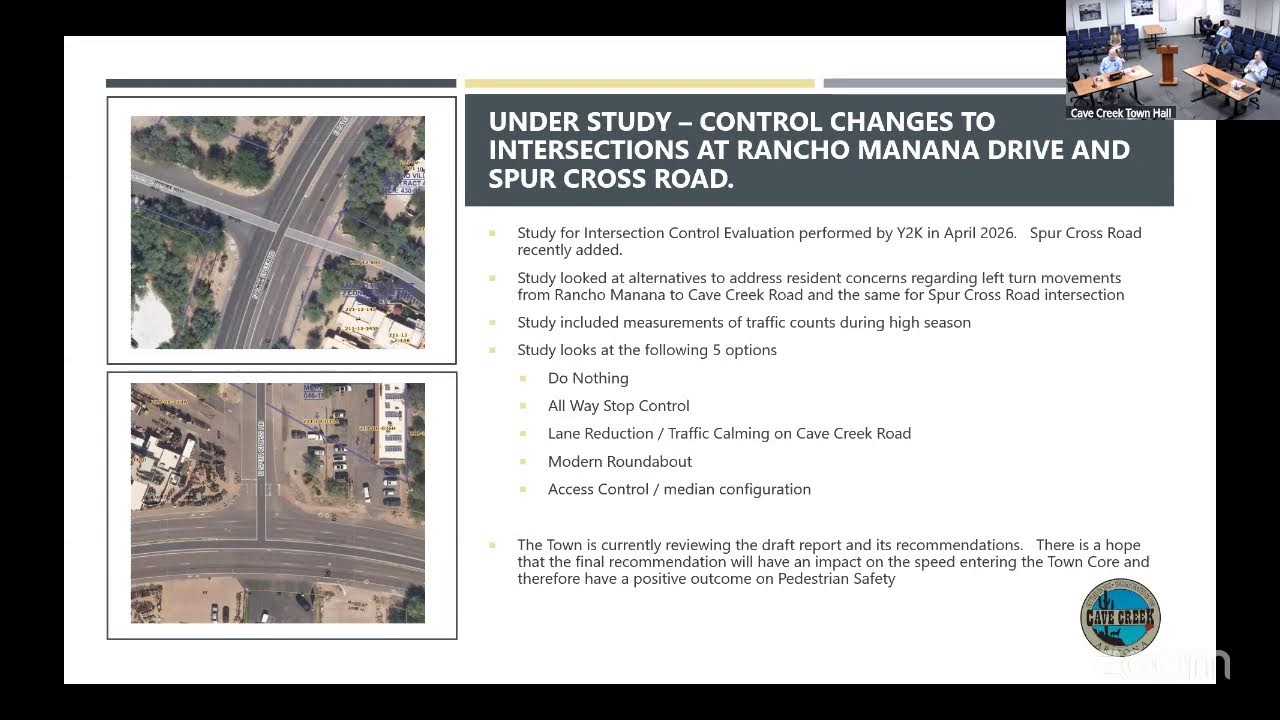
Rancho Mañana / Spur Cross Traffic Control Study: The engineer presented findings from a draft report examining four alternatives to manage left-turn conflicts: (1) do nothing; (2) four-way stop (rejected due to rear-end collision risk from 8,000 vehicles per day on mainline); (3) lane reduction with traffic calming (under further review); (4) modern roundabout (~$750,000); and (5) Michigan left / median access control configuration (U-turn in commercial corridor). The study documented five accidents in 2022 but zero in 2023–24, though Rancho Mañana residents reported persistent near-miss conditions. The Mayor favored piloting a Michigan left with protected left-turn phase (paint-only initially to allow emergency vehicle passage) at Rancho Mañana before implementation at Joe Freedman, a Rancho Mañana resident, praised the Michigan left concept as traffic-calming and noted that stop signs are "your friend," though the engineer countered that accident projections would triple with a four-way stop due to rear-end collisions. Joe Freedman also raised concerns about residents north of Cave Creek Road unable to turn left under the Michigan left design, forcing them to right-turn and U-turn in the commercial corridor—a dead-end that the engineer acknowledged remains under review. The final report is expected within weeks.
-
Galloway Ridge Intersection Study: Councilmembers pressed for an immediate traffic study of the Galloway Ridge 32-unit apartment complex, sited on a 10% grade blind curve with poor sight lines on Cave Creek Road. Expected vehicle trips: 120–125 per day. Councilmember Joe Freedman stated, "I think it's time now. And in fact, I think it's past time." The engineer recommended deferring the Galloway study to summer 2025 after completing Rancho Mañana to allow pilot-testing of lane-reduction or Michigan-left solutions before applying them at Galloway. Councilmembers resisted this deferral but did not override it.
-
Pathway Lighting in Entertainment District: Councilmember Katharine raised the absence of low-level pathway lighting in the downtown bar/entertainment district (the "bar triangle") despite high foot traffic, especially on weekends when intoxicated pedestrians may be crossing. She noted drivers cannot see pedestrians on dark paths. Staff acknowledged solar reliability issues and battery-maintenance costs and noted that standard APS-driven electrical pathway lighting has not yet been priced or prioritized in budget. The director committed to investigating solutions.
-
Speed Control and Enforcement: Tom Augherton suggested rumble strips, lane reduction, and median deflectors as mechanical traffic-calming tools and asked whether scoring asphalt or concrete before crosswalks could slow entry speed. The engineer agreed to review rumble strips with the traffic consultant. Tom Augherton also mentioned a resident suggestion of fake speed-camera boxes as psychological deterrents. The Mayor and council emphasized the importance of ongoing speed and accident metrics to track program effectiveness and requested staff compile and publicize a 2019-baseline pedestrian-car-incident comparison to demonstrate progress.
Vote: No formal votes were taken. All decisions emerged from council consensus and staff direction without a recorded roll call.
Opposition
No organized opposition was expressed during the meeting. Tom Augherton expressed skepticism about roundabouts but remained open to alternatives. Some residents of Rancho Mañana, cited by the engineer, reported near-miss conditions despite zero accidents in 2023–24, suggesting that perception of danger may exceed measured risk at that intersection. No resident public comment was heard.
Support
Council consensus supported:
- Red flashing beacon lights (pending MUTCD research)
- Viola crosswalk installation and Hideaway crossing elimination
- Linda Drive crosswalk upgrade with beacons and illumination
- Low-level pathway lighting investigation in entertainment district
- Continued speed and accident metrics tracking and public reporting
- Pilot-testing Michigan left or lane-reduction traffic calming at Rancho Mañana before Galloway
The Mayor and several councilmembers praised the multi-year pedestrian safety initiative (2019–2025) and its measurable results.
Project Details
Linda Drive Crosswalk Upgrade
- Current status: Existing crosswalk; council consensus to upgrade with rectangular flashing beacon, pre-warning beacon (12-inch solar, 100–150 feet in advance), and illumination
- Intersection: Linda Drive and Cave Creek Road
- Benefit-cost ratio: 2.3 at time of study; expected to increase with hotel development
- Served destinations: Frontier Town, Prickly Pear restaurant, Ellen Kanto, Focus on the Family, future hotel, post office, bank
- Town commitment: Extend sidewalk from Galloway Ridge subdivision down hotel property front; extend crosswalk project to post office and bank frontage
Viola Parking Lot Crosswalk
- Status: New rectangular flashing beacon crosswalk
- Location: Viola parking lot
- Benefit-cost ratio: 1.2 (original study); increased with addition of parking on Viola post-study
- Served destinations: Circle K, parking lot users, chip entertainment venue
- Council decision: Install Viola crossing; eliminate nearby Hideaway crossing to avoid oversaturation
Three Original RFB Crosswalks (Kuanas/Hidden Valley, Hilltop, Herald)
- Status: Installed and performing well (November 2023 decision, completed)
- Equipment cost: Approximately $28,000
- Installation: Town crews with vendor assistance
- Current beacon color: Yellow (advance warning); white (in-crosswalk per MUTCD)
- Pending staff research: Red flashing light feasibility for all crosswalks
Hotel Development (Linda Drive / Schoolhouse Road)
- Applicant/developer: Luke (hotel developer, name not fully spelled in transcript)
- Location: Linda Drive / Schoolhouse Road intersection
- Permit status: Submitted December 2024; review comments returned late January 2025; awaiting applicant resubmittal with corrections
- Expected groundbreak: September 2025 (ballpark estimate pending permit issuance and financing)
- Pedestrian connectivity: Developer extending sidewalk from Galloway Ridge down hotel property front; town to extend crosswalk project to post office and bank frontage. Hotel will have southern vehicular driveway to Schoolhouse Road and south-side access near post office. West-side pedestrian pathway not confirmed due to slope constraints.
- Cave Creek Road address: Developer sought Cave Creek Road address; connectivity from west side to Cave Creek Road under discussion
- Water allocation: Water resource allocation cited as limiting factor for development approval and groundbreaking
Galloway Ridge Apartment Complex
- Units: 32 units
- Location: Blind curve on 10% grade on Cave Creek Road
- Projected vehicle trips: 120–125 per day
- Sight line concerns: Poor visibility; blind corner; high accident risk
- Study status: Deferred to summer 2025 pending completion of Rancho Mañana study and pilot-testing of lane-reduction or Michigan-left solutions
Rancho Mañana / Spur Cross Road Traffic Control Study
- Study scope: Left-turn egress management at Rancho Mañana and Spur Cross Road
- Traffic data (March 2025): ~8,000 vehicles per day on Cave Creek Road mainline; ~400 vehicles per day attempting left turn from Rancho Mañana; ~40 vehicles per hour peak left-turn volume; ~95 vehicles per day left-turning from opposite side at Spur Cross
- Accident history: 5 accidents in 2022; 0 in 2023–24
- Alternatives studied:
- Do nothing
- Four-way stop (rejected—projected rear-end collision increase)
- Lane reduction with traffic calming (under further review)
- Modern roundabout (~$750,000 estimated cost)
- Michigan left / median access control configuration (U-turn in commercial corridor)
- Report status: Draft reviewed; final report expected within weeks
- Pending: Research on protected left-turn phase with lane reduction; impact assessment of Michigan left on residents north of Cave Creek Road unable to turn left
Vote Breakdown
No formal votes were recorded. All decisions emerged from council discussion and consensus direction to staff.
Outcome & Next Steps
Approved in Principle (No Formal Vote):
- Installation of rectangular flashing beacon with pre-warning beacon and illumination at Linda Drive crosswalk
- Installation of new rectangular flashing beacon crosswalk at Viola parking lot
- Elimination of Hideaway crossing to consolidate pedestrian flow
- Town-funded sidewalk extension from Galloway Ridge subdivision down hotel property front
- Town-funded crosswalk extension to post office and bank frontage (Linda Drive area)
Directed to Staff for Further Research / Report Back:
- Research MUTCD guidelines and federal insurance-carrier approval for red flashing beacon lights at all crosswalks; present feasibility and cost before implementation
- Investigate low-level pathway lighting solutions for downtown entertainment district; price out standard APS-driven electrical lighting and solar alternatives
- Compile pedestrian and vehicle safety metrics from 2019 to present (speed by intersection, accident count and severity by location, enforcement activity, pedestrian-car incidents) and prepare for public communication / press release
- Complete final Rancho Mañana / Spur Cross traffic control study (due within weeks) examining Michigan left with protected left-turn phase, lane reduction with traffic calming, roundabout, and four-way stop alternatives
- Pilot-test Rancho Mañana solution (likely Michigan left or lane reduction) before tasking consultant for Galloway Ridge study, estimated summer 2025
- Coordinate with hotel developer on final pedestrian connectivity design and Cave Creek Road address feasibility
Hotel Development Next Steps:
- Developer to resubmit permit corrections (in progress as of late January 2025)
- Permits expected to be issued pending resubmittal
- Estimated groundbreaking September 2025 pending financing and water-resource allocation resolution
Ongoing Monitoring:
- Speed feedback signs tracking 85th percentile and average speeds (current: 37 mph and 36 mph, respectively, down from ~43 mph in 2019)
- Accident and near-miss reporting by intersection and category (vehicle-pedestrian, vehicle-bicycle, vehicle-equestrian)
- Enforcement activity (traffic citations)
Controversies & Context
Federal Standards vs. Local Safety Psychology: The core tension of the meeting centered on whether Cave Creek should follow federal MUTCD guidance (yellow beacons for advance warning, white for in-crosswalk) or adopt red flashing lights used in Carefree, Scottsdale, and other Arizona towns. Councilmembers argued red is universally understood as "stop," while white beacons are ignored by drivers. The engineer cited insurance carrier requirements to follow federal guidelines but agreed to research MUTCD flexibility. This dispute reflects a broader clash between prescriptive federal standards and local judgment about driver psychology—one likely to recur in peer jurisdictions.
Traffic-Calming Strategy Debate: Council divided over whether mechanical traffic calming (lane reduction, rumble strips, median deflectors, Michigan lefts) or enforcement-based approaches best serve safety. The Mayor emphasized speed reduction from 43 mph to 37 mph (85th percentile) and zero accidents at Rancho Mañana in 2023–24 as evidence of success from a multi-pronged strategy (enforcement, sidewalks, crosswalks, parking management). Tom Augherton pushed for additional rumble strips, scoring, and median deflectors. The engineer warned that some interventions (e.g., rumble strips) require traffic engineering vetting to avoid unintended consequences. This reflected broader national debate over infrastructure-only vs. enforcement-based speed management.
Roundabouts vs. Stop Signs vs. Michigan Lefts: At Rancho Mañana, the draft traffic study recommended a modern roundabout (~$750,000) but staff and council explored cheaper alternatives: four-way stop (rejected due to rear-end collision risk), lane reduction with traffic calming, and Michigan left with protected left-turn phase. The Mayor favored the Michigan left as a pilot before broader implementation. However, Joe Freedman (a Rancho Mañana resident) noted that the Michigan left design would force residents living north of Cave Creek Road to right-turn and U-turn in the commercial corridor, unable to make direct left turns—a dead-end scenario under further review. This illustrated the complexity of intersection design in a mixed commercial-residential corridor where every solution traded off access for one group against safety for another.
Galloway Ridge Study Deferral Dispute: Joe Freedman and Katharine pressed for an immediate Galloway Ridge traffic study, arguing the 10% grade blind curve with 32 new apartment units (120–125 daily trips) posed imminent risk. The engineer recommended deferring the study to summer 2025 pending Rancho Mañana completion, to allow pilot-testing of solutions before implementation. Joe Freedman stated: "I think it's time now. And in fact, I think it's past time." The council did not override the deferral but expressed frustration, suggesting resource and sequencing tension typical in small-town infrastructure planning.
Water-Resource Allocation as Development Constraint: The hotel project's groundbreaking was tied to water-resource allocation decisions. The engineer noted: "Water resource allocation is the limiting factor with their approved development plan." This reflected a broader Arizona water-scarcity challenge constraining urban growth even in approved developments. Notably, the town appeared to have discretion over water allocation, suggesting internal resource-management complexity.
Metrics Tracking and Public Communication: The Mayor pushed for compilation and public reporting of safety metrics (speed trends, accident counts by intersection, enforcement activity, pedestrian-car incidents from 2019 baseline) to demonstrate the success of the six-year pedestrian safety initiative. He stated: "I got a pretty good story here that needs to be out there in public." This reflected frustration that internal program success was not translating into public narrative or awareness—a common challenge for local government communication.
Pedestrian Compliance and Enforcement: The traffic engineer noted that even with multiple crosswalks and beacons, pedestrians often cross diagonally outside marked crosswalks, especially on nights when bars close. The engineer described this as endemic to Cave Creek culture, stating: "This is the jaywalking capital of the world." Councilmembers acknowledged the issue but noted the challenge of enforcement vs. design—infrastructure alone cannot mandate compliance.
Entertainment District Lighting Deficiency: Councilmember Katharine identified a significant gap: the downtown bar/entertainment triangle (Roadhouse, Rebel Ranch Hideaway, Buffalo Chip) had high foot traffic, especially on weekends with intoxicated pedestrians, but lacked low-level pathway lighting. Drivers could not see pedestrians on dark paths. Staff acknowledged solar unreliability and budget constraints, suggesting this safety concern had been deferred by budget priority rather than resolved. This may represent a political vulnerability if an accident occurs in a dark pathway.
Hotel Pedestrian Connectivity Uncertainty: Luke (the hotel developer) could not confirm a west-side pedestrian pathway from the hotel to Cave Creek Road, citing slope constraints. Councilmembers appeared concerned that hotel guests would be forced to use Schoolhouse Road access rather than direct Cave Creek Road pedestrian connectivity, reducing walkability and increasing vehicular trips. The engineer's commitment to extend sidewalk and crosswalk projects suggested the town would backstop missing developer-provided connectivity—a common cost-shifting in small communities where developers minimize site amenities.
Duration
- This item (pedestrian safety workshop): Approximately 1 hour 15 minutes of the meeting (estimated from transcript length and content)
- Total meeting: Not stated in transcript
Other Notable Items
None identified. The meeting agenda consisted primarily of the pedestrian safety and traffic control workshop, with no other substantive items voted on or discussed.
═══════════
Historical Context:
Cave Creek's pedestrian safety initiative began in 2017 when two crosswalks were installed between bars. In 2019, the town applied for a MAG local area safety study; COVID-19 delayed measurement. A second study (early 2020s) identified specific projects with benefit-cost ratios. In November 2023, council approved three rectangular flashing beacon installations. The 2019 baseline reportedly included 16 pedestrian-car incidents over a five-year period preceding that year, which catalyzed the multi-year program now showing measurable results: 85th percentile speed down ~6 mph, zero accidents at a previously problematic intersection, and significantly increased enforcement.
═══════════
View source transcript ▼
Source: 09 June 2026 Regular Town Council Meeting — June 9, 2026. Auto-generated YouTube transcript; may contain transcription errors.
go ahead and talk about today. And let's see. Did I get it to start? Um, didn't need to go back. Oops. I'm going forward. Let's Brian, what's back? Oh, the arrow keys. There we go. I did. There's the cover sheet. That's what I said. It came up. Okay. So, today we'd like to talk about the pedestrian safety workshop. Um, so it's been an issue in Cave Creek for years. And while we had uh crosswalks, we did not have any really sort of system to allow pedestrians to cross Cape Creek Road.
In 20 2017, we put in a a pedestrian crossing from the two bars. Actually, two different crossings. One from uh Heralds to the Roadhouse and the other one from our uh down the street. Um. Huh. That Rebel Ranch Hideway. The Rebel Ranch Hideway one. Yes. Those were I trade with those. I I know you do. Uh so anyway, we those were put in and then in 2019 based upon recommendations from a traffic engineering firm.
Uh the town installed raised vertical markers and signs at the existing crosswalk to bring attention to the crosswalk for the pedestrians. Everyone remember the vertical posts that we put in as an interim? Uh we were replacing a lot of those. Uh they did not go over well with some of the motorists in town. So actually about that time frame we we have a actual recreation of a pedestrian trying to cross Cave Creek Road. Why is that doing what it did? So we had didn't go forward. There it goes.
So, we had a pedestrian trying to cross Cape Creek Road. Anyway, yes, an old Frogger.
Um so the first step that the town made was in 2019 where the town made application was awarded a local area safety study from the Maricopa Association of Governments and uh project was extended a couple of as because a couple of weeks before they were come coming to take the pedestrian counts and all that this thing called CO 19 broke out and when they would have been here to take the uh measurements I think could have fired a cannon off in this street. There were no cars.
There were certainly no pedestrians and nothing to really measure. So, we waited almost a year before we got the um the counts done. And this study made general recommendations, but it wasn't enough. Wasn't anything that we could budget. Didn't have projects identified. And it so we asked for u sort of like Oliver Twist.
We went back and said, "We'd like some more, please." And so the county being MER or MAG being what they are and being a good partner, um they produced a second study which identified specific projects. They identified benefit cost ratios and things that we could actually take to MAG for funding. Um so we made application um for three projects which were the top three benefit cost ratio ones on the list.
They were a speed table and RFB at Roadhouse speed table and at Hilltop and an RFB speed table at Hidden Valley also Hilltop. So Hilltop is Kuanas. Uh I have to translate uh the traffic engineer speak and these projects were the best benefit cost and met the requirements of MAG and while we were close the town was not selected for any funding that year. There were like 30ome applications. The best we could get with one of them was sixth place and they funded five.
So we did not have funding for the project. Um the benefit cost ratio uh how they do it is uh basically it's a number that they have a formula for doing. There's a worksheet that you can put in but it considers crashes at specific locations. Crash reduction factor for what will happen if we put in the signal or light. Uh total project cost design and construction. the project life, the annual maintenance costs, and then MAG uses these procedures to determine if a project is fundable.
Uh we use it to determine if the what projects are priority. So in November 23, a discussion was held with the town council to give direction on what we wanted to do with traffic control and pedestrian study. And there were the three crossings, Hidden Valley, Hilltop, and Herald were presented in the with the following options. Uh town staff was uh to enter a design contract for the three elevated pedestrian crosswalks and rectangular flashing beacons.
uh to enter into a design contract for only the rectangular rapid flashing beacons at the three locations and direct staff to enter into a design contract for only the elevated pedestrian crosswalks or maintain the current position current conditions which were basically just the painted crosswalks.
Uh the council d uh directed staff to enter into design contract for the installation of the rectangular flashing beacons at the three locations and those crossings have been installed and are performing well. So we did put the one in at Kuanas, one at uh basically Hidden Valley and one at the U bars. We took the one that was already there and we augmented it. Um, the town also installed three new speed feedback signs, which was item number three on the priority list.
Uh, that way we could track um what the speeds through town were. And no, these are not photographic devices. They don't keep any car dealer, car manufacturer, license plate, or any of their information. All they're doing is saying this many cars went by. These were the speeds of the cars and gives us a breakdown of when the speeds were and when they weren't uh or how many went by.
And the most we've gotten I think we had one guy break 99 miles an hour through town is what we've seen through some of our readings about 2:00 in the morning. Was that person intercepted? Don't know. We we do look at u the information of when things are happening and if there's a consistent outlier of speed versus time we do that sh we share that with the uh people down the street here.
Um so the proposed projects um that we want to do who go ahead history what what are the statistics I mean we had we all this started because we had we had uh pedestrian safety issues are have those improved has has the average speed in town improved we average speed has dropped by about 2 miles an hour uh but I don't know whether that's because of the um pedestrian crossings which are really not meant to control speed uh but or whether because we've had an increase in enforcement through town.
Well, we made major efforts on a lot of other areas on pedestrian safety. Let me just I'm I'm writing these down as we go. One is we really bumped up the enforcement. We gave out a lot more tickets in including Adam and and the sheriff. Um, two, we put in a bunch of walkways. Uh, we put walkways up and down, got new easements to put those walkways in, constructed new walkways in town. Um, we put in no parking areas, including on Jack Cartrite to take care of that pedestrian safety issue.
Um, and we put in a bunch of parking on Viola to reduce the uh possibilities. So, you know, there's a lot more in the history than than I see here. You're correct. As far as pedestrian safety, we the the council and staff have done have really pushed to have the walkways connectivity and also the uh safety the safety of the public in mind as we do these things. Do we have any metrics on pedestrian safety now to compare with the metrics we had when we kicked all this stuff off in 2019?
I will say that when we were looking at just a recent study um the study that we'll get to later about uh the intersection of um Ranchermana and Cape Creek Road in 2000 uh in 2022 we had five accidents at that um intersection whether they were bike whether they were sideswipe but we had five accidents that one year We have had most dangerous location in um I don't know if that is or not but it's one that we're looking at right now because it has between that and uh spur cross are probably where we have the most left turns coming out um and it's on a curve and there's a whole bunch of things going on at that intersection.
But what we find is that in 23 and 24 zero accidents. So whether that's whether that's because of the enforcement the um you know the signalization or whatever but we had zero accidents in 23 and 24 at that location. And I'm only bringing that location because we've done the metrics on that specific location within the uh since March.
Are are you watching the metrics on on the intersections in town, the roads and intersections in town that this we're watching the speed metrics through town uh as far as looking at the uh traffic control, the speed uh devices that we have and we've had taken those over years of information. So what we're seeing is a trend going down in both the average speed and the um 85th percentile speed. And what is your conclusion from that?
That so far I think the enforcement is helping to bring the speed down and it as the speed comes down it improves the safety for the pedestrians. What are those numbers by average? 85 uh the 85th percentile through town is running about 37 miles an hour now. It was up as high as uh it was up as high as 39. The average is running about 36. We were doing 43 in the 2019 study was number I recall. Yeah. About that. So we knocked six month.
I mean I I think there's a me there's a story here that we're missing that we've done a lot of stuff on pedestrian safety. The speeds are way down, tickets are way up. We put money into sidewalks, crosswalks, um curb. Yeah. I stuff I named here. So, you know, we got a pretty good story here that needs to be out there in public. And if and it should show up in the in the metrics that the state keeps um on traffic accidents. I I'd like to see that.
I'd like to see how we had my my recollection from 2019 is that we had um 16 pedestrian uh car incidents over a 5-year period preceding that. And that that kicked off a a massive effort. Um I'd like to not lose that history and see if we have metrics that um that will confirm that all the steps we took have paid off.
I you can't tell which one was the because we did so many things but um I think the two metrics of speed through town and the number of accidents I mean that's what we're that's the metric for traffic safety in town that is and uh again today it's more we're dealing with more pedestrian safety but we also when we deal with uh our traffic we're also looking at pedestrian equestrian and cycling uh that we try and look at within our bike lanes and things like that.
So when we're measuring the accidents, we try and also uh segment them into those um different buckets because uh we do have a lot of equestrian, we do have a lot of um cycling through town and so we do keep track of that those metrics. So we can provide we can certainly provide let's see what the statistics say. Okay. I mean if if it's not measured it's not managed. That's that's the old management saying that is maybe the most important in um keeping things on track over a long period of time.
And so I agree. I I think the town needs to focus on those metrics speed through town and the number of accidents so that when we have something that goes off the rails we know about it and we can act on it. And I think it ought to be uh tracked and and uh and brought out. We got a good story to tell. Frank the severity of the accidents because as you reduce speed then the severity um the severity of the accident tends to decrease as well. Okay.
Maybe we can get some publicity for the people that we really are interested and we're making progress. Okay. It's an issue. We'll pull we'll pull those numbers together. uh the proposed projects the uh flashing warning beacon. So what we have is before the crosswalk we have a sign that warns people. Okay. Oh, sorry. I did on this one. Maybe I have to do it here. Okay. Why is it not advancing down button? We'll see. It's advancing on my screen, but what am I doing wrong? Nothing.
I think Zoom may be having some quirks today. Okay, I'm going to do a stop share and then reshare. There we go. So the beacons um what we're looking at doing is that on the signs and let me go to the next slide. Uh you see where the uh crosswalks are and then you can see where the what we call the shark teeth are in advance of the crosswalks. There is a pedestrian sign there saying stop here for crosswalks. Well they get blended into the background.
So, what we want to do is add a 12-in beacon like on top of this stop sign on top of those at the um at the three locations. There are 12-in beacons. They will they're going to be run by solar and they will and they will be able to so when somebody goes to press the light to activate it, it will flash in advance of the crosswalk.
So, you'll now have the flashing beacon at the crosswalk and the warning beacon uh about a 100 feet up before it that will go off and let somebody know that they're that there's somebody getting ready to cross the crosswalk. One more little piece of um sort of insurance policy uh to try and protect the people crossing. We we notice a lot of drivers when they're coming into town, they're gawking. They're looking here.
They're looking there and it's like at last minute when they're upon the crosswalk. So, this is one more opportunity for them to see a flashing sign. And the button that activates the ones that we have now will activate these in advance. And how far away are they from? About 100 to 150 ft. Okay. So, there's plenty of stopping distance uh before they would be into the crosswalk.
Um and so you would have the warning beacon, you'd have the rectangular flashing beacon at the crosswalk itself and then at um the one location that we have which is the uh between heralds they have the ones in the street but the ones in the street can be seen but they're I don't know that they're as effective.
Uh, I think it's the flashing beacon on the side and then the uh these beacons will call attention to somebody in the crosswalk and then at night when you push the button there's also a light that lights up the crosswalk and then goes out. Yes. Some people don't push the button. Something that maybe could weight of a person could activate those lights walking across the street get push the button.
Uh we can look at it, but right now um you know we're we're hoping that they will push the button to cross the street. I mean to activate the lights um there are automated ones. uh they do put them on bike trails, but the costs go up to um quite a bit. And then what's happens is you get a lot of false readings of somebody who walks by the walks by there like maybe going into the into a bar or stumbling into a bar who then activates the who activates the signal.
Um, so I again if it's something that the council wants us to look at, we certainly can, but I'd rather have it uh sort of the push button so that we don't have a lot of false readings. Yes. Oh, Cynthia was first. Uh, is the duration of the flashing light the same as the duration of the crosswalk light? Yes, they will be on the same they will be on the same signal. So when one goes off, the other will go off. Do you have a sense of what portion of people are actually using the crosswalks?
Uh, not enough. I know, but not enough beyond that. Um, on bull riding nights, um, there were probably as many people, um, coming out of the, you know, coming out of the chip, uh, di going diagonally across the street rather than walking down to the crosswalk and going across Harolds. So even if there's a crosswalk at the chip, which we'll talk about in a minute, there's not a, you know, they tend to want to go diagonally across.
And so we're trying to come up with other methods to deter that path. But for right now, the question is, you know, assuming that they're going to get to the crosswalk, we've we've connected the walkways between them so that there's a there is a pedestrian walkway in front of the chip, in front of um Rebel Ranch and in front of Herald that gets you to the crosswalk.
And same thing on the other side of the street in front of um the you know going from the Circle K all the way over to uh Roadhouse. I think part of the confusion on the the ones that are on the street is they're white lights and anytime you have a white light people just kind of say, "Oh, okay. It's just warning me." If it's red light, you probably have a better chance of stopping them. Yeah.
I think what we're looking at for these is because of the uh MUTCD, I think they have to be yellow, you know, in advance of the crosswalk. Would I like them to be red? Yes. But I think they have to be yellow. But we can check into that. Dusty, were you I I agree with you that the white lights, you know, red light means stop. The white light Yeah. Yeah. I Is that true? Yeah.
I just I mean I I've uh occasionally go over the pizza place and and pick up a pick up a pie and you know obviously they're driving by the uh by the uh and I see the beacons go off and I see people just kind of you know oh look look at the flashing lights they keep on driving. Yeah. So we're trying to get a little bit advance on either side of it to try and set that off.
We think that that will be a um a safety measure that um for the three crosswalks we have um the equipment's about 28,000 and our um our crews can install them with a little help from the vendor. I'd like to see if you can check on the red lights for the flashing lights in the ground simply because people stop. They realize that there's an issue. And you know, Mag, but that's probably a better way of going about doing it, even if Mag doesn't like it.
And I'll have to see if those those lights were from the original installation and we just hooked them up with the new one. The other two crossings do not have the ingground lights, the two new ones we put in. Yeah. Um we'll we'll definitely look into it. Um do you want to explain? It's not mag, it's the MUTC. What that is? Yeah, it's the um it's the MUTCD is the um federal publication for signs, lights, and things like that.
It's a It's the guideline that basically our insurance carriers want to make sure that we're abiding by. Well, but they don't I mean, everybody in the world has red lights flashing when they're pedestrians there. You go through Phoenix and Scottdale and they're all over. I I've never seen the white lights anywhere else but here. I haven't seen red lights in the crossbox, but I have seen like you Well, there's down Carolyn. Carolyn. Uh, there's I just went through it yesterday.
Carolyn's got the red lights. They're on Yeah. Right on. Yeah. They're flashing red lights. Thomas Road is Yeah, we'll take a look and see whether again it it's the same thing. It's a button and if you don't push the button, the red light doesn't come on. But it what it does, it comes on and it it but it actually forces the vehicles to actually stop at an intersection. Those are stop lights, right, that they're stopping at. So it's these don't have stop lights or or stop.
What Bob's saying is you can actually see the lights in the pavement itself. They're red and they're flashing. Okay. Again, I'm going to I'll have to check and see how easy it is to change out those uh elements in the in those lights that are in the pavement. Um, we'll have to we'll check into that, but we'll we'll do some research and see if we can do that. Why not just put a red stop light up at those? Well, we I mean Yeah. Yeah. They're like mid intersections.
That's Well, so Caroline, so Tom, there are plenty of places that have those. There's there's one on uh there there's there's one on on PEMA at uh I think I think you're probably correct that these lights we'll check and see if these lights can be red the ones that we're looking at these beacons because those would be where you want them to stop anyway at the shark teeth.
So, we can certainly look at those being a um a red light much like we have on the lights at the stop signs that we have at schoolhouse and uh Cave Creek Road. But Bob, if I can. So, you're suggesting that we even take a look at maybe having like those smaller traffic signals where those are as cars are coming up to the crosswalk. It's just if someone pushes the button, we want the cars to stop. Okay. And I I think it's a mix. I think it's more than just the illuminated.
It's not a real strong message to stop it because I've never seen them anywhere else. I've never seen anywhere else. And people know what a flashing red light means. It means stop. Okay. We will certainly look into that. Let's hear from other council people. H I like the idea, but for the office of reason or maybe because of it, um if you come in Cape Creek, sorry. Thank you. If you come into Cave Creek from Carefree, you basically have one stop sign from Carefree to past Rancho Mñana.
And I've always wondered and begged and conjucidate at every one of our meetings. But um with Bob's suggestion, the mayor's suggestion, you're almost de facto getting a dual benefit because you're bringing the pedestrian crossings to a stop, but you're using the psychology of encountering a red light kind of like a traffic light. And that would probably do more to regulate the speed in this town, which is so bad.
Stand in front of the car wash on any afternoon, particularly Friday afternoons, and it's a racetrack down the hill. We've taken all the medians out for god knows what reason. We need to really consider in a rural community restoring some of our medians with native vegetation. Five lanes of asphalt is not a small town commercial corridor. So with one stop sign at schoolhouse road, this might kill two birds with one stone.
If they have to stop once, twice, three times through the entertainment triangle as it's referred to, it will slow the speed so that when they do accelerate, they still have the stop sign at Schoolhouse Road. And you know, we have the blinking red light that Ernie Bunch put there, which I think is really helpful with Bob's suggestion. You could put one more red light there. It's just a stop sign, but you could use the same poles.
So psychologically, you're stopping either when pedestrians are there or you're stopping at schoolhouse road. Um, if we continue to have stop signs in town and don't do these red lights, which I think is a great idea, we cannot live with the traffic zooming past Rancho Mñana and anybody who lives north of the downtown, which are many of us, we cannot get out onto Cave Creek Road. You can barely turn right, but you sure as heck cannot turn left.
And if you guys would just give us a stop sign at Rancho Mñana, we could look to see as they're slowing down and stopping and then pull out a SP crossroad and turn left or a schoolhouse.
But before you start roundabouts and other things, which I think some people have an allergic reaction to, what the mayor has suggested this evening is really fascinating because it might be more effective than a traditional four-way stop with conventional traffic lights at schoolhouse, but it would have the desired effect of bringing traffic to a complete halt once, twice, or three times in the downtown commercial corridor in lie of more stop signs. Yeah.
So, I like that having the more stop signs doesn't decrease the number of cars and it's really the number of cars. I'm not disagreeing with the the safety issue, but you know, we've just got a lot of cars and making those lefts is we do. But now we have motorcycles that think they don't have to stop at stop signs and that's a trend. That's not the isolation during a festival week. the new thing.
Just to make sure I'm understanding, what we want is we want a flashing red light that will be activated when there's a pedestrian, not a all the time flashing red light, right? Just a pedestrian just when the pedestrian just when the just the button just when the but a button is pressed that it'll give us a flashing red light that will have the cars come to a stop. um because we will get into the wrench mñana a little bit later because we do have a study that's in process.
We have the first draft that we've reviewed and we're going back for comments and we can talk. That's the last slide on our presentation today. So we haven't given up on Rancho yet.
Well, the Morris memo may supersede all of these things because if you envision it, what you're just talking about, if you envision all traffic coming to a two-way stop, oncoming and other direction as well for the duration of people across the street in more than one location, I think we may have accomplished what we're trying to do, which is to slow this meeting down. And I think when when there are people in the crosswalk, you would have that effect.
But when there are not people in the crosswalk, it would be still back, you know, business. Right. I mean, that's the bonus, I think, is you're only stopping traffic if there's pedestrians actively crossing, which would be during business hours. But if you would generously provide one more set of poles at Schoolhouse Road, we could have a poor man's traffic light. So, do we do we is there another community that is similar to Cape Crate?
I I don't think there is one in the Phoenix area, but other places, I mean, we've got some things that are unique in Arizona. And, you know, balancing having people looking around, which is great, with safety, it's tough. And the metrics, I I agree with the mayor that keeping these metrics is is going to be really important. Yeah. And some of the when we get to the branchana, I I do have some of those metrics memorized. Yeah.
from the report I've been doing and and when we talk about some of the options that we're looking at and why they're um why they may or may not work. So, Cave Creek Road is is asphalt, correct? Cave Creek Road is asphalt. Why can't you just score it? So, like like you have on the you know before you get to any of the crosswalks, before you get to the uh um shark teeth. Talking about rumble strips. Yeah. Put a rumble strip in. Put a rumble strip in both directions.
That'll slow people down, too, because it frightens you when you're Yeah, we talked about that with maybe putting some deflectors, but scoring the concrete is also so or asphalt something else we could look at. I will run that by our traffic engineer to see the positives and the negatives since um I want to make sure that what we do doesn't come back to bite us later. Well, annoying noises tend to slow cars down. Yeah.
So, anyway, as far as these beacons, I'm hearing you'd like them, but but in red, we can Well, I think I think we put it on hold until we come back with additional um answers that they've asked. Um, one more one more comment. Sure. Um, I like the mayor's idea, but I don't want to do overkill and oversaturation. I would say that we need to have probably that red light where they come to a complete stop, probably where the um one is in front of the roadhouse and Herald's there.
That's obviously the key place. And it's not at 7:30, it's later at night, especially when the Buffalo Chip lets out when they're done about 9:30. But I also, if correct me if I'm wrong, Grady, but we are going to beef up some uh a sheriff's presence in his car there on Fridays and Saturdays during the season. There's a deterrent as well. Um but yeah, I don't think you know and and and commenting on um Councilman Auggerton's um comment um I never want to see a traffic light in the town core.
Sorry, Tom. I had to fight hard against that. I have a question just and I haven't seen your full presentation. Are we going to be talking about additional lighting features in the town core at all? Um, not in this presentation. We we know that that's something that we've looked at some pathway lighting. Yes, lowlevel pathway lighting. Um, we haven't figured out quite um how to do that.
Um what we're finding is that um the solar uh arrays that are used are not very dependable and they're ones that if we start it's one thing if we have maybe um 10 or 12 imp placements like we do now. If we all of a sudden go to a hundred, then that's a lot of um batteries, a lot of maintenance and things like that that we have to look at. And the problem is that to get a meter and run electrical is um we have to we'd have to price that out.
We haven't done that yet to do standard low-level um APS driven um lights. Okay? Because from my perspective, that's just as important as slowing down drivers. You know, we have a lot of foot traffic, especially on the weekends, and you can't see them on the paths, and they are not necessarily sober. So, um it it's a safety issue on both sides of the street. So, I think we need to make it a priority to look into how to get at least the what do you call the bar triangle uh lit for pedestrians.
Okay. We can certainly um we've looked at some low-level lighting um that will you know illuminate the path. It's not high up. It's just it's just um you know basically you know the hip level so they can see the ground. Exactly. Yeah. Okay. And and I'm going to agree 100% and then some with Katherine about that. And uh Dr. Bradshaw over at the Roadhouse and Hideway. I know he wants that as well. Maybe he'll share it with us. We can always ask. You got a tough job. Okay.
Um the next one we have it. So then we're looking at two different crossings. um that we would put the same light push button this time with the beacons on. Uh so the first one is at Viola. So this is the area where people are coming out of the parking lot. So to give you a reference, the chip is to the uh chip is to the lower right out of here. This is the crossing that takes you basically across to the Circle K area um across the street from the chip.
And so we would be putting in a rectangular flashing beacon. We would be putting in the pre uh beacons at um the 12-in beacons on the pre-warning sign. And we and the it would have the light fixture that comes out so that it lights illuminates the crosswalk when the buttons pushed. So would this be in addition to the crosswalk that's there at Hideaway? It would be the one that that is the Yes, this wouldn't be an in in addition. I believe this is together. Uh let's see.
I'm trying to remember if this one this one did not have a crosswalk at this location. So this would be a new crosswalk that would be lit. And then whether we got rid of the one at the hideway or not, this one is one that would be um this is where the people are crossing. They're not going down to the hideway crossing which is really um by the you know down about couple hundred feet down. They're they're crossing pretty much at this location. They come out of the parking lot.
Uh they either go to the they go to the chip or they start coming across. they cross the street because they need something at Circle K. So, yeah, I think the visibility of this location is better than the one that exists right now at the hideway that's right on that curve uh without without very good visibility. I agree.
And this one was rated uh this one only had a benefit cost ratio of 1.2 in the old study, but I think it's actually grown uh as we've now put the parking on Viola, which wasn't there before. I I would agree with Cynthia. Um you can't have those two right next to each other and I'm sure that the hideway crossing was there because at one time Rebel Ranch had a lot of activity. Obviously there's been no activity there quite a while.
I'd eliminate that completely and I would put the one across from Viola so we don't have overkill again and that would force people to go down to the main crossing there across from Circle K. Okay. The only thing to remember is people Most people at night are wearing dark clothing. Um, and they stumble across the street where they wherever they happen to be.
We're lucky uh that Harolds and and the uh Roadhouse are across the street from each other because at least people do pay a little bit of attention, but I've seen people in the other locations. I mean, I I was got my wife's car washed today and I saw three or four people just darting through traffic. Um, no nowhere near a crosswalk. I've seen that everywhere in town to be honest with you. As I've stated in the past, this is the jaywalking capital of the world.
They still play frog or the real game. Yes. It's a part of our definition as a town. So how I think we're hearing to abandon the other one and then this would be in place one. Yes. Makes it tough to keep Cave Creek Cave Creek. Okay. And then the other one that we're looking at is there's an existing crosswalk right now at Linda Drive and what we want to do is augment that fix that one up too. Um for many reasons. One, it's right there uh since the study was done.
Uh, and it did have a good ratio of 2.3 at the time to outfit this one. Uh, you've got Frontier T uh, Frontier Town to your left. You've got the new Focus on the Family to the right. You have the Prickly Pair straight across the street. You have Ellen Kanto. And then if the if and when the new hotel comes in, it will be just on the other on north of the Prickly Pair.
So, this would be a walkway that I could see being used quite a bit uh for pedestrian traffic to get to Frontier Town and to Prickly Pair and to other places in the town core. And and don't forget the strong rumors about that actually tomorrow there's going to be an announcement I've been told that Big Earls will be in the old Hansen spot which will bring even more activity to that area. Yeah.
So that and so again I think this this location will become one of our busier crosswalks and it's far it's not far enough or that far away from the uh crossing at um the stop lightss or stop signs. Sorry I almost said stop light stop lightss at schoolhouse. But this would provide again I think a safe crossing or where I see uh extra uh extra pedestrian traffic coming through uh between like I said Ellen Kanto prickly pair Frontier Town and um the focus on the family.
My anecdotal evidence is that this is the busiest daytime crosswalk in town. Uh it's true from what I can see. I see it all the time when I'm at Elen Kanto. People at Frontier Town are crossing and vice versa all the time. If hotel goes in, people don't really qu cross at at the four-way stop sign, but but they cross here, I guess, to get to the Yeah, I think making this one a formalized cross-section with the same type of lights will be, you know, a beneficial location.
And I think, like I said, the benefit cost ratio was 2.3 before and I think that's only gone up and will go up when the hotel is there because it will be right out the back of the hotel. They'll come down through that pathway uh through the prickly pair in the bank and they'll be right at this crosswalk. Is is the hotel going to have access on that west side so they can walk down the street near say between Ellen Kanto and um I I don't know that they're fencing it.
I don't remember seeing a fence but it's a steep slope uh between where the where the um there's probably about there's a slope between or where they're building the hotel and down to the Elen Kanto parking lot. There's probably about a five, six foot rise. Well, I hope hope we're thinking about how people are going to access Cave Creek Road from that hotel walking as one of the not just focus on on the on the traffic.
I mean, we really need to I mean, if they're coming to Cape Creek, what they're going to be walking trying to get from the hotel to Cape Creek Road. And that's one of the things we're looking at. Uh it's not in this presentation, but as we've been dealing with the hotel um the hotel developer, uh they are extending the concrete sidewalk from uh the subdivision, Galloway Ridge, down in front of their property.
And then the town will probably come back to you for a project that would extend that crosswalk in front of the um in front of the post office and to the and then in front of the bank. So that would get them down to Cape Creek Road. Well, we have Luke here with the with the development. loop.
Are they going to be building a fence around the uh hotel so that people can come back on the uh on the west side down past uh uh I don't remember seeing one the prankly pair the uh so commercial development does require a uh barrier around the property any parking areas. So they're they're banding their parking around the exterior of the lot. All of that will have a solid wall um so that you know headlights and different things are not bleeding off the property.
Is is there going to be a pathway on the west end of the hotel to Cave Creek Road? Um I can't say that I recall seeing one. Um I know there the prominence of how the site is configured is really looking towards schoolhouse and and having um pathway and interconnectivity with our sidewalks and and pathways on schoolhouse. Um there is vehicular access from the southwest yes corner. So presumably you could walk you know off the driveway onto the the property behind the post office.
um or on the post office and and out here by the prickly pair. Okay. Yeah, they they have a they have a access the access that is on the south side of the post office. The north half of that is owned by the hotel property. So that access they will have an access there out to um schoolhouse, but they're totally but they want they also want some connectivity. At our last meeting, they wanted some connectivity to uh Cave Creek Road. Correct.
They even asked Luke if they could get a Cave Creek Road address on it. Absolutely. Yeah. So, Luke, I got a couple very quick questions for you. I just want to make sure I'm clear on this. So, the permits and everything's all done. The hotel could start building any time, correct? No. Okay. How's that? Tell me about that. Uh permit was submitted in December. uh review comments were returned to them in late January and we are awaiting their corrected uh revisions for plan submitt. Thank you.
Um if you had to take a ballpark guess when do you think they're going to break ground? Um I believe once their permits are issued. Weren't they thinking something to do with financing? Um I I remember September but I don't again I'm remembering a September time frame in in the last conversation we had with them but nothing in writing or you know no and if the retablo corner gets developed that's going to increase the importance of that intersection. Correct. the retablo corn and the marcado.
The only thing the only thing that's keeping that from going on right now, correct me if I'm wrong, is the fact that we're not going to give them water at this point. Am I correct? Um, when you say we, are you talking about the collective? No, I'm I'm not talking about building. I'm talking about drinking water and water. Water is an issue. Water water resource allocation is the limiting factor with their approved development plan. Yes. Thank you. Okay.
And then the last one is the understudy the control changes to the intersection at Rancho Mñana and Spur Cross Road. Um we went through we looked at the draft report that they prepared on Rancho Mñana and we um they have already collected the control data for Spurcross but we decided to make it one report. Uh so we're still a couple of weeks away from getting that final report back. Um it will be looking at left turns.
Uh, since I've sort of memorized the ones at Ranch Mñana, we have about uh 8,000 cars a day traveling on Cave Creek Road. Uh, we have about 400 cars a day trying to make a lefthand turn out of Rancho Mñana. So, um, we had them look at a couple of different scenarios, and this was working with a traffic consultant, which was a do nothing, just leave it the way it is. Um, an all stop, an all-way stop, in other words, a four-way stop.
Um, I can tell you that one, at least in the draft report I saw, was not recommended because of the possibility of more rear-end collisions. um uh causing because of the 8,000 cars a day on Cave Creek Road, a lane reduction, traffic calming on Cave Creek Road. That one they're they're going back and looking at another alternative on right now.
uh a modern roundabout uh which was their ultimate ultimate recommendation, but it's a $750,000 ticket plus probably buying some land and access control median configuration which um I think uh Councilman Freeman would like which would basically set up Michigan lefts. You know about that? Yes.
So, we're having them look at what would happen if you took the 400 cars a day that would have to make the um left that wanted to make a left-hand turn, make them do a right-hand turn, come back down and U-turn. So, we're looking at that type of we're looking at those scenarios before we make a recommendation to council. Was it 400 or 4,000 uh on Rancho Mñana? 400 402 cars are trying to make a left-hand turn on a mid March day in 2025 and about 40 the peak hour was about 40 cars in an hour.
You know how the Michigan left is proven. I mean it's been around longer than anything considering that we basically invented mass transportation in Michigan. So you know it was the first we'd all be riding horse if it wasn't for us and Henry Ford. But anyway, I just thought I'd let you know that this study is co this study will be coming before you.
Uh, one of the things that we were trying to look at doing is whether we with the lane restriction was whether we could make it so that it still provided the safety. It didn't uh totally obstruct the level of traffic or level of standard for uh passing cars through, but there could also be some traffic calming or slowing as it entered the town core.
Then if that worked there, then we'd go back to uh Galloway on the other uh other side of the town and see if we could then implement it there with Michigan lefts at both effectively have a traffic circle. one huge traffic circle. Yes. Uh there is a graphic that they have, but the traffic circle again, you know, my position, I've never been a fan of them, but the level of service doesn't diminish when we do it.
And I mean, I don't want to I don't want to say carefree, but they they have sort of implemented that lane reduction through their town core, and they've slowed it they've slowed traffic down. Again, I'm keeping an open mind, Joe. I'm keeping an open mind. Well, I want to ask you a question, Hal. Um, if you were sitting up here right now, and again, you don't have to answer this if you don't want to, but which option would you choose? I'm curious what you think is the best option.
I want to see I want to see what the the consultants come back with after we've given the extra information. Uh one of the things that we we were looking at was a a lane reduction with a protected left uh coming out of Rancho Miniata. So reduce the lane but but do it basically start out with paint so that if we have a fire emergency that needs to get through they can you know there's nothing stopping them from doing it.
Um it was really interesting looking at the traffic data for this intersection in that for whatever reason I don't know what was in the water in 22 um there were five accidents at at Rancho Mñana at the Rancho Mñana intersection five in one year since then there have been zero in 20 in 23 uh and 24 we don't have the full 25 data has not been published yet, but the residents who requested us to look at this have have all claimed that they would have been in near accident in near accident conditions.
Yes. So that's why we're looking at it. You know, that area there is really I don't know what you'd use, but the traffic needs to be calmer in that area because you have people coming into town who don't really get down to anywhere close to 30 miles an hour and then leaving town. they're accelerating because they know they've passed the last of the Right. So that that is a ripe area to slow things down mechanically where we don't have to put a policeman out there every time. Right.
And that was an actual that was actually one of the recommendations within the first um loss local area safety study was to do something at that intersection. So, we are looking at it and we're going through the steps and the recommendations that we're getting from the traffic um the traffic uh engineer. So, one last question. Um maybe uh Galloway with the new apartments. We don't see that as being a you know the the apartments themselves are not the are not the issue.
It's going to be the um it's going to be the it's the housing that's growing up in the hills above Galloway. Uh that is driving it more. There are more car trips out of that. Galloway, I believe, is 28 or 32 units. Luke, uh no, sorry. Um 32 units. 32 units. So, uh, they're mostly going to be two, uh, two housing or two people per unit type of or maybe I think if we were looking at a 2.2, uh, units. So, it's really 60. You double the car trips.
So, you're looking at probably 120 125 car trips a day out of it. I mean, right across the street, you have the um the the mall, which fortunately is getting more people in it. Um, but that's that's a bigger driver of the traffic. But are we and so are we looking at that? We will after we get done with this one. We're going to see how I'd rather I'd rather pilot test it on Rancho Mñana coming into that town into our town there.
The problem that we have with Galloway is that when it was constructed, it was constructed at a 10% grade coming up the up to that stop sign. So, it's blind when you start there. You're on a curve on on Cave Creek Road. So, you have a hard time seeing to the left and hard time seeing to the right. So, I think that one's going to require its own special uh study when we're ready when when it's time. But it's it's tough. I think it's time now. And in fact, I think it's past time.
Yeah, you know, I know all of these are a priority, but to me, it's almost impossible to get out of there safely. Yeah, it is an interesting intersection. Um, and it is hard to it is hard to see. I think the Michigan left there would be tough. It would be uh but you're only dealing with you're only dealing with um one you're not dealing with a four-way intersection.
At Wrench Mñana, you have four because even though you have um 400 cars leaving Ranch Mñana trying to make a left, you have another 95 cars on the other from the other side of the street uh trying to make a left out uh at the same time or within the same 24-hour period. So, can you just give me kind of a guesstimate on when we might be able to take a look at Galloway?
Uh let's let's go through the um let's finish this study up and then we can uh see how the reaction what we're getting out of it and whether and then we can task um them to do another study for Galloway but it'll probably be I would say sometime this summer we could get we could task them out. Okay. So in season I've seen traffic back up on on Rancho Mñana. I've seen traffic back up five or six cars. Um particularly as people play golf in there.
So March might not be the best time to to uh to to take a look at that. Um you might want to take a look at at January or February because you're going to be much busier then. people are, you know, actively spending money playing golf and doing things like that. And I think you're going to see a higher traffic number. I've seen the same thing on on uh people trying to take a left-hand turn on Spur Cross. I've seen them, you know, four or five.
It's almost easier to turn right, go down and make a U-turn, but then you're taking your life into your hands because employee taking a U-turn is at Rancho Mñana and people are not happy because you're because you went by them and now you're making a U-turn and stopping them from doing their left. That is correct. So, it's not a it's not a happy way for either one, but I'm just curious, what are you looking at for Spur Cross?
Well, that's one that we've just we're we're looking at these same alternatives at Spurc Cross and the question would be what is the impact on the access control median configuration? Um, it's sort of like the Hotel California, the way they've got it right now, you could make the left-hand turn into Wrench and Mñana, but you wouldn't be able to make a left-hand turn out of Wrench and Mñana. And same thing across the street.
So, it would allow you to turn in, but you'd have to do the forsights, forced rights coming out and then the um and then the Michigan left to go back in your direction. I just have to comment. So, anybody living north of Cade Creek Road from Ranch Mñana at Carree, there's no place to make a left under this new design. Everybody would have to go right and do a U-turn in the commercial corridor. That's why we're that's why we're still in the process of looking at it.
We're not ready to we're not ready to pull it forward because we're asking those same questions. Stop signs are your friend. Uh the problem that we have with stop signs is that the the projection is that the accidents would almost triple at that intersection because of rear-end collisions because you have 8,000 cars versus 400 cars and the stop signs. So, you're stopping all 8,000 cars a day going uh northbound and you have 8,000 cars also going south.
We want them slowing down coming into the town anyways. Why wouldn't we just put a bunch of rumble strips and other things there? Traffic calming. But that's one of the things that we are looking at when we get into the uh the lane restriction to force them into a pattern that they would have to slow down before they come around the corner into the core. Put some fake traffic cameras there. Hey, we could more flock. Yeah I'm not talking about flock.
You put up the box and if somebody's going over a certain speed limit, the camera flashes. That slows people down pretty quickly. Anyway, those are the So, that's what I've got today for you. Any other questions that I can try and answer on pedestrian safety or what we're trying to do with the intersection control? Good luck. Seeing none, uh nothing else on the agenda item.