Cave Creek Secures 3,200 Acre-Feet of Banked Water as Colorado River Cuts Loom; Town Braces for 14–20% Supply Reduction by July
Cave Creek Town Council approved a water storage exchange agreement with City of Peoria to address anticipated Colorado River cuts, authorized the 2026 general election, and created a Deputy Town Manager classification for staff development.
Cave Creek Secures 3,200 Acre-Feet of Banked Water as Colorado River Cuts Loom; Town Braces for 14–20% Supply Reduction by July
The Cave Creek Town Council unanimously approved Resolution 2026-12, an intergovernmental water storage exchange agreement with the City of Peoria, in a 7-0 vote that culminates two years of negotiation with state and federal water agencies. The deal allows Cave Creek to access roughly 3,200 acre-feet of Colorado River water the town has banked in Central Arizona Project recharge facilities, addressing imminent cuts the town projects will reduce its CAP allocation by 14 to 20 percent when the U.S. Bureau of Reclamation announces reductions expected by late July 2026.
The agreement emerged from intensive coordination with Peoria, the Governor's Office, the Arizona Department of Water Resources, and the Central Arizona Project itself—each a critical player in a water-rights landscape now fractured by structural scarcity. Town Manager Sean emphasized that the deal is not a permanent solution but a critical "bridge" to carry the town through the next three to five years while longer-term mechanisms (including potential agreements with the City of Surprise and Arizona Water Banking Authority processes) materialize.
Key Speeches
"Reductions are coming to the Colorado River. It's not next month; the end of July is when we anticipate the Bureau of Reclamation will do that announcement. So we're hopeful that we don't need to call upon this for a year or two but having it in place is a safety net that this town needs to make sure that we can ensure reliable water services for our water customers." — Town Manager Sean
"I want to welcome Kevin. We are very dependent upon our neighbors and we really appreciate you being here and the role that Peoria has played." — Council Member Tom, addressing City of Peoria Deputy City Manager Kevin Burke
"Water banking was essential and important eight years later it has become vital, it's life saving potentially for this community at least as a bridge for three to five years. So I'm so thankful to the staff and our consultants for pulling this all together and the city of Peoria for being an amazing partner." — Vice Mayor Kathryn Royer
"We will not run out of water. It's not going to happen, but people may have to cut back on water. People may have to rethink about how they're using water." — Council Member Tom
Timeline
- Applicant presentation: Town Manager Sean presented the agreement's mechanics, cost structure, and regulatory backdrop over approximately 45 minutes, followed by an extended question-and-answer session.
- Staff recommendation: Unanimous staff recommendation for adoption. Town Manager credited Brad Hillman and Michelle Vanquassen from Cave Creek, plus Kevin Burke (Deputy City Manager, Peoria), David Burke (Peoria Water Services Director), Linda Winnington (Peoria Water Resource Advisor), and Arizona Department of Water Resources staff for solving regulatory obstacles.
- Public comment: Zero public speakers; no opposing or supporting testimony recorded.
- Council discussion: Five Council members spoke; discussion focused on water-migration modeling, recovery mechanisms, the role of Arizona Water Banking Authority, mandatory vs. voluntary conservation, and water usage patterns. Kathryn Royer credited for originating the concept in 2018; Town Manager emphasized ongoing coordination with Governor's Office, state legislature, Phoenix Water Department, and other agencies.
- Vote: Final tally 7-0. All members present voted yes. No abstentions or absences.
Opposition
None stated. Zero public speakers appeared in opposition.
Support
The Council unanimously endorsed the agreement with extended remarks praising staff, the Town Manager, Peoria, and the collaborative water-industry environment.
- Council speakers in favor: Council Member Tom; Vice Mayor Kathryn Royer; Council Member Joe (implied support); Council Member Cynthia Driskell; Council Member Don.
- Key themes supporting the agreement:
- Critical bridge solution to hedge against anticipated 14–20% CAP cuts.
- Recognition of two-year negotiation effort and coordination across state and federal agencies.
- Acknowledgment of Peoria's generosity (1% penalty vs. typical 20–30% water-exchange penalties); cost structure ($460/acre-foot recovery fee) deemed reasonable.
- Access to 3,200 acre-feet of stored credits and potential 450 acre-feet annual withdrawal capacity.
- Enables future agreements (e.g., with City of Surprise) and unlocks Arizona Water Banking Authority credits if distributed.
- Validates town's earlier decision to cut development and restrict meter issuance in subdivisions.
- Town has not run out of water under prior stress; exchange provides optionality for mandatory water conservation if needed.
Project Details
- Case number / Resolution: Resolution 2026-12
- Applicant / Developer: Town of Cave Creek, Arizona
- Attorney / Counsel: None identified in transcript.
- Location / Address: Town of Cave Creek (agreements reference CAP canal; Harquahala Mountain facility (163rd Avenue north of Grand Avenue, City of Surprise); Hour Free facility (between Happy Valley Road and State Route 303, north of Happy Valley Road); Beersley facility / Beersley Road Water Reclamation Facility (Peoria), approximately 3.5 miles south of Hour Free facility.
- APN: Not stated in transcript.
- Current zoning / Land status: N/A (intergovernmental agreement, not real estate transaction).
- Density / Units / Acre-footage:
- Town has 3,200 acre-feet banked by end of 2026 (approximately two-thirds at Harquahala Mountain facility, one-third at Hour Free facility).
- Agreement allows exchange of up to 450 acre-feet per year.
- Town will provide Peoria with 495 acre-feet of storage credits; Peoria exchanges 480 acre-feet of CAP water delivered to Cave Creek
- Town pays $460/acre-foot recovery fee (covers electricity, maintenance, wear-and-tear, and portion of CAP delivery fee; reduces effective cost relative to direct CAP purchase).
- Current CAP costs to town:
14% capital cost; 86% delivery fee ($326/acre-foot delivery fee for 2026). Recovery fee of $460 absorbs delivery component, yielding net cost benefit. - Term: Seven years initial; renewable.
Vote Breakdown
- Final: 7-0 (unanimous passage)
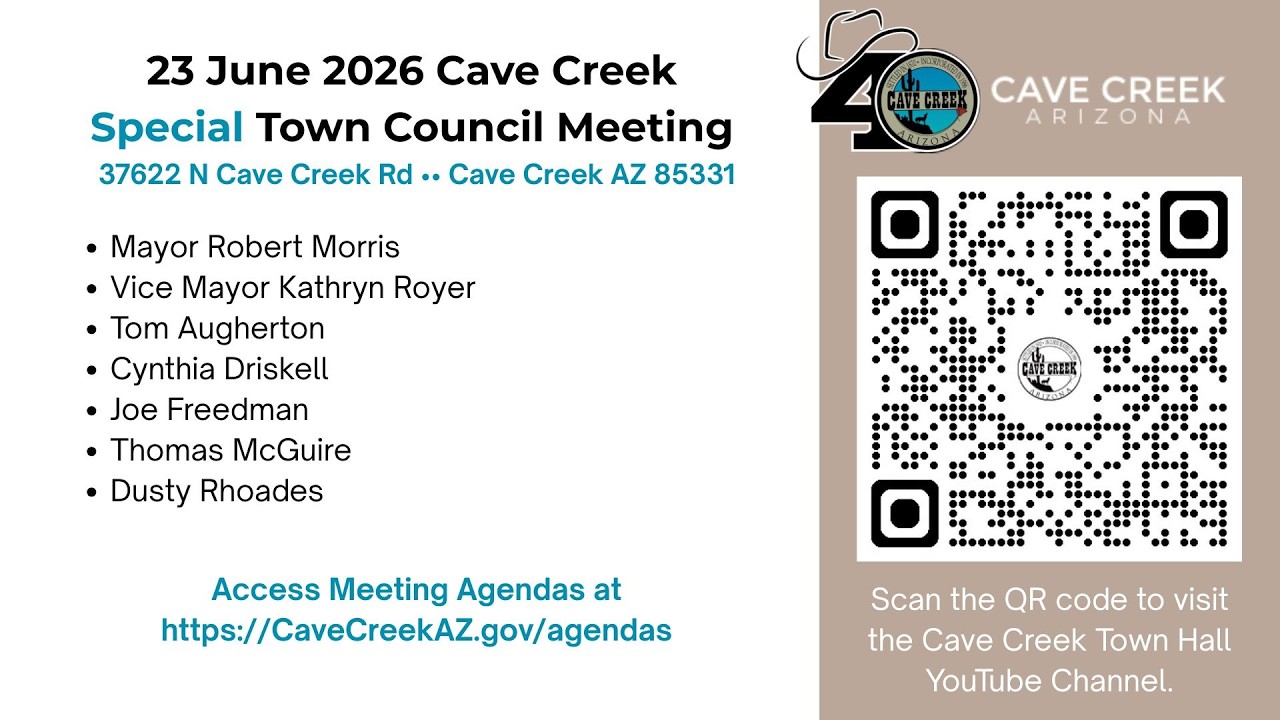
- Yes: All seven council members (Mayor Robert Morris, Vice Mayor Kathryn Royer, Council Member Tom Augherton, Council Member Cynthia Driskell, Council Member Joe Freedman, Council Member Thomas McGuire, Council Member Dusty Rhoades)
- No: None
- Abstentions / Absences: None
Outcome & Next Steps
Resolution 2026-12 adopted. The City of Peoria Council had already approved the agreement the prior week; Peoria had requested Cave Creek sign first to allow for potential final amendments. The agreement now requires signature by the Central Arizona Project board to become fully effective. Town Manager Sean characterized the CAP board approval as "more administrative at that point," signaling confidence in closure.
The town will issue annual orders to Peoria by September requesting recovered water. If cuts proceed as modeled, the agreement could provide relief as early as 2027 calendar year. Town Manager emphasized the mechanism also accommodates future Arizona Water Banking Authority credits if that state agency distributes them.
A companion agreement with the City of Surprise is under negotiation and expected to be presented to Council within a few months, creating parallel recovery pathways. The Water Conservation Study (in progress with outside consultant) is expected to return to Council in the fall with recommendations for amended drought-management triggers and conservation mechanisms.
Controversies & Context
The Colorado River Crisis and Timing
The Colorado River Compact—which allocates water to Arizona, California, Nevada, Utah, Wyoming, New Mexico, and Colorado—has faced structural imbalance for decades. Lake Mead and Lake Powell have declined precipitously. In early 2026, Arizona Department of Water Resources and the Bureau of Reclamation signaled imminent cuts. The town anticipates announcement by late July 2026; the 14–20% range reflects two competing projections: the Bureau of Reclamation's likely policy (closer to 20%) and Central Arizona Project's internal modeling (suggesting possible 14% impact on municipal-industrial subcontractors via portfolio maneuvering).
Water Banking Authority Uncertainty
Arizona Water Banking Authority has been storing water on behalf of municipal-industrial (M&I) users like Cave Creek for over 20 years, accumulating roughly 4 million acre-feet of credits. Its statutory mandate is to distribute those credits when cuts occur, but no clear process exists. Town Manager Sean acknowledged that AWBA has not articulated mechanisms, timelines, or recovery-agent designations. This regulatory vacuum is why Cave Creek pursued the Peoria exchange: it is a testable, interim solution that other municipalities can potentially replicate, pressuring AWBA and CAP to clarify state-level recovery procedures.
Water Usage and Summer Peaking
Council discussion revealed a critical vulnerability: Cave Creek summer water demand nearly doubles its winter demand, driven by outdoor irrigation, pools, and livestock watering on horse properties. Average town usage is ~11,000 gallons per month per residential customer; the Town Manager's own household uses ~3,000 gallons per month, underscoring the potential for conservation. Summer peaking factors in other Arizona towns (Peoria, Avondale) have reached 1.8–2.0× winter usage. Council Member Tom emphasized that restricting outdoor water use in summer is the single largest lever available to the town short of imposing mandatory supply caps.
Development Moratoria and Meter Restrictions
Council members noted that Cave Creek had already restricted development and meter issuance in subdivisions as part of its pre-crisis water strategy. This decision, made years earlier, is now credited as foresight. The Drought Management Plan (adopted 2022, amended 2023) defines escalating stages: Level 0 (excess water, recharging); Level 1 (water watch); Levels 2–3 (progressive constraint); Level 4 (shortage exceeding 26% of supply). The plan is not self-executing; Council must adopt resolutions to enforce escalating restrictions. A revised definition of stage levels is expected in fall 2026 as part of the Water Conservation Study update.
Regulatory Novelty
The one-mile recovery rule under Arizona law requires that water recharged in one location be recovered within one mile, or the recovery entity must model and prove a "mounding effect" (groundwater rise sufficient to reach recovery wells). Peoria's wells are ~1.5 miles from the Hour Free recharge facility, so modeling was required. The solution—shifting some credits to Beersley Water Reclamation Facility (3.5 miles south, where Peoria actively treats wastewater and operates recovery wells)—required coordination with the Governor's Office and ADWR to ensure regulatory compliance. This fix demonstrates the procedural fragility of Arizona's groundwater and CAP law and the reliance on ad hoc state-agency problem-solving.
Political Pressure and Coordination
Vice Mayor Royer's remarks credited eight years of advocacy (2018 to 2026) for water banking. The Town Manager and Vice Mayor have made multiple trips to the Governor's Office, Arizona Department of Water Resources, Central Arizona Project, and the state legislature to push for recovery-mechanism clarification. Council Member Joe noted the town has given television interviews and engaged national media on the Colorado River crisis, amplifying pressure on the Bureau of Reclamation and state actors to move faster. The cooperation Council witnessed from Peoria, Phoenix, and the water industry generally stands in stark contrast to state and federal politics, where competing jurisdictions and states have historically deadlocked on Colorado River allocation disputes.
Duration
- This item (Water Exchange Agreement): Approximately 90 minutes (including Town Manager presentation, Q&A, and Council discussion).
- Total meeting: Approximately 2.5–3 hours (including 40th Town Anniversary Proclamation, 2026 General Election Authorization, Deputy Town Manager Ordinance second reading, and this water agreement).
Other Notable Items
Resolution 2026-13 (2026 General Election Authorization): Passed 7-0 on consent agenda without discussion. Town Clerk authorized to conduct November 3, 2026 general election.
Ordinance 2026-03 (Deputy Town Manager Classification, Second Reading): Passed 7-0. Ordinance authorizes Town Manager to designate department heads as Deputy Town Manager (non-additive FTE) for professional development and succession planning. Sherry White (CFO) designated as first Deputy Town Manager; Teresa continues as Deputy Town Manager/Town Clerk. Administrative Services Director Carla Breeze introduced new procurement administrator Monique Harris (hired from Arizona Department of Transportation).
40th Town Anniversary Proclamation: Mayor Robert Morris adopted proclamation recognizing Cave Creek 40th incorporation anniversary (July 8, 1986). Town celebrates heritage rooted in Ho Kam Native American history, ranching, mining, Western heritage, art galleries, and remote hiking. Harold's Corral 40th anniversary celebration scheduled for Saturday, June 28, 2026, at 2 p.m., with festivities, speeches, and Mayor's welcome address. Celebration to continue through end of 2026. Kathryn Royer and Council Member Cynthia Driskell acknowledged as members present at original incorporation; Council Member Joe reminded attendees of the event.
View source transcript ▼
Source: 23 June 2026 Cave Creek Town Council special meeting — June 23, 2026. Auto-generated YouTube transcript; may contain transcription errors.
Welcome to the special town council meeting for the town of Cape Creek, Arizona. Please join me in the pledge of allegiance. Thank you. You got to say to the mayor. Public for which he stands. One nation under God, individual, but liberty and justice for all. Any public announcements from Council Joe. Hey, everybody, don't forget this Saturday, Harold's 40th anniversary, two o'clock. Be there. Well. Okay, town manager report. Well, council member kind of beat me to it.
So I have no that's what I was going to mention. But to add to that, our communications director will be sending an email off to the mayor and council that provides kind of the game plan. What Saturday is going to look like. We understand there's one or two of you that might be at separate tables, but we wanted to let you know. You know, generally the time that starts. What you can expect once you're there, which tables will be part of the town's tables that we have reserved for this event.
So anyways, looking forward to seeing you on Saturday. And I understand that the festivities are the recognition and see these speeches will not miss much, but at three o'clock is at the. So that's correct. So important at least to get there a little bit before that. So you could be there on and our own mayor will be doing a welcome address and acknowledging people there. Okay, thank you. Call the public. And then. Okay, proclamations.
Proclamation for the 40th anniversary incorporation July 8th, 2026. Whereas Cape Creek is a community that celebrates heritage and acknowledges that the history and culture of our town have been significantly influenced by the ho ho calm. Other Native Americans, ranching mining and whereas Cape Creek founded in 1870. It began as a mining and ranching community served as a vital stop for the US cavalry and showed us to incorporate on July 8th, 1986.
The safeguard is distinctive way of life and ensure that decisions impacting the town would be made locally and. Whereas today the town proudly showcases its Western heritage, maintaining its old west appearance and charm while offering boutique shopping art galleries unique restaurants and vibrant might life. And as Cape Creek rodeo days, turquoise circuit finals rodeo is a destination for some of the most remote and rugged hiking in the Phoenix metro area.
And whereas Cape Creek residents proudly refer to themselves as creekers, a vibrant and diverse community of artists, writers, cowboys, retirees, snowbirds and working professionals. Whereas the town of Cape Creek gratefully acknowledges the tremendous contributions of those residents who worked tirelessly to unite the community and to secure the vote for incorporation 40 years ago.
Now, therefore, I Robert Morris mayor of Cape Creek, Arizona, do hereby proclaim June 27th, 2026 as the kickoff to our 40th anniversary celebration with a party at Harrell's Corral. 40th anniversary will be recognized till the end of the year, 2026. The town urge is all residents to honor our shared heritage, look forward to a bright future and continue to protect the unique spirit of this beautiful community whose motto is where the Wild West lives. So well written. Cynthia, you were.
Were you on the original committee? I was on one of the few cities from the town incorporated online. Okay, so she was just a baby back then. All right, on the consent agenda tonight is the council discussion, possible approval resolution, number 2026-13 calling the 2026 general election and authorizing the 10 clerk to conduct the November 3rd 2026. General election. Any comments? All those in favor? I posed. I wonder if we'd have voted no. It'd be empty out here.
On the regular agenda is council discussion, possible adoption, resolution number 2026-12, approving and intergovernmental agreement between the town of Cape Creek and the city of Peoria for the exchange of water storage credits. Staff. Good evening, Marin council. I thought I was going to sit in Bill's chair, but I have to control to get from over here or so I thought that it's making me smarter, but I don't get that luxury.
Before we start tonight, I want to say a couple of thank you some people who aren't here and some people who actually are here. So this agreement's been in works for a couple of years now. So Brad Hillman, Michelle Vanquassen from the town have been very instrumental in our consultant teams to get this across the finish line for us. But tonight we actually have Kevin Burke, the deputy city manager from the city of Peoria is actually standing up. So. And it took a whole team over in Peoria.
We had David David Burke, who's a water services director who was involved. I'm a Linda Winnington, their water resource advisor and like a good water agreement. We actually started with Brett Fleck, but he actually moved on. So it's you know it's a good agreement when someone's actually moved on during the course of it because taking that long to get done again. So over two years of work to get to this point.
I want to walk you through why I think this is so important, especially after we had our water workshop last week. You know, we're expecting cuts to call our river. They're coming not expecting. They're coming. So the town needs to figure out a solution to continue to get our water resources continue. We can provide our customers with water. We've been playing around a 25% or 20 to 25% cup. That actually gets us to the point where we just have enough water to meet our current customer.
And so that makes us very nervous of water professionals because we want to make sure we can provide water to our customers. So we've been talking a lot about short term bridge solutions. So that started with 2021. The town started recharging a portion of our unused CAP allocations. We have our municipal and industrial subcontracts and we have the a few years ago. We were able to secure the non eating agriculture or NA water.
That gave us additional water resources to over and above all we needed to provide our customers and put that into the ground took some time to get the permits in place. We actually have permits in place with central areas on a project and with city of Phoenix to recharge. We've been utilizing some recharge facilities that the city of our sorry that central areas on a project has.
And what what is recharging is basically putting that water into the ground so put it back into the aquifer and storing it there that you can draw it off. There's multiple ways that can be done. There's shallow beta zone wells. You can do spreading basins or it can do injection wells. In the case of the CAP they use the spreading basin opportunity. So by the end of this year going into the pending cuts, we think we'll have about 3200 acre feet of long term stored cruts.
So that's a check and account or savings account for the town to utilize. And just this is a presentation or slide that Brad had shown but I think it's good for tonight. Where's our water store to store the upstream of the town and on the CAP canal. There's two red dots you'll see on there. The most westerly one is the Harcahaila mountain. Harroglyphic mountains are a facility. That's about 163rd Avenue north of Grand Avenue. It's in the city of surprise.
The one question tonight for the tonight's agreement is the hour free of facilities located along the hour free of river. Closer Lake Pleasant Parkway between Lake Pleasant Parkway and 303 just north of Happy Valley Road. And you can see the two facilities are shown there. They're managed by the central areas on a project and they've been storing some of our unused CAP allocation for us. For the rainy day and the rainy day is coming.
So the next question is how do we get access to this water because having the storage credits is one thing but actually physically getting access to it is actually the benefit to the town and to our customers. So we needed a partner. We obviously do not have water services out where our water is being recharged we don't have wells out there. We could look to drill wells put that into the CAP canal but that actually has a whole litany of issues we have to deal with water introduction rules, etc.
So what we've come up with is actually a water exchange. So the basic foundation of that is that we would work with Peoria we'd exchange our water credits with them. So we have storage credits. They actually have the physical ability to withdraw that through their ground water wells in their area. We give them our credits. They'd exchange that water and for exchanging that water using the ground water our storage credits not recovered water.
They would allow some other CAP allocation to continue on down the CAP canal and they don't utilize and it comes to us. So now we can take it out either through our interconnect or our booster station site on the CAP canal or now with our arrangement with city Phoenix. We have Phoenix Treat and divert that and deliver that to us. So again, it's taken it sounds simple but it's been over two years of progress to get to this point. Peoria's Council approved it last week.
You'll see on the signature pages. They haven't signed yet. They wanted us to sign. We wanted to have them sign first because there was some discussion. There might be some final amendments. So we had them look at it first. And then the agreements are going to help us mitigate our expected reductions. The next step after this is once we both sign it actually has to go to the central letters on our project and actually be signed by their board. So it's not a done deal.
Well, we're getting to the end. We think that the last couple of steps are more administrative at that point. The CAP is aware of what we're doing again through over two years of conversation. We've involved many agencies in this. There's been several issues to overcome in that time frame. And one is you noticed a facility. I mentioned that our water is stored in the hour free of facility again by Happy Valley Road. So why is the facility?
Why does the agreement mention the beer's the water reclamation facility? Well, that's kind of a unique aspect that there's a unique rule in the. The law that in order to directly recover recharge water, you have to be within one mile of the recharge location. If you're more than one mile, then you actually have to show through modeling that you are creating enough of a mound that you can get access to that.
In the case of the hour free facility, pure actually has some wells that actually they can utilize because they have enough water stored in there that they create the mound that they can withdraw from. It's not practical for the town to put that in because actually we'd have to put a think about 4,000 acre feet in the ground to actually create the mound that allow pure to withdraw. So we went into this and came into that stumbling block saying now what do we do?
And I'll actually give credit to the governor's office. We actually reached out to the governor's office and they actually want to read Arizona Department of Water Resources staff said, how can we make this work? 80WR staff came with a unique arrangement. So purie actually has another recharge facility, which is located on Beersley Road, which is their Beersley Road, Warwick, Mesh Facility, our engineers we love from aiming stuff after streets.
Three and a half miles south of the hour free of facility. So we're going to shift our credits down to the Beersley facility and within one mile, the Beersley facility purie has active wells. So that's why when you see the agreement, it says the Beersley facility and the wells within the within the within the area of the Beersley facility. That's why. So I'll give credit to the governor's office and to Arizona Department of Water Resources staff to come up with this arrangement.
So again, in total, there's been more than five permits involved in doing this. We actually now have our own recovery wells permits in place with the two purie recovery wells that they're going to be utilizing in other agencies. So it's not something that just happened overnight again. It's it's and I'll give credit to Brad and really really spent a lot of time on getting us to this point. The mechanism, how's it going to work?
So every year, by September, we will place an order with puria and ask them if they can recover water on our behalf. We asked for basically leaving 10% of the water there. What's the benefit to purie in this agreement? We're actually leaving a little bit of our storage credits to help local aquifer for puria. So that's the we will provide them with 1.1 acre feet of storage credits for every 1 acre feet of cap water they exchange with us. That's typical in these exchange agreements.
Actually, more what you see typically is something like 20 or 30% so the fact that puria was willing to give us just a 1% because they wanted to know they're not trying to penalize us. They've been a huge partner, a great partner for this is great. They actually will charge us a recovery fee. What does the recovery fee provide actually provides because we're they're going to running a well that they didn't have to run.
They have their own surface water treatment plan so they can actually cake direct deliveries of central areas on a project water. So not having to run a well. It's something that having to run a well to recover our water, something that they're going to give us costs on. So the recovery fee has built into it the operational maintenance cost. They actually calculated what's a well cost to run electricity.
You know, we have a person drive by once a week and they actually came out of the calculation. And they also looked at you know, because we're putting wear and tear on a well that they didn't have to use. We looked at it and they said, OK, a well for them costs so much money and has a 30 year lifespan. So that all factored into the calculations and that's the tables you'll see in the back.
The first years like $460 per acre foot and I'll talk to that a little bit later because we actually covers some other stuff because actually in that money, they are actually buying the they will actually order the central areas of project water to come to us. We don't have to pay the full cost of the central areas on project water because it's part of that's built into the fee. So it's interesting. So we're not paying $460 per acre foot to recover water.
And so it's a little hard to explain, but let me go into that a little later. So we will still pay for the cap water cost right now the CAP the capital costs on our CAP water is about 14% of the cost 86% of our CAP water cost is actually delivery fee. Right now the way the arrangement is that in the water recovery fee that we pay to pure they actually will pay that delivery fee. So for next year that delivery fee is 326 acre feet so we pay a little bit more to pure 460 acre feet.
So it's not crossing is that much more to get access to our storage credits. So it's a huge thing. So it's not adding it's something we have to watch for. We are hopeful we don't need to call in at next year, but in case it does we'll build that into the budget. But it's not this is very beneficial to the town and the cost is pure has been more than generous on this arrangement overall. So purious duties on this they will exchange up to 400 they've agreed to exchange up to 450 acre feet a year.
We'll give them 495 acre feet of storage credits and they'll give us 480 feet of of CAP water delivered to us. And if they're able and you'll see that on there because again why would they do this because they're trying to help us out you know we're an municipal agency and overall everybody in the water resource world right now because of the uncertainties with Colorado River is we're all trying to help each other out.
So when we started this conversation over two years ago it was like can you help us get this out and they're agreeing to do that. But there might come a point depending on how bad the cuts go that they can't help us out. So the agreement does contemplate that we're hopeful but we have to be realistic that they could go better so they have to protect their citizens and their their water customers. So if they can't they can't but we don't anticipate getting that but it may have to.
The agreements for seven years initially that was what we all agreed to but it is renewable so as we move into this you know we're hopeful the first couple of years depending on what happens if you remember it's last week's water presentation or two weeks ago water presentation. So we're hoping to get that out of the way from the central areas on projects but they think that they could might be able to with a 20% cut to the states of Colorado River water.
Might be able to do some maneuvering that it only be a 14% to us as a municipal industrial subcontractor at that point we don't need to call up on this but it goes deeper we may. And then we're not sure if the first year cut there will be a second or third year cuts so we this is something we need to have in place to allow us to have some more water security as we move forward.
So this to wrap it all up as I would speak too fast on this stuff so I want to give you guys time for questions and reductions are coming to the Colorado River it's next month the end of July is when we anticipate that's beer of reclamation will do that announcement.
So then we'll have an idea and we'll keep council informed when that comes we want to make sure that we have bridge solutions in place like this exchange agreement to allow us to whether that so with the timing of this this could potentially be available to us. Next year if we need to call upon it we're hopeful that we don't need to in 2027 calendar year but having it in place gives the town that stability.
We've been looking at water resource and shortages for several years as we indicated in our workshop and this is again something that we talked about and again it's taken as two years to come to this place to get to this bridge solution.
The other unique thing about this content this agreement is that the 450 acre feet a year actually allows us to work with people are not only to exchange our the water credits we've currently put into the ground in the our facility but allows for if the Arizona water banking authority who has been storing water for a number of years on on on behalf of municipal industrial subcontractors like ourselves gives us credits then we can actually exchange those credits for this agreement because it's physical access so those credits which we currently don't have a way of getting access to it.
We are looking at another agreement which will come forward to count some a few months with another agency city of surprise said to be willing to do a similar agreement with us so this is the first and this will lead into discussions that we have with the city surprise we've had several years of talking with them also.
Overall you know the town doesn't have one simple solution where I can say we're done we're one and done we're good we're going moving ahead you know the town has been so tied to our central urge on a project allocations that it's really important that we have multiple things in place and being able to access things like our storage credits is huge for the town.
It gives us that bridge to to find that next long term solution where again I'm very hopeful we don't need to call upon this for a year or two but having it in place is a safety in it that this town needs to make sure that we can ensure reliable water services for our water customers. And we'll continue to work on other all the other things that we've talked about in our water briefing on all the other practices of trying to secure down water resources so again.
I just want to thank everybody who's been involved Kevin's here tonight he's willing to be at our meeting which is great. It just shows the coordination and just everybody's willing this in the water industry to help us out and I can't say enough about you know the purious staff who have helped us along this entire process and got us to the 10 points so with that I can answer any questions. Question for Council Tom.
Well first I want to welcome Kevin we were very dependent upon our neighbors and we really appreciate you're being here and the role that PRA has played. Sean that aquifer that storage facility and I encourage people if you're going down the 303 it's right there just off the 303 see the PRA one. Now that the that's in the hour free of river and the hour free of river has a slope to the south is the water that we're putting in there migrating to the south and if so do we know how quickly.
They've done some modeling interaction when you look at the facility it's actually in the flood plain next to the river bottom itself so the river bottom is actually east of the facility. So it does rain it's actually falling there and it's interesting because the hour for you because it's actually a couple miles south of the cap canal there's actually the hour for you.
Constructed facility which is the canal that brings water down to that facility and the hour for you manage facility which is the recharge base and so we actually store our credits in the recharge base because the other one you only get happy credits. But yeah the way it's structured is that you will the hour free does want to flow to the south.
And that's where again where do you recover it that's one of the nuances with the recovery laws is that you know as long as you're within that one mile buffer even north of there and effectively this assumption is you're creating a mounting effect and you're drawing that water from it. In purities case they modeled it and showed that they have enough water that it actually could reach their purier there was to see a community wells which are about a mile and a half from that facility.
Since we couldn't create a mound with the amount of water that we have stored in that facility allow allow them to do that so if purier does move forward with actually drilling a well close shot facility we might be able to look at that move it but shifting it down to the beer facility which is their water reclamation facility which is three and a half miles south of there where they actually treat a substantial portion of their their water resource wastewater system.
It actually gets recharged that facility directly actually they're on recharge facility down there but yeah it's kind of neat it looks like it's in the bottom it's actually the flood way is actually adjacent to the facility they don't try to.
The you there's been attempts to construct a floodway but that you know when the flood event does come to get washed out you got to recreate the berms and limits any downstream migration of the water it would be less than it would be if it were right in the room. Yeah that area of the hour for you is actually very gravely bottom there's a bunch of gravel pits in that area so there's been a lot of gravel mining so it does percolate fairly close.
It's one of the struggles as as as as an agency and even a statewide everybody's trying to recover this ground water you know when you put it in and you put it in for years it does move around on you where does it actually move to and that's one of the things that the centralers are a project as as a recovery agent has found out as when they and as they've been starting to look at recovering water on behalf of of users. As you know where does the water go.
I have a second question less we want other people to have. Yeah I'll call you. Thank you. Sean have has the town already stored additional water credits for 2026 or do we have credits that will be stored before the end of the year before cuts going to place. Yeah this year we have we'll have store about 300 acre feet this year.
Last few years we've been good and that's when we had the NNI subcontract we were actually able to store most of that so in the years part of this we've been re restoring close to 5600 acre feet. This calendar year we were not able to order any of the NNA water which limited us just to the excess MNI so yeah at the end of this year we should have about 3200 acre feeding credits.
It split between the two facilities about two thirds is actually in the higher glyphics facility one thirds in the in the pure facility. And again it shows the collaboration why do we have water even the hour for you originally we had focused on the higher glyphics facility. And then one day Brett Fleck called up said hey I've got you know three acre feet of extra stores past you want to put some water now for you and I said yeah okay.
And that's sort of the conversation if we put more there can we work out an agreement and that's that's that was actually two and a half years ago. That conversation occurred. Can I make a just a brief statement. This is question time okay but I just wanted to say thank you Sean and the staff and everybody for your hard work obviously this is paying off right now for the future hopefully we don't have to use it.
I would also like to recognize vice mayor Royer she was the one that brought this to the table in 2018 and it was initiated in 2021 thank you vice mayor thank you so much. The questions down here over here tumblin yeah this my question goes back to some wraps that you show this sense draft but I think it's pretty much the graph you show water advisory water information. And it shows that going into the future we will be getting water from the states water storage. Is that guaranteed.
Well it's not guaranteed that's there is on a water banking authority so as being a municipal industrial subcontractor of central areas on project. We actually they have been recharging water on behalf of us and we actually as part of our fee we pay into that so they've been recharging for several decades I believe so they have close to four million acre feet of stored water.
Their mandate is if there are cuts to central areas on the town the states call a lot of river water supplies their mandate is to actually allow that water to be recovered and brought back in and distribute those credits.
The struggle we're having is that they don't want to distribute the credits right away and they don't have a full mechanism they don't understand what they need to do they just haven't done it yet so there's a lot of discussions and I'll point out that our our mayor and vice mayor and our staff have really been pushing that issue saying yeah we really need to have a process what is the process going to be.
You know it's it's a little complicated but they are working on that and then the central areas on projects themselves would actually be potentially be one of the recovery agents so not having all those mexas in place we had to go ahead this exchange agreement is sort of a small version of what the state is going to be doing and and allowing for recovery.
These agreements allow for as long as peoria is isn't going to impact their customer base can actually recover some of that water so if we get some of those credits the water bank authority does actually have storage credits in the hour for your facility so we'd ask to have them put in that facility we do the transfer and get your recovery that for us so but the overall it has not been outlaid what the state the goal of the water banking authority was to.
Help keep water providers with miss build us some contracts whole up to 20% cut in Colorado water that was for their mandate when they were put in place I think 20 plus years ago so but all the mechanisms are now coming together it's just not everything's all outlines were a little ahead of the curve by having this agreement with peoria and I like that last statement all the mechanisms are coming together that's essential.
In fact we're the tip of the spear for recovery we've we've took everybody from the governor's office on down and writing a DWR water bank authority C.A.P. who else we we talked to verbally and written letters to everybody saying we expect. The water to be available if if something happens to our supply so.
And I think some of the things you see them doing I think are in direct response to some of the pressure we put on plus we are giving TV interviews interview requests just what do we think is it both yeah all over the country so so our our issues are out there and. We spent a lot of time outside of town working this issue to is you know working with peoria and other people with Phoenix Phoenix is our has been our great partner for some time so.
I have a question I understand that you and the vice mayor at numerous meetings with the Arizona department water resources with others so many meetings if you had on behalf of. Dave Creek looking to other entities for. Well I don't we kind of there's a lot of phone calls to yeah you know you don't need one meeting after that you know you can put on phone but you know there's like four or five agencies and some of multiple times. And these are four. And and state legislature.
Yeah, you'll live capital yep yep you've been very active. This effort. Appreciate it. We all do. Yeah. Well there are no guarantees that's that no one there is every guarantee. Thank you. Last week at the water meeting you and Brad indicated you anticipating a cutback of 14 to 20% which sounded very optimistic.
Do you anticipate there'll be a need to deploy both the peoria agreement surprise agreement and perhaps other additional ones at the same time do we have that kind of mechanism coming up in place should we have more severe cuts. Great question and as one of our frustration is in the water industry right now is that we're we're waiting for the Bureau of reclamation to announce what the cuts will be.
What the state is currently playing for is a 20% cut that seems to be the most realistic number the 14% number is actually coming from the central areas on a project that they believe through maneuvering some of their water resources that I have an portfolio that is a municipal industrial subcontractor it would only come down to 14% those are the two numbers that have been thrown out recently and Natalie at the central areas on a project mentioned that last last week.
So at 14% were we're in good shape so we don't need to call on these but we need these in place what our fear is right now is a the Bureau of reclamation hasn't announced the first year cuts and are they're going to be subsequent year cuts.
The health of the Colorado River is still in question I think there was recently some storm so the lake Powell went up a little bit but you know that significantly but you know this this is there's still talking about the structural issues of the Colorado subcontract and the seven basin states in Mexico and how that's going to be distributed moving forward.
So yeah I answer question it's there's no clear answer right now where I think the air is going to turn more in the maximum stage of uncertainty right now so we're just trying to help get us the solutions in places like this bridge like the exchange agreement to allow as a mechanism to continue provide water service to our citizens and our customers thank you yeah.
I'll put this in the form of a question is it true that cave Creek will not run out of water we have the ability to adapt in terms of how we think about water how we use water and that gives us a great deal of flexibility is that true.
I worked towards that every day in my staff do you know we have so many things in place the exchange agreements we've talked about doing things with the wells we're working with an outside consultant to really help us hone in on our water conservation efforts things like changing out the water meters to allow people to see what's going on.
We work every day to try and minimize and usage of the water and wasting of water in the system so help us get that point that you know I don't know what the future holds that we should add that crystal ball.
But you know do we get to the point where we we're not asking for voluntary restrictions but we have to go to mandatory restrictions I don't know how bad it will get and no one does but that's why we put things in place like the drop management plan we adopted in 2022 and the following year we adjusted town code to give the council the authority to have that discussion so as we find out and get more clarity we'll be coming back to you and asking you what mechanisms you want to put in place and so I want to clarify that again what's in town code is more of a.
Check sheet of you know depending on how bad it gets is here the things we should be looking at we have to come back to you as council and ask you to adopt resolutions to enforce those things and move us forward I hope we don't get demanded to worry I hope that everybody can work together I think it's been said several times that things like the water uses during the summer outdoor water uses a big thing for us we use.
Not quite double the amount of water in the summers we do in the winter time when we actually have more citizens here in the winter time and and we have more use in our restaurants that's because outdoor water use so can we. We have to restrict that and have people cut back on that we're in good place where we don't have a lot of like outdoor landscaping but how can we get people to cut back even more and help that out.
Don I have a quick question for you can you explain the levels of water where we get to an emergency eventually it's like what is it right now we're probably what level one or level two but I think if we get to like three or four it's it's dire.
So when we defined it in the drop management plan I think Michelle and I have been talking about revising that level zero is we've got excess water available to recharge level one is that we would be the level where we don't have water to recharge on the fact on the fact delayed by definition or level zero level one is water watch and then it goes down through I forget the other two levels level four is the most extreme where we see a shortage of over 26% in our water supply so effectively the calculations we defined it because we're told tied to our central areas on project calculation is the available water based on our usage we're currently providing about 2,000 acre feet to our customers of central areas on our project water there's a little bit of well water and desert hills so it's really it's if we don't have 2,000 acre feet of central areas on project water that that pushes us into a water watch through another emergency situation.
So I think we should be actually out of stage zero but by definition we're in stage zero because we actually are re re re charging this year we have excess water so we but we should be into a higher level unless we're going to come back with counsel through the water conservation study we're doing right now with a consultant come back in the fall with an amendment to that plan to better to find that moving forward it's about saving water and helping people do things like restrict outdoor water use limit outdoor water use things like the meters which are helping people find leaks we can help identify leaks more.
Quickly and we hope our citizens can also deal with leaks more quickly and things like that to reduce the loss of water to something they'll help our system. You've referred to the fact that in the summer when populations actually down we're using 70% almost twice as much water so is that a matter of outdoor irrigation that's needed in the hot weather if people are doing that kind of landscaping.
Yeah that's what we believe it's is that you know pools evaporate if you have a pool you know not saying pools are bad but they you get evaporation of a pool if you have landscaping it needs more water in the summertime if you're if you've got you know if you have a horse property if you're you're watering your horses of that some assumption is they're going to use more water in the summertime so.
And that's typical you'll see in a community it's those factors can go up to almost two and the jurisdictions I've been in actually I've worked in purer years ago I worked in Avandale it was getting closer to like 1.8 I think is what the peaking factor was in the summertime but it's we believe it's it's mostly outdoor water use.
One thing we can't say for sure is because when we meter to a customer most of our customers have one water meter so you know can we say exactly where it's being used no but with assumption is it's going to outdoor water use the numbers speak. The questions sir were we ever thought have we ever thought about promoting rain harvesting I know that's been brought up before there's a few people in town that believe in that.
I know we don't get a lot of rain but it's potential for livestock and things like that. You know I think everything factors into it rain water arson is your point out it hasn't rained that much but when it does it's nice you know how much can you you get out of that and keep the system running I think it's going to be a combination of everything.
When we're harvesting I think the water workshops went brought about their systems that actually draw the the music water the water in the air actually draws that into it but our our well we think it's also the human it's actually not that human to have systems like that work with everything will work I don't think there's one solution for us so if everybody works together but if you have rain water harbour seeing system you need to think about that is that water sitting there is going stagnant are you using it there's other things to consider to you but I think everything fact is in there's gray water systems where you can use you know things that don't have you know the waste stream like your toilet water and use you sink water and other water to use that for outdoors there's other things we can do in place to and I'll just take effort and I don't think there's all that will help this community you know we don't have 4,500 water customers we don't have a lot of water customers so if every pitch is in it will help has an impact.
Okay so with that there's public comment on this I have no one okay I'll make them okay go ahead Tom this is a adoption of resolution number 2026-12 approving and enter your mental agreement between the town of Cape Creek and the city of Peoria for the exchange of water storage credits. Second. Get there in a second so Tom you'll come in we will not run out of water we it's not going to happen but people may have to cut back on water people may have to rethink about how they're using water.
Our house is on a little bit of a hill and so we have rills that are around the that they're a part of our landscaping and Joe talked about water harvesting I think that's a part of the water harvesting so it's not actually going off of your bed.
Bestie you had mentioned the French grains on our property French and I'm putting more water in the ground that I'm using and that's water harvesting yeah I believe yeah so it's they're things that we can do but we're not going to run out of water right at one of the meetings somebody say well do I have to sell my house in Cape Creek and you know but we may have to rethink about how we're using water because we can live.
On a lot less water our usage of water for my wife and me is about 3000 gallons per month the average user in Cape Creek is using I think about 11,000 gallons per month so there's a lot that can be done.
I just like to say that you know in 2018 when I was running on this issue I knew that water banking was essential and important eight years later it has become vital it's life saving potentially for this community at least as a bridge for three to five years so I'm so thankful to the staff and our consultants for pulling this all together and the city of Peoria.
For being an amazing partner we're very fortunate to have 3200 acre feet at the end of this year banked this is only 450 so we have some room to use it if we need it and hopefully be able to get it when we need it but it seems more likely now than it did even 60 days ago so thank you Sean and all your team for putting this into place it's more than appreciated by all of us. The comments.
I'd like to add my thanks in the company job well done great and Sean staff has done amazing on this Brad Hill of course in Michelle then Quathen were key and of course Catherine got it all started with eight years that's a long time.
And we also about same time we cut back on development we didn't give meters out subdivisions had to bring water all sorts of things like that so there's been a lot of activity on water well before what we're doing tonight Kevin we'd sure like to thank you and thank you for being here I'm going to call your mayor and thank him here after we get this all signed up so we appreciate it and the cooperation in the water community is amazing.
Phoenix golly but not there but amwa everybody is working hard on this and I just wish the state government had the kind of cooperation that is there in the water community because we would like this in no time. With that we'll have our vote all those in favor I I post motion carry seven zero.
We're on the last item which is council discussion second reading of ordinance 2026-03 amending section 31.25 of the town code authorizing the town manager to designate one or more department has this deputy town manager and establishing a new classification of deputy town manager for the town of Cape Creek personnel system. Thank you mayor.
I'd like to apologize because under reports from town manager I was supposed to have an introduction made and I totally spaced over it with all the excitement of the meeting at the beginning so if you don't mind I would like to call administrative services director up. Carla breeze who will introduce our newest member of the staff. Good evening mayor and council like to introduce Monique Harris we stole her from a dot as our administrator on at Monique.
Hi my name is Monique Harris I was thankfully meeting you this later earlier today but I am on my 10th day here with the town very thankful that you took the opportunity to hire someone that's a procurement administrator. As I was watching Sean I just wanted to say how happy I am going to be a support system for the directors who did their job and procurement.
So thank you for taking the chance and the opportunity to hire someone that's going to support your town and yes I did come from a dot welcome show. Thank you thank you meeting you. So back to agenda item number two so last week as you recall we had the first reading of ordinance 26-3 and this item proposes to create the ability for the town manager to designate a department head to serve as a deputy town manager. In addition to the current job duties that that particular department head has.
It offers current and future town managers the ability to recognize outstanding department heads with additional management assignments and responsibilities who may also have an interest in town management or pursuing careers in city or town management. I want to make it very clear though it's not adding another new dedicated town manager position it's not it's not adding an additional full time equivalent to our existing positions.
This is a really good opportunity the first person that will be in this role is Sherry White she's our chief financial officer I think she'll be great in this. Teresa has been as you know a two for as well she's been doing the deputy town manager slash town clerk she's been doing a fine job at that. This is just more of a professional development opportunity that I can extend to department directors and it's the way that the code is written.
And the job description is that it's not while I'm here it's for the future so after I'm long gone on other managers will have this opportunity to tap talent and create opportunities for professional development of their department directors with that I'd be happy to answer any questions that you may have questions. Questions.
Okay public comment I have none they have none okay i'll make the motion move to approve the second reading of ordinance number 2026-03 amending section 31.25 of town code. Authorizing town manager to designate one or more department heads as deputy town manager and establishing a new classification of deputy town manager for the town of cake Creek personnel system.
Second sent you had the second i'm in favor and I will vote yes sent you yes it looks like a good policy change that will help with the development and stability of town staff. There comes nothing other than you can't go anywhere grating. Thank you. It's been my honor to work with staff for a number of years as a council member they provide us information.
It's not difficult being a council member if you make adequate use of a very talented staff and they have been absolutely wonderful in all the years i've been on the council has so much and indebted to them for any success that i've had. Okay all those in favor i post carry seven zero that completes our agenda by state law or someone has something else we can talk about. Major.