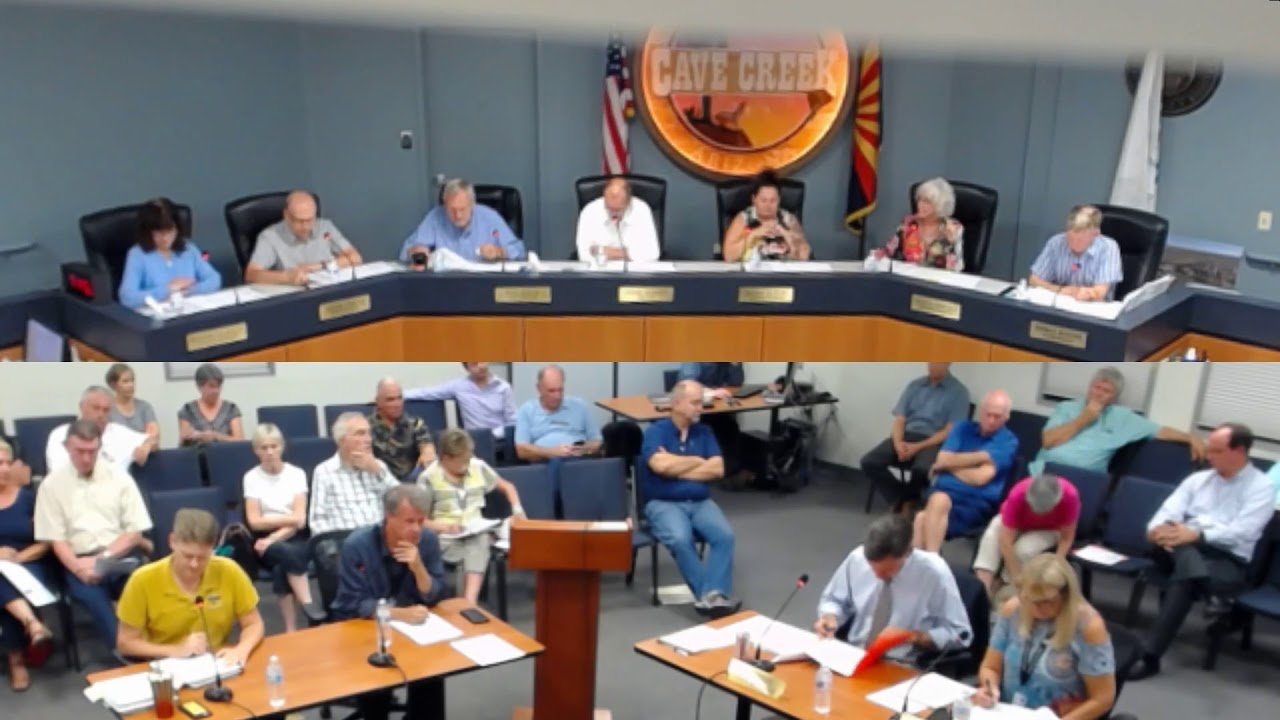
Cave Creek rejects Planning Commission overhaul and revised land-use map in 5-2 votes
Contentious council meeting featuring heated debate over Planning Commission reconstitution due to voter rejection of general plans, with passionate public defense of volunteer commissioners and philosophical disagreements about planning complexity.
Council Rejects Planning Commission Purge and Land-Use Map Overhaul Amid Heated Debate Over Planning Philosophy
Facing the political fallout from two consecutive voter rejections of general plans (2016 and 2018), the Cave Creek town council met on October 3, 2018, for what proved to be its most fractious evening of the year. Two ambitious proposals—one to remove all Planning Commission members and reconstitute the board, the other to amend the general plan with a detailed land-use map—both failed decisively, leaving a philosophical chasm exposed: Should the town simplify its planning documents to comply with state-law minimums, or maintain the detailed, participatory model that two-thirds of the council defended?
The meetings' drama centered on generational tension between departing Councilwoman Right, who sought a clean slate for planning, and the sitting majority—McGuire, Silva, Smith, and Clancy—who credited the Planning Commission with professionalism and hundreds of volunteer hours, regardless of the electoral failures.
Planning Commission Reconstitution
The evening's opening salvo came from Councilwoman Right, who introduced a motion to remove all current Planning Commission members and reconstitute the board. Her rationale was blunt: two failures demanded accountability.
"I brought this forward because I'm extremely concerned about what we're actually doing with the Planning Commission. We are now still using the 2005 general plan which at one time was an excellent plan but now it's dated—it's 18 years old and we have not gone forward, and the vision that's been pushed by the Planning Commission is basically not the vision of the residents of Cave Creek because they have made that quite obvious. The Planning Commission submitted a flawed general plan in 2016 which was soundly defeated by the residents of Cave Creek. The Planning Commission then again submitted a flawed general plan to the residents of Cave Creek in 2018 which was also soundly defeated by the residents of Cave Creek." — Councilwoman Right
She continued: "The past is the only true measure of performance. The Planning Commission may feel that there are reasons, excuses for this, but the bottom line is they did not get the job done. With all due respect, we need a Planning Commission that will listen to the residents of Cave Creek. We need a Planning Commission that will set aside their egos. This last election, 1,000 Cave Creek residents rejected this plan. Obviously, the Planning Commission was not listening to the residents."
Right's framing—equating two ballot defeats with gross failure and lack of responsiveness—sought to reframe a policy disagreement as institutional incompetence. But the council's majority saw it differently.
Council Opposition: Insult vs. Electoral Mandate
Councilman McGuire opened the rebuttal by parsing the temporal reality: two commissioners had arrived too late to meaningfully influence the 2018 plan, and two more were due to leave in December. That meant natural turnover would accomplish much of what Right sought without the "disrespect" of firing volunteers.
"In the normal course of business we would be appointing new planning commissioners in December. Right now there are two commissioners that really did not have an opportunity to work on the general plan—they were appointed too late. Most of the work was done on the general plan in 2017. The two new commissioners did not have an opportunity to spend a lot of time on that. Additionally, there's a vacancy that's going to be filled fairly soon, and then there are probably two people who will be leaving the Commission in December. That leaves only two commissioners on the existing Planning Commission. If we're talking about firing two commissioners, which essentially is what we're doing or considering, I don't think there's a value in that since we're essentially five new ones who did not have a significant participation in development of the general plan." — Councilman McGuire's implicit argument: patience and natural attrition will achieve Right's goal without the moral hazard of discouraging future volunteers.
Vice Mayor Silva, who would cast one of the deciding "no" votes, articulated the deepest concern: institutional damage. If the council fired commissioners for an unpopular but professionally executed product, who would volunteer in the future?
"If I were a current sitting member of the Plan Commission I would be highly insulted tonight. To take a volunteers' time—and I agree with [public commenter Robert Morris] with his statements—to spend hundreds and hundreds of hours of your time, staff time, and more importantly the residents of this town going to Plan Commission hearings, meetings, work study sessions, to add voice to what they would like to see in the plan, and now to ignore that [is] highly insulting." — Vice Mayor Silva
He pressed further on the logical problem: with a town split on priorities, how would any commission satisfy both camps?
"What happens when you have citizens: sampling of ten people, five want plan A, five want plan B? How do you accommodate both? You're going to get five people to approve it, five people not to approve it. And I don't think we should be threatening to fire people who spent hundreds of hours working for free, taking their evenings and afternoons, donating their time, and their reward is to get fired. And that's why it'll be difficult to get people to volunteer." — Vice Mayor Silva
Councilman Smith, who had himself attended "every single one" of the 2016 and 2018 general-plan workshops, echoed the theme: the Planning Commission's crime was not negligence but complexity—and that burden fell on council and the public as much as the commissioners.
"I think you're articulating it beautifully. I think Tom and I probably, in the very beginning, I want to say three years ago, I think I sat through every single one of them. And I remember someone on commission coming up to me and asking me, 'Why are you sitting here?' And I said, 'Because I want to see the process. I want to see what you're doing. I want to understand what you're doing.' And I said, 'It's also a delight to hear a group of individuals being able to take the time to express themselves.' I think I saw them spend about an hour and a half on the word 'Western,' and I thought it was well worth listening because if you knew step by step what they went through on each point, you might understand better that what is being proposed is such a slap in the face." — Councilman Smith
Councilwoman Clancy, who had similarly observed multiple sessions, drew the most pointed conclusion:
"I went to every open meeting, and citizens who weren't even in our town got up and made suggestions, and they took that into consideration. I think if it became a little larger in pages, that was to take into the accommodations of those who came and wanted things in there or considered having things in there. And based on the information you have given us, even if they [the commissioners] weren't just—I can't even imagine doing that to a group of individuals who have given their time, their passion, and their love for this town, and trying to accommodate everyone. And council probably is the one who failed in accordance with—if there were things that were difficult to understand or needed to be added or taken out, it certainly didn't come through in our meeting as well." — Councilwoman Clancy
She concluded with a warning: "If we are even going to be lucky enough when these vacancies open up to have half the passion we have on that commission right now, we would be a very blessed town."
Public Comment: Hundreds of Hours, Zero Gratitude
Two public speakers crystallized the volunteer narrative. Robert Morris, a Cave Creek resident, opened forcefully:
"I'm against this. I think it is far too severe, and it risks showing an incredible amount of ingratitude towards people who spent hundreds, if not thousands, of hours working for nothing on behalf of the town. I went to a number of the meetings—one of the few people in town—I heard no negative comments in the meetings I went to, other than on the water section. I think that's dangerous: when you have people who are working honestly to try to do their best, which I think they did, and you just don't like the answer. We all have different opinions. This town runs on volunteers. I'm looking at seven right now [motioning to council]. And I think that to have the members dishonored and with the feeling of ingratitude, I don't think that's the best thing for the town. This town should be honoring them, no matter what they came up with." — Robert Morris Went, a business owner, bridged the policy and political critique, accusing Right of attempting to overturn the voters' verdict by other means:
"I oppose this attempt at overturning the people's will. You sit there and say that the people spoke and that someone needs to listen—the people spoke—and I don't think it's right for you, on your way out, to try and ramrod something like this down to businesses, homeowners, and as the other gentleman said, people that have put a lot of time into it." — Larry Went
(Went was alluding to Right's pending departure from council; her term was ending.)
The Vote and Its Aftermath
The motion to reconstitute read: "I move to remove current Planning Commission members and reconstitute the Planning Commission with new commission members with the primary objective to prepare and submit to council a revised general plan that accurately reflects the desires of the residents of Cave Creek."
Councilwoman Elrod seconded. The vote came:
- Yes: Councilwoman Right, Councilwoman Elrod (2)
- No: Councilman McGuire, Vice Mayor Silva, Councilman Smith, Councilwoman Clancy, Mayor Bunch (5)
- Motion failed, 2–5.
Right's closing argument—"We need to get a general plan that the residents of the town will support, that they will be pleased with, and that's the point of this, and with two failures it has not happened"—fell flat. The majority had staked its position: patience, natural turnover, and improved council guidance would achieve results without moral hazard.
Town Attorney Simms on Planning Complexity
Interwoven with the commission debate was a parallel critique of planning document bloat, articulated most forcefully by Town Attorney Simms. His comments, delivered during discussion of the land-use map amendment (detailed below), reframed the general-plan failures not as Planning Commission incompetence but as conceptual overreach by elected officials and the public.
"By conflating the zoning process with the planning process, you are demonstrating a symptom that Mr. [Caldwell] and the vice mayor commented upon, and that was over-compliance, over-complex code making. Your general plan far more complex than it has to be. The land-use entitlement process in Arizona is a classic example of participatory democracy. And you go from the extreme—the two extremes—when you talk general plan, that's Jefferson, that's France, that's participatory democracy: the voters get to vote. When you come down the spectrum to zoning, it becomes more difficult for the voters to vote because Adams wanted the Republicans wanted you—the representatives—to act on behalf of the constituents. So by making your planning process a zoning process, you insinuate the voters need to be involved in the planning process. When you go from planning to zoning to subdivision to site plan to building-permit approval, the voters have far less responsibilities and roles as they get down the spectrum. You and staff have a much larger role. This works across the state." — Town Attorney Simms
He delivered the most memorable line of the evening:
"When I look at your general plan, it is unbelievable what's in there. Few governments go to that complexity. And that's one reason you may have had it defeated. The goal would be to challenge you as the elected officials, relying on the planning agency through your Planning Commission, to develop something that you then can recommend, and then the voters get to vote. Once they vote, now you're at Planning and Zoning. Voters don't get to vote unless it's referred. When you get down to site plan, they don't even get to refer. When you get down to building permit, they don't get to refer. Government works quite well when we identify the role of the voter. The voter is classic at the plan, not involved at site plan, and can only be involved by a referendum in Planning and Zoning. What you have done is you've made your planning document, in effect, the Sears Roebuck catalog of everything in government. And we need you to move away from that and have a true planning document." — Town Attorney Simms's framing—treating the 2005 general plan as a Frankensteinian conflation of planning vision with regulatory detail—provided intellectual cover for a radically simpler approach. It also subtly rebuked council members like Right for demanding that commissioners divine the voters' will while simultaneously loading the document with contradictory community input.
General Plan Land-Use Map Amendment: Piecemeal Planning or Necessary Clarification?
The second major vote concerned a resolution (R-2018-18) to amend the 2005 general plan's land-use map by breaking the "desert rural" category into four separate zones: DR-190 (maximum 1 dwelling unit per 190,000 sq ft), DR-89, DR-70, and DR-43. The stated goal was to "clarify and protect large-parcel residential zoning."
Councilwoman Right's Case for Specificity
Councilwoman Right, seconded by Councilwoman Elrod, argued that the 2005 plan had conflated what had always been separate zones created in 1993. The amended map would provide clarity and legal protection against future densification:
"The 2005 general plan's land-use map does not accurately depict the land-use patterns of DR-190, DR-89, DR-70, or DR-43, and it's very important that we clarify this and accurately depict the four separate land-use patterns. This land-use map should be incorporated into the 2005 general plan. It will protect our large-parcel residential zoning and land-use patterns." — Councilwoman Right
She and Elrod saw the amendment as a necessary correction to vague language in the 2005 plan, one that would strengthen the town's legal standing if a developer challenged zoning restrictions as inconsistent with the general plan.
Planning Director Caldwell and Town Attorney Simms: Process Concerns
Planning Director Caldwell, in his memo, noted that Arizona Revised Statutes § 9-461.05 requires that major amendments to the general plan be processed after April 1 each calendar year and subject to 60-day enhanced notice before a Planning Commission hearing. Caldwell recommended proceeding with this process—but only if council voted to do so. His memo implied this was a question, not a given.
Town Attorney Simms, however, went further and directly critiqued the substance of the motion:
"By conflating the zoning process with the planning process, you are demonstrating a symptom [of] over-compliance, over-complex code making. Your general plan [is] far more complex than it has to be." — Town Attorney Simms (quoted above)
His implicit argument: adding a detailed four-zone land-use map to the general plan would further entangle planning and zoning, making future revisions harder and voter understanding more difficult.
Vice Mayor Silva's Process Challenge
Vice Mayor Silva posed a question framed as a procedural objection:
"Wouldn't it be appropriate instead of having this item on here before us today to not take action on it but wait until the Planning Commission gets direction from perhaps the new Town Council in preparation of putting together a new general plan and discuss it at those hearings, study sessions, before the Planning Commission as well as the Town Council, as opposed to treating it piecemeal beforehand? This way the residents of the town will be able to be heard and voice their objections or reasons for something like this, and it would be totally transparent with the residents of our town, given full and complete opportunity to be part of the new general plan." — Vice Mayor Silva's point: amending the general plan now, before the council undertakes a comprehensive revision, fragments the process and denies residents a unified public-comment opportunity. Better to fold this clarification into the next full general-plan update.
Councilman Smith's Opposition: Duplication and Unnecessary Steps
Councilman Smith objected on grounds of regulatory duplication. Caldwell had confirmed that the proposal would require desert-rural property owners seeking a rezone to obtain a general-plan amendment and a zoning change, whereas under current law they only needed a rezone (subject to a neighborhood meeting and local-option referendum). Smith saw this as unwarranted process layering:
"I believe it would add an unnecessary step to any process of modifying a desert rural land use. And sometimes desert rural does need to be modified—both for business purposes. Somebody wants to take a ten-acre lot and cut it into two five-acre lots. There's perfectly good reasons to do things like that. It shouldn't be something where you duplicate the requirements simply to slow down the process." — Councilman Smith
Caldwell had acknowledged that no other Arizona municipality employed this approach, which Smith cited as evidence of its impracticality.
The Vote
The motion read: "Resolution to amend the 2005 general plan to incorporate the land-use map that clearly depicts DR-190, DR-89, DR-70, and DR-43 attached as Exhibit A, to be processed after April 1, 2019, with 60-day enhanced notification process prior to a public hearing by the Planning Commission."
- Yes: Councilwoman Right, Councilwoman Elrod (2)
- No: Councilwoman Clancy, Councilman McGuire, Vice Mayor Silva, Councilman Smith, Mayor Bunch (5)
- Motion failed, 2–5.
The vote mirrored the Planning Commission vote exactly: Right and Elrod on one side; the majority on the other. The message was clear: the council would not proceed with land-use-map amendments outside the context of a comprehensive general-plan revision, nor would it layer additional procedural requirements onto desert-rural rezones.
Site Plan Approvals: Routine Consent Amid Larger Debates
Despite the evening's philosophical turbulence, the council approved two development site plans unanimously, signaling that the Planning Commission's work on discrete projects retained broad support.
Jiffy Lube Site Plan (SPR-18-04)
Project Details:
- Case number: SPR-18-04
- Applicant / representative: Victor Olson, Phoenix Design Group
- Location: Northeast corner of 53rd Street and East Carefree Highway
- Square footage: ~2,643 sf quick-service car-service facility
- Parking: 6 on-site spaces; 11 shared spaces (7–17) in common area
- Zoning: General Commercial (GC), within existing Starbucks development
- Planning Commission recommendation: Unanimous approval (6–0)
Council Discussion:
Vice Mayor Silva raised a single concern: whether the shared parking spaces would be reserved for Jiffy Lube customers or remain first-come, first-serve. His worry was that the existing Starbucks building (already occupying the eastern portion of the lot) could consume much of the lot's parking on high-traffic mornings, leaving Jiffy Lube with inadequate stalls.
"My question is will those additional parking spaces be identified as exclusively used for Jiffy Lube customers or are they to be shared first-come, first-serve? I read through your report, I read through the Planning Commission meeting minutes, and I didn't see any reference to that. So are they going to be reserved, open, first-come, first-serve, marked, identified—how will that be handled?" — Vice Mayor Silva
Planning staff replied that the property was intentionally "over-parked" to allow flexibility among tenants and that a shared-parking agreement existed. When Silva expressed lingering concern—"I get a little concerned when I go to Starbucks and I see just about half of this lot or more some mornings already occupied with cars"—staff offered to add a condition restricting some spaces to Jiffy Lube if desired. Silva, satisfied, withdrew the objection.
Vote: 7–0, Approved.
Black Mountain Vista Site Plan (SPR-18-05)
Project Details:
- Case number: SPR-18-05
- Applicant / developer: Morgan Taylor Homes
- Representative: Eric Hillstrom
- Location: Ten parcels accessed via Conestoga Trail (between Surrey Road and Choya Road)
- Zoning: Multiple Residential (MR)
- Unit count: 20 detached dwelling units (2 per lot on 10 parcels)
- Site history: Platted in 1964 (Maricopa County); utilities extended in 2003 with two meters per lot; original cable company structure (now storage shed) on southeast corner
- Right-of-way status: Conestoga Trail is a 40–50 ft dedicated public right-of-way; improvement standards (curbing, base material) to be determined by town engineer
- Deed structure: Applicant seeking flexibility to sell as either one unit, two units, or both as rental; no lot-line split required if buyer purchases both units
- Planning Commission recommendation: Unanimous approval (6–0)
Council Discussion:
Vice Mayor Silva conducted an extended line of questioning, seeking clarity on deed/title structure, road status, and the mysterious frame structure at the southern end of Lot 24.
On title: Silva wanted to know how a buyer purchasing one of two units on a single lot would have clear title. Staff explained that the applicant sought flexibility (allowing split sales or joint rental) and that deed/survey matters would be resolved between buyer and seller; final plat would clarify the arrangement. Silva's concern—a buyer financing one unit on "half a lot" might face title-insurance or lending obstacles—went unresolved in council discussion.
On the road: Silva confirmed that Conestoga Trail was publicly dedicated (40–50 ft right-of-way, recorded in 1964 plat) and would not be a private road requiring HOA maintenance. Improvements (full curb-and-gutter vs. ribbon curb) would be determined by the town engineer per design guidelines.
On the small structure: Silva's question about potential odors (wondering if it was a sewage lift station) prompted the property owner to come to the microphone and explain: it was a 1960s cable-company office building, now a storage shed, with no water or sewage connections. Future buyers would likely demolish it.
Estimated Unit Costs:
Councilman McGuire asked Hillstrom about pricing. Hillstrom projected single-unit sale prices around $200/sf (implying $150–$250k per unit, rough order of magnitude) and rental rates around $1.25/sf monthly, pending market conditions a year hence.
Rental Tax Implications:
A broader discussion emerged about bedtax collection if all units became rentals. Staff confirmed that rental properties are subject to transient occupancy (bed) tax; council noted that state law prohibits local licensing of rentals, so the town would rely on TPT reporting and voluntary compliance.
Vote: 7–0, Approved.
Tiny Homes Research Item (Administrative)
The council briefly discussed staff research on tiny homes—structures under 120 sf (2009 Building Code) or as small as 70 sf (proposed 2018 Code). Current law allows one RV per parcel (for temporary use, not primary residence), but does not permit tiny-home parks or on-slab installation of RVs as permanent dwellings. No council action was taken; the item was left open for potential future direction if the council wished to amend ordinances to enable tiny-home development.
Continuances and Minor Motions
Two code-amendment items (subdivision code Section 2.3 on preliminary plats, and zoning code Sections 12.3 and 12.5 on applications and review criteria) were tabled unanimously to October 1, 2018, for first reading.
Duration and Attendance
The meeting lasted approximately 3.5 hours. All seven council members were present (Mayor Robert Bunch, Vice Mayor Ron Silva, Councilmen David McGuire and Thomas Smith, Councilwomen Margaret Right, Electra Elrod, and Cynthia Clancy).
Why This Meeting Mattered
The evening crystallized a fundamental tension in suburban governance: How detailed should general plans be, and how much should elected officials accommodate voter input in real time versus delegate authority to professional planning?
Right's failed motion to reconstitute the Planning Commission sought to punish the board for two electoral defeats. But the council's majority—particularly Silva, Smith, Clancy, and McGuire—resisted, arguing that:
- The commissioners had acted professionally and transparently, spending hundreds of volunteer hours.
- Natural turnover (due in December) would refresh the board without the moral hazard of firing volunteers.
- The real problem was not incompetence but overcomplicated documents driven partly by council's own failure to filter community input and partly by state law's requirement for periodic updates.
Town Attorney Simms's "Sears Roebuck catalog" critique offered an intellectual framework for the second defeat: by conflating planning vision with zoning minutiae, the 2005 plan had become impenetrably complex. The remedy, per Simms, was to revert to state-law minimums and reserve detailed zoning language for code amendments, not general-plan language.
The defeat of the land-use-map amendment (DR-190, DR-89, DR-70, DR-43) reinforced this stance. Rather than layer additional procedural requirements onto desert-rural rezones or fragment the next general-plan revision with piecemeal amendments, the council chose to wait for a comprehensive rewrite—one presumably guided by Simms's minimalist philosophy and directed by council to honor existing voter preferences while streamlining language.
The council's approval of the two site plans (Jiffy Lube and Black Mountain Vista) without dissent showed that the Planning Commission retained credibility on routine development review. The real dispute was not competence but vision—and that dispute would play out in the next general-plan cycle, likely beginning in 2019.