Tempe defers $2.5M police budget increase amid 50-speaker defund outcry
Tempe City Council held a contentious meeting dominated by 50+ public speakers opposing a $2.5M police budget increase and demanding accountability for the recent death of unhoused resident Sean Bickings by police inaction, while rezoning and housing debates proceeded amid broader community crisis concerns.
Tempe Council Faces 50-Hour Reckoning Over $2.5M Police Budget as Community Demands Defunding After Sean Bickings Drowning
On June 10, 2022, Tempe City Council convened for what became one of the most emotionally charged and extended public meetings in recent memory, with over 50 residents and organizers taking to the podium in a coordinated push to block a $2.5 million police budget expansion for 19 new officers—a proposal that stood in stark moral contrast to the death of Sean Bickings, an unhoused man who drowned in Tempe Town Lake two weeks prior while police officers allegedly taunted him about his homelessness, ran warrant checks absent a crime, and refused to render aid.
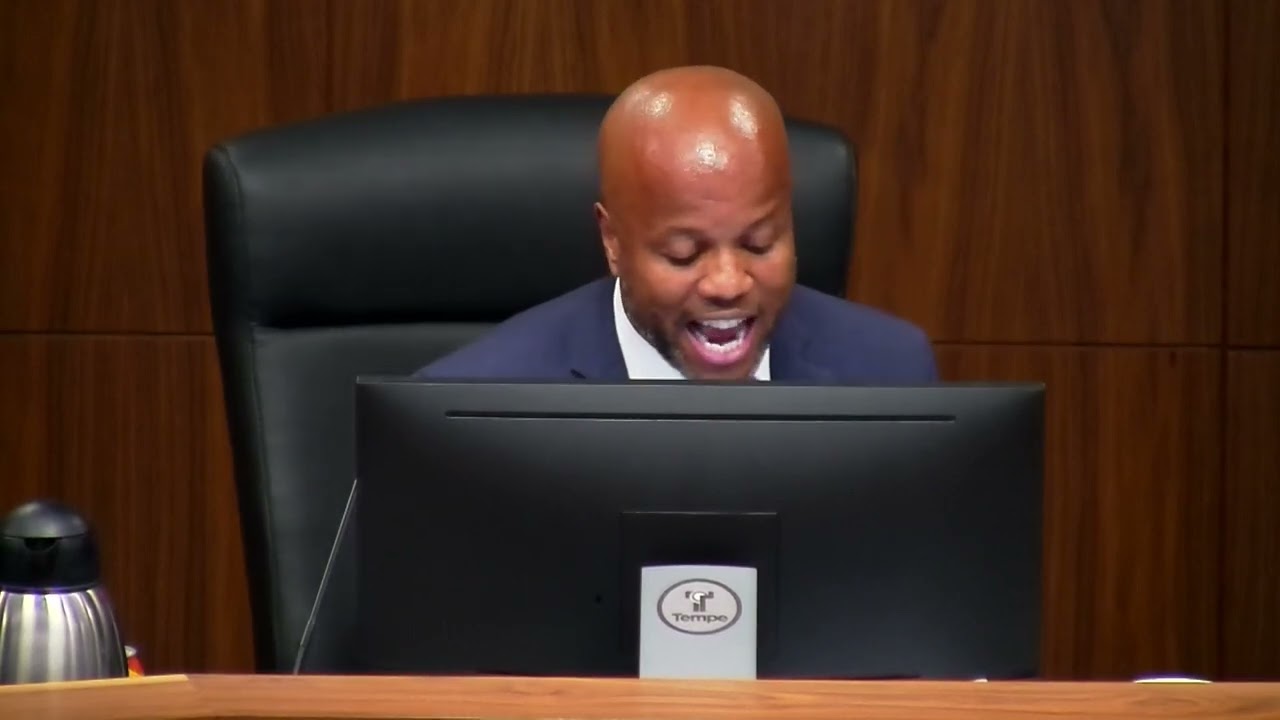
Corey D Woods opened the meeting solemnly, announcing a moment of silence for Bickings—"affectionately known to his family and friends as mad rocks"—whom he said he had met just days before Bickings' death.
"I had the opportunity to meet him a couple of days before his very tragic passing... Sean was gracious enough to be there to help offer his support and advice and frankly his experiences to us so we could actually take that information and use that to help provide better services and better shelter options at the city of tempe... We are very sorry for his loss and we definitely mourn with him and his family and his friends." — Mayor Corey D Woods
Yet within hours, that rhetoric collided with the council's stated intent to move forward with the police expansion, igniting what organizers of the "People's Budget Tempe" initiative—a grassroots effort spanning 18+ months—characterized as outright betrayal of community input.
The Sean Bickings Death and Its Aftermath
Bickings drowned in Tempe Town Lake on May 28, 2022, after an encounter with three Tempe police officers identified in public comment as Jeffrey Gebby, Brian Berman, and Officer K Bennett. According to speaker accounts derived from body camera footage (portions of which remain unreleased by the city), the officers engaged Bickings, who was experiencing homelessness, in a tense interaction marked by condescension. Bickings was allegedly mocked for his clothing and sleeping arrangements, had his name run through warrant checks despite no crime being reported, and when he entered the water in apparent distress, was told the officers would not render aid.
"They bullied him into unconscionably deciding to cross a river to get away from a very real threat as history and present day examples continuously show us and instead of rendering aid they deliberately allowed him to place himself in harm's way they watched as he swam further into the depths of a near 20-foot deep river they watched with indifference as this man recognized the danger he was in it began requesting assistance they directly told him they were not going to help him they heard him say he was drowning." — Jacob Brayford, public commenter and organizer
"Just a few days prior they bragged about saving a dog from a canal... that is what you call safety that is what i call a disgrace to humanity." — Keisha Acton, Tempe People's Budget leader
The three officers were placed on paid administrative leave. The city has released a transcript and a five-minute video clip of the encounter but withheld additional footage, citing sensitivity concerns—a decision that drew fierce criticism from speakers who demanded full transparency.
The People's Budget Tempe Campaign: 18 Months of "Gaslighting"
The People's Budget Tempe initiative, led by organizers including Anisia Groves, Keisha Acton, Dr. Sara Toccola, Lee Christian, Kelly Kwok, and Valencia Clement, presented itself as a direct response to the 2020 national uprising following George Floyd's murder. Over 18 months, they reported convening hundreds of residents—primarily from marginalized communities—and gathering data to propose an alternative to police expansion: funding mental health counselors, expanding the CARE 7 crisis response unit, supporting homelessness services, and investing in climate justice and sustainability programs.
"We have been giving reports on two city council members to the city of tempe we have talked to council members we have talked to people within city staff and have constantly over and over advised for you all not to fund the police department it started with equity in action and it's been continued through the people's budget and this has been nothing but a show of just theatrics you all do not care about the community you all are just giving us a sign or just froms to make us feel as if you care but obviously you don't because if you cared you would listen to the community who has told you over and over again that we do not need more police officers." — Lee Christian, organizer
Speakers described months of participation in task forces, equity-focused meetings, and budget presentations—all of which, they claimed, were performative. Some pointed to Corey D Woods' assembly of a public safety task force as a bait-and-switch that created the appearance of openness to reimagining public safety while staff and council secretly prepared the 19-officer expansion.
"Corey you assembled an entire task force to make it seem as though you were interested in a new way you lied to our faces stating that you too wanted to reimagine public safety while all the while making plans behind our backs to increase the surveillance and low-income communities in the form of community policing." — Keisha Acton
Dr. Sara Toccola, a doctoral candidate at Arizona State University and fellow with Equity in Action, addressed what she characterized as broken trust:
"What is the point of a partnership if we're going to be gaslit for months we asked you for the staffing study cory and for months you told us you would get it and you did and the reason we see now because we had to learn about the staffing study when the budget dropped that you were hiding your plan to hire 19 more officers what is the point of working with community if you're just going to gaslit us... funding 19 more officers which you all chose to do you have chosen which side you stand on in less than a week a month after your own cops killed a homeless black man." — Dr. Sara Toccola
The Missing Person Case of Daniel Robinson
Midway through the public comment period, David Robinson II, the father of missing geologist Daniel Robinson, stepped to the podium to appeal for resources and recognition. Daniel went missing from Buckeye, Arizona, on June 23, 2021—over a year ago—while a Tempe resident. David said he has conducted more than 40 weeks of independent searches across 32,000+ acres with no assistance from law enforcement. His son's vehicle was found nearly 30 days later in a ravine, with no forensic work performed on the scene.
"I am not law enforcement but I'm performing law enforcement work I just want to make sure you guys can understand that I've been here like I said since this time uh the startup that does the surges also have city distribution where many citizens of tempe citizens of phoenix buckeye all over arizona are part of my searches... so my operations are here in tempe vibrations in all the cities here in arizona and all across the country so i want to make sure you guys understand that I've been here locally and also nationally my son's story is out there and to this day i have gotten no help from anybody from city councils to you name it um anybody in law enforcement hire up to help me in my searches for my son." — David Robinson II
Carolyn Jackson Ayers, a South Carolina native who has partnered with David Robinson in the search, appeared later in the comment period to announce a Day of Remembrance for missing persons on June 25 at 6 p.m. and to request that the city provide resources and publicity for the effort.
Public Comment: The Flood of Voices Against Police Expansion
Over the course of more than four hours, the council heard from 50+ speakers, representing a cross-section of Tempe and greater Phoenix residents, as well as representatives of organized groups. Major themes coalesced around several core arguments:
1. Defund Police, Fund Community Services
Speakers consistently framed the $2.5 million as a moral choice. Multiple organizers and residents argued that the same money could fund:
- Six permanent middle school mental health counselors (currently only interns funded)
- Expansion of CARE 7 crisis response units
- Housing vouchers and affordable housing programs
- Climate justice and indigenous land stewardship positions
- Food security programs and community gardens, especially in low-income neighborhoods experiencing food scarcity
"More police are not needed and they will continue to do harm like they did to sean bickings when they stood around and watched him die if you really want to address crises and prevent them by fully funding the six middle school mental health positions interns are great but we need professional staff why are you nickel and diming essential services that promote the safety of young people." — Anisia Groves
2. The Hypocrisy of "Community Policing"
Several speakers, including academics and organizers, rejected the claim that 19 "unbadged" community policing officers would differ meaningfully from traditional police.
"The 19 officers are going to be unbadged and provide crisis response shawn bickings was in a crisis situation and the police were not only useless but utterly violent with their inaction and their comments all caught on video how is reproducing 19 more of them and disguising them by removing their badge is going to create better crisis response." — Anisia Groves
"Community policing killed mad rocks and will kill more people and will let more people die because that's what police do." — Matthew Christler, resident
3. Systemic Over-Policing and Criminalization of Houselessness
Multiple speakers who had experienced homelessness or worked directly with unhoused populations described how police sweeps criminalized poverty, destroyed property and documents necessary for housing applications, and harassed people across the city via trespassing orders.
"The police are a major barrier to getting housing if you're homeless first they sweep your camp when they sweep your camp or wherever you're staying they throw away everything including important documents like social security cards and ids those documents often hold up housing voucher applications and are hard to get back once you don't have a tent or a community to live in once those places are swept and you're lost in a centralized resources they harassed you on the streets." — Cooper Festy, case manager
4. Historical Pattern of Police Violence
Speakers invoked Antonio Arsey, a 14-year-old shot in the back by Tempe police in 2019; Dion Johnson; and other cases, arguing that the Bickings incident was not an aberration but a continuation of systemic indifference to the lives of Black and brown people and the unhoused.
"Three years since antonio arce was murdered not a damn thing has changed we are still here you still have blood on your hands you are only getting more blood on your hands and yet you want 19 more police officers." — Cecilia Ford
5. Calls for Accountability and Video Release
Multiple speakers demanded that the city immediately release the full body camera footage of the Bickings encounter and that the three officers be criminally charged and terminated from employment.
"we should have the video already we shouldn't have to be here begging you for it period second thing i wanted to say uh demanding is what a child does when they're throwing a tantrum we are commanding you as your superiors to release this footage be honest be transparent do what you know you're supposed to do and release the vid." — Jim Freedom
6. Racial Justice and the Stakes for Communities of Color
Several speakers connected the police budget to broader systems of racial oppression, linking over-policing to gentrification, environmental racism, housing displacement, and surveillance.
"Their presence is reflective of a police community that operates like an occupying force this is why we cannot continue to increase a police budget and increase an issue." — Jacob Brayford
"The tempe police department is out of control and the city has no business funding them any further on may 28th your officers literally made fun of mad rocks a man experiencing homelessness and then stood by and watched him drown without a single attempt to save his life... the level of disrespect for the lives of black and brown people that pd has displayed in its actions attest to the larger racist culture of policing present in tempe." — Keisha Acton
Support for Police and Measured Voices
Not all comment was uniformly critical. One speaker, representing the Governor's Commission on African American Affairs, read a card expressing support for Chief Glover and confidence in the department's ability to implement 21st Century Policing practices. Darlene Justice, a long-time resident and housing advocate, offered a more nuanced position: while acknowledging the gravity of Bickings' death, she expressed concerns about the city's broader homelessness crisis and called for officers to speak up internally when witnessing misconduct—drawing a parallel to the George Floyd case.
Key Notable Items Beyond the Police Budget
Rezoning: Ramada Inn Property (3.14 acres, Indian Bend)
During the regular meeting, the council encountered a rezoning proposal for the former Ramada Inn site on Indian Bend. The developer sought 65 dwelling units per acre; the Indian Bend neighborhood, represented by chair Christy Arnold, submitted a petition signed by 36 residents (over 10% of the neighborhood) requesting a reduction to 45 units per acre. Economic Development staff indicated that lower density was feasible; the Development Review Commission also expressed concern about 65 units per acre without height restrictions.
"We oppose a high density allowance without those height restrictions if a future amount of property development can be had at similar calculations which would be about 94 to 116 units three stories tall that could work but right now we fear the city has every inclination to achieve a higher density by height due to the lack of acreage that we have they're just trying to do the impossible there." — Christy Arnold, chair, Indian Bend neighborhood
The applicant, Lane Carraway, was noted to support a 45-unit density. The rezoning remains pending council decision.
Marijuana Infusion Facility Text Amendment (First Reading)
The council introduced, on first reading, a text amendment that would allow marijuana infusion facilities to operate independently of cultivation facilities, with reduced separation requirements (500 feet from sensitive uses, down from 1,320 feet for cultivation). The applicant, represented by Gammage & Burnham, PLC., presented the change as an update to reflect state policy shifts allowing separation of the two operations. Jennifer Adams, Nikki Amberg, and Arredondo Savage indicated support. Second reading scheduled for June 23, 2022.
250 Rio Mixed-Use Development (First Reading)
The council introduced a 14-story mixed-use building with ground-floor commercial (250 West Rio Salado Parkway), requiring general plan and zoning amendments. The applicant, Gammage & Burnham, PLC., on behalf of Heinz Development, emphasized restoration of the historic Ash Avenue Bridge and creation of a gateway to Tempe Beach Park. Jennifer Adams and Arredondo Savage expressed support for the community engagement and historic preservation components. Second reading scheduled for June 23, 2022.
Proclamations: US 60 Workers, Elder Abuse Awareness, Juneteenth
The council issued three proclamations: (1) US 60 Workers Appreciation Day (May 23), honoring workers and contractors who responded to a water main break near US 60 and McClintock Drive; (2) World Elder Abuse Awareness Week (June 13–17, 2022); and (3) declaring June 19, 2022, as Juneteenth, an official city holiday. These passed without objection and drew brief remarks from Corey D Woods on the historical significance of Juneteenth and the city's commitment to equity and inclusion.
The Missing Footage and Transparency Question
A recurring theme in both the police budget comments and later discussions centered on the city's partial release of body camera footage from the Bickings incident. Speakers pointed out that the city released a transcript and a five-minute video but withheld additional footage on grounds of sensitivity. When council members asked the city manager why the full video was not released, the response was that approximately five minutes of footage were withheld due to its sensitive nature. This sparked immediate criticism from public commenters who argued that body cameras exist precisely to provide transparency and that the withholding of footage protected the officers' actions from public scrutiny.
Timeline of the Meeting
- 6:14 p.m.: Meeting convenes; Corey D Woods offers moment of silence for Sean Bickings and remarks on having met him days before his death.
- 6:30–8:10+ p.m.: Approximately 50+ public speakers address the council on the police budget, housing crises, and related issues. The council announced it would "move things around" to allow speakers to be heard before the special budget meeting.
- ~8:15 p.m.: Consent agenda (6-0 vote) and non-consent routine items (6-0 votes) pass.
- ~8:30 p.m.: Ordinances and items for first reading introduced: marijuana infusion facility text amendment and 250 Rio mixed-use project; both deferred to June 23, 2022, for second reading and vote.
- ~9:00 p.m. (est.): Regular meeting concludes; special budget meeting to follow.
Individual speakers against the police budget included:
- Anisia Groves (Mesa, solidarity with marginalized communities)
- Christy Arnold (Tempe, Indian Bend neighborhood)
- Talia Fuentes Wolf (Tempe)
- Jacob Brayford (Maricopa County organizer, public safety task force member)
- Lee Christian (Tempe, People's Budget Tempe organizer)
- Keisha Acton (former Tempe resident, People's Budget leader)
- Dr. Sara Toccola (Equity in Action, public safety task force)
- Taylor Fisher (Tempe resident)
- Alex Monti (Tempe, sustainability commission)
- Jack Maverick (Tempe, 20-year resident)
- Kelly Kwok (Phoenix, White People Against White Supremacy)
- Liam Huggins (lifelong Tempe resident)
- Kim Stravers (Phoenix patron of Tempe businesses)
- Sandra Ojeda (migrant person of color)
- Jewell Valenzuela (Tempe, public school teacher)
- Darian Barrett (Tempe, named the three officers)
- Casey Deaton (formerly homeless in Tempe, Arizona native)
- Charles Seiler (Tempe resident, teacher advocate)
- Jim Freedom (former Tempe resident, transparency advocate)
- Dr. Don Thacker (Tempe resident, former library board, civilian police review board)
- Matthew Christler (Tempe resident)
- Tony Hassan (Tempe resident)
- Cecilia Ford (unhoused)
- Dominic Rios (Gilbert resident)
- Cooper Festy (Tempe case manager)
- Bailey Maddox (Tempe resident)
- Sosan Abdulrahman (Phoenix, environmental justice leader)
- Seth Golden (Tempe resident)
- Sophia Alicia (Phoenix resident, previously attended council for Antonio Arsey death)
- Samuel Dinjeka Jr. (first-year college student, Tempe resident)
- Carolyn Jackson Ayers (Glendale, search advocate for Daniel Robinson)
- Stephanie Valenzuela (homeless, formerly Tempe resident)
- Quinn Rupp (Tempe)
- Jacqueline Alcaraz (Tempe)
- Jira Flores (Phoenix, trans and queer activist)
- Casey Claus (Tempe, Unitarian Universalist Justice Arizona)
- Arnab T. Kabir (Mesa, AZ Hugs for the Houseless)
- Kevin Kansas (recently moved to Tempe)
- Trey Sean Sisk (Tempe resident, born and raised)
- Darlene Justice (long-time Tempe resident, housing advocate)
- Philip Yates (Roosevelt Street resident near the lake)
- Valencia Clement (doctoral candidate ASU, Equity in Action fellow)
- Harley Jackson (speaker, specific details not fully captured)
- Latoya Toliver (Phoenix, social worker, DCS mentor)
- Alexis Isa (3L Arizona State University College of Law)
- Gretchen Reinhardt (Escalante neighborhood resident, 27 years)
- Jordan Harris (13-year-old Tempe resident)
- William Robles (Guadalupe, cop watcher)
- Lefty (Phoenix, activist)
- Malik (recent high school graduate, Tempe resident)
- Lily Villa (former city of Tempe employee, College Connect and Mayak programs)
Vote Breakdowns
Consent Agenda (Item 4a1, 4b1-4b6):
- Final: 6-0
- Yes: Jennifer Adams, Nikki Amberg, Arlene Chin, Berdetta Hodge, Randy Keating, Corey D Woods
- Absent: Navarro
Non-Consent Routine Items (8a1–8a5):
- Final: 6-0 on each item
- Yes: Jennifer Adams, Nikki Amberg, Arlene Chin, Berdetta Hodge, Randy Keating, Corey D Woods (or noted alternates)
- Absent: Navarro
Individual council member votes on substantive items were not fully captured in the transcript where noted above.
Outcome & Next Steps
The regular meeting concluded with introduction of two major agenda items on first reading (to return June 23, 2022): the marijuana infusion facility text amendment and the 250 Rio mixed-use development. The special budget meeting immediately followed this public comment period, where the council was expected to vote on the FY 2022 budget—presumably including the contested $2.5 million police expansion—though the transcript provided does not capture that vote. The community has made clear its intent to continue mobilizing and attending future meetings. The Day of Remembrance for missing person Daniel Robinson is scheduled for June 25, 2022, at 6 p.m., and the city manager was asked to follow up with Carolyn Jackson Ayers on supporting that event.
Controversies & Context
The Sean Bickings death is the second widely publicized police-involved death in Tempe in recent years, following the 2019 shooting of 14-year-old Antonio Arsey by Officer Ryan Schultz (who has remained employed). Speakers invoked Arsey's name repeatedly, arguing that the city had failed to enact meaningful reforms despite public outcry and promises of accountability.
The broader context includes Arizona's documented status as one of the deadliest states for police killings per capita, and Tempe's Police Department having been singled out by multiple speakers for disproportionate use of force against communities of color and unhoused residents. The city's concurrent housing crisis—marked by soaring rents, gentrification, and homelessness—figured prominently in speakers' arguments that police budget expansion represents a moral failure to invest in root causes of community distress.
Gentrification along South Tempe neighborhoods (particularly Apache and Escalante) and displacement of long-standing businesses and residents (such as Don Filo's Meat Market and trailer home communities) was cited as context for why the city's priorities—development over people—have shifted away from the interests of its most vulnerable residents.
Finally, the emergence of Daniel Robinson's missing person case as a parallel concern underscores allegations that law enforcement has been unresponsive to marginalized populations; speakers pointed to the lack of police assistance in David Robinson's independent search as evidence of systemic neglect.
Duration
- Public comment (Item 6): Approximately 4 hours (6:30 p.m. – 10:30+ p.m. estimated), with 50+ speakers at ~3 minutes each
- Total regular meeting: ~2.5 hours (6:14 p.m. – ~8:45 p.m. estimated for regular agenda items)
- Special budget meeting: Followed immediately; duration not captured in provided transcript