Buckeye advances 11,730-unit housing plan and $179 million airport master plan development roadmap
Buckeye City Council workshop covered comprehensive housing action plan addressing 2,840-unit shortage and proposed $179 million airport master plan with 20-year vision for commercial service and cargo operations.
Buckeye Council Balances Market Forces and Policy in Housing Action Plan; Adopts Airport Master Plan Vision Without FAA Approval Wait
Buckeye's City Council workshop on September 16, 2025, tackled two sweeping planning documents with long-term implications for the city's growth trajectory. The Housing Action Plan, required by state law and funded through a Maricopa Association of Governments (MAG) grant, proposes strategies to address a 2,840-unit housing shortage today—projected to swell to 11,730 units by 2029. In parallel, the $179 million Airport Master Plan, prepared over multiple years with federal aviation oversight, charts a 20-year vision for runway extensions, a crosswind runway, an air traffic control tower, and potential commercial service, cargo, and military operations.
The tension of the evening crystallized around a fundamental question posed by Council Member Patrick HagEstad (District 4): Should the city actively direct housing development, or should the market and developers dictate what gets built? The answer that emerged from staff and consultants suggests a middle path—the city should not presume to be smarter than the market, but can offer tools, incentives, and partnerships to shape outcomes when demand justifies intervention.
Housing Action Plan: Data, Gaps, and the Senior Housing Surprise
Andrea Marquez, Senior Planner in Development Services, and Lane Corey, Planner with Matrix Design Group, led a presentation on the draft housing action plan. The plan comprises three phases: a quantitative housing needs assessment, community engagement and qualitative feedback, and policy recommendations with implementation strategies.
Key Speeches
"We are fortunate that we did receive a grant from MAG to fund the housing action plan. The draft that you'll be seeing tonight, this is a collab effort between um matrix through MAG community services and our neighborhood services alongside with the development services." — Andrea Marquez, Senior Planner, Development Services
"Buckeye is one of the fastest growing communities in the nation. We knew that before we even started this. And so we came in um you know our job is to come in with um a clean slate and we say all right let's look at all the numbers. Let's look at all the information and let's see what it tells us." — Lane Corey, Planner, Matrix Design Group
The consultants emphasized that the plan does not mandate new zoning changes, regulate where housing is built, or alter neighborhood character. Rather, it is a policy roadmap identifying gaps and recommending incentives—density bonuses, expedited permitting, accessory dwelling unit (ADU) standards, down-payment assistance programs—to attract private development of diverse housing types.
The headline finding surprised even the presenters: while Buckeye is becoming a younger community (with over 85% home ownership and predominantly detached single-family housing built in the last 10–20 years), there is a critical gap in middle-market senior housing. Publicly funded senior housing serves low-income seniors; private market senior care is expensive. Missing entirely is housing for seniors on fixed incomes who don't qualify for subsidies but can't afford thousands of dollars per month for assisted living.
"Senior housing currently is broken up into really two main, um, groups, if you will. So, the first being, uh, publicly funded senior housing and, um, privately funded senior housing. Um, there are some highs and lows with both of those. Um, but what we're really missing is the gap there." — Lane Corey
Marquez added:
"There is a lot of crossover between recommendations and so to answer the first part of your question. Um yes, we want to find uh solutions for seniors who um have loved living in Victory or other parts of um Buckeye and want to continue living in uh Buckeye but don't necessarily have the means or the income to afford uh some of the higherend um private care necessarily." — Andrea Marquez
Community Engagement: 619 Voices and the Silent Majority
The plan drew from 619 survey responses and two community meetings—one at City Hall East at the Landing, one at the senior center. Council Member Patrick HagEstad flagged a methodological concern: active participants in planning meetings skew the feedback. Residents excited about environmental issues, density, or multifamily housing attend; the "silent majority" living their lives in established neighborhoods like Tartesto and Verrado do not.
Lane Corey presented headline survey numbers:
- 50% of respondents had lived in Buckeye more than 10 years (showing community stability).
- 80% were aged 65 or older (reflecting senior center participation bias).
- 38% of households earned less than $30,000 annually, underscoring workforce-housing needs.
- 23% reported difficulty affording food, medicine, and essentials alongside housing costs.
- 77% prioritized senior living (again, partly a result of senior center recruitment).
- 34% wanted more apartments; 32% wanted traditional single-family homes; 20% wanted duplexes, triplexes, or townhomes.
Council members noted the disconnect: community meetings generate strong support for diverse housing types among participants, yet citywide sentiment remains mixed. Multifamily projects still draw "not in my backyard" opposition, even though Buckeye is significantly underbuilt on multifamily compared to neighboring communities.
The Market-vs.-Policy Debate
Council Member HagEstad pressed the fundamental tension:
"There's an assumption in this packet and this discussion here today that the city should get involved in these decisions. What is built here? Who should live here? Those kinds of things. So the fundamental question is why should we get involved at all in trying to make those decisions when the market and the developers are already looking at these issues themselves?" — Council Member Patrick HagEstad, District 4
Mayor Eric Orsborn reframed the issue as economic development, not social engineering:
"Housing is economic development. Um that's really what it comes down to is uh for a long time housing wasn't considered a critical part of um economics and uh how a city can bring in money. But as Buckeye looks to bring in some additional industries, uh they look to bring in additional employers, uh there's some big names that right are coming into Buckeye. A lot of those important factors come down to um as those industries are seeking potential sites, they say, is there the housing to be able to support, you know, the workforce I'm going to bring into Buckeye?" — Eric Orsborn Corey added:
"Doesn't necessarily mean that the city has to get involved with every aspect of it. But as a council strategic priority, uh really understanding the composition of housing in the community is so critical. Uh who's living here, who could live here, uh who wants to live here, right?" — Lane Corey
Andrea Marquez emphasized state obligation:
"Yeah, Mayor Council said, maybe I would just add a simpler answer to that is we're only required by the state legislature to understand what our housing challenges are. That's something that part of this first half of this process is. Second half is really to lay out the whole And then we can start striking out things as a council we don't think are great opportunities for us or adding things in that we hadn't thought of." — Andrea Marquez
The consensus: the city will provide a toolbox of options—development incentives, streamlined entitlements, partnerships with nonprofits like the Arizona Community Foundation—rather than mandate housing types or locations. If LITC (Low Income Housing Tax Credit) funding disappears, staff will identify alternative grant sources. The private market remains the driver; city policy creates favorable conditions for private developers to serve identified gaps.
Timeline and Next Steps
The draft plan will be reviewed by the Planning and Zoning Commission in two weeks. Feedback will be incorporated, and the final version will return to Council for adoption, likely in November. The document is posted on the city website, and full appendices with survey results will be available for public review.
Airport Master Plan: $179 Million, 20-Year Vision, and Runway 10-28
Scott Gray, Aviation Director, and Charlie McDermott from Dibble presented an FAA-mandated airport master plan covering the 1,600-acre Buckeye Municipal Airport. The plan identifies $179 million in total 20-year capital costs: $90 million from the FAA, $7 million from the state, $20 million in local matches, and the remainder from private sector development.
Key Speeches
"It is a federal aviation required planning document. You generally do them about every 10 years, not necessarily required. You may do them a little bit faster. If development is happening, you may slow things down and not have to do one every 10 years." — Scott Gray, Aviation Director
"The primary runway, the runway that we have today, 1735, that's basically north south um will remain our primary runway throughout the planning period. Um it is identified to have an 1800 foot extension to the north." — Scott Gray
The master plan is not visionary or aspirational—it is a rigid FAA document justifying eligible projects for federal funding. However, Buckeye negotiated with the FAA to include a visionary appendix describing long-range opportunities (commercial service, air cargo, military operations, urban air mobility) beyond the 20-year window, allowing the city to pull strategies forward without requiring a new master plan every few years.
Runway Development and Crosswind Strategy
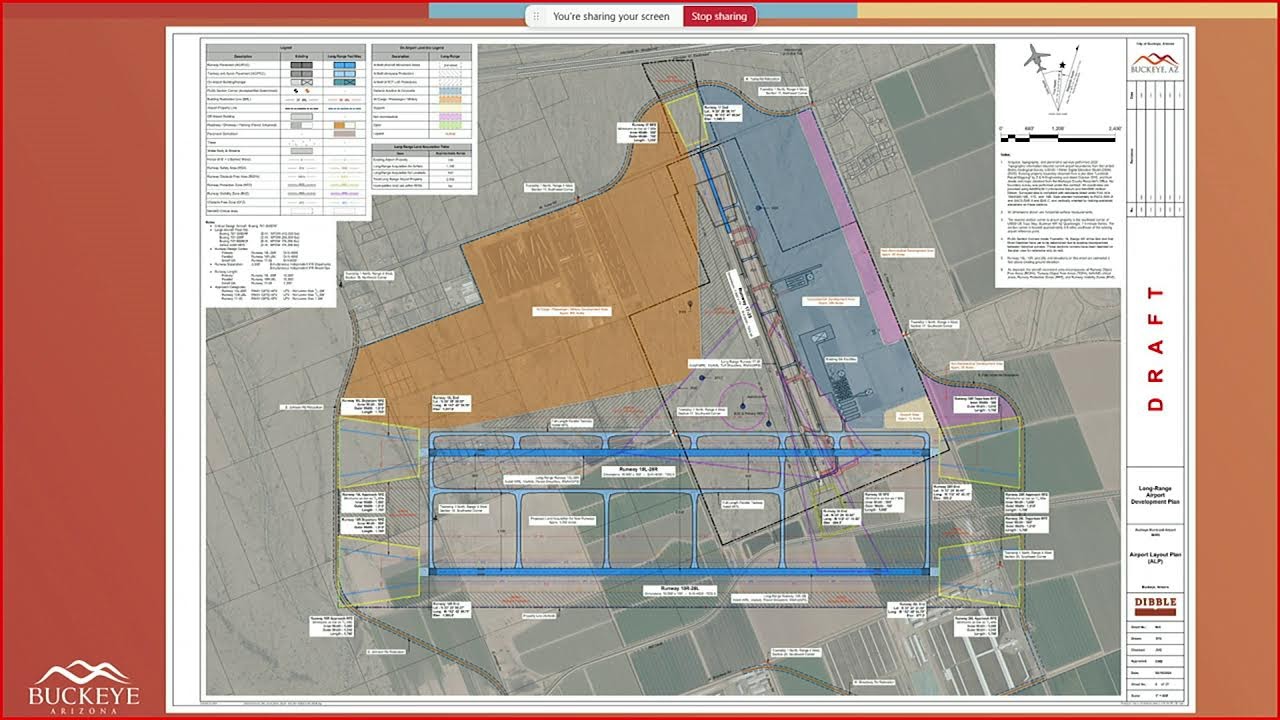
The recommended airside development rests on an airspace and instrument procedures analysis conducted by Lean Corporation to ensure minimal disruption to Luke Air Force Base (approximately 20 miles north). Buckeye's existing primary runway, 17-35 (north-south orientation), will be extended 1,800 feet to the north, nearly to Yuma Road. Buckeye owns property all the way to the freeway, permitting future additional extension.
The most significant recommendation is a crosswind runway, 10-28 (east-west), located on the south side of the airport in the second planning phase (five-year window, likely around year 6–10). The crosswind runway is essential: in strong crosswinds, small aircraft cannot safely land when wind blows perpendicular to the runway. A 6,000-foot crosswind runway will accommodate all aircraft types in all weather conditions, opening the airport to additional users who currently divert to other facilities during wind events.
Gray noted the $20 million projected cost for the crosswind runway (including taxiways, grading, land, and environmental compliance):
"That could be a $20 million project just for that one runway. That would include everything, right? the taxi way, the runway, the land we need, etc., etc. FAA is not going to give us $20 million. They don't they don't do that to general aviation airports. What we'll likely see is we'll get a couple of million dollars here to start doing uh the planning or whatever we need to do the design. Then we'll have a couple million dollars to do grading. Then we'll have, you know, several million dollars to build the runway and etc., etc., etc." — Scott Gray
The phased FAA funding approach, while slow, signals commitment: once the FAA begins funding a project, they typically see it through to completion, incentivizing the city to demonstrate demand early.
Long-Range Vision: Commercial Service, Cargo, and Military Operations
Beyond the 20-year master plan, a Long-Range Airport Development Plan (appended to the master plan) depicts a future where runway 17-35 remains but becomes secondary; the two 10,500-foot east-west runways (10-28 and a parallel training runway) become primary. Development areas for commercial service, air cargo, and military operations are sited in the northern portion of airport property (orange zone). Additional taxiway exits, helicopter operations areas, and hangar/apron expansion fill the planning horizon.
The long-range plan does not presume Southwest or major carriers will arrive, but it positions Buckeye to respond if users express interest. Gray cited Williams Gateway Airport, which took 25 years to reach commercial service after its military-to-civilian conversion. Buckeye, with greenfield development potential, can move faster if demand justifies—a user arriving with concrete plans could accelerate runway completion from the second planning phase into the first.
Council Member Craig Heustis (District 5) emphasized the importance of marketing:
"I think it's important that we publicize this as big and loud as we can that this was really the intent of the whole we could have not done a master plan and just created this document. uh and that's what we need to go out to uh users so that we can show them this is the plan um for when we grow up which could be four years from now it could be 30 years from now when that is but without the vision cast we have nothing to show uncle Jeff or whoever is want to spend money and moving goods and services and people in and out of the area." — Council Member Craig Heustis
FAA Coordination and Instrument Procedures
A key advantage: Buckeye will have instrument approach procedures, allowing pilots to land in low visibility—a feature all major valley airports possess but Buckeye previously lacked. The FAA flight-checked and confirmed instrument procedures are ready; lighting checks remain, with publication expected in March. This qualification is critical to corporate operators' decision to base aircraft at or use Buckeye.
Advisory Committee Controversy: District Representation Omitted
Council Member Jamaine Berry (District 2) expressed disappointment:
"Scott, I have to tell you, Scott, that I'm a little disappointed to not be included in that. This is my district and I did ask whenever we were going through this exercise that I'd be included in that. So, in the future, can we please do that?" — Jamaine Berry 18-member planning advisory committee included city staff, FAA, ADOT, Luke Air Force Base, the Arizona National Guard, the National Business Aircraft Association, the Aircraft Owners and Pilots Association, tenants, and consultants—but not individual council members. Gray acknowledged the omission and committed to future inclusion in airport stakeholder engagement. He noted that council members were invited to public information meetings (which occurred at the Landing and attracted most council members present), but the planning advisory committee itself is typically restricted to staff and technical experts.
"These were not public meetings, right? These are not >> the two public meetings. We certainly advertised and saw most of you at those and we appreciate that." — Scott Gray (responding to follow-up questions about inclusion)
Airport Specific Area Plan and Land Use Protection
Following master plan adoption, a separate Airport Specific Area Plan will be prepared (consultant selection underway). This plan will identify compatible land uses and zoning in the airport influence area, establish a height and noise overlay ordinance, and update the airport area influence zone required by Arizona's real estate department. Brian and Adam Copeland from Development Services will lead the effort, coordinating with Gray's aviation input.
Council members emphasized the need to claim land for aviation uses, not incidental compatible development. Craig Heustis noted:
"And it's not just protecting against the uses that are out there because you can put a compatible use in the south actually in that orange area that has nothing to do with aviation. And that's not what we want. The idea is to claim as much real estate as we can so that we can I mean I think Sky Harbor right now would say we would love to have more property to expand their operation even more." — Craig Heustis Harbor Airport occupies approximately 3,400 acres; Buckeye's 1,600-acre master plan site is roughly half that scale, yet offers significant greenfield expansion potential if the city proactively protects land for aviation uses and communicates the vision to potential users and neighboring property owners.
Adoption Timeline and FAA Approval
Gray stated the master plan will be finalized and brought to Council for adoption in November. Submission to the FAA will follow immediately. FAA approval typically takes 3–12 months, but Buckeye will not wait:
"Um it's at the rate things have been going they've been very um very slow in get turning things around. So we'll turn it in here probably in the next month or two and they'll have it for at least three months, maybe nine months. But as they're doing that, we consider the project done. We're moving on." — Scott Gray
Mayor Eric Orsborn confirmed the city will proceed as if the plan is complete upon Council adoption:
"There's no need to wait for the final approval." — Mayor Eric Orsborn "No." — Scott Gray
This strategic move allows Buckeye to market the plan to prospective users and plan infrastructure investments without FAA delay.
Timeline
-
Housing Action Plan
- Community engagement: 619 survey respondents; two community meetings (May 12 at City Hall East, May 28 at Senior Center)
- Current status: Second draft; staff collecting comments; additional revisions ongoing
- Planning and Zoning Commission review: Two weeks (late September/early October 2025)
- Final adoption: Planned for November 2025
-
Airport Master Plan
- Advisory committee meetings: Four completed
- Public information meetings: Two completed (one at the Landing, one at Senior Center)
- Final planning advisory committee meeting: One week prior to workshop (September 9, 2025)
- Council adoption: November 2025
- FAA submission: November 2025
- FAA approval timeline: 3–12 months (contingent; city proceeds upon adoption)
- Airport Specific Area Plan selection: Shortly after adoption
- Airport Specific Area Plan study duration: Approximately 9 months
-
Instrument Approach Procedures
- Flight check: Completed
- Remaining work: Lighting verification
- Publication: March 2026 (expected)
Opposition & Support (Housing Plan)
The housing plan did not face formal opposition during the workshop, but Council Member HagEstad articulated substantive concerns about the city's appropriate role:
Main concerns (Council Member HagEstad):
- City should not presume to be "smarter than the market" or developers.
- The plan appears to assume active city involvement in directing development is necessary and desirable.
- If developers and the market are already responsive to housing gaps, why intervene?
- Concern about selection bias in community engagement: active participants (those invested in planning outcomes) overrepresent certain viewpoints; silent residents living their lives are absent.
- Before implementing policies, Council should understand what specific gaps the market is failing to address and why.
Craig Heustis counterpoint:
"I agree. The market drives this. you know, they're going to dictate is it senior level housing or is it workforce housing or, you know, the people that don't have a full kitchen, you know, but we can create the environment that um through code or incentives or whatever it happens to be that can help facilitate those decisions on h on behalf of the private market." — Council Member Craig Heustis
Support (implicit in staff response):
- State legislation mandates understanding housing challenges; the plan satisfies that obligation.
- Economic development: employers considering Buckeye inquire about workforce housing availability.
- Identified gaps (senior housing, workforce housing for $30k/year earners, incremental accessibility upgrades for aging in place) justify targeted interventions.
- Proposed tools (density bonuses, expedited permitting, ADU standards, down-payment assistance) cost the city little and leverage private capital and nonprofit partnerships.
- Council can accept or reject recommendations; the plan is a menu, not a mandate.
Opposition & Support (Airport Plan)
Opposition: None expressed during the workshop. The master plan and long-range vision were presented without formal public comment period.
Support (strong among Council):
- Craig Heustis and others emphasized the importance of broadcasting the long-range vision to prospective users and defending land from incompatible development.
- The greenfield opportunity (vs. constrained urban airports) is unique and time-sensitive.
- Economic development case is compelling: cargo operations in the West Valley context; potential for smaller regional passenger service; corporate aircraft basing.
Concern raised (representation): Jamaine Berry noted omission from the 18-member planning advisory committee despite representing District 2 (airport district) and earlier requests for inclusion. Gray acknowledged and committed to future council involvement in stakeholder engagement.
Project Details
Housing Action Plan
- Consultant team: Matrix Design Group (Lane Corey, lead planner); City of Buckeye Development Services (Andrea Marquez, Senior Planner); Michael White (team member)
- Funding: MAG grant
- Scope: Comprehensive housing needs assessment and action plan
- Current shortage (2025): 2,840 units
- Projected shortage (2029): 11,730 units
- Current home ownership rate: Over 85%
- Survey respondents: 619
- Community meetings: 2
- Key findings: Senior housing gap (middle-market affordability); workforce housing shortage; 23% of respondents skip essentials to cover housing; demand for diverse housing types (apartments, duplexes, single-family) acknowledged but not uniformly supported
Airport Master Plan
- Consultant: Dibble (Charlie McDermott)
- Airspace expert: Lean Corporation
- Airport property: 1,600 acres
- Planning horizon: 20 years
- Total estimated cost: $179 million
- FAA funding (estimated): $90 million
- State funding (estimated): $7 million
- Local match: $20 million
- Private sector: Remainder
- Primary runway (existing): 17-35 (north-south)
- Planned extension: 1,800 feet to the north
- Crosswind runway (planned): 10-28 (east-west), 6,000 feet, south side of airport
- Planning phase: Phase 2 (5–10 years)
- Estimated cost: $20 million
- Landside development: Air traffic control tower, conventional hangars, executive hangars, T-hangers, apron, tiedowns, access roads, taxiways
- Long-range plan: Depicts future 10,500-foot dual east-west runways (10-28 primary), commercial service/cargo zones, military operations area, general aviation expansion
- Previous master plan: 2007; costs $110 million; many projects remain unfinished
- FAA coordination: Airspace analysis confirmed minimal impact to Luke Air Force Base
- Instrument procedures: Flight-checked and approved; lighting verification and publication (March 2026) pending
Vote Breakdown
No formal votes were taken during the September 16, 2025, workshop. Both items were presentations and discussions seeking Council feedback. Formal votes on both plans are anticipated in November 2025.
Outcome & Next Steps
Housing Action Plan
- Immediate next step: Planning and Zoning Commission review in two weeks (late September/early October 2025)
- Public input: Open comment period; appendices with survey results will be published on the city website
- Final adoption: November 2025 Council meeting
- Implementation: Staff will identify funding mechanisms (state/federal grants, nonprofit partnerships, development incentives) for priority policies; Council will select which recommendations to pursue
Airport Master Plan
- Council adoption: November 2025
- FAA submission: Concurrently with adoption
- Implementation: Buckeye will proceed as if the plan is complete upon Council adoption, without awaiting FAA approval (expected 3–12 months thereafter)
- Subsequent studies:
- Airport Specific Area Plan: Consultant selection underway; 9-month study following adoption to establish compatible land uses, zoning, height/noise overlays, and influence zones
- Economic Impact Study: Underway as part of a separate airport strategic initiative
- Instrument procedures publication: March 2026
- User outreach: Scott Gray to coordinate with Economic Development to market master plan vision to prospective commercial, cargo, and corporate aviation operators
Controversies & Context
Housing Plan: City Role and Market Direction
A substantive debate emerged around whether Buckeye should actively shape housing development or defer to market forces. Council Member HagEstad's challenge—why should the city presume to be smarter than developers?—reflects a broader philosophical tension in planning. Staff countered that state law requires the city to understand housing challenges, and that providing incentive tools (not mandates) helps attract employers by demonstrating workforce housing availability. The consensus suggests a measured approach: the city will offer a menu of options (density bonuses, ADU standards, down-payment assistance partnerships) without micromanaging development or directing private capital. Implementation depends on Council's judgment and available resources.
Housing Plan: Selection Bias in Community Engagement
Council Member HagEstad noted that the 619 survey respondents and attendees of community meetings represent engaged residents—those invested in planning outcomes. Silent majority residents in established neighborhoods may hold different views (less supportive of multifamily housing, for example). The city acknowledges this bias but has limited tools to correct it beyond making survey and meeting invitations widely available. This caveat cautions against over-interpreting the 77% "support" for senior housing when 80% of respondents were age 65+.
Housing Plan: LITC Funding Discontinuation
The plan acknowledges that Low Income Housing Tax Credit (LITC) programs, which have funded affordable multifamily development, are no longer available. This regulatory change constrains private sector development of lower-income housing without alternative funding mechanisms. The city's role expands: identifying replacement funding sources (state/federal grants, Arizona Community Foundation programs, nonprofit partnerships). This represents a shift from passive approval to active facilitation.
Housing Plan: "Incomplete Homes" Concern
Council Member Clay Goodman noted in the draft plan a reference to housing in Buckeye that lacks complete facilities (e.g., no kitchen). He expressed surprise and concern that residents live in such substandard conditions. Staff committed to identifying funding mechanisms to address this niche problem in the next draft.
Airport Plan: Advisory Committee Representation
Jamaine Berry complaint about exclusion from the 18-member planning advisory committee, despite representing the airport district and requesting inclusion, raises questions about transparency and stakeholder engagement. Gray's response—that advisory committees typically exclude political representatives—was accepted, but Gray committed to including council in future airport stakeholder meetings. This incident highlights the distinction between staff-technical committees and public/political engagement.
Airport Plan: Greenfield Development Opportunity and Land Protection
Council Craig Heustis and Eric Orsborn stressed the strategic importance of protecting land for aviation uses and proactively marketing the long-range vision. Unlike constrained urban airports (Sky Harbor's 3,400 acres hemmed by houses), Buckeye's 1,600-acre site offers expansion potential if the city prevents incompatible land uses. The Airport Specific Area Plan will establish zoning and land-use protections; the challenge will be communicating the vision to property owners and prospective aviation users before speculation or incompatible development consumes available land.
State Legislative Requirements
Both plans exist partly due to state statutory mandates. Arizona law requires cities to complete housing needs assessments and identify strategies to address shortages. The FAA requires airport master plans. These federal and state requirements anchor the plans in law, reducing (though not eliminating) Council's discretion to avoid them.
Duration
- Housing Action Plan presentation & discussion: Approximately 60 minutes (as planned; content and discussion took up most of the allocated time)
- Airport Master Plan presentation & discussion: Approximately 45 minutes
- Total meeting duration: Not precisely stated in transcript, but both items occupied roughly 105 minutes of active discussion
Other Notable Items
None. The workshop consisted of two substantial presentations (Housing Action Plan and Airport Master Plan) and no additional agenda items.
Summary of Key Tensions and Takeaways
-
City Role in Housing: Council divided on whether active policy intervention is appropriate or overreaching. Consensus: provide tools and partnerships; defer to market on what gets built.
-
Community Engagement Bias: Survey and meeting participants are self-selected; silent majority views may differ.
-
State and Federal Requirements: Both plans are anchored in statutory mandates, constraining Council's discretion.
-
Economic Development Lens: Housing and airport infrastructure are tied to Buckeye's ability to attract employers and users; this framing justified Council interest in both plans.
-
Implementation Priorities: Council requested clear mapping of identified gaps to recommended policies, ensuring that proposed actions address specific, documented shortfalls rather than hypothetical scenarios.
-
Airport Vision and Land Protection: Council emphasized the urgency of communicating the long-range airport plan to prospective users and defending land from incompatible development; the greenfield opportunity is time-sensitive.
-
Funding Constraints: Both plans depend on securing grants (state, federal, nonprofit) and leveraging private capital; the city's role is facilitation, not direct funding of housing or airport infrastructure.
View source transcript ▼
Source: Buckeye City Council Meeting 9-16-2025 — September 16, 2025. Auto-generated YouTube transcript; may contain transcription errors.
This is the city of Buckeye council workshop for September 16th, 2025. We have the roll call, please. Council member Younger here. Council member Barry is absent. Council member present. Council member Hstead here. Council, Vice Mayor is absent. Mayor present. Thank you very much. Item 2A, presentation and discussion of that draft housing action plan. We have about an hour for this. It's planned. Miss Andre Marquez, your presenter. Thank you. Uh good afternoon, council and mayor.
Um my name is Andrea Marquez, senior panist development services. Joining me today is the lady and um also on our team with Michael White who couldn't be with us today with matrix design group um our project planners helping us guide us through this process. So as you guys know we are working on the housing action plan which is our roadmap for how Buckeye will be addressing the housing needs now and into the future.
This plan is required by the state and supports city council strategic goals as well um the big picture. So, we kicked off uh things with the housing needs assessment which we reported at the beginning of the year to the Arizona Department of Housing. We are fortunate that we did receive a grant from MAG to fund the housing action plan.
The draft that you'll be seeing tonight, this is a collab effort between um matrix through MAG community services and our neighborhood services alongside with the development services. The doc document that you received is in second draft. So staff is currently reviewing and providing more comments and revisions. And we've also received feedback from economic development legal planning and zoning commission received an email from the public and also from the homebuilders association.
So today's staff is asking council's feedback on the draft plan. Does council support the proposed policy direction? Are there any priorities that you would like to see? And also, the final draft will come before council for final adoption at a later date. And right now, I'm going to be handing it over to Thank you. Thank you so much, Andrea. Uh, good afternoon, mayor and council. My name is Lane Corey. I am a planner with Matrix.
Um, as Andrea mentioned, we are uh working on behalf of the city to facilitate and develop the housing needs assessment and action plan. uh provided a phenomenal introduction um to this project already, but it is grant funded through MAG. And so uh this is really an effort to make housing um and housing studies a priority across the valley. And so MAG um has had some gracious funders who have been able to um provide assistance in supporting communities uh in in the Phoenix region.
So, our agenda today, uh, we'll start out with a little bit of an introduction and we'll go over, uh, really what this project is. Uh, we'll go a little bit deeper in. Um, we'll start talking about, uh, phase one, which we call the housing needs assessment. And so, that's really that quantitative, uh, piece of the report, kind of gives us insight into the data, statistics, gives us really a snapshot of what's housing of what housing looks like in the community.
Um from there uh we'll kind of share some of our takeaways on those existing conditions there. Um we also uh had a pretty robust community engagement effort for this project. And so we'll detail some of those um methods and engagements uh later on in the presentation.
And then from there uh between the quantitative piece of the report report and then that qualitative piece which is engaging directly with residents understanding those lived experiences that's how we developed the housing action plan. Um as Andrea mentioned this is still in draft form and so we're looking today for some feedback on those recommendations. Um there will also be an implementation plan as a part of this uh report.
And so what we uh as matrix would really like to do is understand uh from council where those priorities really are and how we can identify some things like potentially funding mechanisms to really put those uh policies into action and I apologize a little bit for uh the formatting here uh shifted around a bit when we moved it over. But um our goals today as we mentioned really understanding uh what this effort is about. Uh we would love to get some feedback from you all on the draft plan.
Uh looking again to those implementation priorities and then understanding what those next steps look like for staff. Um again formatting shifted a little a little bit there. So I appreciate your uh patience but uh so this really has three large phases uh phases. So um that first piece is going to be that quantitative analysis.
So we're looking at demographics, we're looking at economics, we're looking at projections, um we're looking at really what those housing characteristics and that stock looks like. That helps us understand really what the composition currently looks like. So this is all present, tense, and p and in the past. We look at the housing uh market demand. Uh as you all are aware, uh Buckeye is one of the fastest growing communities in the nation.
And so, um, that certainly dictates, um, a lot of the different, um, types of housing that we're seeing, uh, come about. And so, we really want to take all of these factors and considerations in to make sure that any sort of policy or recommendation, uh, that we're providing in the plan, um, is in line um, with uh, Buckeye's anticipated growth. There's also a site suitability analysis uh, that is done as a part of this effort.
And so what we look at is we see all of the different parcels here in Buckeye and we measure them up um against a number of factors. So um if there's existing utilities on the site um if it has um you know connections to existing transportation major transportation networks and we score them based on ease of developability.
And so really what that might be is that could turn into potentially a tool um so that as Buckeye staff work with um those seeking um some work in the housing space and developing in Buckeye finding really those ideal spaces and opportunities um to build again the community engagement we had um a really fantastic outreach. it was really important that we um had an understanding of lived experiences when it came to housing.
Um so the data can tell us one thing, but going to the community helps us really backfill and understand those gaps. What are we missing here? And so we had some fantastic um uh feedback from residents, uh stakeholders, uh business owners. And then lastly, uh that third phase is going to be the housing action plan. And so that's really the policy uh piece behind it where we look at um okay how do we put these into action?
What are the funding mechanisms uh that can help us accelerate some of these processes? Before you go on, are you going to unpack each one of those? We will. Okay. Yes. Thank you, Mr. Mayor. So um just to kind of set some expectations for what this report will and will not cover. So this report really shoots to understand um where those rising housing costs are.
Um right now um some of our existing conditions uh tell us that there is predominantly detached single family um in Buckeye which has been proven to be successful um as the community continues to grow. So our role is identifying um some other ways that we can continue to grow and evolve um to make sure that there's housing that is attainable for everybody. The last kind of piece here is I really want to distinguish between attainable and affordable housing.
So affordable housing has certain state requirements um that are necessary in order for it to be deemed as affordable. Um and so think traditional like section 8 type housing or any sort of other subsidized um housing program. What attainable is attain housing attainability looks different for everybody.
So, it looks different for the family who is um you know buying their forever home in Buckeye or it looks different for the young professional who's just starting out in a career um and has a great job opportunity out here in Buckeye and really wants to um live and work in the same space and same city. And so really it's understanding um and meeting people where they're at. Um so uh that's an important consideration as well. This will not um create any sort of regulatory changes.
Um it won't dictate where any new housing is built. Um no neighborhood changes will be u made as a result of the adoption of this document. It is purely policy. And um the other kind of uh element that I really want to hit on to is it's not only focusing on new developments. Buckeye has a fantastic existing housing stock. And so the best thing we can do for our community is um is provide some opportunities to continue to make that housing um sustainable in the long run.
Um what ways can we reinvest back in our neighborhoods and help provide maybe some incremental um investment and so uh the housing stock continues to be strong um and aesthetically uh uh aesthetically pleasing. So that first um bracket there, what is the housing needs assessment? This really again is that quantitative piece. We take a look at the demographics of the community. How have they changed over the past 5, 10, 15, 20 years?
Um with Buckeye's outstanding growth, um this is an important consideration given that the demographics have changed uh pretty significantly. Um and I'll touch on those here shortly. Um, uh, the housing needs assessment kind of looks for some of those gaps. Okay, where are we doing a great job? Where are there some opportunities to provide some or promote some additional housing types that might suit this uh, particular uh, demographic or income range?
Um, it really looks at um, you know, who who is currently living in Buckeye, who wants to live in Buckeye, and how can we make Buckeye a home for everybody? So this is really taking a look at those existing needs um those existing conditions um and figuring out what needs to happen to get us uh where we want to go. So um from that report um if you've had a chance to kind of take a look through it um it is a pretty hefty document that we have here and um that was intentional.
We wanted to make sure that we understood income. We wanted to make sure we understood housing characteristics. We wanted to make sure we understood employment, employment trends, commuter trends. Um, all of these factors really play into um the different uh housing policies that we will um inevitably be suggesting um that Buckeye look to um as the community grows.
So um that rapid growth and changing demographics, that's something that we talked about briefly before, but Buckeye is rel is becoming a relatively young community. you have a lot of uh younger individuals in their 30s uh who are looking to either buy their first home or really establish um a great life here. And so um there has been um a pretty significant um home or rates of home ownership uh which is a fantastic uh thing to celebrate.
Um so as of 2022 over 85% um uh it had Buckeye had an over 85% home ownership rate, excuse me. Um that primarily has been a lot of modern stock. So it's been built in the past 10 20 years. Um and it's been pretty univers uh there hasn't been a lot of diversity. It's been a lot of detached single family which again um we don't want to necessarily discourage because it has worked so well in the past. And um there's certainly the demand for that.
Um but we wanted to look to some existing um opportunities and really identify where we can continue to grow and evolve. So that next phase is really looking at community engagement. Um it was really important for us to understand um you know from those who are living and working in Buckeye um what is your experience with housing?
Are you a uh resident that's lived here for the past 20 years and you've seen Buckeye flourish or are you a new um individual who just moved to Buckeye and bought their dream lot. Um what is your experience? How was that housing process for you? what have you noticed in your neighborhood that's grown and changed? What would you like to see? And so the first thing we did, we um deployed a community survey.
Um and thank uh thanks to the impressive efforts from um the city's marketing team, we were able to uh spread that out on social media, we were able to distribute it to the senior center uh and other popular city locations um so that there were hard copies available um for folks who wanted to uh engage that way.
And we uh were able to take in over 617 uh responses and that um is a tremendous uh effort from staff and we are certainly uh very grateful uh to have had those responses and that support because that helps us as consultants really frame out many of those policy recommendations. We also had um two community meetings. The uh both have the exact same content um just hosted in different locations. Uh the first being uh May 12th, that was at city hall east at the landing.
The second being at the senior center about two weeks later on May 28th. Um really uh in engaging and talking with staff, we felt like that was an important um population to really connect with. Senior housing is a very um hot topic um around the valley, but also here specifically in Buckeye. And so we wanted to make sure that we understood um and had those conversations. So that last phase here is the housing action plan and this is really where the meat and potatoes are.
Um these are um policy recommendations. And these are looking at strategies um different ways um to address the gaps and the opportunities that were identified through phase one and phase 2 that housing needs assessment and the community engagement.
Um, so our role as consultants is to go um take a look through all of the um all of your adopted plans, policies, regulations, and see where we could find some maybe opportunities um to improve or modify some of those um some of those uh actions there. And so we want to look to different solutions for availability, affordability.
Um, and our job is to connect with um staff and council um and the community to make sure that as we identify some of these implementation actions, we want to know what those most important factors are. And so we can help um not just have, you know, a set of policies, but really be able to put them into action. And so this is that path forward um that roadmap that uh Andrea talked about um for those future housing uh needs and efforts.
The city of Buckeye has actually been um one of the more proactive communities uh in in the in the valley uh when it comes to initiating uh some different housing um initiatives. Uh some examples of that uh reduced fees within the downtown boundaries. Um Buckeye is also moving towards community development block grant grant entitlements.
Um there has been a tremendous um effort from staff and another consulting team to update the development code and really modernize some of those standards um to help with things like housing affordability and availability. and we've been able to collaborate a little bit on that um so that we can make some recommendations early on um really looking at density bonuses uh within PADs and community master plans.
Um those have always been something that have been um pretty successful with the development community to make um that trade-off a little bit more uh financially uh viable. Uh Buckeye is currently in compliance with all re recent housing state legislation. There have been a number of um uh a number of changes over the past few years and Buckeye uh has brought itself um either through working with a consultant or independently uh into compliance with those legislation.
Um and they're currently in the process too of exploring uh streamlining final plats. So when we look at um some of those attainable housing strategies, uh first one got caught up a little bit by those picture by that picture there, but uh we really want to leverage and capitalize on some of those catalytic development areas. And so um there's a lot of work happening here downtown. This is a really hot spot um and there's a lot of growth opportunity here.
Um the other space um that there is a lot of um development opportunity is really within that branching area. And so while we're kind of in the high level uh planning phases of those efforts right now, uh really we have the opportunity to kind of introduce um some efforts when it comes to planning for some diverse housing types.
Um you know, if we're looking for um a pedestrian friendly environment, then maybe there's some types of housing that we can do to uh potentially support that type of effort in the downtown. um really looking at things like um like some live workspaces and so we can support um some of those local entrepreneurs while also um providing them with those housing opportunities there.
Um looking at things like development incentives um that doesn't necessarily have to um be associated with any particular cost. rather it's looking at things like um you know those development uh or density bonuses that we talked about before um or identifying um maybe some potential waiverss or expedited review processes, things like that to help make um those costs a little bit more manageable.
Um again with the development code updates there have been a number of um modifications and we have been fortunate enough to partner and uh see some of those revised changes and uh we're supportive of those uh looking at accessory dwelling units um potentially uh you know going through the process of uh creating some standardized uh plans for ADUs um to help make that a little bit more of an attainable process uh for those interested. ed in buying um and adding on a unit to their home.
Uh looking at maybe some down payment assistance programs. There are a number of fantastic funding programs um that um you know could potentially be the key to helping um you know continue with those high rates of home ownership here in the valley and just get help get some other folks kind of um that give them that head head start um so that they can live in the community um that they know and love.
Um, we also understand that the human services department uh is continuing to grow and evolve and so um our role was really seeking uh some opportunities there um to potentially help uh expand those services. So um we intentionally kept the presentation uh pretty brief just so that we had plenty of time uh for questions uh comments um if there were any sort of implementation actions um or policies that you want to discuss.
I appreciate your time and um certainly um looking forward to uh some further discussion here. So thank you. Um, thank you, Laney. So, uh, thank you for that. And we just want to make sure that we have this open um for questions that that you may have in the car, we did provide a copy of the draft.
So if there was anything that stood out or you wanted us to elaborate on um moving forward, you know, just we're we're really ask staff is asking council for support on what proposed policy direction that we need to go move forward with.
So, one of the most exciting things is I I know that the housing action plan has been on the council's strategic um one of their goals um to complete and we as we mentioned earlier we it just happened with the timing um you know there was a regional discussion state law changed and we took advantage of the MAG opportunity of getting a grant um to help us with this process.
So right now we are still collecting comments and um I am still providing some revisions to the consultant to matrix and we have a lot of stakeholders out there that have have already provided comments. So we will be um having a meeting um in two weeks from now with uh planning and zoning commission as well. uh we have shared the document with them with the Buckeye Main Street Coalition. So this way it also gives them an opportunity to make comments as well or ask questions.
So once we've gone through um those public meetings as well, we'll come back for council for their final adoption of the the policy. So um of the final version. So, you will get that prior to um prior to the next council meeting that we we put this on the agenda. Ready? Council, what questions we have? Council. Yeah, I was kind of hoping um that this workshop would have kind of got into the data a little bit more.
I did read through it once and um the data that was presented I thought was very interesting especially you know around the demographic data because that's driving your recommendations and we really didn't get a lot of that here. So, was there any big ahas in that data that you collected, not through the survey data, but more demographic and was there any big ahas in there that helped drive some of these recommendations? Absolutely. Uh, thank you, Council Member Goodman.
Um, I'll start by saying that, um, you know, we know that Buckeye is one of the fastest growing communities in the nation. We knew that before we even started this. And so we came in um you know our job is to come in with um a clean slate and we say all right let's look at all the numbers. Let's look at all the information and let's see what it tells us. All those numbers supported um that Buckeye is one of the fastest growing um communities in the nation.
I mentioned it a bit earlier but um you know Buckeye is becoming younger um the average age in the community. And so one of the aha moments though for our team was really still looking at that senior population. People like to live in Buckeye. People want to continue to live in Buckeye and they want to reside there for you know the remainder of their lives. And so senior housing was an area that we noticed um could be um an opportunity for some additional um growth and spaces.
So, um, senior housing currently is broken up into really two main, um, groups, if you will. So, the first being, uh, publicly funded senior housing and, um, privately funded senior housing. Um, there are some highs and lows with both of those. Um, but what we're really missing is the gap there. And so th that publicly funded uh senior housing is uh really primarily focused on more lowincome individuals or those that qualify for state assistance.
Um whereas that private care tends to be extremely costly. And so what we're missing is kind of that middle ground of sorts. Um we know that uh victory has been a fantastic addition uh to Buckeye um over the past decade.
And so, um, as people continue to grow and want to stay in Buckeye, um, we want to explore some opportunities to allow people to do that, um, who maybe, um, aren't necessarily meeting those lowinccome qualifications, but also can't necessarily afford to shell out thousands of dollars a month to be in any sort of state care. And so I think that was something that really stood out to our team um as an important effort uh and something we wanted to continue to explore uh through this effort.
So there um and I wish I would have taken better notes when I read it, but there you older folks are moving here, right? So moving into victory. So what you're talking about is they're aging out of their homes and can no longer live independently but need some assistance. Is that what you're talking about? Yeah, absolutely. Uh thank you council member. So couple different factors there and as we move through some of the policy recommendations you'll notice that some points continue to pop up.
uh there is a lot of crossover between recommendations and so to answer the first part of your question. Um yes, we want to find uh solutions for seniors who um have loved living in Victory or other parts of um Buckeye and want to continue living in uh Buckeye but don't necessarily have the means or the income to afford uh some of the higherend um private care necessarily. um that could look like a number of different things.
Um the other thing that we really dove into in this report was um people want to stay in their homes and so if there is not the medical care and assistance that's necessary, there's some fantastic programs um that can provide grant funding um to the cities to um to administer uh to make incremental accessibility upgrades. And so that might look like a ramp in their home or a lift in their home, things like that.
So as people continue to age, they might not necessarily need that, you know, skilled nursing assisted care. Rather, there are there's that in between and that's what we're really looking to target there. At the other end of that spectrum, there was I can't remember how you phrased it, incomplete housing or where there was not the kitchen facilities or um that didn't make it a complete home.
And I don't remember the term that was used, but there was a a chunk of housing within Buckeye that met that definition, but I didn't see a recommendation to help address that. Um I unfortunately don't recall off the top of my head. Do you remember? I mean, it's okay. I'm just But I'm happy to kind of come back with um you know, an answer solution. um to make sure that we have recommendations in place to Yeah, it may have been there.
I just didn't see it, but it was uh having looked at it that was was kind of a surprise to me that um we have people living within Buckeye that are not living in a complete home. I've never seen it described that way. So, you know, I think that's I I to me that's more of a concern than somebody aging out of a home in victory, right? Is how do we level that up and where resources might be applied? Absolutely.
No, I I appreciate that feedback and uh we can certainly look into um other funding mechanisms to help support um that particular type of development. It's very niche and so um we can go in and explore some of those uh opportunities as well and make sure that those are included with the next draft of the report. Thank you. Absolutely. Thank you. Any other questions from council?
Do do you have uh are there any other slides that you all have that that maybe talk about some of those ahas or the I gota be careful saying that not the ahas moments or or some of maybe the feedback that you got from the 617 respondents um or or just the overall picture of housing. We we know like you had said a couple times that we're fastest growing uh single family homes. We have an abundance of that and we'll continue to build that into the community.
Um but those other housing types that that we need both at the lower end and and the higher end. I know this doesn't generally tend toward the higher end. It's it's really the housing issues that we're experiencing in u affordability and some of the the key issues you talk about up front. But is there is there any more data that you can provide in public meeting and uh the opportunity to to talk about it out loud in public in a workshop like this is uh is pretty important. Absolutely.
if I I could speak the mayor and councel. Um the housing the housing needs assessment is where we collected all of our data in regards to what has been built, what we have in entitlement status and so forth that we had to provide to the state. So I we I don't believe we have that on our website. We can put that there, but it is on the cities website for all of the communities. So for Buckeye, it identified a shortage of 2,840 units for today.
And this is why the housing action plan is so important is because moving forward that number is going to increase and um which is projected to grow to 11,730 units by 2029. So what the data also I would say the aha that I think I found interesting like you know we do have a a really good opportunity that you know we've been fortunate enough that we have that single family um type of housing and we do have a small amount of diversity and we're seeing that diversity move forward.
But one of the aha for me was we actually are lacking even the higher um you know the growth um housing.
So what happens when we start getting you know our hospitals in and our professionals do we have that housing available for them and you know as we know the market is always driven um or that's what we've always been told you know by developers oh the market you know drives this type of development in regards to what size the lot should you know we should be receiving or you know why multif family is starting to come into Buckeye. So, I think that was one of our our big ahas.
It's like, okay, so, you know, when we were looking at this plan, I didn't want to just focus on affordability and and now that I'm thinking about obtainability, I really like the word accessessibility across all life style ranges.
So you know whether you know something that you need housing assistance to where you're a professional depending on you know so it's it's not just your demographics but it encompasses you know where are you working what's your income you know where are you what are you looking for in Buckeye um the other aha which I found really interesting is when we went to the senior center as we all know we do have a new um affordable housing u multif family in our downtown area which we were really excited because right now um I did check there I think at 90% capacity which is really impressive but it also just showed there is a great need but what we were hearing from the seniors is that they're on a set income and you know they there's a few um housing here in apartments that are also affordable housing but they have found that their rents are going up as well.
So, you know, we really want this policy to be able to look at everything and it's not just about the new build, but what types of programs um and that's how we collab with um human resources of ser services um in regards to because they do have a lot of those programs that we can work together in this program. So, we're looking at this as a whole. You know, what kind of services can Buckeye start looking at? Um and then on the development, you know, where can we improve our development code?
Where can we have those incentive? Where can we how can we start um gaining that interest from nonprofits and developers to start helping us u move in that direction of uh providing diverse housing versus um market rate housing. Um and then this way we could uh be able to fulfill our goals on on moving forward. So we we can accomplish that with this plan. Yeah. And we're looking at this a little bit differently than we have ever have in the past.
Generally, in the past, it's been uh if you plan it, they will come essentially and it's single family go. Uh this and and we have we as a city have really not participated in housing aside from just uh being an entity that that approves a land plan and entitlements and the construction of single family homes.
So to start uh trying to drive more of the development or figure out programs or or take whether it's federal or state money and and help that uh deploy that in the right location so that um we can create that diversity of housing that it's a this is a completely different step than I think what we've taken in the past as a as a city. So, I think that's something we need to go to, eyes wide open, make sure that the public understands we're doing what we can there.
But at the same time, there's all kinds of market forces that uh right now are restricting our ability to build single family homes, which is squeezing the market, which makes the prices go higher on single family homes, and that is completely out of our control. Uh and and then there are programs that are thinking the way like the LITC as I understand it where that's not going to be available anymore.
Uh so housing developments like what you had I think referred to a little bit earlier that are just down the road. Uh now there is no LITC component that helps that developer make that business plan make sense. And so it's going to be more and more difficult to build those type of projects within the city and create that diversity not not just right here in the downtown across the entire uh city of Buckeye. And Mr. Mayor, if I may add too, um that's where our role really is the most important.
Um, as you mentioned, there are some programs that are going away. And so, our job is to basically give the city a toolbox and say, okay, if it's not LITC, then it can be XYZ. Here are some great partnerships um that you can explore. Let's start some great relationships with some fantastic nonprofits. Um, American American, excuse me, Arizona Community Foundation, for example, um, pursued, um, some fantastic, um, grant programs, uh, in recent years that help with entitlements.
And so, um, it can help really for a lot of those projects that are qualifying as low income, um, things like that. And so as some of those organizations continue to adapt to evolving um evolving needs and evolving uh conditions um you know we want really want to make sure that that relationship is established between staff and those organizations and so those resources continue to be available. Um and Buckeye stays at the top of that list uh for the first you know group to call uh for example.
And so um At the end of this uh in addition to the implementation uh it really is shaped out to be um a set of tools and resources uh for uh for the community to utilize at any stage wherever uh you may be with your housing journey. Um I'm curious again uh what the public's feedback was in those 617 responses. I know we get varied feedback all over the place just depending on on who it is that's checking in.
In some cases, uh I think I think we all realize that there's a a definite need for more diverse housing stock when we talk about u the uh multif family or or some of those types of housing stock. We have were woefully underbuilt. Uh and if any of them give built, you have public that are coming out of their shoes on I can't believe we're building all this multif family and you know uh talking about there's just way too much of it.
But when you compare us to other municipalities, we are significantly underbuilt on uh projects like that. So there's there's room to grow, but it looks like when it's coming in near you, it's oh my gosh, they're uh they're overbuilding this type of product. Um what what has been the public's response? And in some cases, you have people that take a very rational approach and say we need all housing types.
We don't want to cover build and just build an entire city full of multif family and and apartments because that wouldn't be appropriate, but we don't want to be just single family homes. uh what are what are the what is the public saying in in your surveys? So um yes, thank you Mr. Mayor.
Uh so the first thing I'll share is that um on the website uh under the housing plan uh web page uh there is a community meeting summary and so if there is the interest uh to kind of deep dive into some of those more specific comments um that is available for the public to review uh at this time. Uh, additionally, uh, there will be a full and complete appendex with all of the survey results, too. And so, um, that'll be included, um, as well.
So, you can kind of see how folks responded to individual, uh, questions and comments. Generally, um, I would say with 619 comments, um, we had a range of feedback from the community. As you mentioned, there were some who uh some community members that were adamantly opposed to multif family even though that you know Buckeye is trending uh lower than many other neighboring communities in that uh in that field.
And then there were some who were very supportive of things like additional density and additional multif family. And so our job is to really look at uh what that middle ground looks like and what um that range um and how that range really translates to that housing plan. And so I would say for the most part we had a pretty uh rational and response from community members in the sense that um folks understood that there was the need for housing and housing solutions.
Um many of the comments that we received were um I love Buckeye and I want my kids to be able to grow up and have their own house here one day. And so um there were plenty of individuals I would say the bulk um of responses uh in the community survey but also at the public engagements were hey we want to you know we want to explore this. We're open to that. Um we just want to make sure that it's appropriate and scaled um to um our neighborhoods.
So, if I'm in a, you know, single family neighborhood, I don't want a massive building in my backyard. Um, are there, right, I'm sure that's a comment that comes up quite a bit, but um um are there opportunities to potentially transition uh intensity between developments there? And so, um I think that there was a very proactive and responsive um uh feedback from community members.
They just wanted to make sure um the big takeaway was wherever there's going to be more housing, more multif family um that things like traffic were a consideration, things like um safety and security were consideration, but also that design and aesthetic portion that um you know really draws folks out to Buckeye um was maintained. And so all of those are certainly factors that can be mitigated or at least addressed um as you know projects through the entitlement process.
So, um it was more so about scaling and location um which were really critical to uh respondents. Um can I can I go ahead and just share some numbers? Um I know everyone's really busy, but these were also included in our housing action plan regarding um our our meeting uh responses and a lot of our key findings. So uh 50% of and all of our squadrons were from the city of Buckeye. So 50% have resided in Buckeye for more than 10 years.
So um you know that shows that we do have a very strong community here. Um 80% of those respondents were 65 years or older. Um so we do have a large senior population. Um let's see. I'm not going to go through all of it, but 38% of the respondents household earned less than $30,000. So, I really want that to sink in.
Um, you know, coming in as, you know, a young professional or, uh, just coming into the city of Buckeye and we really do need that workforce housing for our teachers and our, you know, officers and and and so forth. Um, you know, until they they they can actually, you know, just upgrow in into their housing.
Um we did get 23% responded that they have limited consumption of food, medicine and other essentials um to cover their housing cost which is I kind of find that alarming but you know we shouldn't be struggling on you know should I you know should I go and get food or you know do I pay my my mortgage or my rent. Um 59% though did say their current housing is affordable based on their household income. Um but 23 did not.
So, you know, a lot of programs that we can also um you know, maybe even introduce and it it doesn't always have to be through the housing um action plan, but what kind of programs can we help our our you know, our residents on learning responsibility and um down payment assessment and just helping them really understand that home ownership. And then in regards to just um housing tenure, 54% own their home or live in um live here and then 21% rent.
So um 69% found that it was not difficult at all to locate in Buckeye. So that so that's good. That means that you know when they do look out here there it's not too challenging to to find housing. Uh 57% were satisfied with the current housing situation. I said there was 10% that was dissatisfied. Um 81% rate that their condition of their current housing was excellent or good.
Um now in regards to the housing type and priorities, 77% wanted Buckeye to prioritize senior living and it might be a little sketched because we did have a lot of um particip participation from the seniors. Um but they also asked about this meeting. You know, we had reached out and said we're going to have a a meeting at the landing. a lot of them don't drive and they had asked us if we can go to the senior center.
Um 34 uh did want more apartments, 32 wanted traditional single family homes, 20% wanted duplexes, triplexes or town homes. So there's a variety of housing wants here in our community. um 30 36% f feel like their senior living facility best fits their household needs and 53% prefer single family home. Um, I do want to say that, um, being on the development services side, we do get a lot of calls. You know, my children are graduating high school. They want to continue to live here.
There isn't any housing stop for them. Uh, I recently just got a call from uh, Victory in Verado and she goes, "I love my community. My family lives here. I'm afraid, you know, once I outgrow my active adult," she goes, "Do we have any assisted living?
do we have um you know that independent living or even memory care and we actually do have that but again it's not because we have housing saying that you know we need these types of housings or or partnerships and I think that's how this plan helps is that we can do that we can attract partnerships and developers to come in um let's see see if I have anything else I'm not quite sure how much we have in time so policies and services 62% % um combined strongly agreed agree saying that the city should support incentives for developers to to build affordable housing.
87% wanted senior expanded services um from the uh services department. Uh 56% wanted housing assistance and 79% say that um public transportation was very important as well.
So those are some of the numbers that uh we had gathered from our survey and you know that that tells us a lot that Laney mentioned that helps her group really try to focus on what types of policies that they should um provide discuss in our plan and uh what I would like to do is you know just invite council to really go through a lot of those policies and then also the implementations scheduled because all communities are different and you know it it doesn't feel like it's the fit for Buckeye or something that we're not going to be able to invest in right now.
You know, maybe we can uh find something that that we would be interested or would benefit, you know, a guy that we can add to our implementation regarding policy. Council that has a question. I there's an assumption in this packet and this discussion here today that the city should get involved in these decisions. What is built here? Who should live here? Those kinds of things.
So the fundamental question is why should we get involved at all in trying to make those decisions when the market and the developers are already looking at these issues themselves? I can get started if you want to jump in there if you have any other contributions. Uh thank you uh mayor council. Um housing is economic development. Um that's really what it comes down to is uh for a long time housing wasn't considered a critical part of um economics and uh how a city can bring in money.
But as Buckeye looks to bring in some additional industries, uh they look to bring in additional employers, uh there's some big names that right are coming into Buckeye. A lot of those important factors come down to um as those industries are seeking potential sites, they say, is there the housing to be able to support, you know, the workforce I'm going to bring into Buckeye? Is there uh the income? I'm I'm paying my workers a great wage.
Are they still going to be able to afford to live in a house here. Doesn't necessarily mean that the city has to get involved with every aspect of it. But as a council strategic priority, uh really understanding the composition of housing in the community is so critical. Uh who's living here, who could live here, uh who wants to live here, right? Um is the big takeaway.
Um, beyond that, uh, we also recognize that there is, uh, pretty limited city resources that can be allocated to these types of things. And so, um, as I mentioned before, uh, our role is to come in and explore some different funding mechanisms and opportunities or partnerships so that it doesn't necessarily have to be, uh, staff's responsibility to facilitate, you know, housing somebody or, you know, helping a developer get started on a process. Rather, have those relationships.
uh with those different organizations. And so as the city continues to grow and evolve, um Buckeye is at the top of um every organization that has, you know, funding in their pocket to help with just different housing solutions um kind of come to fruition. And so um that's my initial statement. Do you have any other um notes you add? Absolutely.
So, we actually uh received a comment from economic development um because there was a section in here talking about workforce and they said, you know, they actually um hear a lot from employers, you know, what what is available in Buckeye, you know, if I bring my company here, um you know, will they be able to live there as well? And um I I think being able to have policies and direction, it also just gives us as a city tools to be able to help um you know guide.
So like we can even you know in regards to the map that is provided here. We could um say you know these are core area the this is where our workforce um you know should be located. And it it it just gives us another attraction tool to help you know those those companies come in as well to locate here. So what difference does it make if the workforce lives in houses or condos? I guess what I'm saying what difference is they're going to pay their people good wages. What difference does it make?
Why why would we get involved? That's that's my question. It's more fundamental than than that. I I think that um it's a great question and um also too um different cities are in different places with their housing journeys and so again it doesn't necessarily mean that the city has to be at the front lines being the ones to build affordable housing.
Um but as you kind of attract and seek those different employers um you know there very well may be an opportunity where the cost of housing becomes uh too expensive that given the wages that they're, you know, these industries or uh employers are paying their um their people just can't keep up. And so, um to make the city money, you got to kind of have that investment there.
Yeah, Mayor Council said, maybe I would just add a simpler answer to that is we're only required by the state legislature to understand what our housing challenges are. That's something that part of this first half of this process is. Second half is really to lay out the whole And then we can start striking out things as a council we we don't think are great opportunities for us or adding things in that we hadn't thought of or consult thought of.
As long as we annually talk about what challenges we think we're facing and the community is aggregating their comments providing to us. We're meeting the obligation of the state legislature.
But what how we choose to address it is really up to like you said the private market will dictate a lot of that but also council chooses to implement some tools whether we're the partnerships that Laney mentioned or if the council um through the retreat process or other directives to staff decides to put any resources towards that but that's entirely up to that decision making. Yeah I mean I think that if we have you know having 619 responses to to things is is good.
But what I've noticed with a lot of those workshops and people coming is the people that are active and want to know about those things are entering those things while people in Tartesto Festival and Verado are going on their lives and they're not participating in those. So you're getting people for for instance we if you have an environmental issue and you have a meeting about environmental the people that are really excited about environment are going to show up.
So you're going to get kind of a skewed version of what they think is important whereas the rest of the people who aren't coming may not care about those issues may not want those issues are not going to participate. So it makes it look like there's more interest in it than is than is not. So, what I'm trying to what I want to do before we start getting into policy, I would like this is good.
Having the information about what's out there and what's not out there and who's here and who's not is all great, but what I'm concerned about is thinking that I'm smarter than the market, that I'm smarter than the developer, that I'm smarter than all of those out there who own the land and want who want to do something they feel like they can make work.
Now, can we can we get involved in um when somebody brings something and they say, "Well, you know, I could do this and I'm really interested and I think there's a market for this, but in order to make it pencil, I need a little help." Do you have program? Certainly, I'm for that, but um actively pushing it.
I would like to know more about what we should be concerned about as far as bringing the new companies in, bringing that industry in, what they're what exactly they're looking for and why what we have and what the market's provided so far isn't working. That's I would like more information on that before I would get involved in making any policies on. I appreciate it. Thank you. Appreciate Clint.
Yeah, I was gonna similar comments what Patrick had provided, but I think as we move forward on this, what would be helpful for me um is the recommendations that come out of this plan. Um how do those match up with identified gaps that we have? I think that might help address some of the decisions that we may or may not be asked to make. you know, if this is strictly an academic exercise that, you know, the legislaturator's requiring us to do, kudos to you. We check that box.
But, you know, I I think if we've invested time and and money into this, then we really need to have a good discussion about it and make those decisions that are appropriate. I agree. The market drives this.
you know, they're going to dictate is it senior level housing or is it workforce housing or, you know, the people that don't have a full kitchen, you know, but we can create the environment that um through code or incentives or whatever it happens to be that can help facilitate those decisions on h on behalf of the private market.
But I think, you know, I'm a data guy, so I want to see, you know, where those gaps are, what recommendations are going to help fill those gaps and get to where we need to be. Any other questions from council or comments? I did have a question. Andrea, you mentioned earlier we we got we're on time so quick. We're It's just the airport.
This is more important um really the shortage speak more about the you said there's a shortage of housing of units as well the unit shortage yes um I can pull that number for you and provide it um but that was identified uh council member uh as a part of the housing needs assessment uh where those gaps lie and so it might be just a shortage of specific housing types based on income and So, um, happy to pull those numbers and provide those. Thank you. Okay. All right.
Well, thank you for the report. Lots more work to do. Appreciate y'all. Thank you. Item uh 2B is a presentation and discussion regarding the airport master plan recommendations, revised airport layout plan, and long range airport development plan. We have about 45 minutes or as little as we want to this evening to talk about the airport. Uh more important. We're going to do exactly that. You hurt my heart when you say things. Uh Mr. Scott Gray, our airport director, will lead us through.
Well, good afternoon, Mayor, members of the council. Again, my name is Scott Gray. your aviation director and I'm very excited to finally be able to be in front of you and talk about the airport. Um here this evening to talk about the uh recommendations that came through out of the airport master planning process. I have with me today um Charlie McDermott from Dibble that assisted in in putting a lot of this information together. So I'm going to go through a few items uh for you today.
um kind of high level uh information about what is an airport master plan, what it's not, the airport layout plan, uh some of these terms you've probably heard um before, the long range airport development plan, an upcoming study that will be about zoning and land use, the airport specific area plan, um what's the next steps um to finish this uh master plan, and certainly um questions. And again, if you have questions as we go through, please do not hesitate to to jump in.
So, let's take a moment and talk about what is an airport master plan. Um, it is a federal aviation required planning document. You generally do them about every 10 years, not necessarily required. You may do them a little bit faster. If development is happening, you may slow things down and and not have to do one every 10 years. There's a very specific guidance provided by the FAA on what is in that document.
It's usually several hundred pages or more um with several hundred pages of appendices to go along with that. Um it does identify the 20-year capital plan for the airport. So the the planning period for a master plan is is 20 years. It does identify um the extent type and timelines associated with that with that type of development. um both airside and landside development at the airport and and at the end of the day the purpose is to um identify projects that are eligible for federal funds.
So if it's not identified in the airport master plan and then ultimately on the airport layout plan which I'll get into in a moment um then it is not eligible for federal or state funding. Caution just because it's eligible doesn't mean that we'll get it. we have to um compete against all other airports um nationwide in our region and in the state um to be able to get those funds um for specific projects.
And then as I mentioned it supports the depiction on the airport layout plan and I'll show you what that looks like here in a moment. What the airport master plan is not is an is a visionary document. It's it's not a aspirational concept plan. it is very specific to the FAA. Um, hence maybe one of the reasons why we've been um quite a while to get to the point that we are.
Um, but we found a way to blend in the visionary model um with FA's concurrence into the airport master plan is an appendicy and I'll get into that. And at the bottom there, it's hard to read, but the last uh airport master plan was actually completed in 2007. um a lot of the uh projects that are on that plan are still in play today. So, just a moment on on the airport master planning process. It is broken into a number of phases.
um pre-planning um as you do with all planning studies and then the specifics that you see under 2, three, and four are all very specific items that are included by the FAA that need to be included in the airport master plan to provide the justification for what is depicted on the airport layout plan. And you can see a list of things, inventory, forecast, facility requirements, capacity, all those types of things. And then alternatives, how are we going to make it work? Where does it go?
And then lastly is what is the capital plan? Um and finalizing the document and then getting to the airport uh layout plan. Um interesting enough the FAA now requires a recycling and solid waste plan as part of the uh master plan kind of uh different but um uh Dibble is is coordinating that with our environmental folks in the city so we can make sure that we uh we meet that requirement.
Um, one of the things that I I will talk about here, it was on the bottom of that slide, is is the planning advisory committee and the public involvement. Um, there were four planning advisory committee meetings. There are 18 member committee, uh, members of the city staff FAA um AOT there's uh members of our our tenant base, uh, military, etc. that were on that.
Um they review the documents as they're prepared, provide insight to our consultant on on facts about specific to the airport uh that can be included uh into the document. Very valuable to have them involved. Uh the second piece of that is the public involvement. We had two public information um meetings. They're generally kind of an openhouse format. We kind of sort of did an openhouse format and a presentation format in the two that we had.
um worked better for the number of questions that we had by the public. There were approximately 30 or 40 individuals in each of those two meetings. Um I think most of the council was at the last one that we had at the landing a couple months back. Um it was an opportunity to present the material to date to the general public of of what we were looking at. um where we're at today.
The last pack meeting was just last week was the last piece of of the uh study in order for us to move forward and finalize. So, I'll expect you to be able to read all of this. Um there'll be a test later on the specifics. Um but um I just really wanted to point out that the the level of detail that's looked at when we do the airport master plan.
First of all, the three airplanes you see over there in the left hand side is is what we would anticipate operating at our airport throughout that 20-year planning period. All general aviation aircraft, uh skydiving aircraft is the one at the top and then um business turborop and jet aircraft um will be introduced um throughout the planning period.
The rest of that information that you see there is a breakdown of the type of items that are needed both landside and airside throughout that planning period. may be hard to see and I'll get into it in a moment is says PL1 2 and three that's planning activity levels. Um a lot of times you'll see dates of years of okay this thing is needed in 2026. Um it's really not that specific.
It's just easier for um the general public to understand specific years but it's really lumped into fiveyear planning cycle. Fiveyear first one five year second one and 10 year for the last planning cycle. um it it's an opportunity to look at what activity levels are are actually taking place and then you slide projects around to meet that demand level.
So um the recommended airside development that came out of the study I think the most significant thing which is not typically done as part of an airport master plan is the airspace and instrument procedures analysis. We we included uh Lean Corporation to do that analysis, a nationwide um airspace expert um primarily to ensure that whatever came out of this plan um and the long range plan um had no significant impacts to Luke's mission.
That was one of our number one priorities that anything that we do needs to be as minimal disruption to them uh as possible. We did present that uh that study to them. They provided comments back um that indicates that it you know certainly change is change but they did not identify anything that would cause them any significant um impact to being able to conduct their mission. Um so that that is uh was a high priority.
It helped us align the runway in the future um that had the minimal impact on them. And we'll get into what that looks like in some of the uh subsequent slides. But um the primary runway, the runway that we have today, 1735, that's basically north south um will remain our primary runway throughout the planning period. Um it is identified to have an 1800 foot extension to the north.
We are examining the possibilities to um extend that even further to the north because we will own that property all the way to the freeway. um allowing us maybe some additional opportunities for other users to utilize our airport as we move forward in the planning period. Um that airspace analysis did identify um the location for the crosswind runway. So the needs for a crosswind crosswind runway is to meet our our wind coverage.
So in smaller aircraft wind is uh significantly hampers your ability to land. So, if you if you're landing and the wind is blowing directly from the east and you're landing to the north, it's coming directly from your side. Um, at any kind of speed, that can be challenging to utilize the airport. Some pilots choose to go land somewhere else during those types of weather events. Our goal here was to be able to accommodate all of our users at all weather events.
Um, and that would be by adding that crosswind runway, which was identified as runway 1028. And again, it's basically east west. and I'll show you some pictures of that. Um the alignment is towards the south side of the airport property that we have um today. Um and it was identified initially to be a 6,000 ft runway. The landside development to go along with the support of the airside um number one is an air traffic control tower. We are very busy airport.
Um we we had 12,000 operations last month and we were closed for a week. Um that's probably one of the highest level activity levels we had. We're on target for 140,000 operations this year, up from 122 last year and 95 roughly the year before that. So significant activity is taking place at the airport and it's important that we we get an air traffic control tower.
Conventional hangers which are large hangers, executive hangers and T- hangers were identified uh to fill the needs of uh based aircraft um and maintenance facilities etc. Additional apron and tiedowns um opportunity for non-eronautical development opportunities um primarily along Palver Road towards the entrance and then obviously additional access road and taxi lanes to get to the facilities. So this is the draft of the airport layout plan.
So the several hundred pages of documentation in the master plan is all to support what is identified on here. And I have some subsequent pictures where it'll be a little bit easier to see. But what you see in the gray is what already exists. What you see in the blue would be what will be added in the future. Um and then you see some in the red as well which is additional projects. Um this particular document is one of approximately 20 or so sheets that identify that development over time.
It'll include airspace uh sheets uh zoomed in on landside. Um it'll have um land ownership of what is owned by the airport. It's called exhibit A. um that is needed every time we apply for a grant as well as land use on airport as well. So just to make it a little bit easier um it's got a the background makes it a little bit easier and it's broken into those planning activity levels I spoke of earlier you you might be able to see there's some specific dates on some of those projects.
Um again the specific date is really irrelevant. It's main it's mainly there as just kind of a timeline builder but those projects can be slid around based on the demand as it arrives. So if we have a new user that comes to the city says we would like to be at your airport but we need X and X was identified to be 5 years from now then we would work with our our funding partners to try to adjust our our capital program to slide those projects forward to help meet uh that earlier demand.
This particular uh picture here is the first five years. You can see to the north the uh the red area is the land acquisition that we've already purchased or just about ready to finish the last sliver of that. Um you can see the Yuma road alignment um because you can't have a a roadway in your runway protection zone. The the bright green you see towards the north there, that is the proposed runway extension. It takes it to just about Yuma Road.
And then a lot of the other projects you see airside are are really maintenance related projects. The red on the taxi lane is is reworking the taxi lane. And the same with the yellow on the existing uh runway is a rehab project. That pavement is 30 years old and it will need to be rehabbed. On the on the land side, you can see um some of the dashlined areas. Um that that's for hanger development.
We do have a couple of um let's just call them RFPs on the street that that came back with some interest to develop hangers and we're working towards um those agreements to allow that to happen. And then you can see some additional bright blue there kind of right in the middle is additional apron space um for additional parking for aircraft as we move through the first five years. Um this is the second five years.
You can see it's it's really moving down to the crosswind runway which you see down there on the south side in the blue running uh direct east west. Uh for the most part that's the primary airside um development and then you can see um additional apron uh space and hanger space development for landside. Um you can see kind of a yellowish color. I don't know if this maybe look at that right there. That's pretty cool. Um that is for uh helicopter operations.
So separating helicopters from the fixed wing and providing them an operating area is what that identifies there. And then lastly is the last 10 years. And again really this is just fill in for the most part of additional um um aircraft parking locations. And then you can do you can see a little bit more apron. And then you see a little bit of uh uh development there on the air side, which is basically taxiway exits off the runway um for corporate airplanes.
As the corporate airplanes start to arrive, that allows them and or smaller airplanes to exit the runway faster so additional traffic can utilize the runway. So I'm sure this one is is an very interesting slide is the uh the anticipated cost. So, um, just going down to the to the bottom line on the total, you can you can see the planning activity level, uh, breakdown there. Um, approximately $179 million, um, is the total cost for the 20-year development.
um nearly $90 million of that um identified for potential funding from FAA, uh almost 7 million from the state, uh 20 million local, that would be city matches to those those grants as well as um non grant eligible projects. And then lastly, other is really the private sector. So those would be uh private hangers, hanger developments um that the city would participate in.
The city will focus more on the infrastructure side and private sector um will construct um some of those other facilities that would be for aircraft storage. Just to give you an example of the previous master plan um in 2007 that total cost was $110 million. Um and again a lot of those projects um are still remaining to be done. Um obviously we've seen cost escalations quite a bit since 2007 and I think the city match at that particular time was um was about $2.5 million.
Scott that cross runway is contemplated in one of these. Is that correct? Correct. It was it was in the second planning phase. P2, correct? Okay. I think it was actually almost just after five years probably identified at six. Again, um the reason it's it's extended out a little bit further. Um a lot of times somebody like myself that's been doing this for a long time, I'd be out there constructing the runway today. Um because we could use it, our users could use it today.
Um what hampers that ability to do it that quick is some of the processes we have to go through. We have to do environmental um design, all kinds of things that take quite a bit of time to to get through on the planning side just to get to the construction side. And some of these things um require significant amount of money. So let's just use the crosswind runway as an example. That could be a $20 million project just for that one runway. That would include everything, right?
the the taxi way, the runway, the land we need, etc., etc. FAA is not going to give us $20 million. They don't they don't do that to general aviation airports. What we'll likely see is we'll get a couple of million dollars here to start doing uh the planning or whatever we need to do the design. Then we'll have a couple million dollars to do grading. Then we'll have, you know, several million dollars to build the runway and etc., etc., etc.
So, it's usually phased in over time by the FAA just because it's very difficult to get that level of funding um upfront for the entire project. So, generally speaking, when the FAA starts that phasing process, they're committed through the end of that project. So, if we can get them to start working on that sooner, then that's just showing our commitment that we're going to keep moving forward and they'll keep uh providing uh ample amount of funding to keep going with that project.
These are estimated cost. Yes sir. So this anticipates that the design and the environmental and all that this is this is all in will start taking place in the 2030 second phase for the second runway. Yeah. The second runway. Yes. Now my my guess is is we'll be able to start some of the environmental process sooner and again because we have a demand we'll get in line for um for the uh grant funding to do those studies. So, we've already had those conversations with the FAA.
Some of the some of the work that we're doing in the first five years is really kind of catching up to some of those projects that did not get completed in the previous master plan. So, we're focused on those to provide us a a really good uh foundation for growth uh moving forward. It also shows our commitment as a city to the FAA that we're we're investing into our airport and taking it to the next level. So, we stand a better chance to get that federal funding for the next projects.
So I mentioned earlier that the master plan is not a visionary document. This is this is the visionary document. This is not something that a lot of communities do. Um and for Buckeye it is um it is a critical piece to the ultimate success of our airport because we and you've heard different words. We'll call it green field. we'll call it, you know, all kinds of things that that we have the opportunity to mold that a lot of the airports in this valley probably did back in the 70s and in the 80s.
If you look at Williams Gateway, I I had the privilege of working on the conversion plan from military to civilian on that airport. Um that was 25 years ago. They have hit their stride now 25 years later. So, it takes some time for some of these things to take place. But the thing that we were able to do in this particular study is convince the FAA to put it in as an appendy to this document that allows us to pull pieces from that if we see that happening.
Um, a lot easier than saying, "Oh, we're starting to see this now. We got to do another master plan or we got to do an update. Now we got to spend another year or two doing planning process." This this provides us a nice bridge to maybe pull some of these things forward. So, what is this long range airport plan? It's beyond our 20 year horizon, right? It's 20, 40, 50 years, whatever it may be. It may be 18 years, right?
It just depends on the demand as it as it starts to take place in our community.
It does identify um kind of similar things as an airport master plan um except it's more visionary um visioning demand scenarios again facility requirements what would we need the alternatives to meet that need what's the implementation plan and then what's that airport layout plan look like if that were to take place and that is included in our airport layout plan set as well and I'll show you that picture here momentarily um Yes sir.
Is this a prescriptive outline or is just a working outline that we have? This is what we did in that study specifically. There is no guidance on what this study does or doesn't include because the FAA does not um um does not adopt this plan or does not necessarily use this plan for their funding purposes. We would have to pull those into the master planning arena. So as a followup to that, have we done or do we plan on doing an economic impact? Yes. Okay. Yes. Yes. Those that will come.
We we actually have a a subsequent study that that meets the uh the council strategic initiative. We have another airport strategic initiative and that's that process is in okay in in underway. We have to get our baseline right so we can then do that next piece. But this will include some of that.
Um and and some of the primary goals here was to identify the ability for commercial service, air cargo, military, corporate business users, um urban air mobility and advanced air mobility, which is certainly a big topic. Um and then again some additional non-eronautical development. Um and as I mentioned, this is going to be an appendicy of our document. So it will live and breathe with our master plan.
gives us a little bit more flexibility which we we were pleased that the FAA allowed us to do that. Originally it it was likely going to be a standalone document which then means it's completely separate. Um that it helped us quite a bit to do that. So one more question on the economic study. Is that economic study taken into account those uses or is it taking into account what we have in the general plan separate from the long range airport development?
So when you say general plan, may Mary are you talking about the master plan? Master plan. Yeah. Um um the the economics will be for our existing ability and our future ability. So that plan will also include what's the cost, how do we get there, things of that nature, just like we would in a master plan. It's just it's just not adopted the same way. Um so it is it is more high level, right? So, as we see things happening, so let's just pick on commercial service for a second.
Um, Southwest Airlines isn't going to come knocking on the door and say, "Okay, I'm going to I'm going to do a 100 flights a day um next year." It doesn't work that way. It took took Gateway probably 14 years to get their first um commercial service activity. And it was and it was u it was smaller aircraft, smaller market type stuff. those kinds of things actually could start taking place with our runway extension if if there's a user that comes to us.
Um there's a number of other things we have to do. We have to have safety and security um improvements um to meet the uh FA requirements for what's called FA part 139 um and TSA. All the other things that you see at all the commercial service airports, we'll have to get through that. But a smaller operator could do commuter service, say to Southern California as an example, using a smaller airplane similar to what you saw in our forecast. Uh could be 19 passenger airplanes.
It could be regional jet. You know, they they they operate those out of Flagstaff. Um that takes an operator willing to do it. It's it's very difficult to convince the airline to come to your market. They have to be able to feel comfortable that your market can support it. And they have a lot of statistical data of what they need to see and the number of people that live here, businesses, etc. that they they uh go through all those numbers to say, okay, this is what it takes.
Every airport in in the country that has commercial service wants Southwest Airlines. Not all of them have it for that particular reason because Southwest can't make the numbers work. you're also seeing some of the other carriers that are starting to disappear once again because sometimes the market changes.
So this this document here will will fulfill um the opportunity to identify the types of additional airside facilities and landside facilities we may need and the types of users and the forecasted activity that go along with that. Uh again, air cargo could be the same way. may start off with smaller air cargo operations to smaller markets and then expand from there.
Um just the pictures on the left um gives you kind of an example of the airplanes we were talking about and maybe some of the airplanes that we may see in the longer term. You see the the large airplane and the third one down is is is a typical cargo aircraft um that you would see at Sky Harbor today.
um with the amount of of warehousing and so forth that is taking place in the west valley um this may be an opportunity to explore and then certainly um larger uh general aviation jets as you see on the bottom. The recommendations that came out of this was that runway alignment we talked about from the from the airspace study is 1028. It gets extended out to 8,800 ft. Um a small parallel training runway is added.
we start to see ourselves transitioning probably from our 1735 to going to these as our primary runways as we as we get into this phase. The east west, sorry, the east west. Correct. So the 1735 north south runway at some point in time probably will go away and the north side of that runway area then will be used for additional development supporting air cargo, military, etc. Scott, just real quick, can you uh just for everybody's benefit, speak to the 17? What is 17? What is 35? What's 10?
What's 28? Sure. So 17 is the magnetic heading. 88 would be directly south. 36 north. So we're it's basically north south for for the general public. North south. Um 927 is directly east west. We are at 10 28. So, we're just caned 10° for both of our runways. Um, so north south is what we have now. East west is what will ultimately be um these longer runways, which again from the airspace study has the least amount of impact on our on our military neighbors to the north.
This does identify 10,500 foot runways, which would support um cargo, passenger service, military, etc. I'm sure it could be phased in over time um as well. And then additional development areas to accommodate all of that commercial activity. And here's what that picture looks like. Again, I apologize for uh it being so small. Um but you can see the two large runways there on the south side. Those are the 10,500 foot runways. You see that taxi way that's not quite in the middle?
That is that parallel runway that was built early. and then it's converted to a taxi way. So that pavement is continued to be used throughout um throughout that the rest of that planning period. You can see that uh orange area to the north that's where the primary commercial service cargo military type activity would take place. Um the proposed uh connection to I 10 there um about the middle top middle of that uh page with a another exit there.
Another one over at Johnson um would allow access to that area directly off the freeway. And then everything over on the on the east side that you see in blue is just additional expansion area um for general aviation use in the future. And then the pink areas are for um nonavviation development. Could be any types of non-avviation. In other words, non-avviation meaning they don't need to get an aircraft to and from that location.
Maybe aviation related could be offices for manufacturing offices, etc., etc., but they don't have to get an airplane to and from. Scott, that plan shows kind of split the difference between Alberty and Johnson, but that can slide either way. That's correct. For planning purposes, we split the difference, put it right in the middle. Um, it really can go all one direction or all the other direction. I know um there's proposed development on both sides.
So, um, as time goes on, those those decisions can be made whether both roads should be moved or just one. Um, there's other opportunities for tunneling roads and things of that nature. They've done it at a number of airports. Certainly comes with an expense that hasn't been identified here. It's just relocation opportunities. That 10,500 could be more certainly. Um, this was shown at 10,500.
As as time goes on, just like they've done at Sky Harbor over the years, the runway kept getting longer depending upon the types of uh aircraft that they had there. Um, 10,500 foot under today's scenario would cover just about any aircraft that operates today in the commercial air cargo arena. We should be able to handle it with that.
As things develop in the future, um, as we've seen over over the last several decades, aircraft get more efficient, uh, they operate, uh, better in either, uh, temperature or whatnot, and sometimes runway length is that length isn't required. So it maybe by the time we get here um that that length is not necessary but it certainly is a planning uh criteria that we decide to identify to meet current current demands today if it were to happen.
So the next piece if we haven't had enough planning going on um so those are two studies embedded right there that we just talked about the master plan and long range plan. The next one which is actually out on the street now for selection is the airport specific area plan. Um as this the city's the sponsor for our airport to the FAA to receive funds. We are required um by the FAA and the state to control land uses around the airport. This study will help us do that.
Um it will identify compatible land uses and zoning. Um this one this study is being headed up by uh Brian's team in development services and Adam Copeland is taking the lead on that and I'm certainly working in conjunction with them um to ensure that the airport pieces are connected there. Um, as you can see in the third bullet, the master plan, long-range plan that we just talked about, we'll provide a lot of that documentation that they need for height zoning and noise contours, etc.
That's all coming out of our document so they don't have to redo that. And then one of the things that we will get out of that in addition to the specific area plan stuff is a height and noise overlay zoning ordinance and then also a new airport area influence area that's required by the state real estate department. we will update the one that we currently have on file. 10 minutes. So, what's the next steps here is to finalize the airport master plan.
As I mentioned, we've we've completed all of our our our planning uh uh committee meetings and our public outreach. We're here this evening to see if there's any additional information provided by the council. Um we will then finalize the airport layout plan and then um we will bring this document back to the council to adopt the study. My guess is is sometime in the November time frame. Um we we will be submitting um the airport layout plan to the FAA for their adoption.
Um that can take anywhere from 3 months to 12 months. uh the timing is really kind of irrelevant because we're we're going to move forward as if it's completed. The where the line specifically is on that plan may change slightly, but it won't have any impact to what we're looking at in the planning period.
Um so the FA will go through that and then as I mentioned the airport specific area plan um selection will be here shortly and then that study will take um about nine months and then implementation after that. And I wished I had the picture of our brand new markings. Um, which those are the old markings. The new markings actually have a bunch more of white stuff out there for the non-avviation folks um that allow us to have um instrument approach procedures.
We do not have all the other airports in the valley have instrument approach procedures allowing our operators to operate in in uh poor or low weather conditions. Um the FAA already flight checked and confirmed that we were good to go.
They got one more uh flight check to check our lighting and stuff and then those are proposed to be published in March and we should see um that is although weather here isn't really a problem like we have across the country um it is something you know between runway length air traffic control and having instrument procedures those are key pieces for corporate operators to feel comfortable using airport not that we don't have corporate aircraft using it now, but as we start to continue to develop, I think we'll start to see a little bit more shift into the commercial.
With that, I'm happy to answer any questions you may have. Questions from council. Boring. hurts my heart when he I believe that the uh advisory committee uh you talked about for the master plan. Who does that consist of?
Uh there were um 18 individuals um a number of folks from the city um certainly our consultants military being Luke and the uh international guard uh chief of staff um members from FAA and ADOT the national business aircraft association the aircraft owners and pilots association um our tenants and um our other consultants. Okay. I have to tell you, Scott, that I'm a little disappointed to not be included in that.
This is my district and I did ask whenever we were going through this exercise that I'd be included in that. So, in the future, can we please do that? Sure. And and and certainly that was not out of disrespect, sir. We we uh we always try to keep the council informed. Um these particular things are generally don't include um political folks, but certainly we I'm available at any time to provide any briefings on all the things that are going on at the airport.
Um whether you've got the time to be at these, we certainly invite um council to be at our public information meetings, which we present the same information. It's just not in the weeds. Um but certainly there was no disrespect there. These were not public meetings, right? These are not the two public meetings. We we certainly advertised and and saw most of you at those and we appreciate that. And moving forward with the uh area plan, what is the engage um stakeholders in the area? Sure. Yeah.
The the again that plan will be that plan will be head headed up by Adam and and his team and the consultant that's hired there. There will be significant outreach to all the property owners um that are there and and information meetings that will be making a list. Matter of fact, we're looking at when all those property owners are now so they can be on the list to be notified of any any public meetings we have on that study.
I'll just be kind of assisting on the aviation side for for the planning department on that particular document. Can you go back to the the last long range plan that you showed? That's really the money shot right there. And I I know we're talking 20 years out for less than that. But but if you have users that are coming along uh that say we want exactly that and we'll come to your airport. We're not talking 20 to 40 years out for a variation of the plan.
It's it could be in the next several years that potentially we've got uses that come this way. Maybe it's not passenger but uh some pretty significant aircraft that that might be interested in in being a part. Yeah. and and some depending upon the aircraft type could start using the airport with the existing runway and then transition to the other one.
Now we actually have activity levels at the airport that justifies the need which is makes it much easier for the FAA then to advance that funding. Again, the funding is never going to come fast enough. So it it's it's it's on us as staff to be watching what's going on, working with economic development when when these players are coming to the table saying we need X and Y, how we get there.
Documentation from those interested in moving their companies here, that they have an aviation need that helps us then um go to the FA and say, "Look, we've got these folks moving their corporate offices. They're going to be building it here. This is what they need." And that helps us then move these projects up a little bit quicker.
I think it's important that we publicize this as big and loud as we can that this was really the intent of the whole we could have not done a master plan and just created this document.
uh and and that's what we need to to go out to uh users so that we can show them this is the plan um for for when we grow up which could be four years from now it could be 30 years from now when that is but without the vision cast we have nothing to to show uncle Jeff or or whoever is want to spend money and moving goods and services and people in and out of the area. Yes, I mentioned I think hold on.
I think also what we have got to nail down is not only are are we going to grow, we're going to be 300,000 people in 15 years. Uh but but the entire West Valley is going to be growing and and I think with a document like this and robust plans like this, we have an opportunity as a community to go out and far out those opportunities and drag them in. Uh not sitting back and waiting for Southwest to hopefully come out one day. Don't care if they do or not.
There are a lot of airports that fly um that are are small airports that have passenger traffic that that's going in and out. And I we have an opportunity to go out and make that happen, not sit back and wait for that opportunity to come to us, whether it's passenger or cargo or military operations or or whoever that is in the future moving forward. And that the area plan is going to be very important.
But I I think what we need to do is start claiming areas here and u maybe talking with some of those potential users that are out there. So not only that orange area that you have up there, I think that's fantastic, but we probably could use uh area around the southern part of the the runways and and start maybe visioning what that looks like moving forward.
So that we're we're not going to go out and purchase that property, but just making sure everybody understands this is the vision and the size of what we're talking about for for the future by an international airport something. And it's not a it's not a you only got to have one scheduled international flight to be an international airport. I don't know. We could just schedule that.
But in somehow, but it's it's um it's really seizing the opportunity for that green field development to be claiming this area, staking a flag out here so that it doesn't get gobbled up by just willy-nilly development that we can't control moving forward. Yes. And this this plan will be used for that area specific area plan to hopefully protect against um incompatible land uses and things like that. As as growth happens, as you see at every airport, there's there's houses.
I hated to follow the housing because houses and airports don't go together that great, but they all grow towards the airport. Denver bought 50, you know, 50 miles out of town and they've got houses on the fence line. So, it just happens naturally. But doing this this visionary document here and then following that up with the the land use and zoning will help protect us into the future. Yeah.
And it and it's not just protecting against the uses that are out there because you can put a compatible use in the south actually in that orange area that has nothing to do with aviation. And that's not what we want. The idea is to to claim as much real estate as we can so that we can I mean I I think Sky Harbor right now would say we would love to have more property to to expand their operation even more.
We have the opportunity to set aside property for airport uses, not not just uh it's okay to have warehouses there because those folks are not going to call in the middle of the night and complain about uh the jet noise and such. So I I mean as as much as we can do to broadcast this to everybody out there so that folks know this is the plan for Buckeye airport moving forward.
uh and at the same time talking to those users and the land owners around saying we want to state our claim or your claim uh so that maybe there's I don't know potentially through the fence agreements or there's participation in airport property that whatever that looks like in the future uh just making sure that we're our vision is big and we're taking steps to make sure that that vision comes to play. Yes sir.
Just out of curiosity, uh, total acreage of what you're looking at there in comparison to Sky Harbor. Uh, do you know the size of Sky Harbor? No, I know. Acres sounds familiar, but I think this is about 1,600 acres.
I think if if I remember doing really bad mar math on um you can do areas on the assessor's website and from Yuma to the canal from Johnson to Colorado it's about half of Sky Harbor I think this is a pretty large development area for an airplane track according to a Quick internet search. Sky hardware airport is 3,400 acres. So about Thank you. internet doesn't lie. Never never any other questions council. Okay. All right. Thank you.
When when does this uh fin get the final final approval from our friends at the FAA? Um it it it's at the rate things have been going they they've been very um very slow in get turning things around. So we'll turn it in here probably in the next month or two and they'll have it for at least three months, maybe nine months. But as they're doing that, we consider the project done. We're moving on. Okay.
We may just move the lines a little bit on the on the ultimate plan, but it's not going to change the general. There's no need to wait for the final approval. Yes. No. So, we can we can go out and advertise right now. This is I'll be back to let you adopt this plan um the completed document um as is our guidance moving forward. Um probably come in I'm guessing November to bring that forward and sometime that'll go to the FA at the same time.
But we'll consider it complete as soon as you say it's adopted. Then that's what we're going to be watching. We just vote on that right now. You're the boss. Make Scott Mr. Attorney very soon. Okay. Thank you for that. Appreciate it. Appreciate all the work for this. Okay. Uh item number three with nothing else on the agenda. We are pleasure.