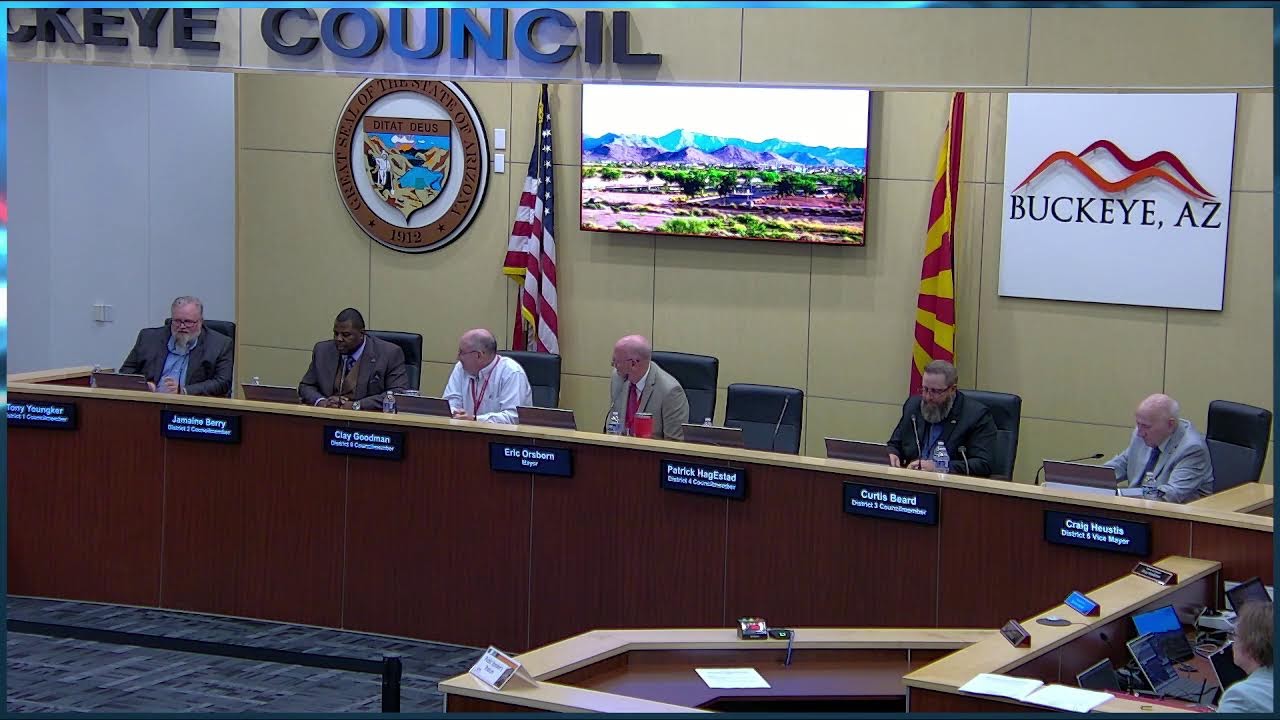
Buckeye approves three-lane Monroe Avenue redesign despite resident opposition, 6-1 vote
Buckeye City Council approved three-lane Monroe Avenue redesign despite significant community opposition, while also approving large annexations and unanimously appointing Douglas Sandstrom as City Manager.
Buckeye Council Approves Three-Lane Monroe Avenue Despite District 2 Community Opposition; Appoints Sandstrom as City Manager
On August 26, 2025, the Buckeye City Council voted 6–1 to approve a permanent three-lane cross-section for Monroe Avenue through downtown, rejecting a motion to restore the four-lane configuration and overriding significant opposition from District 2 residents. The decision culminates years of planning under the Downtown Specific Area Plan (DESAP) but deepens a rift between council and constituents who view the narrowing as a unilateral, unjustified change. In a separate unanimous vote, the council appointed Douglas Sandstrom as City Manager, capping a nationwide search conducted following the abrupt departure of the previous city manager in March.
The Monroe Avenue debate revealed sharp disagreement over whose vision should guide downtown development and whether council should defer to community preference or pursue a strategic vision for future growth.
Key Speeches
"This issue is a major issue in district 2. People in district 2 feels left out. The simple fact that you change the road without permission. They feel like you, you know, need to ask them. I've talked to several people that's lived here. One family's been here a hundred years and they said, 'Look, we didn't have a problem with the road. Why' they change it?' And they feel like they don't have a voice because we just run the gun and just change things without saying, 'Hey, let's change it and make it look this better.'" — Jamaine Berry
"I understand that we want to make it more walkable. I understand we want to make it more pedestrian friendly, but we have not given the community anything to walk to. Uh if you want to call a cigarette store or a liquor store uh walkable, it's not walkable for kids. So when the city decides to make an investment into Oldtown more than just tearing up the road, then I can see narrowing the road instead of uh leaving it the way it is." — Jamaine Berry
"You widen Watson but didn't want to ride in Miller. You left this out. You did an overpass over Verrado, but you wouldn't take the you wouldn't do an overpass over Watson over the railroad tracks. So, they feel they were left out." — Jamaine Berry, citing perceived inequitable infrastructure investment
"The only thing that the city town of Buckeye has done since founding in 1888 is change. That's the only thing that's been constant. And sometimes change is met with open arms and sometimes it's not. And when our job is to figure out what that middle ground is to make sure that we're doing what is felt is the best for the city and best for the future so that we don't look back in 40 years and think what was that council thinking at the time." — Tony Youngker
"We don't deal a lot with what is, but really need to think about what will be. Um, you know, I'm not from Buckeye. Um, but, um, born and raised in Arizona and spent a lot of time traveling through Buckeye to get to family in Southern Arizona and Southern California. also traveled Monroe as a kid um and didn't travel Monroe when they opened um I 10 connected with State Route 85. Stopped coming through Buckeye because we didn't need to anymore. Um so I think you know this is a very passionate subject. Uh, but I'm really focused on, you know, how do we set up Buckeye for success in the future, not tomorrow, um, but long after we're gone." — Council Member Clay Goodman
"On behalf of Main Street, the Buckeye Main Street Coalition, thank you for your continued investment in Oldtown Buckeye. Main Street is more than pavement. It's a place that welcomes locals and visitors alike. Monroe is more than just a roadway. It's our front porch. It's where neighbors meet, families and friends gather, and where our history is held. Our goal is not just to move cars, but to move people into businesses onto the sidewalks and into experiences that keep them coming back. This is an investment in our local economy." — Tony Youngker, Buckeye Main Street Coalition President
"I'm extremely embarrassed by everything that our city attorney said. So hopefully that's the last time we get embarrassed in public. Um, probably not. But I am very, very honored by this opportunity. I'm excited by what the city has accomplished. and I'm really excited about what I know the city will be accomplishing in the coming years." — Douglas Sandstrom, newly appointed City Manager
Timeline
Monroe Avenue Item 3C
-
Applicant presentation: Brian Craig, Development Services Director, presented the Monroe Avenue three-lane permanent cross-section proposal as the culmination of years of planning and community outreach under the DESAP process. Craig reviewed the genesis of the project, pilot striping results, and phased timeline for implementation.
-
Staff recommendation: Approve permanent three-lane cross-section (two through lanes plus center turn lane) and authorize interim striping within 9–12 months (estimated 9 months, potentially extending into early school year); permanent reconstruction planned for fiscal year 2030 or beyond, contingent on future funding.
-
Public comment: Two speakers. Jose Silva raised safety concerns at Monroe and Ninth Street, citing poor pedestrian visibility and dangerous turning conditions from the Circle K, and called for a full traffic signal rather than the current shoulder-mounted signal. Staff acknowledged the over-street pedestrian signal is on order and should be installed within one year. Tony Youngker, Buckeye Main Street Coalition President, endorsed the three-lane design as a catalyst for economic development, emphasizing the need to create a destination environment rather than a highway corridor.
-
Council discussion: Extended and contentious. Jamaine Berry dominated the debate, articulating widespread District 2 resident opposition. Barry cited conversations with 100-year families, emergency responders (fire and police), and business owners, claiming "the mass majority" of 100 residents polled opposed the change. Barry pointed to business closures (Screws and Sparkle, others) and argued that four lanes have functioned since the 1940s without problems. He challenged the council to prioritize constituent voice over planning vision and proposed returning to four lanes immediately, then revisiting the issue in 5–7 years if downtown development materialized.
Eric Orsborn and Council Members Tony Yoner and Clay Goodman countered with arguments focused on future-oriented growth. Yoner noted that Buckeye's only constant since 1888 is change and that the council must balance competing interests. Clay Goodman emphasized the need to create the right environment to attract development, citing Roosevelt Row in downtown Phoenix as an example of successful walkable density, and argued that businesses choose locations based on their own market studies, not city directives. Vice Mayor Craig Heustis shared personal experience comparing three-lane models in other cities (St. Louis) and noted the advantage of the center turn lane for business access. He also expressed satisfaction with the 25 mph speed limit and narrower street width for pedestrian safety.
Council Member Curtis Beard abstained from substantive comment but voted in favor.
Craig fielded questions on visibility triangles, sight lines for parking, and the feasibility of the three-lane design given existing infrastructure. He confirmed that lessons learned from the pilot project would inform parking setbacks and safety buffers in future design phases.
-
Vote: First motion (to restore four lanes) by Jamaine Berry: failed 1–6. Second motion (to approve three-lane permanent cross-section as presented): passed 6–1.
Opposition
-
Number of speakers against: None formally submitted a speaker card; opposition articulated primarily by Jamaine Berry.
-
Main concerns:
- Lack of community consultation: residents, particularly in District 2, felt the narrowing was imposed unilaterally without seeking permission or building consensus.
- No downtown destinations to justify pedestrian-oriented design: four lanes have served the community since the 1940s; narrowing without visible retail/residential development is premature and speculative.
- Emergency response concerns: fire and police officers reported discomfort navigating the narrower configuration, particularly in residential neighborhoods, fearing pedestrian accidents.
- Business closures coinciding with lane reduction: Screws and Sparkle and other establishments have shuttered; Barry attributed this to perceived congestion and crowding reducing customer traffic.
- Perceived inequitable infrastructure investment: residents felt slighted by council's investment in Watson Road improvements and Verrado Way interchange while declining to fund the Watson railroad bridge, suggesting favoritism.
- Parking and ingress challenges: existing pilot striping makes it difficult for customers to identify parking and for business owners to manage access and turning movements.
- Comparison to nearby failed models: Oldtown Avondale pursued similar walkability strategies and now has minimal foot traffic or business activity.
-
Most compelling arguments:
- Barry's account of resident conversations spanning 100-year families and multi-generational homeowners who have experienced Monroe as stable, functional infrastructure and now view it as abandoned by city leadership.
- The specific closure of Screws and Sparkle and other named businesses as concrete evidence of economic decline coinciding with the pilot striping project.
- The firepower of emergency responders' concerns about navigation and response times in a narrower corridor.
-
Organized groups: None opposed on the record, though Barry cited broad District 2 resident sentiment and police/fire field staff (though he noted he had not spoken with department chiefs).
Support
-
Number of speakers in favor: One formal speaker (Tony Youngker); council members Osborne, Clay Goodman, Yoner, and Craig Heustis provided substantive support during discussion.
-
Main concerns/arguments:
- Three lanes represent a compromise between polarized two-vs-four debate: survey results showed two lanes and four lanes were polarizing, while three lanes attracted more consensus.
- Extensive, unprecedented public outreach validates planning process: 1,900+ direct mailings, 11,000 social media engagements, 200+ attendees at community meetings, stakeholder group meetings, two community meetings netting 200+ each, 865 community responses to surveys, monthly newsletter to 4,000 subscribers. Staff characterized this as unprecedented in Buckeye's planning history.
- Three-lane configuration preserves key benefits: center turn lane improves left-turn access and safety for businesses and emergency vehicles; wider parking buffers increase sight lines and reduce door-opening hazards; quieter, calmer environment encourages dining and retail activity without eliminating through-traffic flow.
- Regional transportation network reduces Monroe's role as through-traffic corridor: State Route 30 (1 mile south) and Interstate 10 offer faster alternatives for regional travel; Baseline Road (truck route) and Broadway Road provide east–west alternatives, allowing Monroe to evolve into a destination rather than a highway.
- Successful precedent in other cities: Craig Heustis cited St. Louis and other metro areas that converted four-lane main streets to three-lane configurations with positive outcomes for foot traffic and business activity.
- Developers favor walkable, destination-oriented environments: during DESAP stakeholder engagement, developers indicated greater interest in locating in quieter, less highway-like settings conducive to outdoor dining and street activation.
- Five-year horizon allows course correction: if downtown development does not materialize or residents remain dissatisfied, the decision is not permanent; permanent reconstruction is 5+ years away, providing opportunity to reassess.
-
Most compelling arguments:
- Candy Yunker's narrative of Main Street as "front porch" and cultural hub rather than traffic thoroughfare, framing the three-lane design as enabling economic activity and community gathering.
- Mayor Osborne's emphasis on creating the right environment for development, arguing that the city cannot dictate where businesses locate but can influence their willingness to invest by reducing noise, congestion, and highway character.
- Clay Goodman focus on long-term visioning and the need to avoid 40-year regrets over infrastructure decisions; his framing of "what will be" over "what is."
- Craig Heustis personal experience crossing Monroe at 25 mph and noticing improved safety; his anecdote about opening a car door into the center lane and the practical advantage of a center turn lane for left-turn business access.
Project Details
-
Case number: Item 3C (agenda item; no distinct case number provided in transcript).
-
Applicant / developer: City of Buckeye (staff presentation); Downtown Specific Area Plan process involved community stakeholders, business owners, developers, religious institutions, and elected officials.
-
Attorney: Scott McCoy, Buckeye City Attorney, provided opening remarks supporting the process and timeline.
-
Location / address: Monroe Avenue, downtown Buckeye, from First Street to Ninth Street (implied from references to "one block" demonstration and "entire mile section" for potholeing).
-
Current zoning: Not stated in transcript as subject of this item (Monroe Avenue is an existing public right-of-way, not a zoning/development case).
-
Current configuration: Four-lane street (two lanes each direction) with left-turn pockets at major intersections.
-
Proposed configuration: Three-lane permanent cross-section consisting of two through lanes (11–12 feet wide) plus one center bidirectional turn lane; parallel parking (8–9 feet wide) on both sides; interim striping only (no curb relocation); permanent reconstruction to involve curb relocation, utility replacement, storm drain improvements, and enhanced sidewalk and parklet areas.
-
Timeline:
- September 2025: design concept review and survey work kickoff.
- Fall–Winter 2025: design development and business outreach.
- March 2026: destructive utility testing (potholeing).
- April 2026: final design approval.
- May–August 2026: interim restriping and resurfacing (main work; most equipment mobilization complete before school year).
- Fiscal year 2030 or beyond: permanent reconstruction (contingent on future funding).
-
Changes from previous version: The pilot project initially proposed extending the two-lane demonstration block for the entire downtown section; the council's approval authorizes instead redirecting those funds to create a three-lane interim environment and prepare the permanent three-lane design. This represents a shift from the original two-lane vision in the DESAP document.
Vote Breakdown
Item 3C — Motion to restore four-lane configuration:
- Final: 1–6 (failed)
- Yes: Jamaine Berry
- No: Council Members Tony Yoner, Clay Goodman, Curtis Beard, Vice Mayor Craig Heustis, Eric Orsborn
- Abstentions / absences: Council Member Patrick HagEstad absent.
Item 3C — Motion to approve three-lane permanent cross-section as presented:
- Final: 6–1 (approved)
- Yes: Council Members Tony Yoner, Clay Goodman, Curtis Beard, Vice Mayor Craig Heustis, Eric Orsborn; one additional vote (vote count is 6–1, but only 5 names explicitly stated; Barry's nay is the "1").
- No: Jamaine Berry
- Abstentions / absences: Council Member Patrick HagEstad absent.
Note: The transcript shows roll call votes; the second vote tally states "6–1" but the affirmative votes are not individually named for all council members. Based on the pattern, the vote was 6–1, with Barry as the sole "nay."
Outcome & Next Steps
The council approved the three-lane permanent cross-section for Monroe Avenue and authorized staff to proceed with interim restriping within 9–12 months (staff estimates ~9 months, potentially extending slightly into the early school year due to thermotape curing and warranty work). Interim striping will create the visual effect of the permanent three-lane design using paint on existing pavement, without relocating curbs.
Immediate next steps:
- September 2025: Design Concept Review (DCR) process begins, including survey work to identify existing utility locations, sizes, and conditions.
- Fall–Winter 2025: Continued design development and outreach to businesses regarding parking, parklets, turning movements, and driveway access.
- March 2026: Destructive potholeing at strategic points to confirm utility conflicts and conditions prior to final design.
- April 2026: Final design approval.
- May–August 2026: Restriping project executed during summer (lower business activity season, outside school year event season).
Long-term:
- Fiscal year 2030 or beyond: Permanent reconstruction involving curb relocation, utility and storm drain upgrades, sidewalk widening, parklet installation, and streetscape enhancements (planting, lighting, seating). Funding contingent on future capital improvement plan allocation and potential state/federal grants (storm water management funding mentioned as possible offset).
Controversies & Context
The Monroe Avenue three-lane decision represents a collision between top-down, vision-driven planning and grassroots constituent resistance. Jamaine Berry articulated a coherent critique: that the council had unilaterally altered a 80-year-old roadway configuration without obtaining explicit community consent, despite claiming broad outreach, and had done so in advance of any tangible development outcome (retail, residential density, dining/entertainment venues) that would justify the narrowing. He cited specific community voices—100-year families, emergency responders, business owners—who viewed the change as speculative, unjustified, and emblematic of council's prioritization of its own planning agenda over constituent preference.
The council's response centered on long-term visioning and the argument that creating the right environment was prerequisite to attracting private development. Eric Orsborn and Clay Goodman and Craig Heustis framed the decision as a necessary first step in transforming Monroe from a "highway" to a "main street," acknowledging that visible development might not materialize for 5–10 years but arguing that narrowing the street, reducing speeds, and enhancing the pedestrian environment were foundational. They cited extensive DESAP outreach (1,900+ mailings, 11,000 social media engagements, 200+ attendees, 865 survey responses) as evidence of community support, though the transcript does not reveal the specific question wording or the margin of support for three lanes vs. four in those surveys.
The debate also exposed a philosophical disagreement: Barry argued that council should follow constituent voice ("They are the tax payers. They live down here."), while Clay Goodman argued that council must balance "what is" (four-lane status quo) against "what will be" (a walkable, destination-oriented downtown) and accept that some decisions will be unpopular in the moment but vindicated by future outcomes. Clay Goodman invoked the principle of avoiding 40-year regrets over infrastructure choices, an implicit acknowledgment that the council was accepting short-term political risk for long-term strategic gain.
The closure of businesses such as Screws and Sparkle and the perception of downtown decline were cited by Barry as evidence that the pilot striping project had harmed commerce. Council members did not directly rebut this but suggested that business openings and closings are driven by larger market forces, not city infrastructure decisions alone. Eric Orsborn noted that staff "love to high-five" when a business opens but cannot control where private businesses choose to locate; the city's role is to create the environment, not guarantee outcomes.
The mention of Oldtown Avondale as a cautionary tale (similar walkability initiative with minimal subsequent foot traffic) introduced doubt about whether Buckeye's strategy would succeed. Heustis's comparison to St. Louis offered a counterexample of successful three-lane conversion, though the scale and demographic context of that city versus Buckeye were not explored.
A secondary controversy emerged around perceived inequitable infrastructure investment: Barry cited council's decision to fund improvements to Watson and Verrado roads but not to finance an overpass over the railroad tracks at Watson, suggesting that District 2 (the downtown/Monroe corridor area) had been deprioritized. Eric Orsborn and Eric Orsborn addressed this by noting that the Watson railroad bridge was evaluated in the recent bond measure but scored lower than other projects due to cost, and that the Verrado overpass was funded by a community facilities district (developer/resident funding mechanism), not city general funds. This reframing suggested that the council's resource allocation was rational and not discriminatory, though it did not fully address Barry's complaint about perceived neglect.
The transcript reveals no state preemption or fiscal pressure driving the decision; rather, it was a discretionary planning choice grounded in the DESAP process and the council's vision for long-term economic development.
Duration
- Monroe Avenue item (3C): Approximately 90–120 minutes (comprehensive staff presentation, extensive public comment and council discussion, two votes).
- Total meeting: Approximately 2.5–3 hours (consent agenda, two brief annexation public hearings with no action, Monroe Avenue, City Manager appointment, adjournment).
Other Notable Items
Annexation of Win Oil Company parcel (Item 3A): Public hearing only, no action. 2.52 acres at the northwest corner of East Baseline Road and East MC85, currently zoned C3 General Commercial in Maricopa County, to annex into Buckeye with C3 Regional Commercial zoning. Located within downtown activity center. First of two required public hearings. No speaker cards; no council questions. No outstanding departmental issues.
Grand View, Arizona annexation (Item 3B): Public hearing only, no action. 1,918.85 acres across 43 parcels bounded by Broadway Road (north), Jack Rabbit Trail (east), MC85 (south), and Dean Road (west). Currently agricultural, Maricopa County jurisdiction (rural 43 zoning). Will annex with initial SF43 zoning; intent to rezone to Community Master Plan with heavy employment/industrial focus and mixed commercial/residential opportunity. Project applicant not named in transcript; staff presenter identified only as "Ken." First of two required public hearings. No speaker cards; no council questions. No outstanding departmental issues. Second hearing and approval action anticipated at future council meeting, date TBD.
City Manager Appointment — Douglas Sandstrom (Item 3D): Unanimous approval (7–0) of employment agreement. Sandstrom appointed City Manager following nationwide search conducted by consulting firm, vetted through executive session process. Candidate pool included dozens of qualified applicants. Sandstrom brings decades of municipal government experience; previously worked with Buckeye City Attorney Scott McCoy in City of Surprise. Interim City Manager Dave Rodrik praised by Eric Orsborn and Attorney McCoy for stabilizing the organization during the March–August leadership transition. Rodrik's appointment prevented organizational drift and enabled the council to conduct a thorough, national search. Sandstrom is the first internal appointment to the City Manager role in this search cycle. Brief remarks from Eric Orsborn thanked Rodrik, expressed confidence in Sandstrom, and noted Buckeye's upcoming significant growth and capital improvement projects. Sandstrom expressed honor at selection and enthusiasm for continued improvement and community engagement. Applause followed the vote.
View source transcript ▼
Source: Buckeye City Council Meeting 8-26-2025 — August 26, 2025. Auto-generated YouTube transcript; may contain transcription errors.
call this meeting to order. This is the city of Buckeye special council meeting for August 26th, 2025. We will start with the roll call, please. Council member Yoner here. Council member Barry here. Council member Goodman, present. Council member Hagestad is absent. Council member Beard present. Vice Mayor Hustus here. Mayor Osborne present. Thank you very much. Uh item number two is consent agenda items and new business approval of items on the consent agenda.
All items with an asterct are considered to be routine matters and be enacted by one motion and vote of the city council. There will be no separate discussion of these items unless a council member requests. The section may include the approval of minutes from previous meetings. Council, for the consent agenda, what is your pleasure? Mr. Mayor, I'd like to make a motion to approve consent agenda items 2 A as an Adam through two S's and SAM. Second.
We have a motion for approval of the consent agenda items and a second. All in favor say I. I. And opposed. Consent agenda passes unanimous. We will move on to public hearings, non-consent and new business. Uh item 3A, council to hold a public hearing only related to the annexation of one parcel of land totaling approximately 2.52 acres located at the northwest corner of East Baseline Road and East MC85. Uh Mr. Adam Copeland, you're presenting members of the council.
Uh tonight is a proposed annexation uh proposed by the property owner named Win Oil Company. Uh it's a pretty straightforward annexation. It's located within the downtown uh within the activity center within the general plan located on the northwest corner of East Baseline Road and east MC85. Uh the site uh is uh currently surrounded by primarily the city of Buckeye on the south, west, and the north side and some county property on the east side. It's approximately 2.52 acres.
Uh and the current zoning that's in Maricopa County is C3 general commercial. Uh and what what happens when uh property annexes into the city, we're required to annex it with a comparable zoning that the city has comparable to what the county zoning is. And that zoning is C3 regional commercial. So that'll be the zoning designation that'll be in place at the time of annexation. Um and like I said, it's it is within the activity center within our general plan.
Uh the site is surrounded by commercial center zoning uh to the south primarily um and some uh city zoning to the north, a special use district as well as some open space areas. Uh to the east is Maricopa County. There's a a bar tavern that's located there. Um but it's primarily within our what we call our our big county island um that's surrounded by it's about a 50 square mile area surrounded by a strip annexation that occurred in the early 80s.
Uh so everything uh as part of this annexation meets state law in regard to all the dimensional requirements uh contiguity uh as well as all of their size uh standards. As part of this process, a blank petition was also recorded uh July 29th. Um, and this hearing is to occur within the last 10 days of the 30-day waiting period. And so we're well within that time frame with the hearing tonight.
Uh, all notices have been completed, signage, as well as all newspaper ad postings in accordance with state law. And there's been no outstanding issues from any reviewing uh, departments. Uh, so as stated at the beginning, this is the first of two public hearings. So tonight is a public hearing with no action. And with that, mayor, I'm happy to answer any questions the council may have. Thank you. Okay. Thank you. Uh first we'll open a public hearing for item 3A.
Um do we have any speaker request cards? There are no speaker requests. None for 3A. Um so we will close the public hearing and council. Any questions on item 3A? I'm seeing none. Uh so it is a public hearing only. Uh there's no action on this one tonight. We will move on to item number 3B.
council to hold a public hearing only related to the annexation of 43 parcels of land totaling approximately 1,918.85 acres generally bounded by Broadway Road to the north, Jack Krabbit Trail to the east, MC85 to the south, and Dean Road to the west. Uh, and Ken, you are up. All right. Good evening, mayor, members of the council. Great to be before you again. Hope you had a good summer. Um, similar to the last item, this is an uh annexation public hearing only.
The first of the two uh public hearings required for the annexation. This one's for a project called Grand View. Uh, considerably larger than the last one. This is uh over 1900 acres, 1918.85 acres exactly. Um, as you can see the uh the map, the parcel actually multiple parcels 43 in total um shown in the red outline.
So roughly bounded by Dean Road on the west, Broadway Road to the north, uh portions of it extending out to uh close to Jack Rabbit Trail, uh and then MC85 being that southern uh boundary. Uh all of this land currently is used for agricultural purposes within Maricopa County jurisdiction. Uh the general plan designation of this uh entire site is employment changed about three four years ago um in anticipation that we would be going through this process and a future reszoning.
Um current zoning is in the county uh rural 43 which is rural residential zone allows for one uh dwelling unit per acre uh with some uh like livestock type of privileges. The initial zoning when we annex, similar um to the previous case, will come in uh equivalent, which would be our single family 43. Um the intent is not to have that zoning for long um but to have a uh reasonzoning of the site to community master plan for a project that they're calling Grand View, Arizona.
um that would really provide a for a kind of a mixeduse um community master plan but with a heavy employment or industrial type of focus. Um it would certainly allow for commercial and residential opportunities as well. Um but the kind of the goal is for uh attracting large employment generating types of uses. Uh similar to the previous annexation, this one does also meet our annexation eligibility requirements.
Um the blank petition has been recorded and this hearing is being held uh in uh conformance with the state statutes and timing requirements. Uh notices have been completed and we have no outstanding issues uh raised by any reviewing departments. So with that, mayor, members of the council, uh the recommendation tonight is to conduct public hearing. We'll bring this back at a future meeting. Still to be determined what date that might be uh for consideration of approval. Okay. Thank you, Ken.
Um we will open a public hearing on agenda item 3B. And do we have any speaker request cards on 3B? No speaker requests. Okay. Uh so we will close the public hearing and then on to council. Any questions on item 3B? I'm not seeing any. Okay. And it is a public hearing only. We'll move on then to 3C.
Council to take action to approve a three-lane permanent cross-section from Monroe Avenue through downtown Buckeye and approve an interim threelane striping plan to be installed during the summer of 2026. Presenting tonight is Mr. Brian Craig. Thank you, Mayor. Good evening, Mayor and Council. Craig, city's development services director. pleased to be here tonight to present on this topic, Monroe Avenue project. It's an important topic. We've talked about it a few times.
We met most recently in May uh in a workshop to talk a little bit about getting a little bit more fine-tune on what the council direction is. We presented some overview of feedback and survey results and other best practices. Uh really this is going to set the stage for what happens in development activity in downtown for years to come. Tonight is the culmination not only the last few months but years of planning and discussion in downtown.
We've explored options for two, three, four lanes as I discussed, but also best practices. We looked at data gathered from uh public safety as well as financial data downtown. Um we've had two council workshops and a series of community meetings. Most recently we met with the public in middle of April uh on this topic. So, somewhat of a briefer presentation tonight since you've seen a lot of these slides and a lot of this material before.
We'll we'll hit the highlights and we'll ask to sort of discuss the the recommendation before you tonight on those two action items. Um, a quick a really swift review of the genesis and purpose of this project and and how did we arrive at where we are today. Look at the activity on Monroe to date, including what we're calling the pilot striping project and then take a tour through the long-term phasing plan.
very thoughtful approach of how do we step our way to an ultimate reconstruction of Monroe. Um it's important to rem remind you maybe and it's it's in the presentation later. Regardless of what lane configuration we choose as a community, as a council, we still have to reconstruct Monroe paving needs updated. The water and sewer needs upgraded uh elements as far as the storm sewer will be replaced over the the next few years as well.
So regardless of the outcome, we're going to be moving forward with some of these activities to improve the infrastructure in downtown. Then lastly, um in the next 12 months, what it could the timeline that we could take to approach a restripe to a three-lane section in the interim condition. So this one affectionately the DAP uh the downtown specific area plan was a monumental task.
uh not only staff, elected officials, but the community involvement over a period of of 12 months or so beginning in late 2022. Um some of the stats are there on the screen for you. We we also had outreach through direct mailings, over 1900 mailings, um 11,000 different engagements on social media. So quite a bit of involvement in arriving at what that plan is. Several hundred pages of guidance for what happens downtown.
um from land use to design, but also how do we promote downtown with the branding and devel economic development strategies. And the the book ends really with a series of tasks for council and staff and our partners in chamber and in Main Street to start implementing some of these tools that will help us achieve the vision of that plan broken into short, midterm, and long-term goals.
Perhaps none more important than what we do with Monroe to really catalyze development and encourage activities in downtown. With that said, this is the vision that was created out of that that process for what Monroe could look like. Again, it's a template. Um the numbers across the bottom aren't set in stone. They're a guide for what seemed to be the most um feable and desirable outcome for downtown based on the feedback.
And what we're looking for there is really to discourage through traffic and heavy truck traffic and really encourage more pedestrian more enhanced environment for shopping and dining in downtown. Cater to people and pedestrians rather than uh 18 wheelers and through traffic. And by nature that tends to create uh greater safety enhancements, reducing noise through that section and improving the retail and restaurant setting.
Other elements such as adding shade, adding seating, creating wider sidewalks for more of a prominade style downtown are also elements that come with this. And as you can tell, it's this section calls for a two-lane section. Uh two through lanes, one in each direction with either parking or parklets, a combination to be determined at some date by community and council. But what we're going to talk about tonight, and it was at the top of the agenda, is really promoting a threelane section.
and we'll talk about why we think we're still preserving a lot of the elements of the DESAT plan with the three-lane section, but achieving some greater gains through public safety, safer turning movements for for vehicles in downtown. Again, I talked about a thoughtful approach to how do we step through the stages necessary to achieve ultimately what we're calling stage five, a new cityscape and downtown improvements for downtown somewhere in fiscal year 30 or beyond.
Um, we're we're partway through this list. We've completed those stages one and stage two. There's slides on each of those, but really in the middle there where we we have to nail down what permanent configuration we want in downtown and that will help dictate what we do with utility infrastructure, storm drain infrastructure and all the things that occur below grade.
And as we talked about in the past, that tends to be upwards of threequarters or 80% of the cost of reconstructing a main street occurs below grade and you don't actually see see that. Um, coming up in a future council agenda is a DCR, design concept review for how could we achieve storm J improvements and utility improvements in downtown. And that's really the next step beyond tonight once we nail down the configuration.
Just briefly, you've seen this, you've experienced this on Monroe um over the last year and a couple months beyond really an overhaul from a four-lane section, a true highway section to to more of a main street feel. um two lanes in each direction, preserving left turn pockets at major intersections, but really the goal of creating a reduction in travel speeds, safer environment for pedestrians, and and imagining what we could through a pilot project achieve long term.
We've learned some lessons. We talked about that in previous presentations, things that we would do differently perhaps with the striping, the paint on the ground, but when we go to move the curbs, if council chooses to do so, how we would achieve that in the long term.
And the demonstration was really just one block to imagine what you what the ground feel would look like if you enhance the area with trees and seating and shrubbery, creating additional seating opportunities or bringing that sort of pedestrian environment further out into the middle of the street to create not just the narrow sidewalks that exist today, but creating a greater opportunity for those prominance style sidewalks. This is truly a demonstration. We got feedback.
We solicited feedback on this. these planters and these plant materials will live on through the project and the overall um the overall design and the DCR that's going to occur which includes some destructive testing of of Main Street to see where all the utilities are. These will find a temporary home somewhere else in the near future really achieve the vision of what it could look like downtown. Now, really this is where we're at today.
We're in stage three and the original vision was to extend the demonstration block for the entire section from 1st to 9th. Um we're retooling that. We're proposing tonight to use the money we would have spent on enhancing this two-lane section to really imagining if if the direction tonight is to go to three lanes, plus use that to create that three-lane environment through Monroe downtown. Those funds are already in the budget for this fiscal year.
Some of these things are these elements can still occur post the restriping as we're proposing and you'll see in a couple slides um in the next 9 to 11 months the restripe project the elements that you can see on that center photo such as those string lights across Monroe maybe some additional trees and other seating can still be a part of the project long term really the focus we want to get it right is the number of lanes and line of the striping and again stage four is right on the heels of stage industry here really this work needs to occur now so we set ourselves up for success in the next 3 to 5 years when the reconstruction comes up in the CIP plan book DCR design concept review of what are the opportunities but also challenges we need to know what's what occurs under the pavement where are the utilities at today what are some of the conflicts that may occur with existing driveways the future for expanding additional fire suppression services through downtown other types of utilities that need to upsize to accommodate greater density residential, increased restaurant and retail activity down.
All this may be triggered with the timing. As you are well aware, we're working on storm water management through downtown, which includes money from not only, I think, county, state partners, but federal funding to help offset the cost for the city. So, as we go to do this, it's really about an economy of scale, a dig once policy. Once you tear up the road, we don't want to have it constantly under construction.
and can we achieve the vision of the DESAP but also take care of our needs from a utility and and infrastructure perspective at the same time. Just briefly a reminder, you know, what is the aim here? What are we what are we trying to achieve through the DAP plan? Really trying to create widened amenity zones, encourage nightlife in downtown, expand shopping and dining activities, create festival and gathering spaces.
All these bullets, this list I'm reading off to you are the types of things that occur in the DSAP were what our community told us they wanted to see downtown. Encourage nightife. Uh shed the idea that Main Street closes during banking hours. Really activated a community center again.
So some of these elements you see the crisscrossing, lighting, um some of these other sorts of things that temporary furniture, those can still occur in this interim condition in the next between the next year and next five years when we reconstruct Monroe. So this is a look at a rendering of what the permanent configuration could look like downtown if council chooses to go with a threelane section.
So this is this involves moving the curb to the center line in the street to achieve somewhere between 8 foot 8 foot and 9 foot wide parking um anywhere 11 to 12 foot wide through lanes and a center turn lane all the way through the section. Then again, eight or nine foot parking zones on the other side, parallel parking. Um, also preserving greater visibility for driveway access. And again, we talked about the original DESAP vision was a two-lane section.
One of the things we we realized that creates um create can create hazards or difficulty turning left into some business driveways or accessing different services in the downtown. the center turn turn lane through the section creates opportunities to improve that as well as enhanced opportunity for emergency vehicles to bypass um are pulled over to the shoulder but not within a park.
Um, and because the third lane is not a through travel lane, the goal of traffic calming and reducing the number of vehicles that just pass through the street at at a high volume is reduced because really once you reach those intersections, that turn lane is expected to to make a left or to come back into the travel lane. And here's a sort of ground view and a bird's eye view of a permanent threelane section. Again, you have that center birectional center turn lane.
you have a a wide travel lane through the section with a buffer area between the parked cars. And that was one of the the um feedback we received through the section is it safe to open a driver's side door. And that in the past when you had four lanes travel and parked cars, cars could veer out into the center travel lane to avoid that. The opportunity to create a little bit of additional space for those doors to open. Now, this is what I promised at the beginning of the slideshow.
How can we achieve an interim condition in short order? Um really with the decision tonight and giving direction to our project management office to to kick off and begin the scoping for the DCR, the survey work that's required to do the striping properly, but also that survey becomes part of the the permanent project in a few years as well. kicking that off this month and as well as some of the activity that they're already preparing themselves to do.
And then through the fall in the winter as we begin event season in downtown really we do a lot of the design and development work but also the outreach the businesses you is there an opportunity to look at does a business want parking near the front door? Do we want to create opportunities for them to preserve parkletits? Those sorts of items and what's important from them for them as far as turning and access to their business.
really not disturbing Main Street or or blocking off travel lanes during the prime event season, which is really October through March for the city of Buckeye. In March, while school's still in session, we do need to begin doing some destructive potholeing where we take it's about a foot diameter and there may be 50 through the entire mile section where we go and we see what utilities are under there and what are their diameter, what are their sizing, what are their condition.
And so doing that as close to when you're going to resurface the street as possible limits the number the amount of time that you have potholes that are just cold patched. You do those near the end of the survey and design work so that when you come back in and you're going to either mill or do whatever surface treatment you're going to do to the to the project, you come back in with a cleaner surface instead of a patch surface.
So preserving the event season through March and then really in March and April doing the potholeing through the section at key strategic points and then submitting the final design for approval. But then as school starts to approach dismissal for the summer really that's when the the main work would get underway and businesses the slower season tends to be over the summer. It's not prime shopping season.
Through May, June, July, and August, really the bulk of the work of resurfacing, eliminating the striping that exists today and coming back with a new set of striping for the threelane section. And all this is projected into the fiscal year budget for downtown this year. There may be some because of the time that's required between putting what's called a thermite back down in the fresh asphalt, there's a little bit of a delay.
Some of that may occur after the first weeks of school, but it will be a a quick project. Hopefully, we intend to have all the uh the equipment mobed out by the time school starts again with this proposed schedule. And to give you a sense of what we're talking about in interim condition, um this graphic we we put together for you shows really our idea would be to eliminate the the faux paver crosswalks and go back to the high visibility white stripe crossings. Excuse me.
um develop the three lanes, the two travel lanes and the center turn lane as 11 to 12 foot wide and then have parking up against the curb. That was one of the pieces of feedback we received throughout this process that it can be a little bit harder to discern where someone's supposed to park despite, you know, best efforts with surface painting and symbols. Pushing parallel parking up against the curb where it's natural and it feels appropriate.
Then with the extra pavement, that's one day going to become sidewalk. If this is a three-lane section, that becomes an additional buffer between the parking area and the travel lanes. Um, additional enhancements can occur post reripe. One of the the topics floated was can we introduce these plaza string lights? I mentioned a few times through the presentation.
That's obviously something that can occur as well in the interim period and those can be preserved long term in future development as well. And then the demonstration park lit, those planter boxes and trees will be temporarily relocated during the the potholeing and the DCR project. Really uh thank you for your attention, mayor and council. I'm the staff is asking you to uh vote on these two items tonight.
First and foremost, making a decision on the long-term configuration for Monroe, but also authorizing and approving staff to go ahead and restripe the interim condition to approximate what uh this the community will see in the next three to five years once we redo the section. And I that note says 12 months. we achieve.
We believe it'll occur in about nine months, but as they again thermotape and the coming back to do the warranty items may spill a little bit into the school year, but most of the equipment will be moved out of the site. Thank you, mayor. Available for questions. Okay. Thank you, Brian. Uh let's do uh speaker request cards first. We'll go to public uh comment and uh I've got two that one of them is for non-speaker comments, correct?
So not they're uh Jose Silva, you're not expecting to come up and speak at the meeting. If if if you want to come on up and can get in our little bullpen right here and go go into inside of there and there's a microphone that'll pick you up there. Concern is I know it's not the issue about the three lane. It's about Monroe and Ninth Street with the light and I've seen a lot of times where kids almost get ran over and I think it's very dangerous and we need an actual light. Okay.
Uh, also go ahead. The cars that are parked right now, um, when people want to turn in, uh, they can't see the traffic coming, but you have to go out more and it's very dangerous. Uh, we have someone that can address the concerns. Is that public works or who do we I can answer that, mayor. Um, the Ninth Street Hawk signal. uh not the the true hawk that goes over the travel lane, excuse me. But the signal on the shoulder is installed today.
The over the travel lane pedestrian activated activated signal is on order and should be installed within the next year. Yeah. As soon as we can get it in. Okay, great. As far as a traffic signal, that's not in plans just yet. Okay. because nobody really pays attention to it. And from that turning coming from the Circle K, they don't have enough time to stop and the kids don't have enough time to walk across the street. Okay. Okay. Thank you, Mr. Silva.
I think part of what he's bringing up is also the um uh the site visibility uh triangles or I think there's a a potential in the the new plan uh that's developed to work those a little bit better to where parking doesn't if you have vehicles parked you don't have to push your nose out in oncoming traffic in order to see u an opening to to move. Can you address that also? Sure. Sure, I can address that right now, mayor. Absolutely. We'll work on that as well.
But where vehicles are allowed to park and encroach into that intersection as far as blocking the view of traveling vehicles from young children or adults crossing, that's certainly something we will work on. And and not necessarily just Ninth, but uh along the entire stretch of Monroe. Absolutely.
That's one of the things that I tried to exhibit in one of those those diagrams is creating a better rad uh buffer between parked cars and not only just pedestrian crossings but also vehicular crossings where you can get a greater perspective of view on coming truck. Okay. And probably one of those lessons learned absolutely in the the test case that we have out here. the mayor.
I think initially we we tried to maximize parking and that achieved one goal, but also I think there's greater goal of improving safety means we may have to trim back some of that parking area so we can make sure pedestrians and vehicles can be seen. Okay. Thank you. Okay. Uh our second and this is the last public comment card that I have is uh Candy Yunker. and Candy Younger, Buckeye Main Street Coalition President, 508 East Mayor and Council.
On behalf of Main Street, the Buckeye Main Street Coalition, thank you for your continued investment in Oldtown Buckeye. Main Street is more than pavement. It's a place that welcomes locals and visitors alike. Monroe is more than just a roadway. It's our front porch. It's where neighbors meet, families and friends gather, and where our history is held. Our goal is not just to move cars, but to move people into businesses onto the sidewalks and into experiences that keep them coming back.
This is an investment in our local economy. Communities across the country have seen that when traffic flows predictably, drivers notice storefronts. They see available parking and they feel encouraged to stop. It invites people to stay longer, spend more, and share their experiences with others. The threelane design provides flexibility for the future. Room for the kind of improvements that turn Oldtown Buckeye into a destination. This layout helps us shape that identity.
Improvements such as landscaping, gathering spaces, public art, and streetscapes tells people this is the heart of Buckeye. Mayor and Council, thank you for your vision and your leadership. Together, we can position Oldtown as both the heart of our city and an integral part of Buckeye's economic growth. Okay, great. Thank you, Candy. Um, all right. That's all that I have for uh public comment. Uh, we'll go to council and any questions or comments from council. Yeah, I have several uh this issue.
Sorry. This issue is a uh major issue in district 2. Uh people in district 2 feels left out. The simple fact that you change the road without permission. They feel like you, you know, need to ask them. I've talked to several people that's lived here. One family's been here a hundred years and they said, "Look, we didn't have a problem with the road.
Why' they change it?" And they feel like they don't have a voice because we just run the gun and just change things without saying, "Hey, let's change it and make it look this better. Let's make it look better or let's change it because the traffic is bad." But they don't see any of that. So the bottom line is the bottom line is I understand that we want to make it more walkable. I understand we want to make it more pedestrian friendly, but we have not given the community anything to walk to.
Uh if you want to call a cigarette store or a liquor store uh walkable, it's not walkable for kids. So when the city decides to make an investment into Oldtown more than just tearing up the road, then I can see narrowing the road instead of uh leaving it the way it is. So I walked around and talked to the people.
The mass majority, when I say mass majority, I mean out of a 100 people, maybe five said, "Uh, oh well." But the mass majority of the people does not see nothing wrong with the four lanes or ever had a problem with the four lanes. And that's that's that's what I'm getting over and over again as I talked to the community. So I wrote a little something. I'm just going to tell you how they feel, how I was talking. Uh you widen Watson but didn't want to ride in Miller. You left this out.
You did an overpass over Verado, but you wouldn't take the you wouldn't do an overpass over Watson over the railroad tracks. So, they feel they were left out. I've had several conversations with the fire department, not the chiefs. I didn't even talk to the chiefs because the chiefs don't drive the engines.
and all their guys says they feel they feel uncomfortable driving through the neighborhoods because they're afraid that some kids are going to run out as they're driving through the neighborhoods because of Monroe is congested. U I've also had the same conversation with police officers. They said they're having to uh kind of take their time getting around people to get get from point A to point B even with their lights on because there's nowhere to go. I've grew up right here downtown.
I mean this I mean right here downtown and I've always parked on the side of the road. I don't need a park. I've always parked on the side of the road. I grew up right here downtown. There's always been people if they need to go somewhere I'm sorry y'all. They don't walk. They drive. It's just the way it is.
So if if it was going to be if we had a plan, a true plan, not just coming up with some imaginary thing, but a true plan that was implemented and saying, "Look, we're going to we're going to go three lanes and we're going to widen the sidewalks, but we're going to have somewhere for these people to walk to." Then I can understand. But as of now, we're not giving them anything to walk to.
So if we're not giving them anything to walk to, leave the road, put the road back the way it was because that's what the people like. That's what they wanted. That's they are the tax players. They live down here. This is the road that they not only just come and just uh leisure, but this is how they get to and from home, to and from work. This is their road. Put it back the four lanes.
And if it's just interrum just for seven, eight years, how many years you thinking it's going to take do construction? Be five years. It could be five years. So if it's five years and then we bring some economic development down the main street and we see it then say, "Hey, we got we got we got a buildings with stores on the bottom, we got apartments on top, people are walking around, we need wider sidewalks, but just to do it and there's no no reason to do it, it doesn't make sense.
Doesn't make any sense. So all the all of the the reason being to me it's invalid because Main Street has always been here. Monroe's always been four lanes. Monroe has always thrived. Monroe has always had businesses. A matter of fact, we got less businesses now than what we ever had. And if I tell you the truth, I'm going to stop rambling here in a minute. Scott, if I get to talking too much, just hit just text stop and I'll see it on my phone.
We had we have less businesses now and just even over the years what four four four businesses changed names two businesses two businesses has shut down permanently and the only common denominator is in Monroe. That's the only common denominator. People are not traveling. People don't travel where it's crowded. How many of you just go downtown Phoenix just to drive around? No. You only go when you're going somewhere.
And the reason why you only go when you're going somewhere is because it's crowded. So, if there's congestion on our streets, it's going to stop people from coming down here and they're going to go somewhere else. And it's already been proven. Screws and sparkle shutdown now uh to the limit. They're shutting down. And a lot of businesses have changed names because I believe it's crowded and no one likes to be crowded. No one likes to be congested.
They'll just turn around and go where it's less crowded. Uh, one other point and I'll be done. And I'm going to go back to the people that live here in this district. This is their home. And the majority of us on this board was not raised here. And you can't and we can't take in consideration on what they say and been here hundreds their family's been here 100 years 75 years. I talked to a gentleman today said he's grew up here 75 years and he's never had a problem with the road.
If we can't listen to what they say that means that this council is out of touch because we are voted by the people to represent the people and be their voice. And our job is to listen to their voice. And if they want four lanes, even if it's just intram, just for the four to seven years, let's let's put the four lanes back to what they want and then we come back to the table, put it back up for a vote, and maybe by then three three lanes will look better.
But right now, it doesn't make any sense. Does it make a bit of sense for us to vote for three lanes when we already see it's a mess and it's, you know, to vote for three lanes, we already see it's a mess. Go back to the four lanes because we know the four lanes worked. We don't need another experimented trial. We don't need the experiment anymore. And if we just take a look at Oldtown Aenddale, that's the closest city to us. When was the last time anyone been down Oldtown Aenddale?
I don't think so. there's nothing down there because they're doing exactly what we're trying to do now and everybody walked away from it. We need to take in consideration what's really going on, what's really best for our community, what's best for our city and say, look, if it's been four lanes since the 1940s and there haven't been any problems, why don't we just leave it the way it is and work around it? I believe we can make a great downtown with four lanes. And I can help you with that.
I'm a pretty good visionary. I believe everything you had on the picture, we can do it with four lanes. there's sidewalks we can take in instead of moving out and it can make it work. So, uh I'm just sticking up for my district, but as council, we need to consider the voices of the people and not our own agenda on our own plan. Thank you. Thank you, Council Member Barry.
Uh uh yeah, I I just want to talk Brian, can you speak uh briefly about the stats of the public outreach whenever we uh initially did the DESAP planning and uh talk about that process and the unprecedented amount of outreach that we did to the uh public? You bet me or Susie. Back to that. One of the things we we did was we were intentional to have a extra-l large stakeholder group to ensure we had a wide diversity of opinions.
So we used every tool imaginable, postcards, social media blast, the signs in downtown, flyers where we could to try to recruit folks to that group. Um so that group met often through the process in in a cycle to help direct it. So it had had teens, it had leaders from the religious institutions, it had a couple elected officials, planning don members, business representatives, developers, perspective business owners in downtown as well as existing business owners in downtown.
And then um through that process, we had two community meetings. Each of them netted over 200 attendees each through downtown sort of checkpoints through the process. And then we still send out a monthly update and there's 4,000 subscribers to that. I think we sent one out um over the weekend on tonight's meeting and then 865 community responses that was earlier in the process to really sort of narrow down what's important to you as a community member.
What what do you like already and what would you like to see improved? Then as far as the Monroe specific project uh meetings, we've had five meetings specific about Monroe on this. And again, we shared the survey results during the last um meeting. And if you recall, two lanes and four lanes was definitely a polarizing topic. Three lanes seemed to be right in the middle.
It had more favor favoritism among folks as far as So you're saying that three lanes is more of a compromise in the middle of what both polarized sides feel. And then um most recently really ramping up our social media outreach to this. And I I mentioned 11,000 engagements, but over 77,000 counts reach. So obviously that's not 77,000 people that live in downtown, but folks that are interested in what happens downtown to participate. Okay.
And uh just for this might be a hard question to answer, but comparatively speaking on a pro other projects that happen with outreach and stuff like that, what kind of responses do we normally get on stuff like that? Is it of this stature or is it more? Is it less? I think anecdotally we are most proud about this project. Even um staff that have been here 15 upwards of 20 years have done something of this caliber and we why we really liked the group we were working with Olsson Associates.
They really took that to heart that one of the most important aspects of this project is back as possible. Okay. And um within the the the contemplation of doing all of this, how much different would the interim plan look from the end result? And and we see the we see the uh the drawings and the the the sketches and everything that are done for it. How are we looking at something that's going to be more of that or is that just something for a future us uh to deal with?
Are you asking council member what the intrum would be to the ocean draft look like on this project versus um no no not the first draft what we're talking about the three lanes currently in our end within the DAB our end result oh is that is that typical to to sort of use that as a guide excuse me yeah I think that's really it's it's hard to foresee especially when we did this in 2022 and into 2023 knowing that it was probably 10 years out at that point before we could achieve achieve a reconstruction, it's really hard to predict what is going to go on.
So through a combination of best practices, what works in other communities of our size and what these professional consultants typically see as successful models provided that. But again, it's with the caveat even during the presentation that this is really a tool. This is a guide. You have to really customize it to your local conditions. And I think that's the beauty in my mind of the process. We had uh we had really a relatively speaking a lowcost pilot test that we got a lot of feedback.
Not all of it was positive, not all of it was negative, but it helped sort of steer us in the direction of moving towards more of a three-lane that seemed more palatable from staff's perspective, the broader audience. Okay. Um and just the last part is more of a statement.
think that something that I try and keep in the back of my mind whenever we're doing anything that is of this stature or change is something that is historically viewed a certain way in Buckeye is that the only thing that the city town of Buckeye has done since founding in 1888 is change. That's the only thing that's been constant. And sometimes change is met with open arms and sometimes it's not.
And when our job is to figure out what that middle ground is to make sure that we're doing what is felt is the best for the city and best for the future so that we don't look back in 40 years and think what was that council thinking at the time because there's multiple things that we can point at that we wish that there's a different different outcome or a different decision made but you can't go back and fix it and we just do it the best that we can with the information at hand and move forward.
So with that I'm done there mayor. Thank you. Thank you Councilman Yoner. Uh Councilman Goodman. Do you have questions or comments? Yeah, just a a few comments and I want to thank my colleague Jermaine for speaking from the heart. That's what he's here to do. Um, I think as a council, you know, we're challenged and and typically, you know, there's we deal with what will be um whether it's water and what we did in Harka to ensure water supply for the next 110 years.
um what we're doing with transportation, not just Monroe, but how we're um we went to the voters to get a bond to help us build out our roadways and improve roadways for the future. Um trying to attract industry that'll bring jobs and and economic development here. So, we don't deal a lot with what is, but really need to think about what will be. Um, you know, I'm not from Buckeye.
Um, but, um, born and raised in Arizona and spent a lot of time traveling through Buckeye to get to family in Southern Arizona and Southern California. also traveled Monroe as a kid um and didn't travel Monroe when they opened um I 10 connected with State Route 85. Stopped coming through Buckeye because we didn't need to anymore. Um so I think you know this is a very passionate subject.
Uh, but I'm really focused on, you know, how do we how do we set up Buckeye for success in the future, not tomorrow, um, but long after we're gone. What's that? What's this city going to look like? What's it going to be known for? Um, so I think this is one of those decisions that's very hard. We really need to think about what will be and not maintaining what is. Thank you. Okay. Thank you. Appreciate all the comments. I've got uh maybe a couple uh just clarifications.
Uh from a from a infrastructure perspective, uh I I think Council Barry, you had mentioned Verado and the interchange at Verado and uh versus um work in in or or the bridge going over um the railroad tracks, railroad tracks and and such. Um, Frank, can can you share who built and paid for the bridge over I 10 at Verado Way? I don't would you address that, D? DMB. DMV. I couldn't speak intelligently to that. And in the community facilities district that those residents are paying for.
Um and and when we talk about the the bridge, uh it's being contemplated going over um the rail tracks and um and the canal um and was one of the projects that was looked at in the bond, but wasn't one of the higher scoring one because of the the cost to install that versus say uh an intersection at Watson Road and and um uh Broadway or for one of those other other projects. Uh so just want to make sure we're eyes wide open on on all of that.
Uh and then from a from a business perspective, um the city, I know every business that opens, uh we love to uh high-five on and and um take personal responsibility that that opened and and cheer. Uh but the reality is it's the businesses that are making the investment and it's the businesses that are deciding to open or not open and um and whether they they land on Miller Road or Watson or Verado Way or uh Indian School in Jack Rabbit or or in the downtown district.
It's not the city uh that is opening the business and and I mean that includes um that includes a grocery store up in Festival. It's not the city that is opening that. Uh we c do the best we can to create the right environment for that to happen, but it is the it is the private business that is developing and opening and and going into business there. It's not something that uh that the city can dictate where those uh those businesses open up.
And I think from a um from a a plus minus on businesses, what what we see in downtown uh where you you could say that at the time that a couple of businesses have closed, there are several businesses that have opened or there's been a a trading of spots, um locations. Uh it sort of feels like that's kind of happened across the city. And I'm looking at Susie and she's kind of shaking her head. I got a thumbs up on that.
So, that's happening not only in the downtown corridor, but it's happening in uh some of the other districts that we have throughout the city and actually throughout the the metro Phoenix area. There's a there's an eb and flow to uh to business. What we can control in the downtown is the environment and it's that u the objective uh is not the throughway, which you've stated. It's not a highway that goes through our downtown.
Uh it is it's really creating the environment or that destination for people to show up to. And I I didn't want to raise my hand every time he asked a question, but the I we sometimes go to some of the those downtown areas that are really crowded where there are a lot of people and Roosevelt Row is a a great example of that. uh in downtown Metro Phoenix. Um they've created that right environment that you know is a walkable area. There's a lot of density that's there.
Uh there's some some very very cool restaurants and and night life that happens. Farmers markets and and all kinds of um opportunities like that that we hope uh to create the right environment to where that happens in the downtown core here. um from a there's been conversation about the east west and and ultimately how we're getting to and from uh well actually let me let me finish that thought.
So if uh we can't control whether a business chooses to land uh in our downtown corridor, but we can create that right environment.
And we've heard from some of those developers throughout the the DESAP process that if if it's not a highway that goes through here and it's something a little bit more quaint in a destination, uh that that they're more apt or interested in locating in an area like that as opposed to um I was sitting at lunch today and there's large trucks going through with big loads and that's a little bit more intimidating especially if you're trying to activate that outdoor space and extend some of these smaller restaurants we have outside so they have more room to serve uh people and have a larger pool of business.
Um that that is the intent of of what we're creating. And I I think in some of what you've shown there, it's we're limited by space. if if that business is going to extend out at this time, they're extending out over a sidewalk that we still have to maintain access across. And so it really limits how we're able to extend those businesses out into this open space and really activate it uh without taking away some some of that asphalt that exists out front.
Otherwise, you're going to the back and um and that so you're cutting back through a kitchen maybe in some cases or just not very conducive to uh to serving people and and expanding that business. Is that is that fair to say, Brian? Absolutely. Today, I think a lot of the areas uh along Monroe are six foot wide on average. Some are wider than that, but areas foot. So four to five foot sidewalks typical for meeting ADA requirements and and sidewalk and folks passing comfortably.
So really eliminating the possibility of sidewalk cafes and you mentioned you know asking restaurant tours and that was one of the groups that we targeted specifically how do we encourage cafe restaurants not all year round can have outside seating but how do you get people to come and eat at your restaurant? One of that is creating that environment not only the space also the ambiance. uh two things. People attract more people.
So bringing more people to the area becomes more of an attractive place to be. But also having that space, having that environment that's quieter and calmer, more enjoyable for staying longer. Yeah. Sweeter. Okay. Uh Okay. Um and then from a uh public input perspective, I I think there's been some real key takeaways from this.
Uh, one of the biggest that we're talking about is instead of the two lanes that exist right now, which uh, I I fully understand if you're turning left into a business that you've turned left in for the last 60 years, whatever 80 years, whatever that time frame is. Um, and and it's two lanes only. You're backing up people behind you until you can get that uh until you get that break in the traffic coming the other way to turn in.
if uh if you have that center lane and I think that's what we're hearing is having some ability to get out of the traffic that is running um and wait so you're not backing up traffic behind you. That center lane goes a long way to taking care of that issue that's been brought up not only by the public but what we see in in uh in real life out real time out on Monroe.
Mayor, we think that's the greatest opportunity with the three lanes is not only the convenience, but also the safety of of greater time to make that left. Okay. And another one, I heard you talk about this, but I just wanted to hit on it again, is is that parking width. Um, and I find myself cheating over a little bit in the in that parking stall as they're painted out right now, making sure that you're you're getting far enough off.
So, when you do open your door, uh, it it doesn't feel like you're opening it right into the turn lane. Uh that's I think something that's a lesson learned that as we go into the next design uh this this three-lane design that we have more room for that parking still plenty of room for that sidewalk and the the parklet and the open space that we're trying to create uh but creating a little bit bigger safety buffer in um uh in that parking stall so we're not opening our door into traffic.
Absolutely mayor. I think we did the math actually today as it stands with two lane condition. The parking area is one foot wider than it was with four lanes. When we do the interim, it's going to feel really comfortable because that's just extra space that we're waiting to move into a sidewalk condition in the future.
The goal for longterm is to create an enhanced gap between the parked cars that adding additional space to the travel lane or making the parking stalls a little bit more comfortable. That's something else. Okay. Um, and that throughway, uh, this was one of those thoughts that that I left earlier. Um, from an east west transportation perspective, what does that picture look like here in the not too distant future uh, with some of the Prop 479 projects that are coming? Yeah, absolutely, Mayor.
Long-term, the SR30 is going to be a great asset if someone's really just trying to get west of Buckeye quickly. or or east. Or east. Yeah. Coming from the west. Absolutely. In short order, below's now essentially when you get closer to downtown. Bote's now the truck route designated by Buckeye. And you have the load or you have essentially baseline as an opportunity to get through downtown. Truly your goal is to how fast can I get through downtown Buckeye opportunities for that.
But hopefully our the goal of people coming through is what can I do? What can I shop? Yeah. And that state route 30 is a mile at the most I think south of the of what's Monroe or this downtown corridor. Yes. From the smarter folks in the back at nods at nods and thumbs up. Okay. Okay. It's not set yet, but approximate. Right. Yeah. I think that's the um potential corridor that we have. Uh Councilman or Vice Mayor. Yeah.
I wouldn't normally follow the mayor, but when you were speaking about restaurants, you reminded me I'm down here quite a few days a week and I eat lunch down here a lot and I cross that street a lot out there and I am happy as I'm getting older that you lower the speed limit to 25 miles an hour because I don't see the chief around. But I do have a tendency of jaywalking once in a while and it sure keeps me a lot. There he comes. Chief heard it. Yeah.
It's all This is all being recorded, too, just so you keeps me a lot safer at 25 miles an hour and a little bit narrower street, but um personally, I mean, I've been to other major cities where I was from and I've seen them turn four lanes to three lanes and it doesn't interfere with the through traffic and it allows people to make that left. Now, really, I mess with my wife a little bit about it.
She comes down here to pick up my granddaughter who teaches across the street and you know she says, "Oh, it takes me to stop there and wait for a left turn." I said, "What, a minute? What are you going to do with that minute?" You know, really the way it is with three lanes, you're going to have even more access to being able to make a left turn. When I go to get her cigarettes next door, I've got to sometimes make a left turn to get in there.
You know, that third center lane is quite an advantage. And I saw it in St. Louis where they've turned the four lanes into three lanes like that and kept the parking on the side. I had issues with the parking on the side as you know when we first did it because I was worried about people opening up their car doors as a lot of them had told me. And uh but it just I was thinking about what the mayor was saying.
You know, I want restaurants down here because I want a different restaurant I like to try out once in a while and we're putting a couple new ones in. And uh I enjoy it downtown and I think a lot of other people would too if we can sell the product. But you know, we will. It just you can't pop it up overnight. And as the mayor said, we don't choose who comes down here.
You know, you think we're going to tell McDonald's, "Oh yeah, open up a restaurant down here." They're going to say, "Where's your million bucks?" You know, we don't tell these places where to go. They choose where to go. I come from a large big corporation out of St. Louis, and we have our own people to do our studies. I don't need a city to tell me. So, they're going to do their own studies, and if it doesn't pay, if it's not going to get you enough money back, they're not going to do it.
Or their stockholders will kick them out. That's just big business. That's just life. You know, we hope to get businesses down here, but we've got to get something to get them to come down here. slow the speed down, give them decent traffic through downtown so that we've got other restaurants to go to down here, too. So, anyway, Mr. Mayor, sorry for interrupting, getting on into yours. Thank you very much. Okay. Uh, thank you. I appreciate that. And you know, Deb can hear all this, too.
It's recorded. Uh, okay. Any other discussion from council on on this item 3C? Okay. Council, what is your pleasure for 3C? I'd like to make a motion to move to direct staff to reconfigurate Monroe along uh make two lanes going eastbound, two lanes going westbound and direct staff to move within the next nine months. I got a second. All right. I have a motion and a second to go uh back to four lanes as I understand it. Y uh and um can we do a roll call vote, please? Council member Yoner, nay.
Council member Barry, I member Goodman, nay. Council member Hegestad. Nay. Council member Hegestad. Did you hear him? Was that nay? Councilman Hagistad. Yes. Yeah. Council member Beard. I Vice Mayor Hustus. Nay. Mayor Warsborne. Nay. Okay. The motion fails. Uh, council, any uh can I get another motion for 3C? Mr. Mayor, I'd like to make a motion to approve agenda item 3C as in Charles. Second. Have a motion and a second for approval of agenda item 3C uh as presented. Let's Pardon me, Mr. Mayor.
Just want to make sure that we have clarification on that motion. Thank you, Vice Mayor Hustus. So, what I believe what the intent was was to approve item 3C uh following the staff's recommendation up on the screen right now. Is that accurate? Yes sir. Okay. Thank you. All right. Uh, can we do a roll call vote for that as well, please? Council member Yoner. Hi. Council member Barry. Nay. Council member Goodman. Hi. Heestad. I got it. Thanks. Council member Beard. Hey, Vice Mayor Hustus.
Hi, Mayor Worsborne. I have it. Okay. Thank you. Thank you, Mr. Craig. Thank you, council. Uh, council, appreciate the very, very good discussion on item 3C. All right, I think that's all we have for tonight. Um, don't you dare. Oh, wait. Doug, don't go anywhere. I think that requires a motion. Yeah, it does. Yeah. No, it's a German. It's at the end. I don't have to do any motions. All right. Item uh 3D.
Council to take action on entering into an employment agreement for the position of city manager between Douglas Sandstrom and the city of Buckeye and authorize a mayor to execute and deliver set agreement on behalf of the city of Buckeye. Uh, Mr. Attorney. Well, Mayor Osborne and council members, what an exciting night tonight, not only for the council, but for our organization and for the community.
Uh, tonight, this agenda item styled as an approval of an employment agreement, but the real thrust of that is that you're going to be um choosing to appoint your next city manager to lead this organization into the future. Uh, exciting uh exciting night for sure.
Uh as you know, back in March when we abruptly lost our city manager, uh we were uh in a little bit of a leadership vacuum, this council stepped up immediately, calmed the waters, uh implemented a plan for us to get here where we are tonight. We did it in what I view as record time, but we didn't cut a single corner. Uh you put in place a plan uh where we went out, our very capable um human resources director, Cindy Camaretta, uh went out, hired a a consulting firm, worked with that firm.
They've worked with the city council to establish the criteria for your next city manager. We conducted a nationwide search looking for the top candidates uh to fill our top leadership role in the city. We vetted dozens and dozens of applications from qualified individuals. Uh scaled that down to a manageable group and let the council interview and make your selection. Turns out that the best candidate in the nation to fill our position was right under our roof uh with Mr. Sandstrom. Mr.
Sandrum comes to this uh city with a vast experience. He's worked in uh municipal government for decades. I've had the pleasure of working with Doug back when I was a city attorney 20 years ago in the city of Surprise. So um was Doug was a welcome face when he joined our team and he's going to um assuming you approve this employment agreement is going to do an excellent job leading our organization into the future. I know that staff has all the confidence in the world in in Mr.
Sandstrom and they share your views of him as an extremely effective leader and is going to get us uh uh moving forward. You know, tonight, by the way, wouldn't have happened but for the fact that Mr. Rodrik, this council had the foresight to appoint uh Mr. Rodrik into that role as an interim city manager. You know, you can lose a lot of ground when you lose your top leader.
Dave stepped up uh accepted a pretty difficult task of smoothing things out and keeping the ship moving in the right direction and he did that uh in an extraordinary way. So I think we all owe a great um great amount of gratitude to Mr. Roder for willing to to put his head in that noose and uh and to get through it. So really appreciate you David. But in any event um tonight the this council has had an opportunity to review the um employment agreement that uh our consultant negotiated with Mr.
Sandstrom. it it falls within the parameters that we established in our executive session last week. And so I'm very very excited to hand this off to you, mayor and council, to take action on the employment agreement which will appoint Douglas Sandstrom as our next city manager. All right. Thank you. You've stole all of our talking points and appreciate that purpose mayor. You did very well. Yeah, we we want to get out of here.
Uh so uh just from my perspective uh thank you council for being patient uh and going through a process um as uh Scott McCoy had described uh it would be easy to just when you have that loss in the organization to immediately say well this is the right person we just stick them in but u doing that nationwide search doing our due diligence making sure that um we went through great process and um and you can say that here from here on out you you were the best in the nation uh for this position and I think it is uh it's a perfect very easy transition moving you into that role and I think what it tells the organization is that uh we as a council and I think as a community are incredibly happy with the direction that we're going um and uh and we want to continue making improvements as uh as we have over the last well we're always in this continual improvement process.
Um but continuing what we've done over the last four or five years uh on into the future and doing some really great things here in the city of Buckeye. There is a mountain of growth ahead of us. You're going to be very very busy. No time for any vacations or anything like that. Um but could not be more excited about um about you leading the charge for us. And then uh Dave, you're all we had at the time.
So we had to really appreciate uh you just as Scott said, jumping in and saying, "I I'll I'll do this." I think it may have been a little bit of a surprise that uh we said, "Hey, would you please just mind the ship, keep us on task as we're going along?" Uh and and we as an organization are grateful to you for for doing that. That is um that is no small feat. We've had some massive victories.
Uh in the time that you were here, we've completed the the Harkahala purchase which is uh I can't say how big that is for our future. Uh we've gotten through some of the the planning processes that have been so important over time. We have uh I think kicked into high gear our um capital improvement project list. Uh we are doing some incredible economic development and shortlisted for some really really exciting projects that I'm sure you're going to get good news on here real soon.
Um don't look at Susie. Just just take this. And um and so we're grateful for uh all the work that you've put into this and um and glad that now you can relax a little bit and all that stress goes to Douglas. Do we start calling you Douglas now? Okay. Uh well, I uh thank you both for for stepping up and and being a part of this. And again, thank you to council for uh for being here. Any other comments for Douglas while Yeah, we've got another 20 or 25 questions for you before we approve.
Sounds fun. So, if you'll come front and center, we can get this underway. All right. any anything else from council? I just want to echo everything that uh that you guys both said and uh Dave definitely deserves a pinina colada and a warm beach somewhere for the next couple of weeks after uh jumping in there. Thank you for drawing the short straw. And Dave, I don't know why Doug, I don't know why you're sitting here still. Go do something. We got to prove his contract first, Douglas.
Okay, council item 3D. What is your pleasure? Mr. Mayor, would you like to make that? Yeah, I would I would be glad to make that. Um, council, I make a motion that we enter into employment agreement for the position of city manager between Doug Sandstöm and the city of Buckeye. Uh, and we'll need a second for that. I'll second. Okay, we have a the motion and a second. Uh, all in favor say I. I. I. and opposed. And it is unanimous. Mayor, if I may just make a brief statement.
Um, first I'd like to say I'm very honored by having been selected by the mayor and council for this and I'm extremely embarrassed by everything that our city attorney said. So hopefully that's the last time we get embarrassed in public. Um, probably not. But I am very, very honored by this opportunity. I'm excited by what the city has accomplished. and I'm really excited about what I know the city will be accomplishing in the coming years.
Um I'm really looking forward to working with the mayor and the council with our extraordinary city team um and as well as the entire community to continue to strengthen our reputation as a community of limitless possibilities. So, thank you very much and I'm extremely happy. Awesome. All right, that I think that process uh completion deserves [Applause] Welcome aboard. Okay. Item uh we have no comments uh tonight. A little bit different agenda. This is a special meeting.
So the agenda is a little bit off from uh one of our typical meetings. But uh item number four is adjournment. With nothing else on the agenda, we are adjourned.