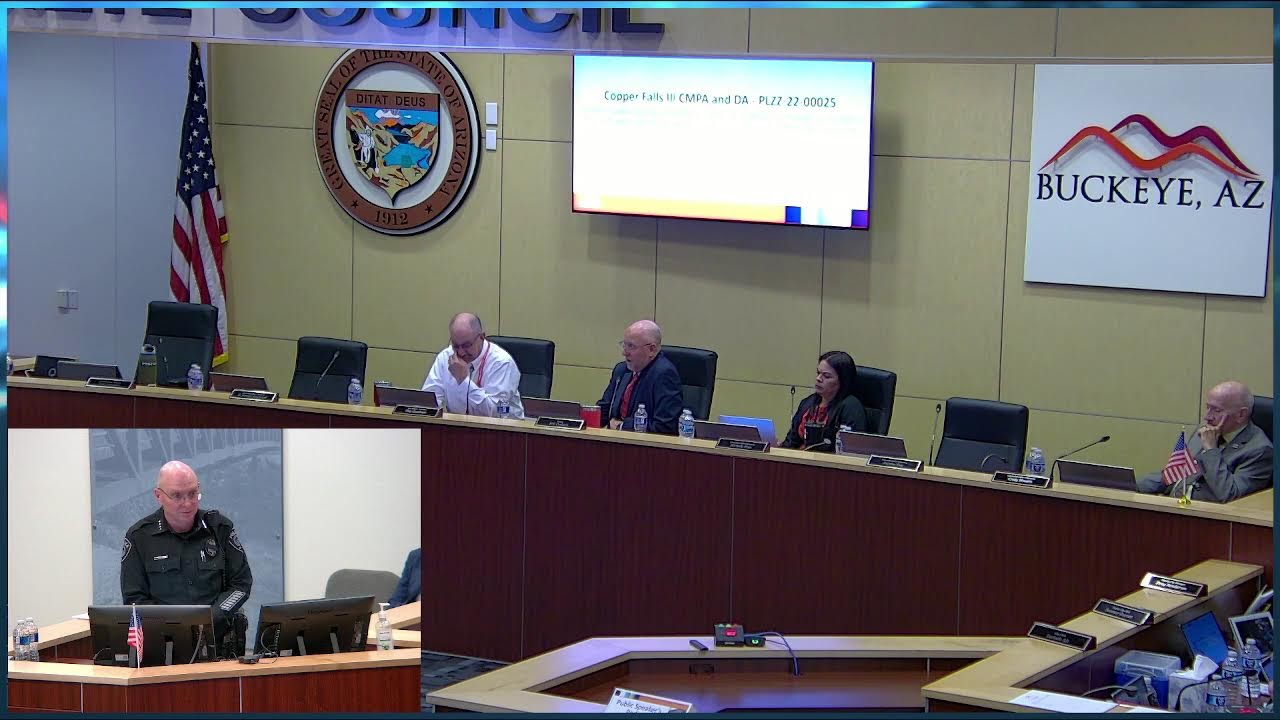
Buckeye approves 879-unit Copper Falls 3 multifamily project on 72 acres despite community opposition
City council approved controversial 879-unit multifamily development on 72 acres (Copper Falls 3) despite significant community opposition over traffic, density, and loss of rural character, with one council member voting no and two abstaining.
Buckeye Council Approves Copper Falls 3 Despite Traffic and Density Concerns; One Council Member Votes No, Two Abstain
On June 18, 2024, Buckeye City Council voted 4-1 (with two abstentions) to approve a controversial 879-unit multifamily development spanning 72.3 acres at the northern edge of the Copper Falls Community Master Plan. The project—comprising single-story bungalow-style rentals, two-story apartments, and three-story units alongside 16.5 acres of commercial space—faces headwinds from neighboring Northwood Park Estates residents and one council member who questioned whether the density and lack of mixed ownership housing align with long-term city stewardship of the Miller Road corridor.
Councilmember Craig Heustis voted in favor; Vice Mayor Clay Goodman and Mayor Eric Orsborn voted yes. Councilmember Hess voted no. Tony Youngker abstained due to a conflict of interest; Patrick HagEstad was absent. Councilmember Craig Guy initially appeared undecided but ultimately abstained as well.
The project, shepherded by developer GM Gabridge Family LP through a two-year design and negotiation process, marks a shift from the original single-family vision of Copper Falls—which would have yielded only 160 homes at 2–3 dwelling units per acre. The amended plan increases the 72-acre parcel's density to 12 dwelling units per acre, with a three-story section reaching 25 DU/acre.
Key Speeches
"I have a lot of heartburn around the zoning transition. We only have a few rural communities actually left that are in our zoning area in our planning area, and that transition is just not quite there." — Councilmember Hess
"If we start doing that we start getting into those six numbers, so we'd have to deal with a certificate at some point. It just depends on the thresholds." — Ken Galika, City Planner, responding to certificate of assured water supply questions
"The density I know I've stated that from the get-go—it shouldn't just be all rentals. To some of the residents' points, it's going to be the same price or not higher than even just owning, so I'd love to see some ownership involved in here." — Councilmember Hess
"For as much is going in it seems like it's compatible or comparable to an activity center and not normal just housing development." — Councilmember Hess
"We're not picking on any corridors. It's just the market seems to be right for multifamily in our more developed areas, and that's including the Miller Corridor." — Ken Galika, City Planner
Timeline
- February 2023: Neighborhood open house at a local school; approximately 12 residents from Northwood Park Estates attended, along with a council member, both opposed to initial proposal.
- Summer 2023: Developer and city representatives met with Northwood Park HOA president Mike Dirks and residents; traffic, density, and wall screening emerged as core concerns.
- Fall 2023: City staff and developer discussed fire station site dedication as potential public facility contribution.
- December 2023: Developer presented revised plan to HOA with reduced densities (single-story down from 15 to 10 DU/acre; three-story down from 30 to 25 DU/acre). Planning and Zoning Commission held public hearing; 11 speakers testified, mostly opposed.
- Spring 2024: Miller Road traffic analysis surfaced; city staff calculated impact fees and raised concerns about segment capacity between Lower Buckeye and Broadway.
- June 18, 2024: Council public hearing and vote.
Public Comment
Six speakers testified during the public hearing:
Susie Newan (Northwood Park Estates resident, ~3 min): Raised concerns about traffic gridlock on Broadway and Miller Road, stating it is already "impossible" to exit Miller during peak hours. Expressed worry about water shortages, light pollution from three-story buildings, and noise from vehicles and drive-throughs. Reported recent crime incidents—prowling vehicles parked overnight, vehicle break-ins, drones flying over yards—and criticized the developer and city for spending two years and money on planning "without" community participation "from the very beginning." She concluded, "I get the impression that money has been spent by the developer and the City and I'm supposed to believe that city council is really going to listen to us when all of this money has already been invested."
Melissa Hamilton (Parkside resident, ~3 min): Emphasized infrastructure strain. "Our schools are already at capacity. We can't get teachers. We can't get firefighters. We can't get police. Our police department and fire department is already stretched thin." Criticized the city for adding density before ensuring schools and emergency services can handle growth. Referenced the failed MC-85 (Monroe corridor) that was built as two lanes, then revised to four, "wasting millions of dollars." Called for the council to listen to residents' stated opposition to certain commercial tenants. Noted a methadone clinic in downtown Buckeye near an elementary school and preschool, adding to safety concerns.
Pamela Hamilton (Parkside resident, ~2 min): Focused on crime. "I can't even put a statue in my front yard without it being stolen. You can't have anything in your front yard without it being stolen, and now the little buggers are starting to come over walls. I mean, we can't handle the crime we have now in Buckeye without adding three and four story apartments to add more crime." Expressed regret at moving from Mesa to escape crime and seeing it follow her to Buckeye. Called for council to either listen to voters or face being voted out.
Derek Newman (Northwood Park Estates resident, ~3 min): Acknowledged the developers' "great presentations" and said "the math works," but expressed concern about quality of life. Described watching his neighbor train a horse in the driveway; children running out to touch it, creating a memory he wants his 2-year-old to retain for 10–15 years. Stated, "When I look at a master plan and it says neighborhoods, I mean be honest with yourselves… what you think of raising your family in? I don't think it is. And I think most of your constituents would agree." Affirmed he is a native West Valley Arizonan and did research before buying, expecting the master plan's "neighborhood" designation to match a specific character.
Mike Dirks (Northwood Park HOA president, ~5 min): Disputed developer claims of neighborhood support. "I have yet to meet one of the people that live along Broadway… that say yes we want this. The majority of the neighborhood says no. There is a couple that say yes, but the majority by and far is no." Called out the developer for claiming "all the signatures" and community buy-in when he had not confirmed resident approval. Disputed the fire station dedication's framing: "There was a comment that there was a buy-off to the city. I don't like that terminology. I believe that the city was given some property to put in a fire station. The city has already stated in several meetings previous and in the last meeting that we had in December that they're not even going to use it for that." Raised traffic safety: "I've seen sent emails. I haven't got anything back from that. I still sit for several minutes no matter which way I go to try and get out and to do it safely is dangerous. I work with the fire department…. I worked a lot of accidents in that intersection in that area and it is getting worse." Warned against precedent: "I think that kind of shows future developers, 'Hey, the city is willing to work around things if you have enough money, time, and you're willing to keep giving us more, so we ask for more and if they give us a little bit more then we'll reach our threshold and we'll vote for what they want.' I don't think that's the right precedence to set for the city of Buckeye. Sooner or later one of these cities and towns is going to have to say no. We could be the first."
No additional speaker request cards were submitted.
Council Discussion
Craig Heustis asked about the right-of-way dedication north of Broadway and its role in the development agreement. Developer attorney Kurt Jones explained that the two parcels in question (outside the subject project) are owned by the same developer entity but not part of this case. The dedication was an extra step to assist the city in addressing the Miller Road pinch point between Lower Buckeye and Broadway, allowing potential future right-of-way for city CIP improvements without taking property through eminent domain. Craig Heustis clarified: "You're not getting the entire blocks of property, you're just getting the right-of-way." Jones confirmed, noting that one segment of roadway dedication on the east side of Lower Buckeye already exists; the new dedication is partial, "not fixing the entire problem" but attempting to help.
Craig Heustis asked whether the developer would build an additional lane on the opposite side (west) of Miller Road, City Traffic Engineer John Willet stated it was "just dedication at this point." Craig Heustis noted that "indirectly" the developer would contribute to that lane via impact fees per the stipulation.
Councilmember Guy had no additional questions beyond those addressed during staff presentations.
Councilmember Hess raised substantive concerns about density, zoning transition, mixed ownership, and traffic. She asked staff for comparable density examples elsewhere in the Phoenix Valley at a similar scale. City Planner Ken Galika cited Avondale Boulevard and I-10 on the south side, with "probably 90 to 100 acres" and "significantly higher" densities (three and four story), though noting that example predated today's development patterns. Hess remained skeptical, noting those examples were at activity centers (Avondale Sports Complex, vanban). She stated:
"I have issues with the density that's just a lot in one area without that supporting Activity Center. A Fries does not make an activity center. The zoning transition—I've got a lot of heartburn around. We only have a few rural communities actually left that are in our zoning area in our planning area, and that transition is just not quite there."
Hess emphasized that while she supports diversified housing (100% in favor), the all-rental composition troubled her. She recalled asking in an earlier meeting whether some ownership-based units (condos) could be mixed with rentals but was told it could not be done due to water certificate constraints. She stated:
"I don't like that we're kind of trying to get away from the water just trying to solve a problem today, because we have to live here for a long time and we're trying to Steward something for a really long time that goes beyond us."
On traffic, Hess said: "I know we've identified as we've gone through this process that we've got some problems, and so I don't know that I have answers today even from staff how that actually gets fixed. I know part of it could be a geobond, some of it's these newer fees, but we don't really have a timeline or anything do we? I mean this is kind of newer information so I don't want to make a decision in favor of something where I'm creating a problem I don't have an answer to."
Hess also flagged that downtown, the landing, and the airport had received 8–10+ months of community involvement and over 200 residents at each meeting, whereas Miller Road was "just flipping into whatever is the newest Trend." She concluded:
"I feel like we aren't getting the same forethought in Miller Road in planning for those that of us that live there, including myself, and so I'm I don't want to just throw something on paper and I want us to just have some forethought into what's left of Miller Road that we can plan—that's we can—that already doesn't have zoning."
She voted no.
Clay Goodman appreciated the changes made through public input, the lowering of densities, increased buffering, and additional commercial area. He asked City Planner Galika whether the retail projected for the commercial corner (Fries) would primarily serve residents of Copper Falls 3 or the broader market. Galika clarified that the high-quality jobs coming to Buckeye—in logistics, distribution, manufacturing (CoreWeary, Ross distribution, etc.)—represent the primary employment market. The retail corner would cater to scaled-up commercial tenants, not necessarily the service jobs of fast food. Clay Goodman also asked Galika to discuss the prevalence of multifamily elsewhere in Buckeye and the region. Galika noted that from 2004 to 2022, Buckeye built nearly zero multifamily units—a "hard to believe" figure—while the broader Valley has seen robust multifamily development. He cited examples in Avondale, Goodyear, Peoria, and Surprise. Development Services Director Brian Craig noted that multifamily currently represents just above single digits (10–11%) of Buckeye's housing stock and would rise to perhaps 15% at current buildout rates, aligning with regional norms of 12–20%.
Clay Goodman asked Police Chief Sanders about crime and multifamily housing. Sanders responded that crime rates in multifamily communities "stay consistent with the people who move into the communities" and that the city "don't expect any type of influx or something that we can't handle for Staffing ways," meaning the department has capacity to service the influx.
Eric Orsborn (in opening remarks) noted the two-year process, public meetings, and evolution of the project. He stated appreciation for "the Lively discussion" and the project's fit on a major corridor where employment and housing demand warrant this type of product.
Opposition
Number of speakers against: 6 public speakers, plus 9 written comment submissions identified during staff review (with one additional letter arriving the morning of the hearing, raising the count to 9).
Main concerns:
-
Traffic gridlock: Miller Road currently congested from stoplight at Miller/Broadway to West Park canal stoplight during peak hours; impossible to exit neighborhood safely; Broadway also constrained; insufficient road widening to serve 879 new units (half-street improvements insufficient).
-
Crime: Existing vehicle break-ins, prowling vehicles parked overnight with suspicious persons walking neighborhoods, drones flying over properties; residents fear multifamily apartments will attract additional crime (prior example: apartments behind post office).
-
Water shortage: More residents = more water demand; unclear how city will source additional water given regional scarcity and 100-year certificate of assured water supply constraints.
-
Schools at capacity: Elementary schools already over capacity; bus routes changed, forcing some children to walk over a mile; private school enrollment necessary due to crowding.
-
Emergency services stretched: Police and fire departments already undermanned; adding 879 units exacerbates staffing shortages; fire station dedication framed as "buyoff" rather than genuine solution.
-
Loss of rural character: Northwood Park Estates and nearby homestead purchased in expectation of low-density "neighborhood" development (per master plan designation); three-story buildings and 12 DU/acre fundamentally incompatible with that character.
-
Exclusion from early planning: Residents criticized developer and city for two years of planning without community participation from inception; impression that investment of capital by developer and city predetermines approval regardless of resident input.
Most compelling arguments:
Mike Dirks's challenge to the developer's claim of community support—"I have yet to meet one of the people that live along Broadway that say yes we want this"—and his warning that approving the project sets a "bad precedence" for future developers to invest capital and expect eventual approval.
Councilmember Hess's systematic critique: all-rental composition at comparable price points to ownership (undermining the housing-diversification rationale), lack of mixed-use activity center to justify 12 DU/acre density, inadequate traffic resolution timeline, and insufficient early-stage community involvement compared to downtown and landing planning processes.
Derek Newman's invocation of master plan intent: "When I look at a master plan and it says neighborhoods, I mean be honest with yourselves… what you think of raising your family in?"
Organized groups: Northwood Park HOA represented by Mike Dirks; apparent coordination among Northwood Park Estates residents and the homestead owner (who filed a protest with city, noted by staff).
Support
Number of speakers in favor: None during the public hearing. Applicant and city staff presented technical and policy arguments.
Developer and staff rationale:
-
Housing diversification: Multifamily rental serves residents with different preferences (lock-and-leave lifestyle); Buckeye has built virtually no multifamily in 20 years despite regional demand and incoming employment centers (logistics, distribution, manufacturing).
-
Appropriate location: Miller Road and Broadway are major arterials ("main and main of the city of Buckeye") with surrounding employment, retail, and transit infrastructure; density comparable to West Valley norms (4.6 DU/acre across the square mile is "medium density" per industry classification).
-
Compatibility measures: Stepped density (single-story bordering Broadway and Northwood Park, three-story concentrated in southwest); 110-foot landscape buffer around homestead; 300–430 feet separation to Northwood Park homes; screening wall per HOA specifications; capped building heights (three stories, not four); reduced lot coverage and increased landscape buffering compared to standard MF-2 zoning.
-
Commercial preservation: 16.5 acres reserved for commercial (similar to original entitlement), allowing for major retail user (Fries Center currently occupies northeast corner); limited drive-throughs (max 4) and prohibited thrift stores/dollar stores.
-
Public facilities: 3-acre fire station site offered for dedication (conditional on city exercise of option); dedicated right-of-way north of Broadway to facilitate future Miller Road improvements.
-
Process evolution: Two-year design process with multiple iterations, neighborhood meetings, HOA engagement, and density/height reductions reflecting community feedback (e.g., yellow parcel 6/7 density down from 15 to 10 DU/acre; parcel 9 density down from 30 to 25; height capped at three stories for parcel 9).
-
Impact mitigation: Developer to pay per-unit and per-square-foot impact fees on Miller Road; fees calculated to fund segments beyond project boundaries (Lower Buckeye to Broadway pinch point); estimated $1.8M residential impact fee and $2M commercial impact fee if fully built out.
Project Details
-
Case number: PL ZZ-22-25
-
Applicant / Developer: GM Gabridge Family LP
-
Attorneys: Kurt Jones, Tiffany and Bosow, 25 East Camelback Road, Phoenix, AZ 85016; Bill Allis, Tiffany and Bosow
-
Client representatives: Mike Jaine and Todd Stransky
-
City Planner: Ken Galika
-
Location / Address: North 72.3 acres of Copper Falls Community Master Plan, bounded by Broadway Road (south), Miller Road (north), roughly between the canal (west) and Durango (east), adjacent to Northwood Park Estates (north) and a single homestead parcel (northwest corner, inside CMP boundary but excluded from amendment).
-
APN: Not stated in transcript
-
Current zoning → Proposed zoning: Planned Community (existing CMP zoning, pre-2010 style) → Amended Copper Falls Community Master Plan with revised land plan and development standards for multifamily residential, commercial, and public facilities.
-
Density / units / square footage:
- Parcel 6/7 (single-story multifamily): 23.2 acres, up to 10 DU/acre (reduced to ~20 acres if city exercises 3-acre fire station option), 232 units (or ~200 if fire station taken).
- Parcel 8 (two-story multifamily, southwest corner): 277 units, capped at two stories, 15 DU/acre.
- Parcel 9 (three-story multifamily): up to 25 DU/acre, balance to 879 total (approximately 370 units).
- Total residential: 879 dwelling units (combined all three parcels).
- Commercial: 16.5 acres at C-2 equivalent density (per CMP standards); limited drive-throughs (max 4); prohibited thrift stores and dollar stores.
- Public facilities: 3-acre fire station site (conditional dedication).
- Project area: 72.3 acres total.
- Density on amended parcel: 12 DU/acre (879 units ÷ 72.3 acres).
- Density across overall Copper Falls CMP (276 acres): 5.5 DU/acre with this amendment; 7+ DU/acre if an unrelated southeast corner multifamily proposal also approved.
- Density across surrounding square mile: 4.6 DU/acre (within "medium density" range of 4–7 per industry standards).
-
Changes from previous version: Original CMP (2008–2009 approval) zoned the site for single-family residential at 2–3 DU/acre (~160 units) plus 21 acres commercial and 5 acres office. Copper Falls 3 amendment substitutes 23.2 acres single-story multifamily (10 DU/acre), 277 units two-story (parcel 8), and three-story multifamily (parcel 9, 25 DU/acre) for single-family parcels 6 and 7, while preserving commercial at 16.5 acres (roughly 4.5 acres less than original). Prior version had no fire station site. Density reductions from developer's initial proposals occurred during 2023 negotiations: yellow parcel originally proposed at 15 DU/acre, reduced to 10; parcel 9 originally proposed at 30 DU/acre with up to four stories, reduced to 25 DU/acre and capped at three stories.
Vote Breakdown
- Final tally: 4-1, with 2 abstentions
- Yes votes (4): Councilmember Craig Heustis, Vice Mayor Clay Goodman, Mayor Eric Orsborn, and (abstained rather than voted no, but the final count shows 4 ayes).
- No votes (1): Councilmember Hess
- Abstentions (2): Tony Youngker (conflict of interest), Councilmember Craig Guy (shown as "thinking it over" during roll call, recorded as abstaining).
- Absent (1): Patrick HagEstad
Roll call sequence (as called):
- Tony Youngker: "Abstained due to a conflict of interest"
- Patrick HagEstad: "Absent"
- Councilmember Hess: "No"
- Councilmember Guy: (Transcript notes "thinking it over," shown online; final record shows abstention)
- Craig Heustis: "I" (yes)
- Clay Goodman: "I" (yes)
- Eric Orsborn: "I" (yes)
Eric Orsborn declared: "Motion carried."
Outcome & Next Steps
Approval: The City Council approved the Copper Falls 3 Community Master Plan Amendment and Second Amended Development Agreement (Ordinance No. 06-24, Case No. PL ZZ-22-25) subject to conditions and two new stipulations addressing Miller Road traffic impact.
Conditions attached (per staff report, referenced but not fully enumerated in transcript): Conditions A through J, plus two additional stipulations:
- Miller Road Impact Fee Stipulation: Developer shall contribute a proportionate share per dwelling unit (residential) and per square foot (commercial) of developed use toward Miller Road improvements beyond project boundaries, specifically to address the Lower Buckeye to Broadway segment. Fees calculated at approximately $1.8M for residential (if fully built) and $2M for commercial.
- Right-of-Way Dedication Stipulation: Property owner (same entity, separate parcels north of Broadway) shall dedicate right-of-way on the east side of Miller Road between the canal (north) and Durango (south) within specified timeframe (latest deadline noted as January of following year) to facilitate future city CIP projects.
Additional agreed-to stipulation (noted on record but not formally in conditions): Screening wall on south side of Northwood Park Estates subdivision to be constructed per Mike Dirks's email specifications detailing construction standards.
Next steps:
- Developer to proceed with site plan design and permitting.
- Developer to enter into binding development agreement with city, incorporating impact fee obligations and right-of-way dedication.
- City to evaluate exercise of 3-acre fire station site option; if exercised, developer shall dedicate and clear land; if not exercised, development density on parcel 6/7 increases slightly.
- Water Resources Department to coordinate with developer on water supply sourcing (likely purchase/contribution to city system or impact fee payment).
- Public Works and developer to coordinate Miller Road half-street improvements and turn-lane additions.
- City Traffic Engineer to monitor Miller Road conditions post-approval; any subsequent phases or related development on Miller Road corridor (including mentioned southeast corner multifamily and Nirvana projects) will compound impact, requiring ongoing coordination.
- Fire Department (if site accepted) to design and plan fire station build-out.
Controversies & Context
Density and Activity Center Conflict: Councilmember Hess articulated a philosophical divide: Copper Falls 3 proposes 12 DU/acre (879 units on 72 acres) without an established activity center (anchor retail/employment). Comparable projects cited by the developer (Avondale, Australian Parkway, Indian School Road examples) cluster around existing employment/retail nodes. Hess stated that a Fries location does not constitute an activity center and that density of this magnitude should be reserved for mixed-use hubs with diverse commercial, office, and transit infrastructure. The city's General Plan designates the Copper Falls CMP area as "Master Plan Community" (not "Activity Center"), which permits diverse residential uses but does not mandate or strongly signal multifamily concentration.
Water Certificate Constraint: Hess raised the certificate of assured water supply (CAWs) issue: state law requires CAWs for subdivisions creating more than five lots with individual lot sizes of 36 acres or less. The Copper Falls 3 proposal, if subdivided as shown (with streets, parcels, and fire station site), appears to trigger CAWs, which are increasingly difficult to obtain. Hess noted that she asked the developer whether mixed ownership (condos) could be incorporated to diversify the housing product, but was told CAWs constraints made this infeasible. She objected to treating CAWs as an immutable constraint that forces an all-rental composition, stating, "I don't like that we're kind of trying to get away from the water just trying to solve a problem today."
Process Criticism—Community Exclusion: Multiple speakers (Susie Newan, Mike Dirks) criticized the two-year planning process as developer-and-city-driven, with community participation limited to feedback meetings rather than visioning. Newan stated: "Why is a developer and the city spending two years putting this stuff together all this time all this money and the community the residents are not invited from the very beginning?" Dirks noted that while the developer eventually held HOA meetings and made concessions, "the developer and city criticized for spending two years and money on planning with limited community participation from inception." In contrast, Hess referenced 8–10+ months of community involvement for downtown, the landing, and airport specific area plans, with 200+ residents attending each meeting. She expressed frustration that Miller Road, which has undetermined zoning for southern segments, was "just flipping into whatever is the newest Trend" rather than undergoing similar deliberative planning.
Developer Claims vs. Community Reality: Dirks disputed the developer's assertion of neighborhood support, stating he had "yet to meet one of the people that live along Broadway" who supports the project, contradicting developer attorney Kurt Jones's references to "signatures" and community buy-in. Dirks acknowledged "a couple" of supporters but said "the majority by and far is no."
Fire Station Dedication as "Buyoff": Community members and Dirks questioned whether the 3-acre fire station site dedication constitutes genuine public benefit or a mechanism to secure approval. Dirks noted that the city had stated in December (prior meeting) that it did not plan to use the site for a fire station, undercutting the narrative that it addresses an acute emergency-services need. He stated, "Let's quit lying to ourselves" and "let's stop talking about that if that's not the case." This framing raises the question of whether the site represents a concession with uncertain civic value or a tool to sweeten the deal.
Traffic and Mitigation Timeline: The Miller Road traffic study emerged late in the process (spring 2024), after the developer had invested capital in two years of planning. Hess observed that impact fees and traffic mitigation are newly calculated and lack a concrete timeline, and she expressed reluctance to approve density she cannot ensure the infrastructure can safely serve: "I don't want to make a decision in favor of something where I'm creating a problem I don't have an answer to."
Precedent and Developer Incentive Structure: Dirks warned that approving Copper Falls 3, after the developer made incremental concessions (density reductions, wall, fees, right-of-way), establishes a precedent: "future developers… the city is willing to work around things if you have enough money, time, and you're willing to keep giving us more, so we ask for more and if they give us a little bit more then we'll reach our threshold and we'll vote for what they want." He called for Buckeye to be "the first" West Valley city to "say no" to such a project.
Rural Character vs. Regional Housing Demand: The broader context is Buckeye's near-zero multifamily construction from 2004–2022, despite incoming employment (manufacturing, logistics, distribution) and regional housing demand. The city's multifamily share stands at ~10–11% of housing stock, well below regional norms (12–20%). Staff's position is that Copper Falls 3 addresses pent-up demand and diversifies the housing portfolio. Hess's position is that location and process matter: this much density should arrive through deliberative corridor planning (as downtown and the landing have undergone), not through individual project negotiations on a corridor (Miller Road) that still has undetermined zoning for southern segments.
Zoning Transition to Rural Neighbors: Hess flagged the inadequacy of zoning transitions from a 12 DU/acre multifamily development to the north's rural residential Northwood Park Estates. While the developer has proposed 300+ feet separation, 110-foot buffers, and a wall, Hess noted that these are buffering measures, not zoning-based transitions. The planned Community zoning on Copper Falls 3 abuts Northwood Park's rural residential zoning; no intermediate transitional zone (e.g., low-density residential, mixed-use) eases the step down. The message to residents is that they are being "surrounded and pushed out," Hess stated.
Duration
- Copper Falls 3 item (Item 5B): Approximately 2 hours (Ken Galika presentation ~30 min, Kurt Jones presentation ~20 min, six public speakers ~15–18 min, council discussion ~45 min, roll call vote ~5 min).
- Total meeting: Approximately 3 hours (Consent Agenda ~10 min, Economic Development Catalyst Program ~15 min, Copper Falls 3 ~120 min, Mayor/Council Comments ~5 min, City Manager Report ~5 min, Adjournment).
Other Notable Items
Economic Development Catalyst Program—Round 2 Funding (Item 5A, unanimous approval): City Council unanimously approved $53,000 in facade improvement grants to two applicants—HFFB Investments ($50,000) and Flat Tortilla Building ($3,000)—as part of a 10-year program that has invested $2.6M total (city + private) across 51 completed projects, achieving a 2:1 return on investment. The program has no controversy and represents routine economic development support.