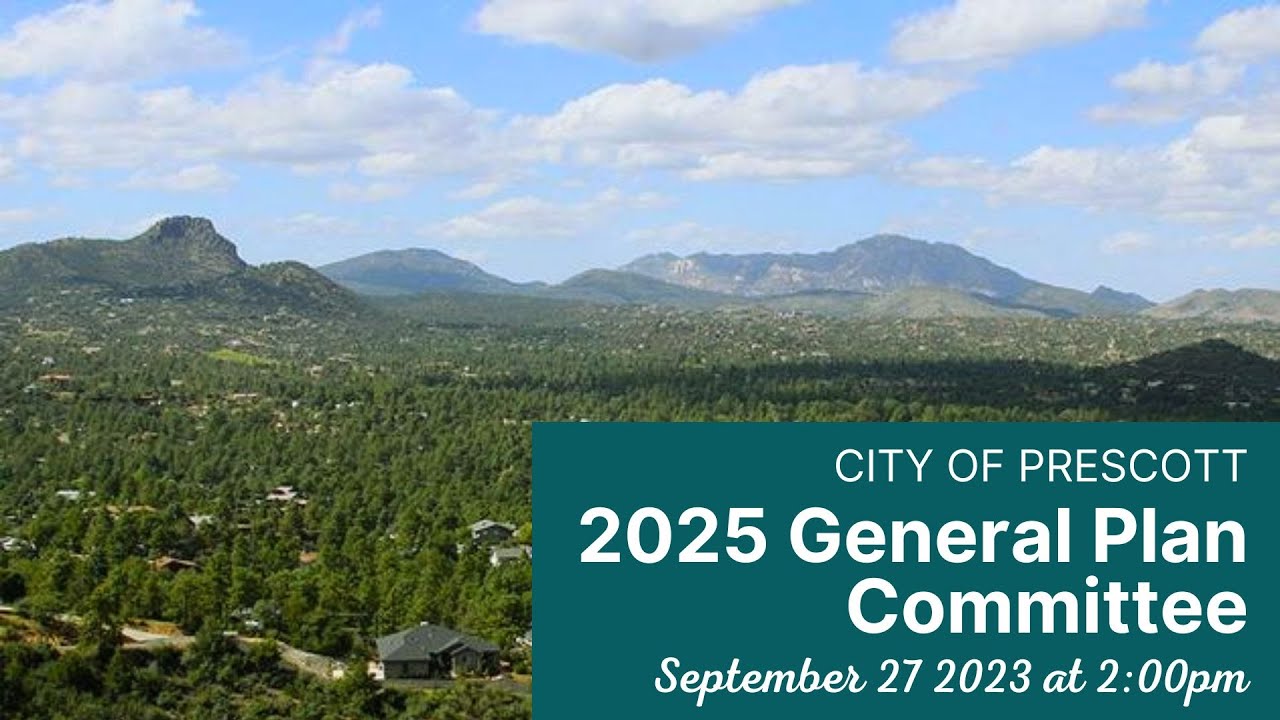
Prescott approves water quality grant, defers major plan amendment criteria to November subcommittee
Prescott General Plan Committee meeting focused on police staffing crisis, water quality restoration efforts with new grants, debate over major plan amendment enforceability, and successful public open house, highlighting implementation and council awareness challenges.
Prescott General Plan Committee Grapples with Water Quality Grants, Police Staffing Crisis, and Plan Enforceability Gaps
The Prescott General Plan Committee met on September 28, 2023, to review three critical environmental and operational elements while wrestling with a fundamental problem: the General Plan, approved by voters and updated in 2015, appears neither legally binding nor widely known among the city staff and council members tasked with implementing it.
The meeting spanned water quality restoration, policing capacity, major plan amendment criteria, and open-house findings—all layered over an undercurrent of frustration that General Plan provisions are routinely dismissed as guidelines rather than enforceable directives.
Water Quality, Lakes, and Green Infrastructure: A Grant-Funded Path Forward
Environmental Coordinator Matt Killian presented a comprehensive review of the city's water quality and lakes elements, revealing both progress and persistent challenges. Most significantly, the city has secured an Arizona Department of Environmental Quality grant for green stormwater infrastructure evaluation—a concrete step toward addressing impaired lakes and emerging contaminants including PFAS.
Killian noted that air quality in Prescott remains strong, with particulate matter averaging six micrograms per cubic meter (half the acceptable 12-microgram standard) and ozone well within acceptable ranges. However, water quality challenges dominate. Watson Lake and Willow Lakes are not swimmable due to nutrient loading, E. coli, and siltation—one-third of Watson Lake is now silted, leaving only two-thirds capacity.
Addressing Lake Contamination: Natural Processes and Hard Choices
The strategy centers on green stormwater infrastructure: rain gardens, curb cuts, detention basins, and phytoremediation using native plants like scouring rush to break down emerging contaminants. Killian explained the half-inch standard—new development must treat the first half-inch of water across all new impervious surfaces before it enters city drains or natural watercourses—and suggested raising this to one inch to match cities with fewer impaired waters.
"We're looking at short and long-term goals. City code currently requires that all new commercial and subdivision developments have a first flush treatment... many of the other cities with fewer impaired waters than we have established it at one inch and so that is one of those methods that we could do to increase our ability to treat water on the site where the pollutants are being generated before it hits either City infrastructure or natural infrastructure." — Matt Killian, Environmental Coordinator
A major historical problem: the lakes' nutrient loading traces back to decades of wasteload rights used by Chino Valley Irrigation District. The Army Corps of Engineers previously offered $100,000 for study and $5 million for restoration—offers the previous council deferred, opting instead to hire consultants for half a million dollars. Committee Chair George Worley, who chaired the lake subcommittee years ago, expressed frustration at the lost opportunity.
Committee members pressed Killian on realistic timelines. Jim McCarver asked whether the lakes could be swimmable by 2035 under current plans.
"I think that's a very reasonable goal and I'd rather see it in there than not quite frankly... there are steps in place, there's some critical components and treatments that are on the horizon... we should see some real improvements at Watson Lake in particular... in the short term not the 10-year horizon but the... two-year horizon." — Matt Killian
Herbicides, Pesticides, and the City as Model
Councilman Eric Moore raised a sharp concern: 60 percent of glyphosate (Roundup) use is residential, applied at 40 times the manufacturer's recommended rate. He linked the chemical to cancer, autism, ADHD, and Alzheimer's progression and noted the city itself applies herbicides and pesticides on streets and medians.
"I just want to share my personal feelings on that topic... I think as a city we should set the example on how we're using herbicides and pesticides and maybe the citizens will follow suit if we're not doing it we can't expect the citizens to do it." — Councilman Eric Moore voted against a landscaping contract with Vicente Landscaping yesterday solely on this point, making him the sole dissenter. Alternatives exist—30 to 45 percent vinegar solutions kill weeds without toxins—but most residents and city crews remain unaware. Killian acknowledged the topic merits inclusion in the General Plan and said alternatives would be researched.
Invasive Species and Native Planting
Moore and Killian discussed invasive trees: tree of heaven, Siberian elms, and tamarisk, which displace natives and offer poor nesting habitat for birds. A native ponderosa pine might host ten nesting birds; a tree of heaven hosts one. Non-native species also consume more water. Killian noted that the Community Nature Center is collaborating with Arizona Game and Fish on endangered Gila topminnow, utilizing safe harbor agreements to shield landowners from liability.
Police Strategic Plan: 17-Officer Shortfall and Affordability Pressures
Sergeant Jack Shapiro presented the Police Department's 2023 Strategic Plan, painting a picture of a force stretched thin. Current staffing: 67 of 84 authorized officers (17 short). The department is losing officers to the valley due to cost of living and housing affordability.
"We lose people to the valley. We have a difficult time getting people to come here from other agencies because of the cost of living... retention can be difficult if people see how much they get paid in the valley compared to what we get paid in the cost of living in the valley." — Sergeant Jack Shapiro outlined five strategic goals: Safe Community (data-informed response, crime reduction); Organizational Excellence (staffing, training, work-life balance); Communication (internal and external); Effective Partnerships (mental health, law enforcement, professional); and Infrastructure (facility upgrades, technology).
Community Services Gutted by Staffing Crisis
The Community Services Unit—bicycle and walking patrols, youth engagement—has been "knocked down" from multiple officers to one sergeant and two school resource officers. These details are now filled as overtime, creating burnout and recruitment challenges.
Committee member Deb Thalassidis asked a pointed question:
"Given the national shortage of police candidates, police officers, why are what is the value of continuing to do things like Citizen Academy, coffee with a cop, where it's taking officers off the street instead of you know being out on the street fighting crime?" — Deb Thalassidis
Shapiro responded that community interaction and feedback are essential to transparency and retention—many Citizen Academy attendees are supervisors with pre-scheduled participation. He noted the department has increased recruiting events to monthly, created QR codes on patrol vehicles, and is advertising nationally (including Los Angeles, targeting LAPD exits).
Down-Payment Assistance and Workforce Housing
Committee member Gary Warren and Councilman Eric Moore raised the two critical levers: funding and housing. Has the police department explored down-payment assistance—city-funded programs that wave down payments for officers who stay ten years?
"We had some people discuss that with me at the open house the general plan open house and it is a great idea and I don't know that's been explored with HR yet but I will definitely bring it up." — Sergeant Jack Shapiro
This suggestion, made at the open house, appears to be the first formal consideration by police leadership. Broader question: should workforce housing be a priority in the 2025 General Plan? Warren suggested it must be, noting the school district has explored similar initiatives.
Major Plan Amendment Criteria: A Battlefield Over Enforceability
The most contentious discussion centered on whether the city's major plan amendment triggers are too restrictive, effectively making the General Plan unenforceability.
Under current criteria (adopted by resolution in 2002, then incorporated into the 2005 and 2015 General Plans), a major amendment is triggered only if a project is 40+ acres AND has 400+ homes within a quarter-mile. Ralph Hess noted that no major plan amendment has ever been approved in Prescott's history—suggesting the criteria are either too narrow or that projects bypass the process entirely.
Hess's Proposal: Any Land-Use Map Change = Major Amendment
Hess advocated for a single trigger: any change to the land-use map shall constitute a major amendment. This would strip away the 40-acre and 400-unit thresholds and make zoning changes visible and subject to the major amendment process, requiring two-thirds city council approval and extensive community review.
"Since the zoning map is the only real enforceable provision or part of this General plan, I would suggest that paragraph or paragraph number one read: any change of the land use map period. So that if there's a change to the land use map that'll constitute a major plan Amendment." — Ralph Hess also proposed that any change to guiding principles, goals, or strategies trigger a major amendment, making the document enforceable by forcing council to deliberate changes explicitly rather than dismissing them as guidelines.
Opposition: Flexibility and Workload Concerns
George Worley warned that making every map change a major amendment could be counterproductive. A single-family homeowner at a zoning boundary wanting a minor rezoning would trigger a major amendment process—constant flow of amendments, workload for council and Planning Commission, and potential paralysis. He referenced Tucson's triggers (65+ acres) and Gilbert's 2020 plan (160+ acres for residential increases), suggesting context matters.
"If you only have a major plan amendment definition that... every map change a major amendment, it will create a lot of major amendments there will be a constant flow of major amendments... it can be workload for Council and it can be workload for the Planning Commission." — George Worley
Terry Sapio raised a deeper concern: overconstraining future councils. In a two-thirds vote, only two council members are needed to kill an amendment—almost impossible to overcome. By tightening triggers, the committee risks handcuffing councils facing unexpected growth or economic shifts.
"I'm kind of listening to the arguments back and forth... by making the major plan amendments more likely to be triggered in other words make it more restrictive we're trying to say we're so good at predicting the future that we're going to make it very difficult to change anything without a major plan Amendment." — Terry Sapio
However, Deb Thalassidis and Jim McCarver sided with Hess, noting that community feedback consistently expresses that "the general plan means nothing" and that council dismisses it as non-binding. If the community wants a say, making amendments harder to bypass protects that voice.
Deferred to November with Subcommittee
After an hour of debate, Committee President Gary Warren proposed deferring the item to November with a subcommittee to review criteria in detail. Hess agreed but insisted November, not October (he will be absent). The motion carried. Worley, Hess, and Thalassidis volunteered for the subcommittee, with staff to provide comparative analysis of other Arizona jurisdictions' thresholds.
General Plan Awareness and Enforceability: A Systemic Crisis
Beneath the major amendment debate lay a more fundamental problem: the General Plan is neither widely known nor considered binding by staff or council.
When asked how many years he had worked for the city before learning of the General Plan, Environmental Coordinator Matt Killian answered:
"I started working for the city in 2016 and didn't learn about this General plan until I was asked to review it a couple of months ago." — Matt Killian
Andre Carmen asked Killian whether his supervisors reference the General Plan:
"Quite frankly I haven't heard it referenced in discussion. The general plan at all." — Matt Killian
Councilman Eric Moore raised the structural problem:
"I guess my concern is we need our elected officials to be reading this document because we see a lot of turnover in elected officials every two years we have an election where at a minimum three Council seats are available every two years and we're talking about a plan that's going to be in place until 2035. And if we're developing the Strategic plan as council members but we're not looking at the general plan there's a real disconnect." — Councilman Eric Moore
Implementation Plan as Solution
Multiple committee members called for an implementation plan—not as a separate document (which would be sidelined), but as an integral element of the 2025 General Plan. This plan would list specific action items, deadlines, responsible departments, and metrics. Crucially, city council would receive annual reporting on progress.
Ralph Hess noted that an implementation plan was promised in 2015 but never delivered, contributing to the General Plan's obscurity. If adoption of the 2025 plan includes immediate adoption of an implementation strategy with council reporting requirements, awareness and enforcement would improve.
"We talked extensively about it in 2015 that Council said they were going to follow up with it there wasn't one it needs to go with the plan right rather than as a follow-on document if it's a follow-on the same thing could happen again it happened last time the plan becomes obscure the public doesn't know about it but if we have an implementation strategy and a reporting requirement on that implementation strategy it's a constant reminder and I think that's probably the best approach to make sure that we remember it." — Ralph Hess
Open House Success and Data Integration
Tammy DeWitt reported on a highly successful open house—50 percent higher attendance than previous events, over 50 green and red dot ratings, sticky note comments. The airport table showed 20 green dots and three red (all requesting additional flights, not complaining about noise). Police, fire, and library received overwhelming support.
However, a weakness emerged: subject-matter experts were not consulted beforehand. Terry Sapio, who staffed the open space table, complained that pre-printed statements on the boards confused participants and that she should have been briefed to align messaging. Going forward, table owners should meet with DeWitt and staff to ensure consistent framing.
DeWitt has compiled all data—dots, notes, pictures (documenting before removal)—into a spreadsheet, numbering each dot for traceability. She will email it to committee members tomorrow. Committee members will then sign up to review their tables with her, adding interpretation and additional comments. The final data will be re-circulated.
Public Comment: Growth, Sustainability, and Neighborhood Plans
Two residents addressed the committee under open call to the public.
Fred Oswald expressed concern about rapid growth: from 33,700 residents in 2000 to approximately 49,000 today—a 50 percent increase in 23 years. He advocated for a much slower growth rate, closer to 0.5 percent annually, warning that traffic doubles with housing growth and the city is losing its character. When asked his ideal rate, Oswald replied:
"Perhaps half percent, but too much growth is the philosophy of the cancer cell." — Fred Oswald
Tana Karen presented on behalf of the Gail Gardner neighborhood plan—originally adopted in 2001 and now being updated. The plan covers the Central West Side from Miller Valley west, addressing traffic, Prescott Frontier Days impacts, and safety. The group seeks adoption of the updated plan into the 2025 General Plan and potential renaming to the Central West Side plan (to reflect that it covers all neighborhoods in the area west of Gail Gardner). Staff will clarify the relationship between the General Plan and neighborhood plans.
Timeline
-
Committee composition: Nine members present (Ralph Hess, Jim McCarver, Gary Warren, Deb Thalassidis, Jim Huffman, Mary Frederickson, Andre Carmen, Terry Sapio, Ted Gambogi). Three excused (Don Michaelman, Rod Moyer out of town; Rod Moyer's wife recently hospitalized with knee replacement). Mayor Phil Goode and Councilman Eric Moore also present.
-
Public comment: Two speakers (Fred Oswald on growth; Tana Karen on Gail Gardner neighborhood plan); limited to 4 minutes each.
-
Presentations:
- Sergeant Jack Shapiro (Police Department Strategic Plan): ~30 minutes
- Matt Killian (Water Quality, Air Quality, Lakes, Environmental Element): ~90 minutes (extensive Q&A)
-
Votes on meeting minutes:
- June 28, 2023 revised minutes: Majority in favor; Jim McCarver opposed; Ralph Hess abstained
- July 26, 2023 minutes: Approved
-
Major decisions:
- Major plan amendment criteria discussion deferred to November with subcommittee review
- Implementation plan recommended as plan element (not separate document) with annual council reporting
- Gail Gardner plan update to be coordinated with staff on relationship to General Plan
- Open house data to be reviewed with table owners; updated spreadsheet to be circulated
-
Next meeting: October 25, 2023 (circulation/transportation presentation by Ian Mattingly; updated plan elements to be distributed in advance)
Controversies & Context
General Plan as Non-Binding: A Recurring Frustration
The unifying theme across three hours of discussion was the General Plan's lack of teeth. Residents, committee members, and staff repeatedly expressed that council dismisses the plan as a guideline, not law. Hess traced this to the fact that major plan amendments have never been triggered—either the criteria are unintentionally permissive or projects bypass the process.
The 2002 resolution establishing major amendment triggers was never voted on by the public; it was created by staff and council, then incorporated into the 2005 and 2015 plans. This dual status (resolution + plan) complicates amendment: both must be changed, but changing the resolution requires council action outside the plan adoption cycle.
Airport Zoning and Two Years of Contention
The airport development—referenced multiple times—exemplifies the General Plan's enforceability gap. A contentious decision two years after the 2015 plan's adoption now creates recurring objections. Ralph Hess and others argue that a stronger major amendment process would have forced that decision through a transparent, community-reviewed process, reducing post-hoc conflict.
Water Rights, Wastewater Legacies, and Regulatory Maze
The lakes' contamination stems partly from historical wastewater discharges and nutrient-rich irrigation water purchased from Chino Valley Irrigation District. Cleanup now requires coordination with the Army Corps of Engineers, Arizona Department of Water Resources, ADEQ, EPA, and U.S. Fish and Wildlife Service—a "round robin" approval process that slows action. The city's hope is that the new ADEQ grant accelerates one of several proposed remediation strategies.
Police Staffing as Citywide Problem
The 17-officer shortfall reflects a national crisis: law enforcement recruitment and retention are difficult everywhere, but Prescott's cost of living and salaries lag valley competitors. The city faces a choice: fund raises and recruitment bonuses (budget impact), develop workforce housing (long-term, requires development coordination), or accept reduced service levels and staffing overtime. The committee is now exploring down-payment assistance as a middle ground.
Pesticide and Herbicide Use: Environmental Justice Issue
Councilman Moore's criticism of city-applied herbicides and widespread residential use of glyphosate (linked in research to cancer, autism, ADHD, Alzheimer's) represents an emerging environmental justice concern. If the city sets an example using vinegar-based alternatives on city property, residents may follow. The 2025 General Plan is expected to include a statement on this.
Other Notable Items
Invasive Species and Native Planting Standards: Eric Moore and Matt Killian discussed invasive trees and birds, noting that non-native species offer poor food sources for wildlife and consume excess water. The General Plan should encourage native planting standards in new developments and possibly city projects.
Gail Gardner Neighborhood Plan Update: Tana Karen presented the 2001-adopted plan's update, covering the Central West Side (Miller Valley west). The committee agreed to clarify the relationship between General Plan and neighborhood plans before the update's adoption.
Duration
- Entire meeting: Approximately 3.5 hours
- Police presentation: ~30 minutes
- Environmental element review: ~90 minutes (including extensive Q&A)
- Major plan amendment discussion: ~60 minutes
- Open house and other items: ~30 minutes
Vote Breakdown
June 28 minutes: Majority in favor; Jim McCarver opposed; Ralph Hess abstained
July 26 minutes: Approved (no dissents recorded)
Major plan amendment criteria discussion: Deferred to November; no vote taken; subcommittee to be appointed
Outcome & Next Steps
Immediate actions:
- Matt Killian to coordinate with consultant (same consultant working with Prescott Valley) on green stormwater infrastructure evaluation; community outreach and stakeholder engagement beginning this month.
- Police department to explore down-payment assistance programs for officer retention with HR; continue monthly recruiting events and national advertising.
- Staff to clarify relationship between General Plan and neighborhood plans (Gail Gardner plan update); propose November agenda item.
- Tammy DeWitt to email open-house data (spreadsheet with dots, notes, comments) to committee members tomorrow; committee members to sign up for table reviews with interpretation/additional comments.
- Ralph Hess, George Worley, and Deb Thalassidis to form subcommittee on major plan amendment criteria; staff to provide comparative analysis of other Arizona cities' triggers.
November 2023 agenda:
- Subcommittee report on major plan amendment criteria (Ralph Hess requested this date specifically)
- Any revised major amendment language, if approved by subcommittee
- Gail Gardner neighborhood plan relationship clarification
October 25, 2023 agenda:
- Circulation and transportation element presentation (Ian Mattingly, Pedestrian & Bike Traffic Advisory Committee)
- Updated plan elements (to be distributed in advance of meeting)
Long-term items flagged for consideration:
- Implementation plan as integral element of 2025 General Plan, with annual city council reporting on progress
- Herbicide/pesticide use policy and community education (30-45% vinegar alternatives)
- Invasive species and native planting standards
- Threatened and endangered species management and safe harbor agreements
- Green stormwater infrastructure scaling (detention basins, rain gardens, permeable pavements)
- Lakes swimmability goal by 2035 with intermediate milestones (improvements expected within 2-5 years under grant and treatment protocols)
- Police staffing and facilities expansion (substation to north); next facility evaluation in 10-year horizon