Cave Creek Approves 434-Acre Open Space Preservation Plan; Adopts Regional Water Security Program Amid Urgent Staffing Crisis
Cave Creek Town Council approved seven open space conservation rezoning cases totaling 434 acres, authorized participation in the Secure Water Arizona Program to address Colorado River supply challenges, and implemented traffic-calming lane reductions while managing significant staff retention issues.
Cave Creek Approves 434-Acre Open Space Preservation Plan; Adopts Regional Water Security Program Amid Urgent Staffing Crisis
On the evening of October 7, 2026, Cave Creek Town Council moved swiftly through a marathon session that combined major conservation victories with frank acknowledgment of an internal workforce emergency. Across seven unanimously approved rezoning ordinances, the town added 434 acres to its open space conservation designation—effectively protecting approximately 41 percent of Cave Creek's total land area from residential or commercial development. Simultaneously, the council authorized participation in the Secure Water Arizona Program (SWAP), a regional water-supply marketplace created by Phoenix and Tucson to provide emergency reserves during Colorado River shortages. But beneath these accomplishments lies a troubling reality: the utilities department, which manages the town's water security and is essential to the preservation mission, has lost employees at a rate five times the national average, with staff now working double duty to cover vacant supervisory roles.
Timeline
Open Space Reclassifications (Items 2–8):
- Planning Commission recommendation: Unanimous approval of all seven cases (Z-26-02 through Z-26-08, plus companion general plan amendments AGP-26-02 and AGP-26-02).
- Staff presentation: Town staff, led by planning personnel (Eric Baker credited for coordination), presented all seven rezoning cases in consolidated PowerPoint to streamline deliberation.
- Council votes: All seven cases approved via voice vote, 7-0. First readings passed; second reading scheduled for October 20, 2026.
- Public comment: None opposed; only casual inquiries during Planning Commission phase.
- Effective date: 30-day public referendum window opens after second reading.
SWAP Water Program (Item 10):
- Presentation by: Town staff and Michelle Van Quatham (water attorney).
- Discussion: Council members praised Phoenix and Tucson initiative; Robert Morris noted phase two (100-year water supply) more critical than phase one (emergency shortage).
- Vote: Resolution 2026-18 approved 7-0 to authorize Robert Morris to execute agreement once finalized.
- Status: Main agreement "very soon" (per Van Quatham); program details and individual contract terms to be developed through end of year; estimated minor administrative cost.
Drought Management Response Stage 1 (Item 11):
- Presentation: Sean Kruse (Utilities Director), Brad Hill, Michelle Van Quatham.
- Council votes: Two motions: (1) to direct staff and water advisory committee to expand conservation education (7-0); (2) to declare Response Stage 1 for calendar year 2027 (7-0).
Traffic Calming Reconsideration (Item 9):
- September 1 clarification needed: Post-meeting confusion about which traffic control measures passed.
- Re-presentation: Melissa (town staff) and Al (traffic consultant) provided detailed graphics and warrant analysis.
- Final vote: Lane reduction traffic calming at both Rancho Mignogna and Spur Cross Road intersections, approved 4-3.
Administrative Services & Procurement (Item 12):
- Carla Williams (Administrative Services): Presented five-year turnover analysis, workforce analytics, and strategic initiatives.
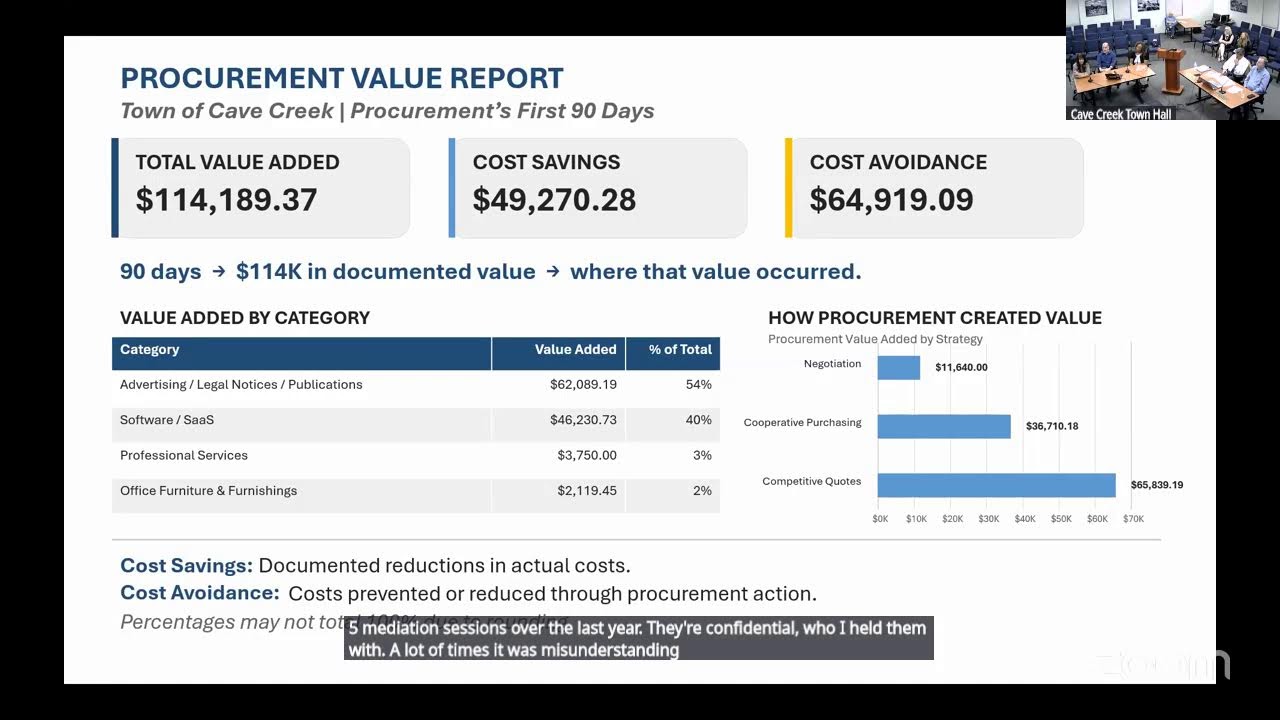
- Monique Harris (Procurement Administrator): 90-day report showing $114,189.37 in documented value (cost savings + cost avoidance).
- Brian Smith (Information Technology): Network security upgrades, VPN migration, SCADA access control review.
- No vote required: Reports accepted for council information.
Key Speeches
"We are not ready at this point to bring an agreement before you, but the resolution before you tonight would authorize you tonight to have the mayor execute an agreement once it is finalized." — Town Staff, on SWAP program participation
"Phoenix and Tucson have shown absolutely incredible initiative, wisdom, willingness to sacrifice. This is the, frankly, serving in place of our state government. Our state government is behind the curve on this." — Councilmember Tom Augherton, on SWAP regional cooperation
"I think we should actually be at least at a stage one, which would be the first time we've actually been in that situation. Things are very volatile right now with water resources. Everything that the Bureau of Reclamation has presented has had an asterisk to it." — Sean Kruse, Utilities Director, on Colorado River supply uncertainty
"The 20% cut to the water supplies to the lower basin states... means a cut to our municipal and industrial water supply... The Central Arizona Project is going to do some mitigations using some stored water." — Sean Kruse, explaining federal water reductions
"My concern with the briefing is not the content or the authorship. My concern is the timing... in our 40-year history, this is the first time there's been a citizen initiative." — Councilmember Tom Augherton, on ballot measure presentation timing controversy
"I just would offer respectfully that presentation would be less taintful, if that's a word, to what people beyond this room are going to do on November the 3rd." — Councilmember Tom Augherton, advocating postponement of ballot analysis
"I think the citizens need information. We need information on the alternatives. I think that the information may help us to make important decisions, so I do not favor delaying this presentation." — Councilmember Tom McGuire, opposing tabling motion
Open Space Conservation Reclassifications
The seven rezoning cases represent the culmination of years of piecemeal land acquisition and donation. Town staff consolidated them into a single presentation to accelerate an overdue cleanup of zoning designations that no longer matched land use intent.
Project Details:
- Case numbers: Z-26-02, Z-26-03, Z-26-04, Z-26-05, Z-26-06, Z-26-07, Z-26-08 (five zoning ordinances); AGP-26-02 and AGP-26-02 (two general plan amendments).
- Current/Proposed zoning: Desert Rural 89 or Desert Rural 190 → Open Space Conservation (OSC).
- Total acreage affected: 434 acres across five parcels (plus two companion general plan amendments for 30 acres of land use designation change).
- Parcels involved:
- Saguaro Hill: Town and DFLT acquisition, east of library.
- Roseness parcel: 25 acres, gift from Alan Roseness (2025).
- Cahava Springs tracks: ~130 acres, gifted by Mark Stapp and development team.
- PA Seats Preserve: ~272 acres (DFLT holding).
- Black Mountain Preserve: 5 acres (DFLT ownership); accompanied by Black Mountain Trail easement realignment.
- General plan alignment: Roseness and Black Mountain parcels required land use amendment from Desert Rural to Open Space; PA Seats, Cahava Springs, and Saguaro Hill already designated open space in general plan but retained residential zoning.
- Outcome: Approximately 41% of Cave Creek's total land area now has open space land use designation.
- Planning Commission: Unanimous recommendation of all seven cases; no public opposition.
"Eric Baker did a magnificent job of putting all these cases together, assembling it, going through all of the legal mandated through state notification processes." — Town staff, crediting former staff member
Vote Breakdown:
- Item 2 (Z-26-02, Saguaro Hill): 7-0 approval (voice vote).
- Item 3 (AGP-26-02, general plan amendment): 7-0 approval.
- Item 4 (Z-26-03, Roseness parcel): 7-0 approval.
- Item 5 (Z-26-04, Cahava Springs): 7-0 approval.
- Item 6 (Z-26-05, PA Seats): 7-0 approval.
- Item 7 (Z-26-06, Black Mountain): 7-0 approval.
- Item 8 (Z-26-07/Z-26-08, Black Mountain land use + zoning): 7-0 approval.
All votes were conducted by voice vote ("Aye" recorded unanimously).
Secure Water Arizona Program (SWAP) Authorization
The Secure Water Arizona Program represents a multi-jurisdictional response to Colorado River supply cuts that neither federal nor state governments have adequately addressed. Initiated by Phoenix and Tucson, SWAP creates a marketplace for short- and long-term water resources, with emergency shortage programs in Phase 1 and deeper portfolio solutions (100-year water) in Phase 2.
Outcome:
Resolution 2026-18 approved 7-0. Mayor Robert Morris authorized to execute the main SWAP agreement once finalized by Phoenix, Tucson, and other initial signatories.
Water Attorney Input:
"I have seen several iterations of an agreement, but what's happening is there's other jurisdictions in front of us online. And so they're customizing their special needs or what their needs are in the agreements." — Michelle Van Quatham, water attorney
"The main part of the agreement should be ready very, very soon. The attachments that describe some of the available programs that you might want to look at, those will be developed probably through the end of the year." — Michelle Van Quatham, on timeline
Private Utility Eligibility & Liability:
A public commenter (Bill Besor) raised concerns about selling Cave Creek's municipally owned water utility to a private company, citing loss of intergovernmental agreement status under Arizona Revised Statutes 11-952. Water attorney Van Quatham confirmed that SWAP is open to private utilities and third parties, not limited to public agencies. This clarification undercuts some of Besor's argument that privatization would jeopardize agreements, though his core concern—that private utilities have different incentives than municipal ones—remains valid.
Vote Breakdown:
- Resolution 2026-18 (SWAP authorization): 7-0 approval (voice vote).
Drought Management Plan Response Stage 1 Declaration
Sean Kruse (Utilities Director) presented a detailed analysis of the town's water supply and demand for calendar year 2027, given Bureau of Reclamation projections of a 20% cut to lower basin states' Colorado River allocations.
Supply & Demand Overview:
- Firm municipal/industrial supplies: 2,228 acre-feet, reduced to 1,783 acre-feet (20% cut).
- Mitigation by Central Arizona Project: 6% cut reduction (stored water from Lake Pleasant).
- Mitigation by Arizona Water Banking Authority: 14% cut reduction (AWBA programs; total of 312 acre-feet available to Cave Creek).
- Net available supply: ~2,297 acre-feet.
- Projected demand: ~2,078 acre-feet.
- Result: Nominal surplus on paper, but Kruse recommended Stage 1 (water watch) rather than Stage 0 due to volatility and asterisks in federal projections.
"Things are very volatile right now with water resources. Everything that the Bureau of Reclamation has presented has had an asterisk to it. They're saying this is our 24-month projection of what we believe the Colorado River can support for the next 24 months, with an asterisk saying depending on the lake levels, we might come back before that 24-month period." — Sean Kruse
Response Stage 1 Actions:
- Voluntary conservation outreach through Utility Advisory Committee.
- Coordination with Mattas Water Management on conservation program expansion.
- No mandatory restrictions (Stages 2–4 trigger mandatory conservation surcharges).
- Revision of drought management plan definition for longer planning horizon.
- Potential participation in Arizona/California/Nevada 700,000 acre-feet removal from river to support Lake Mead and Lake Powell levels.
Vote Breakdown:
- Motion 1 (Conservation direction to staff): 7-0 approval.
- Motion 2 (Response Stage 1 declaration for 2027): 7-0 approval.
Traffic Calming Lane Reduction at Rancho Mignogna and Spur Cross Road
A September 1, 2026 vote on traffic control measures left ambiguity about council intent. Tonight's reconsideration, with improved graphics and traffic warrant analysis, clarified the decision. The final vote approved lane reduction at both intersections, split 4-3.
Background:
Rancho Mignogna residents complained of severe left-turn delays (Level E service: ~90+ seconds wait). Spur Cross Road residents cited access difficulty to leave town. The 2024 traffic engineer report (Al, consultant) recommended lane narrowing (painted reduction from two lanes to one, ~500–600 feet) over all-way stop signs at Spur Cross. Stop signs do not meet warrant analysis and statistically increase rear-end collisions.
Comparative Outcomes (per traffic warrant analysis):
| Intersection | Measure | Left-turn delay | Level of service |
|---|---|---|---|
| Rancho Mignogna (eastbound, northbound) | Lane reduction | ~35–40 sec | C |
| Rancho Mignogna (no action) | Status quo | ~90+ sec | E |
| Spur Cross (westbound through) | All-way stop | ~51 sec queue | F (failure) |
| Spur Cross (westbound through) | Lane reduction | ~26 sec | C–D |
| Spur Cross | No action | ~25 sec | D |
Debate & Concerns Raised:
- Timing relative to new businesses: Dynamite Beer Company (capacity 200) and Foothills Caring Corps (300 volunteers) traffic impacts not in March 2024 data; consultant acknowledged difficulty projecting future trips.
- High-season traffic: Joe Freedman noted March data collection did occur during Rocktober/Bike Week (high season), but seasonal traffic patterns variable.
- Wilhelm entrance at Spur Cross: Dusty Rhoades asked whether lane reduction would block left-turn access to Wilhelm (Speedlot); consultant did not address this directly, citing existing double-yellow left-turn lane.
- Liability for rejecting engineer recommendation: Town Attorney Sims noted that if council votes against professional engineer recommendation and a collision results, the town may lose immunity from negligence liability.
- Spur Cross vs. Rancho Mignogna parity: Tom Augherton questioned why Rancho Mignogna residents' concerns (originally raised) should be prioritized over northern part of town's access via Spur Cross.
- Schoolhouse Road omission: Multiple council members expressed frustration that Schoolhouse Road (which has documented accidents including a resident's T-bone injury and another's 9-day ICU stay) is not on tonight's agenda, though separate study recommended against further traffic signals there.
"This is the engineered solution that takes into account traffic flow, left turn lanes, right turn lanes, service, the delays. That does not add to the problem of increasing the amount of accidents." — Councilmember Joe Freedman, supporting lane reduction
"The lane reduction has demonstrated in multiple communities that it does address speed in a safe way." — Councilmember Cynthia Driskell
"I would not favor the substitute. I think it's reasonable to start with one lane reduction first, give the residents a chance to be familiar with it, make sure it works well, and then proceed from there." — Councilmember Joe Freedman, opposing application at both intersections initially
Design & Implementation:
- Cost: $15,000–$25,000 per intersection (painted lane narrowing only; no physical structures initially).
- Reversibility: Paint can be easily removed if ineffective; emergency services (fire engines) can traverse painted lines without delay.
- Future enhancement: Potential for median planting or hard structures after evaluation.
- Timing: Not expected to be completed by end of week; implementation timeline TBD.
Vote Breakdown:
- Initial motion (Joe Freedman): Lane reduction at Rancho Mignogna only; no action at Spur Cross.
- Substitute motion (Cynthia Driskell): Lane reduction at both Rancho Mignogna and Spur Cross Road.
- Final vote on substitute (4-3 to approve both):
- Yes: Cynthia Driskell, Tom McGuire, Dusty Rhoades, Vice Mayor Kathryn Royer.
- No: Tom Augherton, Joe Freedman, Mayor Robert Morris.
Ballot Measure Presentation Tabled Indefinitely, 4-3
One of the night's most contentious votes involved a staff presentation analyzing the fiscal interaction between two November 2026 ballot measures: Proposition 440 (local sales tax for land preservation, citizen initiative) and a state proposition restricting tax on food for home consumption. Council split sharply on whether presenting neutral fiscal analysis 28 days before the election would constitute election interference.
The Motion:
Tom Augherton moved to table the presentation indefinitely; Dusty Rhoades seconded. The motion carried 4-3, with Kathryn Royer, Dusty Rhoades, Tom Augherton, and Friedman voting yes. Robert Morris, Cynthia Driskell, and McGuire voted no.
Argument for Tabling (Tom Augherton):
"There is no debate per se on the concept of saving the state land for preservation purposes in Cave Creek. There's different proposals on the best way to accomplish that financially. But I think the thing that's the most critical to recognize is that in our 40-year history, this is the first time there's been a citizen initiative... The gathering of signatures, the vetting with the attorney, the comments of advocacy and the publicity pamphlets... I don't know that the taxpayers would appreciate this is just me, and I could be, I'm not trying to be theatrical, but as a resident, I don't know that I want the story of desert preservation through a citizen's initiative being portrayed or presented by someone who doesn't represent that group."
Tom Augherton further argued that while town staff could present their own legislative actions, they should not analyze a citizen-initiated ballot measure within 28 days of election, citing potential perception of impropriety even if slides are neutral.
"It just doesn't seem consistent with our tradition to do anything that could potentially impact the outcome of one of the two proposals to finance the acquisition of state land in 28 days."
Argument Against Tabling (Cynthia Driskell):
"I had requested the presentation based on questions from residents and voters about the two initiatives since they both addressed sales tax... to clarify how do they impact one another so that voters can be informed when they make their choices... I don't think the presentation is going to impact that negatively. I think it strictly information. It not for debate or support."
McGuire echoed Cynthia Driskell position:
"I think the citizens need information. We need information on the alternatives. I think that the information may help us to make important decisions, so I do not favor delaying this presentation."
Town Attorney Opinion:
Town Attorney Sims provided nuanced guidance, citing Arizona Attorney General opinions on election interference statutes. The AG's guidance prohibits using public resources in a manner that "unambiguously urges an outcome" or fails to be "impartial or neutral." Sims stated:
"I blessed those slides. I thought they were neutral and impartial. I had a councillor call me today with concern. And when you look at the AG opinion, this was... he then didn't give you any bright lines. He said, we're going to have to look at it every time and it's whatever a reasonable person could decide. So if a reasonable number of four of you decide that you like to have the information to make it available I can defend the action."
Sims emphasized the AG opinion's language: "For example, the use of public resources to investigate the potential impact of a ballot measure on a jurisdiction could give rise to a challenge where the dissemination of information related to that investigation is made in a manner that fails to be neutral or impartial."
CFO Sherry affirmed her slides were neutral and impartial. Sims noted that while he blessed the slides, a reasonable person (one council member) disagreed, leaving the question open to debate.
Vote Breakdown:
- Motion to table indefinitely: 4-3 (carried).
- Yes: Tom Augherton, Joe Freedman, Dusty Rhoades, Vice Mayor Kathryn Royer.
- No: Cynthia Driskell, Tom McGuire, Mayor Robert Morris.
Administrative Services: Workforce Crisis & Turnover
Carla Williams (Administrative Services Director) presented a stark five-year analysis of employee turnover, revealing that the utilities department is hemorrhaging staff at alarming rates and that internal workplace conflict is accelerating departures.
Key Metrics:
| Metric | Value |
|---|---|
| 5-year separations (2022–2026) | 28 (mostly voluntary) |
| Average tenure (separated employees) | 3.7 years |
| Median tenure | 2.4 years |
| FY26 separations | 10 (vs. 4-year average) |
| Utilities share of separations | 53.6% (15 of 28 total) |
| Estimated separation cost (SHRM formula) | $10–$30K per employee |
Utilities Department Crisis:
The utilities department, despite being a single operational unit, accounted for nearly 54% of all town-wide separations over five years. Contributing factors:
- Workforce burnout: Extended work hours, on-call demands, insufficient staffing levels.
- Work-life balance stress: Young families unable to sustain demands; staff working double and triple duty.
- Internal toxicity: Stress and burnout translating into interpersonal conflict between employees; multiple exit interviews citing toxic work environment.
- Supervisory vacancies: Three supervisors lost; one rehired. Deputy Director Ivan and new Supervisor Ryan covering multiple roles simultaneously.
"It's been a struggle. Recruitments are still ongoing... The same people that conduct the interviews are the same people who are running the operation. So getting some of those interviews scheduled has been tricky." — Carla Williams
Mitigation Efforts:
- Carla Williams (trained mediator) has conducted 4–5 confidential mediation sessions over the past year to repair working relationships and address misunderstandings.
- Planning external workplace professionalism training to clarify workplace expectations and civility standards.
- Actively recruiting water treatment operator and wastewater positions; interviews scheduled for next week or following week.
- Exploring external contractor/consultant support for utilities project backlog to relieve internal pressure.
"There's been some of those internal toxicity that has been expressed in exit interviews as well... Some of it is the work environment because as employees get burned out, they become a little less friendly towards each other." — Carla Williams
"We're working as fast as we can to get them staffed, but it has been a struggle... People like Ryan and Ivan. Ivan's actually taking a shift at the treatment plant, my deputy director. He's actually taking a shift at the treatment plant. Ryan's just doing everything we can." — Sean Kruse, Utilities Director
Procurement Program: 90-Day Report
Monique Harris (Procurement Administrator), newly hired, reported exceptional value generation in her first 90 days, totaling $114,189.37 in documented cost savings and cost avoidance.
Accomplishments:
- Electronic bidding platform launch: Transitioned from paper to 100% electronic OpenGov eBidding; first fully electronic solicitation (East-West Trail Connector project, released August 13) generated seven competitive proposals.
- Supplier registration process: Streamlined vendor onboarding for future contracting.
- Procurement roadmap: Multi-year strategic plan for town purchasing initiatives.
- Due diligence tools: Compliance checks for cooperative contract usage.
- Resource center: Public-facing procurement information hub.
- New cooperative: Partnered with OneGPA (Phoenix-based) in addition to existing cooperatives.
Value Breakdown:
| Category | Amount |
|---|---|
| Total value added | $114,189.37 |
| Cost savings | $49,270.28 |
| Cost avoidance | $64,919.09 |
| By category: | |
| — Advertising/legal notices | $28,000+ |
| — Software | $56,230 |
| — Professional services | $3,750 |
| — Office furniture | $2,119.45 |
| By method: | |
| — Negotiations | $11,640 |
| — Cooperative purchasing | $36,710 |
| — Competitive quotes | $65,839 |
"I do the functionality of procurement. None of this happens unless someone comes to me and say I have a project. So a lot—and some of them already had started negotiations, so we were able to capture savings based on the conversations they had already started. So I want to thank everyone because the staff really did partner with me to create these numbers." — Monique Harris
Other Notable Items
East-West Trail Connector Project (Item 1): Arizona Trail Builders LLC awarded contract for $42,637 (14.7% under $50,000 budget) via first fully electronic solicitation in town history; approved 7-0. Project concludes decade-long effort to connect east-west non-motorized trail systems between Spur Cross Ranch and west side of town.
Lifeline Water Assistance Program Policy Adoption (Resolution 2026-17): Approved 7-0. Unified 3,000 gallons per person per month allowance (100 GPCD: 45 indoor, 55 outdoor) for qualifying low-income customers receiving 50% reduction on water base rate and usage charges. Includes exception authority for town manager to approve overages in unusual circumstances (e.g., distressed livestock, memorial tree watering). Currently serves 6 customers.
Maricopa County Association of Governments (MAG) Regional Presentation: Tim Strow (major projects manager) briefed council on Northeast Valley Transportation Study covering area from Dynamite Boulevard north to Cap Canal. Study area includes 14,000 acres of Arizona State Land Department parcels slated for auction and future development; projects 56,000 new dwelling units and 49 million square feet of non-residential space by 2050. Study identifies safety hotspots and proposes ramp weaving improvements on Loop 101; public meeting planned within next few months.
Cities and Towns Week Proclamation: Vice Mayor Kathryn Royer read proclamation recognizing October 18–24, 2026, as Arizona Cities and Towns Week, honoring municipal employees' emergency response and service delivery (particularly noting staff response to recent 4-inch rainfall event).
Controversies & Context
1. Ballot Measure Timing & Election Interference Debate:
The 4-3 tabling vote reflects tension over the appropriate role of municipal government in informing citizens about ballot measures 28 days before election. While both sides agreed the presentation slides themselves are neutral, opponents worry that any town staff analysis of a citizen initiative—no matter how carefully worded—risks appearing to support or undermine the initiative by the mere fact of being broadcast by elected officials. Tom Augherton argument centered on tradition (in 40 years, no prior town analysis of citizen initiatives) and the distinction between explaining legislative action (legitimate) versus analyzing citizen initiatives (questionable). The town attorney's opinion, while defending the legality, acknowledged the issue remains fact-dependent and subject to challenge.
2. Internal Workplace Toxicity in Utilities:
The 53.6% concentration of separations in the utilities department points to a systemic crisis. While budget constraints and recruitment difficulties are cited, the disclosure of "internal toxicity" from stress and burnout suggests interpersonal conflict is driving voluntary departures. The fact that three supervisors have been lost (one rehired) and remaining supervisory staff (Ivan, Ryan) are working multiple roles simultaneously creates a feedback loop: overwork drives toxicity, toxicity drives resignations, resignations increase workload on survivors. Carla Williams' mediation and planned external training are reactive measures; structural staffing expansion is the long-term necessity.
3. Traffic Calming Compromise:
The 4-3 vote for both Rancho Mignogna and Spur Cross represents a compromise that may satisfy neither side. Opponents of the Spur Cross lane reduction (Joe Freedman, Robert Morris, Tom Augherton) worry painted narrowing will fail during high season and create riskier passing gaps. Proponents (Cynthia Driskell, Dusty Rhoades, McGuire) see a low-cost test consistent with engineer recommendations and community demand for slowed traffic. The two-intersection approach also opens the town to the argument that it is overriding engineer caution, potentially increasing negligence liability if collisions result.
4. Staff Retention and Service Continuity:
The utilities department workforce crisis has direct bearing on the town's water security mission—the very mission SWAP and drought management declarations are designed to address. A department losing 15 of 28 town-wide separations over five years, with supervisory roles unfilled and remaining staff overextended, cannot sustain the complexity of multi-source water procurement, conservation outreach, infrastructure maintenance, and emergency response. Paradoxically, the council is approving participation in SWAP and implementing drought stage 1 conservation initiatives while the department responsible for executing these policies is in crisis mode.
Duration
- Total meeting: Approximately 4.5 hours (including 5-minute break at 7:00 p.m. reconvene).
- Rezoning cases (Items 2–8): ~30 minutes (unusually brief due to Planning Commission unanimity and presentation consolidation).
- Traffic calming reconsideration: ~90 minutes (highest council engagement and debate).
- **Water programs (SWAP, drought stage): ~45 minutes.
- Ballot measure tabling debate: ~50 minutes (one of most contentious items).
- Administrative services presentations: ~40 minutes.
Vote Breakdown
| Item | Description | Vote | Outcome |
|---|---|---|---|
| 1 | East-West Trail Connector contract | 7-0 | Approved |
| 2–8 | Rezoning cases (7 ordinances + general plans) | 7-0 (voice) | Approved |
| 9 | Traffic calming (lane reduction both intersections) | 4-3 | Approved |
| 10 | SWAP water program authorization | 7-0 | Approved |
| 11a | Conservation/drought stage direction | 7-0 | Approved |
| 11b | Response Stage 1 declaration 2027 | 7-0 | Approved |
| 11c | Lifeline Water Assistance Program | 7-0 | Approved |
| Ballot measure presentation table | Tabled indefinitely | 4-3 | Motion carries |
Individual vote breakdowns (where named):
Traffic calming substitute motion (4-3 for both intersections):
- Yes: Cynthia Driskell, Tom McGuire, Tom Augherton (wait, Tom Augherton voted No on the final tally—correcting).
- Yes: Cynthia Driskell, Tom McGuire, Dusty Rhoades, Vice Mayor Kathryn Royer.
- No: Tom Augherton, Joe Freedman, Mayor Robert Morris.
Ballot measure tabling motion (4-3 to table):
- Yes (table): Tom Augherton, Joe Freedman, Dusty Rhoades, Vice Mayor Kathryn Royer.
- No (hear presentation): Cynthia Driskell, Tom McGuire, Mayor Robert Morris.
Outcome & Next Steps
Rezoning: First readings approved; second readings October 20, 2026. If approved, 30-day public referendum period follows before zoning changes become effective. No opposition anticipated given Planning Commission unanimity and staff diligence in notification.
SWAP: Robert Morris authorized to execute main agreement once finalized (expected "very soon"). Program attachments and individual agreements to be developed through end of 2
View source transcript ▼
Source: 06 October 2026 Regular Town Council Meeting — October 7, 2026. Auto-generated YouTube transcript; may contain transcription errors.
Mayor and council and the public that are here. I just wanted to call out tonight we're going to have a proclamation on Cities and Towns Week, which basically is in recognition of cities and towns and all the various programs and services that the cities and towns provide and the great job that municipal employees provide the communities that they work in. We all saw that firsthand with the major storm we had a few weeks back. We saw quite a bit of water running out of the city.
We had nearly four inches of rain. The washes were impassable, but the staff were able to go out there and put signs out there, so we had no stranded motorists. We also were cleaning up before the storm was actually even fully over and continued that into the nighttime, even after the storm was over.
So I just want you to think about when you hear the proclamation tonight that that just kind of sets all of our hearts at ease that we've got employees who are dedicated to the community and the residents and that the town employees just really do a wonderful job of helping with the day-to-day activities of providing quality of life for our residents. Mayor, that's all I have. Mayor Mrakas- Thank you very much. Call to the public. Janet Moore. Mayor, Council. Janet Moore, Cave Creek resident.
I just want to bring to everyone's attention, if you don't know it yet, not all of the crosswalks are lit. It's getting darker earlier. It's very hard to see the pedestrians that are in the crosswalks that are not lit. I don't think the pedestrians that are walking. I don't know. Hello? Okay. I don't know if the pedestrians that are picking their crosswalks are realizing that they cannot be seen at all.
The other night when I was going through town, fortunately I was doing the speed limit, but there was somebody in the median and they were just kind of blended in with all the all the foliage and you know fortunately I was able to stop but you just cannot see them and I would just hope that you would speed up the process and get those other crosswalks lit. Thank you. Thank you. Melissa Smith. Good evening Mayor, Council members. I'm not in the town limits. I'm just out of them.
I'm in the county island, but I'm a fifth-generation Arizona. I built my home out there 45 years ago. I just want to let you all know that I'm going to be sending out a letter for the record of a situation that I think may affect all of us, and not just this town, but the whole area. Yeah, and you'll get it shortly. So there we go. That's it. You have a question about it? No, we can't talk back. All we do is listen during this part because it's safe. Oh, you just are listening people?
Okay, gotcha. All right. Well, I'll be back after you all get a chance to look at it. Okay, thank you. Bill Besor? Mr. Mayor, members of the council, thank you again for showing up to do this job. Once again, I want to talk to you about the possible sale of the water utility company. Cave Creek manages its water, wastewater, and groundwater resource planning as an integrated system.
The town's water supply acquisition, conservation programs, infrastructure investment, land use planning are unified under a single public policy framework. These three examples are on the agenda tonight. The SWAP program, the drought management plan, and the life land water assistance program. This is only possible because we have a municipally owned utility. Selling to a private company fragments this plan.
The private utilities incentives are focused on its regulated rate of return, not the town's broader goals. The management of the water company is an example of government that actually works for the citizens. Let's keep that. Let's keep the good stuff. Rather than improving our water access, selling the water utility may actually impair our situation even more. In particular, we need to focus on the IGAs.
I begin with the Peoria water IGA that 450 acre feet of our banked water our water Cave Creek water exchange agreement with Peoria is a direct intergovernment agreement between two municipalities under ARS 11952 which authorizes only public agencies defined under ARS 11951 as the state counties cities towns municipal corporations and political subdivisions to contract for services or jointly exercise the state of the state A private water company does not qualify as a public agency and therefore cannot be party to an IGA under the statute.
So those IGAs that we've negotiated, where do they go? If the Cave Creek Water Utility were sold to a private company, the IGA's basic premise to municipalities Exchanging shared stored water credits for cap deliveries would lose its legal foundation. A private utility seeking a similar arrangement would need to negotiate a commercial contract with Peoria on entirely different terms, likely at a cost rather than as a mutual exchange. That's even if Peoria was even interested.
The next one's the surprise IGA. We're going to jeopardize this perhaps before it's even finalized. The agreement, if there was to be an agreement, would have to be negotiated from scratch. Everything would go back to the beginning. All of the work by staff would be out. And again, a private company and a municipality, a fundamentally different relationship. I got through most of it. Thank you. Thank you, Bill. I have no additional speakers. Okay next on the agenda is a presentation.
The first one is from the Maricopa County Association of Governments and I've seen Tim Stroh is here. I don't know your title Tim, but I'm sure you'll give it to us. But I just want to put a plug in. MAG does all the planning for the entire area, parts of Pinal County and Maricopa County. It consists of Indian tribes, towns, county representatives, the whole bag. And they've done some really good work. Probably the best work, not in your particular area, is with air modeling.
They kept us from being designated at a higher level for air pollution, Because most of it comes in from outside, things that are not controllable. And that was one of the biggest wins I've seen in a long time in government. And the folks at MAG did that. MAG also does the transportation planning, which is kind of where things all got started. And Tim has presented many times.
There was a presentation that I saw six months ago, something like that, on the development that's going just south of us, basically from the 101 north up this direction. And Tim most graciously agreed to brief our council and citizens on that. So Tim, take it away and thank you for being here. Tim Strowman Thank you, Mayor Morris. Good evening, council members. Again, Tim Strow, a major projects manager with MAG. I conduct regional studies all over the valley for all of our member agencies.
As the mayor stated, currently MAG is working on a study just south of here called the Northeast Valley Transportation Study. We're working with the City of Phoenix, Scottsdale, Arizona State Land Department, McDot, to look at identifying a sub-regional network to accommodate all the growth that's going to happen in the future. So our study area is Dynamite on the north, Cave Creek Road on the west, Pima Road on the east, and the Cap Canal on the south.
If you recall, I was here maybe a year ago presenting on the Cave Creek Road widening study. And so that's kind of what helped us define our study limits. We did the work on Cave Creek Road, and we also just finished a study on Pima Road with the city of Scottsdale. So this study area, as you all know, is extremely large. It's over 14,000 square miles.
There's eight traffic interchanges located in there, and there's 14,000 acres of Arizona state land that will go to auction one day and be developed. Currently, there's 44% of the study area is private and already developed today. And then, of course, BLM and the Bureau of Reclamation own small portions down by the Cap Canal.
The population in the study area today is 63 We expect that number to double by the year 2050 if everything is developed on time and at a steady pace Jobs there a lot of jobs in the area right now over 53 and we anticipate that number to jump to 84 by 2050 So this map highlights all the planned and active development in the study area Currently there 59 known developments at different stages of development with approximately 25 projects in red that are under construction or getting ready to go to construction.
I can't keep this slide updated fast enough since I started this study about a year ago. There's projects being added on The future does include 56,000 total dwelling units, which is split about 50-50 with single family and multifamily residential. It'll also include over 49 million total square feet of non-residential, which includes 10 million square feet of retail, another 9 million of medical, and 14 million square feet of office.
So I think needless to say there's going to be a lot of growth in this area. So as of today this map highlights the traffic patterns from 6 to 9 a.m. and I don't think this is a surprise to anybody in these council chambers. In the a.m. peak hour everybody's heading down to the 101 for the most part and we see a lot of congestion. You can see that those white spaces where all the state land is going to be developed in the future.
That's of our biggest focus areas for this project that we're trying to fill that in, work with state lands, work with the city of Phoenix on right sizing the infrastructure in those locations. So in the PM we can see the reverse flow of traffic from 2 to 6 PM. Like I said, northbound starts to see more congestion. A lot of it happens close to the loop 101 at the traffic interchanges and then it kind of spreads out as you go to the north. There's a lot of crashes in this area.
There's too many to be quite honest with you. There's over 30, 100 total crashes and unfortunately 20 fatal crashes. One of the challenging pieces when I was doing the Key Creek Road widening study, challenging aspect in this area is along the one-to-one you have a commercial more intense urban feel, right? 35 miles per hour, lots of traffic, things are a little bit slower. As you go north, speed limit jumps immediately. You could be going 50 miles an hour.
As I was talking to Hal before the meeting, it could be up to 70 miles an hour going north, right? You have signalized intersections spread out at longer paces, not a ton of light, to be honest with you. So you start to see more and more crashes at these locations, a lot of rearing crashes. So part of our project is we always focus on safety, try to identify hotspots to improve those.
2050, so we look at this, if that white section develops, that state land, and there's not a robust transportation network in there, we're going to see failing conditions in this area. The good news is, City of Phoenix does have a plan. We're working with state lands in Phoenix right now on filling in those gaps to make sure we can help reduce traffic in this area. So in addition to looking at the roadways to the north and south of the Loop 101, we are taking a look at the 101 itself.
As you recall, we just widened the 101 by adding additional lanes. So it's four general purpose lanes and one HOV lane right now. The freeway filled up immediately as soon as it was open. We are widening right now. ADOT is nearing completion on the 101 west of I-17 to match this same footprint. So we are excited to see how the corridor on the top section of the 101 will operate. But we're also a huge region, right? Over five and a half million people.
We add about 60,000 people a year to the state, to the region. So you can imagine moving not the quite size of Flagstaff, but a smaller Flagstaff to the Phoenix metro area every single year. Well, these roads are going to fill up. The faster we build it, this is going to fill up. They take the The path of least resistance. So you can see on the far west side traffic has increased by almost 60,000 cars a day since 2019 and on the far east side up by 54,000. Lots of traffic.
So what we are going to do is look at all the traffic interchanges along this section of the corridor. So Cave Creek Road 101. We're going to look at that intersection and say how do we move people more efficiently and safely through that intersection, getting them on and off the freeway. The freeway itself has its own fair share of accidents. That's a perfect picture. I love that picture that pretty much summarizes the operations of the 101 and the AM and PM peak hour.
This is in the PM peak hour. Everybody's heading back to the west side. 25% of all the accidents occur at the freeway exits and entrance ramps. So that's one thing we're going to take a look at. 75% of the mainline accidents are rearing crashes, which looking at this picture you can see why. So we are looking at some ramp weaving improvements on the 101. I don't think we're going to be adding additional lanes.
I think the system that we see today is pretty much close to being built out, but but there are some things we can do to improve operations So we be including that in our alternatives analysis As I stated we are looking at the traffic interchanges So this is a good example of this is at Tatum and the 101 Over 220 accidents These little circles show the location of where those accidents are located.
So we help try to dive into the weeds a little bit so we can fine-tune intersections, see where there's big backups, where we can add additional lane or maybe optimize the signal timing to make it a safer and smoother operation. We have had one public meeting last year. We didn't have the best turnout. 50 residents to me is not a successful public meeting for a study area this size. So we will be going back to the public probably in the next few months. We're doing alternatives analysis now.
Once we are ready with that, we'll have another public meeting and we're going to change up how we reached out to folks and really try to get a good in-person attendance. But we did get 50 residents. We did get some good survey responses. is part of that. Got some good comments from the public, but it's critical that people show up and tell us what they think. So some of the next steps for the project. Like I said, we wrapped up existing future conditions.
We're here tonight giving you a council update. We are in right in the middle of alternatives analysis. We plan on going back to the public to show what those alternatives are. I'd be happy to come back here and share those updates. We'll have a public meeting and then wrap the project up sometime probably next spring time. Mayor, council members, thank you for having me up here again tonight. I really do appreciate it. I'd be happy to answer any questions.
Were the 220 ramp crashes at Tatum, were those in the period of a year or? That was one year, yes. Thank you. Other questions from council? Well, Tim, thank you very much. We'll look forward to seeing the results of this. There's no way it's not going to change the area, including our traffic up here. And I guess my one question would be, how much traffic increase due to general growth would you see in, say, Cape Creek growth going through town, which is… Yeah, that's a great.
So in the future as this develops, you guys are going to see more and more traffic, right? People, Cave Creek's a fantastic town, carefree, your neighbors to the east. People are going to be coming up here and visiting your restaurants and the different services. We didn't do a calculation on how much traffic goes through the town of Cave Creek. We did start to look at kind of looking at the 101 and cut through of this area.
So if 101 is congested, are there regional trips that people cut through this study area north of the 1 and to get to I-17? So we're looking at more regionally, kind of the cut through trips and the percentage increases in that aspect. Okay, well, any other questions? Tim, thank you very much. We appreciate the update. Appreciate it. Next on the agenda is a presentation on how the November sales tax ballot questions interact and affect one another.
Am I allowed to make a motion right now before this happens? Do you make motion? I'd like to make a motion, please. I'd like to make a motion that this item is tabled until after the election. And the reasons are it could be a conflict of interest. Okay. So you're early. Okay. You make the motion. He's a second before we discuss it. Okay. Is there a second? I certainly second that. Okay. A second? Yeah. Okay. So we're... Comments? Go ahead.
So again, this could potentially be a conflict of interest. Some people might consider this to be election interference. I think that this should be discussed after the election takes place, should the proposal pass. Thank you. Tom? Well, if you want to go to me, Mr. Mayor, members of council, I certainly defer not only numerically, but also verbally with each of you. Thank you. My concern with the briefing is not the content or the authorship. My concern is the timing.
And I would hope that the council would be open-eared on maybe doing this in four weeks at the first meeting in November as opposed to this evening. There is no debate per se on the concept of saving the state land for preservation purposes in Cape Creek. There's different proposals on the best way to accomplish that financially.
But I think the thing that's the most critical to recognize is that in our 40-year history, this is the first time there's been a citizen initiative where the very difficult and Byzantine process of qualifying for an initiative in a state which is quite proud of that heritage, was accomplished by volunteers entirely, not the government, but the volunteers. The gathering of signatures, the vetting with the attorney, the comments of advocacy and the publicity pamphlets.
I don't know that it would be possible to have the town participate in a presentation other than offering its own summary of what legislative action we've taken. I don't know that the taxpayers would appreciate, this is just me, and I could be, I'm not trying to be theatrical, but as a resident, I don't know that I want the story of desert preservation through a citizen's initiative being portrayed or presented by someone who doesn't represent that group.
The town of Cave Creek has its interest, as each of us legislated in favor of some time back, And I think all of us are certainly able to communicate why we felt that was an important thing. Like others up here on the council, I was kind of surprised after we took action that night that there was continuing discussion. And then it went into a variance on how was the best to finance this. I thought we had the knowledge and the wisdom and certainly have shown sympathy for the issue.
But then it was explained to me why this is important. And I thought back to February of 1999, February 16th, when we signed, the council at that time, and myself signed a document allocating a .5% of all revenues coming into the town to be centered on Spur Cross Ranch and subsequent preservation projects being hijacked. If you want to use a better word, diverted, diverted to one of our long-term financial commitments, which is water and sewer.
And then even with this council, and the last council, that's been largely configured, but the monies that were originally specifically earmarked for that are now folded into the general fund.
So, for me, and this is my closing statement, a town that took such a difficulty to become incorporated, ironically on its 40th anniversary, a town that has always provided oversight to its elected officials in the early days through recall elections, many, many, in current days by watching and talking to the staff and talking to the council, It just doesn't seem consistent with our tradition to do anything that could potentially impact the outcome of one of the two proposals to finance the acquisition of state land in 28 days.
If the information has value, which I do believe it does, and nobody but Sherry could explain the Byzantine world of finance and alternative impacts deriving from recent legislation of the state legislature to how money actually comes in here and how it's spent, I just would offer respectfully that that presentation would be less taintful, if that's a word, to what people beyond this room are going to do on November the 3rd. So I don't, I'm not objecting to the presentation.
I just don't think it should be the town in any way characterizing what the citizens initiative is. It's in black and white. It's in the pamphlet. It's there available for everybody to read. Why don't we see what the people have to say about the election on the 3rd? And then, depending on which alternative is the prevailing alternative, have it explained by the town staff. So I'm not falling on my sword on this, but I think we can do better.
And I think Cape Creek rarely is on the same page on any issue in any year. And if ever we wanted to try to bring people together to let the experts explain what the financial implications are, we should wait for the people to make their choice. And I'm sorry I wasn't more brief than that, but I'm attempting to walk through the lineage of the town. And in this issue, it was shoe leather, and they got this issue qualified.
It'll be shoe leather that's putting up the signs and doing the door-to-door and the mailers and the phone calls and the emails. I'm just asking for your indulgence to delay the presentation for 30 days if we can. Other council comments? Cynthia, we'll start with you since it was an issue that you had wanted. Thank you, Mayor. Yes. I had requested the presentation based on questions from residents and voters about the two initiatives since they both addressed sales tax.
One, sales tax on food as it that impacts the entire state including Cave Creek and then sales tax for Cave Creek It certainly not to advocate or influence the merits of either proposal That not our position here It to clarify how do they impact one another so that voters can be informed when they make their choices I think there a lot of history that positive There a lot of initiative and momentum going with the propositions and that good and useful I don think the presentation is going to impact that negatively I think it strictly information It not for debate or support Tom, I think you had your microphone on.
I do. I think the citizens need information. We need information on the alternatives. I think that the information may help us to make important decisions, so I do not favor delaying this presentation. Oh, is Dusty online? Yes, I am. I would like to delay this until after the election. If we were going to do something like this, it should have been done before it was certified, put on the ballot. At this point, no matter what we do, it's going to look hinky.
And my preference is wait until after the election and do it then. I'm a little torn because I'm always one for proactively supporting information and communication to the public, for the public to make educated decisions. I don't think that the chart that is in our packet will help anybody decide one way or the other. The other, how they're going to vote. I do not think that it's advocacy by the government. However, I also know that perception is reality.
And so with that in mind, I don't have a problem delaying. Okay. The legislature has been attacking our ability to tax food for many years. And that's food for home consumption as opposed to food consumed somewhere else. As you know, Cave Creek is highly dependent upon food sales through all of our grocery stores and with other grocery stores on the books to be constructed along Cave Creek Road.
So the tax revenue from that has revolutionized and has made possible the improvements in the things we've done, like the fire department that we all enjoy, that we did not raise taxes for. There are legislators, I have talked to them, I sat next to them. They are adamant on taking our ability to tax grocery away. They were. They tried several attempts to do that. They were vetoed by the governor.
To get around that veto, the legislature put another proposed restriction on the taxing, the sales tax on groceries for home use on the ballot for this election.
uh since we are highly dependent upon that and since the legislature that would potentially impact the abilities town to fund its operations uh and i'm not aware of what actually is in all of that i know more about 440 than i do about that frankly i think it was a good idea to to call for this and it's important information that the public and the council and the staff need to have There's no electioneering behind this. It's just passing information.
It's totally harmless, and quite frankly, censoring this information. That's a little suspicious. So this would be to look at the conflict, potential conflict between two ballot measures that are on the ballot coming up. That's there. And it's important that people understand for both those ballot measures, I'd like to know which one I ought to vote for and against. So I don't see anything wrong. I see censoring information and trying to game when information is available, frankly.
I don't think that's the right thing to do. It's not democratic. People talk all the time about wanting more information, more public interest. How's information going to hurt us? Staff's well aware of their responsibilities. We have the mayor, the town attorney here to ensure that we don't stray into other areas.
staff cannot take a position on any political items Council can but staff cannot So it is a legitimate issue and I going to vote for it because it is in the public interest With that we take a Mr. Mayor, I'd like one just a response to you. Sure. If the town were just to present the legislative action taken by the council, that would make sense. They're not qualified.
They're not appropriate to respond to their opinion and their analysis of something that's already in print for public review that the citizenry did on their own and primarily as a backup to what the council's legislative action is so they have empirical proof that the state lands will in fact be provided, given the history of other councils with funding. It's not censorship.
If the town wants to do advocacy for our legislative effort or any of us would advocate for our legislative action, which would make sense, I just don't think their town. The town is not independent. We did advocacy to get the 7-0 vote. I don't think we can speak for any of the volunteers who did the citizens initiative. As a circulator, I don't feel the town can speak for why we did this action. So, I'm trying to be as respectful and as thoughtful as I can.
We all voted 7-0 on this focus and priority. We wouldn't be here today if it hadn't been for Luke, because Luke has hand carried us through the halls of the State Land Department and so forth. But Why would you ask the town to explain something that did not originate with them? The town is only qualified, I mean that almost legally, to speak for our latest set of action. And again, just an opinion, and I appreciate your tolerance.
Well, I want to answer that because the town attorney and the town financial director are the two people that looked at the way it interacts on our system, if not them, who for the town? I didn't know. This is not on one or the other. It's the way the two interact together and whether we're going to see problems in the future. I'll tell the town attorney to address that. I see he's ready to say something. Yes.
I was called today to inquire whether this was appropriate and it caused me to go back and take a look at the AG opinions in the case law to advise you as to whether or not it would be appropriate to take action tonight. When the legislature passed the law prohibiting influencing election, they didn't define it. So a court stepped in and said the only way you can violate it is if you unambiguously urge an outcome. Pretty hard to meet that standard.
So everyone was just using public resources to influence elections. The legislature then revised, and that's the language we're looking at tonight. And what they said was, you would violate if you support or oppose to circulate, this is a petition, in a matter that is not impartial or neutral. So what they're saying is it's okay to provide information about a ballot measure as long as it's not impartial and neutral. But then they've given us three factors to look at.
And my job as the attorney to not decide with three versus four. My job is to help you figure out what you want to do so that if four of you want to act tonight, I can figure out a way to do it. If four of you wish to table it, I can do that. But let me read you what the law is. This is the AG opinion. And the reason it's not crystal clear, and I know clients are upset when lawyers don't give clarity. The AG said facts differ and we have to look at it every time.
And what would a reasonable person conclude? One of your counselors, a reasonable person, concluded this might violate the influence election. There's the standards. If a reasonable Now, I can tell you, I read Sherry's slides, but then this is the sentence from the AG opinion, which is very applicable.
For example, the use of public resources to investigate the potential impact of a ballot measure on a jurisdiction could give rise to a challenge where the dissemination of information related to that investigation is made in a manner that fails to be neutral or impartial. I blessed those slides. I thought they were neutral and impartial. I had a councillor call me today with concern. And when you look at the AG opinion, this was a he then, didn't give you any bright lines.
He said, we're going to have to look at it every time and it's whatever a reasonable person could decide.
So if a reasonable number of four of you decide that you like to have the information to make it available I can defend the action You hate it when the lawyer says I can defend the action Because that means it not crystal clear I think it is crystal clear That sentence couldn be clearer And I don think the language was not neutral or impartial But it open for debate And so rather than you can avoid the fight by postponing it until after the election My bottom line is I can I could I can defend the action defend whichever action you wish to take.
I blessed those slides because I thought they were neutral and impartial. Some of you believe it might be different and are preferring to wait. That's your call, not mine. I can't make that call for you. Okay. Cherry, are your slides neutral and impartial? Yes, in my opinion, they are. Okay, thank you. Any other debate? We just have 10 more seconds for another debate, Mr. Mayor. The only thing that's not neutral is the timing.
28 days before the decision by the community, to me, is inherently a problem. Even if this was written by an independent third party who had nothing either way, it's going to be participated here this evening and disseminated and recorded and so forth. And there'll be questions about some of the more arcane components and how this would actually work, that it absolutely will have an impact.
Holding it for four weeks until the decision by the voters has been made does not seem to be censorship or a negative impact, or in fact, any different other than consolidating and confirming what the effect would be. So, to me, the timing is the problem and its potential impact on people who have not yet read the issue and made themselves aware of what it is. So, otherwise, you should have two spokespeople up here, the town with the CFO and people related to the petition drive.
Because I just don't think the town can speak for any aspect of the petition, which is now in black and white in a public legal document. So, thank you. Tom? I take issue with the idea that our staff is being partisan. I think it's information, and I don't think it—I think that not giving the information in an impartial way—and we have an opinion from council—is really to our disadvantage. If it's information that is impartial, we should have it, and that will help us in making decisions.
This is not about supporting or not supporting any citizen initiative. It's about giving us information that is of value to us and timely. I'd like to say so please. Sure. So I'm going to agree with Tom Augerton again, and I think that this is a citizen's initiative. This has nothing to do with the town of Cave Creek or anybody's staff, etc. It's no disrespect, but I believe that this should not be discussed 28 days out.
I think that this should be discussed if they win the 440 wins, then it should be discussed after. But I think we've discussed everything that we've brought to the table as a town already. So I just don't understand why we would do this now. I mean, I don't think we should go for this. That's all I got to say. So I'd like to echo that comment. The issue that I've got is the timing of this.
And quite honestly, no matter what we provide today, if it truly isn't going to impact how anyone votes, then let's wait until after the election and let it do then. My concern is the perception of impropriety. We're taking a side, whether we want to or not, whether we say, oh, no, no, we're being honest. I mean, too many people have heard politicians say that in the past. I say, let it slide until after the election. Other comments? Okay, let's take a roll call vote. Councilmember Augerton?
I think we might want to repeat the motion. Okay, the motion is to delay this presentation until after the election in early November. So a yes vote delays until after November. A no vote, we hear it tonight. Point of order, is it delayed to a specific date or is it tabled indefinitely? Well, it would be indefinite. Because it appears it would be a moot point after the election. There's no reason to have a comparison analysis. After the election, we just have a fact. We're dealing with fact.
So to clarify the motion, I think to table indefinitely would be appropriate. I'm not sure. Are you trying to amend the motion? You can always bring it back. But you can read what the original motion was. What do you want to do? Give me something we can act on. I would amend the motion to table indefinitely, which means you can still bring it back at a later date, but it doesn't have a specific agenda return. Then this would be a friendlier motion if you agree with that.
Well, I guess it was the motion I made. I said we'll bring it back after the election basically. And also I want to make one more comment, please, before we do the roll call. We can't do that. We can't. No, we have. We're discussing this now. We can't jump to something else. The motion is to table this until after the election in an indefinite date. Indefinitely. Yes. Okay. So does everybody understand? Okay. So no vote here tonight. Yes vote. We delay. Council member Ogerton. I'm sorry, Mr.
Mayor, are we voting on the amendment to the motion or the original motion? I thought it was a friendly amendment. It was a friendly amendment. The original motion as amended. Yeah, which was... I vote aye. Council member Driscoll? No. Council member Friedman? Yes. Council member McGuire? No. Council member Rhodes? Aye. Vice Mayor Royer? Yes. Mayor Morris? No, so the motion carries 4-3. Did I have that right? You did. Yeah, so we will table this indefinitely until after the election.
Next on the agenda is a proclamation for which the vice mayor has graciously consented to read for the Cities and Towns Week 2026 proclamation. The Town of Cave Creek proclamation, Cities and Towns Week 2026. Whereas, the citizens of Cave Creek rely on the town to experience a high quality of life in our community.
And, whereas, cities and towns in Arizona work 24 hours a day, 7 days a week, to deliver vital city services such as fire, police, and emergency medical response to ensure safe communities. And whereas, cities and towns in Arizona also provide services and programs that enhance the quality of life for residents such as parks, utilities, street maintenance, sanitation, and recycling services, libraries, community centers, and recreational programs.
And, whereas, it is important for Cave Creek to continue to provide the excellent delivery of services and programs that our citizens have come to expect in our community. And, whereas, it is one of the responsibilities of town officials to ensure open and accessible government through frequent communication with citizens using various avenues and means.
And, whereas, through participation and cooperation, citizens, community leaders, local businesses, and municipal staff can work together to ensure that services provided by Cave Creek can remain exceptional elements of the quality of life of our community. Now, therefore, be it resolved that the Town of Cave Creek joins with the League of Arizona Cities and Towns and fellow municipalities across the state of Arizona in declaring October 18-24, 2026, Arizona Cities and Towns Week. Thank you.
Next, we're on the general agenda item number one, which is Council Discussion Possible Approval, instructing staff to enter into a contract with AZ, Arizona, Trail Builders, Incorporated, The council has been incorporated for an amount not to exceed $50,000 to improve a native surface trail within an existing non-motorized trail easement. Thank you, Mayor and members of council. This has been a long time coming.
As most of you may know, the – I'll get right into the presentation here – provide you with a little bit of background. As you recall, the town was presented an easement for a non-motorized trail a few years ago. That consideration caused the town council to appoint a task force group to look at this and other trail alternatives within the area.
The general plan calls out providing for east-west connection for a non-motorized trail easement between our trail inventory, basically Spur Cross, Spur Cross Ranch Conservation Area, and the west side of town.
We looked at several alternatives and through negotiation obtained an easement which council accepted that easement back in May earlier this year So that a little bit of background This is the trail easement itself is pictured in the top right and then you can see that That aerial image on the bottom was from the open or the open space task the trail the Morningstar Trail Task Force Recommendation showing that alternative that preferred route which occurs north of the Morningstar alignment, which is south just off the picture.
So I'll hand it off to Monique at this point to kind of go through the solicitation process and where we're at and what we're asking you for approval for this evening. Thank you. Monique Harris- I remember to turn my mic on this time. I'm Monique Harris. I'm the procurement administrator, so I'm going to talk to you about the procurement journey. But before I start with the presentation, I want to say thank you to Luke and to Bambi. She's somewhere in the audience.
This was the very first 100% electronic bid, the first in the history of the town. And I am so very grateful to do it with these two individuals because anytime you're transitioning to anything that's new, it's always some bumps and some valleys that we may have to go through. But they were so very professional and patient and grace they showed me in this process. So I wanted to start off by saying thank you to those two. They made this process very easy for me.
So Luke has already gone over the project overview, but just wanted to mention that this was classified as a neighborhood connector trail and subject to the town's technical design guidelines. The selection base was on best overall value and not best price. It was actually us looking at the value that the supplier was going to provide for this project. This here is our procurement timeline. August 13th was when we released the RFP, the request for proposal.
On August 27th, we had a non-mandatory pre-proposal meeting, a sidewalk. On September 15th, we had a question submission deadline for the suppliers and the potential bidders. September 17th was the due date at 2 o'clock p.m. On September 17th, we had a virtual proposal opening. And on October 6th, which is tonight, we are coming to you guys to share the intent to award and council consideration. So I want to talk a little bit about the vendor participation. We had 1,038 project views.
And what that means, that's the total number of times the solicitation was viewed. It does not mean total number of vendors. We had 30 followers, a number of vendors following the project. We had 45 downloads. So that's the number of vendors that have downloaded the project. And we had nine applicants. Those were suppliers who actually started drafting their solicitation response. And we ended up having seven official submissions. So we were able to promote vendor participation on this project.
These are the seven that were officially submitted a proposal. The evaluation framework, as I stated earlier, is the best value evaluation. So we had a weighted metrics that we wanted to compare the different proposals with. 30 points was assigned for project Project understanding and design build approach. 20 points was qualifications and relevant trail experience. 15 points was project team and key personnel. 15 points for project schedule and ability to meet required completion.
10 points was reference and past performance. And then the least and the last was cost proposal, the 10 points.
So we performed a review of the proposals It was a consensus process The evaluators reviewed the proposals independently in documented scores and comments The procurement calculation that I chose was a very objective formula So it was the lowest responsive price divided by the proposal price times 10 So that way we could objectively score each of the prices Evaluation team reviewed individual assessments and then we had a develop a one consensus scorecard Procurement documents the evaluation record and prepared the recommended award for council consideration So after reviewing those seven, the recommended contractor is Arizona Trail Builders LLC.
The contract amount is $42,637. And the vendor classification is small business. The award recommendation reflects the evaluations team's consensus review and completion of the applicable procurement due diligence that we performed. So we had $50,000, not $50,000, but $50,000 in our project budget. recommended supplier, their contract amount was $42,637. So we will have a savings of $7,363, and that's 14.7% below project budget. So our value is we had seven competitive proposals received.
The award recommendation resulted from the evaluation team's consensus process. costs represented 10% of the overall best value evaluation and recommended contract amount remains within the town's established project budget. So we still have some money left over, $7,363 left over. Any questions? Questions from council? Joe? It sounds like you did quite a job, so thank you. Okay, public comment? I have none. No public comment? Is there a motion then? I would like to. Go ahead. If I may.
This is approval for instrumenting staff to enter into a contract with AZ Trail Builders Incorporated for an amount not to exceed $50,000 to improve a native surface trail within an existing non-motorized trail easement. Second. Tom, comment? Bambi, this is a long time coming. You've been looking for a way to get Bill and his friends over here to the east side, and they will be most welcome. We have 38 square miles of this town and we have 50 miles of trails, if you include the parks.
I've walked most of them, not lately. But it's one of the ways that we have defined Cave Creek. And the work that's been done by our whole planning department has not always been easy, but I think they've approached it professionally. And I think that the trails are really a testament to the nature of cave, the good nature of Cave Creek. Cynthia? Oh, no, who had a second? Okay, yeah, sorry. Thank you. First, I'd like to compliment staff on the process.
It was very clean, very easy to follow, very thorough, and nice to see seven legitimate bids and an evaluation of those bids in the process. So I applaud you for the work on that. It's always sad to say goodbye to Wildcat trails as development comes across town. I've lost count of how many trails I said goodbye to, but I'm happy to say hello to this one. Other comments from council? My comment is this is the end of a long process. I hope that Mr. Besore will mitigate his comments in the future.
It's worth $43,000. Sorry, Bill. So with that, we'll do a voice vote. All those in favor? Aye. Motion carries 7-0. Thank you. Well done. Next is council consideration approval of first reading of ordinance uh 2026-04 case Z-26-02 amending the underlying zoning of parcels 216-06-013C and 216-06-013D from desert rural dr 89 to open space conservation OSC.
Mr Mayor if you indulge staff we have items 2 3 4 5 6 7 and 8 on the agenda I would like to present them all in this PowerPoint presentation just to go over what they all mean because they are basically the same action for five different properties in the town that the town or DFLT owns or co Any objections from council? No. Proceed. All right. We will scoot through this. Please feel free to stop with any questions or comments.
So, what we- this goes back many years when going through our general plan and our zoning map as we've updated in the past. It's always been a, yeah, we should really get around to doing that someday, but time, staff, energy, effort has caused a delay in doing that. So we were finally with the dedication to the town of the Allen Roseness parcel last year.
It got us talking at staff level and although he's no longer with staff, Eric Baker did a magnificent job of putting all these cases together, assembling it, going through all All of the legal mandated through state notification processes, the surrounding property owner letters, the signage, and everything. So we're proud to present this evening a culmination of those efforts. So, this kind of gives you the background.
Over the years, the properties have come into possession of either the town through deeded dedication. Mark Stapwith, Cahava, gave the town quite a bit of land. I referenced the Alan Roseness parcel earlier. We've worked with DFLT in the past to acquire land for preservation. DFLT has a significant land holding to PA Seats preserve, which are all open space, but the underlying zoning remains residential. So this is our opportunity to come through and kind of clean up our roles.
So in our general plan, it talks about open space. Obviously, the objective of open space is to enhance the livability, character, and appreciation of the Cave Creek community by preserving as many of its natural characteristics as possible within the town of Cave Creek. These amenities help reflect the livability and character of the town. We know that Spur Cross Ranch is a great indicator of that.
Cave Creek Regional Park, which was established long before the town of Cave Creek was incorporated, is another example of that. You can see here on this exhibit showing all the open space areas, namely or most identifiably is the 4,005 acres that we are currently in the process of initiating auction for. The town manages three separate zoning districts related to open space. This is in Chapter 4 of our zoning ordinance. Identifies the use descriptions, what's allowed in each of those zones.
You've got open space conservation, open space recreation, and parks and rec. I want to-we highlighted here that pathway systems for use by equestrians, hikers, and bicyclists, aka non-motorized trails, are allowed in all three of these zoning classifications. The five parcels are indicated on this map. You've got Saguaro Hill, which is just east of the library. That's something that the town in DFLT acquired many years ago.
You've got the Roseness parcel, again, through gift of dedication from Alan Roseness last year. It's 25 acres. You've got the Cahava Springs tracks that were gifted to the town by Mark Stapp and the development team, previous development team of Cahava Springs. That totals about 130 acres. We've got the PA Seats Preserve, which is approximately 272 acres. And last, the Black Mountain Preserve parcel, which is owned by DFLT, which is five acres.
So with the Roseness parcel and the Black Mountain Preserve parcel, those are a little bit different in that the underlying land use, as identified in the general plan, is still a residential category, whereas the PA seats, Cava Springs, and Saguaro Hill are already identified in our general plan as open space, but the zoning is still residential. So what we're asking council to consider tonight is two general plan land use amendments in addition to the five zone change requirements.
Again, here are those parcels. Here's a close-up of the Saguaro Hill property. You can see its current zoning configuration is DR 89. We are recommending an open space conservation zoning district. This is the Rosiness parcel. This is the land use map, which shows it as Desert Rural 190. And what we're asking Council to consider is a change in land use to the open space. Here's the close-up of that.
You can see its connectivity to the ASLD lands, some of the lands that we're considering taking to auction. The underlying zoning. Again, DR 190. We are asking council to consider an open space conservation zone. The Cahava Springs parcel tracks, DR 190, looking for open space conservation. The PA seats, DR 190, open space conservation. I don't know if you guys are realizing a theme here. The Black Mountain Summit Preserve, the current land use is Desert Rural 89.
Again, looking for an open space land use classification for that. And then if you recall, last year we had asked council to accept an easement from DFLT to realign a portion of Black Mountain Trail that crosses this parcel. The zoning, once again, it's DR 89. Staff and Planning Commission is asking for open space conservation. So, just to kind of sum up here, should the general plan amendments be approved, the land use designation of 30 acres will be modified from desert rural to open space.
In total, approximately 41% of Cave Creek's total land area has a land use designation of open space, which is truly incredible. Then, alternatively, are also in addition to should the rezonings be approved, the zoning of 434 acres will be modified from Desert Rural 89 or DR, Desert Rural 190, to open space conservation. And then this kind of summarizes the council actions that are before you. We've got seven cases. They're in order.
So again, from a state perspective for state law, you would have to give action and adopt resolution of the general plan land use change for two of the parcels before the council. Before hearing the rezoning, which is why these cases appear in this order. So we would need to follow this order. The suggested motions are identified for you there. And with the general plan land use resolutions, those are just given one consideration, which would be this evening.
If approved, there's a 30-day effective period, which allows any member of the public to file a referendum to have Council's decision overturned. I just have to always state that. I'm down by state law to do so. And then the zoning changes require two readings. So you would consider first reading this evening and we would bring back for second reading at the October 20th.
After the October 20th, again, there's a 30-day effective period before those zoned changes become effective, allowing a member of the public to file a referendum petition to overturn council's decision to rezone. That's about all I have. Again, staff did a remarkable job putting all this together. We typically don't do this many cases all at once. The fact that they picked up the challenge and ran with it was exemplary, so I'm very proud of my staff to get us this far.
And once again, the Planning Commission unanimously recommended approval of of all seven of these actions before you this evening. With that, I'll answer any questions you may have. Questions? Cynthia. Thank you, Mayor. Has there been any particular opposition from any neighbors, any contiguous landowners, any public concerns that were expressed in the Planning Commission meetings?
No, just more of any time you see a big sign that says zoning hearing, you get a few people that, hey, what is this? And it's always nice to kind of talk shop and talk zoning with people that really otherwise don't understand. Just a few just curious people calling and seeing exactly what we're doing. We had one person misread the sign and say, you're rezoning it from open space to residential. We're like, no, turn your glasses upside down. It's the other way around. So. Thank you.
Other questions? Nessie, how about you?
Okay So these are the motions here are the motions you want us to make here in that order Mayor that would be fantastic And the two top bullets there no motions required for those Yes sir Okay In the interest I guess we have to do one at a time Anybody want to start off I will Thank you Mayor Turn your microphone on though Cynthia Oh it is Your light burning It blinking Is that okay Yep Okay Move approval of first reading of ordinance 202604 Case Z 2602 amending the underlying zoning parcels of 21606013C and 21606013D from Desert Rural, DR 89 to Open Space Conservation, OSC.
I want to make a point of order here. Did you recommend just reading what you have on the screen? That's what my colleague just asked me. You can do either. So obviously... In the purpose of time. Council member Driscoll was an A student and is reading directly from the agenda. So either way is acceptable. With the bonus points. Bonus points. You got them. Yes. Okay. So is there, I'll second that. All right. So with that, any, your comments? It's been a very good process.
I did listen in on to one of the planning commission meetings and it's been thoroughly thought out and a good action on behalf of the town. I'm in favor and other comments. Okay with that we have no public comments so we're ready to vote. All those in favor say aye. Aye. Motion carries 7-0. If you have seven ordinances why don't you have each person make the motion. Why don't you start with number two then and we'll skip Cynthia. Luke shorthand up here. Mr.
Mayor, I move to approve resolution 2026-14. Second. Comments? Yes sir. Good way to progress. All those in favor say aye. Aye. Opposed? Motion carries 7-0. Okay, Tom, you're next. I move to approve first reading of ordinance 2026-05. Second. Any comment? We're working our way through here, Luke. We'll make it. We will voice vote. All those in favor say aye. Aye. Aye. Aye. Aye. Motion carries. I will do the next one, which is move to approve first reading of Ordinance 2026-06. Second.
I have no comment. No. Anyone else? All those in favor say aye. Aye. Aye. Aye. Aye. Aye. Aye. Motion carries. 7-0. Next is move to approve first reading of ordinance 2026-07. Oops, I'm sorry. You have that one. Move to approve first reading of ordinance 2026-07. Second. Comment? All those in favor say aye. All right. Joe, next. I'm next. Okay. Okay. Move to approve case AGP-26-02, a minor general plan amendment changing the land use designation of APN-216-29-011A from Desert Rural-2 open space.
Second. Comment? Is this the same thing as 2026-15? That was number eight, wasn't it? That's correct. Yes. Second. Okay. Are we still good here? Yes, sir. Okay. All those in favor? Aye. Opposed? Aye. Opposed? Aye. Opposed? Okay. Dusty, you're next if you've got your stuff there. Move to approve first reading of Ordinance 2026-08. Second. Comments? Okay. All those in favor, say aye. Aye. Opposed? Motion carries 7-0. So that was the fastest we've ever gone through. You're welcome. Well organized.
434 acres. Hey Tom, that was about as brief as you've ever been. Thank you, Joe. Was that a compliment? All right, council discussion possible approval resolution number 2026-017, approving and adopting a lifeline water assistance program policy. Oh, here comes the fellow this year. Oh my gosh. All right No no no this is people can afford to pay for water Good evening, Mayor, Vice Mayor and Council. We discussed the Lifeline Water Assistance Program at the September 1st Council meeting.
And for anyone watching who may be unfamiliar with The program provides qualifying customers with a 50% reduction on water base rate and usage charges. Sewer charges and fees are excluded. We have a total of six customers on the program. Eight applied and two were denied for not meeting the program requirements. We originally presented a GPCD or gallons per capita per day of 176 for Cave Creek and 151 for Desert Hills.
This comes out to 5,280 gallons per person for Cave Creek and 4,530 gallons per person for Desert Hills. Tonight we are returning with revised monthly water usage allowances and a proposed exception provision for unusual circumstances. So at the September 1st meeting, staff presented separate monthly water usage schedules for Cave Creek and Desert Hills based on the household size and earlier program policy.
Council asked staff to revisit those usage requirements and we are now recommending one schedule for both service areas The proposed schedule provides 3,000 gallons per person per month for each person in the household, up to the household maximum of 15,000 gallons for five or more. The same schedule would apply for both Cave Creek and Desert Hills water customers.
So staff recommends a total allowance of 100 gallons per person per household, and that would be 45 gallons per person, well, GPCD for indoors and 55 for outdoors. And at the time of the research, the Arizona Department of Water Resources suggested 100 GPCD as the amount to use for residential water conservation for both indoors and outdoors. And with this change, based on our review, two customers would be affected by the proposed GPCD reduction.
We also researched how other cities and towns provide assistance. We found that many refer customers to outside agencies such as social services and other programs. Some included usage limits while others who published assistance criteria did not. And then after the September 1st council meeting, a participant in the Lifeline Water Assistance Program came in to share concerns about the program's continuation and the difficulty of meeting water usage limits when unusual circumstances arise.
The customer described an experience a few years ago when their horse was not feeling well and was in distress. They explained that the only way they could keep the horse comfortable was to provide additional water. Doing so caused them to exceed the water usage allowance that was in place at the time. The customer described this as a very difficult situation and they were concerned about going over the program's limit, but they were also trying to care for an animal that needed help.
So they felt they had to choose between staying within the allowable usage and providing the water their horses needed. The customer also explained that they watered vegetation around the properties fairingly and provided only enough water to keep the plants alive. This included a tree that a neighbor had gifted them in remembrance of their mother. Their concern was how to manage those needs while remaining within the program's limits, particularly during the summertime.
The customer also expressed that they had developed health issues over the years and they were on a limited income. So they were also able to have someone assist in replacing a swamp cooler with an AC unit, but not. Most customers on the program probably would not be able to afford that.
So this customer experience illustrates why staff is proposing an exception for unusual circumstances The provision would allow the town manager to consider the circumstances of an individual case when deciding whether to approve an exception to the loss of reduced charges or program eligibility So the program provides a 50% reduction on water base and usage rates. Sewer charges and fees are excluded.
To be eligible, you have to be an Arizona resident, town water account in the customer's name, and live at a service address, and also have income or qualifying assistance criteria. The customer would re-certify every year. During an annual review, the finance director or designee approves the applications. No reduced charges for one month over the limit after three overages in 12 months, the eligibility ends, and they must reapply after six months of allowable usage.
And in an unusual circumstance, the town manager would be able to approve an exception relating to water limit thresholds. So we are asking to Council to approve resolution number 2026-17 adopt the Lifeline Water Assistance Program policy at 100 GPCD for both Cave Creek and Desert Hills. Questions? Questions from Council? Seeing none. I have no public comment. No public comment. Okay, so I will make the motion.
I move to approve resolution number 2026-17, approving and adopting a Lifeline Water Assistance Program policy. Second. I'm in favor? Aye. Aye. Oh, yeah, you're next. I made the motion. You second? I did second. Second. Comments? It's difficult to balance issues when some people are using more water than others. Some of us are equestrian, some of us are not. Some of us do not have outside water, and I don't think there's any easy answer.
So I think this is probably the most rational way to go about it. Other comments from Council? Thank you, Mayor. I think it's an improvement, kind of clarifying and simplifying the process and the information that will go out to water users. Dusty, any comment? No, I think it's good policy, and I also think it's good policy that the town manager can make exceptions. Yep, I agree with that. Okay, all those in favor, signify by saying aye. Aye. Motion carries 7-0.
We are on to agenda item number 10, which is the council discussion possible approval of resolution 2026-18, authorizing an agreement to participate in the Secure Water Arizona program, SWAP, which will provide a lifeline of potable water to the town. Mayor, Mayor and Council, before you as an item that the Council's been briefed on before, the City of Phoenix and City of Tucson deserve considerable credit for this creation of the Secure Water Arizona Program, or SWAP.
Basically, it does two things. One is it helps create what would be considered a lifeline for communities that are in need of water. And basically, it wouldn't provide water at no cost. It would be really trying to match up cities or towns that have a need for water. And it's designed only be a lifeline. It's not designed to be a permanent replacement of water. But it also creates a marketplace for other more longer term water resources. And so we're definitely in that potential marketplace.
We highly recommend approval of this. I believe that council members have seen samples of what the agreements look like that other cities have signed on to. There are a multitude of other cities around the state that are signing on this. And we are not ready at this point to bring an agreement before you, but the resolution before you tonight would authorize you tonight to have the mayor execute an agreement once it is finalized. With that, I'd be happy to answer any questions.
We also have Michelle Van Quatham on, who is our Water attorney and has been very intimately involved with this swap process. Questions? When does this begin? Well, this is the resolution. So we're, we have seen several iterations of an agreement, but what's happening is there's other jurisdictions in front of us online. And so they're customizing their special needs or what their needs are in the agreements. Michelle, you've been close to it.
Do you want to kind of explain where we are in the process of getting a finalized agreement? Michelle Meade- Yes, we're very close to getting an agreement that will be adopted by the major parties that are the initial parties in the agreement. And I have do not have that yet, but I do understand that they're still making changes. There were a number of governments that had to review and make changes over the past several months. So we've we've just got some small changes here and there.
And those are what I expect going forward. That will be the main body of the agreement, so it will be prepared soon for signatures of the initial parties and then everybody else who wants to join can join based on that form of agreement. The attachments that describe some of the available programs that you might want to look at, those will be developed probably through the end of the year because they will be adding details to those as we go along.
But the main part of the agreement should be ready very, very soon. So there isn't any cost involved with participating in this program? Michelle? That is still to be determined, but it would be a relatively minor administrative cost. There will be some need for staff time and expenses to sort of administer the SWAT program. That may or may not be rolled into, you know, the elected programs that would have higher costs that you would choose later.
But I assume that there will be some relatively minor annual fee for the participants just to keep those staff members going in their in their administration of the program. Will private utilities be eligible to participate? Yes, this is not an intergovernmental agreement. This will include private entities. It could include other governments. It could include private water companies. It could include third parties that want to be involved in a water project.
So it is open to a number of different interests. Do we have any idea how much water might be available? The water will be determined, the water availability will be determined by the individual programs that are developed as part of the swap. For instance, there's an emergency pot of water that is going to be available to potentially the town and then others that will be a set amount that, that my understanding is the big cities are sort of establishing a set amount to start.
Depending on the uptake and their willingness to provide more, that may change over time. So the amount of water really depends on which program you're talking about. And every program may have different features. Like, for instance, there may be short term leases. There may be long term leases. There may be developed water that somebody, you know, stores.
And most of that will be considered in the phase two of the SWAT program, but the phase one is really directed more towards those emergency shortage sort of programs. Are there any limitations on how many entities can be included or involved? No. And how do we get to the front of the line? We're already there. Are we?
We have been included in the early discussions and we have provided input and so very pleased with the receptiveness of the initial parties who have arranged this program to hear our opinions. Okay. Thank you, Michelle. Other questions? Cynthia? Thank you, Mayor. Do the specific programs to be developed determine both the availability of water and the delivery options?
Yes and the programs to be developed are going to probably look similar to other programs we seen The idea of the swap is that we all going to be working in groups instead of alone so the town won be going and pursuing all of these you know, potential avenues to get water alone. We would have a sort of a program where the governments are participating, they know what's going on.
It's really a helpful I don't want to call it a joint venture because that has a certain legal connotation, but it's a joint effort to smooth some of the effort it takes to put together water deals. Other questions? Okay, any public comment on this one? I have no one wishes to speak. Okay, I'm going to make the motion because I'm going to change it. Excuse me, Mayor, can we still make a comment on this? We have, you can make a comment after I make the motion. Okay, that would be good.
Okay, I'm going to move to approve Resolution 2026-18 authorizing the Mayor, scratch out Robert Morris, to execute an agreement enabling the Town of Cape Creek to participate in the Secure Water Arizona Program. Second. Okay. I made that motion because we really shouldn't have names in there. We should have titles of positions. First thing to do is this is the first sign we've had of a general big solution to the problem that we really face down the road. And we can thank Phoenix and Tucson.
They have shown absolutely incredible initiative, wisdom, willingness to sacrifice. This is the, frankly, serving in place of our state government. Our state government is behind the curve on this, and I don't say that negatively. There's a lot going on, but Phoenix and Tucson have really hit the ball out of the park, especially as a town like Cape Creek. Phase two is more interesting than phase one, because we've got the first phase fairly covered. Phase two is 100-year water.
So this kind of ratifies our decision not to participate in Harkwahala, thinking, hey, there's got to be a better program coming down the road. And phase two of this SWAT program appears to be that might be it. And if the state government wakes up to this stuff, then I think there's more coming besides. So I am super in favor of this. It is just what we need right now. And it gives us, I think, the fourth or fifth source of short-term emergency. And so it's really in our interest.
And it's very cheap and it's market related. There'll be a market created so we won't have to go out and try to figure out what the heck, what they're selling for and all that kind of stuff. There'll be prices that will be open and public and buyers and sellers. So I just cannot say enough good about the swap program and it's cheap. So who had the second? I did. Yes. We are facing a difficult situation.
I am worried that the reductions that have been put in place on the two reservoirs are insufficient even to maintain the levels of the reservoirs where they are now. So it is extremely important for us to have stopgap measures. And we have indeed good neighbors in the other cities. I'm so pleased, again, with both Tucson and with Phoenix for doing something that others did not. Joe, you wanted to be recognized. Joe Sopcichero- Thank you, Mayor.
I'd like to say, Mayor, here, here, academic no-brainer. Thank you, Mayor. Joe Sopcichero- Other comments? Okay, with that, we didn't have public comment, did we? No? Okay. I'm out of phase here. With that, we'll have a voice vote. All those in favor? Aye. Opposed? Motion carries 7-0.
Number 11 is council discussion possible approval of the utilities department recommendation of the drought management plan response stage for 2027 based on the projected water resources Mr Kruse take it away Thank you Mayor and Council We have Brad Hill who also online and then Michelle I believe is still on Michelle actually helped us draft the drought management plan back in 22 So what I actually doing tonight is doing what defined in town code is the water shortage declaration It was actually something that we put into town code after we adopted the drought management plan in 22 And the goal of that was to allow me every year to come forward you and then look out and project how much water resources we have as a town and then also what we think we project this year we need and see if we have a shortage and that goes into declaring where we be So I'll explain that in some slides for you.
And why we chose this time, it's supposed to be done at the beginning of October because it's usually beginning of October that we know there's usually the Bureau of Reclamation announces their 24 month projection on what the Colorado River will be. It's also when we have to put in our orders to the Central Arizona project. So it's a good timing for us in a water resource world.
It's a few months before the calendar year starts, but it really hones in on the available water resources that we have. Let me go to the page down. What am I doing here, Brian? I've never had this problem before. A little bit of history again. By the end of 2021, we actually had adopted the new water storage and drought management plan, and then we went right into looking at town code changes that we did the following year.
We were trying to come up with a drought plan that was suited and fit more to Cave Creek's model. The old plan we had in place was good, but it wasn't really specific to us. One of the things that we really came out of that was creating a calculation. How do we define water resources and then how does that define us getting into where we need to be with asking our citizens and or requiring our citizens and our customers to actually participate in the process?
So that's the water shortage calculation. That's when we take the water supply that we, I believe, We will confirm supply available versus our projected demands and then do a calculation. If that's in a shortage situation, it's built into code and there's a rounding, then that triggers where we are between stage zero and stage four. At stage zero, Water Smart, that's effectively defined as we do not have a shortage and we actually have some excess water available to recharge.
Stage one is the first one where we don't have any water recharged and then stage two, three, and four when we actually get into shortages. And the real distinction in town code is that stages two, three, and four, it actually goes from voluntary conservation outreach to mandatory, and it triggers things like surcharges. Obviously, everything has to go through town council, but that's actually how we defined it in town code. So this is the definition, as you can see right there.
So where are we going to be at next year? The Bureau of Elk Commission has done its announcements on the Colorado River. They are projecting a 20% cut to the water supplies to the lower basin states. We are one of the lower basin states. It's ourselves, Arizona, California, and Nevada are considered the lower basin states. They're asking for a 1.5 million acre foot cut between the three states, of which 760,000 acre feet will actually be to Arizona. How does that relate to the town?
That means a cut to our municipal and industrial water supply. So at the top line here you see our municipal industrial supplies, which are our main supply of water, 2,228 acre feet, would by the action of the beer reclamation be reduced by 20%. And I'm going to caveat that right now because actually there's two things coming forward. There's a Central Arizona project is looking to mitigate that and also the Arizona Water Banking Authority.
We've been told that there's no non-Indian agricultural water. That's a water supply that we purchased about seven years ago, that none of that will be available in this upcoming year. There's still some value to us having that. If we ever get water to transport and additional water resources, it gives us capacity to canal.
We do believe that the groundwater production in Desert Hills is going to be down next year, partly because one of our wells, the smallest production wells, the casing has failed. So we're starting a study to look to see what we can do on that well. So typically we're producing more like 200 acre feet, just over 200 acre feet of groundwater in desert hills, but with one of our wells out, that's going to be down.
In this calculation, we include the effluent because Rancho Manana is actually, the golf course is actually a delivery to us, so it's our effluent water that we deliver up to them. We also give them what was the backwash water from the wastewater treatment plant.
And the negative number at the bottom, you see there is something new to our calculation because as we get water delivered to us from the city of Phoenix through the interconnect site, There's a 5% treatment and transmission loss going to be added to that water. So 60 acre feet, we project, will be actually water we have to give to Phoenix for treating delivering to us the 5%.
That's a similar actually, Council members, we actually do a treatment transmission loss for our water deliveries to Desert Hills. We have that in our contractual obligation. If we deliver water to Carefree Water Company, there's a treatment transmission loss in there. So it's kind of typical, but we want it to be as complete as possible in looking at it. So summing all this up, we'd have just under 2,300 acre feet of firm supplies available to the town.
So the next portion of this is projections. What do we need? So we looked at what we actually were providing to customers this year.
We forecasted moving forward we looked at customers including the golf course and that gets us close to almost 2 acre feet So on the face of it we be in a shortage situation next year But there two things that are actually going to help us through this upcoming calendar year and that actually there bridge solutions The first one is the Central Arizona project itself While in theory there should be a 20 cut to the municipal and industrial supply Central Arizona project is going to do some mitigations using some stored water on the lake The Pleasant Reservoir Lake is actually the only reservoir on the Central Arizona Project, and they're going to use some of that water, and then they're actually working with some farmers down in Yuma to have them utilize some groundwater wells to free up some Colorado River water they can use.
That will save about 6% of the cut. So instead of a 20% cut to the municipal industrials, the Central Arizona Project's operation will bring that down to 14%. The other 14% is actually going to come through the Arizona Water Banking Authority. That's an agency that this town has actually been reaching out to for the last two years, saying, you know, they were charged with actually banking water for the rainy day of a shortage. The shortage is here, how are they going to deal with it?
So they've actually developed some programs to actually start handing out water credits next year. And what they've proposed is actually to keep all the municipal industrial subcontracts whole. So that would make up the other 14 percent. So the town, that would give us another 312 acre feet. So we take that back to the calculations. Instead of having a gap, we'll actually have a little excess water next year. Sean, could I answer very quickly, just for clarification? 14% CAP is going to make up?
They're going to make up 6%. It's down to 14%. Who's the 14%? 14 is Arizona Water Banking Authority. Okay, so total of 20. Yeah, so it's the two agencies who are working together to mitigate the 20% cut that we anticipate through next fiscal year. So with a little bit of water that we have left over, we've actually talked to the Water Banking Authority.
The state overall has also tried to try and mitigate what's happening in the Colorado River, what's happening with the lakes, Lake Mead and Lake Powell. On top of the cuts that the federal government has initiated on the Colorado River supplies, Arizona and California and Nevada have also agreed to try and limit or take off the river by another 700,000 acre feet over the next two years to try and keep water on the river. We might be able to participate in that project next year a little bit.
And the benefit to us is actually we'll use the credits that the Water Banking Authority gives to us and they'll actually give us a one-to-one relationship back to new storage credits that we get. So, in theory, this would put us in a situation of a water supply state zero because, effectively, we have extra excess water available. I'm uncomfortable presenting that to the council.
I think we should actually be at least at a stage one, which would be the first time we've actually been in that situation. Things are very volatile right now with water resources. Everything that the Bureau of Reclamation has presented has had an asterisk to it.
They're saying this is our 24-month projection of what we believe the Colorado River can support for the next 24 months, with an asterisk saying depending on the lake levels, we might come back before that 24-month period or even next year is usually updated every year and actually reduce that further. So we might have further cuts coming. So that big asterisk makes me very uncomfortable. While on paper we're having a little leftover, I'd say we're pretty much breaking even with next year.
So I don't think we're going to have any shortages. We'll be able to meet all customer demands. But my suggestion to county council from the standpoint of trying to meet town code and doing a water shortage declaration, I would say we're in a stage one. So we're in a water watch. We want to actually work proactively through the utility advisory committee with the work that we're doing right now with Mattis water management to ramp up our water conservation.
The conservation program to really reach out to the customers over this upcoming year and help work with them on conservation efforts. I don't think we have to go into mandatory conservation stage 2, 3, or 4 we actually then trigger mandatory conservation efforts. So my suggestion to council is to adopt this year's water shortage declaration and we'll be putting the town in response stage 1. So again, up till this year we've been in response stage 0 because we've had excess water to recharge.
I don't think moving forward we have the The crystal bar is clear enough that we're actually going to have that water available next year. We hope we will, but I can't guarantee it. I think we should go up. The other thing that we're going to be working on with the program with MATAS, looking at everything, is that we'll probably come back and do some revisions to how we define the drought management plan and how we define water shortage.
Because right now it's really looking at the next 12 months, and I think it needs to have a little bit longer of a plan, but that's actually how it's defined in town code. we're going to suggest some changes to council to change council code to give us some more latitude. I don't want to go into mandatory restrictions, but we need to sort of have that in our back pocket a little more closely, just have a more honest conversation.
The town's water resources are stressed, just as a prior conversation talking about our participation in the regional SWAT program is, you know, we are so dependent on the Colorado River supply, we're trying We're trying to find other supplies, but they're just not available to us right now. We do have a lot of bridge solutions in place. In the next several weeks, we hope to bring the surprise exchange agreement to you. We had a very productive meeting with our staff today to wrap that one.
We'll have the Peoria surprise. We have everything else sort of come together to help us bridge this gap, but we still need to start working on a long-term water portfolio and working with our customer base to reduce their overall water use. So with that I'll stop talking and I'll let you, again, requesting that you declare a response stage number one as part of the water shortage declaration for calendar year 2027. Questions from Council. I have a couple.
How is the ABWA water going to be delivered? They've actually asked us that question and we asked them for a wet water delivery Brad, you want to chime in here. They said they'd be able to do, it's a small volume of water that they'd be able to deliver as wet water. And we said we'd like to take it through the interconnect site with Phoenix and have Phoenix treat and deliver ourselves, treat and deliver. And they said they could meet that obligation in our meeting with them.
And the interconnect will start up? This month at this point is what we're looking at. So Phoenix is actually just, you'll see some activity. The physical disconnects actually were completed on the South Side Carefree Highway. They're going to be in Thursday night to do the disconnects on the north side. And then we have the water meters to change out. So I'm actually had a meeting with the City of Phoenix staff today.
And I'm supposed to have one on Thursday to talk about changing out the water meters east of Cave Creek Road. And then they'll be providing service. And then we'll get MGC into the roadway to cut the 16-inch line that will come in and out of the site. And start that out. So we're there. Okay. I have one question. How are we doing staff-wise? We've been lucky. We actually just filled one staff position. We're trying to get some other positions recruited.
We've been stressed with staff levels right now, to be honest with you. Everything coming on, we've got a lot of projects going on. Everybody's working almost double duty, trying to get stuff done. So, you know, people like Ryan and Ivan. Ivan's again working at the treatment plant, my deputy director. He's actually taking a shift at the treatment plant. Ryan's just doing everything we can.
We actually have a utility advisory board meeting tomorrow, which is a follow up for the meeting last week, because we're working on the conservation program with MADOS and we did some water audits today. So there's just a lot going on. So and we could use more staff resources. We're trying to work to get some more recruitments done and or look to see if we can bring some contractors and consultants in to help us manage projects. Okay, thanks. Any other questions from staff?
I'm going to make a motion then. Could I, could you go back to the slide, that last slide that had the two actions there? I want to make the The second one first. Okay, I move to the staff and water advisory committee to make the efforts and recommendations regarding methods to increase water conservation, education, and outreach. I'll second. Any discussion from council on that? It's a no brainer. All those in favor? Aye. Opposed? Motion carries 7-0.
Second is I move that the council declare the town to be in response stage one for calendar year 2027. Any comment? I have no comment. I think it's obvious. It's free and frankly our objective ought to be to stay out of mandatory reductions and by declaring this and focusing opinion, This is a way to get public help for it, if nothing else. Other comments from council? Okay, all those in favor? Aye. Motion carries 7-0. Thank you, Sean. Next is, does anyone need a break?
Okay, let's reconvene at five minutes to seven. City council meeting, this long yeah after hiking day. City council meeting, a level of money, my boy can you stand up. Yeah. The City council meeting, Arizona. Proprietary. The City council meeting, Arizona. Proprietary. The City council meeting, Arizona. Proprietary. The City council meeting, Arizona. Proprietary. The City council meeting, Arizona. Proprietary. The City council meeting, Arizona. Proprietary. The City council meeting, Arizona.
Proprietary. The City council meeting, Arizona. Proprietary. The City council meeting, Arizona. Proprietary. The City council meeting, Arizona. Proprietary. The City council meeting Arizona Proprietary The City council meeting, Arizona. Proprietary. The City council meeting, Arizona. Proprietary. The City council meeting, Arizona. Proprietary. The City council meeting, Arizona. Proprietary. The City council meeting, Arizona. Proprietary. The City council meeting, Arizona. Proprietary.
The City council meeting, Arizona. Proprietary. Let's start by clicking. Okay. Next on the agenda is council discussion possible re-approval of council action taken September 1, 2026 regarding proposed intersection control changes at the intersections of Rancho Indiana Boulevard and Spur Cross Road with Cave Creek Road. Al, take it away.
Thank you Mayor and Council Again this is all about me After the last sorry I move this back There we go After the September 1st meeting we thought we had a clarity on what the council had voted for. And then we realized that the next day we started getting calls and saying, well, did we vote for this or did we vote for that?
And so we decided that it would be better to come up with a better, a more detailed presentation, get you on what we are looking at and seeing if we still want to go forward with your recommendation. I also did better graphics for you. So you have in front of you a 11 by 17. I also have it here on a bigger board. But what this is, is to show you what the graphics are going to look like. Oh, let's see. So, Al is the traffic consultant here tonight online? She is not. Okay.
We, um, with Melissa, I was asked to conduct this one using the data, but we will be referencing the data from their report. Thank you. So the vote that we, as we interpreted the vote, was to perform the lane reduction and traffic calming option at the Rancho Mignogna intersection and a all-way stop at the Spur Cross intersection. That was the vote that we, as we understood the vote to be. There were some questions following the meeting.
The town staff wants to make sure that we have clarity before I spend money to get it designed. So what I want to show here is the basis comparison of the traffic flow so that we're all on the same page of what it is. This is the- what you're seeing on the left in the purple are the- it's out of the traffic control report and it basically gives the levels of service at the two intersections.
So you'll see that there the left turn coming- the through left and coming out of Rancho Manana is a level E, which is- A is good, B is not so good, E is not- not really Arizona. Proper nouns are not really good at all, and F is failing. But you'll see that at Spur Cross, the left turn and through, that was the worst one, which was a D, which is acceptable. You wait about 25 to 26 seconds to make a left-hand turn. That's what that number is.
It's all based on how long you're going to queue up and wait to make your turns. Is this as is now? This is as is. This was as of about a year ago when they did the, in March of this year, when they did the traffic counts and the studies and the timing. Bill, the real critical thing is in yellow there where you have a terrible situation. Right. That's the Rancho Mignana.
That's the left-hand turns that really precipitated the neighbors to come and say, we need something better to get out of Rancho Mignana. And it's not due to safety, it's due to the delay. The delay... Presumably that somebody's not going to pull into traffic just to prove a point. Right. And so that... and what you can't see in there is that what we're really looking at is about 400 people per day that make a left-hand turn out of Rancho Manana getting on to Cave Creek Road going northbound.
That's the biggest... and that's over on the little graphic to the left that you can't... that you can't see here. I didn't provide you that. Those are too small for us to see. I know. It's too small for me to see without breaking out my glasses. Hey Al, does that mean you're also talking about Hidden Valley Vista as well? Yes, on the other side of the street. Thank you. Yeah, it's still listed as Rancho Mignano on both sides. So we're looking at that as being treating them the same.
They're only about 50 left turns a day coming out of there trying to head southbound. So what we did was the lane reduction. So the first one that we presented was the lane reduction. That is this graphic that you have right here on the 11 by 17. And you'll see that that improved the left turn at Rancho Mignana from an E to a C. In other words, it cut down the time that they would wait there.
It provided they would only have to cross one lane, it would give them a protected left lane to turn into. Same for the people coming out from the east side of the intersection, and they would have a protected left lane that they would be moving into. The all stop condition at Spur Cross was also voted on. That was the other option that was voted and that's the second page in your sheet. Excuse my kindergarten drawing of white lines and stop signs.
What you'll see is that at Spur Cross, the westbound through lane, in other words, people trying to get out of town, dropped to a level F. 51 seconds for people to wait at that intersection. Because you have about 8,000 cars trying to leave and they would be all having to stop at the intersection. That's why this one was not recommended by the consultant in the report.
But this is what was, again, the council can make the decision that they want to, but part of the revisiting that we're looking at. But it does drop the-it drops the whole westbound approach. It's going to stack up traffic. You're going to get to a level E and then a level F, and then the actual-the intersection is going to be a D going the other direction on eastbound. So these are the, again, metrics that we want to measure against.
The lane reduction, if you decided to do a lane reduction at spur cross, which was the other recommendation, either that or this could be a no action and leave it alone, then And then the left turn goes to a level C. So there's a slight decrease, but it's still not a major decrease from the original timing. So that's why what we want to look at is these things. The idea behind it is that the stop sign does not mean any warrant at all.
They did a warrant analysis in here that says, should there be a stop sign or not? There's a formulation that you go through and it makes the decision whether you do it or not. Hal? Yes. Quick question for you. I'm just wondering in your opinion if traffic, if you would say traffic backs up at Schoolhouse and Cave Creek Road where we have a four-way right now? At Cave Creek and Schoolhouse? It can, but it's not, but again it's different. There is quite a, there can be quite a backup.
All you need is one little hiccup on Cape Creek Road before that intersection and people are backed up. We've noticed that any time there's some action going on or a restriction, but yes, it does back up at Cape Creek Road. It's just a difference in timing. It's going to probably add 20 to 30 seconds of timing to the backup.
Did you also take into account the two new businesses and the amount of people that will probably be at those places, being the Dynamite Beer Company and the Foothills Caring Corps? They were not in the calculations, only because these numbers are based on the measurements that were taken in the field in March of last year. Thank you. Or March of this year, sorry, when they did the analysis.
We can't do, it's hard to do projections on traffic when you don't really know what the timing is going to be or what time of day they are. We look at peak hours, we look at, and I would guess that these, the brewing company and the caring core and brewing company are going to have different times of impact on it. One other question about the brewing company that ties into this. Their parking, is it adequate or will they be hurting a little bit for parking? I have not looked at their parking.
Okay, thank you. So when you add a stop sign, you increase the likelihood and probably these statistics of collisions. Is that correct? Correct. That was one of the analysis against putting in the stop sign. It didn't meet warrant.
There have really been no traffic accidents under the existing condition Anytime you put in a stop condition then there is more likelihood of rear end collisions Town attorney if you have traffic engineers expert opinion recommending different things and you decide to not do those things and do something that increases property damage or potential injury what is the town liability there What do you mean, being loosed of immunity? The question is, is it sufficiently negligent to create liability?
So what you're saying is, you now have been told by an engineer to do something and you elect not to do it, you would lose the immunity and I think you could have liability. Yes, there could be liability. What sorts of liability? The town? The town? The town. It wouldn't be personal to you. It would be the council. Yeah. Okay. Thank you. How could you go back to the slide that had the coloration? I think it was E&M. Which one? Let's see. How do-yes, thank you. Thank you, Brian.
If we can run back. Let's see if we can get back. That one or which one? That's the do nothing one. Right. No, it was the one that showed at the Spur Cross Road, Cave Creek Road. That's the one. That one? I think that's where is the mayor. Yeah, the level F is in the red. Again, I didn't colorize these. These were as the E is sort of a warning and the F is considered failure. And that's what we're guiding towards.
And I'm sorry that she didn't make that more expressive during her presentation on the first. But again, the council has the right to do any traffic control that you wish to do. I just can't recommend, I can't recommend doing it against the report. When this came up, it concerned me that the action that we were taking was not in conformance with the analysis done by the experts, assuming you people are more expert than we are. Probably true. Cynthia. A question. Thank you, Mayor.
So, if the Council did choose to move forward with the two items that were selected on the last vote on this, would they be done simultaneously or would one be implemented first and somehow assessed before proceeding with the second? They could be done any which way that the council wished. If they want, they're not required to go together.
So if you wanted to do the Rancho Manana intersection with the lane reduction that was approved at the last one and have us hold on design of the stop condition that was approved, then that could be done. We could do one at a time and see how the lane reduction traffic calming, I hate the traffic calming, the lane reduction option, should and could be done. Thank you. I have a question for Mr. Sims, please.
Since this was a motion that was approved on the last council, and we're talking about potentially reevaluating it and making this motion a little different right now, would it come back to me? Would I still hold serve on this for the motion? No, this is entirely separate.
If something comes back to you during the course of a meeting, then if you voted in the first I'm not sure if you could change it, but in a subsequent meeting, it's entirely, it's a complete redo, and you can vote however you like. What you're saying is that we just threw out the old motion that we voted for. Well, I think if you take action, is you replace the old motion with this motion, but how you voted in the past doesn't determine who can bring the motion tonight. It could be anybody.
Oh, okay. Thank you. If it were the same meeting, it would be different under Robert's rules. Right. Got it. And I'm not trying to bring this, it's just I felt it needed better clarification and better graphics that married the result to the outcome, predicted outcome. When we're done, Mayor, I'd like to make a motion, please. Yeah, let's just chat about it a little bit further before we start doing this again.
um i i i met with Hal on the break and uh being close to Hal makes you look more closely at everything so um i just want to ask two perennial questions and I sorry that I always doing this but if we choose lane narrowing as an option to impact and slow traffic coming into this end of town at one or two locations and I love your question and your answer that maybe you do Rancho Mignon at first and see how it goes and then ask for across later that very appealing I think And I also have learned and understand better tonight why you don't want stop signs on the main drag or additional stop signs.
I understand that. So here's where I did my usual thing. Why can we not have, other than the aversion to the concept of traffic light at Schoolhouse Road, or could you not have a traffic light that doesn't do the three colors and make people delayed, but bring them to a full red stop? Because if we don't have stop signs to get out, and I understand your reason for that, so we don't have it at Spur Cross and we wouldn't have it at other locations as well.
If you're going to stop at Schoolhouse, can we enforce that everybody's going to stop with even a blinking red light? The Ernie lights help a lot because at night people see that it's a stop sign. I'm just sort of begging, can you give us something more to get out without being scathed in the morning to where you don't have a full traffic light, but you have a traffic light fixture, even if it's just the one blinking red?
And then the last thing I'll always agitate you on is, can you ever restore some piece of median anywhere in the town that will make this less four lanes of asphalt or five lanes of asphalt? Because in front of the red truck in that area through there, people do come out. They come out with cars coming, but they sit in the middle like it's an entrance ramp, and then they wait and they go on to the highway. And I'm no expert.
It just seems that we could have an opportunity, not for more vegetation, but just more median protection so we don't have a thousand feet of turning. And again, I'm not the expert. I'm just agitating. But on Schoolhouse, I would just beg you to…I mean, I've had my T-bone there, and Don Asakawa was in ICU for nine days. There's a lot more accidents there than any of us are willing to tell you. That Schoolhouse, yes. And, of course, special events, boom, boom, boom, boom, nobody's stopping.
They do California stops and so forth. So, I think this is appealing, and you've convinced me that stop signs may not be the way to go. But can you throw a bone to the people coming out on Schoolhouse Road? And if you won't do it three-night, then you can do it one-night? I'm going to bring us back to our agenda. Schoolhouse is not on the agenda though. I have not. It's been studied, but not in the last two years. I'd recommend you guys get together and come up with something. Mr.
Mayor, you're asking us to basically reverse thrust from the last meeting. You and Mr. McGuire made a motion last meeting, and you did a second. And you wanted us to deal with a consulting firm that I didn't even know we had. That never came before the council to hire the consultant. I don't know what we paid. We could have used that contract for other purposes, including Bike Week to look at alternative traffic programs. And we're being asked to accept the professional recommendation here.
And I just think that the real decider is not the council. It's going to be the reaction of the public. And I can see the recommendations by the experts to narrow the lanes, and Carefree certainly has their version of it. I don't think we're getting anything out of this except for less asphalt to drive on. And we're going to be asked to believe that by making more traffic in one lane.
I mean, I got taken a task, I think, by Janet Moore when I suggested going from four lanes down to two lanes and returning parking through the business district. So everybody has their own orientation, but It may not be on the agenda, but the entire commercial traffic corridor is being considered. And I think it's fair to continually to ask for relief on Schoolhouse. I agree. There's nothing wrong with it, except in a meeting where the agenda doesn't have Schoolhouse Road on it. Well, all right.
So let's get back to this one here, to what we've got on the agenda tonight and get one thing decided so we can move forward. We can put schoolhouse ideas, you can work together. I tried four years ago, Mr. Mayor, when the idea was rejected. So it's been a long time. Tom Goyer. I wonder if it would be of benefit to us to look at these intersections with Hal. Hal, do you have feelings about that?
Other than you might lose some council members, which wouldn't necessarily be a bad thing, as long as we come up with an odd number. But do you have feelings about actually a visitation at the sites? I have no- I have- this was brought to us because of neighbors out of Branch Mignogna. Right.
This was not a staff agenda item When we got the recommendations though it made sense The lane reduction It a restriction of about 500 feet It not a carefree you know let do this sort of semi circle type of thing that they done This is a reduction of about 500 feet where you narrow it down to one lane to push people over and give uh the people out of ranch manana a better chance to make a left-hand turn into a protected space.
Is there a place where the uh speed reduction whatever we're calling it is now taking place that we could just try to see what it looks like? Well effectively that's what Carefree has done with their downtown. I wish you hadn't said that. I know but but again they've done it they've done it with They've done it with plantings, they've done it with hard structures. They did it at one time with a traffic circle and that failed miserably with them. Then they sort of retrofitted.
What we're looking at here is about $25,000 worth of paint. Between $15,000 and $25,000 in paint to try it out and see if it works. It's not a, you know, and then if it works, then we can do maybe a better amenity or something where that narrow ledge gets planted into a media. I'm not promising anything, but I'm saying... I guess I was bugging for the dimples, Mr. Mayor, to me to have a rapid system. Yeah, but I'm saying it could become a harder structure over time if we want it to be.
But you don't do that until you check. The other nice thing about the paint is that we do have emergency services, we have fire engines, and if there's a fire, the fire engine can go right through that paint and not be delayed at all. They're going to send up their sirens, they're going to go through, and it doesn't deter the one or two times a day that they may have to do it. Mr. Mayor, a question? Go ahead, Jill. Just a follow-up question on that.
For town special events like the bicycle race, the parade, things like that, likewise with traffic control, that striped off lane could be used for appropriate special events? It could be. And when you set up a traffic control for that special event, then obviously any paint that you have there doesn't really, because you have barricades up that trump the paint. Okay.
So if you have to direct traffic so that you have a bike lane that's trying to use the right lane and you need to make that left lane work, then you can do it. But again, you're only talking about a 500-foot long, 500-600-foot long piece that you're dealing with. I have a question. May I go ahead? Yes, go ahead. Thank you. Have you talked with traffic engineers in Carefree about how, about their experiences with what they have?
I had lunch with the town engineer, the new town engineer, but he didn't really have a lot of information because he was there, he's interim, and he's coming back. They haven't been able to keep a town engineer very long. So I have not had a conversation with them. You know, we brought it up during this thing, but he did not have anything to feed back. And I wonder if it would be of value to delay and give us more time.
We've got all the information we're going to have except for, I mean, I think we've all gone through those things a thousand times at least, maybe a thousand times a year. I'm going to summarize what I have heard.
We have an ongoing issue of slowing traffic in town in general, just to keep the speed down, because we had pedestrian accident problems that came up in 2017 or so, which we have put crosswalks in and things, but we still have a lot of enforcement going on to keep us there, which it won't keep us there. There if we ease off on that. Both of these solutions have easier turns for the people coming onto the road, whether it's left or right. You're going to come to a full stop there.
The problem is stop signs decrease the safety by having more accidents. That's what stop signs do. Traffic lights, all of them do the same thing. They cause an increase and therefore a decrease in safety. The engineered solution and why they made it is the fact that we don't have to give up on safety. We can have the safety of not having this many accidents when you start putting in stop signs.
Now stop signs are legitimate, like Schoolhouse Road has to have something because there's a lot more traffic on Schoolhouse making it be unmanageable without something. It needs something. It's more balanced. In other words, you have a lot of traffic coming down Schoolhouse from both directions. You have the 8,000 cars going east-west, but you also have, you know, over a thousand And 1,200 going north-south. So you have a more balanced intersection that it deserves a balanced treatment.
Schoolhouse is also going to be much busier when the hotel and the Mercado are built. Correct. Future projection. Did we do a traffic study on those things? I believe there was a traffic impact. I'm doing the same thing. I just tried to… Yeah. There was a traffic impact analysis. I think the discussion really is in relationship to these roads.
You know, I don't know that we're talking about, well, maybe we were talking about changes and schoolhouse roads, but that, you know, to be fair to Tom, we, the other Tom, I think it bears looking, it bears looking at these other intersections and putting them in our minds in consideration. Yeah, the question was asked of me earlier. What about Galloway on the east side of town?
And if this works at Rancho Manana, it might be an application for the Galloway turning problem that we always hear about. Oh yeah, Galloway's an issue going left up that hill. Yeah. So that's one that we'll see. We can try it at a less restrictive and then try it. Maybe go back to to review Galloway later.
So, to the mayor's point, getting off topic here, these things are great and they would probably be best discussed at the town retreat in February, and they could become potential agenda items at that time. I don't know if it's time to make comments or anything, but I do have a motion as well. I have public comment as well. Public comment. I'm sorry? There's public comment. You have a schedule here. Okay, I'm asking. Public comment, too.
Well, we have to make sure council's got all their questions. I had one last. And again, a little bit off subject on, not off subject, but it's not on the agenda necessarily, but somebody commented earlier today about the lit pedestrian crossings and the status of those. So we need to revisit those and find out the status. Correct. We had two that we proposed to council and they were City council meeting, Arizona. Proper nouns are not allowed to be the mayor of the mayor.
I think the mayor of the mayor has never continued at that time. So we have not decided on that. We need to bring those back to the agenda. Okay, good. I'll bring those back. Okay, so any other comments then? Any other questions? We're in a question session now. Okay, so let's get the... Thank you so much for all the conversation on this. This is a topic that I've heard from a bunch of people in the community in regards to the safety for it.
I'm in agreement and most people are a lot of people are in agreement with the Rancho Manana plan. Something needs to be done. Something, a stop sign would work. I understand what your concerns are with the stop sign. We don't want to create a safety problem where we don't really have necessarily a safety problem. But a lot of people don't understand why spur cross was brought into this.
And putting a stop sign, which wasn't warranted, and you already reiterated that, I think that's a good thing. So if we could hold off and maybe down the road someplace in the future look at spur cross, I think that would be beneficial as far as instead of doing it right now. So my understanding was that the study that was done by the professional Y2K or whatever they were called, I apologize, was done during August.
And the question was asked on September 1st by, I believe it was Dusty, was this study projected into the high season? And the answer was no, she didn't look at the high season. So there's a lot more traffic that runs through town during the busy seasons, the winter months.
And doing a lane reduction, the only concern I would have on that and what I've been hearing, and actually it's in the chart of the consultant's report, is that when there's more traffic coming through and you're reducing two down to one, it's going to cause riskier gaps. Those were her words in the report.
for people to take a chance to jump out into traffic because you got two lanes of busy during high season A lot of traffic coming through and now you feeding them down into one So the line of traffic is going to be a lot longer And those gaps may be fewer and fewer And if somebody tired of waiting they may jump out into traffic So that was a concern that I had As far as Spur Cross goes, you're looking at three-second reduction in time to spend $15,000 or, well, $25,000 now, I'm hearing, for paint to do the lane reduction at Spur Cross.
And I don't know if it was looked at, but from the graph in the report, it doesn't appear that someone coming into town from the south, if they want to go to Wilhom, they're not going to be able to turn into their main entrance anymore. That lane reduction is going to be in the way, and that left into Wilhelm is not going to happen. I understand they have a wide strip on Spur Cross, but they don't use that as their entrance or their exit. So I don't know.
I think the school actually uses that during their times. So I don't know how that impact would be. So that's pretty much... Oh, Speedlot. This is something that I sent an email to you about months ago when you first brought this up. Not September 1st. I don't remember the exact date. Four or five, maybe six months ago. And I sent emails to each of you and I suggested reducing the traffic coming into town when I'm running out. And Dusty brought it up at the September 1st meeting.
You have a sign at roughly this fire station that says 40 miles an hour. And then, I'm not going in distance, but not too far down the road, pretty close to town hall and Oregano's, you have a small sign that's kind of obscured by a branch of a tree that said speed reduced ahead. And then not very much further down long, before Rancho Manana, it changes to 30. If the idea of reducing speed at the diner is not appropriate, maybe reduce it at Desert Foothills Landscape before Town Hall.
Bring that traffic a little bit slower as you approach this area. Most people don't slow down when they see a 30. They're going to keep on going 40, and then they think about it. As it is, they fly down the hill to come in anyways, a lot of people. So anyways, that's my comment. Thank you. Thank you. No additional speakers. Mayor, can I correct one thing about when the collection of data was done? Yes. The collection of data was done in the middle of March, which would have been high season.
So between Rodeo and Bike Week, before Rodeo. So it was done in the middle of March, and we purposely did that so that we would have a worst-case scenario. Okay. Joe, you want to make a motion? Sure. Can I tell you my comments first? No. Okay. That's fine. I'll do it after. Okay, so my motion right now is to not move forward with the stop sign, the three-way stop sign at Spur Cross, and to go ahead and do the lane reductions at Rancho Mignogna in both directions. Second. Okay, now you're coming.
Okay, so I just wanted to say a few things going forward about the whole thing since we were talking about Spur Cross as well. We just had a gentleman here from MAG who is a pretty professional kind of guy who knows the road systems. And he showed us how busy and crazy it's going to get in the future, the entire area. He was asked during the Q&A, will this increase traffic in the town of Cave Creek? His answer was, absolutely, he said, more and more. Okay?
So we got to think about that proactively in the future. Again, some of the reasons I believe that there should have been, and again, going back, I like the idea of what you said tonight about the lane reductions and canceling the sign, but we're going to have to think about this, and I'll tell you why in a second. The town is actively promoting tourism right now to come here. We've never done it like this before. More people, more traffic.
Spur Cross at the end of the road, the conservation area, It's on the map these days. 60,000 people paid entry last year. It's going to continue to grow. I'm going to skip that one. We've got two new businesses that we're not taking into account on this, one being the beer company, which is definitely going to have some sort of parking issues. And those people are going to walk across the street, so there's not going to be any stop sign or anything for them to cross as well.
The capacity which I looked into is 200 people and local Johnny is next to it so that your night problem And your day problem is 300 volunteers and a full staff at the Foothills Caring Corps which also wasn taken into effect I wanted to point those things out the sketchy parking etc And also the left turn was brought in you know that true But we got to be proactive going forward We can ignore the past And my final statement is unfortunately growth is a reality It cannot be ignored It comes down to how we will manage it going forward So again my motion is to scrap for now the stop signs at Spur Cross for now and to go forward with the Rancho Mignogna calming on both sides Okay, my comment is we have an engineered solution that takes into account traffic flow, left turn lanes, right turn lanes, service, the delays.
That does not add to the problem of increasing the amount of accidents, which the other option does. It also has the add-on effect of generally slowing traffic in town, which has been an idea that has a lot of popularity for a number of years. And it's paint. So I don't see... It's not going to be hard to undo it if it doesn't work. I think it'll work. And I just think it hits all the buttons. Now, who knows? The traffic is going to come, that's for sure.
And who knows what the town's going to look like, what the traffic's going to look like. I shudder to think what all that development's going to do down there, but we'll have to deal with that when it finally arrives. So I'm going to support Joe's motion. And that motion is traffic coming at Rancho Manana and they'll change at Spur Crossroads. That's correct. Cynthia. Thank you, Mayor.
In our discussion in September and with comments from the community and discussion tonight, the common denominator is speed. The concern is speed coming into town, speed picking up going out of town, and how it impacts that traffic flow. So I think the lane reduction has demonstrated in multiple communities that it does address speed in a safe way. We can't afford speed enforcement by Maricopa County, and we may not have a photo radar option in the future, even if we wanted to do that.
So we have to look at other reasonable ways to reduce speed. And I think the lane reduction would accomplish that. I think it's important to do one change at a time and evaluate how it works and see where it becomes applicable to other areas in traffic. The town core does have a transportation circulation plan that's part of the special planning area, and certainly it can be looked at by the planning commission as well as council. Other comments?
I guess I don't understand why we don't think a traffic reduction lane at Spur Cross is not important. It might be. I mean, if we have 60,000 visitors to Spur Cross Ranch Conservation Area, they're all going up Spur Cross. Do you want to make a motion to amend the motion? I just would like to get some opinions why we're not thinking that that's just as important as Rancho Mignogna, if not more. One of my observations, if you will, Mayor, thank you, is that you have other options at Spur Cross.
You can go to Basin Road and turn right or left. You can go to Schoolhouse Road and turn right or left. You have options depending on where you want to go in the town core or if you're heading out somewhere else that requires a left turn. So there are residents now who already have elected to make that choice. They go to Schoolhouse because it has the four-way stop because they know they want to go left. And then there's a few of us that take the evacuation route just because it's fun.
Yeah, who can find that? And I can appreciate and respect that, except that some people have to go then out of their way if they want to take Fleming Springs to Schoolhouse Road. That's a long detour. It is a long detour. And I'd like to hear from the people who live off Spur Cross. Why do you, Tom, why do you not think it's imperative? Oh, I, thanks for asking this, Mayor. I'm fine with just trying this first to see if this works.
And I'm also fine for doing crossroad because it would mean acknowledgment that it's unfair to continue to penalize the northern part of the town to not be able to get out.
So if it means it the best we can get tonight then if you make that as a motion I support it I have no feel for how the public will react here in the community They could be fine with it and they could find it novel and maybe it work And it could be a boiling over pot on the stove I just don know But I do know and I not a traffic engineer that as a continued years of indifference for everybody north of the business district getting down and out and especially the enjoyable time of year with Rocktober Apriltober other Tobers It a real unfair imposition And that why and I stop here But if anybody else thinks that we should do the one lanes that spur cross road as well, I don't know why we would eliminate it.
I mean, that was your original proposal, I think, wasn't it? Yes, as a secondary, the primary was Rancho Vignano. We added spur cross and we looked at it. The spur cross also had an improvement for the left-hand turns, but very little, but not as much, because Technically, there's already a protected left because there's a double yellow line there at spur cross that people can pull into.
So living off of spur cross, my experience is you use that double yellow lane there, you're taking your life into your own hands. because people routinely coming around that corner are flying and they cross that double yellow and are halfway in the left lane and halfway in that other lane. So I'm willing to give it a try, but I want it revisited in six months. I don't want to wait six months. The season is upon us. And rather than... No, I'm saying do something now, Catherine.
And then six months from now, let's take a look and see how it worked. Oh. Okay, misunderstood. We could discuss it at the retreat. No, I think that we should move ahead with both. As per the- You get to make a motion. Okay. You can either ask for a friendly motion or you can make a motion. We'll vote on your motion or whether to continue the original.
I'll make a friendly amendment to the motion, which is that we add a lane reduction at Spur Cross Road and Cave Creek Road, as well as the lane reduction at Rancho Manana. No, it's your motion. So you can either yes or no. No. Okay so you want to make a substitute motion we'll vote on that first. Okay. For a crossroad. Fine. I'll make a substitute motion we'll start kind of fresh. You can make a substitute Mr Mayor, not Datington. Can you explain the process? Yeah you make the motion.
I move that we add a lane reduction both at Rancho Manana and at Spur Cross Road. Okay is there a second? Second. Okay so this is This is the calming option at both, correct? The lane reduction, yeah. So is there any comment on the second motion, on the motion? Don't we have to vote on the first motion first, Mr. Fims? Please, if I need assistance, I will certainly answer. Any comments down here on the two restriction motion? Thank you, Mayor, yes. I would not favor the substitute.
I think it's reasonable to start with one lane reduction first, give the residents a chance to be familiar with it, make sure it works well, and then proceed from there. We meet twice a month, so it's easy to add on at another meeting. Any others? I would just speak in- Mr. Mayor, and I'll make it quick, 10 seconds.
I support the substitute motion because Rancho Mignogna And if you compare the population of that affected street area versus the other northern part of town, there's no comparison of parity. Sperm Cross Road is the primary event route for everything from dark sky to 10Ks. We used to have the luminaries. If we're going to paint all the way, I don't see a problem with doing the experiment in both locations.
I would like after 40 some years of living here to be acknowledged so I can get out in the morning on the streets. Okay. I have a question. So would we be more comfortable if we only did one going with Spur Cross instead of Rancho Manana? Okay. I think the people at Rancho Manana were the people that originally raised the complaint. And I think if we don't do something for them, we're doing a disservice to them. And let's let's you have a motion on the table. So that's what happened.
If there's no further comment on the second motion, Catherine do both. Then let's vote on that. All those in fact, uh, let's do a roll call on the second. It'll be split. I'm sure. Council member Ogerton. Council member Driscoll. No council member Friedman. No. Council member McGuire. Yes. Council member Rhodes. Yes. Vice Mayor Royer? Mayor Morris. Mayor Morris. Mayor Morris, No, but you're carried. So we do both of them. Did you get the count? Mayor Morris. Four. 4-3.
4-3, we do both Brancho and Spur Cross. Lane reduction and calming, it's called it. Which I think was the original engineer's report. Yeah, that's it. Yeah, yeah, yeah. It was. Can I ask, why did you vote no? Because I think that the amount of, we're gonna have enough heat for the one. I agree with Cynthia, we're gonna end up heat for doing one versus two. But I also, I agree that spur cross is probably worse than the rancho. But that's democracy. Okay. Hal, do you have clear orders?
I have clear orders. Thank you. I have clarity. Is it going to be done by Friday? Probably not this week. Okay. Thank you, Hal. Now, let's see one more on here. That's a presentation of administrative services department report. Welcome, Carla. This is twice in one day I've seen you. I have my IT support with me, so it works out great. We'll try to make this quick.
Some of these are standard, but there were some new slides that didn't make it into the packet, and I'll hit some of those a little more in depth. But we'll try to spare us all from more extended meeting than we've already had. This is just an overview of my department with procurement, lobby services, risk management, human resources, information technology, and then still the town clerk support and election support that I provide to Teresa. There's a lot going on.
Recruitments are still ongoing. Sean did mention that we've been struggling a little bit. The same people that conduct the interviews are the same people who are running the operation. So getting some of those interviews scheduled has been tricky, but we're hoping to have a water treatment operator interview sessions next week or the following. And then they do, I believe, have a wastewater offer that they're extending soon.
So we're working as fast as we can to get them staffed, but it has been a struggle. So our performance measures you're very familiar with. Probationary employee retention has dropped a bit this year. Some of that is utilities, but we've also lost a few other employees along the way in other departments. Employee turnover has skyrocketed, sadly. So since 2022, we have been below the BLS labor turnover. Right now, we are trending ahead of that. So this is where the new part comes in.
I did do a workforce analytics to try to dive into a five-year backwards glance at our turnover just to see if today's picture is vastly different, but there has been some trend that has been held steady. We've just had a recent spike. So the five-year analysis covers 28 terminations, most of which were voluntary. Department and position counts reflect the source records that we pulled from Cassell. The relative risk index combines both separation volume and early exits.
Does not account for the department staffing size itself. It's not a ratio. And then the average tenure describes employees who separated, not the average tenure of our current workforce. So total separations were 28 over that five-year period. The average tenure was 3.7 years. Median tenure, 2.4 years. And this cost estimate is just based on a SHRM formula of what separations cost us. It's not based on our actual overtime.
It's really hard to analyze the cost to especially our salaried staff that are covering operations because they're not measured the same. So for FY26, we have 10 separations, which as you can see has jumped way ahead of our average 4. 15 in utilities accounted for 53.6% of all separations. This again is the glance backwards for the year plus this quarter. Finance had a good portion of those over time.
As you remember, we've had some turnover at the director position, some other positions in finance.
This again is This again is a five glance backwards So from the five indicator model utilities obviously has a high risk They had low tenure low average tenure lots of exits for various reasons Some is the workforce burnout the fact that they working extended hours they having a tough time with work balance Some of these are young families and the demands that are placed on them just start to exceed what their capacity is Some of it is the work environment because as employees get burned out, they become a little less friendly towards each other.
So there's been some of those internal toxicity that has been expressed in exit interviews as well. So again, these are just cost estimates based on some industry standards about what separations cost us. But again, the intangible costs aren't there and these are not actual costs. These are just based on a calculation of $30,000 per separation, 20,000 per separation on base and then the low was 10,000 per separation. But there is a cost to us whether it's tangible or intangible.
It does take a toll and it takes a toll on the remaining employees. Now we're back into our standard reporting. Injuries are low this year. We've had five injuries, no lost days, or were considered preventable. I'm going to move through the strategic plan. I don't have a lot of updates here right now. We've been busy with recruitments. And those are all in your packet. So we did recently bring in gas monitor and confined space training.
Some of our newer staff, Eddie, one of the new supervisors, and Ivan came forward and we found that we were very lacking in that area. So we immediately brought in some training, got the newer staff especially up to date on how to use their gas monitor equipment and the proper methodologies and safety constraints for confined space entries. So I'm going to go again back through these performance measures. Again, these are all in your packet. And moving to IT, it's Brian's turn.
Brian Smith- Thank you, Mayor and Council. So we have done a fair bit this-for this presentation here. We've migrated our VPN solution from an existing one to something that improves our speed and stability. We've implemented a chatbot called RET that Bo and I believe is a considerable improvement over our previous one that the metrics are coming in right now and they do appear to be driving more engagement with us.
We've also moved from, moved to a social assurance social media archiving service, which is trying to meet regulation on making sure that we have backups of our social media so that if we get public records requests, we can comply with those.
We did have a previous solution, but this one has more features and may allow us to Get rid of some other software that we have because it just offers enough features that I believe we're going to get rid of Hootsuite because it allows us to do good posting through social assurance. I've helped with the 4005 open space project, getting the domain procured, making sure it was added to our Microsoft 365 management and set up for vendor creation of the website, working with tech for life.
And I believe we have a meeting regarding that tomorrow. I've also very gladly worked with Bill Mitchell on an IT assessment to help us define our needs and begin efforts towards an IT roadmap for the town. I do have a fair bit of feedback from him to work on, and I think we're going to engage with him more to try to address some of the issues that he found for us.
And lastly, we have been working on revising our network segmentation to restrict unnecessary and insecure traffic between the subnets, something that's becoming more and more important as AI gets more prominent and people are using it as a tool to hack into systems.
We really have to start restricting that traffic Before it would be very difficult for a person to figure out now I got to worry about a machine being able to figure it out And that is a different level of speed and intelligence that we dealing with So we addressing the security concerns And that what I got A question for you Certainly Are our process control IT is it separated from the rest of the IT Can someone at home for example get into our process IT Yes.
Getting into the SCADA is what I'm presuming you're asking about. We do have the ability to do that. It does require going through a couple of security layers. We don't really have the availability to do 24 hours staffing all the time, and so we do have to be able to monitor and address issues from home. So, whereas I'd rather have it air gapped completely, it's just not something that we can functionally do. And are you keeping up with passwords, password changes, complexity of passwords?
How are you keeping that? Maybe more general question is, how are you keeping that secure so a foreign actor is not going to shut our water system down or drive something down this capacity? But we are regarding passwords, particularly we're going with the NIST guidelines of how often they get changed, which is not as often as they used to. They found that that actually drove issues with people writing their passwords on notes and it being hackable that way.
And that turns out to be a bigger risk. But we are using more complexity in the passwords or longer passwords to mitigate that. So we're trying to abide by the National Institute of Safety and Technology guidelines to make sure that we are compliant and keeping things secure. Thank you. Thank you. And lastly is the procurement progress at a glance. Building procurement while supporting town needs. I have the privilege of celebrating my 90th day with the town.
So I have been 90 days with the town. Thank you. In those 90 days, I was able to complete 23 initiatives. There are eight work-eight projects work in progress. We had the first electronic solicitation that was released August 13th, which you approved tonight. That was the East-West Trail Connector Project. The completed highlights, OpenGov and eBidding was launched. Supplier process was established.
So when someone wants to do business with the town, they can just go to the procurement site and they can register to be a supplier there. The procurement roadmap was developed. I also developed the tool for due diligence. We use a lot of cooperative contracts, so I've created some checks and and balances when we're using those. A resource center was launched, and that is also added on the procurement site. Department outreach was completed.
I met with all of the directors in the departments, got a chance to sit down with them, understand what their needs were, what were some of the projects that they really wanted procurement to take on. So I appreciated I attended that, and they taught me about the town. So that helped a lot. And then the cooperative purchasing is driven. So I connected with all the cooperatives that you have been working with. I met with all of them. And I did actually include a new one to the town, OneGPA.
It's a Phoenix-based cooperative. So I signed an agreement with them to start working with them as well. And then for my last slide, I wanted to share the value report. So I track all of the projects that I work on, and I make sure that I can justify, defend, and provide supporting documentation as to what the cost savings is and what the cost avoidance is. So in the past 90 days, I was able to total value add $114,189.37. That is split between cost savings and cost avoidance.
$49,270.28 was cost savings. $64,919.09 was cost avoidance. The value added was by category so a lot of that was advertising Advertising legal notices publications That was a lot and that was based on a process change and being more strategic as to how we will be doing our advertising and legal notices We also captured value with software. That was $56,230 and change. Also with professional services, $3,750. And last is the office furniture and furnishing. That's $2,119.45.
And how did we do that? So the procurement added by strategy negotiations, $11,640 was through us doing negotiations. Cooperative purchasing, that was $36,710.18. And then competitive quotes, that was $65,839.19. So the cost savings was the documented reduction in actual costs. Cost avoidance was cost prevented or reduced through procurement actions. And while the percentage is not exactly 100, it's 99 and change, but it was close.
But I want to say all of this was because of the staff partnering with procurement. I do the functionality of procurement. None of this happens unless someone comes to me and say I have a project. So a lot—and some of them already had started negotiations, so we were able to capture savings based on the conversations they had already started. So I want to thank everyone because the staff really did partner with me to create these numbers.
And this is just the beginning because that's just 90 days. Very good. Thank you. Well, that's impressive. I have a question. Yeah, okay. For Carla. I have a question for you, Carla. You used some terminology that was troubling to me, that perhaps some of our turnover is due to internal toxicity. I'd like you to elaborate on that and also tell me how we're addressing that. So this is based on exit interviews.
Some of the stress and the extended work hours and things have led to conflict between employees. I am a trained mediator. I have held more than probably four or five mediation sessions over the last year. They're confidential who I held them with. A lot of times it was misunderstanding. Sometimes it was just lack of sleep. Usually I led those partners back to a working relationship and agreeing with what that was going to be.
Grady made his own intervention with the department that I referred to him as well. We are working on mutual respect, civility. We've enhanced our training to a degree, but I do am looking to bring in an outside trainer to come in and still bring what does professionalism look like? What are your expectations in the workplace? those types of discussions and bring those out a little more holistically from the employees and maybe a more settled group.
So after they're in good moods and we're hopefully well fed, there might be some food involved. We'll address all Maslow's hierarchy of needs and then we'll move into the next level to try to help mitigate some of that. Some of it's lack of communication. It's just been a myriad of factors, but it's the stress. It's stress showing on the workforce.
Yes, it's unfortunate and I'm glad you're dealing with it because when we look at an annual report and all of the accomplishments that you all achieve, it makes me think that everything is so perfect. But obviously not so much. Yeah, we have some people balancing from very heavy workloads and very heavy demands and sometimes they just need a little respite too. So we're trying to address that by bringing in the people that we need.
I do encourage our utilities department to continue to look at some outside help to bring in because we still have staffing gaps. We have positions that haven't been posted because we're not sure what's happening in that arena. So we're still lost three supervisors. We've hired one and he and the deputy director are fulfilling all those functions. So it's a lot placed on them as well, but they are troopers. They are pitched in every day.
So I really do appreciate the work that I see from folks around me and we're going to work a little more on some more employee appreciation, but a pizza party is not going to do it. We will find that relief. Very good. Thank you. I wanted to say thank you to all three of you. We definitely appreciate you guys and you've already pretty much paid yourself for 90 days and I mean it's proven that it works very well. I have a question for Brian.
So you mentioned the passwords Who has access to the passwords and if an employee who does have access leaves, do you change the passwords? When an employee leaves, we disable their accounts pretty quickly. But yeah, people have access to their own passwords. They shouldn't have access to other people's passwords. I have access to some passwords, but more often I rely on the ability to reset them if needed.
I'd rather not know somebody's password to just allow them to do do their function without having any concerns about me being nosy. Thank you. Anything else? Dusty, anything? No, I don't have anything. Thanks, Bob. That completes our agenda. So, by state law, meeting adjourned. Very good. P마 this, Is not a easy night. Easy night. It was because we did all those six, right? Tell me changes. We're not being the essentials. Oh, yeah. In Indian. In the way this season, that's right. Yeah. Right.
We should finalize for the difficult ones. I'm hungry. I want dinner.