Tempe Council Debates Comprehensive ALPR Ban While Mixed-Use Housing Project Advances to October Vote
Tempe City Council held first readings on a 376-unit mixed-use development at Emerald Center and a controversial ALPR surveillance ban ordinance with extensive community testimony on privacy and policing concerns.
Tempe Council Debates Comprehensive ALPR Ban While Mixed-Use Housing Project Advances to October Vote
The Tempe City Council held first readings on September 28 on two significant development and governance items: a 376-unit multifamily residential project at Emerald Center and a far more contentious ordinance to ban automated license plate reader (ALPR) technology citywide. While the housing project proceeded smoothly through its initial hearing, the ALPR ordinance drew approximately 30 to 40 public speakers, council divisions over exceptions and task force participation, and sharp confrontations between privacy advocates and law enforcement over the efficacy and constitutionality of the surveillance technology.
No votes were taken on either item tonight. The Emerald Center project is scheduled for its second and final reading on October 15, 2026. The ALPR ordinance will undergo further revision, with community input sessions on October 1 (noon virtual, 6 p.m. in-person at Pyle Adult Recreation Center), before returning for final consideration and vote also on October 15.
Emerald Center Mixed-Use Development: Vacant Site Conversion
Location & Zoning: 8550 South Priest Drive, southwest corner of Priest and Ruby Drive, approximately 12+ acres currently zoned GI (General Industrial).
Applicant & Representation: Hu Manantel and affiliates, represented by attorney Alexis Proper.
Proposed Use: 376 multifamily dwelling units on a site that has remained vacant for approximately 26 years, adjacent to IKEA and the Electric Pickle entertainment venue.
Key Project Parameters:
- Zoning change: GI to MU4 (Mixed-Use 4) with Planned Area Development (PAD) overlay
- Density: 31 dwelling units per acre (consistent with General Plan designation of moderate density, up to 45 units per acre)
- Height: Four stories maximum, 65 feet
- Parking: 590 spaces with reduced requirement
- EV chargers: 30 installed (not merely planned)
- Landscaping: Low-water desert palette, 20–25% landscape coverage, 30-foot buffers along Priest and Ruby
- Sustainability: Multiple IGCC (International Green Construction Code) features voluntarily incorporated, including native and drought-resistant plantings
Council Discussion: Council Member St. George praised the project and its sustainability commitments but requested that the developer consider a higher proportion of family units (two- and three-bedroom apartments) rather than concentrating on studios and one-bedrooms, citing recent school closures in the Kyrene School District due to lack of housing for young families. Proper committed to reviewing the unit mix.
Council Member Garland asked about shade-providing trees given the age and limited shade efficiency of existing palms and pines on site; Proper acknowledged CCNR (Covenants, Conditions, and Restrictions) limitations imposed by the Emerald Center architectural board. Garland also confirmed the 30 EV chargers would be installed, not merely planned.
Public Comment: One speaker, Peter Mains, a Tempe resident, spoke in favor, highlighting the project's role in converting vacant commercial land to residential use (preferable to converting single-family neighborhoods), its proximity to transit, and its potential to create a transit-oriented corridor. He noted the developer's willingness to reduce parking requirements and suggested walking paths to the nearby Electric Pickle would enhance amenity access.
Outcome: First reading and public hearing completed. Second and final hearing scheduled October 15, 2026. No exceptions, conditions, or modifications were formally imposed tonight, though the developer indicated responsiveness to council concerns about the unit mix.
ALPR Technology Ban: Comprehensive Ordinance, Contested Exceptions
Ordinance Number: 26-202646 (per staff notation and ACLU speaker reference).
Background: In 2022, the City of Tempe contracted with Flock Safety to deploy automated license plate reader cameras throughout the city. On August 31, 2025, following national and local concerns about data misuse and privacy violations, the city council voted to discontinue the contract. In spring 2026, staff decommissioned the cameras, covering them to prevent continued data collection. However, community members requested a formal ordinance codifying the ban to prevent future city councils from reinstating the technology.
Council Member Nichols introduced the ordinance and led a four-draft iterative process involving community surveys (900 responses, approximately 70% in favor of a ban, 30% opposed) and two public input meetings before tonight's first reading.
Key Speeches
"When I came back recently in the summer, I was proud to see the city that I grew up in...be leaders of the state of protecting the fourth amendment and other civil liberties. This is a great example of local government addressing the needs of the community and being leaders in Arizona." — Ahmed Susi, Tempe resident
"ALPR is a tool. It's one piece of evidence no different than fingerprints or DNA or a photograph. So we don't track statistics that way...it's just one piece of an investigation...So that's why there's not stats regarding that." — Police Chief McCoy, responding to questions about case closure correlations
"There is no evidence that ALPRs reduce crime...let's ditch them." — David Blakeman, Tempe homeowner and small business owner
"Tempe Police have not abused this technology...What about human trafficking, child abductions, hit and runs, amber, turquoise, and silver alerts?...Do not ban the golden goose...working with Tempi police and possibly ASU and ASU PD develop the best and most comprehensive regulations." — Darlene Justice, longtime Tempe resident
"The ABC's claim that guardrails should be pursued instead of a ban...Our rights cannot be adequately protected regarding this technology by guardrails...Guardrails are not enough. A ban is the only way to protect privacy rights." — Nathan Taylor Taft, Chandler student attending Arizona State University, citing documented ALPR abuse cases
Timeline
Ordinance Development & Process:
- 2022: Tempe contracts with Flock Safety for ALPR deployment.
- Spring 2026: City explores alternative vendors; decides not to renew Flock contract due to data protection concerns and staff inability to implement adequate guardrails.
- August 2026: City decommissions cameras, covers them, halts data sharing.
- September 2026: Four drafts completed; community survey conducted (900 responses); two public input meetings held.
- September 28, 2026 (tonight): First reading and public hearing; approximately 30–40 public speakers; council discussion reveals divisions over exceptions and task force provisions.
- October 1, 2026: Two community input sessions (noon virtual, 6 p.m. in-person at Pyle Adult Recreation Center) to receive final feedback before revised ordinance is finalized.
- October 15, 2026: Second and final reading and vote.
Applicant/Staff Presentation:
Council Member Bobby Nichols presented the ordinance, explaining:
- Prohibition scope: City agencies prohibited from acquiring, installing, operating, maintaining, borrowing, leasing, subscribing to, or using any ALPR system; prohibited from querying ALPR data or entering into contracts, renewals, or data-sharing agreements; prohibited from permitting ALPR installation on city-owned, city-controlled, or city-managed property.
- Exceptions (as drafted): Warrant-based data receipt; court order or subpoena in a specific case; data produced by defendant; federal or state law mandates; parking enforcement/lot management (with privacy carve-outs prohibiting sharing of location or movement data with third parties).
- Decommissioning & Data Destruction: All existing ALPR systems to be dismantled; data destroyed except where legally required to retain.
- Employee Discipline: Supervisory personnel knowingly instructing subordinates to violate the ordinance subject to discipline; subordinates presumed to lack knowledge on first violation.
- Rationale: FBI study of Atlanta (5,000+ Flock cameras, 2021–2025) showed virtually zero correlation between ALPR proliferation and crime reduction; case clearance rates in homicide, sexual assault, robbery, and motor vehicle theft either flat or declined slightly.
Public Comment: Approximately 30–40 speakers, split roughly 70–30 in favor of ban.
Council Discussion (Pre-Vote):
Council Member St. George raised concerns about the rapid process (public meetings announced Friday before Wednesday meeting) and requested Tempe-specific crime statistics rather than FBI Atlanta data. Nichols provided examples of ALPR misuse nationally (San Diego wrongful arrest, Sherwood, Arkansas gunpoint detention of couple with infant) and noted Tempe's July 2025 "ATL No Kings" search incident (435 cameras queried for red vehicles near a protest, though staff claim it was unrelated to the protest and concerned a downtown burnout incident).
Council Member Garland expressed strongest objection: the ordinance before council tonight is "very different" from the version presented at public meetings two weeks prior. She said the original ordinance preserved multi-jurisdictional task force participation and permitted receipt of ALPR data from other agencies and private businesses (e.g., HOA) via warrant-less request. She does not support the current draft and urged a slower timeline, implementing police department safeguards first before moving to an ordinance ban. She also criticized the timeline (public meetings announced Friday before Wednesday meeting) as appearing secretive.
Nikki Amberg (referred to in some later context as "Anberg" in transcript) echoed Garland's concerns about removed exceptions. She was comfortable with the earlier draft but has "serious angst" over the red-line (cut-down) version. She noted that the survey asked broad questions ("Do you want ALPR cameras?") that oversimplify the "whatifs" (narrow exceptions like HOA-provided data requiring warrant).
Council Member St. George also pressed Police Chief McCoy on whether he could provide Tempe-specific case closure data correlating to ALPR use since 2022. McCoy acknowledged the department does not track statistics that granular because ALPR is one evidentiary tool among many in an investigation, like fingerprints or DNA. He offered anecdotal cases but no systematic closure-rate analysis.
Police Chief & Officers Association Opposition:
Police Chief McCoy testified in opposition, stating:
- ALPR has "proven to be instrumental" in solving serious crimes (homicides, sexual assaults, robberies).
- A 16-year-old girl remains in ICU after a hit-and-run incident at an intersection where Flock cameras had been decommissioned; earlier camera detection might have accelerated case resolution.
- Tempe Police Department does not support the ordinance as written.
- Requests "strong guard rails" rather than an outright ban; willing to work with city to implement robust oversight policies and pursue prosecution for misuse.
- Multi-jurisdictional task force participation is essential to public safety; federal and state law enforcement partners actively use ALPR.
- No documented cases of Tempe officer ALPR misuse (aside from the "ATL No Kings" search, which McCoy characterized as unrelated to the protest).
Rob Ferraro, President of the Tempe Officers Association, opposed the ban and criticized the process:
- The ordinance has been substantially revised since the online survey was conducted; survey respondents could not have weighed the revised language.
- Survey methodology unclear (open link, no verification of respondent connection to Tempe or uniqueness).
- The ordinance language continues to evolve as of tonight's first reading, undermining the notion that council has a stable document to consider.
- No other city has adopted this ordinance; testing its language on Tempe would be premature.
- Officers need clear rules before a prohibition is codified; current ambiguity creates disciplinary and liability risks.
- The recent hit-and-run case and a shooting at a Tempe In-N-Out illustrate the investigative value of ALPR data from partner jurisdictions.
Opposition (Against the Ban)
Number of Speakers: Approximately 5–7 speakers opposed to the ban (Police Chief McCoy, Officers Association President Ferraro, Darlene Justice, and approximately 3–4 others).
Main Concerns:
-
Crime-solving utility: ALPR has assisted in solving homicides, sexual assaults, robberies, motor vehicle thefts, and hit-and-run cases. Chief McCoy cited a 16-year-old victim of an ongoing hit-and-run case who might have been helped faster if the decommissioned cameras had remained operational.
-
Multi-jurisdictional task force participation: Federal, state, and local task forces depend on ALPR data sharing. A city-wide ban would hamstring Tempe's participation and create a disadvantage relative to partner jurisdictions.
-
Rapid ordinance evolution: The ordinance has undergone four drafts; the version before council tonight differs substantially from what was circulated for the public survey. Officers and council members (Garland, Nikki Amberg) noted the process is rushed and the language remains unstable.
-
Survey limitations: Respondent pool not verified; respondents rated the original proposal, not the revised version now before council.
-
No documented Tempe misuse: Police argue that absent evidence of actual abuse by Tempe officers, a blanket ban is overkill. Guardrails and policy can address concerns without eliminating a valuable tool.
-
Task force constraints: The revised ordinance appears to bar Tempe from receiving ALPR data even via warrant or court order if the underlying search was run by another agency. This creates operational friction with partners.
Most Compelling Arguments (from law enforcement perspective):
- The specific hit-and-run case with the 16-year-old in ICU and the In-N-Out shooting case demonstrated real, recent investigative needs that ALPR data from partner agencies could address.
- No Tempe-specific evidence of abuse or misuse justifies a preemptive ban.
- Privacy and safety are not mutually exclusive; guardrails can be strengthened through policy and potential state-level criminal penalties for misuse.
Organized Opposition: Tempe Police Department, Tempe Officers Association.
Support (For the Ban)
Number of Speakers: Approximately 25–35 speakers in favor of the ban (overwhelming majority of the public comment period).
Main Concerns:
-
Fourth Amendment violation: ALPR technology enables warrantless collection and retention of detailed location histories of individuals, violating the reasonable expectation of privacy recognized in Carpenter v. United States and Jones (U.S. Supreme Court precedent). Searchable databases of location data require warrants.
-
Documented misuse nationwide: Over 244 documented cases of ALPR abuse by law enforcement, including stalking romantic partners, tracking women across state lines seeking abortion care, wrongful arrests, and months-long wrongful detention. Five Indianapolis police officers were charged just this week for misusing ALPR data.
-
Misuse in Arizona: Chandler police conducted immigration-related ALPR searches on behalf of ICE; Tempe police ran "ATL No Kings protest" searches (despite police characterization as unrelated to protest, the search term itself raises concerns).
-
No crime reduction evidence: FBI study of Atlanta (largest ALPR deployment in U.S., 5,000+ cameras, 2021–2025) shows virtually zero correlation between camera proliferation and crime clearance rates. Some categories (homicide, robbery, sexual assault) actually declined slightly. Motor vehicle theft clearance rates increased only 0.3 percentage point over four years.
-
AI/data accuracy concerns: ALPR systems misread plates at rates up to 10%; AI pattern recognition enables tracking of individuals and associations, not merely license plates. Multiple speakers noted cases of people wrongfully detained or imprisoned for months due to plate misreads.
-
Corporate surveillance and data sales: Flock Safety and Axon Evidence maintain searchable nationwide databases; data is shared with multiple jurisdictions and federal agents, creating a de facto national tracking system without individual warrants. Companies profit from data collection and sharing.
-
Immigration enforcement: Police in multiple states have used ALPR to conduct immigration sweeps and share data with ICE, endangering vulnerable communities.
-
Community survey mandate: 70% of survey respondents (900+ responses) supported a ban; this represents a clear community mandate, especially when viewed against the backdrop of a national surveillance expansion.
-
No guardrails will suffice: Speakers argued that guardrails are ineffective because the underlying business model of Flock and Axon depends on harvesting and selling data. Corporate profit motive cannot be overcome by municipal policy. Future governments (e.g., under hypothetical Texas-style abortion ban scenarios) could weaponize the data.
-
Technology alternatives exist: Warrant-based access to data when genuinely needed (e.g., hit-and-run, kidnapping) is constitutional and proven effective. Emergency carve-outs for specific scenarios (fleeing felon, abducted child) could be narrowly tailored.
Most Compelling Arguments (from civil liberties perspective):
- The Atlanta FBI data was cited repeatedly and is powerful: despite 5,000+ cameras and an eight-fold growth in integrated networks between 2021 and 2026, crime clearance rates remained flat or declined. This undermines the core justification for the technology.
- Documented misuse—including the local "ATL No Kings" incident—illustrates that policy "guardrails" are insufficient; abuse happens despite rules and audits.
- The 70% community survey support is substantial and reflects broad concern about privacy, data sharing, and Fourth Amendment rights.
- No city in the country currently has a comprehensive ALPR ban ordinance; Tempe has an opportunity to lead.
Organized Support: ACLU of Arizona (Caitlyn Contrarus, attorney), Dignity USA (advocacy), various civil liberties and criminal justice reform advocates.
Project Details (Emerald Center)
- Case Number: Not explicitly stated in transcript.
- Applicant/Developer: Hu Manantel and affiliates.
- Attorney: Alexis Proper (PO Box 1833, Tempe, Arizona 85280).
- Location/Address: 8550 South Priest Drive, southwest corner of Priest and Ruby Drive, South Tempe.
- APN: Not stated in transcript.
- Current Zoning → Proposed Zoning: GI (General Industrial) → MU4 (Mixed-Use 4) with PAD overlay.
- Density/Units/Square Footage: 376 multifamily dwelling units; 31 dwelling units per acre; lot coverage 50%; landscape coverage 20–25%; four stories, 65 feet maximum height.
- Parking: 590 spaces (reduced from standard requirement).
- EV Chargers: 30 installed.
- Sustainability: IGCC features including low-water desert landscaping, drought-resistant plants, 30-foot buffers along major roads.
- Changes from Previous Version: Not applicable; this is first reading.
Vote Breakdown (Development Item)
No vote was taken on Emerald Center on September 28, 2026. First hearing and public hearing completed. Second and final hearing scheduled October 15, 2026.
Vote Breakdown (ALPR Ordinance)
No vote was taken on the ALPR ordinance on September 28, 2026. First hearing and public hearing completed. Second and final hearing and vote scheduled October 15, 2026.
Council Member Garland and Nikki Amberg expressed reservations and indicated they could not support the ordinance as currently drafted. Council Member St. George indicated openness but requested clarification on Tempe-specific data and task force implications. No formal vote tallies are available because no ballot was taken tonight.
Outcome & Next Steps
Emerald Center:
- First reading and public hearing completed September 28, 2026.
- Second and final public hearing and vote scheduled October 15, 2026.
- No conditions imposed tonight, though developer indicated willingness to revisit unit mix in response to Council Member St. George's concerns about family-sized apartments.
ALPR Ordinance:
- First reading and public hearing completed September 28, 2026.
- Ordinance language remains subject to "non-substantive" revision based on stakeholder input between now and October 15.
- Community input sessions scheduled:
- October 1, 2026, noon: Virtual session.
- October 1, 2026, 6 p.m.: In-person session at Pyle Adult Recreation Center.
- Council Member Nichols indicated that substantive changes are not anticipated after October 1, and that the October 15 version will be final.
- Second and final reading and vote scheduled October 15, 2026.
Controversies & Context
ALPR Ordinance Controversy—The Core Divide:
The ALPR ban ordinance has exposed a fundamental tension between privacy advocates and law enforcement over the proper role of surveillance technology in public safety. Community members and civil liberties organizations cite Fourth Amendment jurisprudence, documented nationwide misuse, and FBI data showing minimal crime reduction to argue for an outright ban. Police and the Officers Association counter with specific, recent cases (the 16-year-old hit-and-run victim, the In-N-Out shooting) to argue that ALPR data, when obtained through proper channels (partner agencies via warrant), is investigatively valuable and should not be wholly prohibited.
Process Concerns:
Council Members Garland and Nikki Amberg raised serious concerns about the rapid pace and iteration of the ordinance:
- Public meetings were announced Friday before a Wednesday meeting, leaving minimal notice.
- The ordinance has undergone four substantial revisions since the community survey was conducted.
- The current draft is materially different from the version circulated for the survey, potentially invalidating the survey's claim to represent community mandate.
- Officers argue they need stable, clear language before a ban is codified, not an ordinance that is still being rewritten on the day of first reading.
Specific Local Incidents:
-
July 2025 "ATL No Kings Protest" Search: Tempe police ran ALPR searches across 435 camera networks using the search term "ATL No Kings protest" on the day a protest occurred. Police Chief McCoy characterized the search as unrelated to the protest, claiming it concerned a downtown burnout incident and that the officer who typed "ATL No Kings" had worked during protest hours, inadvertently mixing terminology. Critics and Council Member Nichols argue the search term itself illustrates the potential for misuse or conflation of purposes, even if unintentional.
-
2025 Hit-and-Run Case: A 16-year-old girl struck by a fleeing vehicle remains in ICU. The accident occurred near a Tempe ALPR camera that had been decommissioned following the city's August 2026 decision to halt the Flock contract. Police Chief McCoy used this case as the most compelling example of ALPR's investigative value: an operational camera might have yielded a suspect vehicle or license plate within hours or days, potentially accelerating resolution and justice.
-
In-N-Out Shooting (recent, no date specified): A witness provided a fleeing vehicle's plate to police. ALPR information from another jurisdiction corroborated the lead. Under the ordinance as drafted, Tempe officers may be unable to use such data legally without creating a workaround or risking discipline.
National Context:
- Atlanta ALPR Study (FBI, 2025): Despite 5,000+ Flock cameras and an eight-fold growth in integrated camera networks between 2021 and 2025, crime clearance rates remained relatively flat or declined slightly across eight major crime categories (homicide declined 5.4 percentage points; sexual assault flat; motor vehicle theft increased only 0.3 percentage point).
- Documented Misuse: 244+ cases nationwide documented by the Institute for Justice, including stalking (67 cases with Flock alone), wrongful arrests, immigration enforcement, and tracking of women seeking abortion care across state lines.
- Chandler, Arizona: Police conducted immigration-related ALPR searches on behalf of ICE in violation of stated policy.
- Indianapolis Police (September 2026): Five officers charged this week for misusing ALPR data.
- National Legislation: Congressional hearing on ALPR held as recently as late September 2026 (referenced by speaker Ahmed Susi).
- Harrisonburg, Virginia (September 24, 2026): Ordinance banning stationary ALPRs passed, making Tempe potentially the first city to ban all ALPR use (fixed and mobile) if ordinance is adopted.
Ordinance Revisions & Exceptions Debate:
The most contentious revision involves exceptions for multi-jurisdictional task forces and receipt of data from other agencies:
- Council Members Garland and Nikki Amberg preferred the original draft, which explicitly preserved Tempe's participation in task forces and ability to receive ALPR data from other agencies (e.g., HOA with private cameras requesting police assistance with burglary investigation).
- Revised Draft (before council tonight) appears to restrict such receipt unless data is obtained via warrant, court order, or subpoena in a specific case and Tempe did not request or arrange the underlying collection or query.
- Police and Officers Association argue this creates an operational straitjacket: a witness provides a plate number or a partner agency offers data, but Tempe officers cannot use it without risking discipline or termination.
- Council Member Nichols and privacy advocates argue the warrant/court order requirement is the constitutional baseline and that permitting warrant-less receipt of data defeats the purpose of a ban.
Council Member Nichols indicated that "non-substantive" language revisions may be made between now and October 1 to address task force concerns, but that substantive structure (i.e., the core prohibition and warrant-based exceptions) will not change.
Aramark Labor Dispute (Secondary Item):
Multiple ASU Tempe campus food service workers testified during the public appearances period (not formally on tonight's agenda) about an ongoing labor dispute with Aramark. Workers earning $19/hour have had hours reduced, dining halls are closing early, and negotiations have stalled despite a year-long process. Workers report having to supplement income through plasma donation and food delivery gigs. The council received the testimony supportively but took no formal action, as the matter was not on the agenda. This item was referenced as an ongoing concern from previous meetings.
Duration
- Emerald Center item (8B1): Approximately 15–20 minutes (presentation, council questions, one public speaker, closing remarks).
- ALPR ordinance item (8B3): Approximately 2+ hours (Council Member Nichols presentation, extensive council member questions, Police Chief testimony, Officers Association president testimony, approximately 30–40 public speakers at 3 minutes each, Council Member Nichols closing).
- Total meeting duration: Approximately 3.5–4 hours (including consent agenda, proclamations, and other items).
Other Notable Items
Proclamations: Corey D Woods issued proclamations declaring September 2026 as Healthy Aging Month, Suicide Prevention Awareness Month, September 15–October 15 as National Hispanic Heritage Month, and October 2026 as National Community Planning Month. Council Members St. George and Nikki Amberg ceremonially declared September 25, 2026, as "Dolly Parton 925 Day" in Tempe, with St. George noting Council Member Amber's Louisiana roots and her fandom for Parton.
Consent Agenda: Items 7A1–7A5 (miscellaneous), 7B1–7B16 (awards, bids, and contracts), and 7C1–7C3 (resolutions) passed 6–0 with Arlene Chin absent.
Easement Abandonments (Items 8C1–8C3): Three waterline and irrigation easement abandonment items passed 6–0 (Arlene Chin absent): 4415 South Wendler Drive (waterline), 1401 South 52nd Street (waterline), and 147 East Bonita Way (irrigation).
View source transcript ▼
Source: Tempe City Council - Regular Meeting - Sept. 24, 2026 — September 28, 2026. Auto-generated YouTube transcript; may contain transcription errors.
I know that was rather regressive. I apologize. So, uh, good evening everyone. Welcome to the Tempe City Council regular council meeting. As you can see, there are two empty chairs next to me. So, apparently I forgot to bathe this evening. Um, but I want to note to the council member Keing is going to be joining us online and he'll be participating virtually. So actually once there are motions and seconded comments uh the city clerk will actually enter his votes on his behalf.
Just wanted to let you know uh council vice mayor Chin will not be here this evening but uh count counciling will be here kind of watching from the sky. So with that said item number one is called to order. Council meetings can be watched in real time via coxcable channel 11 and at tempy.gov/temp1. Members of the public may also attend the meeting virtually through Microsoft Teams. Public speaker sign up in the council chambers is electronic.
If you would like to speak during tonight's meeting, please scan the QR code displayed in the chambers and select the agenda item or public appearances period you wish to address. If you need assistance signing up, please see a staff member at the back of the chambers. If you submitted an online comment card before the meeting and requested to speak, you do not need to sign up again.
As the presiding officer, I may take agenda items out of order to accommodate scheduling, address items with a large number of speakers, or otherwise to expedite the business of the meeting. Tonight, I plan to take two items out of their regular agenda order, following item number seven, the consent agenda. We're going to take item 8V1, the first public hearing on Emerald Center mixed use, followed by item 8B3, the first public hearing on the proposed ALPR ban ordinance.
We will then return to the remaining items in their regular order. There are two opportunities for public appearances. Item six near the beginning of the meeting and item 10 near the end. When signing up, please select the public appearances period during which you would like to speak. You may speak during only one of the two public appearance periods.
If you speak during the public appearances regarding an item that appears later on in tonight's agenda, that will be your opportunity to address that item, and you may not speak on the same topic again when the item is considered. Thank you very much. That was a lot, but we're now going to get to item number two, which is a moment of silence. I'd like to ask everyone who's able and willing to stand to join me in a moment of silence, followed by the pledge of allegiance. Thank you.
I pledge allegiance to the flag of the United States of America and to the republic for which it stands, one nation under God, indivisible, with liberty and justice for all. Okay, we'll now play a video conveying the city of Tempee's native land acknowledgement statement. We acknowledge that Tempe lies on the ancestral land of the native peoples who have lived here since time immemorial. The ancestral land of the aumage stretches far beyond the boundaries of our city.
The landscape is sacred to them, embodying cultural values that are integral to their identity and way of life. The autoipage continue to maintain a deep spiritual connection to this land. We embrace the responsibility of caring for these places and vow to uphold this commitment in all our actions. Thank you very much. That's going to turn me to item number four to uh the meeting minutes, I should say. That's easy for me to say. I'm going to look to council member Amber to assist with those.
Item number 4A, approval of city council meeting minutes. Council member Amber. Yes. Thank you, Mr. Mayor. I move to approve the city council meeting minutes in items 4 A1 and 4 A2. Okay. It's been moved by council member Amber. Do I have a second? And that's from council member Garland. All right. Please vote on the approval. And council member Keading. Yes. Okay. And that item passes six to zero with Vice Mayor Chin absent.
Next up, item 4B, acceptance of board, commission, and committee meeting minutes. Council member Amber. Yes. Thank you, Mr. Mayor. I move to accept the board, commission, and committee meeting minutes in items 4B1 through 4B5. Okay. It's been moved by Council Member Amber and seconded by Council Member Garland. Please vote on the approval. Yes. And that item passes six to zero with Vice Mayor Chin absent. Next up, mayor's reports and announcements. Uh, I've got a few here. All right.
Item 5 A1, the Healthy Aging Month Proclamation. I'd like to see if we have staff from our community health and human services team and community services department who can join me down here in the front. All right. So, this proclamation reads, "Whereas Tempe is a city that values and supports its aging population, recognizing the importance of ensuring that every individual can age with dignity, independence, and a sense of belonging.
And whereas Tempe is honored to partner with the World Health Organization through AAP Arizona to be an age-friendly community, a designation received in 2022. And whereas the city of Tempy's community health and human services and community services departments are committed to fostering an inclusive community where people of all ages and abilities can stay active, build connections, participate in meaningful events, and thrive.
And whereas by 2030 when all baby boomers will be older than age 65 and are projected to outnumber children for the first time in US history, it is more important than ever to ensure that comprehensive support systems are in place for our aging population. And whereas the city of Tempe has developed and is implementing its 2026 to 2030 agefriendly Tempe action plan to serve the diverse needs of our community.
And whereas the action plan supports civic participation and employment, communication and information, community support and human services, housing, outdoor spaces and buildings, respect and social inclusion, social participation and transportation. And whereas this work is a testament to the values that define our city. Compassion, inclusivity, and a dedication to improving the lives of all who call Tempee home.
Now therefore, I, Corey Woods, mayor of the city of Tempe, Arizona, do hereby declare September 2026 as Healthy Aging Month in Tempe, Arizona. Always want to note to when Jason takes photos and says, "Don't blink." Of course, all I want to do at that point in time is blink. Uh, so next up, item 582, suicide prevention awareness month. I'd like to invite our staff from the Community Health and Human Services Department to come down in the front and join me again.
We also have partners here from Impact Laara as well who are going to be joining us up front. So, thank you all for being here this evening. All right. So this proclamation reads, "Whereas September is recognized as suicide prevention awareness month, a time dedicated to raising awareness, promoting hope, and encouraging communities to come together to support individuals and families affected by suicide.
And whereas suicidal thoughts can affect anyone regardless of age, gender, race, orientation, income level, religion, or background. And whereas suicide prevention touches every part of life extending across homes, schools, workplaces, faith communities, and health care systems. And whereas Tempee's community health and human services department offers a wide range of resources to meet diverse community needs.
And CAR7, the city's crisis response program offers 247 crisis response services, mental health crisis response, youth support specialists, veteran services, and victim services through our family advocacy center. And whereas Tempe's counseling services provides the community with access to professional highquality therapeutic care delivered by licensed clinicians at an affordable rate.
And whereas city partner Lafronta impact provides critical behavioral health crisis intervation intervention and suicide prevention services to individuals and families throughout Tempee. And whereas residents are also encouraged to call the 988 suicide and crisis lifeline if they are facing mental health struggles, emotional distress, alcohol or drug use concerns, or just need someone to talk to.
And whereas suicide prevention is not one moment or one person's job, it lives in the relationships we build, the support we offer, and the communities we create together. Now therefore, I, Corey Woods, mayor of the city of Tempe, Arizona, do hereby declare September 2026 as suicide prevention awareness month in Tempe, Arizona. All right. Next up, item 53, the National Hispanic Heritage Month Proclamation.
And I want to invite Aston from our diversity office to come and join us as long as well as members of the city's soul attemp group who are all Yeah. All right. Come on down. All right. So, this proclamation reads, "Whereas each year the United States observes National Hispanic Heritage Month by celebrating the culture, heritage, and countless contributions of those whose ancestors came from Mexico, Central America, South America, Spain, and the Caribbean.
And whereas the starting date of the annual celebration, September 15th, is the anniversary of the independence of the Latin American countries of Costa Rica, El Salvador, Guatemala, Honduras, and Nicaragua, and is followed by the independence days of Mexico and Chile on September 16th and 18th, respectively.
And whereas after the Civil War, Mexican laborers who worked alongside the Salt River established a camp near where the town of Tempe would soon be founded, other Hispanic families from southern Arizona and Sonora joined them and homesteaded farms nearby. These first settlers lived in several small communities that together were known as Tempe. And whereas the cultural, educational, economic, and political influences of Hispanic residents can be appreciated in all aspects of our life.
From fighting against the segregation of the 10th Street School and Tempe Beach swimming pool in the early 1900s to the incredible gifted artists, vibrant businesses and music and community festivals of the present day.
And whereas the city of Tempe is committed to recognizing Hispanic and Latino culture and heritage as an important part of the city and acknowledges the crucial role that is that the Hispanic community played in shaping the past, present, and future of Arizona and the United States. Now therefore, I, Corey Woods, mayor of the city of Tempe, Arizona, do hereby declare September 15 through October 15, 2026 as National Hispanic Heritage Month in Tempe, Arizona. All right. Here.
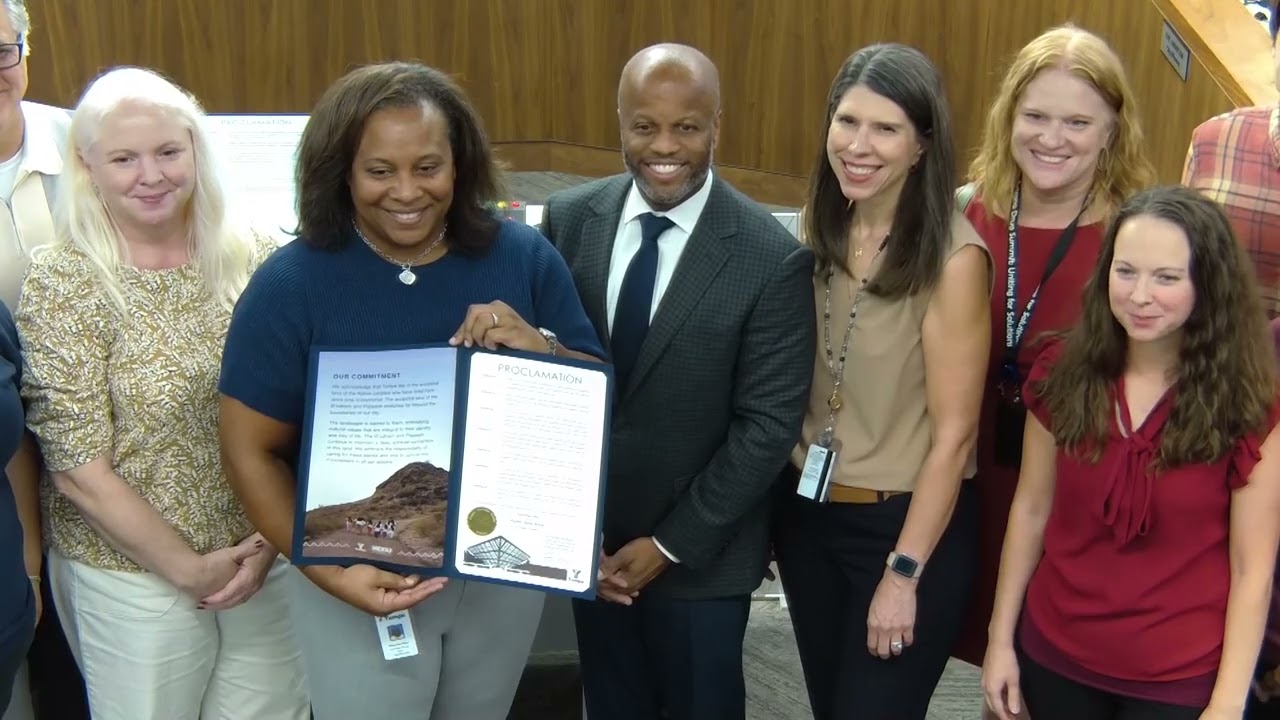
Next up here, item 5 A4, National Community Planning Month Proclamation. I'd like to invite members of the city's community development department who are present to come join me up front. And look at that. They're all right behind me. And I've got two of these. So, first of all, I'm going to hand one to their director, Mr. Jeff Tamvich. And the second one I'll go ahead and read. So, this one reads, "Whereas change is constant, it affects all cities and towns.
And whereas thoughtful community planning and policy plans can help manage this change in a way that provides better choices for how people live, work, and play. And whereas community planning provides an opportunity for all residents to be meaningfully involved in making choices that determine the future of their community. And whereas the month of October is recognized as National Community Planning Month throughout the United States of America and its territories.
And whereas National Community Planning Month provides an opportunity to recognize the participation and dedication of Tempee's boards and commissions, city council, residents, and community partners who contribute their time, perspectives, and expertise to the improvement of our city.
And whereas we recognize the many valuable contributions made by Tempy's professional planners and planning community and extend our appreciation for their knowledge, dedication, and continued commitment to public service and thoughtful community development. Now therefore, I, Corey Woods, mayor of the city of Tempe, Arizona, do hereby declare October 2026 as National Community Planning Month in Tempe, Arizona. Next up, I'd like to have council members Amber and St.
George come down here in the front with me for item 55, which is Dolly Parton 925day proclamation. You know what? Okay, hold on. Hold on, hold on, hold on, hold on. You know what, Council Member St. George, go ahead. Just, you know, keep hyping it up. Well, I'm just saying like, come on. She was an icon. She was an angel in human in a human cloak. And uh All right.
I just have to say there's not Thank you, uh, Mayor Woods for humoring me here, but there's not a lot of people in this world right now with the craziness that's going on every everywhere. Everybody from the left, the right, top, the bottom, front, back, everyone felt it whenever she passed away recently. And as much as I would like to take credit that the idea of, you know, declaring 925 September 25th in Tempe, Arizona is uh is a thing, uh, mayor let me go ahead and do it. So, thank you.
I want to note too that what was very interesting is when I uh had a conversation with Council Member Amber about this at one point uh when uh Dolly Parton passed away, I said, "I didn't know that you were such a big Dolly Parton fan." And she said, "Corey, I'm from Louisiana. What do you think?" So that was with literally the exact conversation we had that afternoon.
So with that, this proclamation reads, "Whereas Dolly Parton has spent decades proving that big dreams, hard work, and a little nineto-ive determination can take a person from humble beginnings to stages around the world. And whereas with talent, humor, and enough ambition to fill more than a few cups, Dolly has built an extraordinary career as a singer songwriter actress author entrepreneur, and philanthropist.
And whereas Dolly's coat of many colors reflects a story of perseverance and pride in where you come from. Values that resonate in Tempee, a city strengthened by creativity, individuality, and people from many different backgrounds. And whereas Dolly has shown that success means more than what you accomplish for yourself, championing literacy through her imagination library and demonstrating the power of using success to create opportunities for others.
And whereas Tempe knows something about working 9 to5, dreaming big and refusing to stand still. And we recognize a fellow trailblazer when we see one. And whereas Tempe knows success does not happen two doors down, but through people showing up, pitching in, and finding ways to work together. And whereas while some days may feel like here you come again, I'm hoping you're getting all these references.
People, Tempee's workforce continues to meet new challenges with resilience, innovation, and a willingness to get the job done. And whereas after more than six decades of making music, breaking barriers, and reminding generations to pour themselves a cup of ambition, Dolly Parton remains an American original. Now therefore, I, Corey Woods, mayor of the city of Tempe, Arizona, do hereby declare September 25th, 2026 as Dolly Parton 925 day in Tempe Arizona. Thank you all All right.
Next up here, item 5B, city manager reports and announcements. Madam City Manager, no announcements this evening. Thank you Mr. Thank you so much. I'm going to go ahead and get organized again here for one second. All right. Tonight's agenda has a number of items that the city council must consider in order to conduct city business. Guidelines for conduct at city council meetings are on the table near the entrance for those in attendance at tonight's meeting.
We will now play a video with the proper protocol for ensuring the appropriate conduct at city council meetings. The public appearances portion of the Tempe City Council agenda welcomes people to address the Tempe City Council on city related issues. Speakers will generally be taken in the order in which they have signed up to speak. No visual aids or pre-recorded materials are allowed. People may speak once during public appearances for up to 3 minutes.
If there is a large number of speakers, the mayor may limit the amount of time allotted for each person. The city council as a whole is prohibited by state law from discussing, responding to, or taking action on matters that are not on the current agenda. However, an individual council member may respond to criticism made by those who have addressed the public body, may ask the staff to review a matter, or may ask that a matter be put on a future agenda.
The city council rules of procedure provides everyone with an opportunity to speak. However, rules of decorum are in effect and behavior that disrupts, disturbs, or otherwise impedes the orderly conduct of any city council meeting is not permitted. This includes behavior at the podium, inside or adjacent to the council chambers. Speakers shall refrain from name calling, making personal or insulting comments, or slanderous remarks while addressing the city council or while attending the meeting.
Should a speaker become disorderly, action will be taken. First, the mayor may issue a verbal warning. And if the speaker continues disruptive behavior, the speaker will forfeit any remaining time for public comment and will be asked to leave the podium. Further disruption beyond that may result in removal from the council chambers and the mayor may ask security officers to remove the speaker.
If the speaker refuses to leave, security will warn the speaker that they are now trespassing and the next step is an arrest for disorderly conduct, trespassing, or both. If necessary to maintain order, the mayor may recess the meeting. Your right to address the Tempe City Council is important to us. These rules are intended to create an atmosphere that is conducive to thoughtful public speech. Thank you.
Okay, before we move into public appearances, I want to take a moment to address campaign related activity ahead of the upcoming Tempe special election on November 3rd. City council meetings are open to the public and are a vital forum for civic engagement. We welcome all individuals, including political committee representatives, to speak on matters of public concern during the public comment portion of the meeting.
However, because this is an official city council meeting that is both televised and livereamed using city resources, we ask everyone, including members of the city council, to refrain from electioneering or campaign related activity during the meeting. That means no discussing local ballot measures, asking for votes or signatures, or displaying campaign materials such as signs, t-shirts, or literature while speaking.
Thank you for helping us maintain the integrity and neutrality of our public meetings. Which brings me to item number six, public appearances. This portion of the meeting is reserved for those wishing to speak on matters within the jurisdiction of the city council that are not listed elsewhere on tonight's agenda for discussion or legal action. If you speak now about a topic that appears later on the agenda, that will serve as your only opportunity to speak on that item.
You won't be permitted to speak again when that item comes forward later in the meeting. As a reminder, public speaker signup is electronic. If you would like to speak during this public appearances period and have not already signed up, you may scan the QR code displayed on the signs in the chambers and select public appearances item six or see one of the designated staff members at the back of the council chambers for assistance.
If you submitted the city's online comment card before the meeting and requested to speak during this public appearances period, you do not need to sign up again. Your name has already been added to the speaker queue. Let's see now. Once again, still kind of a semi- new system here, so I'm going to switch over. All right. The first speaker I have is Nolan Williams. Please come forward. State your name and city of residence. You have three minutes. Neighborhood.
And I hope that you guys will forgive me when I start with a sort of tortured and strained uh metaphor, which is to say that a frog in water is not a swamp. Right? You find frogs in swamps. You might look at a frog in a swamp and think, "Wow." Or you might look at a frog in water and think, "Wow, that's a swamp.
That looks like a swamp to me because there's a frog there." In fact, someone might go to great effort to drive many, many miles and take a frog and put him in water somewhere and think, "Man, that was really difficult. It was a very difficult, arduous process. Surely I have a swamp now. But it's not a swamp unless there are lily pads. It's not a swamp unless there are crocodiles. It's not a swamp unless they have, I think, sycamores, you know, big trees hanging over providing shade.
You know, a swamp is an ecosystem. It's a whole system of different parts that work together. And it takes a lot to make the ecosystem happen. And sometimes the best thing to do is once you get the ecosystem started, you let it run on its own. You don't try to manage or control the ecosystem.
I think what we have in this city based on the number of people here that are coming to public speak, the number of people that spoke at the last couple meetings, we have a strong desire for privacy, for housing, and for shelter. I think it is sort of a difficult process that you guys came through with ALPRs.
think if we vote yes on the ALPR bill banning al ALPRs in the city I think that's a wonderful thing and I think that puts us ahead of many cities in the country but that is not the only thing that needs to be done and if it is so difficult for us to do it that we then say look I've dropped the frog into the water we have a swamp now then we have not gone necessarily far enough the same is true for housing the same is true especially for housing I know that there is a proposal before you guys today to build over 300 homes for over 300 new families, new residents, and new people to bring their joy and their laughter and their jobs and their work into the city.
And I know that there were many meetings beforehand and there are many people who have things to say about it. But just because it was difficult to get one housing project built does not mean that we have done enough to allow housing to be built in the city. Many many more homes need to be built in the city.
Whether we work hard on doing it, whether we have a bunch of meetings or not many meetings, at the end of the day, we need lots and lots of housing the same way that we need lots and lots of privacy, security, protections for our most vulnerable people, homes available for families that need them. My request to you guys today is to vote yes on the ALPR ordinance, to vote yes on the new housing ordinance, and then to wake up tomorrow and think, what is the next thing that I can do? Thank you.
Thank you. Thank you very much. Okay, the next speaker I have is Picente Martinez. Please come forward. State your name and city of residence. You have three minutes. Hello, mayor and city council. My name is Fenta Martinez and I am a food service for Aramark and uh ASU. As you know, my co-workers and I have been in a labor dispute with our employer for over a year now.
I would like to thank you for not only listening to us at the last meeting and I and my co-workers spoke at taking our concerns seriously. Since we last spoke to you, we've had dealings with underst staffing while also having our hours cut. Dining halls are now closing early on and on the weekends, leaving students with no uh option to use their meal plan. This is unfair to the workers who rely on our hours to pay our bills.
On top of my shifts at ASU, I've heard to take I've had to take on food delivery as a second job just to stay afloat. I work extra hours every week doing deliveries and I also have to donate plasma to cover my basic expenses. Like so many of my co-workers, my top priority is stability. But that's impossible when you're making $19 an hour and even harder when I'm working less and less. Meanwhile, Airark today refused to make any moves at bargaining on wages to help resolve this dispute.
The hardship workers are the hardship workers are experiencing are happening every day at the dining halls down the street from this chambers. The people who keep this campus running should be able to afford their rent and pay their bills and support themselves. I urge you to continue look into hold Aramark accountable and other major food uh service employers for the for these poverty wages. The that leave workers and students struggling. Thank you. Thank you. Okay.
The next speaker I have is Anhelica Delgado. Please come forward. State your name and city of residence. You have three minutes. Hello Mayor and council. My name is Anelica and I'm a food service worker for Airark at Arizona State University here in Tempe. My co-workers have picketed and protested many times over that that year to bring attention to the fact that my co-workers and I feed thousands of students on ASU campuses, but we can't afford to feed our families.
In my department, we have seen our hours reduced since last semester. When we asked our managers why, we were told that some of our work was being done by another company. At the same time, we are being rushed to work faster and faster. Dining halls are closing early. My co-workers and I are losing hours. No one is winning here but Aramark. We just made September 25th 9 to5 day. But aren't getting the to work that much? And even if we did, most of us would barely make over 30,000 per year.
Is that enough to live on in Tempee? We have sat across a negotiating table numerous times and it's always the same story. Our work is not enough. Our work is not worth the wages we are asking for today. They chose to refuse to move at all on wages or benefits. Even as we made concessions, Aramark is a multi-billion dollar company. There's no reason why they can't pay us what we are asking for. We are not asking for too much. We are just asking to be paid enough to live.
Aramark operates in your city. I want to thank you for taking these concerns concerns seriously and taking steps to hold Aramark accountable. Workers deserve a living wage, affordable health care, and respect on the job. Thank you for your time. Thank you. Okay, the next speaker I have is Eric Cadman. Please come forward, state your name and city of residence. You have three minutes. Good evening, council members. My name is Eric Cadman. I'm a resident of city uh of the city of Tempe.
Uh, I'm a Tempe resident and a food service worker for Aramark at Arizona State University on the Tempe campus. I'm here today because workers have been fighting for months for a fair contract with Aramark, a multibillion dollar food service company. They brag on their website about operating in 15 countries on four continents. We are asking for fair wages that allow us to do more than survive, affordable healthcare, and a pathway to retire with dignity after years of service.
Some people working there have worked for decades. Workers have spent months asking Airark to negotiate a fair contract. We have spoken at meetings, organized peacefully, and shared our stories. Yet, instead of pushing its contractor to settle this dispute and avoid disruptions, ASU chose to arrest organizers who are standing with workers and speaking out. That sends a troubling message.
It tells workers that when we raise concerns about low wages, health care costs, and economic insecurity, the university's response is not to address the problem, but to silence those demanding change. Are we not entitled to be part of the same public discourse as the rest of a campus that prides itself on freedom of speech? The reality is that this labor dispute will not end until Aramark agrees to a fair contract. The arrests did not solve the problem.
Silencing workers will not solve the problem. Ignoring workers will not solve the problem. I urge you to speak up as ASU's home city and take action. Hold Aramark accountable and support policies that will ensure a living wage for food service workers at Aramark and mega corporations like it. Thank you. Thank you. Okay. The next speaker I have this evening is Mario Martinez. Please come forward. State your name and city of residence. You have three minutes. My name is Mario Martine. Oops.
My name is Mario Martinez. I live in Tempee. The city use of self-described public relations manager uh David Lieowitz who builds the city as Liboit Solo has drawn scrutiny. Public information requests on Liboit Solo disclosed some serious uh public relations and labor accounting concerns. In 20 uh 2023, when Liboit sent city official Rosa Enshowsi a contract proposal, he was immediately put on the city books for a monthly retainer of $5,000 per month or $60,000 per year.
Lately, Lee Bulitz's uh retainer got bumped up to $7,000 per uh per month or $84,000 per year. While the invoices have not been summed up, Libo's appear to have banked around at least $200,000 or more since uh 2023 for a part-time job that typically comprises less than 25% of a full uh work week. The April 26 invoice. So, it's a typical hardworking month for Liboits.
Without providing a time sheet or any other evidence that he worked, Lieowitz build the city $7,000 for a total of 10.5 hours, including 4 hours for what he calls crisis comm's plan. Billing the city for $7,000 for 10 12 hours comes out to $666 per hour at taxpayer expense. In 2023, Lieowitz's first paycheck was signed off by Rosen Shousty and Tempe forward uh chairperson Tom Duning while Tom while Duning was officially working for Tempe.
Both officials uh participated in all three illegal meetings with Corey and the council at the time. For a typical employee, they're required to work about 160 hours per month. For the for for his June 20 26 invoice instead of 160 hours per month, he claims that he works 29 hours. This would make his hourly uh pay for the month $241 per hour. And this includes 25 hours for sales tax messaging. This might be a crisis for the taxpayers, but it is not a crisis for Lee.
You need to do something about it. Okay. Thank you. Next speaker I have is Edward Buffford. Please come forward. State your name and city of residence. You have three minutes. Mr. Mayor, you don't know how much I was hoping you weren't going to call on me. right now. I mean, hey, you were next to the queue. I just I take the cards in the order in which I received them. I was going to shuffle them, but they stopped me.
I'm going to take advantage every time I can to use my three minutes um at the city council because not just because there's so many things going on because there are things there are there are additional things going on. By the way, is there Oh, there you go. That's what I need. I wanted to mostly um state how great it is to see the different things that we do uh regarding healthy aging. For example, since the last time I was really encouraging, let's do more.
You know, I was a marketing teacher for 35 years and I should I decided that I really should be focusing on saying that because we're doing a lot of things and I didn't give the city nearly enough credit for all these different things that we're doing. And once I started really looking through all of them and all the different options people have, it's pretty great. But we're not marketing it enough in my opinion.
If I go around my neighborhood, I think I'm going to have a lot of people if I say, "Who are you going to call and what are you going to do if you have a stroke or something and you're all alone in your house?" And there's too many people out of 190,000 that would be in that possible category. Um, so I would just like to encourage continuing to not be so involved just in in Tempe Community Action and and all the different programs, but to get the word out.
It's not really in the newsletter and uh I mean what I offer my guess is but not a whole lot and that's a good venue. Seems like that could be a good venue for that. So 101 I wanted to say that suicide prevention week. I think it's really great that we're acknowledging that and doing things to make people aware of that because uh not a whole lot's really been done as much as I would have had wished in the last 50 years.
So, I'm one of those ones that had a brother two years younger that just went to a bar one day and bought a gun and killed himself. I look back over all those 50 years and try to think of what are all the things we're doing where people really It's not a matter of knowing so much as it is a matter of that person being able to act on it. 23 seconds.
The third thing, the I might as well mention I've been around here for so long that I think that's great that we have a national Hispanic Heritage Month and do even more things. I went to the Tempe Tempe Beach. I went to the Tempe Beach when my Hispanic friends were not allowed to go. Thank you. Thank you. Okay, that's all the cards I have this evening. Uh yes, I did register to Okay, they're here. All right. No, thank you for letting me know. Appreciate it. So, come on. Come on forward.
State your name and city of residence. You have three minutes. Hi, mayor. Hi. Uh, city council members. Um, my name is Ellen Stant. Uh I am a Tempe worker resident and worker at um Aramark Arizona State University on the Tempe Arizona campus. Um I am here today because after months of negotiations, we workers are still waiting for a fair contract that would allow us to support ourselves and our families with dignity.
I have shared my story with all of you before, but I I I was unhoused and I came to this job hoping it would make, you know, I would be able to make myself a way out and be a better person. Um, and hopefully have the finally the opportunity to get back on my feet. I was eventually able to get my own apartment, you know, through a shelter program, but I know how quickly everything I have could disappear and feel constantly at unease.
Aramark continues to drag out these negotiations instead of agreeing to a fair contract with living wages and today even refused to make a movement at the table. I can't see anything. My eyes are water. Sorry. As my city council, I asked to think about what this labor dispute means to workers like me. I am not asked to skiing for luxury at all. I am asking for the opportunity to work hard and to not have to live with constant fear of falling back into homelessness.
The hardships workers are experiencing are impacting residents of your city and taxpayers. I urge you to hold companies like Air accountable for the way it pays local residents and workers. I want to thank you very much. Thank you for your time. Thank you. All right. Who else do I have next here? Please come forward. State your name and city of residence. You have three minutes. Uh, hello Mayor and council. Uh, I can't top that, but I still got to say what I got to say.
So, um, my name is Jeremy West. Um, I'm a utility worker for Armark at ASU. Uh, as workers, we have spent months trying to get RMARK to address our concerns and negotiate a fair contract. We have spoken publicly, shared our stories, organized peacefully, and ask for accountability. Workers should not have to struggle to survive because Armark pays us poverty wages. I have many co-workers who have had to take advantage of city services just so they don't lose their housing.
Why is Aramark a multi-billion dollar corporation paying workers so little that they have to use government funded programs to feed our families and keep a roof over our heads? Um, the people who keep this campus running should be able to afford rent, pay their bills, and support themselves. I would like to thank you for not only listening to us at the last meeting I and my co-workers spoke at, but for taking our concerns seriously. Please continue to hold them accountable. Thank you. Thank you.
All right. Do I have any other speaker? I think that's all I have unless there's someone else. Uh, yes, please come forward. Oh, so yeah, let's see. I Are you uh Isabelle? Okay, perfect. So, yeah, Isabelle Hogan is the next speaker. So, just please state your name and city of residence. You have three minutes. Hi, my name is Isabelle Hogan.
Um, I live in Tempe and I'm speaking to support the proposed automated license plate reader ban ordinance as I believe it's necessary to protect the fourth amendment rights of Tempe citizens. ALPRs are cameras that capture information on every single vehicle. This includes not only a car's license plate, but date, time, location, make, model, bumper stickers, dents, and any other identifiable characteristics. An AI system. An AI system. Sorry, it's on. You're just talking. Oh, okay.
An AI systems embedded in this surveillance technology. This type of dragnet surveillance is what violates our constitutional rights. The ACLU argues that using ALPR systems gives the government unprecedented powers of surveillance that upset traditional expectations of privacy in the violation of the fourth amendment. This is an issue that applies to all ALPRs fixed and mobile and not just from Flock or Axon. This includes Motorola, Genetic, Leonardo, and any other ALPR company.
The city has already said it won't use ALPRs. Now it's time to stick by your word and codify it. Given the vast majority of your con constituents oppose ALPRs, I urge you to pass this ordinance and ensure it as strong as can be protected um the fourth and first amendment rights of your constituents. Thank you so much for your consideration. Thank you. All right. Do I have anyone else in the a Yes, please.
And just to note too, if you're coming to speak up on the ALPR, that's also during the actual item, but you can, but either one works. Are you coming to speak about that item? Do you want to actually wait until we actually call up the item or are are just before you sit down, are you registered to speak on that item by chance or Okay, perfect. Excellent. All right. Anyone else who wants to speak under item number six, which is sort of general public appearances?
If so, can you get my attention at this time? Yes. Please come forward. State your name and city of residence. You have three minutes. Hello. Uh my name is Andrew Gooden. I live in Tempe. Uh I just at the tail end of this section, I want to say I like the new system with the timer. This is This is good. Uh, I like uh people being able to see who's on deck and uh get out of each other's way.
I do also want to mention sitting in the back uh when the 30 seconds remaining timer happens and eight TVs at once uh turn red like Simon Cowell has just voted me off and I uh I don't know the psychological effect of that is something that may not have been uh considered and I just uh uh if maybe the bing maybe no bing or maybe a bing just here perhaps Uh, and there we go. All right. Thanks. I am also going to be talking about ALPRS later. Sounds good. Appreciate it. Thank you. All right.
Anyone else uh who wishes to speak under item number six, public appearances? If so, can you please get my attention? Okay. Seeing none, I will close that portion of the meeting and move to item number seven, which is the consent agenda. All items listed on the consent agenda will be considered as a group and it will be enacted with one motion by the city council unless an item is removed for separate consideration.
Members of the public may remove public hearing items for separate consideration. Public hearing items are designated as public hearing item at the beginning of the item title. Council members may remove any item for separate consideration or to declare a conflict of interest. If any council member would like to declare a conflict at this time, the city clerk will provide the council member with a disclosure form. As a reminder, public speaker signup is electronic.
If you wish to speak on a public hearing item and have not already signed up, please scan the QR code displayed on the signs in the chambers and select the specific agenda item or see one of the designated staff members at the back of the council chambers for assistance. This evening, the consent agenda is listed as miscellaneous items 7A1 through 7A5, awards and bids and contracts items 7B1 through 7B16, and resolutions items 7C1 through 7C3.
Any agenda item scheduled or or designated as public hearing item can be removed by a member of the public for separate consideration. If anyone in the audience would like to have a public hearing item removed, please get my attention now. Okay. Seeing none, I'll look to the council. Would you like to have any item removed from the consent agenda for separate consideration? Seeing none, I have a motion for approval from council member St.
George, followed by a second uh from Council Member Amber. Uh any comments or questions? All right. Seeing none, please vote. Council is counciling here. Sorry, mayor. Yes. Thank you. All right. And that item passes six to zero with Vice Mayor Chin absent. All right. Moving forward, let's get as stated earlier, I'm going to move up an agenda item out of order this evening, which is going to be item 8B1. And item 8B1 is in the ordinances and items for introduction and first hearing.
It will be read and introduced tonight, but no substantive vote will be taken. The second hearing and vote on this item is scheduled for October 15, 2026. Item 81 is to introduce and hold the first public hearing to adopt an ordinance for a zoning map amendment from GI to MU4 and a planned area development overlay for Emerald Center mixed use located at 8550 South Priest Drive for a new horizontal mixeduse development consisting of 376 multifamily dwelling units.
The applicant is Hu Manantel and affiliates. Good evening. Good evening, mayor and councel. For the record, my name is Alexis Proper. address is PO Box 1833, Tempe, Arizona 85280. And I'm here tonight with a request for a new multifamily project on the southwest corner of Priest and Ruby Drive um in South Temp. You may be familiar with the site. It's in the Emerald Center area. So, there's IKEA, the new electric pickle, and I've included some photos of the site today.
It's been vacant for about 26 years. Um, and so we are proposing to add this to the site and our requests for you tonight are for a zoning map amendment from GI to MU4 and for a planned area development overlay. And we are in conformance with the general plan which um designates this area as mixeduse moderate up to uh 45 dwelling units per acre. And here's just an exhibit showing currently G and uh requesting ME4.
And then um the site to the south is an existing office building and that is going to remain unchanged. Um it's just the property to the north that is going to become the multif family parcel. And here again you can see the site is the multif family's up north. The community college office building is to the south. And then because we are requesting a planned area development overlay, I want to include these standards for you.
Uh we are requesting 376 units uh which is a density of 31 dwellings units per acre. The lot coverage is 50% and the landscape coverage is 20%. It's more like 25%. Um and it's going to be four stories. We're requesting 65 ft and then the vehicle parking is 590. And then um here's our landscape plan and we've included desert landscaping, low water use, drought resistant. Here are some pictures of those landscape um the landscape pallet that we've chosen.
And then um I do know that the IGCC is voluntary in Tempee, but we are including um a lot of items and happy to leave this up, come back to it if there's any questions, but we are doing 30 EV chargers planned, not just um or they're installed, not just the planned for. Uh there's the 30 foot landscape buffers along Priest and Ruby. Um, yeah. And with that, I conclude my presentation. I'll take any questions. Thank you so much, Alexis. Appreciate it.
Uh, anyone on council, any comments or questions for Alexis? Yes, Council Member St. George. Thank you. Um, I really, first of all, excited to see something going up in that area. It is ripe for um putting some more families in that in that section. And we've got so much entertainment and retail and space around there that they're going to be able to um utilize. So, I'm looking forward to that. Um, I do also want to commend you for including so many things from the IGCC. I love to see it.
Sustainability is a passion of mine. So, I appreciate um what you guys are doing to make sure that this is something that can last for decades and be good for our environment. I do want to note um one thing that I noticed and perhaps we can go back to the number of units. Did you put that up in the in terms of like the breakdown of like single family Um, well, it's not it's not showing here, but I saw in the packet about how you had, you know, studios, one bedrooms, two bedrooms.
Um, this particular location is in the heart of the Kyne School District. And as we all know, they recently had to close down several schools because there's just not enough housing for young families in that area.
And what I would love to see, what I hear from my counterparts on the different school boards, Kyne, Tempy Elementary, is when these multif family dwellings go up, so much is there's so much focus on studios and singlebedroom apartments and really not enough that families could move into. And so I would love to see if you guys could figure out a way to maybe lessen the number of studios and onebedrooms and maybe increase the number of three bedrooms that families could go into.
I would love to see a change like that just so that we can provide more housing for our for our schools and allow and allow families to grow here in Tempe. Thank you. You'll take a look at that and we'll get back to you. Yeah, of course. Great. Thank you, Council Represent George. Uh any other council members? Any further comments or questions for Alexis? Yes. Uh, Council Garland. Thank you. It's a really good question about making it more family friendly. I I appreciate that.
Thank you for saying that. Um, the one of the things I was reading is something about the the trees and palm trees and things. Those things are going to stay because that was original. That's part of the HOA of that area. Is that correct? Uh, mayor council garlic. Yes. That's part of the CCNR's the landscape pallet for the street trees. Okay. So, so th So, those street trees, so the pine the palm trees are great. Um, they're they're old.
They've been there for a really long time, but they're not super shade efficient. So, your picture that you just showed us, will there be additional shaded type trees that will be going in between that to just provide a little bit more shade in that area? So I we are adding some street trees as required, but there is with the CCNRs like we're pretty limited on what is going to be allowed um by the architectural board. Okay. Um within the Emerald Center. Okay. Okay. I know. I'm sorry. No, no, no.
That's all right. That's um I just wanted to know because I drove by there and I looked at them. I'm like, these are great, but it'd be nice to have a little bit more shade in those areas than than it's right there. That's there right now. The other question is um you it had mentioned EV um charging stations. How many of those will are you going to have? We'll have 30 um like installed installed in the property. Okay. And um I think that was the last question I had. Yep, that's it. All right.
Thank you. Yeah. Thank you. Thank you, Council Garland. Uh anyone else on council? Any further comments or questions? Okay. Hearing none. Thank you so much. Thank you. Just want to note too, this is also a public hearing item and I do know I do have one speaker so I'm going to open up the public testimony portion. Let me go back here. A lot of toggling here sometimes. Okay, you can come up. I'm I'm waiting for the speaker thing to come up, but come on up.
I don't see the screen with the speaker here. Oh, okay. Please uh state your name and city of residence. You have three minutes. Hi, my name is uh No problem. My name is uh Peter Mains. I'm a resident of Tempe, Arizona. Uh Mr. Mayor, uh I I speaking today in support of this project. I think there's a lot of wonderful things to suggest. I think the the comments from the council members were uh you know, they made very good points as well.
um you know that there you know if we could get more family housing I think that would be excellent but this does put some family housing some two two-bedroom apartments it's not just simply studio apartments so that that's all good that we're moving uh residential uh into a commercial area as opposed to you know moving apartments into single family we know that can often be controversial and so I think this has a a good chance I didn't notice any opposition when I was going through the documents um I did notice had said that this would be buffered from the commercial areas around it.
I I hope there will be walking paths so people can enjoy the amenities. You know, sometimes when you have an apartment complex, you have a fence all the way around and you just it's really hard to get to the electric pickle or wherever you're going. And I I hope that's that's not the case. Um the current parking requirements, I notice that they're asking that the parking requirements be reduced. I think that's that's really smart.
Um this is on a major arterial road where it says that there's a very busy uh uh bus stop already and as we know you know our our public transit is underutilized and we want to create sort of a virtuous cycle where where we sort of normalize using using transit otherwise traffic will get worse and worse. So I think this is a good opportunity to not um you know swing through the fences but to slowly move us towards being a more transitoriented city. Um, and I I I believe that's uh that's it.
Thank you so much. Thank you so much. Appreciate it. That is the only speaker I have listed for that item this evening. Anyone else wish to speak on item 8B1? If so, can you get my attention? Okay. Seeing none, I'll close the public testimony portion of the public hearing. Council members, any last questions? Uh, there's no vote this evening. It's only the first hearing. All right. Seeing none, the second and final public hearing on this item is scheduled for April.
April October my god April October 15, 2026. All right. Next up, item 8B3, which I'm also moving up this evening. Uh, this is also going to be read and introduced this evening, but we're not going to take any substantive votes. The second hearing and vote on this item are scheduled for October 15, 2026.
And that item is 8B3, which is to introduce and hold the first public hearing to adopt an ordinance addressing public health, safety, and welfare by amending chapter 26 of the Tempe City Code relating to police and adding a new article six related to the use of automated license plate reader or ALPR technology. Let's see here. I'm going to probably go ahead and start here with Council Member Nichols, I'm assuming, and then we'll probably get into the public comment portion.
So, thank you very much, Mr. Mayor. So, good evening, Mayor and Council. I'm going to be making my uh presentation from up here because my notes are virtual. Uh good evening, mayor and council. Tonight is the first public hearing for an automatic license plate reader ALPR ban ordinance. I'm going to briefly go over what an ALPR is, what specifically would be prohibited under this ordinance, and I'll be answering any questions about the substance of this ordinance from the rest of council.
Additionally, I'll be answering questions about the technology and why we are bringing forward an ordinance to the full council. I will note the process of creating this ordinance has been one of continual input and deliberation from community members, subject matter experts, and city staff. This ordinance will likely have further edits in the coming weeks, but we have here today is something that I'm very excited to go over with all of you.
And I would also quickly thank everybody who has contributed their uh time, energy, and insights to this process.
So an automated license plate reader system, it can vary from company to company and these are offered by private companies exclusively at this time and generally they require a camera to record data on every single vehicle that passes by in addition to a system of categorizing and uh managing the um downloading of that data by people who buy subscriptions to it and that can be law enforcement agencies or it can be HOAs, private businesses, etc.
Artificial intelligence is then used to take the information derived from the photos captured by these cameras like vehicle make, model, color, and license plate number and upload it into a searchable nationwide database that is accessible by any other law enforcement agency that subscribes to that same service again as well as um HOAs and private companies.
In this way, ALPR systems are similar to social media where the city is both a user of the tech and its data including its residents and visitors data is a product that is sold to other cities and towns through data sharing agreements through the private companies that manage this technology in Tempe. The city started using this technology in 2022 when we entered a contract with flock safety.
It's my understanding that in spring of 2026, the city decided to explore alternate vendors for ALPRs and decided that we would not renew the contract with Flock after many months of data protection concerns and attempts to put in guardrails by city staff. In August this year, the decision was made to stop sharing data, to turn off the cameras, to bag them, and this all came following instances of officer misuse at other cities and towns.
And although we took the proactive step to remove those cameras a month ago, we still have had community members write into council communicator, call into 311, and attend the August 31st regular council meeting asking for an ordinance that codified the city's decision. Their concerns included the fear that this technology was brought to the city without their direct knowledge that a that a future city council and mayor could simply reverse the policy that was put in place.
And that brings us to the ordinance we have before us today. This ordinance has gone through four separate drafts. We have attempted to be as responsive to as many constituencies as possible in this process. It has been our goal to be directly connected to the community and I'm so thankful to everybody who filled out the survey on this issue. We had nearly 900 responses. That survey is linked in the agenda packet here and uh I'm certainly going to advise everybody to take a look through that.
So while we are on this topic, I'm going to go to the ordinance itself and I'm going to talk first about what specifically is prohibited under the current version of the ordinance. So except is expressly permitted. Uh no city agency under this ordinance shall be permitted to acquire, install, operate maintain borrow lease subscribe to except including by gift, grant, trial or pilot program or use any ALPR system. And no city agency shall be quer shall query any ALPR system or ALPR data.
No city agency shall expend or authorize the expenditure of any funds including grant funds and asset forfeite funds or any ALPR system. And no city agency shall enter into renew or extend any contract, subscription, memorandum of understanding or data sharing agreement concerning any ALPR system.
And finally, no city agency shall permit the installation or operation of an ALPR system on city-owned or city-controlled property, rights of way, or infrastructure, or by any other governmental agency or private entity, except where the city is required to permit such installation by state or federal law.
In which case, the city shall grant no greater access than the law requires and shall disclose each installation on the city's website unless such disclosure is prohibited by the applicable state or federal law. Essentially, this would operate in a way that requires our city to be very thoughtful about the way we engage with this technology um by deciding by moving forward away from uh this specific type of technology. I'm going to go next to exceptions to prohibition.
There are a few exceptions that are written into this and this is an area where we expect there will be continued conversations. Uh, this article does not prohibit the receipt or use of ALPR data produced to the city pursuant pursuant to a search warrant, pursuant to court order, or subpoena issued in a specific case, or produced by a defendant, provided that no city agency requested or arranged the underlying collection or query.
The con um this also article also does not permit conduct that the city or its officers are required or expressly authorized to undertake by federal or state law, judicial warrant or lawful order from a court of competent jurisdiction. And finally, this article does not permit does not prohibit the use by a city agency of an ALPR system or ALPR data for business purposes unrelated to law enforcement such as parking lot or garage enforcement and management.
provided that such use of an ALPR system or ALPR data does not cause any person's location, movements, personally identifying information or other information in which a member of the public might have a reasonable expectation of privacy to be made available to or accessible by any private third party for collection and inclusion in any data set which may be provided to any public or private third party as a searchable database by the collecting third party.
This article also provides for the decommissioning of any existing ALPR systems within the city and the destruction of ALPR data except where expressly permitted to be continued uh the use of which to be continued by the city.
I would also note uh down in the bottom we have included another section on employee discipline which uh establishes that in the event that a city employee with supervisory authority over a subordinate city employee knowingly instructs their subordinate to violate this article and the subordinate does in fact violate this article in carrying out the supervisor's instructions, the supervisory employee shall be subject to employee discipline pursuant to the section.
And if the violation at issue is the subordinate employees first and only violation of this article, the subordinate city employee shall be presumed to have lacked knowledge of this article, which would establish uh an exception for that specific instance. I would thank council member Amber for helping us come up with that specific language. And I'm going to continue on here.
So, there's actually also been recent evidence uh that's been reviewed by the FBI that the risks here do not outweigh the benefits on this technology. In the future, should that no longer be the case, a future mayor and council could reverse this ordinance. And it's my belief that the necessity of a public hearing on that reversal would be a step towards transparency and accountability to the public.
Uh again, I would like to thank everybody who has participated in the survey, everybody who has come out to speak on this issue, everybody who has participated in uh the online dialogue around this or the inerson dialogue even. And thank you to all of my colleagues for going through this process with me. Again, this has been an iterative process. We've worked very hard to make sure that we are getting all of the potential issues addressed and continue to do so.
We have also uh I would like to go over briefly the timeline of this. We have had a month now of input from the public, including two community input sessions, a former city council, a prior city council meeting, a survey, and we will be having additional meetings on the ordinance itself on October 1st, one at noon and one at 6 p.m. The one at noon is going to be virtual. The one at 6 p.m.
is going to be in person, and I do not remember off the top of my head where that will be held, but I can find that out and let everybody know. Uh, I would like to answer any questions from my colleagues first at this time. Sounds good. Thank you so much, Council Member Nichols. Uh, council members, do you have comments or questions for C? So, let's go. Council member St. George. I do. Thank you, Mayor. I have two questions if I may.
Um, the first, you mentioned uh the risks outweighing the benefits, and I was just wondering if you had any specific examples of cases where the technology posed a risk to public safety or or any data that supports that statement. Yes. So, there are a few instances. It's sort of a two-part question.
one, when are these instances um where there are there instances where there have been issues created by this technology and then the second part is what data is there to support the idea that the risks outweigh the benefits. Uh and I will start with that first part of the question.
So in February of this year, there's a flock camera in Sherwood, Arkansas that misread the license plate of an SUV, leading officers to detain an innocent couple at gunpoint while their six-week old baby sat alone in a car seat in the back of the vehicle. Last year in San Diego, for instance, officers were searching for a red uh red vehicle connected to an attempted carjacking.
The officers didn't have a plate and were instead relying on Flock's vehicle signature technology, which captures detailed characteristics of individual cars, make, model, and color. Uh, and again, a lot of this has to do with the artificial intelligence angle. Uh, there has been data that shows about 10% of hits by flock and ALPR systems in general are u mis hits. So they are essentially of only 90% effective in finding the actual vehicle, but 10% of those are are inaccurate.
The flock system gave a positive hit on a superficially matching car. Going back to the story in San Diego, but it was totally different from the red car they were looking for, which was located 5 miles away from the scene of the crime at the time it occurred. Officers nevertheless arrested all three of the cars occupants. One passenger spent nearly a month behind bars during the holidays before officers realized their errands set him free.
This is a reliance on a technology that is based on um a further technology and artificial intelligence programming which is not effective at actually providing for law enforcement purposes. And that leads me to the recent um review of uh flock data from Atlanta, Georgia that the FBI um performed. Uh Atlanta has experienced far and away the largest influx of ALPRs in the country. There are over 5,000 various flock cameras now blanketing the city.
And the recent data released by the FBI shows that the city's massive web of surveillance has had virtually zero impact on their police department's ability to solve crime with some instances actually um experiencing a decline in case closures over the few last few years. And I'd like to go through a few of those numbers quickly. I can provide this information to you directly.
uh there from 2021 to 2025 criminal homicide rates during the time which ALPRs were being used in the city the closures were uh decreased from 54 53.4% to 48% that's a difference of negative 5.4%. Uh sexual assault cases stayed exactly flat from 37.7% to 37.7%. Robbery actually decreased by a point from 25.5 to 25.4 so by.1 percentage point. Uh, and one mo one that's particularly useful.
There were a few that went up, but the amount that they did go up was relatively minor, essentially a rounding error for motor vehicle theft. From 2021 to 2025, case closure rates increased from 9.9% to 10.2% which is a difference of.3%. Uh and ultimately this shows that the technology, the argument that's being made in favor of the technology, which is that it actually does help to solve crimes is not borne out by the data that has been provided. I'm really glad we were able to get this.
This is something I've been looking for for the last few months, and only very recently were we able to find a specific example that from a large city that uses these ALPRs extensively, which does show that there is not a significant uptick in the ability to resolve crimes using this technology. Thank you. if you'll permit me a second question. Um, so the version that's before us tonight is very different.
I I attended one of your public meetings about this and I appreciated not only your presentation but the engagement of the public um and the the quite a lot of questions that they had and it was a really informative session. Um, but the version that we have before us tonight is very different than the one that was presented a couple of weeks ago and I was just wondering what prompted those changes.
So those changes were prompted by the survey that was completed in additional in addition to the continued outreach from community regarding potentials for loopholes, potentials for in uh continued use after the ban was put in place, should it be put in place, and these changes were made to try and address those concerns.
Uh we've been having good meetings about that still and there will potentially need to be a continual iterative process between now and October 1st, but by the time we get to that meeting, we will be at the final version of this um going forward. And we don't plan on making any substantive changes and I would if we want to know what substantive means, I can defer to the city attorney, but we've had that conversation as well. Thank you. Okay. Thank you, Council Member St. George.
Uh anyone else on council have any questions for Council Member Nichols? Uh, Council Member Garland. Um, thank you. So, um, I I have um concerns with this. Um, and I've talked to you about this, but I'm I want to just mention out in public. Um, the first the ordinance that was passed out for our community to look at before the community meeting that you had, the one that people responded to from the survey, is not at all close to what this is that we're looking at tonight.
Um, I was comfortable and ready to support that ordinance because um I think it didn't um it didn't tie our officers from being able to take part in multi-jurisdictional task force which we have done. This would stop us from being able to do this the way that this is written, the way that was written before the last part of the last time this is put together.
Um, so I recognize that you said that you had public input and things were changing, but this is this takes us out of the ability to do a lot of the things we do with other communities.
And one of the things I had written down and I was asking about um, and I was going to ask our police chief about this, but um, will we be able to take when we have had the president come here, we've had bunch of police departments that have worked together, and I think I don't even know if we would be able to do that now because of this. Do you do you know, Jaser? I would love to respond to that if that's all right. Yeah. And I would just say thank you very much for bringing that up.
I do um have been working directly with our um city staff to try and make sure that issue is addressed. We do want to make sure that our officers are able to participate in multi-jurisdictional investigations and multi-jurisdictional task forces. Uh in addition, we also want to make sure our officers are not feeling as though they can't go canvas other neighborhood businesses to request data on issues that may have occurred in their area. as is standard practice at this time.
These are things that are being addressed at this point and we are I'm fairly certain we can address these with what would be legally described as non-substantive changes which would allow us to bring forward language on the 15th of October to be able that will be able to address correct because there are six items there are six items in here that were removed from the original one. Like I said, I I could have supported that one. I can't support this one. It just it takes to way too much.
There was a a few redundancies that needed to be limited down as well. But beyond that, the initial protections that were afforded for officers on task forces and officers who would like to use or access data that has been uh gathered by another agency or by a private business so long as the underlying search or query itself was not run by or specifically requested by the city. There's that is something we're working on language on right now. Okay. Um yeah, so I'll be interested to see that.
And I mean, one of the things that I have I have a pause with I have that is when we did our first the first first public meeting, it was brought up on a Friday before a three-day weekend and the meeting was on a Wednesday.
I'm a council member and I did not even know that these public meetings were going to be held because it it happened it happened so quickly and we have been we get attacked by um members of the public when we do something that quickly because it seems like we're trying to be sneaky about it. I'm not saying that's what what you did, but I'm just saying we have to be watching that and be careful with that.
When I when we voted to um to get rid of the the contract that we had, um you know, the the reasonable expectation that I had is that the next step would be um we would put up safe safeguards in the police department, add to the safeguards we already had because the problems that are happening in or have happened in other um mun municipalities have not happened in Tempe. So that has not happened here.
So I would expect and think that we would have the next step would be putting in additional safeguards, creating a policy within the police department that that we can support and then if that all those things didn't work, then do an ordinance. It just seems like we are just rushing through this and now in the next few weeks, a couple weeks, we've got to have other public meetings and um and then make all these try to make these changes, but try to also be working with um with our public safety.
So, I I I I appreciate what you're doing. I've told you that many many times. Um, but I just think that I don't understand why we're rushing so fast. I could respond to a few of those parts as well. So, on one hand, I understand this is a relatively quick process. Though, I will say we did have very encouraging turnout at both of those public meetings that were brought forward.
We also again had 900 responses to a city survey which showed that 7 or 70% were in favor of a ban on automatic license plate readers. 30% opposed and uh the other side of that was just the process. Sorry, can you Yeah, the process. Yeah.
How that that I would have expected us to do different steps along the way before we jump to the So the other the issue that has been brought forward is that a lot of the guardrails which could be put in place around this would be undermined by the private entities that offer offer this technology. If there happened to be a governmental agency that did not have a profit motive where it required them to take in all the data they possibly could, then sell that data to a third party.
It might be significantly easier for us to implement those guardrails. And there are potentially conversations like that that are going to take place at the state level. But here at the city, unfortunately at this time, because there are no companies that offer a policy or technology like that, and there are no companies that appear to be moving in that direction.
The idea here is that in order to have a comprehensive protection for our data, our privacy uh and our residents, movements locations associations etc. Uh that putting something like this in place would be an effective way of making those um making those protections established in law.
And again, moving forward with a uh ordinance was one of the things that was brought forward pretty significantly at a pretty significant clip within the survey and within those public meetings, trying to make sure that we were codifying what we put forward here so that it wasn't as easy as potentially just turning around and making that change. Okay. Okay. Um I have a couple questions for our police chief. I'm sure to request that. Absolutely. Um, Chief McCoy, would you mind?
One is I didn't uh listening to the statistics that they were just talking about.
I just wondering I mean those are statistics from other cities and I'm just wondering if you could give us a little bit of the statistics here and I'm again I I know that we have gotten rid of that contract but just if you can give me a little bit of background and also um you know one of the things that I had mentioned is that there there seemed like the h handstrapping us a little bit um with what was removed from the ordinance that we saw la this last week or a couple weeks ago compared to what we have now and just your thoughts.
on that. Great. Well, mayor, council, uh, council member Garlet, thank you for the opportunity to address you all tonight. So, our priority at the Tempe Police Department is public safety and we utilize every tool that's available to us to ensure our community is safe and ALPR has proven to be instrumental in the work that we're doing on a daily basis. And we have heard uh the privacy concerns. We have been involved in many conversations about those privacy concerns.
And um we were in agreement when we all made the decision that we needed to step away from Flock. And we did that with the understanding that we were going to move forward and identify a technology that was going to be responsible, a company that was going to work with us responsibly. um we were going to get the technology in place with all the appropriate guard rails and what um we have here before us today is a complete ban on ALPR.
And I can tell you uh as the chief of police uh the Tempi Police Department does not support uh that ban and cannot support this this ordinance as written. And we know ALPR has helped solve many, many crimes in this city, serious crimes from homicides to sexual assaults. Um, what we also know is that since we've decommissioned this technology, there have been crimes that we have not been able to solve from shootings to stolen vehicles.
And sadly, we have a 16-year-old girl right now fighting for her life in ICU. She was hit by a car and the car fled the scene and we have not been able to apprehend the individual involved. And the sad part of that is the area where this happened, we had decommissioned flop cameras at that intersection. And she's fighting for her life. Her family is devastated and praying for her. And we want to bring justice to her and her family. Um, and we're going to work tirelessly to do that.
Um, but we're several weeks out and I'm confident we would have been able to solve this case a lot sooner um, if our technology was in place. Um so moving forward um I I want us to remember uh there are real impacts uh by us not having this technology on community safety and we want to work together to put the appropriate guard rails in place to ensure that privacy concerns are addressed um while giving us the tools that we know are effective at keeping our communities safe.
And when I say strong guard rails, any misuse of it, um, you know, I I would be the first to say we need to terminate the employees involved in the misuse, um, we can have strong ordinances to even move towards prosecution for misuse. But taking the tools away, um, is only going to law enforcement and it's only going to prevent us from solving crime and, uh, keeping our communities safe as expected.
So, the way that this was written, um, the the ordinance before this one that everybody saw at the public meetings, the one that I was I could support, you got you supported that one. Um, I No. No. Um, if ALPR technology is taken away from the police department, um, that is something I cannot support. And then did um when when you looked at this for the the task force, can you tell me a little bit about our ability to be able to work with the task force or work with other cities um around? Yes.
Yes. So u our task force work is a force multiplier. We are involved in task forces at the federal, state, and local level. And those are things that uh again uh we uh partner um to to keep our communities safe. And if we were not able to participate um or utilize APR ALPR data, it would put us at an extreme disadvantage. Uh and we wouldn't be able to participate in any of those task forces. Uh the federal government is in support of uh ALPR technology.
Our partners are in support of the technology and they're actively using it. Um again we um are proponents of responsible use um for ensuring the proper guardrails are in place and um again our task force participation is contingent upon that. Um one thing I'd like to also mention I know we talked a lot about some other cities Arkansas some abuse Atlanta um there has been no uh abuse that we have found in in the city of Tempe.
Um we have had um you know strong expectations and guidelines in place and we continue to strengthen those. Um when uh before we let go of flock we made um numerous uh adjustments to our policies and procedures and uh up upping our regular audits and so forth. So um again I am uh confident with the appropriate guard rails this is a technology that can be used appropriately and we can continue to ensure uh safety for our community. Thank thank you Sure.
Council Nichols you want to respond then I'll move to council. Yeah. Thank you so much for being here chief. I appreciate you. So a few about a month and a half ago, I reached out to the office after a meeting that we'd had to request data specifically on the case closure rates from before we had flock cameras and then while we had flock cameras and um I have not seen that this time. Do you have any data to that degree? Any specific statistics? Right. So we we have some data.
Um however we don't have uh we weren't tracking data uh to to that level to to make that uh analysis. Um so so we have some anecdotal data uh data that we can provide.
Um what we do have though is we we have specific cases uh where we can uh share I believe I I have shared with with the entire council a list of specific cases where we can say definitively that um ALPR data contributed in in solving the case and and again those are serious violations homicides sexual assaults robberies um so that's the data we have at this time um being able to look at it um from your perspective with seeing if we can show a correlation uh we we don't have that but nothing on the Okay so nothing on the specific case closures got it and then I also wanted to make one more I had one more question there was a few I know that we've said a lot that there has been no misuse of the flock systems by temp but in July of 2025 a search was run on uh no kings protesters uh with a sort of drag net no kings description as the reason for the search can Can you describe how that would fit within the definition of not being abusive?
Oh, well, that's incorrect, council member. Um, that search was done in relation to a vehicle that was doing burnouts downtown. Uh, the officer uh reported that vehicle and the search was conducted uh for that purpose. It had nothing at all to do with the No Kings protest. And just quickly then, why was the no kings used as the uh the no kings protest was at uh in the morning that day?
Uh this incident happened in the evening and the operator who typed that in um or excuse me, the officer who reported uh the incident had worked uh during the protest hours and we believe that's why it was put in that way. Okay. But the the search had nothing at all to do with that protest. Got it. It was just Yeah. Yes. Understood. I think that's all I have for right now. Thank you. Thank you very much, uh, Council Brand. Yes. Uh, thank you, Mr. Mayor.
Um, looking at it, it's at the Pile Adult Recreation Center, that October the 1st, 6 PM meeting. Um, I also I also was at the same uh public public meeting that Council Member St. George was at. Um, I have the same problems. I was as as council member Garlic did, I was kind of okay with that original language. I got some serious angst whenever I saw the red line version and it took out some of those exceptions. Now, I absolutely agree that if you ask people, do you want LPR APL LPRs?
70% are going to say no. But as a former campaign person and that has run polls before, you you can't just ask, do you want the these flot cameras on the corner? Everybody's going to tell you no. The meat of the data is the whatifs and the stuff that you took out that was the exceptions to the prohibition were that to me kind of satisfied some of those whatifs.
Um, and I know you've told me that you're working with a bunch of the stakeholders to add some of that back, but the two things that I was I had the most angst over was whenever you took out the the part where I'm just going to give an example like you have an HOA down in South Tempee that has, you know, the HOA themselves uses their private money to put these these cameras up in their neighborhood and they've had a rash of burglaries and they call the police and say, "Hey, we've got this information.
and we'll give it to you. This is going to require the police, even though both parties are saying we're going to do this, they're still going to have to go to a judge and get a warrant. And that's a step that I really don't think that they need to have to take on that. And the second one was, and I think we've talked about it and and you know, and adnauseium is the uh the task force part.
I don't want to put the citizens of the Tempe if Tempe in the position where we're not going to be able to participate in some of these task forces because of some of the other jurisdictions and what they're doing. I'm not going to as a Tempe council member go to Scottsdale and tell Scottsdale what they can and can't do. Um, and I don't want them to do the same thing with me.
Um, I do agree on the one point that you did say though, even though we passed this as an ordinance, nothing is going to prevent a future council from coming back and changing it, once the technology has advanced to the point where a lot of these concerns that we have and as the public have um are kind of dealt with, then they can come back and revisit it. And again, it's going to require a public meeting, several public meetings to do that, but I think that's a good thing. Thank you very much.
Thank you, Chief. Thank you. Thank you, uh, Council St. George. Actually, Chief, sorry. Oh, I apologize, but I I did I I I just had some concerns. So, Council Member Garland specifically asked for statistics, Tempe related statistics. You know, it's it's one thing to hear about what the FBI has found out has happened in Atlanta. Um, we like to say that Tempe loves data.
So I find it personally troubling that we do not have speci specific tempe statistics in the difference between when we instituted ALPRs which was what 2022 2023 something like that um to now that we're not tracking specifically the cases that have been solved as a result of this technology. I would still like to see that. I don't know if we have it if if we just haven't been doing then that that was a major ball dropped on our part. Um and that was just a comment.
But you said something about being confident that we will be able to find a company in the future that where the guard rails will be in place to make all of the privacy and the safety concerns um that are brought up in this current iteration of ALPRs palatable.
I suppose um and and I just I don't know if I I definitely want to maybe not use the term naive, but it's really the only one that's coming to mind regarding um these companies and and the fact that their their main profit driver for this technology, as much as I would like to believe it is altruism and that they truly care about public safety, they care about tracking and the selling of data. That is how they make their money.
And so to to hope that that they will see the light and and come up with something that will protect the public um and not require them building a massive data centers etc. I mean I could go down a rabbit hole um if we look at the broader picture of what what this technology means.
I just I I think we we have discussed it um that it would be nice to like you mentioned as this technology advances and perhaps someday one of these companies will come along and create something that will allow us to use technology like this safely without violating fourth amendment rights. I just at this point it doesn't exist. And so we kind of have to meet the moment that we're in today and not hope that maybe someday in the future.
Maybe someday in the future if it happens a different council that's sitting up there here can make a different decision at that time. But I sorry I actually made you come back up and stand here and listen to that. But those were just some of the concerns based on on what you said earlier that we don't have the statistics and there is not a company out there that's able to provide the guardrails at this time. May I respond? Yes, Chief, please.
So, first I just want to respond about uh your comment about major ball being dropped. So, a first of all, ALPR is a a tool. It's one piece of evidence no different than fingerprints or DNA or um a photograph. So we don't track statistics that way. If you ask me, chief, how many cases have been solved by uh eyewitness or how many cases have you solved by a single fingerprint? I I couldn't give you that data. I don't have that at my fingertips uh because it's a collective in any case.
So when you ask how many cases have been solved by ALPR, that's not something we have at our fingertips because that's just one piece of an investigation. That gives us a lead that we then continue to investigate um and track a case and hopefully come to a conclusion with it. So that's why there's not stats regarding that. Um my comment about being confident um I I am confident that we can put appropriate guard rails in moving forward and right now um we do not have ALPR.
We moved away from flock and it's the technology is not being used. So there's no risk uh for privacy in the public in Tempe because we're not using the technology. So why are we rushing instead of slowing down and working together to come up with the appropriate guard rails? And as I said, I believe we can get there. Um the technology is new. It's evolving. Uh you know, a lot of this is in our control. If we move forward with a new contractor, it's in our control what we sign a contract to.
And if we're not comfortable with the way the data is going to be stored, retained, or utilized, we don't have to sign a contract. that's under our control. We can put policies in place to hold people accountable for misuse. And I repeat again, no one in Tempe has misused the data, but if so, we can have appropriate policies in place.
And we're working with the state now to move this type of technology and data underneath the same criminal justice information platforms that we already have that we hold people accountable to up to include criminal penalties for misuse. So again, I'm confident that we can put the guardrails in place. Um, you know, it's going to take time. Um, but again, we're we don't have the technology. We're not using the technology. There's no risk.
So, we have plenty of time to sit down together, figure it out. Um, but again, I'm confident and um, happy to answer any of your questions. Do you mind if I add one more one more thing there? Sure. So just quickly the specific statistics that I had requested initially it wasn't like how many cases did you use flock on specifically where flock was dispositive. It's broader than that.
It's how many what is our case closure rates since going from installing these cameras to um to today or to the removal of the cameras and that would be more that would be really helpful to see. Okay, we can get you that data. No problem. Okay. Thank you.
I've got some comments, but I know we have a lot of speakers here, so I can actually save my comments or questions until the end just to make sure that we can uh not make the speakers in the audience wait any longer unless council members have any further comments before I uh open up the public testimony portion. Okay. Um seeing none from my colleagues, once again, I I'll save my comments and questions for the end. And once again, this is only the first hearing.
We're not going to be taking any substantive votes this evening. But uh with that said, I'm going to go ahead and switch over here and get open up the public testimony portion of this public hearing. All right. So, the first speaker I have is virtual and it's Ross Egleston. Uh hi everyone. My name is Ross. Um I actually live in Surprise, but I work in Tempee uh with various nonprofits. Um, and I'm speaking out on behalf of supporting the ALPR ban.
Um, the use of ALPR is a violation of people's constitutional rights and does not meaningfully deter violent crime. Um, ALPR is a violation of the Fourth Amendment against unreasonable search and seizures. Um, I appreciate the council being leaders on ending the contract with flock, but this is not specifically a flock issue. It's an issue with the fundamental technology and how it is used to collect data on people.
Retaining and searching many play reads over time creates a detailed record of a person's movements and obtaining that record without a warrant violates this right. Um, as far as the stated benefit about crime deterrence, this has been researched widely. Um, as Bobby kind of went into, um, it was also researched in 2025 in Atlantic City, New Jersey, where they installed ALPRs on every road into and out of the city.
They found no material evidence that ALPR networks reduce violent crime in any capacity. Um, and then expecting guardrails that can cover all possible abuses that could be done for this technology is misguided in my opinion. And I think we've seen across the country how it's been widely abused by many different police departments. Um at the end of the day, people's rights are being violated and the results for use of this technology is not there.
That leaves me with the only logical choice to fully support the bing of ALPR technology in Tempe. Thank you. Thank you. Okay. The next speaker I have is Spencer Quit. Please come forward. State your name and city of residence. You have three minutes. Good evening, council members and mayor. My name is Spencer Quit. I'm a former resident of Tempe.
While I currently reside in Phoenix, I regularly come to Tempe for mutual aid work, community engagement, and regular religious practice at the Hakuanji Zen Center. In solidarity, I'm here to stand alongside the overwhelming majority of community members to oppose ALPRs. My arguments My arguments in opposition to this technology, excuse me, uh, pardon, my arguments in opposition to this technology are manifold and could take a significant amount of time into detail in full.
To instead be brief, I will simply offer that I oppose ALPRs on the merits and on their moral and existential consequence. Taking aside the supposed ease with which they might allow law enforcement to conduct their work, lower your voice a little bit. Sorry. Um, I wish to reckon with the associated ethical cost. It was Benjamin Franklin that declared that those wishing to sacrifice liberty for safety deserve neither liberty nor safety.
Long has the American project been mired in an everexpanding surveillance apparatus that grows more invasive and totalizing with every passing year. One must wonder to what degree the alleged safety ALPRs can create is worth the cost of the privacy to the public, which is a form of safety in its own right. For my master's degree, I studied the mathematics of artificial intelligence at Johns Hopkins University. In that capacity, I had direct contact with the ethical implications of these tools.
It might be worth considering now how trivially easy it is for AI to explore the behavioral tendencies of a person better than they can do of themselves. A person's identity can easily be reextracted from medical data even after anonymization. Consider that uh what may be learned by the constant tracking of travel of the city's people. Consider where that data may go once obtained, who might gain access legally or otherwise, and what kind of social structure that implicitly creates.
It is a benthamite panopticon, an eye over everyone's shoulder, an innocent and guilty alike. This is not a comforting reality for most Americans not directly involved in the carceral system and this spans across many political divisions in a way that few issues do at present and Tempe has the potential to serve as an example for the rest of Arizona and I strongly urge you to do so. Thank you for listening to the community and strengthening the ordinance after the survey closed.
Please pass the ordinance as is without any additional loopholes. Thank you for your time. Thank you. Next speaker I have is Michael Kincher. Please come forward. State your name and city of residence. You have three minutes. Hello, my name is Michael Kincher and I am a Tempe resident. My pronouns are they them. I'm a PhD candidate at Arizona State University in computer science and part of my research work includes studying the use of artificial intelligence or AI.
I've called Tempe home for 11 years now. Tempe is the place where I moved out of my parents' home and the place where I bought my first and current home. I've always loved the Tempe Leads the Way in Arizona with our beautiful parks and bikable downtown area. So, when I heard that my city, Tempe, was discontinuing the use of ALRP cameras, I was proud.
I was proud that my local leaders, the city council sitting before me now, would make the courageous decision to put the protection of our privacy and the protection of our rights above the lies and manipulations being spread by these ALRP companies. That's all these companies do. They lie and they lie to sell fear. They want you to be afraid so that you believe that somehow somebody following you around all day with a camera makes you safer because well it might record a crime.
No independent studies have ever found a substantiative connection between the use of ALRPs and a decrease in crime. The supposed connection are all stories and fantasies that are created by these same companies just to try to sell you shiny new toys without any regard for our privacy or our rights. their use actively degrades both. So, council members, I strongly urge you to stand up for our rights and pass this ordinance.
This ordinance, informed by the feedback from our survey and community input, is just common sense. Our country was founded on the idea that the government should have limits and that those limits are necessary for the freedom and security of the people and for our democracy.
I can think of no better way to honor America's 250th birthday and to continue Tempee's leadership in the state of Arizona than to draw a clear line in the sand and say we, the city of Tempe, in the interest of protecting our people's privacy and rights will no longer allow the broad usage of ALRPs. Thank you. Thank you. Okay, the next speaker I have is Nathan Taylorft. Please come forward. State your name and city of residence. You have three minutes. Uh, hi, my name is Nathan Taylor Taft.
I live in Chandler and I'm a student in Tempe. To be absolutely clear, lower your voice. To be absolutely clear, the city has already claimed it won't be using ALPRs. This ordinance would codify that to ensure that there are rules that the city has to follow. Over 70% of the people who filled out the city survey said they strongly support the ordinance. According to separate statewide polling, about twothirds of Arizonans oppose ALPR use.
And when going into details, the vast majority of those wanted the complete elimination of ALPRs. I think if you ask most people in Tempe, they will express support for the removal of the exceptions in the ordinance. There's substantial demand for this kind of legislation, not just in Tempe, not just in Arizona, but nationwide. East Valueite has been in contact with people from California all the way to Virginia.
And just two days ago in Harrisonburg, Virginia, the city passed an ordinance banning use of stationary ALPRs. In Tempee, we also have mobile ALPRs from both Motorola and soon Axon. And because they can lead to the same misuse and privacy rights violations as fixed cameras, this ordinance addresses that. As written, if passed, this would be the first ban on law enforcement use of all ALPRs in the country. Tempe should lead the way.
While your constituents overwhelmingly support it, as we have seen in other cities, police are often opposed to this kind of progress that protects our Fourth Amendment rights. In case you've heard arguments from police like just happened, uh whether in Tempi or in other cities that support ALPRs, I wanted to correct a few common claims. I also sent you an email regarding this. So, please make sure you read through that. First, uh the one common claim is that ALPRs track vehicles, not people.
This is false. Flock software explicitly identifies people and so does Vicatas. Even if they didn't, most of us travel by car. If your vehicle is being tracked, you are too. Second, police argue that guardrails should be pursued instead of a ban. Our rights cannot be adequately protected regarding this technology by guardrails. I often hear that officers need a legitimate reason to search ALPR data because of the company's built-in checks. That is not true.
Officers have successfully listed terms like LOL, haha, IDK, TBD, and more as reasons. And in Tempe, they've used quote ATL, no kings protest. That was the reason. ATL stands for attempt to locate. That's obviously a vi a violation of both the fourth and first amendments. And there are 244 other cases of ALPR abuse documented by the Institute of Justice nationwide. And Chandler were searching data for immigration purposes against policy. You could consider that a safeguard.
Uh Mesa PD searched Chandler's data for that exact reason on behalf of DHS. This is not to mention the 67 and counting instances of stalking using flock and other APRs nationwide. This is all with supposed guardrails in place. Guardrails are not enough. A ban is the only way to protect privacy rights. We can't give up our essential civil liberties for the convenience of police officers. This argument is not anti-law enforcement. It's proconstitutional rights.
The vast majority of people want this ordinance to pass. We need it to protect our rights. And all it takes is the c is the council sticking to its word. I urge you to pass it. Thank you. Thank you. The next speaker I have is Mandy Everett. Please come forward. State your name and city of residence. You have three minutes. All right. Hello, council members and mayor. Uh, my name is Mandy Everett. I'm a Tempe resident. I'm here today to voice my support for this ALPR ban as written.
Um, also, I originally only came to speak about this item today. Uh but I just wanted to briefly voice my support for the folks who came here um asking for your support uh in getting a fair contract with Aramark. As someone who used to work at an Airmark location here in Tempee, I can attest to the fact that they do not treat work their workers well, even going so far as to take our breaks away and mishandling sexual harassment issues when I worked there.
So please support them with the power that you have. Um anyway, so I live, work, and live out my happy hot mess of a life here in Tempee. So when I make a midnight run for ice cream with my friends after a rough week wearing the world's ugliest fit, I don't want to be that moment to be recorded in perpetuity and preserved in some Microsoft Azure server that Axon Evidence uses to store data. Last month, you all made the right decision to end the city's contract with Flock.
You even went as far as bagging these cameras to prevent their continued warrantless data collection on our movements. Um, because that's the business model of these surveillance tech companies like Flock and Axon, data collection and sharing. and they turn police chiefs into marketers for their business, complete with education on how to pitch the company's product to city councils and the public as 404 media has reported on.
This is a technology that only has theoretical value as there's no independently verified data that demonstrates that ALPRs prevent crime or help solve crimes at a higher rate than law enforcement would otherwise be able to do without ALPRs. The police chief even proved that with the example he provided today that they could determine um he proved that they could determine what happened without ALPRs. How else would they know the car passed the bagged ALPRs?
There is however the reality that this technology constantly gather gathers and stores data on us indiscriminately and without due cause or without probable cause. And convenience cannot trump our right to privacy. There's also too much potential for additional abuses on top of these violations. Officers in Arizona and throughout the country have misused this technology, even unintentionally with numerous cases of mistaken identity.
I'm asking you all to codify the decision you already made in regards to flock to protect residents from the dangers of ALPRs. Please vote yes on the ALPR ban. Thank you. Thank you. The next speaker I have is Jamie Wagner. Is Jamie Wagner here? Okay. Uh, then I'm going to move forward here. The next speaker I have is David Blakeman. Please come forward. State your name and city of residence. You have three minutes. Hi. Thank you so much. My name is David Blakeman.
Uh, like many of you, I'm a Tempe homeowner, small business owner, a parent, and an ASU graduate. Tempe is my home and has been for 20 years. Uh, I'd like to take a moment to voice my concerns and the concerns of many of my neighbors who oppose ALPRs. In short, ALPRs are unconstitutional, unethical, and creepy. Uh, to say this as plainly as I can, I don't want to live in a for-profit surveillance state. I don't want to be surveiled by AI powered cameras.
I don't want my daughters to be surveiled by AI powered cameras. And I don't want to live in an urban environment that feels like a corporate panopticon. Uh to say this another way, uh Tempe PD has had access to an outofstate technology company's searchable network and database for months and didn't need warrants or legal justification to spy on anyone they wanted at any time for any reason. That database contains videos of you and me that were recorded and compiled without our consent.
It's weird. Anyone looking at our situation uh can see that it's weird. We should be honest about how weird it is instead of pretending that this is a wonderful development for our community because it isn't. Since 2022, the Institute for Justice has cataloged more than 200 incidents of ALPR abuse by police departments all over the country. Those include romantic stalking, wrongful stops and detentions, non-law enforcement use, and other types of misconduct.
When we adopt this technology in the name of public safety, we expose ourselves to an entirely new set of threats to public safety. As well as well, as well-intentioned as Tempe PD might be, and as appreciative as we are for their work, we cannot trust officers or anyone else with this power without constantly risking abuses of that power.
The fact that we do not currently have documented cases of ALPR misuse by Tempe officers other than the affforementioned uh no Kings instance uh is does not mean that this technology is not being used in unethical ways every day without our knowledge. This system creates an adversarial dynamic that increasingly turns officers into stalkers and residents into targets. Um, who wants that relationship with their local police? I don't, and neither do my neighbors.
Uh, even if we put aside the plainly creepy and demonstrable threats that ALPRs pose to our community, there is currently no definitive consensus evidence that ALPRs reduce crime. I will state this fact again for the police officers and pro AALPR folks in the room with us right now. There is no evidence that ALPRs reduce crime. So, let's ditch them. Thank you very much. Thank you. The next speaker I have is Jamie Wagner. I think that was already in there before, but it's back again.
Is Jamie Wagner here? All right, moving on. Then I'm going to go to uh Caitlyn Contrarus. Please come forward. State your name and city of residence. You have three minutes. Mayor Woods and Council, for the record, my name is Caitlyn Cutter with the ACLU of Arizona in support of ordinance 20 uh 202646. I live in Tempee. Automatic license plate readers or ALPRs pose a serious risk to your constituent civil rights and civil liberties.
Flock Safety, the largest provider of ALPRs, has made egregious waves in the media with violations of tracking women across state lines seeking abortion care, stalking romantic partners, tracking the freedom of movement across state lines, and using that as a pretext to stop an individual visiting a marijuana shop, plates being improperly read, and countless individuals being unconstitutionally detained for months on end.
Some almost losing their jobs and means of supporting themselves as a result. However, while temp took the correct first step in ending their flock contract, I want to emphasize that is it is the technology itself that creates these risks. Axon has a history of lobbying against state ALPR regulations and bans as well as local surveillance tech transparency laws.
Motorola Solutions is facing multiple class action lawsuits for illegal sharing of data in violation of California and Illinois state privacy laws. Our communities are worried about how this technology is being deployed and how the data is being collected, shared, and used. The Supreme Court has weighed in on various instances of what the right to privacy means in an advanced technological landscape.
In 2012, the court rejected the government's argument that there is no reasonable expectation of privacy in a person's movements on public roads. And in 2018, the court furthered this understanding in the Carpenter case. Both Carpenter and Jones established that people do have a reasonable right to privacy in public.
Most recently in June of this year in the Chatry decision, Justina Justice Kagan noted that quote, "A new technology should not transform what individuals had reasonably thought they could withhold from the government. In looking at the efficacy of this technology, studies and reports have shown that ALPR technology has not improved the saf has not improved public safety.
According to the Electronic Frontier Foundation, less than 1% of all ALPR data scans are connected to any crime or or wrongdoing. Further, the Business Insider noted that one in 10 plate records scanned misread the plates the state that the plate was registered to.
Compounding this in a recent FBI study done in Atlanta, Georgia, the most surveiled city in the country, despite the eight-fold growth of integrated camera networks between 2021 and 2026, ADP's clearance rate across eight major crime categories remained relatively unchanged. In some instances, crime clearance rates even went down. With the prevalence of tools like flock uh like the flock license plate readers, it would stand to reason that more motor vehicle thefts are solved now more than ever.
However, the data does not show a strong correlation. Tempe shouldn't wait until someone's rights are violated to act. Tempe has been a leader when it comes to addressing things like heat relief, committing to a dementia free friendly foot footprint, affordable housing solutions, and can now lead the way to affirm your constituents right to privacy through this ordinance. The ACLU of Arizona urges the Tempe City Council to adopt to adopt ordinance 26 202646. Thank you.
Okay, the next speaker I have is Ahmed Susi. Please come forward. State your name and city of residence. You have three minutes. Hello, uh, council mayor. My name is Ahmed Susi. I'm a longtime temp resident. I actually just moved back. I was in New Orleans, so we have the Louisiana connection. And I'm here to say that to for you all to approve this ordinance.
Um, when I came back recently in the summer, I was proud to see the city that I grew up in, Kyne or Kyne Middle School, Coronel Soul, ASU, right? This is my home. I was proud to see the city be leaders of the state of protecting the fourth amendment and other civil liberties. And I was proud to see this movement here. But I want to talk about two quick points.
The first being um just yesterday Congress had a hearing about ALPRS and there was an Arizona representative there and what I think that's important about this meeting right here is shows how important local government is. One of the things I truly believe is every level of government matters but local is the most important and I I'm thankful that you all came here and are addressing the respon the concerns of the community of saying that we don't want this type of technology here.
So this is an great example of local government addressing the needs of the community and being leaders in Arizona. The second part that I want to discuss is when we kind of heard it here already is today but this technology is going to continue to grow and there's going to be a new thing tomorrow couple years from now and it's going to be that same discussion of this makes our jobs easier. I get that. I understand that.
But we the people have decided that there is the fourth amendment protections. And one of the things that was brought up was, you know, we want checks in place or if there's a private company who wants to give this information to law enforcement, the the reasonable check is the judge. If they want to get this information, they have to go get that warrant. That is what we the people decided and what we're asking you all to protect us from this.
So I understand ALPRs is a today thing, but tomorrow it might be a 247 camera that goes all over that follows you. So the decision today is a is a bedrock decision of we people of 10p want to ensure the fourth amendment guarantee. So I thank you guys for hearing us out, listening to us and responding to our concerns and ask you to approve the ordinance. Thank you. Okay, the next speaker I have is Hayapatia um Miraelia. Please come forward. State your name and city of residence.
You have three minutes. Hi, I'm Hipesa Medavia. I'm a resident of Tempi. I'm a worker at ASU. Um, I want to encourage the city of Tempi to adopt this ordinance, banning AOPRs as is. I believe that increased surveillance, especially surveillance by private companies and police forces, makes our communities more dangerous for everyone. Police in other cities have used flock cameras in immigration sweeps which target and endanger people I love. Police have used flock cameras to stalk women.
I'm angry to hear about Tempi police using AOPRs to track No King's protesters. Our city is ma made better by our right to protest and make change. In addition, I believe that as people who live in a desert ecosystem, we should understand the disastrous environmental consequences AI data centers can have. And to be honest, I don't want my data sold to line the pockets of corporations just because I'm walking around my beautiful city.
I don't trust corporations or police to put checks in place from abusing our data out of the goodness of their hearts. We don't need mass AI surveillance. We keep us safe. Please adopt this ban on ALPRs as is. I hope that ASU takes notes. Thank you. Thank you. The next speaker I have is virtuous Rajat Aurora. Hello mayor. Hello uh council. My name is Rajat Aurora. I am a city of Phoenix resident uh and I'm also a law student at Arizona State Law School.
Um, I want to speak in favor of supporting the ordinance as it's written, um, without any amendments and exceptions. I want to speak on behalf of a a law school class I'm taking called criminal procedure, where in that class we've learned about the Fourth Amendment, um, the protection against unreasonable searches and seizures. And our founders were pretty wise when they wanted us to curtail unnecessary government overreach.
And they wanted to prevent the abuses of power from the police state by requiring a neutral magistrate to sign off uh on searches and seizures.
Today I we pass this ordinance as written because through the uh era of the 70s through the '90s court case after court case has actually really taken out the fourth amendment has really whittle down our rights and we've learned that it's up to the legislators of m municipalities um to step up and to protect the private rights where the Supreme Court has failed us and the court systems have constantly chipped away at our rights.
The legislature today, the city council today needs to uphold what our founders intended, which was to protect our rights to privacy, to pro to have a neutral magistrate check on what the abuses might be um and to prevent ALPRs being used indiscriminately um to not just do more than just read license plate, which we've seen from multiple reports that it does more than just reading license plate, but we've seen that It also is track taking uh tracking people. It is tracking dogs.
It's tracking people walking around. Um and I really am concerned about how ALPRs are being used as uh the police had mentioned to be solving things like homicides um when it's supposed to only be reading license plates. Uh I'd like to bring that into question. Um I also really commend the comments made by um Councilwoman um St.
George about how it we we we really need to be cautious about how this city that loves data is not being forthright with data that actually is supporting it and that kind of echoes what uh my other speakers have spoken about which is there is no data to support the fact that this uh AOPR technology works as it's being uh sold to the public. We know that the period of the 70s through the 90s were periods of great panic about crime.
And we saw that that panic was being used as a pretext to chip away at the rights that the founders wanted us to have guaranteed in our constitution. We need to do more than just protect our constitutional rights. We need to raise the floor and we need to um codify our right to privacy and prevent abuses of power. Thank you. Thank you. Okay. Okay, the next speaker I have is Mason Patty. Please come forward, state your name and city of residence. You have three minutes.
Uh, hello, my name is Mason Patty. I'm a PhD student here at Arizona State studying engineering. Um, as a PhD student, I take data and research very seriously. I think it is very important to substantiate your claims. So, I've done some research in ALPRs myself.
Um ALPR is the utilizing optical character recognition or OCR has been in use for decades uh several decades that is and reports by the National Police Institute have shown no reduction in motor vehicle crimes where OCR ALPRs have been implemented. Um OCR ALPRs have assisted law enforcement with tracking motor vehicle crimes but around 2018 ALPRs began being AIdriven such as flot cameras that we're all aware of.
Although a few studies have shown motor vehicle crimes have been slightly reduced in areas with AIdriven ALPRs, it has yet to be shown as a causation of ALPRs, only a slight correlation has been shown. In the in many of these areas, motor vehicle crimes were already decreasing prior to the adoption of AIdriven ALPRs.
In a study published by Flock themselves, they state it makes intuitive sense that ALPR cameras uh would likely be more effective at solving crimes directly related to motor vehicles or where motor vehicles are likely to be involved. This flock study showed some small improvements in clearance rates where flock was used, but flock researchers also acknowledge that the causation is based more on intuition and likelihoods than it is on actual data.
Even still, if a alops were solely being used to relic license plates, like the name suggests, people would be less inclined to take issue. After all, ALPRs have been used for decades now, and these have received far less push back from than the AIdriven ALPRs of today.
The primary issue with ALPRs of today is that they are being used to collect much more than license plate data such and they are collecting the license plate data into a centralized database and AI is being used to track people's routines. This has allowed law enforcement to use the ALPR database to track and or stalk people for personal reasons which thankfully has not yet happened in Tempi.
But even just earlier this week, there were five officers in Indianapolis who were found guilty and charged for misuse of ALPRs. Given the current state of ALPR technology, an outright ban on ALPRs makes the most sense to protect the privacy of citizens. As part of Tempee's mission and values, we provide superior services and continuous improvement. We are attentive to the changing needs of the people.
The change in ALPR technology has called for a change in the needs of the people so that privacy is being protected and safety is being assured. Timb has made a start to this by cancing his flock cameras. Not only this, but a ban on ALPR shows continuous improvement not just to the state of Arizona, but also to the country as a whole.
Just earlier this week in Harrison Harrisonburg, Virginia, uh pass an ordinance banning stationary ALPRs, and this is an opportunity for Tempi to stand out as another leader in the movement. Thank you again for your time and consideration of this matter. Please pass this ordinate as is without any changes. Thank you. Okay, the next speaker I have is Brendan Clean. Please come forward. State your name and city of residence. You have three minutes. Hello, my name is Brendan Clean.
I've been a resident of Tempee most of my adult life. Um I like 70% of respondents to the survey referenced earlier. Support a ban on ALPRs here in Tempb. In recent years, many of us have noticed the unmistakable influx of flocks flock cameras throughout the city. I appreciate that appreciate that you all acted to move on that.
But as we have learned more about these tracking devices which were installed in our communities without our consent, it's become clear that they not only go against the spirit of the fourth amendment but also have been abused by both local law enforcement as well as the partners with whom data is shared. Many of examples of those which have been shared by speakers throughout the night. Uh these abuses were directly made possible by ALPR technology and would not have been possible otherwise.
On the other hand, the supposed successes of this technology are often anecdotal and unconvincing. While I believe Tempe police intends to use these cameras to keep communities safer, it is beyond clear that the threat this technology poses vastly outweighs its benefits. Cities across the country are crying out in similar manner, asking for action that meets this view, especially given the fact that experts have not demonstrated a clear link between the presence of ALPRs and a downtick in crime.
When we talk about guard rails or checks and balances, we ignore the fact that the fundamental purposes purpose of these devices and the AI powered pattern tracking deployed alongside them is to surveil. New rules will not change that. Partnering with a different company would not change that. Uh I love living in Tempi. I want it to be safe and there may be fears among the council of moving first or faster than our neighboring cities.
But I urge the council to take pride that it listened to the concerns of its community and acted more decisively than others have so far been willing. If we do not ban this technology now, we have already heard our police department tonight express it will push the city to pursue another similar partnership that would put us right back to square one. So, please vote yes on the ALPR van ordinance as it currently stands. Thank you. Thank you. Okay, the next speaker I have is Harrison Redmond.
Please come forward. State your name and city of residence. You have three minutes. Good evening, Mayor Woods and members of the Tempe City Council. My name is Harrison Redmond and I'm a Phoenix resident though I work in and travel through Tempe often. I'm here testifying on behalf of myself to urge you to adopt this ordinance. We hear a lot of conjecture about the very valid concerns that community members have regarding ALPR technology.
And I want to delve into that a bit more because we also hear a lot from the folks who support ALPRs despite their habitual threat to our civil liberties. And it's vital that those same people who refuse to listen actually hear what we're saying. We hear there's been no misuse of ALPR technology in Tempe.
However, in June of last year, your own police department ran three AOPR searches labeled ATL no Kings protest, sweeping 425 camera networks, not for a suspect, but for any red vehicle that might have been near a political protest. It was never flagged as misuse because department policy allowed it. Regardless of whether the search was in relation to protesters, the fact that it can be done that way and thus potentially abused is precisely the gap this ordinance addresses and would close.
We also hear that banning the city use of ALPRs would handcuff multi-jurisdictional task forces that Temp are a part of. That could have a negative impact on public safety if that allegation were actually accurate, but it simply isn't. The language under section 26 26-78 already preserves AOPR data obtained through a warrant, a court order, or a subpoena. Task force work can continue and public safety remains prioritized.
What does end, however, is a standing warrantless subscription to a searchable crossjurisdiction drag net that affects every single Tempe resident and those who pass through Tempe every day. And let me be completely unambiguous. A judicial warrant is not a handcuff. It is the constitutional baseline of the Fourth Amendment. We also hear that seconds count in these cases if there's a fleeing felon or an abducted child.
If this council genuinely wants a narrow emergency carveout for those specific scenarios, that's a fair limited amendment to negotiate. However, it is not a reason to leave a permanent, unregulated, warrantless database running.
To allege that ALPR technology is something that police departments can't possibly do their work without, and invoking horrific examples of crimes to make that weak argument seem more salient is not only disingenuous, but it largely tells on themselves and their efficacy at doing the very thing they're sworn to do and had been doing long before AOPr even existed. We hear that the technology will get better, so why rush to ban it?
The idea that we should delay this ban because a responsible vendor or perfect technology solution will simply appear down the road is a complete illusion. Artificial intelligence is evolving rapidly. But it is only evolving in the direction of a deeper, more invasive mass tracking. Corporate vendors like Flock and Axon make their money by harvesting public movements, commercializing data, and building permanent search net drag grids.
The hope that technology will mature toward more privacy despite all evidence to the contrary is just that. We hear that this keeps us safe. However, the best evidence says otherwise. In Atlanta, the most surveiled city in the country, in a city with thousands of AOPRs, data from the FBI itself, shows homicide clearance actually fell as the cameras multiplied. And autotheft, the crime this technology is literally built to catch, failed to be solved 90% of the time.
Those systems do not stop crime. They simply record the existence of innocent people. Nearly 70% of your own residents who responded to the survey support cottifying this ban. I urge you to adopt the ordinance and prioritize the will of the people, all part of the people. Thank you. Thank you. Okay. The next speaker I have is Gene Kadesh. Please come forward. State your name and city of residence. You have three minutes. Thank you, mayor and council. My name is Jean Kades.
I'm a 50-year resident of the city of Tempi. I practice business and real estate law. I have my 50-year pin. Uh thank you for recognizing our demographic tonight. I really appreciate that. Um when I Excuse me. When I uh read about the u interest in uh fa flock in particular several weeks ago, it inspired me to write a Substack uh piece which has been published and I'd like to read that. When we Americans, excuse me, sorry.
When we Americans take to the streets on the road in our cars, we assume we're doing so anonymously. No one knows or cares who we are unless we break a traffic rule, have an accident, or tick off another driver. then that's how it should be. But flock cameras are there for a different purpose. Not to ID a careless or Rambo driver, but to ID each and every license plate that passes by on a fishing expedition to try to connect the license plate perhaps with a nefarious character.
Rude driver or god forbid an immigrant who has overstayed their visa. Horror of horrors. According to federal law, overstating overstaying a visa is not a crime. It's a civil offense. Trust me, I am a lawyer.
It's like you're literally walking down the street minding your own business with a barcode or a QR code tattooed on your forehead, which when accessed has your name, contact information, social security number, uh, and with AL AI enhancement, excuse me, your medical records, court dockets for litigation you've been involved in, and extrammarital affairs you wish you had forgotten about, so forth. Think about it.
With Flock camera technology, and I'm including ALPR, whatever that is, all your personal identifying information is accessible and ready available for whoever places that camera on the sidewalk. We Americans enjoy the right of privacy. It's actually been upheld as such by the US Supreme Court decades ago as an unenumerated right included in the 10th Amendment of the US Constitution. one of the original bill of rights.
That's why our government is prohibited when from using ID cards to uh for US citizens unlike many other countries. But like all of our constitutional rights and privileges as US citizens, if not protected and fought for, when challenged, they can be eroded, even taken away over time. Our sacred constitutional right of privacy as a citizen of this great country is threatened if not eroded by flock camera technology. That's why they are unamerican and they must be abolished. Thank you. Thank you.
Next speaker I have is Darlene Justice. Please come forward. State your name and city of residence. You have three minutes. Mayor Woods, Vice Mayor, Council members, my name is Darlene Justice. I'm here tonight greatly concerned with the proposed ban on automated license plate readers. First and foremost, Tempi police and the Tempi Police Chief are not our enemies. Tempy police have not abused this technology.
Tempe police have been working for some time to improve the security and to protect our personal information. Tempe police and many Tempe citizens have seen the real value of this new technology. Recently, our neighbors had their car stolen in the middle of the night. It was a devastating crime to them. Times are very times are difficult enough these days.
the loss of their transportation, a possible $1,000 deductible, and insufficient insurance funds to purchase even a similar yet priced uh replacement. Many neighbors were all very upset. Just two days later, Tempe police called our neighbors. They had tracked the license plate to a location in Arizona Mills parking lot and even returned their car the same day. Talk about happy and very appreciative. No, folks.
This example is certainly not one of the most serious and beneficial uses for this everimproving technology. What about human trafficking, child abductions, hit and runs, amber, turquoise, and silver alerts? We are seeing more of these all the time. Speedy investigations in all these incidents are certainly needed. This technology can fill the bill to alert and more quickly assist police. I agree that it needs it needs guidelines. More than guidelines, there need to be laws.
We've got big companies that have been sued recently, billions of dollars for doing things they shouldn't be doing. This is a tech. This is aid AI, folks. AI is here and it's been operating. Some look at me as just an elderly person. However, working for 35 years in research labs for the fastest growing and earliest booming micro electronics technologies and finally retiring as a process engineer developing radiation hardened technologies.
I understand the importance of and the need to correctly define and use of new technologies. Tempe police have many instances where the technology has alerted and assisted the camera inter uh with crime intervention. Do not ban the golden goose.
working with Tempi police and possibly ASU and ASU PD develop the best and most comprehensive regulations and any necessary misused consequences not just by the people using the technology but the people making the technology and I'm sorry that's time I'm sorry be the leaders be the leaders who help with this thank you thank you okay the next speaker I have is Finn how Please come forward. State your name and city of residence. You have three minutes. Good evening, uh, mayor and council.
My name is, uh, Ben Howa and I live in Tempe. And, uh, I want to thank the city for, um, disabling the block cameras around a month ago. Uh my workplace has since moved, but at my old workplace, I would come out um university past the 143 into Tempe, you would see the welcome to Tempe sign, and there was a very noticeable flock camera like right next to it. And so every time coming home from work, I just feel like, you know, I'm being watched. But uh now, you know, it's it's good.
You know, I still live pretty close to ASU, so still feel led a little bit. But um you know, thank thank you again. Um I I want I think that this is a part of a larger conversation that didn't start a month ago when this got uh disabled. It didn't start in 2022 when the city uh bought flock.
Um but it started I you know frankly I think goes back uh about you know about 50 years ago when you know we started to see the uh chipping away and erosion of the fourth amendment with the creation of um unaccountable FISA courts uh which issue um these are secret courts which issue very broad warrants on telecommunications companies internet providers to collect massive amounts of uh data.
Um I think this uh conversation came to a fever of pitch um after the 2013 uh global surveillance disclosures by uh Edward Snowden.
And um you know since then the Supreme Court um we might finally be seeing the um you know the Supreme Court kind of uh maybe take a a positive uh new angle on this where very you know some years ago there was a court case where uh actually the FBI had gone to a um a company to get um location data from a company that voluntarily gave it and the Supreme Court said actually you do need a warrant for that as well.
And um to my mind, if you can't even if the FBI can't even use it from a private company uh to take that data, the city collecting it itself uh would, you know, seem to be a non-starter that it just violates the Fourth Amendment outright. Um, so, you know, while I, you know, greatly sympathize with the police's desire to stop serious crimes to, uh, use every tool at their disposal to do so, um, to me this seems like a settled Fourth Amendment issue that this is, uh, you know, a violation.
And I think historians will look back at this time and see that this is the end of kind of a dark period of you know the history of the fourth amendment being chipped away at and you know America finally uh you know restoring that and you know just a a little note about I think that there are a few people in Tempe and you know outside of Tempe who are trying to make this a referendum on the role of police um and I think that you know it's just not the case.
You know, I mean, in 2018, 2020, I mean, there were some very ugly scenes between Tempe police and protesters, you know, right outside these city council chambers, and nobody here is saying that we want to, you know, open that can of worms and bring that into this conversation. It's a whole another conversation. Thank you. Thank you. Okay, the next speaker is uh Cassandra Karuki. Please come forward. State your name and city of residence. You have three minutes. All right.
Uh, thank you, Mayor Woods. Thank you, council. So, thank you for getting pronouncing my last name correctly. Thank you. Um, hi, my name is Cassandra Kerik. I'm a resident of Tempe, and I'm coming today in to speak in favor of this ordinance barring the use of ALPRs in the city before us. I'm so thankful to see this being considered today, especially with the amendments further strengthening its protections. It makes me proud. I didn't grow up in Tempe.
I grew up in the West Valley, but I'm I'm a Valley girl through and through, and I'm It's a proud thing to see. I've even had friends from out of state message me going like, "This is what your city's doing?" I'm like, "Oh, yeah, yes, yes, we are." Um, anyways, ALPRs are unwanted, unliked, and in my opinion, flatly unconstitutional.
I, like so many of my neighbors, do not want to live in a city with the kind of warrantless mass surveillance that ALPRs enable, especially in a time with far too many examples of state overreach and blatant violations of people's rights. We already turned off the flock cameras. Once again, thank you so much. And we can now cement those protections into a lasting ordinance.
So many speakers before me have outlined in much better language than I could that ALPRs have been abused and are inherently prone to abuse. And that's even before we get to the companies providing these services. Like you you you take one look into Flock's business practices and I think you can the case is almost made by itself. Anyhow, especially in this moment as as this our city considers the tax a proposal for public safety.
I'm especially concerned that if it were to pass, millions of our tax dollars could potentially be funneled into mass surveillance without this ordinance. And Tempe can be a leader on on this issue and show our state and the whole country that we can both protect the constitutional rights of to privacy and preserve public safety. I ask council to pass this ordinance without watering down the loophole, the protections that it provides from loopholes. Thank you so much. Thank you.
Okay, the next speaker I have is Jeremy West. Is Jeremy West here? Okay, I'm going to move on then to the next speaker, which is Ellen Stant. Is Ellen Stant here? Okay, the next speaker I do know is here because she's right up front, which is Karen Gitlas. Please come forward. State your name and city of residence. You have three minutes. Karen Gitlas. Thank you so much for for listening.
Um my name is Karen Gitlas and I am a longtime resident of Tempee and um I uh yes am against the flock type camera and was very excited to see them disappear uh from the city of Tempe. I was excited when they were taken down. I thought that was a step in the right direction. Uh this is a surveillance program. It is intrusive. Uh it's an invasion of privacy. There are opportunities for misuse as we've seen happen in other cities across the country.
Um it's shades of something very dystopian that um we're a little too close to in my opinion anyway. Uh and the 10% inaccurate hits factoid I think was something from council member um Nichols and uh that that's kind of scary that that would h be happening. So um I I do not think this is a good program and I know the technology will evolve and perhaps there is some time when we can use this in some way for something but I don't believe it's here now. Thank you so much. Thank you. Okay.
The next speaker I have is Eric Fowler. Please come forward. State your name and city of residence. You have three minutes. Good evening, Mayor Woods, and council members. My name is Eric Fowler. I live in Chandler and I chair the Maricopa County Libertarian Party. The city's own survey on this ordinance drew tons of responses and 75% support this ban. Their top reasons though, privacy, 58%, oversight and accountability, 50%. Data shared with other agencies, 45%. Crime prevention came in at 22%.
This process started because residents asked for a real ban. We gave the council model ban language written in conjunction with the ACLU full of protections and accountability. Now late tonight's ordinance next to it, the definitions, the prohibitions, and the decommissioning are word for word. What came back from the city attorney's office is missing exactly two things. A ban on requesting or receiving plate data from other agencies and a clear rule that knowing misusing data is a crime.
Those protections your residents ranked at the top. The latest revision cut some of the uh exceptions to prohibitions. Good. But it added presumption that an officer who breaks the law with his supervisor's order didn't know the law and widen an exemption to anything state law quote expressly authorizes. Tempe can't run the plate itself, but it can receive plate data and alerts from agencies including those through Axon AI fus in the real time crime center.
One phone call gets around this ban and the penalty section says civil and or criminal. Under your city code, a civil sanction tops out at $500. So an officer who might be caught tracking an ex with this data could walk walk away with a $500 ticket. A record where every car goes is a map of our lives. In the Carpenter case, the Supreme Court said that this kind of location history requires a warrant.
plate readers and AI pattern recognition and mass tracking are all uh headed for the exact same judgment and it just can't come soon enough. The city attorney advised, but this council decides. 92% of the law enforcement responses strongly oppose this ban. Limits on police power belong with the people's representatives, not the department being limited or its own lawyers. So, let's give this ordinance some more teeth.
Number one, make a knowing misuse a class one misdemeanor as Queen Creek did on September 2nd. That ordinance did pass, so there is a precedent for that. This means up to 6 months in jail, not a ticket. Councilman Nichols already has this language and hopefully it's being spread. Number two, bar the city from requesting receiving ALPR data from any agency or platform in including through the real-time crime center. If that limits the crime center, fine.
That's the privacy protection that your residents have asked for. And if that can't happen tonight, continue this item until it can. You started this because residents asked for a full ban. Finish it in the way that they asked. Thank you. Thank you. Okay. The next speaker I have is Jerica Trimble. Please come forward. State your name and city of residence. You have three minutes. Thank you so much. Hello everyone. My name is Jerica Trimble. I'm a community organizer with Pentecuses.
So, I'm a personal stakeholder in Tempee's consideration of an ALPR ban. I'm here to voice my support for this ordinance as written, as well as voice support for a statewide statute uh banning them. So, first and foremost, the Supreme Court, like many people have mentioned, has already determined that searchable computer databases of location information requires a warrant to be searched by law enforcement. uh already been established twice by the Supreme Court.
Every time an officer searches this database without a warrant, our Fourth Amendment rights against illegal search and seizure are violated. Uh one day ALPR technology will be viewed at one viewed as one of the largest and most widespread violations of the Fourth Amendment in this country's history. Secondly, ICE uses these cameras to stalk and kidnap our neighbors and put them in concentration camps.
Even though ICE doesn't have a contact contract directly with flock, ICE asks their buddies and law enforcement agencies to run searches for them. An audit in Ohio revealed 15,000 immigration related searches since 2024. And that's just one audit. Third, cops and city officials across the country have been investigated, fired, and arrested for abusing ALPR technology. There have been countless reports of stalking of harassment of romantic partners, family members, and community members.
One officer created a hot list of women he thought were hot and would get an alert every time their vehicle was scanned by a flop camera. Uh la lastly, this technology just doesn't work. license plates are misread. Uh people report their car stolen and then it's recovered, but then the system's never updated. So then police pull them over over and over and over again at gunpoint because they think this car is stolen, but it's been recovered and returned to the owner.
Uh there's several reports of people being wrongly in prison. One woman for almost 6 months because she was misidentified and wrongfully accused of bank robbery in a state she's never been to. Uh bond was set at $100,000 and she had no one advocating for her to get her out. So, she's now steuing suing the state of North Dakota and the local police department for $10 million because she was wrongfully held for almost six months.
Um, another story that broke just last week that I thought would be of major interest to the law enforcement in the room, uh, a DC police union out of Washington DC has filed misconduct complaints because the internal def affairs department used flock data in searches against police officers who were actively being investigated for police misconduct. So now even police are starting to speak out against ALPRs because apparently the stalkers don't like to be staled themselves.
Uh Tempe has an opportunity to do an amazing thing. Uh being the first city in the country to put a citywide ordinance in place banning these things. Thank you. Thank you. Okay. The next speaker I have this evening is Andrew Gooden. Oh, there we go. Please come forward. State your name and city of residence. You have three minutes. Uh, good evening, Mr. Mayor and council members. My name is Andrew Gooden. I live in Tempe and I drive a baby blue Fiat with the license plate number FAK6767.
Uh, the audit of Tempe PD's usage of the system. Found no evidence of abuse. And especially while we have the police chief here, I want to congratulate our department. Lower your voice. I would like to congratulate our department for meeting this standard that so many departments across the country cannot. Uh I'm sure we all agree it is unwise to lean on trust. Guard rails create a framework to punish bad actors. Discontinuing the system removes that possibility entirely.
Uh addressing our chief of police, it is good to meet you. Uh, I call on your department to perform an audit of your evidence collection, categorizing and cataloging the types of evidence that were collected in investigations. Uh, it sounds like we're overdue, especially if we are to slow down and take our time. Uh, a good use of that time would be to build a scientific and evidence-based case adjudicating the utility of an ALPR system using existing data.
On that note, you told us tonight that no king's protesters were not profiled, and I'm ready to trust you. Forgive my ignorance, but if you have not made public those documents that would provide evidence to that statement, I would appreciate if they were released. And I want to address the ACLU reps in the fourth row, uh maybe you could something something freedom of information act. I'm not a lawyer. Thank you for being here.
Uh, Councilwoman Anberg uh suggested how the meat of the system is based on what if. What if we were to forego these systems and they prove to be the only way to close a criminal case? I want to meet that with what if a future government of Arizona chooses to introduce a Texas style abortion ban and drag net surveillance is used to identify women who travel out of state.
I look toward Chandler, who recently deactivated a camera in their flock system strategically pointed at an elementary school in a majority Hispanic area. Uh, Flock as a company has shown a comfort in engaging in racial profiling and I dare you to tell me the data collected by that camera was not utilized by ICE.
This is the concern and it is not a hypothetical and I wish we lived in a country where we did not need to have that level of distrust of the higher spheres of government but we do and it is a legitimate consideration and frankly regardless of any of that it's unamerican to put that much trust in the federal government. Come on we want to trust them with our data. All right. Thank you Jason. You're doing a wonderful job controlling the levels tonight. I work in live music venues.
I know how difficult your job is. Uh and uh thank you all for your time. Thank you. Okay. The next speaker I have this evening is Patty Serrano. Please come forward. State your name and city of residence. You have three minutes. And if you need to lower that a little, there's a little button on the side in case. All right. Well, good evening, mayor and council members. My name is Fati Srano.
I'm a resident of Chandler and I'm privileged to join this evening with the strong majority of community members who have expressed support for putting Tempee's decision to stop using automated license plate readers into city code. The community survey showed substantial support for this ordinance with privacy oversight and how ALPR data can be shared with or accessed by other agencies among the top concerns raised. All preserved in the draft presented this night.
I actually appreciate the city listening to feedback and strengthening the ordinance since the survey closed. That responsiveness matters. Now is the opportunity for Tempe to lead. As we've heard all night, I urge you to pass the ordinance as presented without creating loopholes that could undermine the protections it is intended to establish.
Tempe can demonstrate that it is possible to protect residents privacy, respect community valid concerns, and establish clear boundaries around surveillance technology while still supporting real public safety. If adopted, if adopted, Tempe would have an opportunity to set a meaningful precedent for communities across our state.
As an elected, an ASU alum and former employee, a neighbor, and city staffer elsewhere myself, I hope other cities and ASU will look to Tempee and recognize that we can choose thoughtful evidence-based limits on surveillance technology and put those principles into law rather than leaning into and being guided by the terrorizing UNC constitutional practices being instituted at the federal level, which I was incredibly disappointed and disheartened to hear encouraged from police leadership this evening.
Thank you for listening to your residents, Tempe employees and neighbors. I look forward to you collectively taking this important step step to make Tempee safer. Thank you. Thank you. Okay, the next speaker I have this evening is Juel Valenuela. Please come forward. State your name and city of residence. You have three minutes. Good evening, Mr. Woods and council. Um, my name is Joel Valenuela. Um, I'm a Tempe resident and I'm a retired uh Tempe Elementary School District teacher.
taught for district for 21 years and um as a native indigenous yame yaki um I travel to Guadalupe back and forth and so the surveillance of my license plate would um look at the discrepancy of us traveling there back and forth in the middle of the night when we do our ceremonies that take all night throughout at different times do throughout the here. Um, as a native indigenous person, we have a right to religious freedom like anyone else, but for us, it includes the land.
And so, our ceremonies are taking place outside on the land. And so when this data looks for the discrepancy of me driving back and forth to Guadalupe in the middle of the night and I'm a brown person, um it is going to, you know, affect me and it affects us already. We do have ordinances in the town of Guadalupe when our ceremonial practices are in place that you are not allowed to videotape.
You are not to take pictures because um just the fact of that I'm traveling to a ceremony to pray and in prayer and maybe bringing back and forth an elder. The fact that someone is recording me during this time when I go out to the land to pray um is very um disturbing to me because this is our sacred time and our spiritual sacred prayer that we hold dear to our souls and um our people and our community.
So I am against them tracking me, my family members, and of course the fact that we are going into Guadalupe um is uh sometimes um Tempe doesn't the Tempe police doesn't see that as as oh what are you doing going into there? Um, I also taught in Guadalupe and we had to deal with Joe Araio's um horses chasing our people um families not coming to school um war tanks in our community. So, as far as my spiritual native indigenous um pictures are sacred to us, too. We don't always take them.
We don't do a lot of selfies and that kind of stuff because we believe that our spirits um can get trapped in pictures. Thank you. Thank you. Okay, the next speaker I have is Laura Reyes. Please come forward. State your name and city of residence. You have three minutes. Hello, mayor and city council members. My name is Laura from Phoenix and I visit Tempe frequently visiting friends and business.
I want to com commend the decision to cancel the flock programs and steering clear of access technology. That was a smart move. It felt like a big win, but and I say this respectfully, it feels like you're not sure why Flock needed to be cancelled. This evidence regarding the profound risk associated with unchecked surveillance technology is not merely substantial. It is overwhelming and globally recognized beyond the obvious erosion of fundamental privacy rights.
These systems possess inherent vulnerabilities to misuse and can foster a shilling effect on legitimate civic expression. The public is aware of numerous documented cases where such tools have been leveraged inappropriately by law enforcement leading to serious breaches of public trust and individual liberties.
Are we going to wait for another public or up a costly lawsuit or for people to complete to for people to complete completely lose faith in your leadership before you take a stance once and for all? We really can avoid some major trouble both in this city's reputation for residents rights if you just act with some conviction. So here's my ask. Let's not just cancel things and then wait. Let's move beyond mere cancellations and establish robust legally binding safeguards.
We must close all avenues for the introduction, expansion or deployment of any invasive surveillance technology within the city limits. This is not about sacrificing safety for privacy. It is about recognizing the gener safety is built on trust, transparency, and the protection of civil rights, not on an illusion of security offered by pervasive monitoring.
We have an opportunity indeed, a duty to codify these principles into our municipal framework, ensuring that the city stands on the beacon for responsible governance and preservation of individual freedoms for generations to come. We stand at a truly pivotal juncture faced with not just an opportunity, but an undeniable civic imperative. It is our collective responsibility to do better. Vote to ban ALPRs. Let's make this city an example of proactive thoughtfulness governance.
We absolutely must let go of the outdated idea that constant surveillance is the secret ingredient for a safe community. Thank you for your time. Thank you. Okay, the last speaker I have in the queue here is Alexandra Gardner. Is Alexandra here? Okay. Um, that is all the speakers I have. Is there anyone else in the audience? Oh, Sergeant Ferraro, please, please come down. State your name and city of residence. You have three minutes. Good evening, Mayor Woods, members of council.
I'm Rob Ferraro, president of the Tempe Officers Association, and I'm here on behalf of the city's 330 police officers. We oppose putting this ban on automated license plate readers into the city code. We also oppose the way this ordinance is being rushed through the process. Earlier today, I participated in a meeting with the ACLU, city staff, Chief McCoy, Councilman Nichols, and Councilwoman St. George.
The discussion made clear that the ordinance is still evolving and another revision is now being contemplated. That means the ordinance included in tonight's packet and schedule for first reading may not ultimately be the version council has asked to consider. It is also important to recognize that the ordinance has changed substantially since the city's online survey was conducted.
The survey was open to anyone with a link and the materials provided to council do not indicate the respondents connection to Tempe was independently verified or that each response represented a unique individual. Those results can still provide useful public feedback, but they should be viewed in the proper context. More importantly, even assuming every response was genuine, residents could only react to the proposal that was existed at the time.
They were not asked to weigh in on restrictions that were added, removed, or or materially changed afterward. For that reason, I believe council should be cautious about treating the survey as a clear mandate for the ordinance now before you, particularly while the language itself continues to change. This is a serious problem when when the proposed law affects what officers can do in an investigation. Earlier this month, a 16-year-old girl was struck by a hit-and- run driver.
The vehicle passed a Tempe ALPR camera, but the camera had been covered after the city shut down its system. That operating camera may very well have given investigators a critical lead in a case that still remains unsolved. Days later, after a shooting at a Tempe Inn and Out, a witness obtaining a fleeing vehicle's plate, ALPR information from another jurisdiction gave investigators a strong lead.
Under the ordinance in tonight's packet, it appears that Tempe officers would no longer be able to use such information. Our officers need clear answers before a prohibi a prohibition is written into law. They need to know what information they may use without risking discipline or firing. We know of no other city that has adopted this ordinance, and its language is still changing. Privacy concerns deserve serious attention, clear rules, and effective oversight.
But you should not advance an untested ordinance that is being rewritten on the very day of its first reading, especially given that no evidence exists that any Tempe officer has ever misused information from the ALPR system. Thank you very much for your time. Thank you. Okay, once again, that's all the speakers I have this evening. Is there anyone in the audience wishing to address the council on this item? If so, could you please get my attention?
Yes, please come forward and state your name and city of residence. You have three minutes. Hello. Uh, my name is Jason Chavez. I live in Aenddale and I do want to thank the council for bringing up the ALPR ban because this will be the first here within this state and you guys can really be like a leader in this. every single like city that signs in on this will be momentum for like a statewide ban.
As far as the uh trust within uh ALPR themselves, you know, we have many people in support of them like saying that you know the police have been misused them or like that the companies themselves have mis misused them. I would like to state that those like whatever statistics that they give off of how much it is being misused, it is completely worthless because what they constitute as misuse is is not necessarily what they think is is acceptable use would be misused to any other standard.
for example, uh giving this information to ICE in order to like stalk immigrants in order to in order to like deport them. That may not be constituted as misuse, especially now with uh Prop 314 with Arizona like giving state and local officials uh authority to enact enforcement over immigration law. They will also not label like stalking of the protesters as as misuse because you know they view that as a safety issue.
As I said I am from Arizona and there is a west valley uh like mobile task force there across multiple cities and in their justification for this they state it's because that they have they predict future like civil unrest. Why is that? because of the detention center being built in surprise. They're way more concerned about like protests happening over that detention center o rather than the detention center itself.
And then we have the uh companies that are that are pushing this flock and Axon you know they are being funded by you know very big like tech billionaire oligarchs who entire goal is to create a network and surveillance state and for us to essentially be their feudal peeons while they are they become the feudal overlords over us. These are not like people we should be trusting like at all. And I just want to say this, monitoring is not safety. Community trust is.
And they and the people pushing this simply do not put trust in the community, nor do they even want to establish that trust. Why? Because they know that we don't trust them for very good reason. Like if there was pedophiles like actually like advocating for this just on their own like private property like would we like trust them with that? Of course not. And you have to realize those are the exact people that are pushing this. Thank you. Thank you. Okay.
The next speaker I just I was informed as uh Everett Mando. Is there ever Mando here? Yes. Please come forward. State your name and city of residence. You have three minutes. Hello. Thank you mayor, council members. My name is Everett Mando. I'm a resident here in Tempe and a student at ASU. I come here to commend the ALPR ban and believe that it should be enacted uh as it is right now. That is because I support public safety. I support a reduction of crime. I want to see that.
I want to be safe. All of the data I've been presented by the other speakers here tonight shows that it does not stop crime. It solves crime. Absolutely. But that girl was still hit by that truck. That person was still shot. It hasn't stopped anything. So why why do we need them? We don't. That's the that's the issue. We could take the money from the the ALPRs and put that into a system that actually stops crime, which is to say prevented because that is the only way to stop crime.
You want to stop crime, you reduce scarcity. you you give the people the resources they need or the means to access those resources or use them. Al it doesn't stop crime. So again, please do enact the uh the ALPR man. Thank you. Thank you. Okay, another I saw another hand over there. Yes. Yep. Yep. Please come forward. State your name and city of residence. You have three minutes. Good afternoon.
My name is Lucero Gonzalez and I live in Phoenix, but I lived in Tempe when I went to ASU and I became a social worker. Since then, I have gone to uh UVA to uh get a degree in human rights practice. Um, and uh, I want to say that I'm in support of this ordinance with the full ban of this technology because I support the community well-being.
And I think as um a fellow neighbor uh just suggested um what is going to prevent and stop crime is investing into our communities, investing into the well-being of our schools, into the health um um social services that is going to decrease the the the um the decrease of crimes.
Um, I may not have the statistics because I wasn't um um planned on talking tonight, but I know that community-based solutions and practices, social work based practices that have evidence that back them shows that your community is speaking and is showing you a solution. Um, so in order to prevent crimes, investing into our communities is is what is going to do that. Um, thank you um for listening. Um u very much appreciate this time. Um that is all. Good night. Thank you. Okay.
Is there anyone else in the audience wishing to address the council on this item? If so, could you please get my attention? Okay. Seeing none, I will close the public testimony portion of the public hearing. Um I have some maybe one comment and a few questions actually. You know, the first comment is just once again, thank you again for everyone for attending this evening.
I know this meeting is going pretty long, but I appreciate uh as all of us do up here, all of the commentary, people who participate in surveys, public meetings, coming to council meetings, etc. So, just appreciate you spending your time with us this evening and sharing your viewpoints.
Um, one thing though, I know uh many of the speakers actually said this and I just want to point this out not for the purpose of it all being snarky in any way, shape or form, but I know a lot of folks said, "Hey, you know, we want to make sure that the council adopts this as written this evening, but even, you know, council member Nichols, who's the one who actually has introduced this, has said he's still having additional public meetings, meeting with state with sher stakeholders and trying to find ways to solve some of the issues that have been brought up.
So, there is a very high likelihood that by the time we get to October 15th, the language is going to change between now and then. I'm not trying to prejudge anything for council member Nichols, but even he has said that. So, while I understand a lot of speakers said adopt this exactly as it's written, there's a very strong likelihood the language is going to change.
So, I want to make sure just to put that out there, not for the purpose of any snarkiness, but just for the purpose of actually just saying that. Um, there are some questions I have and whether, you know, they could be addressed, I guess, to council member Nichols or perhaps even to our city attorney, Eric Anderson, or to Chief McCoy, whoever wants to jump in, feel free.
Um, one of the things I think it was council member Garland brought this up, you know, quite some time ago now about a multi-jurisdictional task force and obviously our police department will work with other police departments or agencies when it comes to things like narcotics or gang related activity or things of that nature. And one of the things I was sort of curious about and this I think is something that's been brought up.
If we're in a situation where we obviously our flock cameras have been turned off and bagged and so we are not in any way, shape or form actively using that kind of ALPR technology right now, but if we are in a multi-jurisdictional task force, let's say on narcotics and we're working with another agency, but they do actually have access to that technology and they still use that in their m mun uh municipality or whatever it is.
My question becomes if they actually if that city and I don't want to state a city, city X, uh is in receipt of some kind of information or evidence or something of that nature and it was maybe obtained through ALPR data. Uh and we're part of a task force. We've all basically kind of signed an agreement that we're going to take part in trying to find ways to stop whatever the issue is.
is our police department, even if they didn't initially initiate that query and we're not using ALPR data in any kind of proprietary way, are they able to accept that data or that evidence for the purpose of trying to solve a crime or bring someone to justice? Or is it a situation where they're not allowed to accept it or they have to now sort of ask the other agency before you actually hand over this piece of data, how was this data actually obtained?
because I could see the concern about that sort of slowing down the process and possibly creating additional hurdles especially if there are sort of exit circumstances involved. So I'm just sort of curious about that and obviously whether it's council member Nichols or someone else wants to take that it's just a question that's been popping in my head all evening.
Yeah, thank you so much for bringing that up and I would sort of defer to one of the things that was brought up by Harrison from ACLU at this time.
there is um it it does not initially like directly ban the use of or the engagement in those multi-jurisdictional um operations and the idea would essentially be that the depending on how the data was acquired as long as the the city of Tempe employees were not the ones requesting or managing the underlying process the intent would be that that is something that we are still going to allow our officers to review for the purposes of resolving criminal activities and I think that answers that question for the most part from my perspect very much so.
Thank you. I appreciate that cuz that was just sort of my thought was that right if there's evidence that's obtained by a different law enforcement agency uh and they and we're all kind of participating equally in trying to bring down a crime syndicate or people that are bringing drugs, you know, into our community just to make sure that it's not a situation where our officers and department have to then start sort of asking the question of the other agency.
Where was this, you know, how was this data obtained? And if someone says, "Well, actually, it was obtained through the use of an ALPR, which in our jurisdiction is actually still legal, but now we basically say we can't uh take that evidence, or the officer or the police department employee who accepts it uh is sort of subjecting themselves to some kind of civil liability." And that's my that's my concern. Yeah.
And there's there's nothing specifically in the ordinance that would prohibit that sort of agreement and arrangement. And it's also not the intent. Okay. Thank you, C. I appreciate that. one of the other questions too and I wonder maybe this is a perhaps a question for Chief McCoy um just out of curiosity.
So there was some of the speakers um made comments regarding the sort of task forces and saying you know hey if they if people have a subpoena or a warrant they still have the ability to sort of share this kind of information.
My question is, do these task forces regularly op operate in that fashion where there's always sort of a warrant or subpoena or is there a situation where you're dealing in situations where that's not necessarily how things play out kind of in the everyday life of an officer or when these investigations or task forces are actually kind of taking place? Is it always sort of that simple?
the the warrants and the subpoenas are kind of obtained upfront and then you're sort of following those leads uh and kind of working together or is it sort of no this is just this evolves in such a way where we don't always have time to get all of those things and so I'm just sort of curious about the process of the flow because I'm not a law enforcement officer right so thank you for that question mayor so our task force officers uh when they're embedded in the task force they they work as a cohesive unit and and so the investigations s are all jointly uh investigated.
Uh the evidence u is is built upon the warrants are obtained. So it's not a situation where uh a task force may gather a bunch of information and then they're ready to move forward and now we're going to bring Tempe in and and and we evaluate what's in place. we're already involved that so that that unit um that task force has been operating from start to finish in whatever capacity or whatever investigation they're looking into. So our people um are embedded and um and again it's seamless.
It's as if they're one one agency um although their home a agency is temp if that makes sense. Absolutely. Yes. Thank you chief. Appreciate that. Another question, I don't know if this was specifically asked, but I know there had been some conversation surrounding uh private businesses and organizations who might be employing ALPR technology and you know, maybe for you, Council Member Nichols or or Mr. City Attorney.
So, one of the questions, you know, my apartment complex, uh I don't know if it still does. I know they've in the last probably two or three months gone to a uh kind of park mobile app system when it comes to because we have parking for uh residents like myself there and we have visitor parking as well. They even have a contract with the city for employee parking.
Uh but at one point I know within the last year they definitely had ALPRs as the way that they actually uh kind of did parking enforcement. I know because I got a ticket a couple of times. Uh not because of actually anything wrong that I necessarily did. I just ended up at one point uh changing out license plates, but I forgot to report that license plate.
And so therefore, I got the ticket in the mail from a from a third party California agency and it clearly had a picture of my plate and that was clearly how they captured it and sent me a $50 ticket. Um, so I'm just sort of curious in that situation, if this is passed sort of as it's written currently in front of us, would this prohibit private businesses and organizations and other entities from using ALPR data?
Because sort of my understanding of this was trying to find ways to make sure that the city of Tempe as a municipality was not necessarily using this. But are there additional prohibitions that would be placed upon private business owners and organizations where they wouldn't be allowed to use this either? So there's nothing in here that requires private businesses to change the way that they're operating their business.
And in fact, having discussed that with the city attorney early on, we did include specific provisions in this version of the ordinance that allows for the use for non-law enforcement purposes as relates to specifically garage maintenance and enforcement. But then there are other opportunities with or um other potentials within that as well.
But we did include language specifically to uh deal with some of the specific worries that were brought up around that uh in order to make sure that the data collected by those uh systems is not being stored in one of these privately available thirdparty systems which can then be sold on the back end for profit by the third party company. So yes, it's still permissible. there would be some limitations in place to make sure that we are protecting people's data.
And again, this would only apply to city property. So, there are some specific vendors that offer services within the city of Tempe um for parking specifically that is technically on city property, but I think it's about 6% if not Yeah, I think it's about 6% of the total parking. So, thank you for city properties. And so, that's why I was thinking about this from the perspective of you know, you know, obviously the apartment complex I live in that's privately owned.
If this passed, would we and once again, I'm not even sure if they're still utilizing ALPR technology or if they've moved away from that, but would we be in some way prohibited from entering into a parking agreement with them? Because they're using a technology that's now on the books in the city of Tempee as being more or less sort of banned. Under the way their ordinance is written, it would essentially just prevent that from being used on city property. Okay.
Just on city property specifically. Okay. And I guess um you probably already covered this, Council Member Nichols, but it probably kind of connects a little bit back to the question uh regarding the multi-jurisdictional task forces um in a situation, let's say, where there was some kind of a crime committed in that parking garage that sort of and let's say that they're still using ALPRs at this sort of private apartment complex.
And then they have a conversation with a member of the police department and say, "We've obtained some kind of data uh from the parking garage where it captured a license plate of a person who committed a crime while in the parking garage." Is that the kind of thing that they could then hand over to the Tempe Police Department that they could use to pursue uh the person who committed that crime or would it be a situation where they'd have to say uh this was obtained through a an ALPR and therefore we're not going to be able to utilize that evidence or that information uh in an effort to bring that person to justice.
So there's no specific requirement that a private business would have to tell us where their footage came from. In many cases, you'll have a police canvas of an area where they ask if there's any been any specific information about this crime that took place there. This would not be uh and it's not certainly not intended to hamstring the police's ability to go and request support from local businesses.
There are, as some people have mentioned today, uh warrant requirements for more invasive technologies and more invasive searches around that. But the reality is like there's still more to be uh I think I answer that question actually. I'm not going to keep rambling. Yeah. No, you you answered it very well. I appreciate that. Thank you. Um I think at the moment that may be all the questions I have. Let me uh look to any other colleagues where if they have any questions perhaps about anything.
No. Okay. All right. Um thank you council member Nichols. Appreciate your answers on those. Thank you Chief McCoy for your answer as well. greatly appreciate that. Um, with that said, uh, I just want to once again reiterate that this is only the first hearing on this item. The second and final public hearing on this item is going to be scheduled for October 15, 2026. With that said, right now it is 9:09 p.m.
Uh, I would like to have a brief recess here so we can all get up and sort of stretch our legs here and maybe use the facilities of the back. So, uh, let's see if we can come back promptly at 9:25 p.m. to resume this meeting. So, we are going to be on recess until 9:25 p.m. Thank you, everyone. Beautiful. All right, we're going to go ahead and reconvene the uh regular council meeting here at 9:25 p.m.
as stated before and we'll take up the remaining items in the order they are listed on the agenda which means we're on to item number eight which is our non-consent agenda. All items listed on the non-consent agenda will be considered separately. Agenda items scheduled for introduction and first public hearing will be heard but will not be voted upon at this meeting. Agenda items scheduled for second public hearing and final adoption will be voted upon tonight.
Council members who may have a conflict of interest may abstain from voting on a matter and the city clerk will provide the council members with disclosure form at this time. Public hearing items subject to Arizona Revised Statute section 9-462.04 are designated as public hearing item pursuant to ARS section 9-462.04 in the item title.
A person who gives testimony or submits written comments on a designated item must declare whether they have received compensation in any form to testify or submit written comments. First up AA miscellaneous items contracts and resolutions. The only item under the section is 8A1 which is to approve the utilization of a one-year state of Arizona contracts with Fishial Co.
Grreybar Electric Incorporated, Level 7 Technologies LLC, Doing Business as Aspen Technologies, Premise One Incorporated, Teltech Networks Incorporated, and Corporate Technology Solutions LLC for data and telecommunications, cabling, fiber optic installation and repair services in city buildings and streets in alignment with the capital improvement plans for traffic, sewer, and water projects. Council members, any comments or questions?
Okay, seeing none, it's been moved uh for approval by Council Member St. George and seconded by Council Member Amber. Any further comments or questions? If not, please vote. Yes. And that item passes six to zero with Vice Mayor Chin absent. Voice of God. All right. Next section on the non-consent agenda is ordinances items for introduction and first hearing. The items under the section will be read and introduced tonight, but no substantive votes will be taken.
The second hearing and vote on these items are scheduled for October 15, 2026. The item under the section we're now going to consider is 8B2, which is to introduce and hold the first public hearing to adopt an ordinance for a zoning and development code text amendment for section 3-409, group homes for adult care, persons with disabilities and child shelter and part 7, chapter 1 definitions for clarifications and related updates in conformance with Arizona State Senate Bill 1473.
The applicant is the city of Tempee. Council members, any comments or questions or questions for Ryan Le? Nope. Okay. This is a public hearing item, so I'm going to see if there's any public testimony on this item. If so, can you please get my attention? Okay. Seeing none, I'll close the public testimony portion. And let's see. Looks like there since there is no vote here once again, the second and final public hearing on this item is going to be scheduled for October 15, 2026.
The next item under the section is 8B4 which is to introduce an all the first public hearing to adopt an ordinance to transfer cash from fund 56 fire capital to fund 52 general obligation debt service fund in fiscal year 202526 and fiscal year 202627. Sorry I flipped a little bit too far forward. I was overly aggressive with the flip. Um council any comments or questions? Uh this also is a public hearing item.
If there's any public testimony on this item, can you please get my attention at this time? Seeing none, I'll close the public testimony portion of the public hearing. I just want to reiterate the second and final public hearing on this item is scheduled for October 15th, 2026.
The last item under the section is AP5, which is to introduce and hold the first public hearing to adopt an ordinance authorizing the city manager or designate to negotiate a power distribution easement to Arizona Public Service Company or APS over certain city- owned land located at 34 East 7th Street, Tempe, Arizona 85281, and authorizing the city manager or designate to execute an easement agreement and related documents. Council members, any comments or questions on this item?
This is also a public hearing item. So, I'll go ahead and open up the public testimony portion. Anyone have anything to say on item 85? Shocking, but no. So, I'll go ahead and close the public testimony portion of the public hearing. Uh, once again, the second and final public hearing on this item is scheduled for October 15, 2026. The last section on the non-consent agenda is ordinances and items scheduled for second hearing and final adoption.
So, votes on these items will be taken this evening. First up here, item 8C1, hold the second and final public hearing to adopt an ordinance authorizing the partial abandonment of the waterline easements located north of Baseline Road and west of Interstate 10 for 4415 South Wendler Drive. Council, any comments or questions here? Seeing none. Okay, this is also a public hearing item, so I'll go ahead and open up the uh public testimony portion. Anyone here want to speak on this item?
If so, get my attention. Seeing none, I'll go ahead and close the public uh testimony portion of the public hearing. Uh it's been moved for approval by Council Member St. George and seconded by Council Member Garland. Any final comments? Seeing none, uh please vote. Yes. And that item passes 6 to zero with Vice Mayor Chin absent.
The next item under the section is 8C2, which is to hold the second and final public hearing to adopt an ordinance authorizing the abandonment of a waterline easement located west of Priest Drive and north of Broadway Road for 1401 South 52nd Street. Uh, council members, any comments or questions? All right, this is also a public hearing item as well. So, I'll see if anyone wants to speak on this item. Can you please get my attention?
Seeing none, I'll close the public testimony portion of the public hearing and I'll move to see uh first of all the motions been made by council member Nichols and the second has been joyfully made by council member Garland and after this over I will figure out what's going on over there. Uh tired. With that said, please vote. Yes. And that item, I'm on it. I'm on it. Oh, and that item passes six to zero with Vice Mayor Chin absent.
Last item under the section is 8C3, which is to hold the second and final public hearing to adopt an ordinance authorizing the abandonment of an 8oot easement for irrigation located north of Broadway Road and west of College Avenue for 147 East Bonita Way, which is the Hefernan residence. Council members, any comments or questions on this item? Once again, this is also a public hearing. So, if there's any public testimony on this item, can you please get my attention at this time?
Seeing none, I'll close the public testimony portion of the public hearing. There's been a motion to approve by Council Member Nichols and a second by Council Member St. George. Please vote. Yes. And that item also passes six to zero with Vice Mayor Chin absent. Which brings me to item number nine, current events, council announcements, and future agenda items.
Council members may request that an agenda item be added to a future council meeting, but in accordance with the open meeting law, there should be no discussion on the item other than to clarify a request. Council members, if you have a request to add an item to the agenda for a future council meeting, please select the request to speak button in the member app.
I'm going to go ahead in the order in which they are here on my agenda, which means I'm starting this evening with council member Amber. Uh, thank you, Miss Wrong. Thank you, Mr. Mayor. Um, I know I did this two weeks ago, but apparently I jumped the gun and did not have the slide it, but tomorrow is actually Tyler's birthday.
Uh, not last week, and she has graciously agreed to share it with the new Dolly Pardon 925 day, but um, she's down in Tucson going to that other university, but I just wanted to wish her a happy birthday. Thank you. I didn't realize that was Celeo. Yes, happy 925 day. Everybody should wear their Dolly Parton shirts tomorrow because I'm sure everybody does. I may actually wear a wig. I kind of have one that looks like that.
Well, my first meeting is at 9:00 tomorrow morning, so I will try to observe in my best possible way. Uh, let's see. Next up, Council Member Garland. I don't have a slide or anything, but I was actually going to welcome the class of 42 from the Tempe leadership class that was sitting in the back, but they left about an hour and a half ago. So, welcome group that's no longer here. Thank you very much. All right, next up, Council Member St. George.
Yeah, I just wanted to congratulate our community services team on the grand openings, grand reopenings of two fantastic new playgrounds, Daily Park and Kuanas Park. Uh very successful events, lot of community engagement, and great turnouts. And it's just incredible to see um your tax dollars at work improving the services that the city provides. So, thank you to community services. You did a fantastic job. Wonderful. Thank you, Council Member St. George. Next up, Council Member Nichols.
No slide for me, but I do want to again thank everybody who came out to speak today. Whether you were speaking in public comment, whether you were speaking regarding the ALPR ordinance, it's very important that we have a robust public conversation about these important issues. And it means a lot to see everybody giving of their time to be here with us tonight.
Uh, I would also say that if you're interested in learning more about the ALPR ordinance, there is going to be another community meeting to discuss the specifics of the ordinance on October 1st, one at noon, which will be virtual, and one at 6 p.m., which will be in person at the Pile Adult Recreational Center. Thank you very much to Council Member Amber and to Tanya in the back for letting me know where my meeting is. Appreciate you. Thank you, Council Member Nichols.
Uh, Council Kitty, any announcements? Uh, yes, Mayor. Thank you. want to announce the next meeting of the government representation and elections committee will be Friday, October 16th from noon to 1:00 p.m. right here in uh the city council chambers. Thank you. Thank you. Uh I have no announcements this evening, which brings me to item number 10, which is public appearances.
Just a note, the rules for speaking during the second public appearances period are the same as stated earlier for the first public appearances period. Uh as a reminder, each person may speak only once during public appearances. If you spoke during the first public appearances period early tonight, you may not speak again during this second period. And speakers have up to three minutes. Is there anyone who wishes to speak before the council at this point? Please get my attention if so.
All right, seeing none, that brings me to the allimportant item number 11, which is adjournment. The next scheduled regular council meeting will be on October 15, 2026. We are adjourned at 9:35 p.m. Everyone have a wonderful evening.