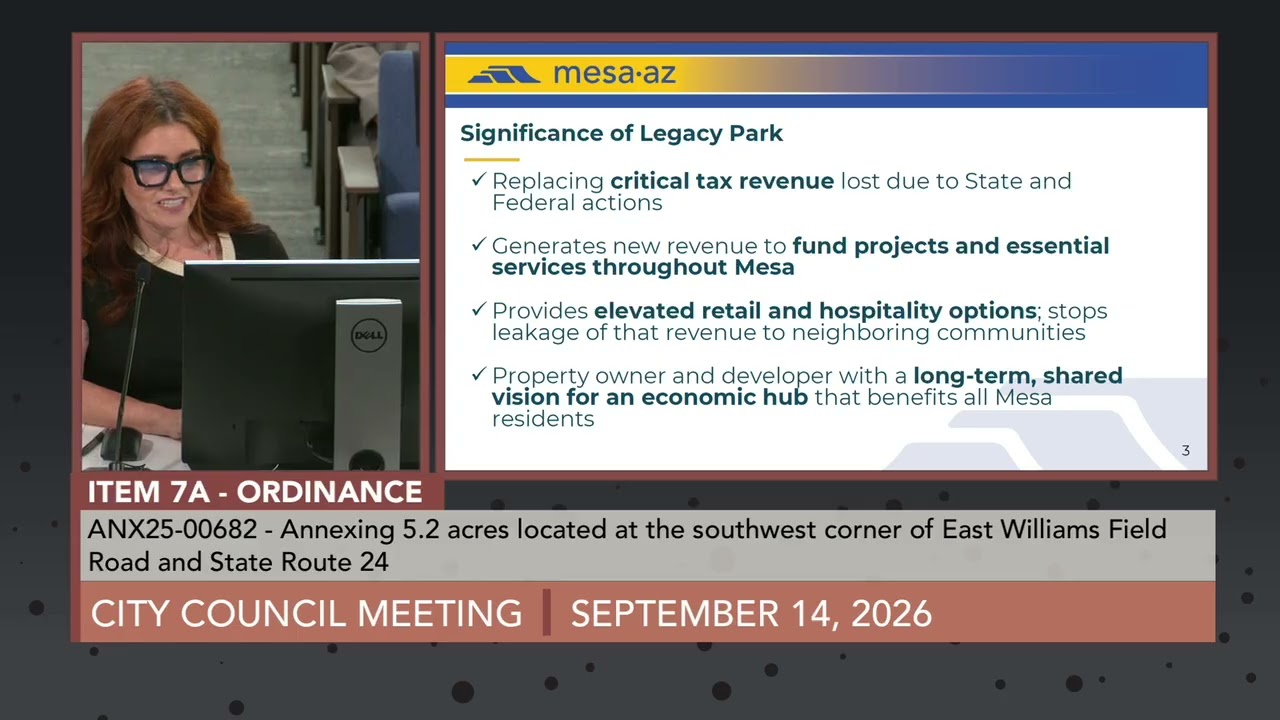
Mesa Unanimously Approves $3 Billion Legacy Park and Gateway Crossing—A "Generational" Mixed-Use Development Despite Water and Transparency Concerns
Mesa City Council unanimously approved Legacy Park and Gateway Crossing, a $3 billion mixed-use development project featuring luxury and mid-tier hotels, restaurants, retail, Class A office, and public parks designed to retain visitor and local spending while generating $545 million to $1.4 billion in estimated tax revenue for the city.
Mesa Unanimously Approves $3 Billion Legacy Park and Gateway Crossing—A "Generational" Mixed-Use Development Despite Water and Transparency Concerns
On September 14, 2026, Mesa City Council unanimously approved the most significant mixed-use development in the city's history: Legacy Park and Gateway Crossing, a $3 billion project featuring luxury and mid-tier hotels, high-end retail, restaurants, Class A office space, and a 10-acre public lake and park. All seven council members voted yes on Items 7A through 7E, approving annexation, zoning changes, and a development agreement with an unprecedented public-private partnership structure. The unanimous vote came despite recorded public opposition and council-acknowledged concerns about water usage during a Colorado River drought crisis, transparency deficiencies in the incentive structure, and questions about job quality and economic equity.
City Manager Scott Butler framed the project as critical to Mesa's long-term fiscal sustainability. With no primary property tax, Mesa relies heavily on sales tax revenue—a constraint that leaves the city vulnerable to state and federal budget cuts. Butler emphasized that this development would generate revenue "generated on site" by project users, not by general Mesa taxpayers.
Key Speeches
"It would have been easy over the years to sell off this property or to use it for a different use, but we have a property owner that believed in how special this site is considering where it's located and the resources and the assets around it. And so now they brought in a world-class developer to help partner on what is just a world-class project that will again benefit everyone in Mesa." — Scott Butler, City Manager
"Rarely does an opportunity arise to develop a generational project that can really define a community's identity. And that opportunity is what we have with Legacy Park. It's the right location. It's the right time and we've got the right project to accomplish this." — David Larcher, President and CEO, Vestar
"I was prepared to come in here to say no, I have an entire speech written about water. But they've come through for that 75% shade coverage for this project and I truly do appreciate that because I want it to be a great place not only for the success of the project but for our residents." — Council Member Jen Duff, District 3
"This whole area is going to bring more of those opportunities because we're going to have a myriad of restaurant opportunities and service opportunities and bartending opportunities. And those jobs can pay out very well affording people lifestyles that they like living and then they can leave their job and go hang out with their friends literally right there." — Vice Mayor Scott Summers
Timeline
-
Applicant Presentation: David Larcher (Vestar CEO) and Andrew Cohen (Pacific property owner) presented the project scope, quality standards, and partnership model. Larcher emphasized Vestar's proprietary GreenStar sustainability program and partnership with Athens Group for luxury hospitality. Cohen noted the 25-year track record between Pacific and Vestar at Desert Ridge and the three-year development timeline.
-
Staff Recommendation: City Manager Butler and Heather Bassford presented economic projections: minimum buildout of $545 million gross tax revenue, full buildout of $1.4 billion; 1,687 to 13,511 jobs; $7.4 billion to $58.8 billion in total economic output over 30 years. Staff emphasized that public infrastructure reimbursement ($76 million estimated) is performance-based and generated only from on-site user tax revenue; developer donates park land and maintains public improvements perpetually (499 years); Type 2 water rights allow independent well and private water acquisition, independent of city supply.
-
Public Comment: 20 speakers total. Supporters (10-11) emphasized retail and dining variety, job opportunities, convenience, benefits to young professionals, families, and visitors. Opposition (4-5) raised concerns about water usage during drought, job wage quality, transparency of infrastructure reimbursement cap, theme park district bond risks, and ethical concerns about luxury development across from Gateway Airport deportation flights.
-
Council Discussion: All seven council members spoke. District 1 (Mr. Adams) framed the project as fulfillment of 20-year-old live-work-play vision; District 2 (Miss Taylor) cited frequent resident requests for Scottsdale-level amenities; District 5 (Miss Goforth) praised Vestar's track record and patient capital; District 6 (Vice Mayor Summers) defended hospitality jobs using wage data from Glass Door and Zip Recruiter (servers earning $22-28/hour or $42,000-65,000 annually, experienced servers $85,000-90,000+); District 3 (Jen Duff) negotiated 75% shade coverage and water conservation discussion commitments before voting yes; District 4 (name not stated in transcript) did not speak; Mark Freeman thanked developers and drew parallel to failed 2009 Gaylord Hotel proposal (82% voter approval).
-
Vote: Motion to approve Items 7A, 7B, 7C, 7D, and 7E all on a single motion. Unanimous 7-0. No split votes, no amendments, no failed motions.
Opposition
Number of speakers: 4-5 speakers (Jillian Ryan, Margaret Schultz, Shannon Woods, Angelica Delgado Navarro, and potentially others noted but not transcribed in full).
Main concerns:
-
Water usage during drought crisis: Jillian Ryan questioned whether the 10-acre lake and landscaping would consume Mesa's limited water supply during Colorado River cuts. City clarified that Type 2 water rights allow the developer to drill an independent well and acquire water on the open market, not from city municipal supply.
-
Transparency of infrastructure reimbursement structure: Margaret Schultz (Worker Power) noted that the $76 million infrastructure reimbursement estimate appeared in the economic impact report but the actual reimbursement cap in the development agreement listed only "total cost of infrastructure plus financing," creating ambiguity about what happens if actual construction costs exceed the estimate.
-
Layering of incentives without full public assessment: Schultz raised concerns that public infrastructure reimbursement plus theme park district sales tax authority plus bonding capacity created a complex "layered" incentive package presented to the public only days before the vote, without comprehensive impact analysis of the combined effect.
-
Job wage quality: Jillian Ryan questioned whether retail, dining, and hospitality positions would be livable-wage or part-time/minimum-wage situations, lacking specificity on job quality breakdown.
-
Favoritism toward luxury commercial over affordable housing and small business: Angelica Delgado Navarro argued that city resources should prioritize affordable housing and small business support (e.g., Asian District) rather than luxury commercial development; questioned why the city should ask the developer for less than the developer should fund the park and lake themselves.
-
Theme park district bond default risk: Delgado Navarro raised concern that if theme park district bonds default, the district may be unable to pay off debt, creating financial risk.
-
Ethical optics and class inequality: Jillian Ryan noted the "dystopian" juxtaposition of a luxury resort development across the street from Gateway Airport, where families are separated on deportation flights; criticized the project as catering to wealthy people while ignoring small businesses and working-class residents.
Most compelling arguments: Jillian Ryan's water crisis concern and Margaret Schultz's transparency/reimbursement cap questions generated the most substantive council engagement and concessions (Jen Duff negotiated shade coverage and water conservation commitments).
Organized groups: Worker Power (represented by Margaret Schultz).
Support
Number of speakers: 10-11 speakers (Victor Atlasman, David Derizo, Sally Harrison, CJ Symbolic, Zachary Palmer, Brandon Sulock, Megan Palmer, Abraham Elmore, and others).
Main themes:
-
End to having to drive outside Mesa for premium dining and retail: Multiple supporters emphasized that the project would end the need to travel to Scottsdale, Phoenix, Tempe, or other communities for fine dining, shopping, and entertainment; noted that residents currently drive 35-45 minutes for such amenities.
-
Economic engine for southeast Mesa: Supporters highlighted Arizona Athletic Grounds (2+ million annual visitors), ASU Polytechnic, Gateway Airport, and Eastark as existing anchors that lack complementary hospitality and retail; noted that visitor spending currently leaves Mesa for Scottsdale and Phoenix.
-
Live-work-play community vision fulfillment: Multiple speakers cited the original Eastark development vision and the failed Gaylord Hotel proposal (2009) as evidence of long-standing community demand; Legacy Park was framed as the next opportunity to realize that vision.
-
Job and economic opportunity for young professionals and families: Supporters emphasized that the project would create employment at all skill levels and offer family-friendly amenities, making southeast Mesa more attractive to residents.
-
Property values and neighborhood lift: David Derizo (Eastark resident since 2013) noted that the project could boost property values in adjacent communities like Cadence and Eastark.
-
Vestar's proven track record: Supporters cited Vestar's success at Desert Ridge (25-year partnership) and Avalon in Alpharetta, Georgia, as evidence of quality and staying power.
-
No burden on city taxpayers: Multiple speakers emphasized that the project is privately funded and on-site reimbursement means "if you don't shop there, you're not paying for it."
Most compelling arguments: Victor Atlasman's narrative of having relocated to southeast Mesa specifically to benefit from future development; David Derizo's third-generation Mesa family perspective and frustration with unfulfilled live-work-play vision; Zachary Palmer's young professional framing; Megan Palmer's emphasis on quality amenities within reach.
Organized support: Mesa Chamber of Commerce (Sally Harrison spoke on behalf); Visit Mesa; Arizona Lodging and Tourism Association; Mesa Gateway Airport; United Mesa Firefighters and Mesa Police Association (provided letters of support, per City Manager Butler).
Project Details
-
Case number: Not explicitly stated in transcript for annexation/zoning; referenced as part of agenda items 7A-7E.
-
Applicant / Developer: Vestar Development Company (led by David Larcher, President/CEO); property owner Pacific (Andrew Cohen, principal).
-
Attorney: Not mentioned in transcript.
-
Location / Address: Southeast Mesa, approximately 200 acres, adjacent to Arizona Athletic Grounds and Mesa Gateway Airport; currently in Maricopa County (unincorporated), subject to annexation. Near Signal Butte Road and surrounding infrastructure.
-
APN (Assessor's Parcel Number): Not stated in transcript.
-
Current zoning → Proposed zoning: Current unincorporated county land; proposed rezoning to accommodate mixed-use hospitality, retail, office, and public park (specific zoning designation not stated in transcript).
-
Density / units / square footage:
- Hotel: luxury and mid-tier rooms (specific count not stated).
- Retail/dining: high-end anchors named include Louis Vuitton, Pottery Barn, and others (exact square footage not stated).
- Office: 120,000 square feet of Class A office space.
- Public park: 10-acre lake and recreation area with 75% shade coverage requirement.
- Pedestrian tunnel connecting to Arizona Athletic Grounds.
- Total project cost at full buildout: approximately $3 billion.
-
Changes from previous version (if reconsideration): Council Member Jen Duff negotiated 75% shade coverage (increased from the initial 50% mentioned in the development agreement); Vestar committed to a "significant contribution" to city water conservation programs in parks (discussed in good faith but details not finalized).
Vote Breakdown
- Final: 7-0 (unanimous).
- Yes: Mayor John Giles, Vice Mayor Scott Summers, Councilmember from District 1 (identified as "Mr. Adams" but not fully named in transcript), Councilmember Jen Duff (District 3), Councilmember Miss Taylor (District 2), Councilmember Miss Goforth (District 5), and one additional member (District 4 or 6, name not clearly stated in transcript).
- No: None.
- Abstentions / absences: None stated.
Note: Individual votes were not read aloud per council member name; the motion passed unanimously on a single voice vote. The transcript confirms seven council members were present and voting yes.
Outcome & Next Steps
Approval granted: All five sub-items (7A Annexation, 7B Zoning, 7C Resolution approving development agreement, 7D Resolution approving development agreement continuation, 7E Resolution creating theme park district) were approved simultaneously on a single motion. No conditions were imposed beyond those already negotiated (75% shade coverage, water conservation discussion commitments).
Implementation timeline: Not explicitly stated in transcript. The development agreement provides for phased buildout with minimum and full buildout scenarios over 30 years; reimbursement begins only when on-site tax revenue is generated.
No continuance or deferral: The vote was final. No additional study period, public engagement timeline extension, or transparency clarifications were required before the vote.
Outstanding items: Miss Duff's negotiated commitment to discuss Vestar's "significant contribution" to city water conservation programs in parks was acknowledged as ongoing discussion (details not finalized at time of vote).
Controversies & Context
Water crisis and drought concerns: Arizona is experiencing severe Colorado River water cutbacks. Jillian Ryan raised legitimate concerns about a 10-acre lake's water consumption during scarcity. The city's response—that the developer would use Type 2 groundwater rights and private market acquisition—addressed the legal mechanics but did not fully satisfy concerns about the ethical messaging of a luxury amenity during statewide water stress. Miss Duff's struggle with this issue was visible in her prepared "no" speech, which she ultimately abandoned after negotiating shade coverage concessions.
Transparency and process criticism: Margaret Schultz and Shannon Woods documented that the project was introduced to the community over 2.5 years but critical financial details (the $76 million infrastructure reimbursement cap, the theme park district incentive structure) were released to the media and public only days before the vote. The economic impact report estimated $76 million in infrastructure reimbursement, but the development agreement itself listed only "total cost plus financing" without a fixed cap. This discrepancy raised valid questions about the actual financial obligation and whether the economic analysis was based on incomplete or different numbers. No staff response clarified the discrepancy before the vote.
Layering of incentives: Schultz raised an overlooked concern: the development agreement provides for public infrastructure reimbursement (on-site user tax revenue) plus a theme park district that can levy additional sales tax and issue bonds. The economic impact study analyzed only the infrastructure reimbursement, not the combined incentive effect. The council did not separately analyze or discuss the cumulative impact of stacked incentives.
Class and equity tension: Jillian Ryan's critique—luxury resort across from deportation flights; small business and affordable housing neglected; hospitality jobs often underpaid—articulated a coherent working-class and progressive perspective. Vice Mayor Summers' wage data response ($22-28/hour for servers, $42,000-65,000 annually, $85,000-90,000 for experienced fine-dining servers) was factually grounded but did not fully address whether the specific mix of positions at Legacy Park would skew toward entry-level or high-value work. The council's consensus was that "not every job must be high wage to have value," shifting the frame from job quality to job diversity.
State fiscal pressure context: City Manager Butler and Jen Duff both referenced state and federal budget cuts (~$30 million annually) that have squeezed city revenue, creating urgency for sales tax generation. This fiscal pressure, while real, was not independently verified in the transcript and may have motivated the council's unanimous yes despite documented concerns.
Historical parallel: Mark Freeman drew explicit connection to the failed 2009 Gaylord Hotel proposal, which passed with 82% voter approval but collapsed due to economic headwinds. The council framed Legacy Park as a second chance to realize that decades-old community vision, lending emotional and historical weight to the yes vote.
Duration
- This item (Items 7A-7E): Approximately 2.5 to 3 hours (public hearing, staff presentation, developer remarks, 20 public speakers, full council comment rounds).
- Total meeting: Approximately 3.5 to 4 hours (consent agenda, Canon Beach Hotel Item 6A, Legacy Park Items 7A-7E, citizen present item Todd Towers at end).
Specific time stamps were not provided in the transcript.
Other Notable Items
Canon Beach Hotel Development Agreement (Item 6A): Approved unanimously with no discussion or public comment. Appears to be a smaller hotel development; no details provided in the transcript.
Consent Agenda (Items 1-5A): Approved unanimously, including annexation case 25-725 for 38 acres of county right-of-way along Signal Butte Road. No discussion.
Postscript: Todd Towers' Citizen Comment
After the council vote on Legacy Park, Todd Towers (a small business owner and Mesa resident) used the citizen present time to address the council on an unrelated topic: Fourth Amendment search-and-seizure concerns related to law enforcement practice. Towers expressed gratitude for Vestar and Cohen's work and encouraged young people to enter trades as he has done. He referenced a memorandum he had sent to the council but ran over his time limit and did not fully elaborate on his statutory law concerns. His remarks, while appreciative of the development, were primarily focused on a separate police and legal matter.
View source transcript ▼
Source: A9GbvxTCBzY. Auto-generated YouTube transcript; may contain transcription errors.
Welcome everyone to our city council meeting for September 14, 2026. All our council members are present. We'll begin the meeting as usual with an invocation from re Reverend Albert Balden at Fiser Chapel Amy Zion Church followed by the pledge of allegiance by Scout Sam RmIrez of Troop 54. Thank you. Come on forward, Reverend. See here. Please stand. Okay, we'll have a moment of silence. Thank you. Sam, would you come forward for the pledge of allegiance? Right here at the microphone.
Please join me in the pledge of allegiance. I pledge allegiance to the flag of the United States of America and to the republic for which it stands, one nation under God, indivisible, with liberty and justice for all. Thank you. Thank you, Troop 54. Sam. Okay, before we do the consent agenda, Miss Mosley, can you say the names of the three people who'd be speaking under items from citizen present?
Yes, mayor, we actually only have one citizen that requested to speak under this item and that is Mr. Todd Towers. Thank you. We'll hear from him later. With that said, item one is the consent agenda. Mr. Christopher, could you please forward and read our consent agenda? Good evening, mayor and council members. These are the items on the consent agenda. All items listed with an asterisk will be considered as a group by the city council and will be enacted with one motion.
There will be no separate discussion unless a council member or citizen request in which event the item will be removed from the consent agenda and considered as a separate item. Item two, approval minutes of previous meetings is written. Item 3 A, approving dollar limit increase to the cooperative contract for the managed service provider for innovation and technology contractor services for the department of innovation and technology.
Item 3B, approving 5-year use of a cooperative term contract for information technology, temporary, and professional services for the Mesa Police Department. Item 3 C, approving three-year term contract with two-year renewal options for landscape maintenance at city facilities, zone 3 for the facilities management department.
Item 3D, approving three-year term contract with two-year renewal options for landscape maintenance at city facilities, secured sites for the facilities management department. Item 3E, approving 5-year term contract for electrical equipment, parts, and supplies for various citywide departments. Item 4 A, approving resolution, enter into a ride-of-way occupancy license for MMR fiber solutions communications.
Item 4 B, approving resolution to accept Proposition 202 funds from the Hilo River Indian Community and administer awarded funds. Item 4 C, approving resolution to enter into a foreign trade zone operator agreement with JX Advanced Metals at 10,036 East Germaine Road. And item 5A, approving ordinance for annexation case 25-725 to annex approximately 38 acres of county right ofway along Signal but Road about 1,250 ft south of the southwest corner of Signal but Road and Williamsfield Road.
Mayor and council members, these are the items on the consent agenda. Thank you, Mr. Christopher. We'll entertain a motion to approve the consent agenda. Thank you, Mr. Summers. Thank you, Mr. R. Please cast your vote. Motion passes unanimously. Thank you everyone. Next is item 6A is to take action on a resolution to approve a development agreement for the proposed development known as Canon Beach Hotel. Miss Mosley, are there any blue cards for this item? Um, no cards received for this item.
Okay. Do any council members wish to discuss? All right. Seeing none. Again, is there a motion to approve item 6A? Thank you, Vice Mayor. Thank you, Miss Goforth. Please cast your vote. Okay, that passes unanimously. Thank you.
Next is item 7 A through 7EE is to conduct a public hearing and take action on an annexation ordinance, zoning case ordinance, and resolutions approving a development agreement and creating a theme park district which are related to the proposed development known as Legacy Park and Gateway Crossing. I declare the public hearing open. First, I would like staff to give us a brief presentation. Mr. Butler, would you start us off? Yeah, mayor, council, good evening.
And Heather Bassford is coming up as as well and we'll do the bulk of the presentation, but just wanted to kick it off. We we talked for several hours about this on Thursday of um a lot of the details of the project.
So, um, we won't rehash all of those points that were raised on on Thursday, but it it should be really stated tonight that what a generational opportunity it is for uh the largest mixeduse uh hospitality uh retail um housing project in the city's history uh to to come forward uh tonight. It's been um an effort that a lot of folks have have dedicated their time and energy to over the course of years to get to the point that we are tonight.
And uh staff's very supportive of the final documents that stand before you for your consideration this evening.
And we think that uh we have struck a tremendous balance between looking at a strategic public private partnership but one that really works in the best interest of uh the the residents of Mesa, all the residents of of Mesa um who have asked for additional um amenities, additional opportunities to spend their tax dollars local and not um have those leave our community for any neighboring community. uh that replacement of critical uh tax revenue is is important.
We've been talking about that now for many many months ever since we saw changes uh brought forward by the state legislature that impacted our revenue changes at the federal level um that impacted our revenue. Those were all things that took away revenue from our ability to deliver essential services to our residents.
And so as you as you've seen in other communities that may have chosen a different route where they've gone out to their voters to um increase their sales tax or to do other things, we've taken the o opposite approach here in Mesa. We've we've tightened our belt. We found efficiencies. We made cuts across the board uh so that we could live within our means.
But part of the long-term sustainability relevant to that is the fact that we need to grow those uh revenue sources that will ultimately find fund those essential services that all of our residents um rely on day in and day out. And it's projects like this that give us that opportunity uh to grow that base and do it responsibly.
Um, moving forward, I I one thing that's really important, we'll get into the numbers a little bit more as Heather goes through the presentation, but again, this this is a project that will benefit all the residents of Mesa.
And um while revenue will be created on site as part of Legacy Park and Gateway Crossing, uh it will have ramifications across every square mile of Mesa as that additional revenue will go back into fund essential services, parks, um all of the things that we look at through our general fund and secondary property tax uh throughout um the entire in throughout the entirety of Mesa.
So, this is this may be situated in southeast Mesa in District 6, but will have a huge economic impact uh on the city of Mesa and the residents of Mesa. And that's why I think you you received letters of support today from many different entities, but um both internal and external.
you had um the United Mesa Firefighters and the Mesa Police Association um echo their support of this project because again, in order to continue to provide those essential services, including police and fire, we have to make sure that we as a city have the resources available to make that a reality.
But then, and you may hear from some of these entities tonight, you've had Visit Mesa, the Arizona Lodging and Tourism Association, the Mesa Chamber of Commerce, um Mesa Gateway Airport, all entities that understand that the economic value and impact of tourism and hospitality and retail on our community is is what creates and sustains a uh a thriving community where our residents are able to find those options and opportunities all locally without having to leave the city boundaries in In order to do that, um we we really have we talk we talk a lot um at this DAS about the need to have responsible land owners and responsible developers who have a long-term vision that have a long-term desire to better this community and and that is what we have in this project.
We appreciate everything that the property owner has done um since they acquired this property decades ago in order to be good stewards of this and to wait until the market was right to support the type of development that that stands before us tonight.
It would have been easy over the years to sell off this property or to use it for a different use, but um we have we have a property owner that believed in how special this site is considering uh where it's located and and the resources and the assets around it. And so now they brought in a world-class developer uh to help partner on what is just a worldclass um project that will again benefit uh everyone in Mesa.
So, with that, let me turn it over to Heather Bassford, who will walk over walk through some of the um highlights um many of the numbers that you heard on Thursday, but it's it's worth noting what a huge impact this will have on the city. So, Heather, please. Thank you. Thank you, Mr. Butler. Heather, before you start, I just want to key up Mr. Cohen and Mr. Larer. They'll come up after you. Yes. Okay. For some comments. Thank you. Thank you.
So, we wanted to highlight for you the public engagement that the project has gone through over the last two and a half years, dating back to the first public meeting that the developer hosted at the Eastark community um introducing the project at in the early stages um and then moving through the the next two and a half years um to where we are today. uh but they uh did do presentations to the economic development advisory board going over the project that was in December.
They um visit Mesa presented to the economic development um subcommittee going over the project and that was in June and they had public meetings for both Gateway Crossing and the Legacy Project um in June and August. um and then coming through to council um in August and September of this year. So the overall economic impact that the project creates um this slide will go over both the economic impact as evaluated by our third-party independent economist.
Um, at minimum buildout, we're looking at $545 million of estimated gross tax revenue into the city. Um, and at full buildout, that's $1.4 million. Um, moving to the jobs, at minimum buildout, um, there's a total job, uh, that will be added of 1,687. And at full buildout, we're looking at 13,511 jobs created by the project.
And then the total economic output for the project at the minimum buildout will be 7.4 billion and um full buildout is 58.8 8 billion and those are estimated over um the 30 years of the reimbursement period. So what is eligible for the public reimbursement is is just the public improvements at the site and that reimbursement is only given um to the developer from revenues that are generated on site.
So if you visit the site and you spend your money there, that will go into what is available for the developer to have for reimbursement. And what is eligible for reimbursement? Public infrastructure, the pedestrian tunnel, park, and the park parking. And just to clarify, the public infrastructure that'll include all of your roadway work and your utility infrastructure.
So, um, public water, public sewer, the roadway improvements, and that will include pavement, curb, gutter, um, and then traffic signals and street lights. These aren't all inclusive. These are just examples of what would be included. Um, and then the connection between Legacy Park, Gateway Crossing, and the Arizona Athletic Grounds. Um, that is included. And then the construction of the park, the public recreation area, and the public parking.
And then um just to note that this project is this property is currently located outside of the city limits in Maricopa County. So right now it is not generating any revenue that's being um put into the city. So by annexing the property this allows for those um revenues to be generated. And so, mayor and council, just just to drive that home, too, again, this is reimbursements for public infrastructure, and it's it's going to be reimbursed by revenue generated onsite.
So, unless you come and shop and recreate here at Legacy Park and Gateway Crossing, you're not um contributing towards this. So, if you're a Mesa taxpayer who does not set foot on this property, um none of your tax revenue is being utilized to reimburse for these public infrastructure improvements. And I think that's really important. The users of the site are paying for the public infrastructure that goes along with it.
And so it's it's a real um testament to this this development that we've been able to secure that to where it's only those on-site uh improvements that are being paid for by on-site users of the of the location. But anybody can visit this anybody can visit the park space and we want everyone to visit the park. Yeah.
So um part of the the agreement that we we have uh with the developer was really to try to define quality and one of the conditions precedent for um reimbursement is that they meet the the quality standards that we we talked about last week. Um so we just wanted to provide again these seven um benchmark locations uh that uh one of the uh restaurants or retail locations needs to operate in in order for the um to meet the quality requirements.
Um there is a provision of uh for new or emerging concepts for the developer and the city manager to meet and confer on those to allow um maybe local locations or restaurants or um those new and emerging restaurants. And then those requirements will be held for 15 years in order to maintain that quality. And then just a a reminder on the uh hotels and our mix here in Mesa. Uh we really lack the uh luxury or up upper scale uh rooms available here.
And most of our visitors that are visiting Mesa are staying and spending their money in locations outside of Mesa. So in Scottsdale or Phoenix um because we don't have the right hotel mix here and this project helps bring that hotel mix to the community and mayor council again just to to that point um it is it is both the types of amenities through um through a luxury hotel that would be part of this that meets a demand where we are severely lacking the rest of the region.
as evidenced by the numbers that Heather had on the screen. Um, our percentage is dramatically lower than the region as a whole for that. But also overall when you think of the amenities from Gateway Airport to ASU Poly Technic, um all of the jobs that have been created in Southeast Mesa and not um and of course right across the street the Arizona athletic grounds that has millions of visitors a year. Um we just don't have the hotel stock period in order to meet uh that demand.
So both um the luxury resort and um the mid-tier hotels that are part of this development and other developments that are occurring in and around this area will be a huge opportunity for us to capture more of that hospitality um spending that is now uh going to other communities. Thank you. Heather, is that it? Yes. I'd like to um introduce We'll ask uh which two of you would like to go first. Mr. Con. Thank you. Yes. Thank you, Mayor Council. Nice to see you all again.
It's been quite some time. Uh, as you know, uh, we've made great efforts and strides to really be good curators of this property that we bought from General Motors, which was 1,800 acres. We're talking about the heart of this now, which is this 200 acre amazing piece of property that we've been able to induce Vestar to come in. They're partners of ours at Desert Ridge. We've been partners with them 25 years up there.
And if you go up at Desert Ridge now and you look at the level of quality, I know Vice Mayor Summers has been up there to take a look at it. You'll see quality is a theme that we talk about throughout all of our property. Of the 1,800 acres, we have sold off some of it. DSV, high quality, high design. NT, high quality, high design. Arizona Athletic Grounds had a couple of problems at the beginning with their previous ownership. We got in, helped shore it up, and got the right operators in there.
So, quality is something that I think we're really excited about. I will also tell you, we have pushed staff pretty hard to be quite candid with you. Uh, Mr. Butler says this has been a uh a weekly meeting. I would say we've been involved in this project now for almost three years. This is a 24-year overnight success to be candid with you.
So, if you're going to do a study for a a college program, this would not be one you would want to go ahead and talk about because financially we were willing to wait for the right time, the right place, the right vision, the right people, the right politics, the right staff. And I believe we have that now. And it's taken quite a bit of time to do that. As it relates to the hotel, I think it's really important Mr. Butler mentions that we don't have the right concepts of hotels in this area.
The folks at Flight Safety that you approve their deal, they need 15,000 hotel room nights a year. We need to service the people that you've already approved. DSV needs hotel rooms. This is not a function of what we're trying to do just for this 200 acres, but for the greater good of that property. And we're excited to be able to deliver that. It's really important that we've been patient. We look forward to continuing to be patient. We're not going to hurry this.
We're going to take our time to make sure it's done right. And again, I'm going to introduce Mr. Larcher, who is really the one behind the project and the one that's going to deliver on this for us. So, David, thank you. Thank you, sir. Mayor Freeman, members of the council, David Larcher, uh, president and CEO of Vestar. Um, as I'm here before you tonight, um, rarely does an opportunity arise to develop a generational project that can really define a community's identity.
And that opportunity is what we have with Legacy Park. It's, as Andrew said, it's the right location. It's the right time and we've got the right project to accomplish this. But more importantly, we've got two additional factors that really make this truly a rare opportunity from a developer perspective. First, we've got a perfect partner in Pacific proving uh and Andrew. Um it's a partner committed to a long-term view of this land rather than turning a quick profit and moving on.
Secondly, we've got a city with the vision to help create a project to enhance the quality of life for its citizens as well will serve as an economic engine for generations to come. With this project, we are committed to delivering a project of the highest quality, one that offers connection, experience, and cultural value to everyone who visits. Legacy Park will serve as the community focal point, not merely a shopping and dining destination.
At Vestar, we are firmly committed to sustainability as well. Matter of fact, we have a proprietary program that we uh call GreenStar that we implement in all of our projects. um has a number of sustainability measures uh good for the environment, good for the project, and long-term view. Again, it costs us more to do it upfront, but we take that long-term view of those sorts of things. And we'll be implementing all of those standards in this project.
the attention to detail uh and execution will be unmatched to anywhere in the valley, creating a place where commerce, lifestyle, and community truly intersect here. Um, also we're we're fortunate to uh partner with our long-term affiliate, the Athens Group, on the luxury uh hospitality resort component of the project. Uh they are known literally worldwide for their award-winning projects they've developed with the likes of Ritz Carlton, Four Seasons, and Montage.
And they will bring that expertise to Legacy Park in the execution of the hospitality component here. But finally, I just want to thank you for the confidence you've placed in Bestar and let you know the and our entire development team for this very important project. and you've got our unwavering commitment to execute the vision that we collectively share here to the highest possible standards. Our goal is to make Legacy Park truly the crown jewel of the East Valley. Thank you. Thank you, Mr.
Larger. With that, it's our blue cards now. So, I'll return to Miss Mosley and you will Why don't you give the first three speakers and we'll go from there. Sure. So, the first three speakers we have are Victor Atlasman, David Gerizo, and Sally Harrison. All right, come on forward. You have three minutes, sir. Just say your name so I can keep track. Hi, my name is Victor Atlasman. Uh, and it's always unfortunate to be the first because you never know how to open. So, council members, thank you.
Mayor, thank you. And a special shout out to, uh, Vice Mayor Scott Smers, who's our, uh, local community, uh, council member. uh very much pays attention to everybody in the community. I'm a uh local uh what do you call it neighbor within Cadence which is right next door to uh Eastark and uh I got three stories I want to tell you very quickly over here. Uh the first one is when I moved to Arizona about 20 years ago I lived in North Scottsdale. Back then there wasn't really much.
And I got the benefit of watching uh uh Kierland and Scottsdale Quarters get built, but until it got built, I had to travel to see my friends down in South Scottsdale, Oldtown Scottsdale, uh Tempe. That was usually the hangout spot until I met my wife, my now wife. Uh and we moved eventually to Gilbert. And so Gilbert is the place for families. It's the place to hang out with your friends.
It's a very different lifestyle from what you see in the bachelor life of like Scottsdale um or the the life within uh Tempe. So it was between Chandler and uh uh downtown Gilbert was the place to hang out. About 5 years ago, we we decided to move to East Southeast Mesa and we knew that was the place to raise our family eventually. Uh the schools, the neighborhoods, it's all up and coming. uh the mayor uh back then just really opened up the town for what the vision was going to be.
Um and so now still today in order for us to hang out with our friends from Gilbert, we still have to travel Gilbert Chandler. There's not really a lot. Um although I'm pushing a lot of people to come visit us in um uh Queen Creek u because there is up and cominging development that's happened over there. But I am very very grateful, very much in support of what's going to uh come up for Legacy Park. That's the first story. I'm very excited for this.
The second one is there's a grown community over there. A lot of young talent. Uh ASU is over there. Poly uh uh G a lot of other community colleges down there. Uh GCC, uh Eastark High Schools there. Uh for the young talent that's growing, uh where are they going to work, play, and eat? They're all going to have to travel. They're not going to AJ. Queen Creek is is quite a drive.
Many of them don't even drive today, but it's very much a bicycle path enough to get to the Legacy Park so you can work, play, and eat. And I also know that uh uh Vice Mayor Smer sees on on Facebook often, hey, we want more shops around. We want more places to go out. Sometimes I'm just too tired. I don't want to drive out for 20 minutes going west side of town. So, great place for work, plate, and eat. So, that's number two.
And my last point is I travel a lot for work and usually what I like to do is stay near the airport. One of my favorite airports to visit is Long Beach Airport because they have a place called The Hangar. It's a bunch of similar shops that's a lot smaller and there's all these local restaurants, just local hangout spots. You can go there any night of the week and see a bunch of people just hanging out there having a good time. Local gyms are there and it caters to the traveling people, too.
I know with uh Gateway Airport being near here, I know you're going to get a lot of visitors from out of town who are here for the industrial parks, uh all the the office spaces, staying in this community, this area over here to support um this local business. So, those are uh my three points and thank you for your time. Thank you, Victor David. Then after David is Sally Harrison.
Good evening, mayor and council, and thank you for this opportunity to speak on this agenda item about Legacy Park along with Gateway Crossing. My name is David Derizo. I am a native of Mesa, third generation uh East Valley realtor, a husband, a father of five, and a resident of Eastark since 2013 when they first opened their doors. Uh we are Eastark originals through and through. We love where we live.
We love our community, are deeply embedded there, and we hope to be there for uh a long uh time still and see our family stay connected nearby. When my wife and I uh first moved to Eastark, we did so because we bought into a specific vision for the community and for that part of Mesa. A vision that included a dynamic uh live, work, play uh kind of atmosphere. uh a place that would be as it was called the heart and hub of the east valley.
While we've seen tremendous growth in that period of time uh residentially we've seen a lot of rooftops go up uh what we haven't seen is that grander vision uh of economic growth fully realized yet. I remember when Gaylord Resort was first mentioned as uh coming to Eastark and just as soon as it was mentioned I remember it disappearing.
Uh I remember when Grand Canyon University was uh announced that it was going to build an East Valley campus uh in Eastark and then I remember when those plans changed. I know that many of my neighbors feel the way I do that the original vision for Eastark and the surrounding communities has still not yet come to fruition.
And while that vision is probably not in the cards for the the five square miles that is Eastmark proper, it could still very much be a part of our community in Southeast Mesa. And I believe Legacy Park is the next closest thing to fulfilling that grander vision for this part of our city.
You know, I've I've gone to plenty of conferences as as you probably have and stations all around uh Phoenix metro, and I've often wondered what's keeping Mesa in the Southeast Valley from having the types of higherend resorts and retail and dining that we find uh in other parts of the valley. For us in district six, the development of Legacy Park where and how it's being proposed uh means not having to always drive across town to go to conferences and events or even date nights for that matter.
Uh it means better shopping and dining uh closer to this side of the valley and then seeing those tax dollars stay in Mesa. Uh it means more decent paying jobs closer than Tempe and Scottsdale and and Phoenix. And that's not even to mention the potential lift over time of property values that a project like this could have on nearby communities like Cadence and and Eastark among others.
So with that, I would respectfully ask this council to vote yes in approving uh the proposal for Legacy Park, not Park, not only for the long-term benefit for my family and neighbors in D6, but for Mesa and the Southeast Valley as a whole. Thank you. Thank you, David, Miss Harrison. And while she's coming up, will you give us the next three? Sure. Uh after Sally is CJ Symbolic, Zachary Palmer, and Jillian Ryan. Thank you, Miss Harrison. Yeah, thank you. Good evening, mayor and council.
Thank you for the opportunity to be here this evening. Um from the business community's perspective, Legacy Park in Gateway Crossing represent an important opportunity for Mesa and particularly the Gateway area. Mesa spent years building the foundation for economic growth in southeast Mesa.
From Gateway Airport and ASU Polytechnic to Arizona Athletic Crowns and the continued growth of businesses and neighborhoods throughout this part of our city, Legacy Park has the potential to build on those investments by creating a major destination for hospitality dining retail employment and recreation.
One of the challenges we continue to see is that Mesa attracts residents, businesses, and visitors, but too much of their spending leaves our city for restaurants, hotels, and retail in neighboring communities. This project could help change that by giving people more reasons to stay and spend their dollars here in Mesa. The potential impact goes well beyond the businesses located within the development.
And as mentioned before, that kind of investment can create opportunities for businesses throughout Mesa, from suppliers and contractors to restaurants, retailers, and service providers. Just as importantly, a project of this scale sends a message to companies considering Mesa. This is a community where significant investment is happening and where businesses want to be. We believe Legacy Park has the potential to strengthen Mason's economy.
expand our tax base and help establish the gateway area as one of the valley's premier economic destinations. On behalf of the Mesa Chamber and our business community, thank you for considering this long-term opportunity and this project that Mesa represents. Thank you. Thank you, Miss Harrison. Uh CJ, what's that? Welcome CJ. Hi there. My name is CJ. I am a resident of Mesa. Have been lifelong. Um, reason why I'm here today is to voice my support for the legacy project.
I believe that this project would be a great addition to our community. Um, and would provide a lot of amenities that are exactly what the city of Mesa are looking for. Um, I think it's important that we continue to invest in these opportunities and amenities that give residents more places to enjoy, connect, and spend time with family and friends. Um, I'm excited to see what the Legacy Park project could bring to Mesa and I'm just want to say again that I fully support moving forward.
Thank you, CJ. Next Zachary Palmer. And then after Zachary, Miss Ryan, uh, Mayor Freeman, thank you for the opportunity. Councilman, Councilman. Um, my name is Zach Palmer. I live on Ellsworth and Brown and I'm here to express my strong support for the legacy project as well. Um, as a young professional living in Mesa, I see a real need for the highquality amenities that have been presented here tonight. Um, that includes the restaurants, the gathering spaces, the entertainment.
Uh, it's all something that we need on this side of the valley. Uh too often people of my age are headed to Scottsdale and other parts of the valley to to uh go participate in these amenities and um Legacy Park would bring all those to Mesa, but it would also bring the best of those to Mesa. Uh the quality that's been presented here looks second to none. So um I think it'll also support strong growth around the Gateway Airport and create a place where we can live, work, and spend time locally.
U it's a project that looks like it'll pay for itself 10 times over. Um so once again I think it's exactly the investment that Mesa needs to uh consider and I'm in strong support of it. Thank you. Thank you so much Miss Ryan. As Miss Ryan comes, can you give me the next three speakers? Sure. Following Jillian is Brandon Simbul, Margaret Schultz, and Megan Palmer. Okay. Welcome Miss Ryan. Hello. Hi. Okay. So, um I oppose this legacy legacy park.
In this current climate, a luxury development like this is an extremely outofouch project. Um we are in a drought. People can't afford groceries and housing. I really have no idea why this is something that's a priority for us at this point. Um I would like to know how much of our limited water supply is going to be used up so that rich people have a place to shop and stay and go to a park.
Um, even if I don't ever go there, which I won't, um, I don't want any of our water resources to be used for something like this. So, while my taxes may not go to it, I still don't want any of our water going to this, and I'm sure it will be, and that's highly irresponsible. Uh, Mark Freeman issued a statement about the recent Colorado River cuts, and he committed to protecting the Colorado River and strengthening Arizona's water future.
I'm unclear how this project could help strengthen our at risk water supply. Um, I know that the park's going to be type two groundwater, so that's not what I'm talking about. And, um, I also know that when I watched the info session, y'all were talking about attracting big businesses like big tech, Google, Meta. Those are the jobs, the people y'all want here. Um, I have concerns about that, too. You've talked about that this project will create jobs.
We know that most retail dining positions, hospitality positions don't pay livable wages, often don't offer benefits. So, I'd like to know a breakdown of how many of these supposed jobs are actually going to be livable, thrivable wages, or are they going to be like part-time, close to minimum wage situations. Um, similarly, let's see. Um, I did do a quick Google search on David Larer here.
I couldn't find a lot because I didn't have a ton of time, but I did find out that he lives in a 17,000 square foot home in Paradise Valley. That's 13 times the size where I live with my family of four. So, I really don't think that this is the type of people, companies that we need to be um supporting in our city, giving more money to, giving more business to. We have a lot of small, unique businesses that could really use the help. Great places that could be actually developed over there.
We're not shopping at Louis Vuitton and Pottery Barn. Um, and then I know I'm getting close to time, but this project also feels particularly dystopian. Building a playground for rich people across the street from Mesa Gateway Airport where families are separate se separated and deportation flights occur.
So, are you going to make sure that all the rich people who go visit this place right across the street for them, they have y'all are separating families, moms from their kids, dads from their kids, etc. That could be something that may they may like to see out when they're shopping. Uh, we're not Scottsdale. We don't want to be. Copying Kirland Commons isn't the move. Uh, we're not a weird word class worldclass destination. We're Mesa. So, let's do better for the people who already live here.
If we need to grow, it shouldn't be like this. I request that we have more time to talk about this project as a community. Just posting it to the neighborhoods and to your boards behind the scenes isn't enough time for us to talk about this. We don't want it. We don't need it. Think about the water. Do something for the people. Thank you, Miss Ryan. Next we'll hear from Brandon. Do you want to finish comments and then we can address the water? Yeah, we'll do that. Good afternoon.
My name is Brandon Sulock. I've lived here in Mesa my entire life. It's somewhere that I've seen my family grow up and it's a neighborhood that I'm very proud of. And seeing a project like this come to light and the opportunity to build it makes me for one very excited as a resident and also just makes me excited as a community member.
As a lot of the individuals before me said, I kind of echo that same sentiment where people my age, which like I say right now, I'm not a rich individual, nor are a lot of my friends, but we like to go to areas like Scottsdale, the Tempe, the Santan villages every occasional weekend to hang out, have fun, be able to relax, and they said, be youthful, enjoy our lives. And that's something I can see this uh this project doing.
um aside from just myself, I know that a lot of my family, they live out of state in more northern states and even north of the border in Canada and they like to come down here in the winter time and I see this as not only just a great way to build a community and kind of build a family and reconnect with family, but I see this as a place when we talk about hospitality, lodging as a great opportunity to fill those, you know, even upper upscale extended stay properties with these individuals who want to come down, spend time with their family.
they don't always able to get and be able to spend time with their kids, grandkids, etc. So, I kind of really see this as not only from an individual perspective, but as community building block, and I'd love to see this, you know, happen in our area and I strongly support this and I would appreciate if you guys consider that as well. Thank you. Thank you, Brandon. Are you a brother to CJ? Yes, sir. How come you're taller? I like a little humor in our meetings. Um, thank you, Brandon.
Margaret Schultz. After Margaret is Megan Palmer. Good evening, Mayor and Council. My name is Margaret Schultz. Uh, I'm here with Worker Power, a nonpartisan nonprofit. Um, I'm here in opposition to the tax incentive package for this project. Um, and I have kind of maybe more technical questions about the transparency and the amount of funds at stake.
Um, so in the economic impact report that was released just a few days ago by the city, the estimate of the uh public infrastructure reimbursements is listed as $76 million. But when you look at the actual development agreement, that number isn't there. uh the reimbursement cap is listed as just the total cost of the infrastructure plus financing.
So my question and I'm wondering if you all have discussed this is what happens if the actual cost is much higher than this estimated 76 million and how does that affect this uh economic analysis that's been done? Um and then secondly where did this estimate come from?
So those are just a couple of questions around that and I think given the the concerns of transparency the kind of reporting on this project that came out and then the very different documents that were released um we want to ensure that there's transparency and clarity on the exact details before we move forward. Um in addition there's no explanation perhaps I'm missing it and you can enlighten me um but of how the kind of layering of incentives works.
So the economic impact study is looking just at the public infrastructure reimbursements, but we also have the creation of this theme park district, which would allow for the levying of an additional sales tax and issuing of bonds. Um so my question is when we stack incentives on top of each other um how are we considering this full package right not just as public infrastructure reimbursement but as including the theme park incentives as well in the economic impact.
Um so I just don't believe that there's enough information and that this has been clearly enough presented to the public to move forward with approval today. Uh so in the interest of full transparency requesting a no vote on this incentive package. Thank you so much for the opportunity to speak. Thank you Margaret. Next we'll hear from Megan Palmer and mayor. Following Megan is Angelica Delgado Navaro followed by Abraham Elmore. Hi there. Good evening. My name is Megan Palmer.
I've lived in Mesa my entire life. Um, I'm here tonight to show my support for the Legacy Park project as well. It's really been exciting to see how much Mesa has um, grown and changed over the years, and I feel like we're becoming we're evolving into a new chapter with Mesa. Um, I really think that this legacy park could take Mesa to the next level. My husband and I really like to go shopping, spend time outdoors.
Um, we love to find new things to do and this park will really help to um allow us to enjoy these experiences and not have to, like everybody else has said, travel outside of the valley for these experiences. Um, I would really love to see these opportunities right here in Mesa. I think that the restaurants entertainment outdoor spaces, um, and the other amenities that Legacy Park would have would really give people a reason to stay here in Mesa.
Um, and it would really just allow us to enjoy our community of Mesa a lot more. Um, overall, like I said, just having lived here my entire life, I would love to see Mesa continue to grow and become just overall a destination of its own. Um, I really think that it would be a great part of the next chapter of Mesa, and I really fully support this project and hope to see it move forward. Thank you. Thank you, Megan. With that, um, Angelica Hello, mayor and council.
My name is Anhelica and I live at Maine and Dobson in district 3. I'm here today with some concerns about the proposed incentives for this project. I'm not in favor of incentivizing luxury commercial development when we desperately need affordable housing and support for small businesses in our communities. For example, I really love the Asian district and I want to see more small businesses like those supported by the city.
When a luxury commercial development is proposed, I believe the city has a responsibility to ask for more from the developer developer. Why not ask the developer to cover more of the cost themselves? For example, why not ask the developer to fund the proposed park and lake themselves as a benefit for the community? Finally, I'm concerned about the potential risks of this theme park district. Through the district, future development can be funded through districts bonds.
While the city is not liable for this debt, if the bonds default, what happens to a theme park district that cannot pay off that debt? In my opinion, I'd much rather see incentives go towards projects that will benefit workingclass families in Messa rather than luxury developments. Please say no on these incentives. Thank you for your opportunity to speak. Thank you, Angelica. Next, we'll hear from Abraham. And after Abraham, Shannon Woods on deck. do it on deck site right down here.
Good evening. My name is Abraham. Thank you for listening to me. Uh I am in support for the Legacy Park project. I think it is a fantastic opportunity for Mesa. Um I was born and raised here. I moved and moved back recently within last year uh for projects like this. I love Mesa. I love everything that it stands for. Um, I love my friends coming in town and showing them all the great parts of Mesa.
Unfortunately, my friends really like to see the Scottsdale, the Phoenix's, um, and even the Tempes. And so, a project like this would be fantastic for for me to show, you know, what Mace is all about, right? I think it is, um, a great place for families. This is a place I'd want to take my my parents to dinner one day, right?
I'd want to take my, you know, kids one day to shop around and, um, all the opportunities that comes with this, the jobs, the markets, the location, uh, with the plans for the regional airport. Um, the growth of that, the proximity to that, uh, space is a fantastic opportunity.
So, um, again, in my economic background, I think this is a place that I would spend a lot of time and would save also a lot of time not having to drive all the way up to North Scottdale, um, Scottdale Fashion Square, you know, any of those kind of places. So, um, again, really just in support of the Legacy Park project. Again, a lot of work has been done on this. um would hate to see that work go to waste. And um again, just thank you for hearing me out. Thank you, Abraham. Uh Shannon. Hello.
Hello, mayor and council. Uh my name is Shannon Woods and I live in district 3 off of Do I mean off of Broadway and Dobson. I'm here with concerns about transparency and the process by which the public infrastructure reimbursements and theme park district incentives have come up for a vote this evening.
This incentive estimated at $76 million in reimbursements was reported to Mesa Tribune and the city did not disclose most of the details of this potential deal with the public until a few days before the vote. Deals made without substantial public input are not acceptable. And public input means more than releasing the details a few days before a final vote by mayor and council.
It means serious ongoing engagement with the community on how best to meet our needs and how to incentivize development responsibility. Why should luxury commercial developers get tax breaks when residents and small businesses are struggling to make ends meet? I am asking that y'all vote for no for this tax incentive for Legacy Park. Thank you for the time to speak. Thank you, Shannon. We'll next hear from Alexandra.
Hello, my name is Alex and I live in Mesa and I'm here to support the Legacy Park project. I'm really excited about the idea of having more restaurants, shopping, entertainment, and things to do closer to home. Right now, I often find myself driving 35 to 45 minutes to places like Scottdale for those kinds of amenities. So, I think it would be great to have more of those here in Mesa.
I think Legacy Park would be a really great addition to the community and give people more reasons to stay, shop, eat, and spend time in Mesa. I definitely support the project. Thank you for your time. Thank you, Alex. With that said, that's all we have. Correct, Miss Mosley? Yes. Okay. With that said, uh Mr. Dr.
Butler and your staff, would you like to respond to any of the comments which I've heard about the infrastructure, the reimbursement of the infrastructure, bond structures, you know, why we wouldn't bond a project like this like a CI CIP and put in the structure and uh working with the developer. That's some of the ones that I heard. Sure. And and mayor, let me um maybe start with the the issue of transparency as as was stated during the presentation.
The first public discussion of this started over two and a half years ago. Uh this has gone through multiple neighborhood meetings. This has gone through multiple public board meetings here uh at the city that were that were legally noticed and and you know we always encourage folks to watch and participate uh in our events and and that is on sometimes the residents to do that. We have uh been very transparent through this through this whole process um with a robust engagement of the community.
Um folks who um have heard about this project now as was stated for going on years uh understand that all all of the discussion all the public discussion public meetings that went into this.
Um secondly on as it regards to the public improvements, yes, the 70 $76 million of public infrastructure that is eligible for reimbursement um was identified as the city worked with the developer to see what was u a reasonable public private partnership based on the amount of the the total project u which is estimated to be about a $3 billion um full buildout of this project. but also this public infrastructure is all going in on phase one of this project.
This is this is infrastructure that's going to support the retail and hospitality components of this and will be constructed as part of phase one of this of this project. And every dime of this is performance-based. Every dime that goes back to reimburse for that public infrastructure is generated on site by the users of of the site. So that's really important. Also, the developer is donating the land to the city. Uh, normally we have to go out and purchase that land.
And so, in this agreement, they will donate the land. Not only will they do that, but they will maintain those improvements uh into perpetuity. That's also something that generally falls on uh the general Mesa taxpayers in order to maintain those public improvements. The developer has agreed to maintain uh that into perpetuity or as Kelly would say 499 years. So um we're very thankful of that.
The bidding the bidding for those um infrastructure will be will follow state procurement laws bid under title 34. The estimates of those numbers were um were given by engineers um from the developer and were reviewed by our own city engineers to verify the accuracy of those numbers. Again the developer must follow state law in procuring this.
It's a very transparent process under title 34 and then uh th those um infrastructure improvements would be turned over to the city upon completion of that um by the developer and reimbursement for those infrastructure for that infrastructure will not start flowing to the developer until it's generated on site.
again since the improvement since the activity on the site is is um covering that reimbursement that will happen in line with when the retail and hospitality comes online uh at this particular development.
And and also I I might want Jim to speak to uh the particulars of the theme park district, but again as as people talk about the theme park district, this is an opportunity for a private property owner to provide an assessment onto their private property that can then go back u to fund infrastructure improvements uh to benefit that that property. So again, no Mesa taxpayer will be paying for that. The city will not be issuing bonds.
the thing park district can issue bonds to finance that infrastructure. Again, the city has zero liability for that and that is on um the back of the private uh property owner who's choosing to exercise that that option of a theme park district. Jim Kelly, anything else to add to that point? Yeah, mayor and council, I'll just add on the theme park district.
It's uh it's governed by state statute and it allows the city to create a separate legal entity and then that entity um uh through the property owner uh is empowered to be able to assess the tax on that particular property. And so like Scott said, the theme park district is really just a way for the property owner to assess additional tax on the property to also provide financing.
Um one of the also just say one of the speakers or one of the comments was was why why doesn't the developer pay for the park and the lake? The developer is paying for the park in the lake. They are developing the park in the lake. They become eligible for reimbursement through a number of conditions and requirements that we've discussed in detail, but they're fronting all the money to build the park in the lake and all the other public infrastructure.
Um, and they're just they're going to become eligible for reimbursement from taxes that are generated on site. So, I thought I would just clarify that. And then also on the water issue, someone asked a question regarding the water. no meal water will be used on the parks or the lake. They will they will they will get type two water rights and have their own well and they will provide all the water for the lake uh in the park. And so it's a very unique um uh agreement in that way.
If the city were to do a park to come to council on park, we would provide you with an engineering estimate. Um and as part of that, we'd also include cost for acquisition of the property and then we'd also have to discuss the on and m over time. Um there is no acquisition cost. They're donating. There is no O on& and M overtime. And so you're getting this the property for free, the on&m for free, and the reimbursement for the actual construction um is coming from taxes on site. Okay.
Thank you, council. I'm going to give each of you the opportunity to if you have some comments, we'll just start at district one and we'll end up at district six. District 1. Mr. Adams, any thoughts? Well, it's always an interesting thing to be the first to go. Yeah, that's why you're number one. That's why I'm District One. Well, several several thoughts about this.
Um, you know, I was I was listening to the presentation and uh reflecting back on probably 20 years ago, give or take a year, when I joined the economic development advisory board. This is something we only dreamed about back then. And we were still very much a bedroom community. Most of our jobs were going into Phoenix every day or Chandler or Scottdale or somewhere else. And we talked a lot about live, work, play projects like this.
And I think uh honestly back 20 years ago it was just like a pipe dream. Um I think fortunately these gentlemen and their partners uh were willing to make an investment and they were willing to wait. You know they could have built strip centers. They could have built things that would bring less value, less sales tax revenue to the city of Mesa long ago. They chose not to.
Um and truly we were a bedroom community back then and the majority of people over that time I think um looked for something better. I think in my view this project fulfills a lot of those hopes and visions that we talked about 20 25 years ago. So here we are. Um, in my time on the Visit Mesa board, we discussed often the fact that so many visitors to Mesa were staying somewhere else. They were staying in Scottsdale or even folks who are here on business.
They'd come here to do business in Mesa, but they'd stay in Scottsdale. They'd stay in Tempee. They'd stay in Phoenix. They weren't staying in Mesa because we didn't have much to offer them. It was something we talked about all the time when I was part of the Visit Mesa organization and now here we are. We have this opportunity. Six out of 10 are going somewhere else. They're not staying here in Mesa.
And that's alarming because if they're going somewhere else, they're spending money somewhere else. The sales tax being generated is going somewhere else. Um, we're looking at jobs. I don't know what kind of jobs they are. There are there are folks out there who appreciate jobs and hospitality. They appreciate the flexibility. I'm not here to judge that. I'm seeing the numbers that we're talking about here. And those are substantial jobs. We talk about jobs all the time in economic development.
Here's a project that offers not only construction jobs and the revenue that comes with that particular part of the project, but jobs as the project matures and goes on. Um, you know, sales tax revenue is a is a real thing in a city that doesn't have a primary property tax. Um, this is a true opportunity, I think, to really change the paradigm. Um, if you don't shop there, you're not paying for it.
If you want to stay on the west side of Mesa and never go there, it's not costing you a dime, but you're going to benefit from it. That's the thing about a rising tide. Rising tide floats all boats. It's an old saying. It's a very true saying, and in a true sense of economic reality. This isn't just about rich people. This is about everybody. Not just about folks who live here in Mesa. It's about people who visit Mesa. We have a ton of folks who come here every winter.
I hope they go there and I hope they spend a lot of money because it's going to benefit everybody who lives here 365 a year. And let's not forget about the fact that this is private property. This belongs to the developers who have invested millions and waited. They've waited for the right time. And um I I see no reason not to support this project. Yes, there there's a concern about water, but again, private property, type two water rights.
Anybody who owns that property can acquire those water rights, drill a well, and do what they care to with it. That's the law. So, uh, I'm supportive of this project. Um, looking forward to all the good that it brings and will bring to the city of Mesa. So, thank you, mayor. Thank you, Rich. Uh, District 2, Miss Taylor. Thank you. Um, I just want to first thank David Larer for coming up and giving us a great presentation of his his vision and his goals.
Um, I know that this is not technically a perfect free market capitalist venture and that it's more of a a public private partnership, but I have looked extensively at this land and I understand that this county land that's seeking to be annexed into Mesa uh didn't have a whole lot that was offered to it. So, I'm just short and straight. I'm a huge supporter of the project. I'm a big supporter of the project though for several different reasons.
I have a lot of friends that live out in the east valley and they moved there with the vision exactly as was described for future development in this location at top the 2 million people that come out there to visit the Arizona athletic grounds and literally have nowhere to shop, dine, play, and stay in Mesa. They take their money to other cities. They benefit other cities.
At top that we have a lot of families that live in this part of the valley that are seeking to have a place to go and spend private time. Time where they're going to hang out. Time where they're going to have local places where they go and they meet their friends and their family. This is the kind of community development that people ask for. Give us a place where we can go and we can be regulars. I don't know if anybody ever watched Cheers. I grew up watching it.
Don't you want to go where everybody knows your name? Is kind of the one of the the themes that came to mind. Uh, further than all of that, um, I I don't think a lot of people know that during COVID, when everyone was spending money in their centralized locations, after I came into this job, I learned that Mesa, even though we lost a lot of money, we gained, I think it was approximately $76 million of spending in our city over the course of that terrible pandemic.
And that showed that when people spend in their city and they bring the money back into their local region, it does benefit all of the subsequent communities. It brings jobs into that area and it brings tax dollars into that area. And those tax dollars act as leverage. The more money the city makes off of businesses generating tax revenue, the less the the burden to be shouldered by residents having to fund more of the city infrastructure and development.
This is a win-win situation both for the economic development side, a business coming in and being successful, giving pe people a place to go, but also reducing the burden that the residents might have shouldered. Additionally, when I was running and I was campaigning, one of the things I heard often from many people, even after some of our council meetings, was when are when are we going to have a place to go here in Mesa that substitutes our drive to Scottsdale?
I mean, I can't tell you the number of meetings I've been to, legislative district meetings, the Mesa Republican Women's Club meeting, um, HOA meetings, town hall meetings in people's homes, and they said, "We need more development in Mesa that gives us a place to go have a really nice fine dining experience or a really great outdoor experience or we want to go to more concerts and we want bigger spaces." I looked at Legacy Park and I saw all of that. I saw a wonderful development.
I saw future generations having a place to go. I saw the local community niche spaces where people are going to go all the time because that's just going to be where they hang out. And I saw that request that I had been given over and over again coming to fulfillment. And then lastly, I have friends that live in Atlanta and Vestar has a really cool development called Avalon in Alpharetta, Georgia. And uh the friends of mine, they live in the northern Atlanta area.
It's it's a fairly affluent space. And they said that them and their friends with kids will drive to Alpharetta, Georgia to go to the Avalon all the time. They go for all of the outdoor events. They go to do shopping and dining and just hang out. It's a place to go. It's something to do and they enjoy it. And Avalon is highly successful. It's busy every single day. There's always something going on out there. And it shows that Vestar has a very stable reputation.
I think a lot of us have probably been to Carolyn Commons. We go because it's beautiful. It's someplace to go with your family. It has nice amenities. You don't have to spend all of your money there. You can if you want to. They would love that. Um but it it's a beautiful location and it draws people in. So, I love the idea of having this this development area that's all contained where many Mesa residents can go, but we're also going to draw in people from Gilbert.
We're going to draw in people from Queen Creek. We're going to draw people in from Scottsdale. And we're going to draw people in from probably all the way across the valley because they're going to come out here for something and they're going to want to go someplace cool to eat and hang out. And this is going to be one of the new places that everyone's going to want to visit. And I think it's going to move out of just the new phase into the consistent phase.
And we're going to see people visiting this location year-over-year to go to events, to hang out with family, to have picnics in the park. Our weather is gorgeous for about seven months out of the year. That is a long time to have to spend hanging out, outdoor dining, going to the park with your friends, listening to events, good live music. This is what we've all been asking for. I'm super excited about it. I hope my fellow council members will see the vision as I do.
And I I know it's a big infrastructure reimbursement, but remember, we are not being burdened. We are not being burdened as residents. We're not being asked to pay more in our utilities and more in our secondary property tax through a bonding process. It's all being generated on site which I think is a very fair public private partnership and I'm very grateful for it. Thank you. Thank you Miss Taylor. Miss Duff three. Sorry you skipping me. Still number three comments right here.
No no um want me to speak for you? No no I'm good.
Um just I I think some of our colleagues shared some of my um um points here along you know Mesa having no primary property tax is a big burden for us to figure out how we pay for services right uh we're heavy rellyant on a sales tax piece which um gives us uh the need to create uh or the need to create uh opportunities um in in areas that you know people can gravitate to shop and spend their money here in order to meet those services that we have in a growing city, right?
Um, and I think over my last, you know, nine years on the council, uh, Mesa as a whole, you know, we've been very judicious on when we enter these development deals. At least per my uh experience and perspective um in having conversations when we have these these uh these uh partnerships with developers is that we really stress and our staff works really hard in in ensuring that we have added value and that it it creates a lot more revenue in our city than than the the uh the uh the deal has.
Right. So that is an important aspect for for us to uh evaluate uh you know anytime we we uh provide um you know any type of incentive you know we want to make sure that we do our due diligence and making sure that it adds tremendous value to to our city and to the neighborhoods that that development is going into. Right.
So for me, that's that's one of the main pieces as I as I looked at this uh opportunity uh as a as a person over the last 5 years that's gone to Arizona athletic grounds um because my my son plays uh soccer out there. Um just the frustration that I think a lot of people feel. You have one of the premier youth sporting complex in the country. uh and we have really no amenities around there that we can collect, you know, sales tax dollars.
As as as a council member, that really frustrates me uh because that those those dollars are so precious for us to be able to provide the services from public safety to social uh services out there in in our communities for for our people to benefit on. And so when when we discuss this this uh opportunity to have, you know, uh the the piece of property across the street from Arizona Athletic Grounds that is only growing with attendance uh in the millions.
Now, uh we it is a it is an an opportunity that we have to further leverage uh our uh our work uh that we've done in and around that area. And so I I appreciate um the the comments from everybody. We take that very serious and ensure that you know we are looking at additional ways on how we can create uh you know housing options and and others.
But you know when we look at these uh these uh these developments you know at least for me I look at you know what makes sense what's what's realistic what's strategic uh you know what's fiscally sound uh uh and and ensure that you know the neighborhood there um I think the problem that we'll have and I've expressed this even to to staff is going to be traffic right uh I I think traffic is going to be a key portion, but I think we can figure out piece, you know, that piece uh and work with the developer and the community around there to ensure that, you know, the flow of traffic is is is going to be uh it's going to be uh a priority for for the the city and and the developer there.
And so I I'll leave it there and pass it to over to my colleague, Miss Duff. Yes, this has been a tremendously difficult situation for me. I know it's a project that many of our residents want where our entire council, including me, is all about creating place and community. And this project brings so much to Mesa, things that we've been wanting for a very long time. The one thing that I couldn't step over is the lake, a 10 acre lake, because of the water issue.
As we all know, we have a we're in a water crisis. And um I was prepared to come in here to say no, I have an entire speech written about water. Um, some things happened that started changing my mind and I appreciate the vestar. I made kind of a a stink about the shade last week.
We talked about a 50% shade coverage covered in the um development agreement and how I thought 75% under a uh with a project of this scale and this quality should be the minimum and they've come through through for that a 75% shade coverage for this project and I truly do appreciate that because I want it to be a great place not only for the success of the project but for our residents.
the sustainability we know the impacts of heat still the water is there and I thought really hard like how am I going to get past this I mean I have to I've made a lot of decisions over the course of my term around water and I knew the sustainability is my number one and then getting into economics is number two just from our conversations at the council that we've had in discussions I was very aware that I was in the minority, probably the only no vote, and I have little to accomplish by saying no.
But I have a possibility of making an accomplishment for our city by saying yes, by extending our conversation with Vestar. This is very last minute and it hasn't been to really fully discussed but it is on the table right now that I'm asking to make a significant contribution to the um conservation of water in our parks as we look to how we have to conserve water in the city. We have identified a long laundry list.
We've been working on it, but our parks, we could do so much more to save and conserve water. And we're looking at a number of ways of trying to come up with that money. And I do appreciate that bestar is at least we'll have that discussion. And on good faith, I will vote yes on this project. I appreciate the project. the sustainability, the commitment to that is very important and I know it'll serve the entire community if that's kept to the forefront.
This project, how does it benefit the working class, the average person, as has been said by my colleagues and management as a city? Because we don't have a primary property tax, no tax on food. We rely very heavily on the sales tax that we derive and we as a large city are underperform in the ability of sales tax. This project brings that possibility to us. And I would like to say that we're going to get rich from all this.
But unfortunately, the state has made significant cuts to our budget that we are facing now through rental tax um some other federal kind of state shared income tax about $30 million a year. And so we will by at the minimum buildout we will make up that on on this project. And we have more projects that we are working on in the city in order to do that. Why does that matter?
Because the more we can derive through sales tax, the less we have to depend on other fees and for services and rates that we have in our city to make end meets to continue the excellent quality of our um services in the city. So yes, deriving sales tax from whoever that is is important. Now I would hope that all residents would take the opportunity to visit the park. It is a public park in which all can enjoy it and we hope the revenues are keeping our city from taking the measure. As Mr.
Butler had mentioned as we opened our meeting, many cities are taking significant utility rate hikes um and sales tax hikes to compensate a number of expenses um especially in regards to the cuts in our budget. Um also would like to and put out a a shout out for local businesses and advocate for local businesses.
So as the best goes forward, I know we have a lot of corporate uh national names in there and they would be anchors and such, but our local businesses are the richnesses of our community and those monies and profits are reinvested back in our state. The money does not leave the state. So I encourage you and investor um there's probably some other things. I think we've mostly um covered that.
Um, we've talked about the water, of course, it's not from Mesa's portfolio, not from the water that we have inhouse. This is independent of that. Besar is going on the water market to derive those water rights um for the lake. The city is not paying for the water um in any way and it does not affect our supply. Um I think that's about it.
Um, I appreciate the consideration of SR to continue to have the conversation about what we can do and making contributions to uh, water conservation and so we can all benefit from the water use that's going into this project. Thank you. Thank you, Miss Duff, Miss Gford. Thank you. Um, and thank you to everyone who u provided their comments. We appreciate hearing all of that. And of course, thank you to the developers and um land owner for providing your comments as well.
Um I you know, you've you've you've pretty much heard everything um that I also support, which is the sales tax revenue that's being generated there, the reimbursement that is generated on site by the users of the development, the water that isn't coming from our supply, um the city of Mesa supply, and the level of quality and brands that our residents are looking for. Uh this is the most exciting part.
um my residents in district 5, this is a recurring theme you keep hearing from both you and and us as representatives of you that you are driving to surrounding cities to get the level the brands and the quality of restaurants and retail and even job some in some cases jobs. Um and and we agree um I do it too. Uh and this is absolutely um the kind of development that will satisfy that.
Uh it's a beautiful de development and one that we will not have to travel to the surrounding cities for that we'll have right here in Mesa. Um what I cannot emphasize enough is how important it is to have a land owner who takes a long-term view of their property and of the community around it. It takes patience and commitment to hold on to land and to wait for the right project to come along.
one that makes sense for the property owner and for the surrounding community and for the city as a whole. And just as important uh of the as the project itself is who you partner with and to develop it. Vestar is a proven quality developer with a track record of great projects. And as important as the words on the pages of the development agreement are the projects that we can point to.
I appreciate everybody's willingness to collaborate on this project, all the work involved um and your collaboration with the city and in coming up with this beautiful vision and this beautiful project um that we're also very excited about. So, thank you. By the way, I love the Asian District, too. Um but we are a big city. We're a large diverse city with a lot of different needs in different areas of the city.
So, um this um the Asian district is great where it is and this will be great for the Southeast Mesa and the East Valley. So, thank you. Thank you, Miss Goforth. Vice Mayor, is there anything left to be said? I guess it's a question. I I was going to say that. Yeah. I First of all, I I appreciate everybody who uh took time out of your busy day to come here to to make your voices heard. For those folks who uh who oppose, I I hope thank you for asking critical questions.
We've been asking that of the developer as well. Uh and I hope you got your your answers because we did have the answers and to council for all your comments. I' I've been I prepared a lot of comments um for this meeting and hearing everybody just tick off all those boxes. I think I'll be able to get through the rest of them in about 20 25 minutes. So, not funny. I I'll just say this. Um it's very rare in public policy that you get a second chance to realize a vision.
uh when when we were doing the planning for the gateway area and specifically for the East Mark region, many of us will remember the Gaylord Hotel and all of the amenities that that promised to deliver. In fact, in 2009, uh when Mesa voters were asked whether we should pursue that, it passed by nearly 82%. And as as popular as our public safety folks are, I can't find anything public safety included that came anywhere close. That speaks to a strong demand and desire to have that kind of amenity.
And I think what we've heard today is that even more than a decade later, people still want to see that vision. You know, back then we had the discipline, we had the public support, but the economic headwinds and an impatient developers took that opportunity away. We now have a new partner that brings that patient money that can really uh deliver that premier destination. And this time we do it on a strong footing. And I want I want to close with this.
Back in those days, too, we also talked about the Gateway area providing a 100,000 highwage jobs. And I love high wage jobs, don't get me wrong. We want to bring more of that. But we don't talk about that. At least I don't anymore because I realize not every job that is important is high wage. It's about value. High value jobs. to someone who is homeless, the opportunity to work in a retail position uh or hospitality or support that is pulling oneself up by their bootstraps.
We shouldn't cheapen that job. It is so important. And this site at the end of the day when it's all said and done and in hopefully 30 years, maybe even less, the opportunity to have hospitality, retail, office, executive services, construction jobs over that time, not to mention the contracts for landscapers and security. There are job opportunities at all levels at this site, and every one of them is high value. So, I thank you for council.
I think everyone's well, we haven't heard from the mayor, but uh for your support. I think this is going to be a great opportunity for Mesa as a whole. And with that, mayor, can I just jump in on one thing on the jobs aspect that I wish I said and I know you were just talking about it is that um there's 120,000 square feet of class A office. So that is jobs that are in at the professional level. So we are providing space and providing jobs in that aspect not just in in service to the um project.
Thank you. Are you sure? Okay. I got really excited. I really wanted to say something to Jen. I'm I'm on the same wavelength as you on jobs. Um I was a server in college. I worked at like three different restaurants at once. It's a lot of work, but it's a really enjoyable job. I don't know. You learn how to hustle and grind. It's one of the best places to start your career because you have to work with people. You have to have really interesting conversations.
And I was paying my way through school. So, you know, we can imagine, right? Books were expensive. Now you have just ebooks. They're so much cheaper. Um, while we were up here, I was doing a little research through Oyster Link, Glass Door, Zip Recruiter, and they Zip Recruiter, and they were looking I was having it look at locations like Postino's Wine Bar versus Ruth Chris Steakhouse. I worked in the semi-fine dining restaurants, and I worked in what's called Turn and Burn Breakfast.
First Watch was actually one of my first jobs. They came out of Sarasota, Florida. And I wanted to let you all know that in the Phoenix metropolitan area, boiling down to the Mesa, East Valley, Gilbert region, if you are just a server or a bartender and you were working around 35 hours a week, okay, according to all these different sources, like I said, there's glass door, glass door, oyster link, zip recruiter, where people comment on what they make.
I'm seeing that an individual could earn anywhere from 22 to $28 an hour. Your weekly earnings can be 800 to 1260 at the low end. That's an annualized income of $42,000 to 65,000. But let me tell you, things change. I worked with career servers. They were making back in 2003 $85,000 a year working in semi-fine dining. And I can tell you now that I have friends that are still serving because they're making an upwards of $90,000 a year at a fine dining steakhouse.
So, number one, I love the service industry. I think it's awesome. I think it thrives and survives. Um, but number two, this whole area is going to bring more of those opportunities as well because we're going to have a myriad of restaurant opportunities and service opportunities and bartending opportunities. And those jobs can pay out very well affording people lifestyles that they like living and then they can leave their job and go hang out with their friends literally right there.
So I just wanted to share that as an encouragement. I know that we heard some comments around it not being able to provide good working opportunities in the hospital. I'm sorry I just disagree. I worked in the hospitality industry. I made good money. I worked with people who make good money. So I was excited to to share that when I was thinking about it. Thanks. Thank you, Miss Taylor. Well, in closing, I'd like to thank Mr. Conn and Mr.
Larger and your team for coming and being here and bringing this exciting development. And no pun intended, but this will be a legacy project, right? But with that said, I'm excited for this coming to Southeast Mesa. It's going to create an ecosystem out there that's pretty unprecedented for that area. and with the visitors to the AAG, our gateway airport and the extreme growth that we're going to experience out there. This is just a huge asset. So, thank you for all you're going to do.
And I am going to move forward, council, and hearing nothing else, I'm going to declare the public hearing closed. And if there's no objection, I will take uh one motion to approve item seven. So, is there a motion to approve item seven? Thank you, Vice Mayor. Thank you, Mr. Adams. Please cast your vote. Mayor and council, just to make sure because I don't want to have to come back on this. It's all of it's 7 A, B, 7 C, 7 D, and 7E. It's all the sub items within seven.
Just for the record, so everyone knows that it's A through E. Okay, that is my motion. Thank you. Council understand what you're voting on. A through E. Correct, Mr. Smith? All right. Please cast your vote. Okay. Motion passes unanimously. Thank you. If you wish to leave, you can. We have one person to speak from item citizen present. Is that correct, Miss Mosley? And who would that be? Yes, if he's still in the room. Uh Todd Towers. I feel like I may have recognized him. Mr. Towers present.
Oh, there he is. Thank you. Yeah. Come on up and give us about 30 seconds to Quitters. Todd, we're ready when you are. I think they're quiet. Thank you so much. Is Is Mr. Larger and Mr. Cohen still in the house or have have they left? They have. They're walking out. Could Could someone tell them to come back if possible? Um, don't we don't do that. Yeah. Sorry. Well, I came here to talk about If you want to talk to him, you can.
If you want to forfeit your three minutes and you can go out and visit with them. No, Mr. Mayor, I I I did come to talk about a different topic, but um Okay. I'm grateful and so that's really where I'm going to start. Uh certainly grateful for this opportunity to address this council. Um, madame clerk, thank you for the opportunity. Uh, Mr. Mayor, Mr. Vice Mayor, and council city members.
So, on the topic of gratitude, um, I've heard a lot of discussion in this particular assembly moments ago, um, about wealth gaps, um, riparian rights, and maybe small business. Um, I'm here to tell you, uh, and here to express my gratitude for the opportunity I've had to work in this country and enjoy the civil rights that I have. Um, while Mr. Larger and Mr. Con are not here, what I wanted to tell them was congratulations, sir, on your success.
And I hope as a small business owner in Mesa who at one point was homeless and who've had to struggle just like anybody else, I hope I can live like nobody else so I could one day live and give like nobody else. I've got a minute, minute and a half. I just need a moment. Um, grinding is important and this is the land of opportunity. So to the young miss in the red shirt who um rudely interrupted the speakers, uh I would just advise you to listen to Dave Ramsey 92.3 KT and tune in.
Uh and if you're interested, uh maybe get into a trade because that's what I'm here to talk about today. uh is a trade that I'm in and a trade that relies upon statutory law that was subverted by our desire for public safety. And I definitely don't have enough time to talk about the details, but I did send a memorandum to the council. Uh Mr. Mayor and Mr. Vice Mayor, I'll send that as well. uh to both of you gentlemen, the public trust uh sers and ladies and gentlemen uh has been violated.
Um and it's something that I hold very dear. It's something that's very important to our country, the fourth amendment of search and seizure that protects the citizens uh against unlawful surges and unlawful seizures. And in the the few moments I have left here and this was probably a 15-minute speech and now I'm realizing that. So, I just want to ask the council to please read through that memorandum at your leisure, please. Thank you to the men who are here to serve and protect.
Um, I back the blue, but you know, we're not always perfect and sometimes we do make mistakes and sometimes we do need some positive feedback on how we can improve our law enforcement body. And, uh, I'm I'm out of time. Uh but uh I just wanted to introduce myself lastly here because personally I may not matter much but I'm Todd Towers. I'm a father of three children, Mesa resident, the youngest who is one.
Um we're blessed to be here, blessed to own a small business and have this American dream happen. And I do hope one day we can take our family through hard work living within our means. Hopefully one day we can take our family to enjoy this lovely development that these gentlemen have worked so hard to build, probably through blood, sweat, and tears throughout their career. I apologize for over overgoing my time. Um, but thank you for this opportunity. Thank you, Mr. Towers. Have a good evening.
Thanks, Council. That's all we have for meeting today. Is there a motion to adjourn? Thank you, Miss Goforth, Miss Taylor. All in favor say I. I. We're journ. Thank you. Have a great evening. Heat. Heat. N.