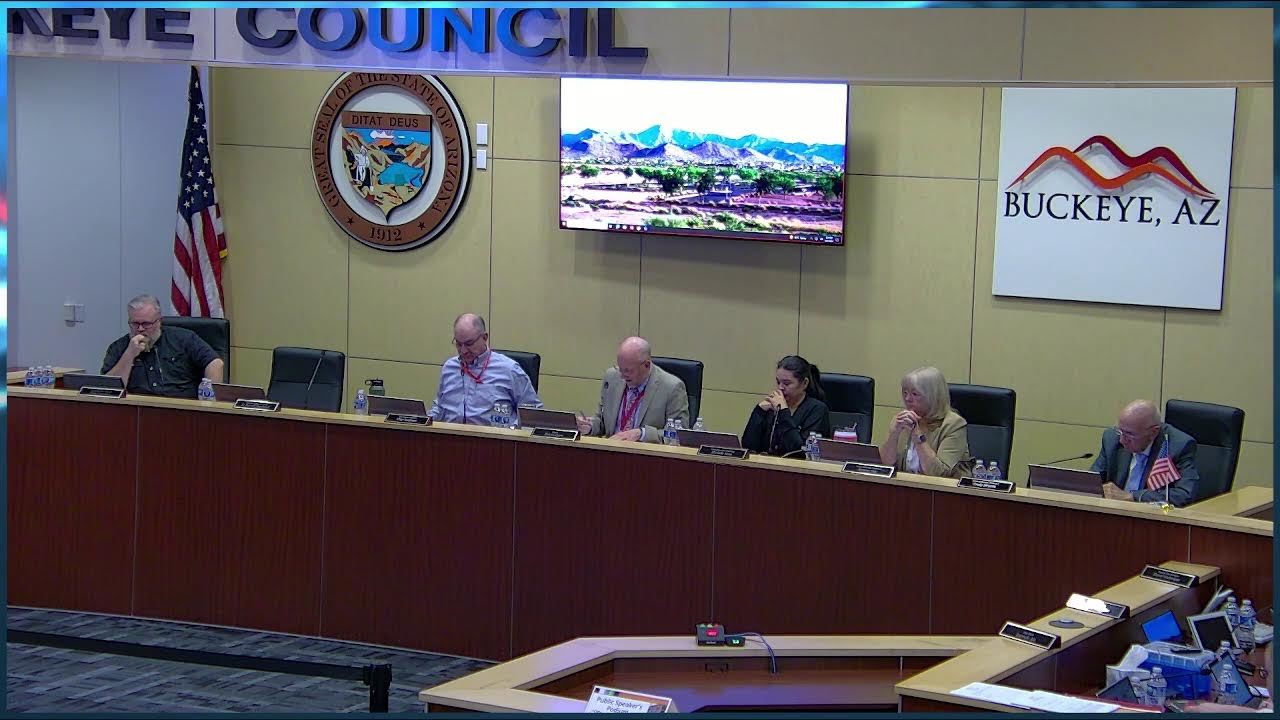
Buckeye approves downtown expansion, 250 MW solar facility, $686.65M budget, November bond election
Buckeye City Council unanimously approved a downtown expansion plan, 250 MW solar facility with interim use provisions, $686.65M budget, and called for November 5 bond election for $282M in public safety and transportation infrastructure.
Buckeye Council Unanimously Approves Downtown Plan Amendment, Solar Facility, Budget, and November Bond Election While Equity Concerns Resurface
In a single meeting that consolidated four major capital and policy decisions, Buckeye City Council voted unanimously on May 22, 2024, to amend the downtown specific area plan, approve a 250-megawatt utility-scale solar facility, adopt a tentative $686.65 million budget, and call a special election for November 5 to place $282 million in public safety and transportation bonds before voters. The agenda delivered on the council's stated priorities for downtown growth, renewable energy development, and infrastructure funding—but not without renewed friction over who bears the cost of expansion in a city growing at approximately 12 percent annually.
Key Speeches
"The Kyper Family Trust property is overall it's about 150 just under 150 acres in size and it's located essentially at the southeast corner of the Monroe alignment... with our DAP plan that we've put a lot of work and effort into we are seems like we're on the precipice of big things." — Ken Gleason, City Planner
"The 40-year period is really to accommodate upwards of 12 to 18 month construction period and then a 35-year operational life of the project while it's generating energy and delivering that power to the grid and then approximately a 12 to 18 month decommissioning." — Dave Lungren, Avantis Solar
"Growth pays for growth until it doesn't and we need to get a different system so that there's fairness across the city and that's that's my point." — Councilman Patrick HagEstad
Timeline
Item 6A: Downtown Specific Area Plan Amendment
-
Staff presentation: Ken Gleason outlined a 33-acre conversion from mixed-use core to downtown residential land use on the Kyper Family Trust property, relocating an 8-acre park site from the private southern tract to city-owned property on the north side of Monroe Avenue. The amendment maintains 25 acres of mixed-use core on the Kyper property (in addition to 50 acres already designated in the original plan) and preserves the downtown expansion vision east of Monroe.
-
Applicant: Kurt Jones, representing Kyper Family Trust. No prepared remarks; available for questions.
-
Public hearing: No speaker request cards filed; no public testimony offered.
-
Council discussion: Councilman Craig Heustis thanked the Kyper family for the time spent refining the amendment. No other council members raised questions. The discussion was brief and consensus-oriented.
-
Vote: Approved unanimously, 7–0.
Item 6B & 6C: Sun Valley Area Plan Amendment (Solar Text Changes) and Cat Claw Solar Conditional Master Plan
-
Staff presentation: Ken Gleason presented a two-part approval sequence: first, a text amendment to the Sun Valley Area Plan (adopted 1995, covering ~16,300 acres) to permit interim use of properties as solar generation stations for up to 40 years; second, a specific conditional master plan and development agreement for Cat Claw Solar, a 1,600-acre utility-scale solar facility with 250 MW generation capacity and 250 MW battery storage.
-
Project details:
- Located approximately four miles north of Tartesso, on the west side of Sun Valley Parkway, about a quarter-mile setback from the street.
- Solar panels limited to 15 feet in height; 50-foot minimum perimeter setbacks; no herbicide use; wildlife corridors and natural washes preserved; financial assurances for decommissioning.
- Applicant Avantis Solar (Dave Lungren) indicated the 40-year term accommodates 12–18 months construction, 35 years of operation, and 12–18 months decommissioning.
- Separate traffic impact analysis to be completed; during 40-year operation, anticipated 1–2 personnel on-site monthly, with periodic maintenance.
- Output: 250 MW generation; 250 MW storage.
-
Neighborhood meeting: Held January 2024 at Holiday Inn Express on Watson Road; approximately 15 attendees. Ken Gleason reported hearing from two or three opposed (primarily on aesthetic grounds—concern about "ugly solar panels"), one in favor, and general sentiment from some that "we just dump whatever in this area."
-
Public hearing for 6B: No speaker request cards; no public testimony.
-
Council discussion for 6B:
- Councilman Tony Youngker sought clarification on whether natural washes would be left in original condition or regraded: "are they being left the way they are currently or is it going to be graded through and put back during the construction process?" Ken Gleason confirmed that washes would be graded as necessary during construction and restored.
- Councilman Curtis Beard asked whether the applicant planned to use the full 40-year term; Dave Lungren confirmed intent to operate the full 40-year period and explained the industry-standard 35–40-year lifespan for utility-scale solar.
- Curtis Beard also sought clarification on how a development agreement functions and whether there is "an exchange of you do this we do that." Ken Gleason noted the agreement focuses on roadway dedications (to preserve future transportation network flexibility), phasing, and decommissioning plan and financial assurances. Development agreement language prohibits use of permanent herbicides to protect future soil health.
- Curtis Beard asked about potential flexibility if wildlife fencing interferes with animal migration; Ken Gleason stated that fencing is placed at the upper elevation of wash beds, outside the regulated floodway and active wash corridors, preserving wildlife movement intentionally and prohibiting additional grading.
- Vice Mayor Clay Goodman asked whether existing power lines (500 kV transmission) run diagonally through the site; confirmed affirmative. Clay Goodman noted those lines are "much more visually dominant" than the solar panels themselves.
- Tony Youngker asked whether a developer could redevelop the site earlier than 40 years if business model changes; Ken Gleason replied that any redevelopment would require a new CMP starting from ground zero with no provisions for alternative uses in the current CMP.
- Curtis Beard confirmed that the city did not require exceeding minimum notification, but Avantis Solar voluntarily notified Tartesso HOA.
-
Vote on 6B (Text Amendment): Approved unanimously, 7–0.
-
Public hearing for 6C: No speaker request cards; no public testimony.
-
Council discussion for 6C: No questions raised.
-
Vote on 6C (CMP and Development Agreement): Approved unanimously, 7–0.
Item 6D: Tentative Budget FY 2024–2025
-
Staff presentation: Bill Copley, Budget Director, presented a $686.65 million tentative budget with the following components:
- Operating expenditures and general fund operations
- $25.4 million in carryovers (primarily streets, fire stations, police communication center, vehicle purchases, and ongoing encumbered requisitions)
- $82 million for Haraqua water rights purchase (rebudgeted)
- 66.1 new positions across departments (including police, fire, public works, airport, utilities)
- 3.2% COLA effective July 7, 2024; 5% merit increases (based on individual anniversary dates); public safety receives one-step increase (~5%)
- Capital projects totaling $212.5 million for FY 2025; five-year capital plan totaling $600.4 million
- Tax rate adjusted from $1.65 to $1.60 per $100 assessed value due to increased assessed valuations
-
Key adjustments since workshop (two weeks prior):
- Added $82 million for Haraqua water rights bond issuance
- Increased fund balance by $19.3 million
- Added $15 million budget authority for contingency and potential grant opportunities
- Increased Communication Center CIP project by $1.4 million
- Noted declining state shared revenues: $4.5 million loss in income tax allocation
-
Council discussion on 6D:
- Councilman Curtis Beard asked whether HERF (Highway and Emergency Response Fund) supplementation of $3.7 million comes from the general fund or state funds; Copley confirmed the general fund supplements HERF for pavement maintenance.
- Curtis Beard asked about the new $15 million budget authority and whether it would enable the city to apply for larger grants (e.g., Watson Road $15–20 million grants); Copley confirmed that flexibility was the intent.
- Curtis Beard asked about monthly financial reports showing revenues exceeding expenditures and what "surplus" means; Copley explained that monthly fluctuations reflect timing of revenue receipts versus expenditure timing, not structural surplus. City is drawing down fund balance and reappropriating expected carryovers.
- Clay Goodman thanked Copley and his team for providing council with information to make good fiduciary decisions.
- Tony Youngker asked about the difference between assessed valuation and market value; Copley explained that Arizona Constitution limits assessed value increases to 5% annually, while market values have risen rapidly. Median assessed value in Buckeye is $176,000, but many market values are substantially higher (example provided: $800,000 market value corresponding to $400,000 assessed value for a Verrado home).
-
Vote: Approved unanimously, 7–0.
Item 6E: Bond Election Call for November 5, 2024
-
Staff presentation: Doug Sandstrom, Elections, presented the call for a special election on two bond measures:
- Measure 1 (Public Safety): $137 million in bonds for fire stations, public safety headquarters, and training facilities (component projects total $167 million; shortfall covered by other funding sources)
- Measure 2 (Streets & Transportation): $145 million in bonds for street and transportation improvements, including Jack Rabbit Trail improvements, Miller Road upgrades, Rooks Road improvements, and traffic signal/intersection work (component projects total $159 million; shortfall covered by other funding sources)
-
Citizens Bond Committee process: Clay Goodman, as committee chair, noted that a 13-member citizens committee representing all city districts met from January through April 2024, reviewing projects totaling nearly $600 million and deliberating on recommendations. Committee members were present at the meeting and were recognized by Eric Orsborn.
-
Property tax impact (stated for a $250,000 assessed-value home):
- Average annual cost over 30-year bond term: $247/year
- Actual year-one impact: approximately $130 (costs ramp up as assessed values increase)
- Maximum tax rate ceiling: $2.25 per $100 assessed value (to remain within state-imposed growth cap)
- Commercial property (per $1 million value): $1,484 average annual
- Agricultural/vacant land ($100,000 value): $148 average annual
-
Election outreach plan post-call:
- Website dedicated content on bond projects
- Educational videos on project scope, timing, tax impacts
- Utility billing stuffers
- Social media
- Community event collateral
- Staff talking points and messaging guidelines (city attorney to provide guidance on permissible speech post-call)
- News releases
- Focus on education ramping up in late September/October when voters actively pay attention to ballot materials
-
Council discussion on 6E:
- Councilman Craig Heustis asked for clarification that $2.25 per $100 is the "high end" or worst-case scenario, not the projected rate; Sandstrom confirmed it represents the maximum permissible rate and that the city's goal is to remain at or below $2.25, with actual rates potentially lower depending on the pace of construction and bond issuance sequencing. Year-one impact would be $130, not $247 average.
- Councilman Tony Youngker confirmed that the assessed valuation figure (not market value) is critical to messaging consistency; Sandstrom acknowledged the importance and said the city would use the median assessed value of $176,000 to help residents understand their specific impacts via online calculators.
- Tony Youngker emphasized that all projects discussed are growth-related and fall outside existing CFD-funded infrastructure. He noted that the city's 11 CFDs typically pay for infrastructure within their boundaries but that infrastructure improvements between CFDs and citywide services (e.g., fire stations, headquarters, training facilities) require different funding mechanisms. He argued that without bonds, projects would compete for general fund dollars and be spread over decades, causing inflation-driven cost escalation. He explained that the city's $600 million five-year CIP already prioritizes roads and infrastructure out of general fund revenue; these bond projects are additions. He noted that state shared revenues have declined by $4 million this year and that stable funding is essential for predictability.
- Tony Youngker also highlighted that if the city continues to grow at 10 percent annually (versus the state-mandated conservative forecast of 2.5 percent after year 5), assessed valuations would rise tenfold, accelerating bond repayment and reducing the effective tax burden.
- Councilman Patrick HagEstad objected to the funding structure and raised equity concerns: He confirmed that residents in CFDs already pay assessments for local infrastructure growth within their CFDs but would also be assessed for city-wide bond repayment. He stated: "Growth pays for growth until it doesn't and we need to get a different system so that there's fairness across the city and that's that's my point." He emphasized that this is the first time the city is issuing bonds and that the pattern of growth-funded infrastructure costs should be systematically reconsidered to ensure equitable distribution across all city residents, not just those in CFDs.
- Tony Youngker reaffirmed that the decision ultimately rests with voters.
-
Vote: Approved unanimously, 7–0.
Opposition
Cat Claw Solar neighborhood meeting opposition:
-
Number of speakers against: 2–3 residents at January 2024 neighborhood meeting
-
Main concerns:
- Aesthetic impact: concern about visibility of solar panels from residential areas and commute routes
- Perception of inequitable land use: sentiment that undeveloped areas on the city's edge are used as repositories for unwanted infrastructure ("we just dump whatever in this area")
- Concern that rural/fringe areas bear disproportionate environmental or visual burden compared to core city development
-
Staff response: Ken Gleason noted that while aesthetic concerns are valid, the 15-foot height limit, 50-foot setbacks, and perimeter landscaping screening will mitigate visual impact. Panels will not block mountain views. Transmission lines already visible in the area are more visually dominant than the solar arrays.
Bond Election concerns (Councilman HagEstad):
- Voiced concern that residents in CFDs pay both CFD assessments (for local infrastructure) and city-wide bond assessments, creating a "double burden" for growth-related costs
- Called for systemic change to ensure fair distribution of growth costs across the entire city
- No other council members voiced opposition, but HagEstad's concern was noted for the record
Support
Downtown Specific Area Plan Amendment:
- Councilman Craig Heustis expressed gratitude to the Kyper Family Trust for taking time to refine the amendment and working with staff
- No organized public support; staff presented the amendment as consistent with the Downtown Area Plan vision and meeting the intent of the October 2023 approval
Cat Claw Solar:
- Clay Goodman noted that existing 500 kV transmission lines are "much more visually dominant" than the solar panels, implying that the visual impact concern is overstated
- Curtis Beard confirmed staff's environmental protections (no herbicide use, wildlife corridor preservation, wash preservation) are adequate and thanked the applicant for exceeding minimum notification requirements
- No organized public support; staff characterized the interim use as "low impact" compared to other potential uses during the 50-year build-out timeline of the Sun Valley Area Plan
Budget and Bond Election:
- Clay Goodman commended the Budget Director and staff for a thorough, transparent process that enables council to make sound fiduciary decisions
- Tony Youngker endorsed the bond process, noting that the Citizens Bond Committee included representatives from all districts and that public input is essential
- Eric Orsborn thanked all volunteers and staff involved in both the budget and bond processes
Project Details
Downtown Specific Area Plan Amendment (Item 6A)
- Case number: Resolution 30-24
- Applicant/developer: Kyper Family Trust
- Attorney: Kurt Jones
- Location: Southeast corner of Monroe Avenue and Apache alignment; approximately 150 acres total, with 50-acre amendment area east of the current terminus of Monroe, between McDowell Road (approx.) and Watson Road
- Current land use: Agricultural
- Current zoning: Primarily planned residential (single-family) with some rural residential
- Proposed zoning: Rezoning to be determined at future council action; currently covered by Downtown Area Plan land use designations
- Proposed land use changes:
- 33 acres: Mixed-use core → Downtown residential (new)
- 8 acres: Parks & Recreation (relocated from south side to city-owned property on north side of Monroe)
- 25 acres: Mixed-use core (retained)
- 20 acres: Multifamily residential (unchanged)
- ~67 acres: Suburban residential (unchanged)
- Density/units/square footage: Not stated in transcript
- Changes from previous version: Original DAP (October 2023) designated the entire property with a greater proportion of mixed-use core (50 acres) and placed the park site on private property. Amendment reduces mixed-use core acreage to 25 acres, adds 33 acres of downtown residential, and relocates park to city-owned land.
Sun Valley Area Plan Amendment — Solar Text Changes (Item 6B)
- Case number: Resolution 27-24
- Applicant/developer: N/A (text amendment only; no specific project applicant)
- Location: Sun Valley Area Plan boundary (adopted 1995; ~16,300 acres)
- Current zoning: Planned community (with some ambiguity regarding applicability)
- Current land use (per 1995 SVAP): Primarily residential (single- and multifamily), commercial, industrial at various nodes
- Proposed change: Incorporates language permitting interim use of properties as solar generation stations for up to 40 years; excludes concentrated solar power (CSP) facilities with central focusing dishes
- Implementation: Via separate CMP and development agreement
Cat Claw Solar Conditional Master Plan and Development Agreement (Item 6C)
- Case number: CMP and Development Agreement (no separate resolution number provided; approved alongside Resolution 27-24)
- Applicant/developer: Avantis Solar
- Attorney/representative: Dave Lungren, Avantis Solar
- Location: West side of Sun Valley Parkway, north of Tartesso, south of future Peoria Avenue alignment, bisected north-south by future Bruner Road alignment. Property does not directly front Sun Valley Parkway; approximately 0.25 mile setback.
- APN: Not stated in transcript
- Site area: 1,600 acres
- Current zoning: Planned community (status ambiguous per transcript)
- Proposed zoning: CMP (conditional master plan)
- Generation capacity: 250 MW solar; 250 MW battery energy storage
- Height limit: 15 feet maximum above grade (roughly equivalent to one-story building)
- Setbacks: 50-foot minimum perimeter setback
- Operational term: Up to 40 years (12–18 months construction, 35 years operation, 12–18 months decommissioning)
- Environmental protections:
- No permanent herbicide use
- Wildlife corridors preserved
- Natural washes left unobstructed (no development within wash boundaries)
- Individual fencing around solar clusters (not perimeter-wide enclosure)
- Perimeter landscaping for visual screening on visible property frontages
- Traffic impact: 1–2 personnel on-site monthly during operations; periodic maintenance; full traffic impact analysis to be completed
- Water/sewer impact: Minimal
- Financial assurances: Developer posts financial assurances to cover decommissioning and restoration costs in event of abandonment
- Right-of-way dedications: Preservation of right-of-way for future Peoria Avenue, Johnson Road, and Northern Avenue alignments; Bruner Road dedication (initially temporary, then realigned to final location at end of project life)
Tentative Budget FY 2024–2025 (Item 6D)
- Case number: Resolution 31-24
- Total tentative budget: $686.65 million (increased from $429.9 million recommended at workshop by adding $25.4M carryovers and $1.4M CIP Communication Center increase)
- Key components:
- Operating expenditures: specific breakdown not fully detailed in transcript
- Capital projects (FY 2025): $212.5 million
- Capital projects (5-year plan): $600.4 million
- Carryovers: $25.4 million (primarily streets, fire stations, police communication center, utility projects, vehicle purchases, encumbered requisitions)
- Haraqua water rights purchase: $82 million (rebudgeted)
- General fund balance use: $123 million
- Transfer to CIP projects: $87.9 million
- HERF (pavement maintenance) supplement: $3.7 million
- Fleet replacement program set-aside: $3.7 million
- Budget authority (contingency/grant flexibility): $15 million
- Positions: 66.1 new positions added across departments (police, fire, public works, airport, utilities)
- Compensation:
- COLA: 3.2% effective July 7, 2024
- Merit increases: 5% (effective on individual anniversary dates)
- Public safety: one-step increase (~4.8–5%)
- Tax rate: Adjusted from $1.65 to $1.60 per $100 assessed value due to increased assessed valuations
- Estimated revenues: $433.5 million (2.9% decrease from prior year, driven by reduced bond proceeds and $4.5M state shared revenue loss)
Bond Election Call for November 5, 2024 (Item 6E)
- Case number: Resolution 29-24
- Ballot measures: Two separate bond questions
- Measure 1: $137 million for public safety (fire stations, public safety headquarters, training facilities)
- Measure 2: $145 million for streets and transportation
- Total: $282 million
- Property tax impact (on $250,000 assessed-value home):
- Average annual cost over 30-year bond term: $247/year
- Actual year-one cost: ~$130
- Maximum sustainable tax rate: $2.25 per $100 assessed value
- Committee process: 13-member Citizens Bond Committee; met January–April 2024; represented all city districts; reviewed ~$600 million in proposed projects
- Election date: November 5, 2024
- Outreach plan: Website, videos, utility billing stuffers, social media, community events, staff talking points (subject to city attorney guidance on permissible speech post-call)
Vote Breakdown
Item 6A (Downtown Specific Area Plan Amendment)
- Final: 7–0 (Unanimous)
- Yes: All council members present
- No: None
- Abstentions/absences: None
Item 6B (Sun Valley Area Plan Amendment — Solar Text Changes)
- Final: 7–0 (Unanimous)
- Yes: All council members present
- No: None
- Abstentions/absences: None
Item 6C (Cat Claw Solar CMP and Development Agreement)
- Final: 7–0 (Unanimous)
- Yes: All council members present
- No: None
- Abstentions/absences: None
Item 6D (Tentative Budget FY 2024–2025)
- Final: 7–0 (Unanimous)
- Yes: All council members present
- No: None
- Abstentions/absences: None
Item 6E (Bond Election Call for November 5, 2024)
- Final: 7–0 (Unanimous)
- Yes: All council members present
- No: None
- Abstentions/absences: None
Council members present: Mayor Eric Orsborn, Vice Mayor Clay Goodman, Councilmember Tony Youngker, Councilmember Jamaine Berry, Councilmember Curtis Beard, Councilmember Patrick HagEstad, Councilmember Craig Heustis
Outcome & Next Steps
Downtown Specific Area Plan Amendment (6A)
- Status: Approved and adopted via Resolution 30-24
- Next step: Zoning amendment to align with new land use designations to be brought forward at a future council meeting. Park site relocation to city-owned property to proceed.
Sun Valley Area Plan Amendment and Cat Claw Solar (6B & 6C)
- Status: Both approved and adopted; Resolution 27-24 for text amendment; CMP and Development Agreement approved with conditions A through P
- Conditions: Prohibit use of permanent herbicides; preserve wildlife corridors and natural washes; maintain 15-foot height limit and 50-foot setbacks; establish financial assurances for decommissioning; dedicate right-of-way for future street alignments; develop traffic impact analysis
- Next step: Conditional Master Plan and Development Agreement to be executed by city manager designee. Applicant to secure all necessary permits and begin construction activities per phased timeline.
Tentative Budget FY 2024–2025 (6D)
- Status: Adopted via Resolution 31-24
- Expenditure limitation: $686.65 million set for FY 2025
- Next steps:
- June 4, 2024: Special council meeting; public hearing on Truth and Taxation; public hearing on final budget; approve SLIDs for consideration
- June 18, 2024: Council meeting; adopt final budget; approve property tax levy; approve final SLIDs
- July 1, 2024: FY 2025 begins
- July 7, 2024: 3.2% COLA takes effect (paycheck received July 26, 2024)
- Changes to contingency and fund balance policy: Planned update to be presented June 18, 2024
Bond Election Call for November 5, 2024 (6E)
- Status: Approved via Resolution 29-24; election officially called
- Next steps:
- City to conduct public outreach and education via website, videos, social media, utility billing stuffers, and community events
- City attorney to provide guidance on permissible speech to council and staff post-call of election
- Voters to decide on two ballot measures (Public Safety $137M and Streets/Transportation $145M) on November 5, 2024
- If approved, council to authorize issuance of bonds and proceed with project sequencing (initial issuance projected for 2025, with potential second and third issuances as projects advance and assessed valuations increase)
Controversies & Context
Growth Funding Equity Concerns (Councilman Patrick HagEstad)
Councilman Patrick HagEstad raised a recurring systemic concern about the distribution of growth-related infrastructure costs across the city. He noted that Buckeye has 11 Community Facilities Districts (CFDs), which are special taxing districts that fund infrastructure improvements directly related to growth within their boundaries. Residents in CFDs pay dedicated assessments for local infrastructure (roads, utilities, schools, fire stations, etc.) tied to growth within their district.
However, when the city issues general obligation bonds to fund city-wide infrastructure improvements—such as fire stations, public safety headquarters, training facilities, and major arterial roads serving the entire city—all property owners, including those in CFDs, are assessed through the secondary property tax bill used to repay those bonds. This creates what HagEstad termed a "double burden": CFD residents pay their local CFD assessments for growth infrastructure in their district and also contribute to city-wide bond repayment for growth-related infrastructure outside their CFD.
HagEstad stated explicitly:
"Residents who are in cfds and already pay for their in their infrastructure would also be paying additional amounts for these repayment of these bonds... I'm still very concerned about how every time we do these CIP projects every time we do and this first time we're doing bonds I see that there's um grow going all over the city um and we're all uh a city when it comes to that and so we're putting in for that um so I'm making my point again that growth pays for growth until it doesn't and we need to get a different system so that um there's fairness across the city."
HagEstad did not vote against the bond resolution (it passed unanimously), but he placed his objection on the record as a statement of principle calling for systemic reform. He indicated that the city should explore alternative mechanisms for allocating growth-related costs—such as expanding impact fee authority, creating district-specific CFD overlays, or implementing user fees—to ensure that growth costs are borne equitably and not concentrated on residents in CFDs.
This concern represents a friction point common to rapidly growing Sun Belt cities where master-planned communities (and their associated CFDs) have already absorbed infrastructure costs within their boundaries, but the city-wide growth pattern exceeds the capacity of existing local infrastructure. The tension between district-level growth funding and city-wide growth infrastructure is not new, but HagEstad's explicit call for systemic change suggests it will likely resurface in future budget and capital planning discussions.
State Preemption of Growth-Cost Allocation
Tony Youngker noted that impact fees—direct charges to developers for growth-related infrastructure—apply primarily to direct, specific impacts (e.g., a new fire station triggered by specific new development). However, many city-wide improvements, such as public safety headquarters, training facilities, and major multi-year arterial projects, do not fit neatly into impact-fee categories and therefore fall to the general fund or require bonding. This creates a structural dependency on bonds and general revenue for infrastructure that is indirectly (but substantially) growth-driven.
Assessed Valuation vs. Market Value
Sandstrom and Copley emphasized that property tax impacts are calculated using assessed value, not market value. Arizona's constitutional 5 percent annual cap on assessed value increases, combined with rapid market appreciation, has created a significant gap between assessed and market values in Buckeye—particularly in master-planned communities like Verrado where homes have appreciated 10–15 percent annually. This gap means that actual tax impacts on residents may differ substantially from the average estimates provided in the publicity pamphlet, and residents will need to look up their individual assessed values to calculate precise impacts. The city plans to provide online calculators to help residents determine their specific costs.
Duration
- Downtown Specific Area Plan Amendment (Item 6A): ~15 minutes (staff presentation, council discussion, vote)
- Sun Valley Area Plan Amendment and Cat Claw Solar (Items 6B & 6C): ~40 minutes (two presentations combined, extensive council discussion, two separate public hearings, two separate votes)
- Tentative Budget (Item 6D): ~30 minutes (comprehensive presentation, council questions on revenue, fund balance, HERF, merit increases, assessed valuation)
- Bond Election Call (Item 6E): ~40 minutes (presentation of Citizens Bond Committee process, property tax impacts, outreach plan; extensive council discussion on assessed valuation, CFD equity, impact fees, and repayment acceleration due to growth)
- Total meeting duration: Approximately 2 hours 45 minutes (estimated; full timestamp not provided in transcript)
Other Notable Items
MainStreet America Conference Insights (Item 7 — Comments from Mayor and Council)
Councilman Tony Youngker reported on attendance at the MainStreet America conference in Alabama and noted findings that Buckeye's Downtown Area Plan positions the city "on the precipice of big things" in attracting private capital for downtown development. He cited successful examples from other cities and emphasized the importance of accelerating the downtown vision to capitalize on private investment momentum. This comment contextualizes the downtown expansion amendment as part of a broader strategy to foster downtown revitalization and private-sector participation.
Memorial Day Ceremony (Item 8 — City Manager Report)
City Manager announced that a special Memorial Day ceremony will be held Monday, May 27, 2024, at 8:00 a.m. at the Lewis B. Hazelton Cemetery. General Roof will be the keynote speaker. (Informational only; no action required.)