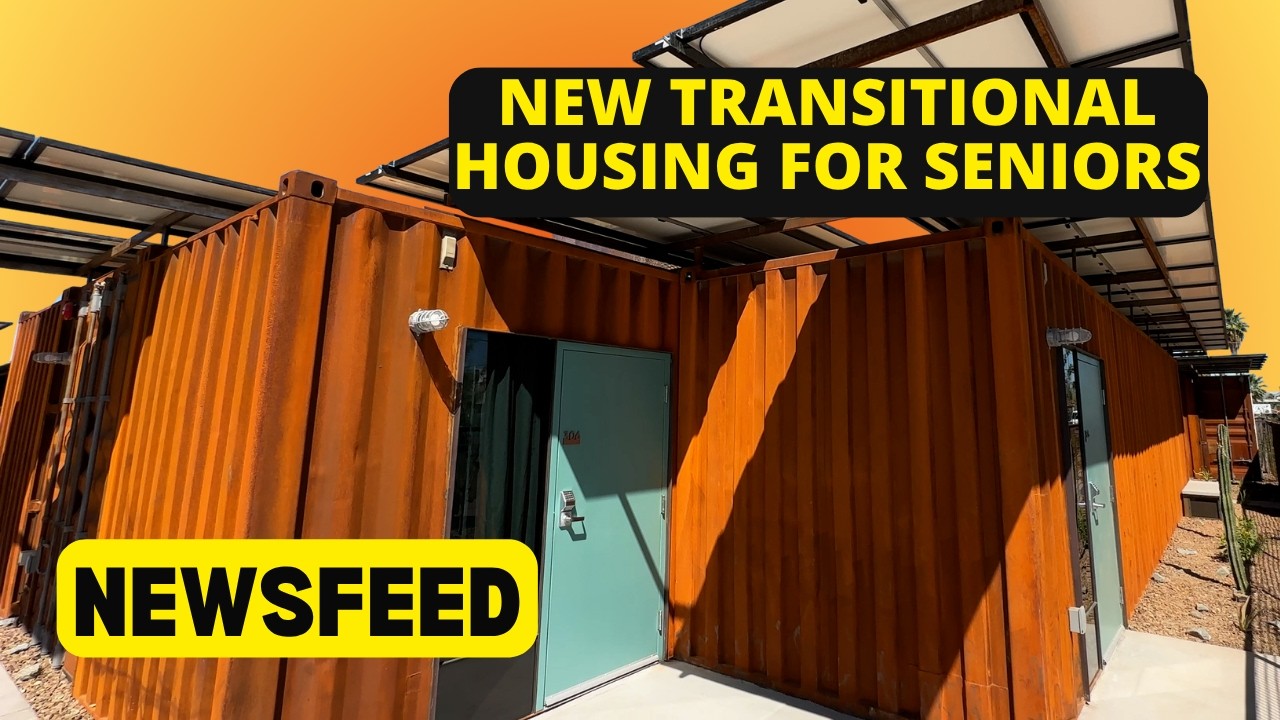
Phoenix opens Senior Bridge Housing, 40-unit shipping-container senior community in District 8
City of Phoenix celebrates opening of innovative Senior Bridge Housing project, a 40-unit transitional affordable housing community for seniors using repurposed shipping containers with Phase 2 expansion planned.
Phoenix Opens Senior Bridge Housing: 40-Unit Shipping-Container Community for Low-Income Seniors Touted as National Model
The City of Phoenix, Arizona Department of Housing, and private development partners marked the grand opening of Senior Bridge Housing on March 26, 2026—a 40-unit transitional affordable housing community built from repurposed shipping containers, designed specifically for seniors experiencing housing instability and powered entirely by solar energy and lithium batteries. The project, located in District 8 and operated in partnership with Mercy House, was presented as proof-of-concept for a scalable, replicable model to address what speakers characterized as an imminent national housing crisis for low-income seniors.
The event drew city leadership including Mayor Kate Gallego, Vice Mayor Kesha Hodge Washington, Councilmember Ann O'Brien, Councilmember Kevin Robinson, Arizona Department of Housing Director Ruby Dylan Williams, and Maricopa County Supervisor Clint Hickman, alongside the development and nonprofit teams that brought the vision to life.
Key Speeches
"We know a lot of people want to live here and we need to do our part to make sure everyone has a safe place to call home. Also want to thank Supervisor Clint Hickman who chaired the boards of supervisors and who made a very important investment in making this project go forward." — Mayor Kate Gallego
"This is one of this is a real peak experience for me personally um and our organization collectively. So, thank you so much for including this in all this. And thank you to all of our public and private partners, uh, from the city to the state to all the private sector, the Garcia Foundation, everybody that's invested in this." — Larry Haynes, Mercy House CEO
"They were willing to believe that housing could be built differently, that the rules we've always followed might not be the rules we always should follow. And moments like this only happen when leaders decide to do the safe thing. Doing the safe thing isn't the same as doing the right thing." — Debra Stark, Steel and Spark, architect
"By 2034, for the first time ever, there will be more Americans over the age of 65 than under the age of 18. This is considered the crossing of the age curve. It's not just a statistic, it's a turning point in our American trajectory. At the same time, seniors are the fastest growing group experiencing homelessness." — Debra Stark
Timeline
- Development genesis: Demonstration project on Second and Roosevelt (pre–Super Bowl, several years prior) tested shipping-container housing typology with Arizona Department of Housing and city of Phoenix.
- Project development: Steel and Spark led design; city planning and development team, including Cindy Startler (assistant planning director), worked to modify building code and develop code exceptions to permit container construction.
- Financing and capital stack: Complex affordable-housing capital structure closed with support from Arizona Department of Housing, city, Maricopa County, Garcia Foundation, and other public and private sources.
- Grand opening: March 26, 2026; ribbon-cutting ceremony with city council members, state housing director, and nonprofit leadership.
- Public comment: No public opposition or comment period noted in transcript; event was celebratory announcement and tour.
Support & Stakeholder Remarks
Mayor Kate Gallego emphasized the project's alignment with city housing priorities, noting that housing investments are "unanimous and broadly supported" on the council. She highlighted Senior Bridge's speed to market, affordability, sustainability (solar power as "sunniest big city in America"), and innovative construction methods. She noted that the project will "get a lot of well-deserved national attention" and praised Steel and Spark's visionary leadership.
Vice Mayor Kesha Hodge Washington (District 8) spoke at length about the project's significance within her district and its alignment with her advocacy for equitable service distribution across all Phoenix neighborhoods. She described her role in championing the project internally ("calls and emails to the city manager's office, including quite a bit of follow-ups"), noting that "Senior Bridge Housing represents exactly the type of collaboration we strive for in Phoenix where we align resources, expertise and compassion to meet real needs in our community." She emphasized the demographic urgency: "By 2030, one in five Americans will be over the age of 65. And here in Phoenix, we are already experiencing some of that shift." She framed the project as centering "dignity while delivering results" and noted its ripple effects on emergency services: "Stable housing is not only the right thing to do, it is a smart thing to do. It reduces the strain on our emergency rooms, shelters, and public safety systems."
Ruby Dylan Williams, Director of Arizona Department of Housing (in post since March 2025), described a personal connection to the project, noting that she and her deputy Cindy Startler had discussed the concept with Steel and Spark founders during the Super Bowl demonstration-project phase. She acknowledged the difficulty of closing complex affordable-housing deals from a practitioner's perspective and praised the developers for persisting through financial and regulatory challenges. She positioned Senior Bridge as "a high performance pilot for the entire state" and framed housing as healthcare: "Housing is healthcare and it is a platform to future success."
Larry Haynes, Mercy House CEO (in role since 1990 as one of the organization's original employees), emphasized Mercy House's track record (100,000+ people served; operations in six counties across California and Arizona; eight programs in Maricopa County). He articulated the operational philosophy for the project, stressing that "shelter within a competent and compassionate system of care works"—and underscoring each word's criticality. He explicitly acknowledged and validated the concerns of neighbors and private investors: "We are also acknowledging that there are neighbors just right over here and their most important emotional and not financial investment have been in those homes. For them to want to see that value of that investment appreciate is not greed. It is virtue." He committed to accountability: "You have my commitment that we understand what is important and we will fix every mistake that we ever make and we will value what is important to you." He closed with a directive to his operations staff to remember that the residents are "somebody's mom and this is somebody's dad" and that "this is not how their story was supposed to end."
Debra Stark, architect and principal of Steel and Spark, delivered the longest and most substantive speech, positioning Senior Bridge within a historical and demographic narrative. He opened by praising Kate Gallego and the Arizona Department of Housing for willingness to say "yes to an idea that didn't look familiar" and for understanding that "doing the safe thing isn't the same as doing the right thing." He presented demographic data: 60 million seniors in the U.S. today; 30 million living on less than $29,000 per year; seniors as the fastest-growing group experiencing homelessness; homelessness up 34% in the past decade while population growth was only 7%. He argued that the "crossing of the age curve" (2034, when seniors outnumber youth for the first time) will define the 2030s as a pivotal decade for housing policy. He positioned innovation not as technological disruption but as a deliberate redesign of cities and priorities: "The defining challenge of the next decade is not going to be artificial intelligence. It's not going to be automation and it's not going to be some technology we haven't invented yet. The defining challenge of the 2030s will be this. How do we house millions of lower income seniors with dignity?" He concluded: "This proof of innovation if given the chance in an industry is typically it isn't housing can help close the gap proof that when the age curve crosses in 2034 people will be able to back look back at this moment and say Phoenix figured it out."
Chris Mackey, President and CEO of Greater Phoenix Economic Council (former economic development director for city of Phoenix, departed role five months prior to event), served as emcee. He framed the project as the fifth collaboration with Steel and Spark (following Oscar, IDA, Second and Roosevelt demonstration project, and Senior Bridge). He emphasized the shift in cultural mindset: "it wasn't the how can we it wasn't why can't we do something, it was the how can we do something." He underscored the partnership's focus on removing barriers rather than accepting constraints.
Project Details
- Case Number: Not stated in transcript.
- Applicant / Developer: Steel and Spark; Debra Stark (architect/principal); Kathleen [surname not provided in transcript; noted as co-founder or principal].
- Operator / Service Partner: Mercy House (Larry Haynes, CEO); on-site case management and supportive services.
- Location / Address: District 8, Phoenix; specific street address not stated in transcript.
- Financing Partners: Arizona Department of Housing, City of Phoenix, Maricopa County, Garcia Foundation, United Way (mentioned as supporter), and unnamed additional private-sector investors.
- Current Zoning / Proposed Zoning: Not stated in transcript; city planning noted that code exceptions and modifications were necessary to permit shipping-container construction.
- Phase 1 Scope:
- 40 units of transitional affordable housing for seniors.
- Repurposed shipping containers; 300,000 lbs of steel reused; 280 tons of carbon emissions avoided.
- Solar panels + lithium battery storage; energy independent.
- Cooling benches (pulling cool air and moisture from subsurface).
- Dog park (named Grace).
- Public/gathering spaces designed with cooling features.
- On-site case management and supportive services.
- Phase 2 Scope: 54 permanent housing apartments on same site (in planning stage); led by Phoenix Community Development and Investment Corporation in partnership with Maricopa County and city of Phoenix.
- Target Population: Low-income seniors experiencing housing instability; transitional housing model (Phase 1).
- Affordability / Pricing: Not stated in transcript.
- Construction Method: Modular/prefabricated shipping-container units; noted as faster than traditional construction, with much of work done indoors (significant in context of Phoenix's heat).
- Sustainability Features: Solar power; lithium batteries; reused materials; carbon-neutral operations; microclimate cooling infrastructure.
Vote Breakdown
Not applicable. This was a grand-opening celebration event, not a legislative vote or approval proceeding. The project had already been approved and was in operational phase.
Outcome & Next Steps
Phase 1 Status: Successfully opened March 26, 2026. The 40-unit transitional housing community is operational and beginning to receive residents.
Phase 2 Planning: 54 additional permanent housing apartments are in planning and development stage through Phoenix Community Development and Investment Corporation, Maricopa County, and the city of Phoenix. No timeline for Phase 2 approval or opening was stated.
Community Engagement: Kesha Hodge Washington indicated ongoing coordination with the District 8 community and local stakeholders. Mercy House committed to accountability and responsiveness to neighborhood concerns and to fixing operational problems as they arise.
Replication & Regional Expansion: Multiple speakers (Chris Mackey, Debra Stark) noted that the model is designed to be replicable at scale across the region, state, and nation. No formal partnerships or replication announcements were made at the event.
Controversies & Context
Code Innovation and Regulatory Barriers: The project required modification to Phoenix's building code and development of code exceptions to permit shipping-container residential construction. Chris Mackey specifically credited Cindy Startler, assistant planning director, with leading the effort to work with Steel and Spark to devise code modifications and exceptions, stating: "we will not would not be here today with this project if Cindy had not taken the lead." This suggests that traditional permitting would have blocked the project absent regulatory adaptation.
Demographic & Social Context: Debra Stark positioned the project within a larger demographic and policy narrative. He noted that seniors are the fastest-growing population experiencing homelessness, that 30 million U.S. seniors live on under $29,000 annually, and that many have been depleted through reverse mortgages or inability to afford rising housing, healthcare, and inflation costs. He framed the "crossing of the age curve" (2034) as a defining policy moment and argued that the question "How do we house millions of lower income seniors with dignity?" will characterize the 2030s.
Community Integration & Reassurance: Larry Haynes explicitly addressed potential community concerns about a homeless-services facility in a residential neighborhood. He validated neighbors' equity concerns ("For them to want to see that value of that investment appreciate is not greed. It is virtue") and committed Mercy House to minimizing negative community impacts while operating with care and professional standards. This suggests an awareness that some residential or business neighbors may harbor concerns about the project's effect on property values, neighborhood character, or public safety—though no organized opposition was evident at the event.
Partnership Model: The project was presented as a successful model of public-private-nonprofit collaboration, with the city and state providing land/capital, Steel and Spark providing innovation and development expertise, and Mercy House providing operational and supportive-services capacity. No friction or disagreement among partners was mentioned; the tone was uniformly celebratory.
Duration
- Event Duration: Not precisely stated in transcript. The formal program included remarks from Chris Mackey (emcee), Kate Gallego, Ruby Dylan Williams, Kesha Hodge Washington, Larry Haynes, and Debra Stark, followed by a tour of the facility. Estimated 60–90 minutes for formal remarks and ceremony.
- Total Meeting / Event: Not applicable; this was not a city council or planning commission meeting but a public celebration and ribbon-cutting ceremony.
Other Notable Elements
Demonstration Project Lineage: Chris Mackey and Debra Stark both referenced earlier Steel and Spark projects—Oscar (shipping containers on Grand), IDA (residential downtown with ground-floor retail), and Second and Roosevelt demonstration project (pre–Super Bowl, where the shipping-container housing concept was first tested with Arizona Department of Housing and city partnership). Senior Bridge is positioned as the scaled-up success of that earlier proof-of-concept.
National Recognition: Kate Gallego predicted the project will "get a lot of well-deserved national attention," and noted that Steel and Spark's work is being showcased at Phoenix Sky Harbor International Airport as "one of the great things that are happening in the city of Phoenix."
Economic Development Framing: Chris Mackey, as representative of the Greater Phoenix Economic Council, framed the project as both a social solution and an economic opportunity, emphasizing that innovation in housing construction (speed to market, lower cost, prefabrication) can help Phoenix compete regionally and nationally.
Elected Leadership Alignment: The presence of Kate Gallego, Kesha Hodge Washington, two council members, a county supervisor, and the state housing director signaled strong political support across city, county, and state levels. No dissenting voices or skepticism was expressed.