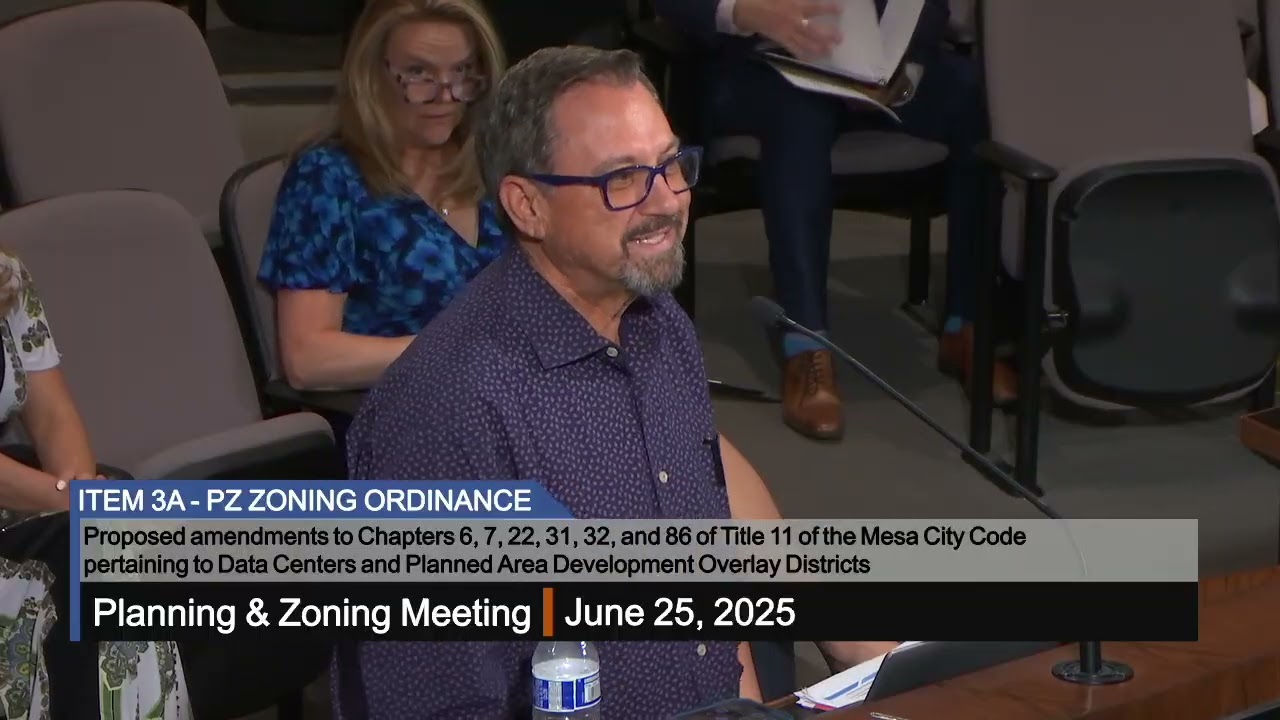
Mesa Planning Board approves data center ordinance 6-1, advances to city council July 1
Mesa Planning and Zoning Board approved data center ordinance amendments establishing new zoning regulations and development standards with a 6-1 vote despite industry and some board member requests for additional clarification time.
Mesa Board Approves Data Center Ordinance 6-1; Legal Ambiguities and Speed Concerns Persist Into Council Phase
The Mesa Planning and Zoning Board voted 6-1 on June 26, 2025, to recommend adoption of comprehensive text amendments establishing the city's first codified regulatory framework for data centers. The ordinance (PZ 25507) creates new definitions, land-use permissions, and development standards in response to rapid growth in the sector—60 certified data centers now operate in Arizona, up from four in 2013. However, the vote masked persistent technical disagreements over waiver language, setback calculations, and scope of exemptions that industry representatives and board members alike flagged as unresolved, setting the stage for continued negotiation as the item moves to Mesa City Council for introduction on July 1, 2025.
The ordinance restricts new data centers to General Industrial (GI) and Heavy Industrial (HI) zoning districts but permits Light Industrial (LI) properties to apply for a waiver. It mandates a 400-foot setback from residential properties, requires screening and facade enhancements, limits accessory uses (such as office, parking, or support services) to 10 percent of floor area, and specifies parking and mechanical-equipment standards. The Planning Area Development (PAD) overlay standards are made non-deviable—meaning the Planning Commission and City Council cannot modify them for individual data center projects.
Key Speeches
"We had just come out of the great recession... We're trying to figure out how to get it back up and alive... And so we came up with this idea: Well, let's attract data centers. And so we did the legislation in 2013... Today we have almost 60 in Arizona. And I can also tell you that I had no idea what these things would look like when we did them... We have those facilities all over the valley and we've done this incredible job of making sure that they're welcome here." — Russell Smolden, Data Center Coalition
"We don't see why the LI zone couldn't be included as a permitted district in general. Reason being is that the ordinance does require rezoning. Therefore, even within LI, there would be discretion as to whether that LI property is appropriate place for data center... We're still very concerned that the definition of rezone within the ordinance is not crystal clear... Adding a CUP or even a PAD to an existing LI as our client has. Does that or does that not mess up your waiver?" — Ben Graph, Corals and Brady (representing Nova Holdings LLC)
"Restricting data centers to the GI and HI is overly restrictive. I have been a developer. I'm a builder. I am not going to buy property that requires a waiver. I am going to go somewhere else... The waiver process is correct to you. It's intimidating and it's unclear and uncertain to people that might be investing tens of millions of dollars." — Tom Maples, 7x24 Exchange
"These data centers, we think of them as these big box facilities... But these facilities are more than that. These facilities are saving lives. And the fact that I'm standing here before you today is testament to that fact that these servers in data centers have important information and are helping people in more ways than one more ways than we know." — Sepand Alazada, Arizona Technology Council
"As far as site selection goes, Phoenix as well as the greater Phoenix area is—I'd like to say that, you know, five years ago people said, 'Mark, you watch. This is going to be another Virginia.' And I kind of chuckled, but truly it has... These data centers want to welcome to communities. When they put billions of dollars into a community, they do not want to feel like they are the bad person." — Mark Bower, JLL and 7x24 Exchange board member
Timeline
-
Applicant presentations: Russell Smolden (Data Center Coalition) outlined industry economics, noting 81,730 total jobs in Arizona and $6.2 billion in labor income as of 2023, with data centers emerging from 2008 recession brownfield remediation strategy. Emphasized historical context: four certified data centers in 2013, now 60 statewide; average data center salary ~$100,000, with six ancillary jobs created outside data centers for every one within. Noted uncertainty around AI and SoftBank's reported $1 trillion planned investment in robotics/AI, warning that overly restrictive regulations could push development to other states.
-
Legal counsel testimony: Ben Graph (representing Nova Holdings LLC, a property holder with rezoning and site plan approval for data center at Ellsworth and Warner Road) outlined specific ambiguities: (1) unclear whether LI zone should be permitted use given waiver requirement; (2) waiver language ambiguous about recently approved vs. existing data centers; (3) definition of "rezone" unclear regarding CUPs and PAD additions—adding a CUP for a required substation might destroy waiver eligibility; (4) waiver applies only to uses, not development standards, creating exposure for sites with existing approvals facing new standards; (5) PAD standards are non-deviable, eliminating Planning Commission/City Council discretion normally available in other rezoning cases.
-
Industry testimony: Tom Maples (7x24 Exchange Arizona chapter) and Mark Bower (JLL, representing site selection for data center developers and hyperscale companies nationally) both requested additional time to review ordinance language. Maples cited specific concerns: GI/HI restriction overly limiting and waiver process "intimidating and unclear"; 10 percent accessory use cap possibly insufficient for advanced manufacturing integration with AI; 400-foot setback "excessive" given proposed screening and massing measures; MEP (mechanical, electrical, plumbing) yard orientation requirements "confusing"; recent acoustic submissions arriving after deadline not yet addressed. Bower noted firm had expanded site-selection focus beyond one Mesa location due to "unknowns" in the amendment and Phoenix's own concurrent rulemaking.
-
Resident testimony: Anthony Grinovich, Eastmark resident, testified that 95-foot-tall data centers built 40 feet behind residential properties obstruct backyard views. Cited resident concerns about "red wines" (transcript unclear on meaning) and retail attraction challenges; referenced Mesa's retail consultant citing Mesa's aesthetics as barrier to attracting higher-quality restaurants and retail. Requested design-standard review for future projects without removing entitlements.
-
Technology council testimony: Sepand Alazada (Arizona Technology Council) contextualized data center importance through personal emergency-response narrative—data centers had stored his medical records, enabling rapid care after car accident. Praised Mesa as "best-run city" and called for deliberate, time-intensive rulemaking process.
-
Staff response: Rachel, Planning and Development Services director, addressed comments by stating that waiver, setback, screening, accessory-use, and acoustic concerns had been raised during and after the previous meeting and were addressed in staff's recommendation based on "best practices" seen in and outside the region. Clarified that "rezone" is defined in Chapter 76 of the zoning ordinance; waiver process mirrors successful drive-through restaurant waiver (no cost, runs with land on sale, protects future buyers); PAD standard non-deviation was intentional to protect character and regulate impacts; LI district remains available via waiver. On whether waivers should protect development standards, not just uses, Rachel stated: "If you've got a site plan that's been approved and you follow the site plan that's been approved, you're not required to follow those [new] standards... [New] standards would apply to someone who has a waiver who puts a new data center in."
-
Public comment: Seven speakers addressed the board, representing Data Center Coalition, Nova Holdings LLC, Arizona Technology Council, 7x24 Exchange, JLL, and Eastmark residents.
-
Council discussion: Board members expressed divided sentiment. Chair (unnamed in transcript) acknowledged wishes of constituents but worried ordinance was "reactionary vs. looking forward," noting unknowability of future uses and importance of advanced manufacturing integration. Vice Chair Pitcher highlighted that standards protect both residential enjoyment and development feasibility, reducing future contentious individual cases. Board member Carpenter sought clarification on 400-foot setback calculation (confirmed to be measured from property line of closest residential property, not data center property line, allowing intervening uses like parking or landscaping). Board member Blakeman expressed concern that clarifications flagged in recent emails and letters remained unaddressed and requested further work between board approval and council introduction. Board member Farnsworth stated acceptance to proceed with recommendation, trusting staff to refine legal language as ordinance progresses to council. Board member Montes disclosed his employer Mortonson had repositioned a property (originally marketed for data centers) toward advanced manufacturing, and raised concern that 10 percent accessory-use cap may be insufficient for future AI-integrated advanced manufacturing, urging the board to frame language "broad enough and expansive enough to be able to embrace that future that we don't know."
-
Vote: 6-1 approval (individual votes recorded: Farnsworth yes, Montes yes, others not named individually in transcript).
Opposition
Number of speakers expressing concerns: Approximately 4 speakers (Ben Graph, Tom Maples, Mark Bower, and implicitly the Eastmark resident Anthony Grinovich, though Grinovich framed concerns as collaborative rather than outright opposition).
Main concerns:
-
Waiver definition ambiguity: Unclear whether recently approved or existing data centers can use the waiver; unclear whether adding a CUP or PAD to an existing project invalidates waiver eligibility.
-
"Rezone" definition: Not crystal clear in the data center ordinance whether rezoning—such as adding a CUP or PAD to an LI property—triggers new data center standards or destroys waiver protection.
-
Setback excessiveness: 400-foot setback from residential properties called "excessive" given that proposed screening, massing, and facade enhancements already mitigate impacts; Tom Maples suggested 50-foot addition to base zoning setback as sufficient.
-
Waiver scope (use vs. standards): Waiver protects only land-use permission, not development standards; applicants with existing site-plan approvals remain vulnerable to new development standards if site plans are amended or campuses expanded. Concern that this creates uncertainty for sites with approved but not-yet-constructed projects.
-
PAD non-deviation restriction: Ordinance prohibits Planning Commission and City Council from deviating from PAD standards for data centers, unlike other rezoning cases. Concern that this eliminates discretion without due process evaluation by applicant, commission, and council.
-
LI zone restriction: Requiring waiver for LI properties is overly restrictive; buyers/developers prefer straightforward permitted-use zoning to waiver-dependent entitlements, creating perverse incentive to develop in other jurisdictions.
-
Accessory-use 10 percent cap: Potentially insufficient for advanced manufacturing integration with data centers and AI, limiting innovation and future flexibility.
-
Speed and incomplete clarification: Multiple speakers (Graph, Maples, Bower, Tom Maples on behalf of 7x24 Exchange) explicitly requested additional time to review language, stating that clarifications in recent days (emails as late as 1:00 p.m. on meeting day) suggest work is ongoing. Concern that rushing to council introduction without additional review will create unintended consequences.
Most compelling arguments:
- Ben Graph's technical dissection of waiver-scope ambiguities, particularly regarding CUPs and PAD additions, which could inadvertently invalidate protections for projects with existing approvals.
- Tom Maples' assertion that waiver requirements themselves are a "barrier" creating perceived risk for developers considering tens of millions of dollars in investment, likely driving deal-flow to other jurisdictions.
- Board member Blakeman's follow-up observation that letters and formal comments in the public packet express similar concerns and appear unaddressed, questioning whether "more time" would yield material clarifications.
Organized groups: Data Center Coalition (Russell Smolden), 7x24 Exchange (Tom Maples, Mark Bower), Arizona Technology Council (Sepand Alazada), Nova Holdings LLC (Ben Graph).
Support
Number of speakers favoring ordinance: Approximately 3 speakers explicitly endorsed the ordinance path (Sepand Alazada, staff; board members during discussion); implicit support from Data Center Coalition and 7x24 Exchange representatives, who supported ordinance principles while requesting refinement.
Main supporting arguments:
-
Economic development priority: Russell Smolden (Data Center Coalition) documented 60 certified data centers in Arizona generating 81,730 total jobs and $6.2 billion in labor income, with average salary ~$100,000 and six ancillary jobs per data-center job. Characterized data center industry as Arizona's strategic "silicone desert" success story emerging from 2008 recession.
-
Balanced residential protection: Board members emphasized that ordinance protects existing residential uses (400-foot setback, screening, massing) without outright prohibition, creating "win-win" scenario where both development and neighborhood character are respected. Reduces future case-by-case contention by establishing clear standards.
-
Best practices: Rachel (staff) stated recommendations are based on "best practices" seen locally and nationally, implying ordinance reflects peer-city and industry standards.
-
Mesa's strategic positioning: Sepand Alazada framed Mesa as "best-run city" and appelingly urged deliberate process; Mark Bower noted Phoenix area has become "another Virginia" (referring to Northern Virginia's hyperscale data center concentration) and emphasized that companies with multi-billion-dollar commitments seek certainty, not perception of restriction.
-
Future flexibility (from within ordinance text): Ordinance permits data centers in GI and HI "by right" and allows LI via waiver, preserving some development optionality while channeling uses to appropriate zones.
Project Details
-
Case number: PZ 25507
-
Applicant / developer: City of Mesa (staff-initiated text amendment); affected stakeholders include Data Center Coalition, Nova Holdings LLC, 7x24 Exchange, Arizona Technology Council, JLL, and Eastmark resident association.
-
Attorney: Ben Graph, Corals and Brady (representing Nova Holdings LLC). Staff: Rachel, Planning and Development Services director.
-
Location / address: Citywide; specific properties mentioned include Ellsworth and Warner Road (Nova Holdings LLC site), Pursuit Park (Mortenson property—per Board member Montes disclosure).
-
Current zoning → Proposed zoning:
- New permitted use: Data centers in GI and HI zones (by-right).
- Waiver availability: LI zones via waiver process (no rezoning required).
- Restrictions: None elsewhere; PAD overlay standards non-deviable.
-
Density / units / square footage: Not stated in transcript.
-
Changes from previous version (if reconsideration): Ordinance had undergone revision between study session and this hearing. Tom Maples noted that email responses from staff arrived as late as 1:00 p.m. on meeting day, suggesting continued drafting. Ben Graph stated ordinance "is already better than it was," implying prior versions were tighter or less favorable to developers.
Vote Breakdown
-
Final: 6-1, approved
-
Yes: Board member Farnsworth, Board member Montes, Chair (unnamed), Vice Chair Pitcher, Board member Peterson, Board member Carpenter (individual votes for Peterson, Carpenter, and Chair not explicitly voiced in transcript, but unanimous consensus phrasing and final count imply affirmative)
-
No: Board member Blakeman (only named dissent)
-
Abstentions / absences: Board member Montes was initially marked absent/excused, then signed in partway through discussion and participated and voted yes.
Outcome & Next Steps
The Planning and Zoning Board recommended adoption (moved to formal approval vote 6-1) of proposed amendments to Mesa City Code Chapters 672, 3132, and 86 establishing:
- New "data center" definition and land-use table entries
- Development and parking standards specific to data centers
- 400-foot setback from residential properties
- Screening, massing, and facade requirements
- 10 percent accessory-use cap
- PAD overlay modifications allowing land uses via PD overlay approvals
- Modifications to indoor warehousing/storage definition
Next step: Item advances to Mesa City Council for introduction on Tuesday, July 1, 2025. This is not final adoption; council will hear presentation and public comment before scheduling final vote. Staff indicated other items also on July 1 agenda include subdivision regulations, form-based code, marijuana text amendments, and adaptive-reuse ordinance (all previously recommended by Planning and Zoning Board).
Conditions or caveats: None explicitly stated; however, Board member Blakeman requested that staff continue to address clarifications flagged in recent letters and comments before council consideration, and Board member Montes urged ordinance language be "broad enough and expansive enough" for future AI-integration scenarios.
Controversies & Context
Historical context:
Data center industry in Arizona emerged from 2008 recession brownfield remediation strategy. In 2013, utilities (notably SRP, where Russell Smolden worked) promoted data centers as steady-load tenants to stabilize power capacity that had dropped below 50 percent. Industry exploded: four certified data centers in 2013; 60 today. Notable facilities include digital realty's 120 East Van Buren carrier hotel (established ~1999–2000, still 100 percent leased after 25 years) and a 19,000-square-foot data center in Park Central Mall basement (Phoenix).
Perception and pace criticism:
Multiple speakers and board members noted that perception matters more than technical merit. Tom Maples warned that overly restrictive rules or waiver requirements create perception of reluctance, driving developers to "path of least resistance" elsewhere (San Antonio, Texas; Gilbert; Goodyear). Developers and attorneys repeatedly requested "more time" despite staff assertions that concerns were "repeat comments from previous meetings." Board member Blakeman pointed out unresponsiveness to formal letters in public packet, suggesting staff's claim of thorough engagement may be incomplete. Chair acknowledged feeling the ordinance was "reactionary vs. looking forward" but ultimately deferred to constituent sentiment.
Resident concerns vs. industry incentive tension:
Anthony Grinovich (Eastmark resident) and implicit broader neighborhood sentiment oppose large data centers on aesthetic grounds—95-foot walls 40 feet from residential properties, constant lighting/hum, obstruction of views. He raised whether design-standard review could improve outcomes without removing entitlements. Board member Montes echoed concern that data centers are "taking our building quite faster than the other parts," creating imbalance. Staff and industry countered that screening, massing, and setback standards address aesthetic impact without prohibition. Unresolved: whether further design refinement is possible without additional process time.
AI and advanced-manufacturing unknowability:
Russell Smolden and Tom Maples emphasized that SoftBank's reported $1 trillion investment in robotics/AI signals uncertain future demand for data-center infrastructure. Board member Montes flagged that 10 percent accessory-use cap may be insufficient if advanced manufacturing increasingly integrates AI/data processing on-site. Staff's response—that ordinance is based on "best practices"—does not directly address whether those practices anticipate AI-era adjacency and blended uses.
Waiver vs. permission debate:
Core disagreement: Is a waiver "good enough" or does it create unacceptable investment risk? Ben Graph and Tom Maples asserted waivers are perceived as onerous and uncertain by institutional investors; staff and Rachel countered that successful waiver models (e.g., drive-through restaurants) prove efficacy and impose no cost, running with land on sale. Unresolved technical question: whether waiver should protect development standards (not just use), allowing existing approvals to grandfathered under older standards—staff indicated no; Graph/Nova requested yes.
Duration
-
Item 3A (Data Center Ordinance): Approximately 90–120 minutes (public comment, staff response, board discussion, vote)
-
Total meeting: Not stated; began with consent agenda and continued through adjournment. Likely 2–3 hours.
Other Notable Items
Consent agenda (Item 2A): Minutes from June 11, 2025 Planning and Zoning Board meeting approved unanimously with brief technical note about voting apparatus malfunction and recovery.
Future council consideration: Rachel noted that Mesa City Council will consider for final action on July 1 the subdivision regulations, form-based code, marijuana text amendments, and adaptive-reuse ordinance, all previously recommended by the Planning and Zoning Board. Data center ordinance scheduled for introduction (not final vote) on same date.