Mesa approves $18.1 million Valley Metro rail deal in contentious 6-1 vote despite fiscal concerns
Mesa City Council approved Valley Metro rail and bus funding agreements despite significant public opposition questioning cost-benefit, crime impacts, and fiscal responsibility, with a notable 6-1 split on rail funding and extensive debate over transportation strategy.
Mesa Splits on Light Rail: Council Approves $18M Annual Subsidy in 6-1 Vote Amid Warnings of Fiscal Misalignment and Regional Cost-Shifting
The Mesa City Council approved a $18.143 million operating agreement with Valley Metro Rail on January 27, 2026, in a contentious vote that exposed sharp divisions over the city's transportation commitments and fiscal priorities. Despite impassioned public testimony from seven speakers opposing the funding, the council voted 6-1 to authorize the annual subsidy, with only Council Member Taylor dissenting. The debate crystallized a fundamental conflict between those who view light rail as a failed investment draining general-fund resources and those who argue that contractual obligations and regional cooperation demand continued payment.
The core numbers framed the dispute: Mesa will pay $18.143 million in operating and maintenance costs while generating only $2.93 million in revenues—leaving a $15.1 million general fund subsidy for a system that, according to opponents, serves fewer than 2% of regional commuters. Yet supporters cited 1.8 million annual riders in Mesa and a $1 billion economic impact in downtown development since the light rail opened in 2008, arguing that subsidies for public services are a normal and necessary cost of community investment.
Key Speeches
"It is costing us six times more to operate than the revenues that this produces annually. According to some recent reports I have seen, between 1 and 2% of valley commuters are using the light rail system. While its intent was to be a public service, you have to question the enormous cost that benefits the relatively few." — Bob Hathcock, District 2 resident and light rail opponent
"The Valley Metro Light Rail has a 5:1 return on investment. That means every dollar we put in generates $5 in regional growth. The rail alone has driven over 689 million in private investment. This is revenue that funds our police, our parks, and our schools." — Mary Mayno, light rail supporter and civic advocate
"This is not what Mesa residents consented to when the regional rail was sold to the public. We are being asked to take general fund dollars which are very important to our taxpayers and our residents. These are dollars that are meant for public safety, parks and recreation, street maintenance, and other core services. And we are asking to subsidize a system that by the numbers in this item recovers a small fraction of its total cost. This is a fairness problem." — Council Member Taylor, in formal opposition statement
"Not a fan of light rail, agree with most of the objections here, but we got a contractual obligation we have to stand behind. That's integrity. Prior councils committed this city, our city, to a contractual obligation with Valley Metro in 2002. It's a binding legal obligation." — Council Member Adams, explaining his yes vote despite personal reservations
"Two million people ride our rail in Mesa every year. Do you want to see two million people on our roads causing more congestion, more pollution? We cannot increase our density without transit. We cannot increase our revenues in this area without a way to move people outside of highways." — Jen Duff, defending the multimodal transportation system
Timeline
-
Public comment: Seven speakers presented over approximately 20 minutes total. Opening speakers—Bob Hathcock, Reggie Braun, and Mary Mayno—established the opposition framework: cost-benefit failure, low ridership, crime concerns, and fiscal irresponsibility. Later speakers Alex Reikes and Kathy Carlson added personal ridership experiences and questioned why Mesa taxpayers should subsidize a system used by a small fraction of the population.
-
Staff presentation: City Manager Butler and Valley Metro staff member Jody outlined the contractual obligation framework. Butler emphasized that Mesa entered into a binding 2002 agreement with Valley Metro Rail, Inc., and that voters approved Proposition 400 in 2004 to extend regional transit funding. The distinction was critical: unlike the bus service (which Mesa contracts for annually), the light rail is a shared ownership structure with Phoenix and Tempe, making unilateral withdrawal legally and financially complex.
-
Council discussion: Francisco Heredia and Jen Duff mounted the principal defense, citing 1.8 million riders, $1 billion in private investment tied to downtown development, and the necessity of multimodal systems for future growth. Council Member Adams stressed contractual integrity and the legal hazard of default. Council Member Taylor delivered the longest and most detailed opposition statement, framing the funding as a "fairness problem" because benefits are regional while costs and local impacts (policing, homelessness response, street constraints) are concentrated in Mesa. She called for a cap on general fund exposure, termination clauses, and a serious study of alternatives.
-
Vote: 6-1. Francisco Heredia, Jen Duff, Adams, Go forth, Summers, and Jeremy Whittaker voted yes. Council Member Taylor voted no. Mark Freeman and David Luna were absent or silent on vote breakdown (individual votes not stated in transcript for all members).
Opposition
Number of speakers: 7 speakers totaling approximately 20 minutes of testimony.
Main concerns:
-
Cost-benefit misalignment: Light rail costs $18.1 million annually but generates only $2.93 million in revenue, leaving a $15.1 million general fund subsidy for a system used by fewer than 2% of valley commuters.
-
Comparative fiscal performance: City of Gilbert ranks 29th and City of Chandler ranks 40th on Wallet Hub's 182-city survey of best-run cities; Mesa ranks 71st. Opponents argued that neighboring cities generate surpluses while Mesa overspends by $59 million on a $1.549 billion budget.
-
Crime and quality-of-life impacts: Speakers reported increased crime on both sides of Main Street near light rail stations, poor ticket enforcement under an honor system, and unsafe conditions discouraging business and community use of downtown.
-
Constraint on Main Street development and accessibility: Light rail reduces street capacity, narrows lanes, and makes downtown less appealing for business investment and community events. The Veterans Day parade was unable to proceed down Main Street due to rail infrastructure.
-
Unfair burden on non-users: Mesa taxpayers subsidize a service used primarily by a small population, while bearing downstream costs (policing, homelessness outreach, street maintenance) without corresponding benefit.
-
Opportunity cost: $15 million annually could fund public safety, utility subsidies, street maintenance, or library services used by a broader population.
-
Contractual entrapment: Opponents argued that prior council decisions have trapped current and future councils into an indefinite obligation, undermining fiscal control and legislative authority.
Most compelling arguments:
Alex Reikes framed the issue as "doing the same thing over and over again and expecting a different outcome," noting that Mesa is in year 16 of a 25-year Valley Metro obligation with no plan to improve performance. He cited cost-per-rider data ($7.20 per trip after fares are deducted) and questioned why Mesa taxpayers should subsidize riders when half the city population lives 5–15 miles from the nearest station.
Council Member Taylor's formal opposition statement carried the most weight, articulating a coherent "fairness problem": regional benefits concentrated in downtown development accrue to the region, but operating deficits and local public-order costs fall squarely on Mesa taxpayers. She drew an explicit parallel to taxation without representation and called for a study of whether the city should pursue an exit strategy.
Organized groups: No formal coalition identified in transcript; opposition came from individual residents, civic advocates, and one council member.
Support
Number of speakers: 2 speakers (Reggie Braun and Mary Mayno) presented pro-light-rail testimony.
Main arguments:
-
Generational shift in transportation preferences: Fewer young people (60% of 18-year-olds, 25% of 16-year-olds) are obtaining driver's licenses. Gen Z demands communities where car ownership is optional. Light rail enables mixed-income access to opportunity.
-
$1 billion economic impact and private investment: Valley Metro estimates that the light rail has catalyzed $689 million in private investment in Mesa alone, plus $4.2 billion in Tempe and $12 billion in Phoenix. This translates to sales tax revenue funding police, parks, and schools.
-
Regional obligation and multimodal necessity: Phoenix, Tempe, and Mesa are partners in Valley Metro Rail. Unilateral withdrawal would breach trust, trigger litigation, and fragment the only efficient way to move millions of commuters across jurisdictions.
-
Actual ridership significantly higher than opponents claim: Staff cited 1.8 million annual riders in Mesa on light rail, not 1–2% of commuters. Paratransit and ride-choice services serve 54,000 and 100,000 people respectively—vulnerable populations dependent on these subsidized services.
-
Parking and congestion cost: Light rail is part of a rational response to sprawl. Cars and roads are not free; Mesa spends $50 million in highway user revenue funds annually plus $40 million in local street sales taxes—$90 million yearly on vehicle-dependent infrastructure with significant public safety and environmental costs.
-
Downtown revitalization prerequisite: For 40 years before light rail (late 1970s through 2015), Mesa had no residential permits in downtown. Post-rail, downtown has attracted apartments, restaurants, distilleries, and cultural venues. Shutting down the rail would halt planned West Mesa density and development.
-
Innovation and performance improvement are ongoing: Valley Metro has enhanced fare enforcement, explored last-mile transit partnerships (Whim), and staff continue to work on signal priority and service speed improvements. The contract is not static; it permits annual renegotiation and improvement.
Most compelling arguments:
Jen Duff defense of the multimodal system reframed the debate away from light rail alone to a connected network. She emphasized that subsidizing transit is no different from subsidizing parks, libraries, or public safety—core city services that don't generate revenue but strengthen the community. She also noted that the alternative—putting 1.8 million riders into personal vehicles—would cause intolerable congestion on already-constrained West Mesa corridors where most future growth is planned.
Francisco Heredia drew a historical analogy: 11 years ago, Tempe transitioned from operating its own bus service to using Valley Metro. The move produced efficiency and cost savings through economies of scale. He cautioned that a solo Mesa operator would cost millions more per year—precisely what Tempe discovered when it conducted the analysis.
Project Details
- Case/Item number: 5D (Valley Metro Rail Annual Operating and Maintenance Funding Agreement)
- Applicant / developer: Valley Metro Rail, Inc. (owned jointly by Cities of Phoenix, Tempe, and Mesa)
- City representative on Valley Metro Rail Board: Francisco Heredia
- Location / scope: Light rail operations in Mesa; specifically, Mesa's 5-mile segment of the Central Mesa extension through downtown, operational since August 2015
- Term of agreement: Indefinite (perpetual); annual appropriation required. Unlike bus services, exit requires consent of both Phoenix and Tempe City Councils plus other negotiated conditions (likely substantial capital buyout).
- FY 2025–26 Operating costs: $18,143,000
- FY 2025–26 Revenue (fares and ancillary): $2,930,000
- General fund subsidy: $15,213,000 (approximately 1.5% of Mesa's general fund)
- Systemwide light rail costs (Phoenix, Tempe, Mesa combined): Approximately $97–108 million annually; fares cover only 7% systemwide
Vote Breakdown
- Final: 6-1
- Yes: Francisco Heredia, Jen Duff, Adams, Go forth, Summers, Jeremy Whittaker
- No: Council Member Taylor
- Absent or no recorded individual vote: Mark Freeman, David Luna (two seats; attendance noted at start of meeting but individual votes not stated in transcript for this item)
Outcome & Next Steps
The council approved Item 5D by a 6-1 vote, authorizing the city manager to enter into the FY 2025–26 Valley Metro Rail operating agreement. The vote binds Mesa to the $18.143 million payment for the coming fiscal year and reaffirms the city's continued membership in Valley Metro Rail, Inc.
Directed follow-up actions:
-
Study session on light rail crime: Mayor and Council Member Summers requested a formal study session to examine recent crime data around light rail stations, presented alongside broader downtown and corridor crime trends. This was intended to move the debate from anecdotal complaints to data-driven assessment.
-
Performance metrics and renegotiation: Council directed staff to work with Valley Metro on identifying efficiency improvements, fare enforcement enhancement, and ridership-growth strategies. No expansion of light rail in Mesa is required under current agreements.
-
Corridor alternatives and Main Street reassessment: Council Member Taylor requested staff to return with a "serious corridor alternative analysis" and proposals for reducing Mesa's general fund exposure. She also sought a feasibility and cost study of removing light rail and restoring Main Street to full traditional corridor use.
-
Contract term and flexibility review: Council asked whether future transit service agreements (bus or rail) could employ shorter terms (2–3 years) rather than 7-year or indefinite commitments, to preserve council discretion. Staff noted that a 60-day termination clause exists within the bus contract but that rail, as a shared ownership structure, requires regional partner consent and likely substantial financial settlement.
-
Data transparency: Staff committed to working with residents (specifically David Winstanley) to ensure Valley Metro cost data, ridership reports, and route performance metrics are easily accessible on city and Valley Metro websites.
Controversies & Context
Contractual entrapment and prior council decisions:
The city's light rail obligation stems from two foundational decisions made before most current council members took office: the 2002 Valley Metro Rail membership vote and the 2004 voter approval of Proposition 400, which extended the Maricopa County sales tax to fund regional transit. City Attorney Smith explained that while future councils cannot be bound by internal spending caps (e.g., a council cannot freeze a city fee to prevent future changes), contracts with third parties are binding, and Mesa cannot unilaterally exit Valley Metro Rail without Phoenix and Tempe consent and likely substantial financial penalties. This legal reality created frustration among council members who view the current subsidy as fiscally irresponsible but legally inescapable.
Regional transportation planning vs. local fiscal control:
The debate highlighted a fundamental tension: regional transportation systems (light rail, bus networks) require multi-jurisdictional governance and long-term commitment, yet local taxpayers bear the cost and see the impacts concentrated locally. Mesa's subsidy covers operations in its jurisdiction alone, but the broader system design (routing, frequencies, pricing) is set by a 19-member Valley Metro board. Mesa has one vote via Council Member Heredia. Opponents argued this is "taxation without representation"; supporters countered that regional bodies exist precisely to balance competing interests and achieve economies of scale.
Economic development claims vs. subsidy justification:
Proponents cited $1 billion in private investment tied to light rail, but critics noted that this comparison is imprecise: it conflates capital investment (developer spending) with operational subsidy (Mesa taxpayer burden). The $1 billion figure represents private development returns that generate sales and property tax revenue, yet those revenues do not offset light rail's operating deficit. Francisco Heredia framed this as a long-term regional GDP investment; Council Member Taylor framed it as misdirected public spending that should be evaluated on a cost-per-beneficiary basis.
Crime and homelessness:
Several speakers cited increased police calls for service and homelessness concentrated near light rail stations. City staff acknowledged this and committed to a study session. However, Jen Duff and Francisco Heredia noted that crime and homelessness are regional challenges affecting many corridors, not unique to light rail, and that addressing them requires broader redevelopment and social-service strategies. The debate over whether light rail causes or merely attracts these issues remained unresolved.
Main Street constraints and business impact:
Council Member Taylor and residents expressed frustration that light rail narrows Main Street, constrains event use (the Veterans Day parade cannot proceed as planned), and reduces street appeal to new business tenants. She proposed that the cost of removing the rail and restoring traditional street capacity should be factored into the true cost of light rail ownership. Staff did not provide this analysis. Jen Duff countered that no alternative transportation mode could handle the volume Mesa must absorb as it densifies, and that light rail is the only feasible tool for moving people in downtown and West Mesa corridors.
Generational divide:
Light rail proponents emphasized that younger residents (Gen Z) and future populations prioritize walkable, car-optional urban environments. Opponents dismissed this as ideological and noted that Mesa is "car-heavy" and will remain so given sprawl and distance. This generational and lifestyle disagreement was never reconciled but framed the longer-term conflict: Is Mesa investing in its future transportation identity or subsidizing an underused relic from an earlier planning era?
Duration
- Item 5D (light rail agreement): Approximately 90 minutes, including public comment (7 speakers × 3 min ≈ 21 min), staff presentation and Q&A (approximately 30 min), and council discussion (approximately 35 min).
- Item 5C (bus services agreement): Approximately 60 minutes (one speaker, staff explanation, and council discussion).
- Total meeting duration: Approximately 3 hours 15 minutes (opening through Item 11A; Item 12 open-comment period occupied final 20 minutes).
Other Notable Items
Item 5C — Valley Metro Regional Bus Funding Agreement ($4.997 million): Passed unanimously despite similar cost-per-rider criticism from David Winstanley. Staff explained that the four Mesa-only bus routes (which do not meet regional funding criteria under Prop 400) are subsidized locally, while regional routes receive Prop 400 support. Council focused on transparency and data availability; Winstanley and Council Member Taylor pressed for accessible cost breakdowns, and staff committed to providing them. The unanimous vote, in contrast to the 6-1 split on rail, reflected broader acceptance of bus subsidies as a necessary public service, even if cost-efficient.
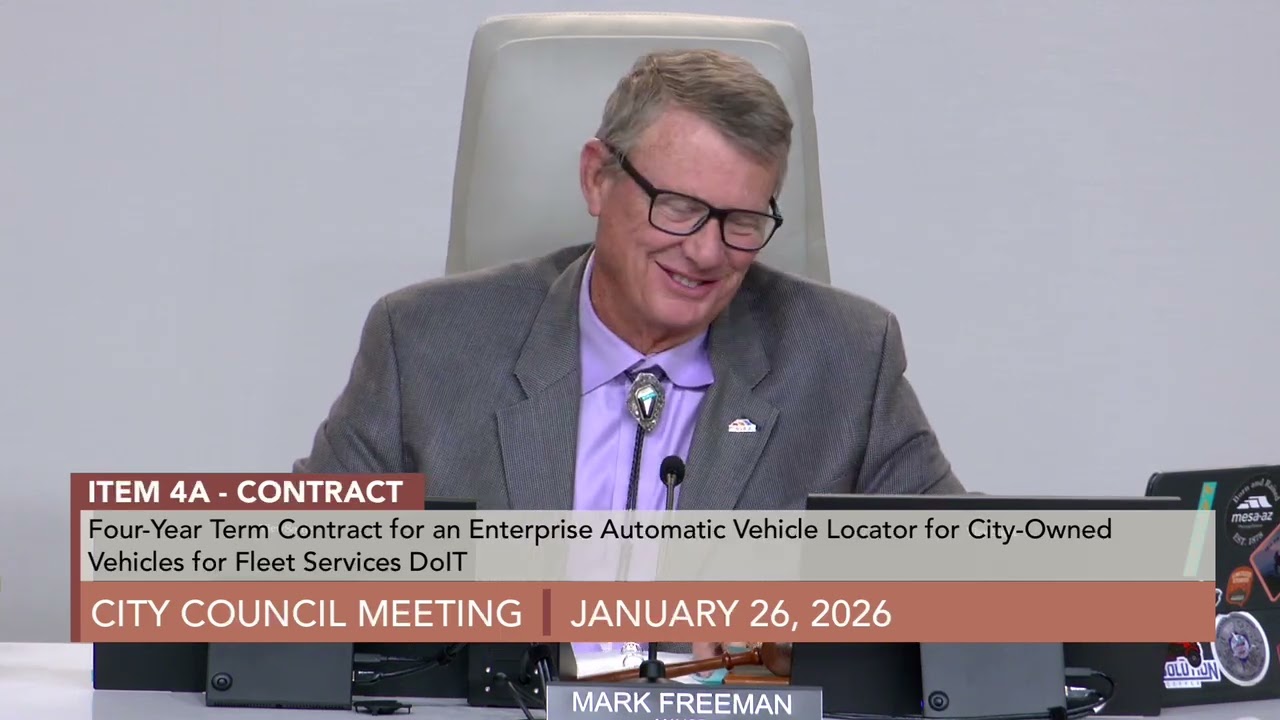
Item 4A — Enterprise Automatic Vehicle Telematic Solution Contract (approved unanimously): Public speaker Reggie Braun raised privacy concerns about telematics data collection on city fleet vehicles, warning that if the vendor goes bankrupt, sensitive driver-behavior data (eye-pupil tracking, fatigue detection, vehicle location) could be sold to third parties. He cited 23andMe genetic-data sales as a precedent. City CIO Scott Khan clarified that the contract covers automatic vehicle locators for city-owned fleet only, consolidating six separate AVL systems into one. The measure passed unanimously, but Khan offered to brief Braun separately on data-handling protocols.
Item 11A — Annual Comprehensive Financial Report (approved unanimously): Auditor Jean Dietrich of Clifton Larson Allen reported a clean, unmodified opinion with no material weaknesses or significant deficiencies found. City Manager Butler highlighted that Wallet Hub rated Mesa the best-run city in Arizona and ninth-best in the nation, deflecting Carrie Davis's critique that Mesa ranks 71st among 182 cities while Gilbert (29th) and Chandler (40th) generate surpluses. Davis also questioned why police and fire general-fund spending jumped from $101 million (2023) to $118 million (2024), but his time expired before receiving an answer. Staff noted the city has had no material weakness in over 10 years.
Item 12 — Citizens Present (three speakers): Jason Smithson proposed a formal partnership between Mesa City Council and Mesa Public Schools, pairing each council member with a high school for annual civic-engagement visits. Noah James Markham (from Tempe) criticized the delay in addressing light rail's impact on people with disabilities and called for bathroom renovations at Superstition Springs Mall. Bob Hathcock reflected on his year of civic engagement since attending a December 2024 council meeting on utility rates, noting a "subtle shift" in council culture—including the first no votes on budget and utility increases—and urged the council to be good stewards of the new $32 million council chambers.