Mesa acquires two downtown buildings for $4.73 million, approves 342-unit residential rezoning
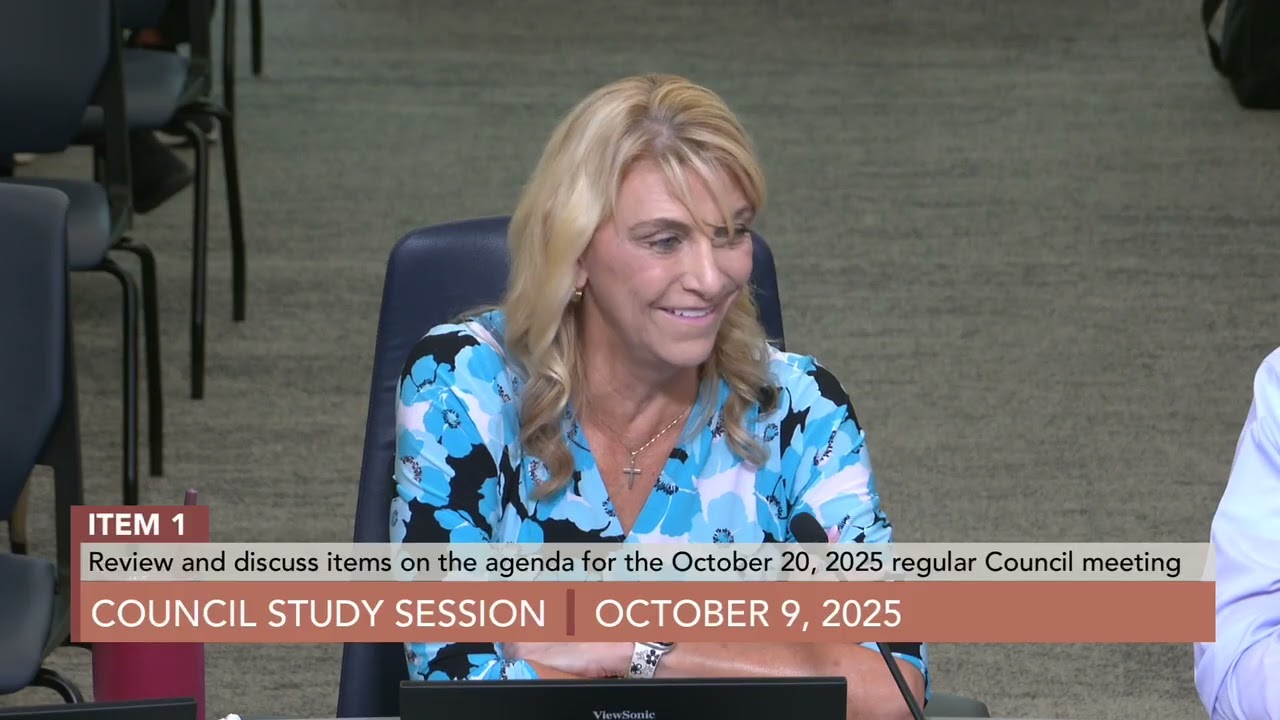
Mesa City Council study session featuring discussion of downtown property acquisition, Haw Crossing Village 5 rezoning approval, comprehensive citywide branding initiative, and new entryway monumentation plan, with consensus to move forward on major placemaking and identity efforts.
Mesa City Council Study Session Advances Major Downtown Acquisition, Haw Crossing Rezoning, and Unified Branding Initiative
Mayor John Giles convened the Mesa City Council study session on October 9, 2025, to review the October 20 council meeting agenda and present major initiatives spanning downtown real estate, residential development, citywide branding, and entryway monumentation. The session was marked by consensus direction on placemaking priorities but also revealed governance concerns over Planning and Zoning Board quorum and questions about alignment between branding and physical placemaking efforts.
MCCD Building Purchase and Downtown Revitalization
The council reviewed a proposal for the city to purchase two buildings from the Maricopa County Community College District (MCCD) located at 145 N Centennial and 165 N Centennial in downtown Mesa for $4.73 million. The purchase is a cornerstone of the city's long-term Arts and Innovation District strategy.
Project Details
- Applicant / Owner: Maricopa County Community College District (MCCD)
- Locations: 145 N Centennial (33,000 sq ft, appraised at $4.8 million); 165 N Centennial (2-story structure with $2.7 million in deferred maintenance, appraised at $650,000)
- Total Purchase Price: $4.73 million
- Funding Source: Prior land sales (127 West Pepper and 5950 East Adobe) plus interest reserves; per Sam Schultz, assistant director for Home & Buildings, "The budget for this came from prior land sales. So, we set aside some of the sale from 127 West Pepper as well as 5950 East Adobe. And then the additional funding came from interest on investments that we reserved to then fund the rest of this in general capital."
Intended Use and Strategic Context
The 145 N Centennial building, located atop the city-owned parking garage, will be renovated to house city staff currently occupying deteriorating facilities, including the 55 North Center building (55 N Center), which is slated for a long-term redevelopment partnership with Arizona State University. The 165 N Centennial building, which currently houses the Veterans Coalition (through end of November 2025), will be demolished and the land reserved for future redevelopment as part of a broader downtown connector strategy.
Mark Freeman emphasized the strategic importance of the acquisition to the Arts and Innovation District vision:
"The location of this adjacent to Culdeac, adjacent to the Delta and the convention center and the library, uh it's it's just a key uh site for us to be able to help control redevelopment on the area for the one for the site that we would demolish and then um look for future opportunities for redevelopment."
Jen Duff elaborated on the broader district vision, linking the property to a "Light Walk" (also called the Lewis pathway) that would connect the convention center, amphitheater, and Delta Hotel:
"when we think about our future development and um transformation. Um, we're looking at, you know, definitely from Main Street, if not further, tying in the Mesa Arts Center between Center and Centennial, which this is the street that about to this property all the way to University that being our arts and innovation district where we're bringing in ASU, we want to have some uh economic development opportunities, going more vertical, getting a garage, convention center, amphitheater, all tying in having a pedestrian pathway along the Lewis pathway."
Veteran Coalition Relocation Support
Council Member Adams raised concerns about the Veterans Coalition, which currently occupies 165 N Centennial and operates a small memorial garden. Staff confirmed that the city is assisting the organization with relocation, providing an extended deadline (end of November 2025) and connecting them with potential alternative properties and resources. Council Member Adams stated:
"Um, I'm I'm a little bit familiar with their struggle to find a new home. Have they been able to locate a place to go?"
City staff confirmed that Jeff McVey's team was actively working with the Veterans Coalition to identify alternatives.
Timeline and Conditions
If council approves the purchase on October 20, the city will enter escrow on October 21, conduct 90 days of environmental testing and ALTA surveys, and close escrow in January or February 2026. Council Member Adams also requested clarification on the land value of the 165 N Centennial parcel (just over half an acre, appraised as part of the $650,000 total valuation) and suggested exploring the reuse of recently replaced AC units from the building.
Outcome: Recommended for approval October 20; purchase is part of long-term master planning for city facility consolidation and downtown activation.
Haw Crossing Village 5 Rezoning and Development Approval
The Planning and Zoning Board recommended approval (4-0) of an 18-acre rezoning swap and residential development plan for Haw Crossing Village 5, located at the northeast corner of Warner Road and Haw Road. The project is being developed by Lennar Homes and includes 342 single-family residential units across three product types.
Project Details
- Case Number: Z2400892
- Developer: Lennar Homes
- Location: Northeast corner of Warner Road and Haw Road (Village 5 of the larger Haw Crossing master-planned community)
- Total Acreage: 18 acres
- Rezoning Request: Swap of general commercial (GC) and Residential Suburban Low (RSL 2.5) zoning; applicant moving GC from freeway-adjacent location (SR-24) to corner of Warner and Haw Road for enhanced viability; RSL 2.5 moving to west side of site
- Residential Units: 342 total
- 216 attached single-residence units (north of planned commercial area)
- 126 detached "cassita" units
- Open Space: 8+ acres of common open space (~19% of site)
- Parking: 684 spaces in garages (2 per unit); 684 on driveways (18 ft full-width); 26 guest parking spaces; 72 on-street spaces; total 1,466 spaces
- General Plan Amendment: Required; shift from "urban center" designation to "urban residential"
- Council Use Permit: Requested for density variance related to attached units in GC zoning
PNZ Board Recommendations and Modifications
The Planning and Zoning Board voted 4-0 (with only 4 of 7 members present, raising governance concerns) to recommend approval with conditions. Key modifications required before coming to council:
- Relocation of Merit Street: Move the easternmost street away from SR-24 to reduce direct adjacency of residential units to the freeway
- Landscape Buffer: Five-foot landscaping buffer plus an eight-foot theme wall along the east property line
- Lot Reconfigurations: Applicant reconfigured lots north of Merit Street to create additional separation and open space between residential and freeway
Staff presented before-and-after site plans showing how the applicant addressed these concerns, moving previously freeway-adjacent lots to more interior locations and creating buffer space.
Applicant Changes and Alternative Compliance
Lennar Homes made significant design modifications to the master site plan after the PNZ board meeting to address board concerns. Key design features include:
- Building Elevation Compliance: Spanish-style elevations (primarily stucco) with alternative compliance allowing ornamental details (ironwork, additional architectural elements) in lieu of material diversity
- Window Reductions: Slight reduction in corner lot window requirements (from 10% to lower percentage) due to Spanish design language
- Street Configuration: Alley-loaded streets and mix of detached and attached products to meet Haw Crossing PAD requirements (Ordinance 5567)
- Second PAD Overlay: Project includes deviations to garage dimensions, wall heights, lot widths, lot depth, and lot coverage specific to residential development in GC zoning
Staff Recommendation and Public Engagement
Staff recommended approval with conditions. The applicant conducted a citizen participation meeting; no residents attended. No members of the public have contacted the city with concerns. Two public hearings were held as part of the general plan amendment process (Dobson Ranch Library and former council chambers).
Council Discussion and Governance Concerns
Council Member Adams expressed concern about the PNZ board quorum:
"I noticed that uh you have a 50 PNZ recommendation. I would just make the observation I have before that it would be better, I think, if the uh staff and the other PNZ board members had the benefit of all seven members input. I know that's outside of your control, but and I will continue to comment on that. We have a seven member PNZ board. It would be nice to uh to see all seven members engaged. We've seen quite a few 4050 votes and that troubles me."
Council Member Summers, who initially expressed reservations about residential development without transit, reviewed page 5 of the submittal documents and found merit in the parking and site design approach:
"This is probably the best um discussion on page five of the submittal documents... this is the best description of why lesser depth is okay here... In addition, I'm going to be looking at this more, but because of that parking space, the pads that you do have a driveway you can park on, it's important... I'm reserving my judgment, but I might be all right with this."
Francisco Heredia inquired about the commercial/residential percentages required by the original Haw Crossing approval, concerned that the project not erode the mixed-use commitment. Staff confirmed those percentages are being tracked and that relocating the commercial (rather than eliminating it) maintains the required mix.
Outcome: PNZ board recommended approval 4-0 with modifications; council action scheduled for November 3, 2025, in conjunction with general plan amendment. Staff is preparing updated presentations reflecting post-PNZ design changes.
Citywide Branding and Identity Initiative
Communications Director Anna Pareda and Economic Development Director Jay O'Donnell presented a comprehensive branding initiative aimed at creating unified visual and narrative identity across Mesa. The city currently has 40+ departmental and initiative logos without consistent design language, and the effort seeks to establish a cohesive brand framework while preserving the existing Mesa logo.
Current State and Problem Definition
Pareda noted:
"Despite Mesa's unprecedented growth and transformation into a thriving urban hub of education, innovation, and arts, we are still facing tired old negative stereotypes that don't really reflect who we are today or our trajectory. We currently lack a cohesive, consistent, easily recognizable, and modern brand identity."
The city's internal logo audit identified 40+ distinct logos. Examples of inconsistency include the Launchpoint Mesa logo, Mesa Business Builder, Falcon District, Asian District, and Together Mesa—each with different design treatments and color palettes. While some (such as Asian District) incorporate Mesa's three-color palette, many do not.
O'Donnell emphasized the nuance of branding at different scales:
"There can be very complex processes and there can also be very simple processes. So when we were building Launchpoint more than a decade ago, it was a program that we were just getting off the ground and it was a pretty simple process that we used to develop that we talked to uh some of the users, we talked with a council member and from the district and we also talked about internally what we wanted to accomplish."
Proposed Phased Approach
The initiative proposes a six-month, three-phase process:
Phase 1: Discovery (3 months)
- Internal logo and identity audit (completed; identified 40+ logos)
- Stakeholder surveys, focus groups, and interviews (internal and external)
- Identification of current pain points and brand strengths
- Development of visual and narrative codes
Phase 2: Brand Identity Development
- Define brand pillars (values and attributes)
- Create brand wheel and audience matrix
- Develop brand strategy and messaging framework
- Determine how departments and initiatives reflect core brand identity
Phase 3: Testing, Refinement, and Implementation
- Test brand identity with council, stakeholder groups, employees, and residents
- Refine narratives and visual codes
- Create brand guidelines (visual and narrative)
- Internal staff training
- Ongoing monitoring for compliance
Key Deliverables
Pareda outlined the anticipated outputs:
"At the end of this process what um how does this look like? Um we will have a clear brand strategy, messaging framework, refresh visual identity uh system, colors, fonts, imagery while keeping the current logo to preserve um recognition. Uh practical communication tools, taglines, key messages, templates, marketing toolkit, and that's those guides with those standards that I mentioned."
Importantly, the existing Mesa logo will not change. The effort focuses on creating visual and narrative consistency across all city departments, districts, and initiatives. Pareda emphasized:
"We will not be overhauling our brand um or redesigning our logo. We already have a good logo, but it's how are we going to build from here to strengthen what we currently have."
External Facilitator and Budget
Staff recommends retaining an external facilitator for the discovery phase to ensure candid stakeholder feedback. O'Donnell noted:
"if we're there in the room, people are likely not going to really share their actual opinions. They might try to be nice and we want to hear the truth, right?"
No specific budget was presented; the initiative will primarily be staffed internally with external facilitation for discovery.
Council Discussion and Direction
Council Member Spillsberry expressed concern that the initiative was more extensive than necessary, given existing work like the Mesa Business Builder (which incorporates the three-color palette and Mesa plateau imagery):
"I don't think we need that much work. I just really don't. I mean, do you want me to be the moderator? We could save a lot of money. I'll do it for free."
However, she acknowledged the value of the process and noted that existing initiatives like the Asian District already embody the consistency being sought.
Mark Freeman emphasized the strategic importance of brand strategy over logos:
"I do think that um I I do think that it's always a good thing to do a refresh. Um maybe every 10 years is a good idea to look at it and say, are we keeping up with changes?... I think brand strategy frankly is the most important thing because that is what we say... I think more important what are we saying [is] that's going to define whether we've been successful or not is you know that we all have a cohesive message that we take out to the community."
Council Member Goforth stressed the importance of council's role in defining Mesa's values and identity:
"I went through this exact exercise with my community. We were kind of obviously a smaller scale, but... when you define your values and your identity. And we've talked about the lack of identity in Mesa, which is almost an identity of itself, I think, is really what it was, right? is that everybody is who they want to be and we don't really define who we are but I think it is important to go through that and define it."
Council Member Adams raised the risk of rebranding failure but deferred judgment pending discovery:
"I am not going to prejudge the effort until I see what you present. I'm I'm anxious to see, but I would... We've seen recent examples on a national level of how all kinds of research was done and how outside firms were hired and focus groups were had and we roll out a brand and all of a sudden boom and then within a week it has to be withdrawn."
O'Donnell cited Glendale's "Glendale's Got Game" campaign (early 2000s) as a successful example of a citywide messaging initiative that transcended logos and created regional perception change.
Outcome: Council provided direction to proceed with phased branding initiative; external facilitator recommended for discovery phase; 6-month timeline proposed; next update to council after discovery phase completion (~3 months).
Entryway Monumentation Plan
Long Range Planning presented a comprehensive plan to create cohesive gateway and entryway signage throughout Mesa as a placemaking initiative. The proposal establishes a sign family hierarchy and identifies Phase 1 locations for six gateway monuments (one per council district) at major freeway entrances.
Project Scope and Sign Family Hierarchy
Staff proposed a four-tier sign hierarchy:
- Gateway Monuments: Bold, iconic entryway monuments at major freeway exits (highest visibility, largest scale)
- Entryway Monuments: Welcoming markers at key access points (slightly smaller, secondary visibility)
- District Monuments: Identification of economic hubs, cultural areas, and special destinations (mid-scale)
- Community Monuments: Neighborhood-scale identity markers in parks, civic spaces, and neighborhood centers (smallest scale)
The plan emphasizes consistency in design language across all typologies without requiring identical physical treatment. Staff noted that Chandler and Queen Creek have evolved more sophisticated monumentation programs; Gilbert relies on private development (corner treatments) with inconsistent design language.
Phase 1 Proposed Locations (Pending Refinement)
Staff proposed six gateway monuments, one per council district, based on traffic volume, visibility, sightline geometry, right-of-way availability, proximity to major destinations, and commercial signage context:
- District 1: Country Club / Loop 202 (median, vertical orientation)
- District 3: McKellips / Loop 202 (east side of roadway, horizontal orientation)
- District 4: Gilbert / US-60 (north access, right-of-way)
- District 5: Power / Salt River (right side, south access)
- District 6: Ellsworth / SR-24 (median location south of exit)
- Unspecified: One additional location TBD
Council members raised alternative sites for consideration:
- Francisco Heredia suggested reviewing Dobson and Loop 202 as Riverview develops, and the Salt River / 101 area as Sloan Park access point
- Jen Duff recommended considering Ellsworth over Power (higher traffic volume) and noted the 101/Rio Salado corner redevelopment opportunity
- Council Member Goforth expressed skepticism about Country Club / 202, suggesting data support traffic volume claims
Design Standards and Maintenance
Key design principles include:
- Timeless Design: Avoid branding elements that may require updates if logo or colors change; use modular components (removable logo/branding elements)
- Durable Materials: Easy-to-source components for long-term maintenance by city staff (avoiding vendor-dependent systems)
- Legibility: Text size and contrast calibrated for roadway speed; uncluttered presentation
- Landscaping: District-specific landscaping reflecting local character (native desert in uplands; high-foliage elsewhere)
- Lighting and Power: Local utilities for self-maintenance; dedicated power supplies; easily sourced bulbs and components
Staff consulted with city street light maintenance personnel to ensure maintenance feasibility.
Operations, Maintenance, and Partnerships
Staff proposes establishing:
- Clear departmental responsibility matrix for maintenance and inspection
- Dedicated ongoing maintenance funding plus contingency reserves for vandalism/vehicle strikes
- Detailed shop drawings for component replacement
- Standardized components across sign family to streamline procurement
- Partnership opportunities (P3s) to offset design and construction costs
- Coordination with CIP projects touching relevant corridors
Conceptual Design Examples
Three concept image variations were presented (illustrative only, not final designs):
- Country Club / 202: Vertical monument in median, neutral palette, no specific logo
- McKellips / 202: Horizontal monument, on south side, neutral materials
- Power / Salt River: Horizontal with removable component top (for future logo/branding updates), landscaped base
Council Discussion and Direction
Council Member Adams (District 1) endorsed the concept but suggested data-driven approach:
"I assumed when I saw traffic volume here... you've looked at the traffic volume on these various arterials. Um, the missing P and I like datadriven decisions... we don't know... of the traffic volume. How many of those are people who live in Mesa and how many of those are people who don't live in Mesa? We have no way of knowing that. So without that knowledge, I don't know what else we would use other than traffic volume."
Adams also referenced former Mayor Wayne Brown's frustration with the wastewater treatment plant being the first entry point into Mesa from the west.
Council Member Spillsberry expressed preference for consistency in design language across all monuments, noting that while scale and orientation may vary, the "font," color palette (three Mesa), and overall aesthetic should tie together. She suggested retaining the three-color palette even on modular components:
"like where it could be taken off if we end up taking that brand away someday but um it's it could show up on the other signs."
Council Member Goforth raised a critical sequencing concern: the monumentation plan should await completion of the citywide branding initiative to ensure design cohesion. Staff acknowledged that the concept images were illustrative and reiterated that final designs would be completed after branding pillars and visual codes are established.
Council Member Summers noted that two district sites (Country Club/202 in District 1 and McKellips/202 in District 3) are in close proximity and questioned whether to prioritize traffic volume or geographic distribution across the city.
Francisco Heredia praised the potential for local architect competitions and local fabricator participation (noting District 1 has steel manufacturers) and suggested exploring solar integration for monument lighting as future-proofing.
Outcome: Council provided consensus direction to proceed with entryway monumentation plan; approved Phase 1 six-location concept subject to site refinement based on traffic data and council input; authorized staff to conduct site feasibility studies and cost estimates; coordination with PIO office (branding) emphasized to ensure consistency.
Key Speeches
"the location of this adjacent to Culdeac, adjacent to the Delta and the convention center and the library, uh it's it's just a key uh site for us to be able to help control redevelopment on the area." — Jen Duff, City Council
"We currently lack a cohesive, consistent, easily recognizable, and modern brand identity." — Anna Pareda, Communications Director
"We will not be overhauling our brand um or redesigning our logo. We already have a good logo, but it's how are we going to build from here to strengthen what we currently have." — Anna Pareda, Communications Director
"I do think that it's always a good thing to do a refresh. Um maybe every 10 years is a good idea to look at it and say, are we keeping up with changes?... brand strategy frankly is the most important thing." — Mark Freeman
"I noticed that uh you have a 50 PNZ recommendation. I would just make the observation I have before that it would be better, I think, if the uh staff and the other PNZ board members had the benefit of all seven members input... We have a seven member PNZ board. It would be nice to uh to see all seven members engaged. We've seen quite a few 4050 votes and that troubles me." — Council Member Adams
Timeline
MCCD Building Purchase
- Study session presentation: October 9
- Council vote: October 20
- Escrow entry: October 21 (if approved)
- Environmental testing and ALTA surveys: 90 days
- Closing: January or February 2026
Haw Crossing Village 5
- PNZ board vote: Pre-October 9 (4-0 approval with conditions)
- Applicant modifications: Between PNZ vote and October 9 (Merit Street relocation, landscaping buffer)
- Council action: November 3, 2025 (with general plan amendment)
Citywide Branding Initiative
- Discovery phase (stakeholder engagement, brand wheel development): ~3 months
- Brand identity development and testing: ~3 months
- Total timeline: 6 months
- Next council update: After discovery phase
Entryway Monumentation Plan
- Phase 1 site feasibility studies: Underway
- Cost estimates: In progress
- Site refinement and council input: Ongoing
- Coordination with CIP and branding completion: Future integration
Vote Breakdown
Haw Crossing Village 5 PNZ Board Recommendation (only notable roll call in transcript):
- Final: 4-0 (recommended approval with conditions)
- Board Members Present: 4 of 7
- Notable Concern: Council Member Adams noted that only four of seven board members were present, raising governance concerns about quorum consistency across recent 4-0 PNZ votes
MCCD Building Purchase, Haw Crossing Village 5 (Council Action), Branding Initiative, Monumentation Plan: Individual votes not taken during study session; all items presented for October 20 (MCCD) and November 3 (Haw Crossing) council meetings or for phased implementation.
Controversies & Context
Planning and Zoning Board Quorum Concerns
Council Member Adams repeatedly noted that the PNZ board voted 4-0 on Haw Crossing Village 5 with only four of seven members present. Adams flagged this as a recurring pattern:
"I have before that it would be better, I think, if the uh staff and the other PNZ board members had the benefit of all seven members input... We have a seven member PNZ board. It would be nice to uh to see all seven members engaged. We've seen quite a few 4050 votes and that troubles me."
Staff did not address the cause of absences or mitigation strategy during the session.
Timing and Documentation Upload Issues
Council Member Spillsberry noted that Haw Crossing Village 5 backup materials (including updated site plan reflecting PNZ modifications) were uploaded to council only on the morning of the study session, just as the presentation began. This prevented advance review of the material in its final, post-PNZ form. Spillsberry stated:
"I don't really have any questions on it. on item 6A, the HA village 5. It's just I have not been able to see any downloaded documentation for that... I thought, you know, maybe it was just late being uploaded, but I'm still don't have it."
Staff acknowledged the challenge of early study sessions and committed to improved advance distribution.
Branding Initiative Scope and Cost
Council Member Spillsberry questioned whether the branding initiative was oversized relative to the actual need for unification. She noted that existing initiatives like Mesa Business Builder already demonstrate the desired consistency and suggested that a simpler approach might suffice. However, she ultimately acknowledged the value of strategic definition (pillars) and supported moving forward.
Monumentation Plan Sequencing
Council Member Goforth raised a critical concern about sequencing: finalizing monument designs before completing the branding initiative creates risk of misalignment. Staff acknowledged this and emphasized that the conceptual designs presented are illustrative only and that final designs will reflect the completed branding strategy.
Downtown Redevelopment and Veteran Coalition Displacement
The purchase of 165 N Centennial necessitates relocation of the Veterans Coalition by end of November 2025. While city staff is assisting with the transition, the speed of displacement and availability of suitable alternative properties remain uncertain. Council expressed appreciation for the extended timeline but acknowledged the challenge for the organization.
Duration
- MCCD Building Purchase discussion: ~30 minutes
- Haw Crossing Village 5 presentation and discussion: ~45 minutes
- Citywide Branding presentation and discussion: ~50 minutes
- Entryway Monumentation presentation and discussion: ~40 minutes
- Current Events and Adjourn: ~10 minutes
- Total meeting duration: Approximately 3 hours 15 minutes
Other Notable Items
Veteran Coalition Relocation Assistance: City providing extended deadline (end of November) and staff support to identify alternative properties for the Veterans Coalition, which currently occupies 165 N Centennial and operates a small memorial garden. Council Member Adams expressed appreciation for the proactive assistance.
Celebrate Mesa Event: City monitoring weather for the upcoming Celebrate Mesa outdoor event; decision on cancellation or rescheduling expected within coming days pending storm development. City committed to early notification via social media and city channels.