Mesa advances data center zoning amendments, approves upscale restaurant recruitment at Medina Station
Mesa City Council approved police chief swearing-in, data center zoning amendments for future development, retail development incentives for Medina Station, and library funding while receiving public testimony on immigration enforcement concerns.
Mesa Council Approves Data Center Ordinance for Introduction Amid Industry Requests for Further Refinement; Medina Station Restaurant Development Advances
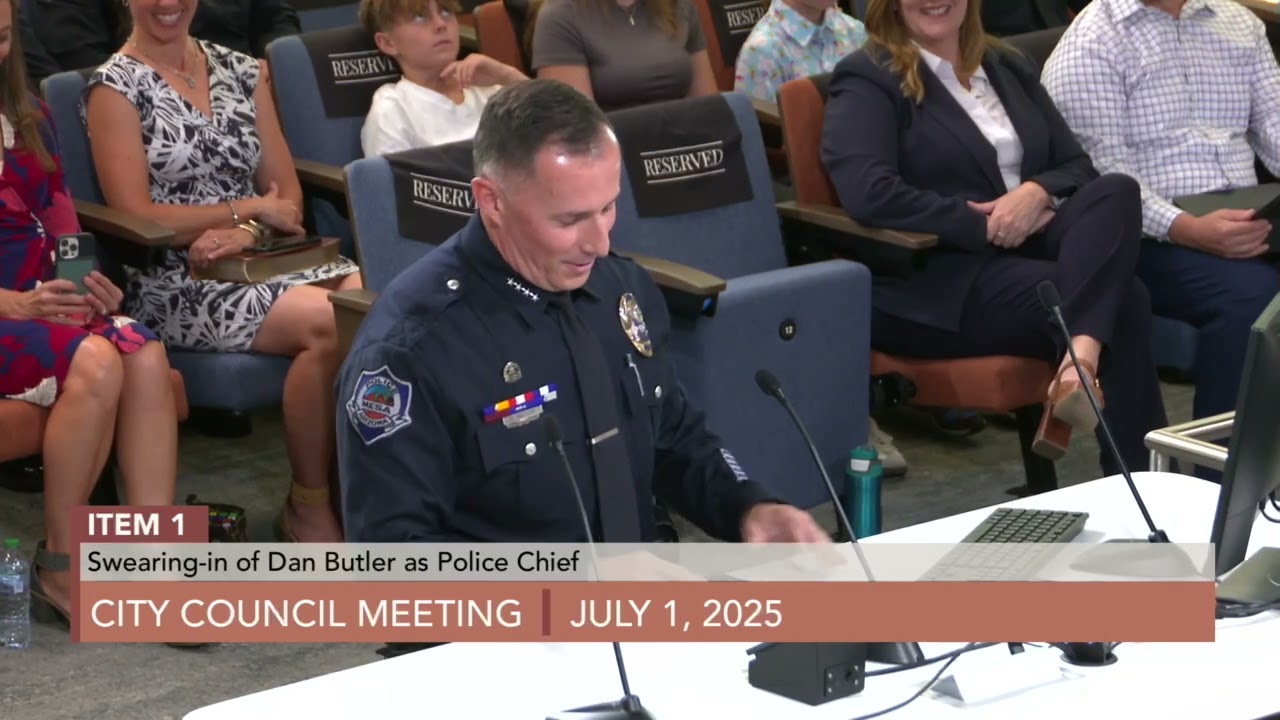
Mesa City Council advanced a major zoning initiative on data center regulation and approved a curated restaurant development agreement on July 2, 2025, while also fielding urgent community testimony on immigration enforcement. The meeting drew an overflow crowd, including celebration of newly sworn Police Chief Dan Butler and discussion of how much concentrated data center development is compatible with economic diversification.
The council approved introduction of two data center zoning ordinances (Items 8A and 8B) on a unanimous vote with Councilmember Francisco Heredia absent, scheduling a final vote for July 8th. The amendments establish the first comprehensive regulatory framework for Mesa's data center sector, which now accounts for 15 of Arizona's 60 operating or planned facilities—25% of the state's total. However, industry representatives made clear that additional refinement is needed before final approval, citing overly restrictive location rules, a low IT function threshold that could inadvertently classify advanced manufacturers as data centers, and mechanical equipment placement standards that contradict other protective measures in the code.
Key Speeches
"I think we're on the 10 yard line. We're not in the end zone yet. I'm requesting a little more time to resolve a couple of issues...specifically in section two of the proposed ordinance is overly restrictive saying that it's only in GI and HI. [I] continue to request continued use allowed in the light industrial subject to all of these new regulations...In 8.1 the definition that any development that has over 10% of an IT function is a data center. That's a really low number and I think you're really going to preclude advanced manufacturing." — Tom Maples, Arizona Chapter 7x24 Exchange, representing 60 member data center firms
"We're not quite at the part where we can say we support of course but...putting opposed would actually not acknowledge the amazing work with your staff, your city attorney's office, with the vice mayor that we've been pushing forward to really perfect this ordinance...The most recent change that I want to highlight was that it is now clarified that a conditional use permit, a council use permit or similar item will not undo or negate your waiver." — Reese Anderson, representing NOVA Holdings LLC, approving site for data center at northwest corner of Warner and Ellsworth
"When I think of Mesa, you know, I think of economic ingenuity, economic innovation, a welcoming business climate...Uh, the data center coalition had made the comment a week or two ago that you know there are 60 data centers currently in the state of Arizona. We have 15 in Mesa existing or coming online. So we already have a very large amount of density of data centers and I think it's safe to say that there are other communities who could and would be welcoming to data centers as well." — Jonnell O'Donnell, Mesa Economic Development Director, on balancing data center growth with land preservation for advanced manufacturing and other innovation sectors
Timeline
Data Center Zoning (Items 8A & 8B)
- Applicant/Industry presentation: Tom Maples (7x24 Exchange representing 60 member firms), Ben Graph (NOVA Holdings LLC via Corals & Brady), and Sepand Alazada (Arizona Technology Council) each presented concerns about the proposed ordinance. All three requested additional time to refine specific provisions before final adoption.
- Staff recommendation: Cappski Brown (City of Mesa planning/development services) defended the ordinance framework, explaining location restrictions, the 10% IT function definition, residential setbacks, screening, and mechanical equipment provisions. City staff and attorney's office have conducted extensive one-on-one meetings with industry stakeholders over four weeks to refine language.
- Public comment: Three speakers, all requesting either more time or continued dialogue. No opposition from the public; all discussion centered on technical refinement of the regulations.
- Council discussion: Councilmember Mark Freeman raised the foundational question: "How much of a good thing is enough?" He asked when data center development reaches saturation and whether Mesa risks losing land and jobs to other uses. Jonnell O'Donnell answered that Mesa seeks balance and diversification; while data centers provide significant tax revenue and construction jobs, they deliver fewer jobs per acre than advanced manufacturing. Council noted that Phoenix allows 150-foot residential setbacks versus Mesa's proposed 400 feet. Mayor John Giles stated Mesa has now "put guard rails about future development sites" after attracting one-quarter of Arizona's data centers and pledged continued "concier service for the attorneys" to expedite the final ordinance.
- Vote: Unanimous approval for introduction with Francisco Heredia absent (6-0). Final ordinance vote scheduled July 8, 2025.
Medina Station Development Agreement (Items 10A & 10B)
- Applicant presentation: Reese Anderson (attorney, 1744 South Val Vista) and Josh Simon (Simon CRA, the developer) presented the mixed-use project. Kelly Whitmore, deputy city attorney, clarified the restaurant qualification criteria embedded in the development agreement.
- Staff recommendation: City attorney and planning staff endorsed the development agreement as meeting city objectives for high-quality retail and experiential dining.
- Public comment: No speakers opposed or in favor. Councilmember Jen Duff raised a clarification question about whether certain national chains listed on the website (Hawaiian Brothers, Cafe Zupas, Einstein Brothers) qualified as "upscale" or "mid-scale service restaurants" eligible for tax incentive reimbursement.
- Council discussion: Councilmember Goforth (District 5) gave an extended remarks supporting the development, explaining that attracting quality restaurants with incentives is essential to Mesa's retail and dining competitiveness. Residents currently leave Mesa to dine in surrounding cities, depleting sales tax revenue and making Mesa less attractive to talent and high-wage employers. Goforth stated that incentives are a temporary tool to build market confidence; once Mesa proves itself, incentive programs can be phased out. Duff's question was answered by Whitmore and Anderson: the development agreement restricts eligibility to restaurants with fewer than 100 national locations, mid-to-high quality only, and no locations within 10 miles of Mesa (except Mesa Gateway Airport). Other national retailers listed on the website—Einstein Brothers, Cafe Zupas, Hawaiian Brothers, Zara Nails, Boot Barn, Good Vets, Dick Sporting Goods—are part of the mixed-use project but are not eligible for the retail sales tax reimbursement portion. Only the designated "Restaurant Row" or "Gallery Alley" restaurants meeting the curated criteria receive incentives. All tenants are eligible for construction sales tax reimbursement.
- Vote: Two separate motions. Item 10A (statutory findings for tax incentive agreements): unanimous approval with Francisco Heredia absent (6-0). Item 10B (development agreement): unanimous approval with Francisco Heredia absent (6-0).
Opposition
Data Center Zoning Amendment Opposition: No members of the public testified against the data center ordinance. However, industry representatives requested additional time and refinement:
- Location restriction overly narrow: Limiting data centers to GI (General Industrial) and AI (Automotive Industrial) districts with only a Light Industrial waiver option prevents development on existing industrial land and forecloses economic opportunity.
- 10% IT function threshold too low: A threshold triggering data center classification at 10% of gross square footage on a site will inadvertently classify advanced manufacturing facilities (which may have IT components) as data centers, precluding mixed-use advanced manufacturing complexes.
- 400-foot residential setback excessive: While Phoenix requires only 150 feet, Mesa's 400-foot setback is impractical; Maples suggested "something more than the code minimum but less than 400 feet seems reasonable."
- Mechanical equipment placement contradicts screening requirements: Section F.8B restricts MEP (mechanical, electrical, plumbing) placement "next to residential" while other sections require screening for substations. The language creates ambiguity and fails to apply the detailed screening standards worked out for substations to the MEP, which "is actually probably more important."
- Removal of council's PAD amendment authority: The ordinance removes council discretion to amend Planned Area Development standards, limiting flexibility for case-by-case compatibility with neighborhoods.
- Lack of clarification on minor site plan amendments: Industry sought codification that minor amendments to approved data center site plans would follow prior (not new) development standards, though staff indicated comfort with this through normal process.
Most compelling argument: Sepand Alazada and Tom Maples emphasized that data center development and advanced manufacturing are linked: "If you want an economy based in AI, you have to have data centers to process all this information." Restricting future data center locations and imposing aggressive setbacks may displace a complementary industry Mesa is actively marketing.
Organized groups: 7x24 Exchange (Arizona chapter), IMASONS, AFCOM, Arizona Technology Council all submitted concerns.
Support
Data Center Ordinance Support:
- Sepand Alazada praised Mesa's economic innovation strategy and noted that data centers deliver "thousands of construction jobs, hundreds of facility jobs, and millions in tax revenues" funding public safety, parks, and roads.
- John Giles and Mark Freeman acknowledged data centers' economic benefit and the work staff has undertaken to refine the rules. John Giles stated: "we have done a great job in attracting data centers and we're just putting some guard rails about future development sites for them."
- Jonnell O'Donnell affirmed economic development's commitment to balance, noting that Mesa's 15 data centers represent a large concentration and that other Arizona communities are also welcoming data center projects.
Medina Station Support:
- Councilmember Goforth delivered extensive remarks supporting the development as a catalyst for Mesa's retail and dining competitiveness. She emphasized that attracting curated, experiential dining venues is essential to retaining spending and attracting talent.
- No public speakers opposed the development.
Project Details
Data Center Zoning Amendments:
- Case numbers: Items 8A and 8B (no zoning case numbers provided in transcript)
- Applicant/Representatives: 7x24 Exchange (Tom Maples), NOVA Holdings LLC (Ben Graph, Corals & Brady), Arizona Technology Council (Sepand Alazada); City of Mesa (Cappski Brown, Development Services; Kelly Whitmore, Deputy City Attorney; Assistant Attorney Steedman)
- Location: Citywide; applies to all future data center development in General Industrial (GI), Automotive Industrial (AI), and Light Industrial (LI with waiver) zoning districts
- Current zoning → Proposed: Existing industrial zones; data center use definition and performance standards added
- Key provisions introduced:
- Data center defined as facility with 10% or greater of gross square footage dedicated to IT functions (revised from "part of building" to "gross square footage of buildings on site" per staff)
- Location restricted to GI and AI districts; LI district properties may apply for waiver (must apply within three years; waiver perpetual unless property rezoned)
- Residential setback: 400 feet with acoustic, facade, and height screening requirements
- Mechanical equipment placement restricted; screening standards to apply
- PAD deviations cannot be modified through PAD to preserve minimum standards
- Minor site plan amendments follow existing code; major amendments follow new data center standards
Medina Station Development (Items 10A & 10B):
- Case numbers: Not provided in transcript
- Applicant/Developer: Simon CRA; Josh Simon (principal); Reese Anderson (attorney)
- Attorney: Reese Anderson (1744 South Val Vista); Kelly Whitmore (Deputy City Attorney, City of Mesa)
- Location: Not specified in transcript (referred to as Medina Station)
- Project name: Medina Station; mixed-use retail and restaurant development known as "Restaurant Row" or "Gallery Alley"
- Development type: Mixed-use retail, restaurants, and national brand tenants
- Incentive structure:
- Retail sales tax reimbursement: Eligible only for restaurants meeting strict criteria: fewer than 100 national locations, mid-to-high quality only, no locations within 10 miles of Mesa (exception: Mesa Gateway Airport)
- Construction sales tax reimbursement: Available to all tenants meeting conditions precedent
- Named eligible retailers (non-incentive): Boot Barn, Cafe Zupas, Dick Sporting Goods, Einstein Brothers, Good Vets, Hawaiian Brothers, US Bank, Zara Nails
- Restaurant Row/Gallery Alley: Subject of primary retail sales tax incentive; specific restaurant tenants not named in transcript
- Funding/Incentive amount: Not stated in transcript
- Changes from prior version: Not applicable (first presentation at council; approved at planning commission prior)
Vote Breakdown
Items 8A and 8B (Data Center Zoning Introduction):
- Final: 6-0 (unanimous with Francisco Heredia absent)
- Yes: Goforth (Zoom), Jeremy Whittaker, Kevin Thompson, Jen Duff, Mark Freeman, David Luna
- No: None
- Abstentions/Absences: Francisco Heredia excused
Item 10A (Medina Station Statutory Findings for Tax Incentive Agreements):
- Final: 6-0 (unanimous with Francisco Heredia absent)
- Yes: Adams, Spillsberry (second), Goforth (Zoom)
- Individual votes not fully named in transcript
- Abstentions/Absences: Francisco Heredia excused
Item 10B (Medina Station Development Agreement):
- Final: 6-0 (unanimous with Francisco Heredia absent)
- Yes: Spillsberry (moved), Summers (second), Goforth (Zoom)
- Individual votes not fully named in transcript
- Abstentions/Absences: Francisco Heredia excused
Item 5 (Library Materials Funding - $700,000 increase):
- Final: 6-0 (unanimous with Francisco Heredia absent)
- Yes: Spillsberry (moved), Summers (second), Goforth (Zoom)
- Individual votes not fully named in transcript
- Abstentions/Absences: Francisco Heredia excused
Consent Agenda (Items 3, 4A, 4B, 5A-5G, 5I-5J, 6A-6C, 7A-7G, 9A-9F):
- Final: 6-0 (unanimous with Francisco Heredia absent)
- Yes: Spillsberry (moved), Jen Duff (second), Goforth (Zoom), and others
- Individual votes not fully named in transcript
- Abstentions/Absences: Francisco Heredia excused
Outcome & Next Steps
Data Center Zoning: Introduction approved unanimously for Items 8A and 8B. Final vote scheduled for July 8, 2025. John Giles and staff indicated willingness to make further refinements between now and final adoption based on industry feedback, positioning the ordinance as a "living document" subject to future tweaks if needed. Industry stakeholders (7x24 Exchange, NOVA Holdings, Arizona Technology Council) invited to continue dialogue with city staff and attorney's office to address concerns about location restrictions, IT function threshold, setback distances, and mechanical equipment placement before final vote.
Medina Station: Both resolutions (Items 10A and 10B) approved unanimously. Development agreement now in effect. Project authorized to proceed with tax incentive structure binding restaurants to quality and location criteria (fewer than 100 national locations, mid-to-high quality, 10-mile exclusivity). Simon CRA and Josh Simon now have green light to execute leases and commence development of Restaurant Row/Gallery Alley.
Library Funding: Item 5 ($700,000 one-time increase for Gateway Library materials) approved unanimously. Library staff committed to follow-up with parent Alex Francic regarding book selection oversight, review committee names, purchasing guidelines, and policies on sexually explicit materials in children's sections.
Police Chief: Dan Butler sworn in as new Mesa Police Chief following extensive remarks about police culture, crime fighting, and community partnership. Transition from Chief Cost (outgoing, referenced in remarks) complete.
Controversies & Context
Data Center Saturation Concern: Councilmember Mark Freeman raised the most fundamental question of the evening: "How much of a good thing is enough?" With Mesa hosting 15 of Arizona's 60 data centers (25% concentration), Mark Freeman asked whether the city has reached saturation and whether aggressive regulation is now appropriate to preserve land for higher-job-density uses like advanced manufacturing. Economic Development Director Jonnell O'Donnell answered that data centers generate significant tax revenue and construction employment but produce fewer permanent jobs per acre than advanced manufacturers. She noted Mesa is pursuing a diversified economy strategy and does not want to prohibit data centers but rather direct and steer them into appropriate zones. The ordinance amendments represent Mesa's first attempt to balance continued data center attraction with preservation of industrial land for other high-tech employment.
Industry Pushback on Restrictive Provisions: Data center industry representatives (7x24 Exchange, NOVA Holdings, Arizona Technology Council) did not oppose the ordinance in principle but requested additional time and refinement, particularly on three fronts: (1) location restrictions limiting development to GI and AI districts with only a waiver path in LI discourage investment; (2) a 10% IT function threshold designed to identify data centers may inadvertently capture advanced manufacturing facilities with IT components, forcing misclassification; and (3) a 400-foot residential setback combined with strict mechanical equipment placement rules creates practical siting challenges compared to Phoenix's 150-foot standard. These requests were positioned as refinements, not opposition, with industry acknowledging staff's "tireless" effort to balance growth with neighborhood protection.
Immigration Enforcement and 287G Agreement: Non-agendaized public comment by Cassandra Winchester and six additional speakers (names recorded for council) called on Mesa to withdraw from its 287G cooperation agreement with Immigration and Customs Enforcement (ICE). Winchester testified that ICE, once operating under defined procedures, has become "an agency of fear, separating families and routinely violating civil liberties." She shared the case of Kareem Diaz, a legal permanent resident with approved work permit who was deported after 24 years in Mesa despite no criminal history. Diaz's 14-year-old son now lives with her in Mexico; her daughter remains in Mesa in her grandmother's care. Winchester cited 70% of immigrants held in ICE detention having no criminal history and urged Mesa to prioritize "humanity over fear" and align the police department's stated goal to "protect and serve all residents" with withdrawal from ICE cooperation. John Giles stated the city cannot respond to non-agendaized items but acknowledged the comments were "heard."
Library Material Selection Oversight: Parent Alex Francic requested clarification on library book selection procedures, oversight committee names, and purchasing guidelines, citing concern about "sexually explicit" materials in children's sections and potential violations of Arizona Revised Statutes 13-3505 regarding obscene materials. Library staff (represented by City Manager Butler) committed to follow-up but made clear that the $700,000 funding increase does not include policy changes to book selection procedures. This unresolved concern may signal upcoming library advisory or policy discussions.
Duration
- Police Chief swearing-in and remarks: Approximately 40–50 minutes (including photo opportunities, acceptance speech, and family acknowledgments)
- Consent Agenda discussion and vote: Approximately 5 minutes
- Item 5 (Library Funding): Approximately 10 minutes (one public comment, library staff response, council discussion, vote)
- Items 8A & 8B (Data Center Zoning): Approximately 45 minutes (three industry speakers, staff overview, economic development director remarks, council discussion, votes)
- Items 10A & 10B (Medina Station): Approximately 20 minutes (council member remarks, developer/attorney clarifications on restaurant criteria, votes)
- Non-agendaized immigration enforcement comment: Approximately 10 minutes (Cassandra Winchester testimony, six additional speakers recorded)
- Total meeting duration: Not stated, but estimated 2.5–3 hours based on section timing
Other Notable Items
Police Chief Dan Butler Swearing-In (Ceremonial Item): Chief Butler was sworn in as Mesa Police Chief following remarks about the city council's collaborative leadership and his commitment to leading with "humility and gratitude." He pledged to the Mesa Police Department—which he noted is the second-safest major city in the nation with population over 500,000—that he will be "relentless in our crime fighting," transparent, and willing to fix mistakes. He thanked his wife of 15 years, three children, and community and religious leaders for support, positioning his leadership around family stability and community partnership.
Consent Agenda (Items 3, 4A, 4B, 5A-5G, 5I-5J, 6A-6C, 7A-7G, 9A-9F): Passed unanimously with Francisco Heredia absent. Items included liquor licenses (Sacred Pint, Pacos Tacos), equipment and service contracts (jet fuel, landscape maintenance, crack sealing, automotive repair, water analysis), infrastructure projects (Elliot Road, Dobson Road), ordinance introductions (accessory dwelling units, freight terminals, vehicle repair, mixed-use development, annexations, adaptive reuse, marijuana, form-based code, land divisions), and zoning approvals (multiple residence development, school expansion, marijuana facilities, etc.).