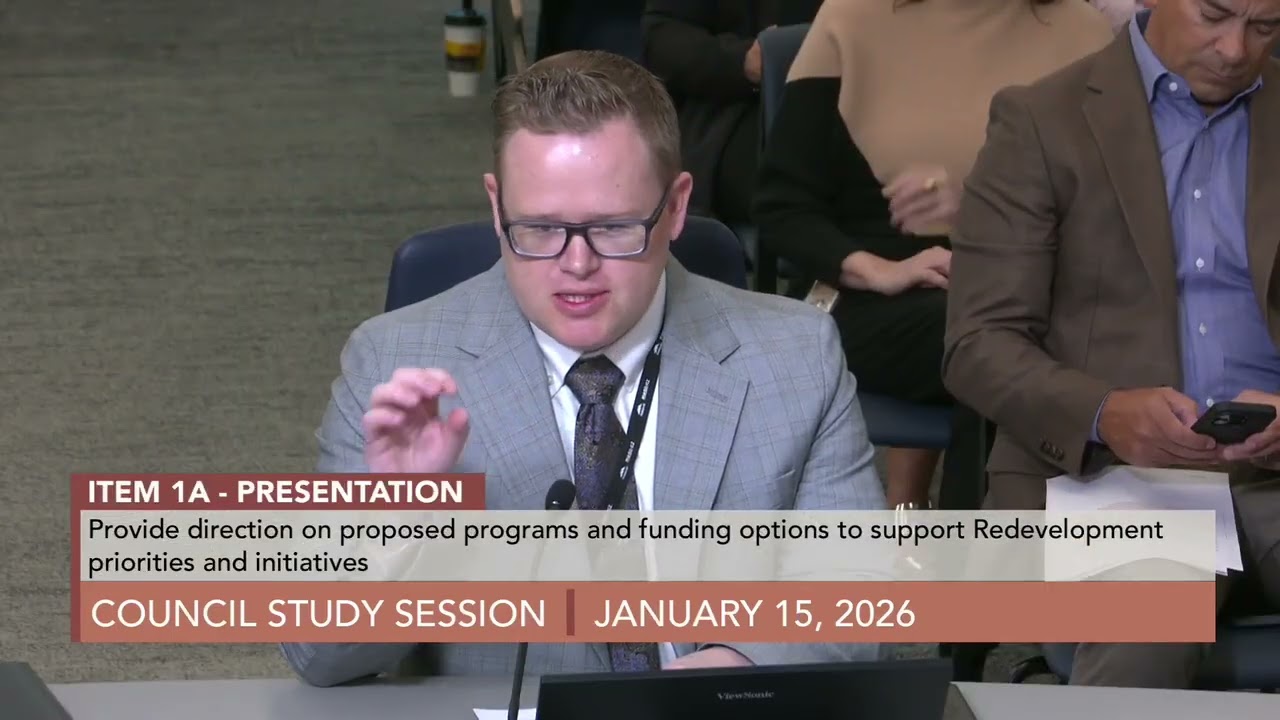
Mesa Council backs $3 million five-year redevelopment pilot with vacant property registration, loan funds
Mesa City Council study session presented comprehensive $3M redevelopment toolkit pilot program addressing blighted properties through multiple financial and regulatory tools, while establishing outcomes-focused performance management across 30 city departments.
Mesa Council Embraces $3M Redevelopment Toolkit and Outcomes-Focused Performance Management, Signaling Operational Transformation
Mesa City Council spent nearly three hours on January 15, 2026, charting what staff framed as a fundamental reorientation of city operations: externally, a comprehensive redevelopment program targeting deteriorated properties and underperforming commercial corridors; internally, a systematic shift from reporting on bureaucratic outputs to measuring actual community outcomes. Though no formal votes were taken, council expressed strong support for both directions and directed staff to refine design and funding strategy during spring budget discussions.
The meeting underscored two competing but complementary narratives: Mesa has built redevelopment capacity and data infrastructure but has lacked a coordinated, sustained toolkit to deploy them; and the city spends vast resources managing chronic problems (code enforcement, permitting delays, blighted properties) that preventive investment might solve faster and cheaper.
Key Speeches
"When communities start slipping into this stage, it creates a negative reinforcing cycle that just gets worse and worse until there's an intervention… whether it's from the private sector, the public sector, or often a combination of the two, cities can make tactical interventions to mitigate the decline of communities." — Mr. Robinson, City Staff
"So this is a challenging property for us. We have a property owner who is out of state who we have issued multiple citations to… they've been in the permit process for over two years and it's not for a lack of staff not trying to work with them." — Angelica Gavvar, Code Compliance, on Indie Car Wash (Power Road)
"What we're introducing is a systematic approach that ensures alignment across the organization with the council priorities and really thinking about the stewardship of the city's resources and constantly looking at continuous improvement, innovation, and efficiency and effectiveness." — Michelle Tjo, Performance Administrator, introducing Performance Plus initiative
"This isn't an add-on. This is a reallocation. We as a council have said this is a priority. So something else will have to fall off that priority list." — Mark Freeman, on $3M redevelopment funding
"I don't want to talk about this particular one on Power Road, but on a lot of other properties, there's something they can't work through and they get distracted, and talking to Jeff has been able to unlock it to move forward and then one improvement leads to another." — Jen Duff, on redevelopment's incremental effect
Timeline
Redevelopment Toolkit Presentation:
-
Applicant presentation: Jeff McVey (Urban Transformation Manager) and core team outlined two-year research effort interviewing comparative cities, evaluating best practices, and designing seven integrated tools: vacant property registration, code compliance assistance, revolving loan funds ($2M EDA grant target), commercial space activation, public infrastructure support, demolition/remediation, and strategic placemaking.
-
Staff recommendation: Recommend $3 million annual pilot funding (5-year program) sourced from construction sales tax and development revenues; treated as annual one-time appropriations; staff to return with detailed allocation, qualification criteria, and implementation timeline.
-
Public comment: None during study session.
-
Council discussion: Extended Q&A spanning zoning thresholds, LLC ownership tracing, property owner engagement, loan default liability, qualification standards, and whether new redevelopment areas (RDAs) should be created to expand tool availability. Jen Duff, Taylor, Adams, Mark Freeman, Francisco Heredia, Summers, and Goforth all contributed; widespread support tempered by questions about funding source displacement and staffing capacity.
-
Vote: No formal vote; direction approved with assignment to subcommittee oversight (likely Finance & Audit Committee per Council Member Summers' suggestion).
Performance Plus (Office of Innovation and Efficiency) Presentation:
-
Applicant presentation: Evan Alred (Chief Data Officer), Michelle Tjo (Performance Administrator), and Ian Linson (Assistant to City Manager) outlined shift from outputs-based to outcomes-based reporting, with 30 city departments defining KPIs aligned to council priorities and public dashboard templates.
-
Staff recommendation: Formalize Performance Plus as systematic, ongoing department-level initiative; no budget appropriation required; expected to yield process improvements, pilot programs, and efficiency gains; open to external validation and AI tools.
-
Public comment: None during study session.
-
Council discussion: Council Members Taylor, Adams, Mark Freeman, Jen Duff, and Goforth asked about external auditing of prediction models, accessibility of dashboards, AI implementation timeline, willingness to eliminate non-performing programs, and whether employee input and stakeholder engagement would be embedded in process redesigns. Strong affirmation from Jen Duff on embedding cultural change; Council Member Adams emphasized importance of field-level employee feedback.
-
Vote: No formal vote; presented as ongoing internal management initiative.
Opposition
No organized opposition. Council Members raised procedural, financial, and implementation concerns:
-
Funding source displacement: Council Member Adams and others questioned what existing programs would lose priority if $3M is redirected to redevelopment. Staff acknowledged this is a reallocation (not new revenue) and will be worked out in budget.
-
Staffing and administrative burden: Mark Freeman asked who will manage the redevelopment program given existing workload on Jeff McVey, Jeff Robbins, Angelica Gavvar, and others. Staff indicated roles will be distributed among departments (Economic Development, Development Services, Code Compliance).
-
Loan default risk: Council Member Taylor asked whether revolving loan fund defaults would be borne by the city general fund or the fund itself. Staff confirmed defaults would be absorbed by the fund (not taxpayers), though the fund's long-term viability depends on repayment discipline.
-
Property qualification and remedial tools: Council Member Taylor noted some properties (e.g., Indie Car Wash) may not qualify for voluntary assistance programs and asked whether compulsory enforcement (foreclosure, lien sales, condemnation) would be the fallback. Staff acknowledged the challenge and indicated case-by-case approach; noted potential for development agreements with conditions.
-
Efficiency of some programs: Council Member Adams questioned whether Mesa spends more on event permitting administration than revenue generated, suggesting cost-benefit analysis should guide program continuation.
-
Predictive model reliability: Council Member Taylor emphasized that predictive analytics can fail and recommended periodic external validation before resource deployment.
Support
Broad council consensus on redevelopment direction:
-
Infill and redevelopment as stated priority: All council members acknowledged council has identified redevelopment as strategic priority for two years; staff presentation provides concrete tools and funding mechanism.
-
ROI and sales tax impact: Jen Duff and Mark Freeman emphasized redevelopment yields long-term sales tax and property tax revenue; not a pure subsidy but an investment with measurable returns.
-
Environmental remediation success story: CiderCore downtown project cited as example of how $30K environmental phase-one grant unlocked $2M+ development and now-national-award-winning business; demonstrates catalytic effect.
-
Signal to market: Mark Freeman and Jen Duff noted formal program adoption signals to developers and property owners that city is serious about partnership and redevelopment—important for market confidence and speed.
-
Small business focus: Jen Duff emphasized tools should prioritize locally owned small businesses (under 50 employees, per COVID-era definition) rather than corporate chains, so tax revenue stays in community.
-
Performance management shift: Jen Duff, Goforth, and Mark Freeman expressed enthusiasm for outcomes-based reporting and data-informed decision-making; Mark Freeman noted importance of embedding efficiency culture and preventing "boxes that can't be checked" from driving workflow.
-
Subcommittee oversight: Council Member Summers requested (and Mayor approved) assignment of redevelopment program to oversight subcommittee for continuity and accountability.
Project Details
Redevelopment Toolkit Pilot Program:
-
Case number / formal designation: Not assigned; study session item only; referred to subcommittee review and budget process.
-
Applicant / developer: City of Mesa (self-directed); no external applicant.
-
Leads: Jeff McVey (Urban Transformation Manager), Jeff Robbins (City Staff), Angelica Gavvar (Code Compliance), Nana [last name not stated in transcript], Jay [last name not stated].
-
Funding request: $3 million annually (5-year pilot, 2026–2031 = $15 million total).
-
Proposed funding sources (in order of priority):
- Federal grants (EDA, Brownfields, ADEQ environmental remediation programs).
- Redevelopment activity revenues (GIFlet leases, negotiated development payments).
- One-time construction sales tax allocation and development revenues (filling gaps).
-
Seven tools:
- Vacant Property Registration: Proactive registration by owners; enables city tracking and police coordination; assists redevelopment office in connecting vacant spaces to interested tenants. Model: Phoenix (30-day threshold). Details (fines, notification process, timeline) to be refined at 90% design phase.
- Code Compliance Assistance Program: Subsidized or cost-sharing repairs for publicly visible violations (pavement, landscaping, irrigation, walls, fences, signage). Potential split: 50/50 match, 70/30, TBD. Reduces displacement and minimizes code re-violation cycles.
- Revolving Loan Fund: $2 million EDA seed grant target (maximum allowable under EDA program). Addresses lending gap ($50K–$250K range where underwriting doesn't justify traditional bank loans). Managed by third-party CDFI; city does not underwrite. Loans repaid into fund for redeployment.
- Commercial Space Activation Program: Addresses code barrier (occupancy change triggering expensive upgrades). Partnership funding for fire sprinklers, ADA access, other conversion costs. Recent example: grant helped enable restaurant retrofit in downtown mercantile building.
- Public Infrastructure Program: Addresses utility and sewer bottlenecks blocking development (e.g., 100-to-200-amp electrical upgrade triggering transformer replacement; sewer line extensions). Fund enables city to contribute to infrastructure upgrades when private developer cannot absorb cost.
- Demolition and Environmental Remediation Assistance: Phase One and Phase Two environmental testing (soil contamination assessment). Clears "spectre of contamination" blocking property sales and redevelopment. Success story: CiderCore cidery site (former transmission shop) cleared via $30K ADQ grant phase-one testing; now ranked #1 cidery in nation by USA Today.
- Strategic Placemaking Initiatives: Branded signage, gateway improvements, streetscape enhancements in economic activity zones (e.g., Fiesta District, Asian District). Layered with other redevelopment tools.
-
Evaluation and Pilot Structure:
- 5-year pilot (2026–2031).
- Annual KPI reporting and reallocation by council.
- 2031 evaluation of permanent program viability.
- Treatment as annual one-time appropriations (not standing budget line item).
-
Known example (non-approved project):
- OVO project: Developer has negotiated $500K one-time payment to city, which would be redirected to redevelopment fund.
Indie Car Wash (Power Road) Case Study
Context: Property closed since 2017. Owner out of state. Multiple citations, criminal misdemeanor charges (non-extraditable). Violations: trespassing, graffiti, dumping, squatters, lack of maintenance.
City expenditures: $30K+ on abatement, boarding, fencing, and ongoing maintenance.
Owner's stated position: Willingness to reopen but stuck in permit process for 2+ years; does not complete permit applications.
City's enforcement path:
- Abatement invoices sent; owner has paid some, but none in last 6–9 months.
- City is leaning property (securing liens for abatement and citation costs).
- City exploring lien foreclosure (discussed with City Attorney's office ~2 weeks prior to study session).
- Compulsory access via judicial search warrant being finalized (described below).
Timeline: Property remains unresolved; lien foreclosure expected to proceed; judicial warrant procedures estimated 2–3 months to finalization.
Judicial Search Warrant Procedures
Development: City Attorney's office (Mr. Smith) has spent ~7 months developing procedures for judicial (administrative) search warrants to allow code enforcement access to private property for violations (e.g., unlicensed boarding homes, interior code violations where evidence cannot be obtained from public right-of-way).
Scope: Warrants to be issued by judges (not city administrative process); procedures being finalized with Mesa Police Department for safe warrant service.
Timeline: Expected operational within 2–3 months.
Rationale: Current code enforcement authority limited to evidence collected from public right-of-way; judicial warrants enable documentation of interior violations (e.g., unlicensed boarding homes) and non-compliant property uses requiring interior access.
Council urgency: Mark Freeman expressed frustration with extended timelines and urged expedited finalization. Staff confirmed urgency heard and noted that legal conformity and police coordination are necessary delays.
Status: Nearly finalized; expected to be operational spring 2026.
Office of Innovation and Efficiency (Performance Plus Initiative)
Presentation leaders: Evan Alred (Chief Data Officer), Michelle Tjo (Performance Administrator, 6 months tenure), Ian Linson (Assistant to City Manager).
Purpose: Systematic, sustained shift from outputs-based (activity/bean-counting) to outcomes-based (community impact) reporting and decision-making.
Scope: 30 city departments engaged in defining council-priority-aligned outcomes and KPIs.
Three pillars:
- Envision: Ongoing data collection and reporting (existing effort).
- Elevate: Transition to outcomes-based KPIs and dashboard reporting; alignment with council priorities.
- Impact: Sustained efficiency and effectiveness culture.
Key elements:
- Department purpose statements: Define the outcome each department seeks to achieve.
- KPIs: Linked to outcomes; include leading indicators, service delivery impact metrics, and budget impact.
- Dashboards: Template dashboard includes purpose, outcome, KPI, outputs, service delivery impact, budget impact tiles. Departments to have individualized dashboards.
- Council priority alignment: Department directors meet with Assistant City Managers / Deputy City Managers to validate outcomes and KPIs against council priorities; directors adjust accordingly.
- Threading: Cross-departmental analysis of common process improvement needs to enable system-wide, coordinated improvements.
Current data-driven projects:
- Specialty Licensing & Permits: Analysis of building permit and planning case turnaround times, bottlenecks, third/fourth/fifth submittal patterns; business license and short-term rental licensing processing times and compliance rates.
- Public Records Requests: Processing time analysis and bottleneck identification.
- Water and Energy Resources: Leveraging smart meter data (15–60 minute intervals) for consumption patterns, outage prediction, efficiency improvements.
- Prediction Models (ASU partnerships):
- Code Compliance case load allocation and officer deployment.
- Water main break prediction and prevention.
- Pedestrian injury/fatality spatial and causal analysis.
- Fleet vehicle maintenance and breakdown prediction.
Reporting and accountability:
- Annual KPI reporting to council.
- Willingness to adopt external validation of prediction models.
- "Fail fast" culture: iterate and adjust if outcomes not achieved.
- No anticipated eureka moment before budget season (weeks away); full toolkit expected for following budget cycle.
AI and future: Evan Alred noted active AI working group; cautioned that enterprise-level AI deployment is unfinished (accuracy and reliability challenges); committed to case-by-case evaluation and sandbox access for council dashboard review before formal rollout.
Vote Breakdown
Redevelopment Toolkit:
- Final: No formal vote taken; direction approved via council consensus and assignment to subcommittee.
- Yes (implied consensus): Jen Duff, Taylor, Adams, Mark Freeman, Francisco Heredia, Summers, Goforth expressed support or engaged constructively.
- No: None expressed.
- Abstentions / absences: Council Member Adams had to leave before conclusion of study session for business obligation.
Performance Plus Initiative:
- Final: No formal vote; presented as ongoing internal management initiative.
- Approval mechanism: Implicit approval via council engagement and affirmation; no vote required for internal process.
Board Minutes Acknowledgment (Item 2):
- Final: Motion approved unanimously (individual votes not stated).
- Motion: Made by Vice Mayor Summers; seconded by Jen Duff.
Outcome & Next Steps
Redevelopment Toolkit:
Council directed staff to:
- Refine and develop tools to 90% design (detailed qualification criteria, allocation methodology, implementation timeline).
- Conduct stakeholder outreach (property owners, developers, small businesses, Chamber of Commerce) to test tool demand and refine based on feedback.
- Finalize funding source analysis and present options during spring budget discussions.
- Consider expansion of redevelopment areas (RDAs) to include District 2 (Main Street corridor, per Council Member Taylor and Jen Duff request).
- Define and implement conditions (e.g., development agreements, liens) for qualified applicants to ensure accountability.
- Assign program oversight to Finance & Audit Committee (per Council Member Summers).
- Return with detailed presentation to council during budget process (spring 2026).
Performance Plus Initiative:
Staff committed to:
- Provide dashboard sandbox access to council for review and feedback (coming months).
- Continue department partnerships to finalize outcome definitions and KPIs.
- Implement dashboards and begin outcomes-based reporting across 30 departments.
- Evaluate external validation of prediction models (open to external audit).
- Report back to Audit & Finance Committee quarterly or as determined by chair.
- Deploy AI tools on case-by-case basis; full enterprise deployment timeline TBD.
Indie Car Wash:
City pursuing:
- Lien foreclosure (legal process underway).
- Finalize judicial search warrant procedures (2–3 months to operational status).
- Potential compulsory sale or seizure if owner does not comply or remediates.
- Possible condemnation if property becomes safety hazard.
Controversies & Context
Redevelopment as Council Priority: Council has identified redevelopment and addressing blighted properties as a strategic priority for two years. This presentation represents response to that direction. However, tension emerged regarding:
-
Funding source displacement: Redirect of construction sales tax revenues from other priorities raises question of what programs will be deprioritized. Mayor and Mark Freeman acknowledged this is an explicit reallocation: council has decided redevelopment is higher priority than some current initiatives, so funding will shift accordingly. Staff will finalize during budget discussions.
-
Regulatory barriers: Council acknowledged that tools alone are insufficient; city must also remove regulatory barriers to infill and redevelopment. Development Services and City Manager committed to infill ordinance update (underway with consultant; council to hear mid-year update).
-
Small business vs. corporate: Jen Duff emphasized tools should focus on small, locally owned businesses (not corporate chains or large regional developers) to maximize tax revenue retention and community benefit. Staff acknowledged this will be incorporated into qualification criteria.
-
Indie Car Wash as cautionary tale: Property on Power Road has been a chronic enforcement and fiscal burden ($30K+ city expenditure) since 2017. Owner is out of state, unresponsive, and stuck in permit process despite stated willingness to reopen. Case illustrates high cost of regulatory inaction and justifies need for judicial search warrant procedures and more aggressive lien/foreclosure tools. Council Member Summers in particular invoked this example when asking about compulsory enforcement escalation.
-
Staffing and capacity: Council Members Adams and Mark Freeman expressed concern that redevelopment program will require substantial administrative overhead and potentially additional FTE. Staff indicated roles will be distributed across existing departments (Jeff McVey, Angelica Gavvar, Jay [Economic Development], Nana [Development Services]) but did not commit to staffing increases. This remains TBD in budget discussions.
-
Data and prediction model accountability: Council Member Taylor emphasized that predictive analytics can fail and urged external validation before large resource commitments are made based on model recommendations. Staff confirmed openness to external audit; Evan Alred noted that enterprise-level AI remains challenging and requires iterative refinement.
-
Performance management as cultural shift: Mark Freeman and others underscored that performance management is not a one-time exercise but a culture change requiring buy-in from department leadership, field-level employees, and union representation. The police officer realignment case (under prior Chief Ken Cost, continued under current Chief Dan Butler) was cited as successful example of data-informed, bottom-up process redesign.
Environmental Remediation Opportunity: CiderCore success story (national #1 cidery, per USA Today) demonstrates catalytic effect of removing environmental contamination spectre. Council Member Adams asked about timeline for properties under EPA/ADEQ oversight; staff noted phase-three remediation can be costlier than property value and sometimes exceeds economic justification, but phase-one and phase-two testing often reveal contamination is manageable (capping, natural off-gassing, etc.).
Duration
- Item 1A (Redevelopment Toolkit): ~120 minutes (including questions, discussion, staff responses).
- Item 1B (Performance Plus): ~60 minutes (including questions, discussion).
- Total meeting: ~210 minutes (3.5 hours), excluding brief acknowledgment of board minutes and current events/conferences.
Other Notable Items
Cambria Hotel Groundbreaking: Mark Freeman (Vice Mayor) announced groundbreaking yesterday for Cambria Hotel; 12–14 month buildout timeline; will include rooftop bar with Superstition Mountains views. Characterizes type of hospitality-sector growth supporting downtown/mixed-use development corridor.
NLC Conference (Salt Lake City): Multiple council members attended National League of Cities conference; noted presentations on AI-enabled efficiency improvements and cost-saving discoveries in peer cities (running into multi-millions of dollars). Mark Freeman and others expressed hope Mesa will identify similar redundancies and cost savings through Performance Plus and data-driven reallocation.