Mesa approves 36-unit Beverly Apartments workforce housing project near light rail in 4-2 vote
Mesa City Council approved the contentious 36-unit Beverly Apartments workforce housing project near light rail despite neighborhood opposition to density and traffic concerns, while also facing public pressure on its 287G ICE agreement for immigration enforcement.
Mesa Approves Beverly Apartments 36-Unit Workforce Project in Heated 4-2 Vote; Council Split on Infill Density Near Light Rail
Mesa City Council voted 4-2 to approve the Beverly Apartments project—a 36-unit, three-story workforce housing development at 50–60% area median income (AMI)—despite substantial neighborhood opposition centered on density, traffic, and neighborhood character. The approval, which came after three hours of public comment, design presentations, and council debate, grants the applicant COPA both a minor general plan amendment (from traditional residential to mixed residential) and rezoning from RM2/RM3 to RM4 zoning, unlocking a project designed to serve the city's documented shortage of 11,000 affordable units at that income level.
The contentious vote illuminated a core policy tension for Mesa: whether infill development at higher density near transit corridors is essential to downtown revitalization and affordable housing delivery, or whether such projects threaten the livability and character of legacy neighborhoods and risk overburdening local streets. Mark Freeman and Adams dissented; Council Members Dove, Goforth, Francisco Heredia, and Spillsbury supported approval. The vote also demonstrated that even council members nominally aligned on density principles diverged on the specific project, with Mark Freeman—the presiding mayor—voting against despite staff and some peers' advocacy for transit-oriented infill.
Key Speeches
"We're just we have had a lot of talk with Curly and whoever they are. My husband's really worked with them. They've, you know, done a lot of work with these guys and they've been really cooperative…the density is killing us. Three stories in the middle of a neighborhood." — Linda Spy, neighbor at 1019 West Second Street
"Hope will not keep our children safe. We are asking you, the city council, to stand with us, require COPA to pay the full traffic impact study before any approval. Show us proof, not guesses or estimates." — Madison Reynolds, neighbor at 239 North Beverly
"So with that those sort of elements that reduce the amount of trips…86 trips per day is what the increase would be on the site…about one extra car every 20 minutes or so…the amount of impact is extremely low throughout the day." — Taylor Earl, attorney for COPA (Earl & Earl & Earl & Curley, P.C., P.C., P.C.)
"To suppress any density is suppressing the possibility of Main Street developing into a viable business community. Right now, it is doesn't have the density. It is depressed…without the density, we can't get the businesses. And this is an affordable project." — Council Member Goforth
"This is some of my internal thoughts about and I've said this for the last year or so. Infill Development will kind of be our Achilles here as a council as we look at how we collaborate and integrate these neighborhoods…trying to maintain their quality of life…I'm not really comfortable with having this project move forward." — Mark Freeman (Mark Freeman in context of presiding at meeting)
Timeline
-
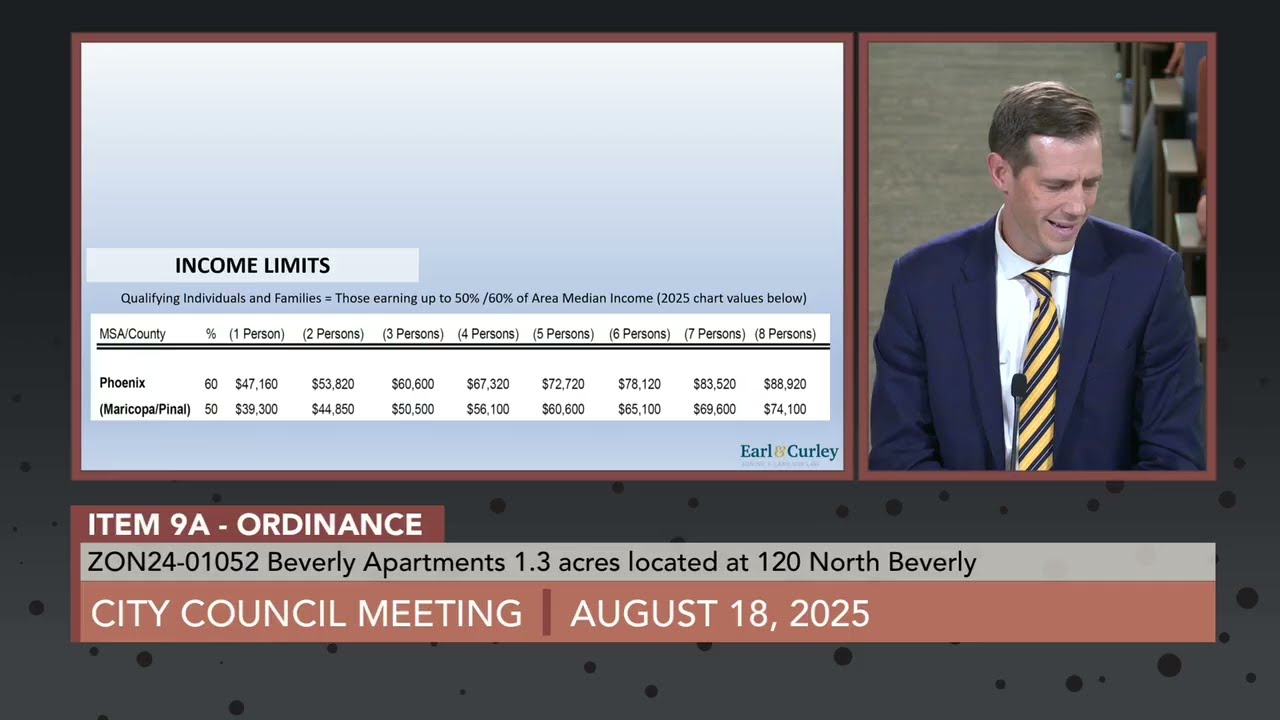
Applicant presentation (Taylor Earl, COPA): Presented workforce housing project reducing from initial four-story, 40-unit design to three stories, 36 units (prior to neighborhood outreach). Emphasized proximity to light rail within a quarter-mile, 50–60% AMI residents earning $50,500–$60,600 annually (family of three), rent-first affordability strategy, and reliance on transit. Presented traffic study by Y2K Engineering commissioned after planning commission showing 86 net additional daily trips (increase from existing 12-unit building), distributed across multiple neighborhood streets, with AM peak at 12 trips/hour (~one car every five minutes) and PM peak at 7 trips/hour (~one car every eight minutes). Noted 44 parking spaces with lease restriction of one reserved space per unit (not a lease deviation from city code), 80-foot setback to northern property line, and design incorporating neighborhood architectural elements.
-
Staff recommendation: City staff (via Christopher, interim Transportation Director Eric Gaderian, and planning staff Mary Capasky Brown/Evan) recommended approval. Staff confirmed project meets RM4 zoning density (29 dwelling units per acre), supports general plan mixed residential designation, and parking standards are not deviated from (44 spaces meet city code for transit-adjacent development). Noted surrounding RM4 zoning (Eden Village to west, apartments to south) and RM3 residential (single-family-platted 11 units/acre to north), with proposed 80-foot setback providing transition buffer. Acknowledged prior consideration of cul-de-sacing Beverly Street but rejected as infeasible due to impacts on private property and light-rail constraints at Alma School intersection. Interim Transportation Director Gaderian noted Beverly did not meet 500+ daily trip threshold for speed bump warrants under prior traffic volumes; reconsideration possible with additional projects.
-
Public comment: Four formal speakers (Linda Spy, Jennifer Sandstrom, Madison Reynolds, Michael Ziggler) plus 14 blue cards read into record. Opposed speakers (3 formal + ~12 blue cards) centered on: (1) density—36 units excessive for neighborhood, requested reduction to 24 units; (2) traffic and parking—concerns about enforcement of one-car lease limits, inability to control tenant behavior, danger to children and elderly on Beverly Street, request for independent traffic impact study as condition; (3) neighborhood character—three-story building out of place in legacy single/two-story area; (4) alternative traffic solutions (cul-de-sac on Beverly, traffic-calming measures, gateway to Alma School). One speaker (Ziggler) raised broader concern about overdevelopment and "ghost apartment complexes" given upcoming reductions in immigrant population opening rental inventory. Two blue cards in support of 287G ICE agreement; 12 opposed. One blue card (TJ Jensen) on decriminalization of psychedelics. One (Jane Wakefield) on public safety (unspecified).
-
Council discussion: Mark Freeman (presiding) expressed concern about density—"three stories is a bit much out of character for the area"—and acknowledged trade-offs but voted no. Council Member Adams questioned applicant about prior COPA projects (data not provided at meeting), noted density concern, but did not move to reject. Council Member Goforth delivered extended remarks defending infill strategy: emphasized city's 11,000-unit affordable housing shortage at 50–60% AMI, two-block proximity to Main Street and light rail, downtown Main Street depression without density (car repair, car sales, car lots), necessity of density for viability of affordable rents, risk that 24-unit cap would render project uneconomical, role of density in supporting transit and reducing suburban sprawl traffic, professional credibility of Y2K Engineering, and COPA's reputation in community. Noted majority of traffic distributed to Main Street corridor, not single-family neighborhoods. Council Member Spillsbury asked clarifying questions on parking, traffic study methodology, and lease enforcement. Council Member Dove confirmed staff recommendation and RM4 zoning alignment with adjacent properties. Francisco Heredia seconded Dove's motion to approve.
-
Vote (Items 9A and 9B combined): 4-2. Yes: Council Members Dove, Goforth, Francisco Heredia, Spillsbury. No: Mark Freeman, Council Member Adams. No dissent from other council members; Jeremy Whittaker, Kevin Thompson, David Luna not mentioned in debate.
Opposition
Number of speakers against: 3 formal public commenters (Linda Spy, Jennifer Sandstrom, Madison Reynolds) plus approximately 12 blue cards (names read by Miss Mosley: Noah James, Christopher Cody, Ryan Jera Burch, Alyssa Owens, Rosio Patino, Kelly Davies, Michael Stanley, Betsy Soderquist, Charles Green, and three others not fully transcribed) plus one additional speaker (Michael Ziggler, whose primary concern was overdevelopment generally).
Main concerns:
-
Density excessive for neighborhood character: Three-story building incompatible with legacy single- and two-story residential area; requested reduction to 24 units as compromise still doubling current 12-unit occupancy.
-
Traffic and parking enforcement: Applicant cannot guarantee tenants will limit to one car per unit; lease restrictions alone insufficient; concern that hope is not protection; neighborhood not suitable for tripled traffic from tripled units.
-
Safety for children and vulnerable residents: Every additional car increases risk; Beverly Street used by children, elderly, and disabled residents; no concrete traffic impact study commissioned by applicant despite neighborhood request.
-
Neighborhood character and setback: Three-story structure towers over neighborhood; inadequate visual screening despite 80-foot setback; trees may not grow fast enough or tall enough (Jennifer Sandstrom's study of drone photographs suggested modest tree growth sufficient only because setback was large, but concern remained).
-
Infrastructure and neighborhood livability: Requests for traffic-calming measures (speed bumps, islands) previously denied; suggestion to block off Beverly Street with gate turned down repeatedly; proposed alternative: cul-de-sac or connection to Alma School to redirect traffic away from single-family blocks.
-
Lack of developer investment in community mitigation: COPA refused to fund independent traffic impact study; refused to reduce density; viewed as unwilling to invest in neighborhood safety if not contractually required.
-
Broader neighborhood decline under light-rail proximity: Increased vandalism attempts on homes near light rail; safety concerns tied to transit station proximity and transient population.
Most compelling arguments:
- Madison Reynolds' framing of the traffic debate as risk-quantification: "Hope will not keep our children safe…Show us proof, not guesses or estimates." This reframed applicant's traffic analysis from sufficient to insufficient without independent verification.
- Linda Spy's concession that COPA had been cooperative and that the project had merit ("This is really an awesome project. We're going to be helping people") but the density was the core impediment—suggesting the neighborhood was not reflexively anti-development but density-specific, which may have resonated with some council members (Mark Freeman, Adams).
- Quantification of density increase (12 to 36 units = 200% increase) and assertion that even 24 units (100% increase) would be more palatable, creating a politically viable compromise framing.
Organized groups: Informal neighborhood group organized around the COPA project; no formal homeowner association name cited. Jillian Ryan identified as organizer of Indivisible Mesa (separate 287G ICE agreement issue, not Beverly project opposition).
Support
Number of speakers in favor: None during formal public comment periods. Council Members Goforth (extended remarks), Spillsbury (questions), Dove (brief confirmation), and Francisco Heredia (seconder) effectively advocated for approval during council discussion.
Main arguments:
-
Workforce housing critical need: City documented shortage of 11,000 units at 50–60% AMI; rare to see projects at 50% AMI; reflects balanced housing plan priorities and demographic equity.
-
Location is optimal for density: Two blocks from Main Street, within quarter-mile of light rail, aligns with Mesa 2050 general plan growth strategy for transit-oriented infill; density should concentrate near transit, not disperse into suburban areas where traffic burden is higher.
-
Main Street revitalization dependent on density: Current state of Main Street corridor characterized as depressed (car repair, car sales, car lots); without residential density and subsequent foot traffic, Main Street cannot support viable business district. Denial of density perpetuates commercial decline.
-
Traffic impact minimal: Y2K Engineering (professional firm used for city's own transportation plan) calculated 86 net additional daily trips, distributed across multiple streets (majority to Main Street corridor, not single-family neighborhoods); peak-hour impact (12 trips AM, 7 trips PM) absorbed into existing traffic patterns; project meets (not deviates from) city parking standards for transit-adjacent development.
-
Affordability dependent on density: Per-unit development costs inversely correlated with unit count; reduction from 36 to 24 units would increase per-unit cost, jeopardizing ability to deliver rents at 50–60% AMI; project becomes economically unviable at lower density.
-
Developer reputation and cooperative engagement: COPA has significant track record of quality affordable housing projects; not the developer of controversial Eden Village carless community to west, though respects that community's carless mission. Engaged neighborhood extensively (two formal meetings, website, drone study for visibility impact).
-
Zoning precedent and transition: RM4 zoning already present in area (Eden Village to west, converted condos to south); RM3 (11 units/acre) to north; 36 units on this lot creates logical density gradient stepping down toward single-family to north; 80-foot setback and proposed trees serve as transition buffer.
-
Alternative traffic solutions available: Speed bumps, traffic islands, or other calming measures can be pursued independent of project approval; city staff open to evaluation of Beverly Street calming (separate Second and Beverly intersection improvements already planned).
Project Details
- Case number: 25-0608 (minor general plan amendment per transcript) / Items 9A and 9B on council agenda
- Applicant / developer: COPA
- Attorney: Taylor Earl, Earl & Earl & Earl & Curley, P.C., P.C., P.C., 3101 North Central Avenue, Phoenix
- Location / address: Not explicitly stated in transcript; references indicate Beverly Street corridor near Main Street and Second Street, proximity to light rail station, two blocks from Main Street
- Current zoning → Proposed zoning: RM2 (15 units/acre) + RM3 (20 units/acre) → RM4 (30 units/acre)
- General plan designation (current → proposed): Traditional Residential → Mixed Residential
- Density / units / square footage: 36 units total, 29 dwelling units per acre; existing 12 units on site (Mark Apartments), being demolished/replaced; three-story structure; two- and three-bedroom units
- Income targeting: 50–60% area median income (AMI); at 50% AMI, family of three income cap $50,500; at 60% AMI, estimated ~$60,600
- Parking: 44 spaces; lease restriction of one reserved space per unit (44 ÷ 36 = 1.22 spaces per unit); meets city code for transit-adjacent development (no deviation requested)
- Setback / design: 80-foot setback to northern property line; trees proposed along north property line (subject to utility relocation); three-story (not original four-story proposal); incorporates neighborhood architectural elements (railing design from existing building)
- Affordability mechanism: Low-Income Housing Tax Credit (LIHTC) program; zoning approval precedes financing; rent-first education and emphasis on transit/bike use to reduce car dependency
- Changes from previous version: Original design was four stories, 40 units; revised to three stories, 36 units prior to neighborhood outreach
Vote Breakdown
- Final: 4-2
- Yes: Council Members Dove, Goforth, Francisco Heredia, Spillsbury
- No: Mark Freeman, Council Member Adams
- Abstentions / absences: None noted; Jeremy Whittaker, Kevin Thompson, David Luna did not participate in debate or recorded votes (may not have been present or may have voted silently as part of the recorded tally without individual attribution).
Outcome & Next Steps
The Beverly Apartments project was approved on both the minor general plan amendment (Item 9A, resolution) and rezoning plus site plan approval (Item 9B, ordinance) in a single combined 4-2 vote. The project now has zoning authorization and may proceed through site plan refinement, building permit review, and LIHTC financing. Financing is expected to follow zoning approval (zoning before financing is a LIHTC requirement). City staff committed to evaluating traffic-calming measures for Beverly Street, including speed bumps or traffic islands, though staff noted the 36-unit project alone did not trigger the 500+ daily trip threshold historically used to warrant such measures; reconsideration may occur if neighboring projects (referenced but not identified) move forward. No conditions specific to traffic mitigation (e.g., traffic impact study, developer-funded speed bumps, monitoring plan) were imposed as part of the approval.
Controversies & Context
Infill density vs. neighborhood livability: The Beverly Apartments debate exemplifies a broader tension in Mesa city planning between the 2050 general plan's mandate to concentrate density near transit and the expectations of legacy residential neighborhoods that character preservation is a priority. Mark Freeman vote against, despite his mayoralty and presumed influence, suggests even council leadership is ambivalent about the pace and scale of infill. Council Member Goforth's robust defense of the density strategy indicates that at least one council member views infill opposition as a threat to affordable housing delivery and downtown revitalization—a theme likely to recur.
Precedent of concurrent design reviews and prior proposals: The applicant noted that design review board feedback on this project was minimal and complimentary, suggesting staff and design expertise viewed the project favorably. The history of the site (multifamily since the 1960s, now beyond useful life) was cited as justification for replacement at higher density rather than lower. The existence of Eden Village (carless tiny homes, RM4 zoning) immediately to the west, and the existence of converted-condo apartments (RM4) to the south, provided zoning and use precedent.
Traffic analysis credibility: A key debate centered on whether the applicant's traffic study (86 additional daily trips, 12 AM peak, 7 PM peak) was sufficient. Applicant and staff argued the absolute numbers were low and dispersed; opponents argued that absence of an independent study or traffic-calming conditions was inadequate given the neighborhood's vulnerability (children, elderly, disabled residents). Council Member Adams' request for prior COPA project data (unfulfilled at meeting) and his emphasis on peak-hour impact suggest some skepticism of the applicant's modeling, though he did not demand rejection.
Light-rail proximity as a double-edged sword: While applicant and staff cited light-rail proximity as justification for density and car-light design, one neighbor (Jennifer Sandstrom) expressed concern that light-rail proximity itself had correlated with increased vandalism attempts, suggesting the infrastructure attraction brought unintended consequences. This tension—between transit-oriented development as a planning principle and livability concerns in adjacent neighborhoods—was not fully resolved in debate.
Affordable housing scarcity as moral/equity argument: Council Member Goforth's reference to an 11,000-unit shortage at 50–60% AMI and the rarity of projects at the 50% AMI level gave the approval a moral dimension—that denial would perpetuate inequity. Opponents did not engage this framing directly, instead accepting the project's merit ("This is really an awesome project") while objecting to density, suggesting a potential path to future compromise (e.g., lower density + city-funded affordable housing gap-financing to maintain viability).
Secondary public controversy: 287G ICE Immigration Enforcement Agreement: Three formal public comment speakers (Jillian Ryan, Amanda Snider, Michael Ziggler) and 12 blue cards addressed the city's 2009 287G agreement with ICE for immigration enforcement authority in the city jail. Speakers argued the agreement increases racial profiling, creates community fear deterring crime reporting, is financially expensive, and positions Mesa as the only Arizona city still participating. City Manager Scott Butler defended the program as unchanged in practice since 2009 and operating consistently across two Democratic and two Republican administrations. No council member responded to the 287G speakers; the issue was not on the formal agenda and state law prevents council from responding to citizen-present speakers. However, the high number of blue cards (12 opposed, 2 in support) suggests this will likely return to agenda in future meetings. Butler's statement that the program is unchanged despite federal policy shifts under Trump 2 may face further scrutiny in future public comment.
Duration
- Beverly Apartments items (9A and 9B): Approximately 2.5–3 hours (from first speaker through vote)
- Total meeting: Not explicitly stated; appears to have concluded with adjournment after citizen-present speakers and city manager response on 287G
Other Notable Items
Consent Agenda (Items 2–8A): Passed unanimously. Included liquor license approvals (Main Market, Mountain Mike's Pizza), street and railroad sewer contracts, traffic signal and equipment purchases (including body scanner funded by opioid settlement), office furniture cooperative contract, time terminals, data center collocation contract, and development agreement with CBDG Mesa for a commercial center at Ellsworth and Railroad.
Annexation Hearing (Item 10A): Public hearing conducted for release of petition for signatures on proposed annexation case 25-00231 (southeast corner South Hawk Road and East Mosquite Street). No public comment. No action taken; item will return to council for annexation decision in future.