Mesa defers Falcon Field Airport fee increases to March 23 vote after sustainability study
Mesa City Council study session addresses proposed Falcon Field Airport fee increases (landing fees, fuel flowage, hanger/tie-down rents) to address $2 million airfield cost center shortfall and deferred maintenance, with decision deferred to March 23 council vote pending FAA compliance verification.
Mesa City Council Studies Falcon Field Fee Overhaul: $2M Airfield Shortfall Drives Proposed Landing Fees and Double-Digit Rent Increases
On March 12, 2026, Mesa City Council held a detailed study session on proposed Falcon Field Airport fee amendments designed to address a persistent financial crisis: a $2 million annual shortfall in the airfield cost center and a critical backlog of deferred maintenance threatening the airport's long-term viability. The presentation by Airport Director Karen, Finance Director Sam Schultz, and external counsel Jill Owens (Snell & Wilmer LLP) laid bare the airport's operational and capital challenges and proposed a three-pronged fee structure that will be formally voted on March 23. If approved, the fees take effect May 1, 2026.
The central issue is straightforward but consequential: Falcon Field, once sustained by one-time land-sale proceeds and conservative budgeting, can no longer defer maintenance on 411 aging hangars (many built in the 1980s–1990s with oxidized, unpainted metal) or on aircraft parking ramp pavement that has gone unmaintained for six to seven years and now approaches end-of-life. The staff proposal seeks to transition the airport from a subsidized model (where ground-lease tenants subsidize other airport functions) to a cost-center model in which each functional area—city-owned hangars and tie-downs, airfield operations, and ground leases—must achieve financial self-sustainability.
Key Speeches
"The proposed fees and charges for Falcon Field includes landing fees. Staff is proposing landing fees to make Falcon Field Airport as financially self-sustaining as possible. These fees are not being proposed to reduce noise or flight traffic, discriminate against a specific user or favor one user over another similarly situated user. That is not allowed under the FAA rates and charges policy." — Jill Owens, legal counsel, Snell & Wilmer LLP
"We are at a crossroads here with this airport. It is not the same airport that it was many years ago. And it is absolutely critical as an economic asset to our city that we keep it in a high quality, customer service centered, well-maintained condition where people will want to continue to be part of it." — Karen, Airport Director
"I'm damn proud to work for a city where we were wise enough to take the time to bring in outside eyes to do the wise choice of taking hours to mull over this and make sure that we are in compliance with outside requirements before we just fly off the handle with some great idea in our mind." — City Manager (name not clearly stated in transcript)
Timeline
- Staff presentation: Airport Director Karen outlined the airport's financial picture, maintenance backlog, and proposed fee structure across three cost centers.
- Council questions: Members pressed on FAA compliance, fuel-pricing competitiveness, landing-fee implementation mechanics, and the rationale for distinguishing among cost centers.
- FAA compliance discussion: Jill Owens confirmed that staff consulted with FAA Phoenix District Office, compliance managers from Eastern and Western Pacific regions, and the deputy administrator of the Western Pacific region. The FAA indicated no concerns about the rate base or exemptions during preliminary conversation.
- Council direction: After extended Q&A, Council Member Goforth (whose district includes Falcon Field) moved to advance the proposal to a council vote on March 23; no objections.
- Study session: Adjourned with no formal vote (study sessions are informational).
- Formal vote: Scheduled for March 23, 2026, at 5:00 p.m. (moved up from 5:15 p.m. to allow staff to answer questions).
Opposition
Not stated in transcript. This study session had no public comment period. Council members raised concerns about design rather than fundamental opposition:
-
Competitive concern: Vice Mayor Summers noted that Gateway Airport's different mission (commercial passenger traffic) makes it an inapt comparison for potential diversion of itinerant traffic; he and other members emphasized that Chandler, Deer Valley, and Glendale are the more relevant competing general aviation airports.
-
Fuel flowage fee sufficiency: Members questioned why the city couldn't solve the shortfall by doubling the fuel flowage fee; staff replied that such a move would push the FBO's fuel prices so high that customers would buy fuel elsewhere, eliminating the revenue source and jeopardizing the FBO's viability.
-
Business impact: Implicit concern that landing fees might drive itinerant traffic away; Karen acknowledged this possibility but framed it as a business choice by users and a necessary trade-off for financial self-sustainability.
-
Reserve balance adequacy: Jen Duff asked whether the reserve-balance target of $2.5 million was appropriate; staff confirmed it as a minimum and noted that higher balances would be used to accelerate capital projects.
-
Third-party collection vendor cost: Members confirmed that the RFP for landing-fee collection would be competitively bid and that costs were already factored into the airfield cost center forecast.
-
FAA challenge risk: John Giles pressed on whether the FAA would support the landing fees if challenged; Jill Owens confirmed that the FAA would make an independent determination based on fair, reasonable, and non-discriminatory criteria, and that staff believes the fee will withstand scrutiny based on the rate-base analysis and cost-center approach.
Support
No formal public comment was received. Council members expressed strong support for the cost-center philosophy and the urgency of addressing deferred maintenance:
-
Cost-center accountability: Council Member Goforth stated that users of each airport function should pay for the costs to maintain that function, and praised the multiyear plan (now three to five years) to achieve self-sustainability.
-
Deferred maintenance imperative: Council Member Adams emphasized that failing to address pavement and hanger deterioration now will result in exponentially higher reconstruction costs later—a sentiment supported by Karen's testimony that complete pavement reconstruction costs far more than ongoing crack-fill and seal-coat cycles.
-
General-fund protection: John Giles and Council Members Adams and Taylor stressed that the airport should not require subsidies from the city's general fund and that users should bear the costs of operations they generate.
-
Prudent process: Multiple members praised the involvement of external counsel (Jill Owens) and the multi-year FAA consultation process, noting that independent review reduces liability and ensures compliance.
-
User-base readiness: Council Member Goforth noted that hangars and tie-downs are fully occupied with a waiting list, indicating strong demand and ability to absorb modest fee increases.
Project Details
- Case number: Not stated in transcript
- Applicant / sponsor: City of Mesa (airport operator)
- Legal counsel: Jill Owens, Snell & Wilmer LLP (external); City Attorney's office (not named individually in transcript)
- Location / address: Falcon Field Airport, Mesa, Arizona (located in City Council District 5)
- Zoning / designation: General aviation airport; FAA grant-assurance compliance required
- Current operational structure: Three cost centers proposed (city-owned hangars/tie-downs, airfield operations, ground leases); historically cross-subsidized
- Based aircraft: Approximately 877 based aircraft currently
- Facilities: 411 city-owned hangars; aircraft parking ramps; runway, taxiway, and apron pavement; aircraft rescue fire station with specialized equipment and FAA-certified personnel
- Current revenue sources (FY2026 estimated):
- Ground lease rent
- Hanger and tie-down storage rent
- Fuel flowage fees: $340,000 annually (at 14 cents per gallon)
- Other (rental car concessions, gate access cards): ~$30,000
- Total airfield cost center revenue: ~$374,000
- Airfield cost center expenditures: ~$2.4 million
- Shortfall: ~$2 million
Proposed Fees & Charges
Hanger and Tie-Down Cost Center:
- City-owned hangar rent: 10% increase
- Open tie-down rent: 23% increase (current rate $55/month)
- Covered tie-down rent: 11% increase
- Rationale: Tie-downs currently charged at only 55% of cost to be financially self-sustaining; hangers require funding for cane-bolt installation (storm-door reinforcement) and eventual repainting (~$2 million capital need)
- Timeline: Graduated increases over three to five years to allow user adjustment
Fuel Flowage Fee (Airfield Cost Center):
- Current: 14 cents per gallon
- Proposed increase: 15% (to approximately 16.1 cents per gallon, within competitive range of other regional FBOs)
- Rationale: Fuel flowage alone cannot cover $2 million shortfall; increase is modest to avoid driving FBO out of business or customers to competitor airports
Landing Fees (Airfield Cost Center):
- Proposed fee structure by aircraft category (exact per-operation fees not itemized in transcript)
- Exemptions:
- Based aircraft: first 10 landings per month per aircraft free
- Rotor-craft in training/testing patterns: limited exemptions
- Government aircraft and aircraft under contract for sale to government agencies (with FAA authorization)
- Aircraft undergoing production flight testing prior to delivery
- Flights in support of government functions: public safety, search and rescue, disaster response, infrastructure protection, emergency operations, forest firefighting, wildland fire suppression
- Special events sponsored by the city
- Medical flights (patient transport, organ/blood delivery)
- Animal rescue
- Emergency declared aircraft (FAA alert levels 1, 2, or 3)
- Rationale: Landing fees are necessary to close the $2 million airfield shortfall; exemptions ensure compliance with FAA non-discrimination policy and support public safety, government, and emergency operations
Effective Date: May 1, 2026 (if approved by council on March 23)
Vote Breakdown
Study Session (March 12): No formal vote; study sessions are informational. Council moved to advance to council vote on March 23 by general consent (no dissent recorded).
Formal council vote: Scheduled for March 23, 2026, at 5:00 p.m. (moved up 15 minutes from usual 5:15 p.m. start to allow staff Q&A prior to the meeting).
Individual votes on March 23 not yet recorded.
Outcome & Next Steps
Decision deferred to March 23, 2026, council meeting. The study session confirmed the financial necessity of the fee increases and validated the staff's FAA consultation process. Council members indicated strong likelihood of approval, contingent on final review of the council agenda (first draft to be issued March 12; council members to review over the following week while several are attending the National League of Cities conference in Washington, D.C.).
If approved:
- Fees effective May 1, 2026
- Airport staff to issue RFP for third-party landing-fee collection vendor (to manage data collection, invoicing, collections, and compliance)
- Annual fee review process to begin (staff committed to reassessing rates annually to adjust for actual costs and inflation)
- Cost center accounting will track revenues and expenses separately by functional area to enable performance monitoring
Conditions implied:
- FAA compliance verification prior to implementation
- Cost-center financial tracking and annual reporting to council
- Continued evaluation of whether rate increases can be reduced in future years if cost recovery targets are exceeded
Study session scheduled for March 19 cancelled due to council travel to National League of Cities conference in Washington; study session moved to morning of March 23 vote to allow staff to address any remaining questions.
Controversies & Context
Financial crisis backdrop: Falcon Field's troubles stem from three factors: (1) reliance on a 2005–2006 one-time land-sale proceeds ($4.6 million net) that masked structural revenue shortfalls; (2) dramatic inflation in pavement and construction costs beginning in 2020–2021, making the same maintenance work cost significantly more; and (3) historical resistance to rate increases due to concern about user burden, resulting in deferred maintenance and cross-subsidization in which ground-lease tenants effectively subsidized airfield and hanger operations.
Deferred maintenance severity: The airport's pavement condition index on some ramps has fallen below 50 (the point at which reconstruction becomes necessary rather than ongoing maintenance). Aircraft parking ramp pavement has gone unmaintained for six to seven years and is approaching end-of-life; the FBO is visibly avoiding parking aircraft in the worst-condition areas. Complete reconstruction of pavement would cost substantially more than ongoing crack-fill and seal-coat cycles (which cost $1.4 million annually going forward). Additionally, 411 city-owned hangars, many from the 1980s–1990s, have oxidized unpainted metal and have never been repainted; a $2 million repainting program is needed.
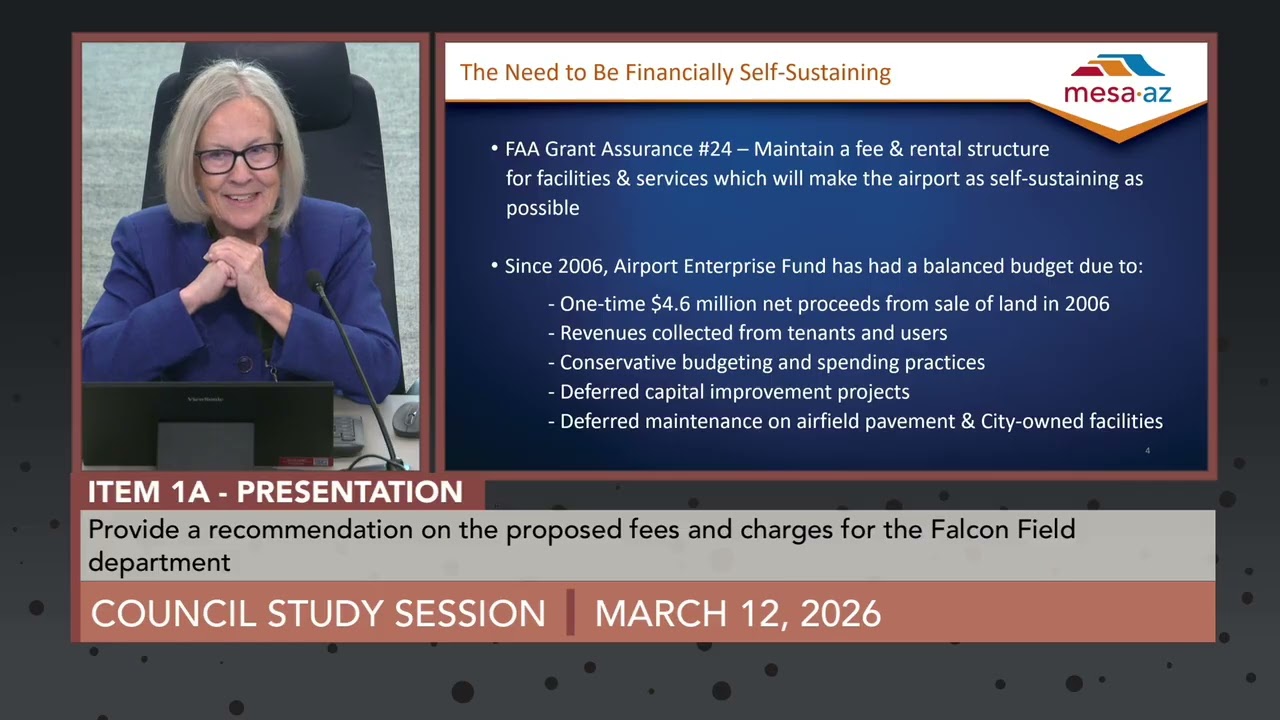
FAA grant assurance compliance: Under FAA Grant Assurance 24 (a condition of receiving federal or state airport improvement grants), airports must maintain fee and rental structures that make them "as self-sustaining as possible." This regulatory requirement was cited by staff and council as the legal and policy justification for the fee increases, independent of local fiscal pressure.
Competitive positioning concern: Vice Mayor Summers raised a legitimate issue: if Falcon Field imposes landing fees and nearby general aviation airports (Chandler, Deer Valley, Glendale, Coolidge) do not, itinerant traffic may be diverted. Staff acknowledged this possibility but emphasized that the alternative—continued deterioration and eventual reconstruction costs—is untenable. The Gateway Airport comparison was rejected as inappropriate because Gateway serves commercial passenger traffic and has a different mission and safety model.
Public outreach effort: Karen stated that airport staff conducted 15 virtual public meetings with aeronautical users and tenants, posted information on the website, sent notifications, and held monthly "Ask the Airport" sessions. Several design changes to the original proposal were made based on user feedback, indicating responsiveness to stakeholder input.
Fuel flowage fee misconception: A common belief among the public is that fuel flowage fees generate substantial airport revenue (one pilot suggested doubling them would solve the problem). In fact, fuel flowage generates only $340,000 annually—approximately 14% of the $2.4 million airfield cost center expenditure. Even doubling the fee would still leave a $1.7 million shortfall. Staff stressed that raising fuel flowage fees too aggressively risks making the FBO's fuel prices uncompetitive, which would drive customers to other airports and potentially force the FBO out of business, leaving Falcon Field with no fuel supply at all.
Aircraft rescue firefighting cost allocation: An important detail that emerged: Falcon Field maintains a specialized aircraft rescue fire station, operated by the city's fire department, staffed with FAA-certified aircraft rescue firefighters and equipped with specialized foam-delivery apparatus for jet fuel fires. This is not an FAA requirement for general aviation airports but was implemented by city council in the 1990s as a policy choice. The cost is approximately $2.4 million annually, with the city covering approximately 63% from the airport enterprise fund (the remainder was funded by a general obligation bond's operating hours component). This specialized service responded to 80 incidents in the prior year, reinforcing council members' view that it should not be eliminated or under-funded.
Cost-center philosophy and future precedent: Council Member Goforth emphasized that the cost-center model is not a one-time fix but a framework for ongoing financial discipline. She noted that she had advocated for steeper increases when the hanger and tie-down cost center analysis was completed last year, but council opted for a graduated three-to-five-year approach to allow users to adjust. She views the current proposal as an opportunity to establish the principle that users of each airport function pay for the costs to maintain that function—a principle that should be applied consistently going forward.
Duration
- Falcon Field agenda item (Item 1A): Approximately 90–120 minutes (estimate based on extensive questions and back-and-forth dialogue)
- Total study session: Approximately 150 minutes (including board/committee appointments, current events, and adjournment)
Other Notable Items
Board and Committee Appointments: Council unanimously approved appointments to various city boards and committees (motion by Council Member Adams, seconded by Jen Duff; no discussion).
Public Budget Meetings: Mayor and council members reported strong attendance and engagement at three district-based public budget meetings held in the preceding week at the northeast, west, and district library locations. Positive feedback on staff presentations and ability to address resident questions.
Community Engagement: Multiple council members reported recent HOA presentations, economic development networking events, and Coffee with Cop sessions. Mayor noted upcoming art event (ALT Fest, art–light–technology) at Mesa Arts Center on the evening of March 13.
Spring Training: Mayor and council noted that spring training baseball (Chicago Cubs) is ongoing in Mesa and encouraged residents to attend and support local sales tax revenue.
Future travel: Several council members will travel to Washington, D.C., for the National League of Cities conference and meetings with the state's congressional delegation, necessitating cancellation of the March 19 study session.
View source transcript ▼
Source: Council Study Session - 3/12/2026 — March 12, 2026. Auto-generated YouTube transcript; may contain transcription errors.
Well, welcome everyone to our Mesa City of Mesa. I I think Frank will be here. I hope so. And Mesa City Council study session for March 12th, 2026. All right. As announced, uh everybody's here. Thank you. We're going to hear a presentation. Item 1A is recommendation on the proposed fees and charges for the Falcon Field Department, one of our enterprises. So, Corrine and Sam and I forget our attorney's name. Jill. Jill. Yeah, welcome. So, we'll turn the time over to you. Okay.
Thank you, Mayor and council members. It's um an honor to be here with you this morning, and thank you so much for taking the time to to hear uh about this proposal. Uh as you well know, here on my right is Sam Schults. You know Sam, and Jill Owens is outside legal counsel with Snell & Wilmer, who has been assisting us from a legal perspective through this this process. So, um we'll go ahead and get started.
Corrine, before before we start, if I could just maybe make a a statement uh for council and for the benefit of the public also. Um many times it's important to talk about uh what this is, but I think it's important also to talk about what this isn't. Um the proposed fees and charges for Falcon Field includes landing fees. Staff is proposing landing fees to make Falcon Field Airport as financially self-sustaining as possible.
These fees are not being proposed to reduce noise or flight traffic, discriminate against a specific user, or favor one user over another similarly situated user. That is not allowed under the FAA rates and charges policy. Simply, noise reduction and flight traffic is not part of or the reason for the proposed fees, and is not part of this agenda.
I just want to manage the expectations of the public that's watching this as they're seeing what we're discussing, but also what we're not discussing and the reason why. Thanks, Mayor. Sorry, Corrine. Well, and to that point, uh that's why we're here. And I think it's been long overdue that we've had this discussion. So, um again, it like I stated, it's one of our enterprises.
And so, as we look at the financial well-being of our enterprises, this is something that we have to evaluate year to year. And so, we appreciate all those who work so hard on it. Uh Council Member Goforth, uh she led a team to analyze that, being in her district. So, I appreciate her work and everyone else. Vice Mayor. Well, you used the term enterprise and maybe somebody might want to define what that is or what the enterprises are since folks might be watching.
Well, I don't I think I think maybe to to Jim and Scott or they should be able to do that first, and then Sam as well. Mr. City Manager. Yeah, absolutely. Um Mayor, actually, I think Sam is probably the best positioned uh person to to really articulate uh how we treat our enterprise funds. Okay.
[laughter] So, Mayor and council, from an enterprise standpoint, what the city looks for is that this is a self-sustaining fund, um similar to like a business where there's no additional contributions when you look at it from a general fund contribution. What we look for is that the revenues from an ongoing basis will sustain those expenditures and the capital expenditures and/or debt service payments within an enterprise fund. Well, on that point, I think that's for a lot where it's confusing.
There's different buckets of uh different buckets at the airport that the money's allowed to be used in, and sometimes they cross lanes, so to speak. And so, I think for clarification for what money's can be used for at Falcon is essential for all of us to understand. That's why hopefully you can break it down why what the FAA requires uh for, you know, the runway and ramp services, tie-downs, obviously hangars leases ground leases. You have a whole whole group Correct.
Portfolio of things, let's put it that way. And one thing to add with it, with when we look at the this utility fund, it is restricted from an FAA standard in the sense that the revenues generated within Falcon Field are exclusively used in for expenses related to the operations and infrastructure of Falcon Field. Okay. I'm sure we'll have some questions as we go on. So, just have some clarity in that, I think, for those who are listening, the public, and ourselves as council. Okay Corrine.
Thank you, Mayor council members. And I think we'll go into a little more detail here regarding that observation of yours, and hopefully clarify some of that through the presentation. Okay, so we wanted to include, first of all, the purpose statement for Falcon Field Airport. And I don't need to read through all of these items, but just few just highlights. Um it's absolutely critical that we are a safe, reliable, and well-maintained airport.
That really if you don't have a safe, well-maintained airport, you really don't have an asset. So, that is really a big focus for all of this. Of course, we're a very customer-centered. We want to foster positive community relationships. Again, the need to be financially self-sustaining, and also to be um a great economic development opportunity that brings jobs to Mesa. So, let's talk about the primary sources of airport revenue, which are not related to a grant.
So, these are revenues that come in that we can use um from the enterprise fund to operate the airport. And you can see that list right there. These are the primary sources. The biggest revenue generators are the ground lease rent and the city-owned hangar and tie-down storage room rent. And so, that's going to be important to um focus on as we go into this.
We do have about $340,000 coming in for from fuel flowage fees, but that that is not enough to to support um one of the cost centers that we're going to be spending a lot of time on today, which is the airfield cost center. Mayor, can I Corrine, I I just want to reiterate that point because I think that there's some confusion about what we collect as far as fuel flowage. Can you say that number again? It's about $340,000 a year. Annually. Okay.
That we collect because we don't actually sell the fuel. We don't sell the fuel. The fuel flowage fee is collected based upon the amount of fuel that is delivered to the airport with the assumption that it will then be sold. Okay. Great. Thank you for that clarification.
So, some people might uh say, "Well, why do you need to be financially self-sustaining?" Well, FAA Grant Assurance 24, which every time we collect uh funds from the FAA or the state from a grant fund um for a capital improvement project, we have to sign a set of assurances, a set of guarantees that as a condition of getting this revenue for a major capital improvement project, we will agree to these assurances.
And Grant Assurance number 24 specifically states that the airport will maintain a fee and rental structure for facilities and services, which will make the airport as self-sustaining as possible. So, right there, the FAA is saying, "This is the direction we want airports to go." So, to give a little background, since nine uh 2026, the airport enterprise fund has had a balanced budget due to the following factors.
One of them was a uh net proceeds that we received from the sale of some land that the airport had purchased several years ago, like back in the '80s and '90s. That was sold in 2005-2006. And as a result of that, $4.6 million from the net proceeds was placed in the airport enterprise fund. So, it was a one-time um sort of win there for for us to have some additional revenue in addition to the other revenues that we collect on an annual basis from the tenants and the users.
We've also been very conservative as to how we budget, and I want to thank the Office of Management and Budget for helping that as well, because they set the standard, they set the amount that we are supposed to stay within when we put together our annual budget, and it's very conservative. And so, we've been able to budget conservatively, and also be very conservative with our spending practices.
[snorts] However, what's happened is as prices have gone up, and we'll talk a little more about that, we have started having to defer some of our capital improvement projects that we might otherwise be needing to do. And in particular, um our deferred maintenance on airfield maintenance and city-owned facilities, we've had to back away from spending the amount of funds that we need to spend on those particular items.
And we're going to talk about here what what ultimately is going to happen if we continue to defer that. That's right, Corrine. Question. Another question. Can you just give us a couple examples of some of those deferred either maintenance or capital projects that you have had to deferred due to yes lack of funds. Um. Was it later in here? I can't remember.
capital improvement projects Mayor Councilmember Go forth, most of the capital improvement projects that have been deferred are ones dealing with that are strictly funded by the airport. So we always try to make sure that we have enough money to fund our our local match for a federal or a state grant because that's money coming into the airport. So we want to make sure that we have those pro that money coming in to do those capital improvement projects.
So some of the things that we've deferred are for example um signage improvements on the landside which is like along Falcon Drive and and Roadrunner and so forth. We've deferred project a project to improve some of the landscaping along Falcon Drive. So it's been mostly projects that that were not tied to federal or state grants. So that's that's what we have as far as a capital improvement projects. But the big issue is the the airfield pay pavement and then the city owned facilities.
We do have 411 city owned hangars. Several of those hangars were built back in the 90s and the 80s and quite honestly what's happened is the paint has oxidized on those hangars. They've never been repainted. In some instances the metal is just showing right through and we have held off on doing anything with any of that just simply because we didn't have the funds to do it. So we need to be able to generate revenue at some point so that we can continue to take care of those assets.
And I know the pavement you'll you'll speak about that as well. Yes. So here's what Falcon Field's current financial picture is. As of today we are financially self-sustaining. However, as we look forward we are not going to be financially self-sustainable with the current situation that we have in terms of our revenues. And that is a result of general inflation which we've all seen that all the costs of uh products and services that the airport purchases have all increased in cost.
But what we really started to see was the cost of the capital improvements and and for example the the cost for the the grant funded projects. The the cost to do the pavement maintenance. All of those costs just really started skyrocketing in about 2021. Part of it has to do for with the pavement with the cost of oil and and so forth. And so we've gotten to the point where we're paying more or the same amount but we're getting less for what we are paying.
So seven or eight years ago for example if we were going to do a crack fill and seal coat project on one of our main aircraft parking ramps now we can only do half of it compared to what we were able to do six or seven years ago just simply because the cost has gone up. So we need to be able to get some more revenue coming in there so that we can continue to stay ahead of the game because we'll very quickly fall behind if we don't do something. Yes, question. Um yes Corrine.
When is the last time the airport increased its rates and fees? Mayor Councilmember Duff, last year we did an increase of the hangars and the tie down rents of 10% and that's because we started looking at that particular area to see where we were financially with that. Were the hangars and the tie downs sustaining themselves? And we learned from that analysis that no, they are not.
And so last year we embarked upon a program and to to let let everyone know that we're going to be raising or recommending that we raise these rents for several years if necessary to get them to the point where they're where they will be financially self-sustaining. So last year. So this is just an example. I put this picture in here to show you some pavement that is in dire need of some some work on it and this is one of our main aircraft parking ramps.
As you can see the the fixed base operator there is avoiding parking any aircraft on that area there just simply because the pavement is in such poor condition. And if we continue to let that happen then at some point we're going to be looking at complete reconstruction. I have a quick question. Yes. Um Corrine, could you go back that to that slide of that picture of that pavement situation? Um I don't know first question then I have a comment.
How long um has this gone unmaintained that it's developed into these cracks? When was the last time we did anything there? Uh with this particular ramp I'd have to Approximate is fine. I'd say at least six or seven years. Six or seven years? Mhm. Well I'm not a expert in asphalt pavement or other pavements but I'm I'm thinking that if this goes unchecked at some point in time it becomes unrepairable and has to be torn up and redone. Is that a correct assumption?
Mayor Councilmember Adams, yes that is absolutely correct. If we do not continue to do the crack fill and the seal coat every four to five years then that that pavement will eventually get to a point where its condition is so poor that we will have to do a complete reconstruct which is going to dramatically increase the costs. Have you received any information as to how how how much longer this could sit like that before we'd have to do that? Is it almost at end of life?
Mayor Councilmember Adams, yes it is almost to the end of its life because we do have a project we have it listed on our long-term capital improvement project for a complete reconstruct but that's a five or six years out. So we would need to do at least one more set of crack fill and seal coat before we can request the funding because with a reconstruction on a ramp like that you can request federal or state grant funding for that which is obviously good because it's very very expensive.
But yes, at this point that project is probably going to be reconstruct in probably five or six years. So in a perfect world we would have taken care of this a while ago but we've been forced to defer this. Mayor Councilmember Adams, that is correct. Okay, thank you. Hi Corrine. Good morning. Good morning. So I guess I'm just looking at this picture. Am I am I in understanding that the asphalt is heaving?
Uh Mayor Councilmember Taylor, it it does appear that it is heaving but what what you can see is that it's just it's get it's gets the moisture and you have the heat and then the cooling and the heat and the cooling. The weather is the is what deteriorates the pavement the most. But yes, if you look there you can see where around where the cracks are that the crack fill is just coming back up. And so it's not an even flat ramp.
And does that have anything to do also with the weight of the aircraft? Mayor Councilmember Taylor, it it really doesn't. It's more the weather that is is what deteriorates the pavement. Um wow. Thank you. All right. So what steps have we already taken as we've seen this situation approaching with the potential shortfall? I already talked about cutting back on non-grant capital improvement projects.
We've basically taken the band-aid approach with the pavement maintenance where we say okay, we have this much money that we can put into the ramp pavement main ramp and runways and taxiway pavement maintenance and we're just going to work on the worst pieces of pavement wherever they are.
And if if the pavement gets below pavement index condition index of 50, that's where you're quickly approaching the reconstruction point and we do have some areas on the airport that do have have pavement PCIs that are below 50. So as we look at our pavement projects we try to tackle those first. But again, if you have one that's in the let's say the higher 50s, if you don't pay attention to it very quickly it will then fall below 50 and then you're looking at reconstruction.
So we're we're just trying to keep up with it. So our colleagues in engineering prepared us an estimate of what it would cost for ongoing pavement maintenance over the next 8 years and you can see what this number is. With crack fill and seal coat, as I mentioned earlier, you really need to do it every four to five years. And so, you could go through the entire airport, let's say we came up with some other money that we could we could use and we just did the entire airport.
Well, it'd be great for four or five years, but then we have to start all over again. So, it's just a constant cycle of repeating this year after year after year. It's not going to go away. So, some people may ask, "Why can't you just use your federal and your state grants to cover these costs?" Well, the FAA and the state will pay for capital improvements that include pavement reconstruction. But, they will not pay for the ongoing maintenance.
So, the four to five year cycles, they will not pay for that. That is something that we have to pay for ourselves. Now, the state does have some pavement maintenance money that they distribute to airports across the state of Arizona and occasionally we will get one of those grants to help with some of our pavement, but that is primarily used for runways and taxiways. That's their primary focus, keep the runways and the taxiways in good condition.
They will not pay for anything, for example, in the areas where the the city-owned hangars are located down in that part or on on any of the other major aircraft parking ramps, they will not pay for that. So, that is all on the airport to pay for. Karin, I have another question. How long does a full pavement reconstruction last? You know, you're saying the the fill and seal is about five years, so we would just rip the whole entire thing up and redo it. What is the estimated timeline on that?
Good question. Um Mayor Councilmember Taylor, that would probably last the airport at least 15 to 20 years, if not more, if it's really well maintained. And can we exceed that 70 mark when we do something like that? Is is there kind of a goal? I know that's the FAA's minimum, but is there a goal to say, "Hmm, maybe we should go a little bit above that?" Yes, uh Mayor Councilmember Taylor, that is correct. If you do a complete reconstruct, then you will exceed that 70.
You may be up in the 80s and the 90s. So, at that point, if you can then just go back and do the crack fill and the seal coat and you do it on a regular basis, then you can get I mean, you could you might even be able to get 30 years out of it if you that cycle. Yes. Thank you.
So, as we were looking at our situation with the costs going up so dramatically, we looked at at the financial situation with the airport and it said, "Well, we probably need to be looking at doing something different." And this is something we started looking at three or four years ago as we saw what was happening. So, in 2024, we started having some conversations about converting to what they call a cost center approach for how you look at your areas of the airport.
This is an approach that the FAA fully supports that um that you set up various zones, if you will, within your airport and work towards making each one of those areas financially self-sustaining. And so, that's what we decided to do. We said, "Okay, because we know for a fact right now what is happening is the ground lease tenants are major subsidizers of the rest of the airport. None of these the airfield cost center and the city-owned hangars and tie-downs are not financially self-sustaining.
They are relying on the revenues generated from the ground leases. So, we made the decision that the goal the goal would be to get each one of the cost centers financially self-sustaining. And of course, we recognized that this may take a little bit of time. So, in August of 2025, we came before this council or the council and we recommended we said, "We're going to take one step at a time." And we decided we were going to look at the city-owned hangars and tie-downs.
As I mentioned previously, we discovered they were not financially self-sustaining and so, we said, "Okay, let's put together a program here to try to get them financially self-sustaining over the next three to five years." So, last year council approved an 8% increase in the hangars and the tie-downs. So, that was step one of us moving moving in this direction.
So, for this year, we took a look again at the city-owned hangars and we recognized the biggest cost in the city-owned hangars area and the tie-down area is the pavement. You know, we have tenants that will ask us, "Well, you know, what what what are you paying for for my hangar? It's been here, it's paid off, you know." It's the pavement. That is the biggest cost of, you know, providing that area for those tenants and users.
We also, after the 2023 storm where we lost over 90 hangar doors off of our hangars, we made the decision to invest in installing cane bolts, which would help hold the doors in when we have our next storm. It's not if, it's when. It's going to happen and we have three more years. We phased this out over five years. We have three more years that we need funding for to to get that completed.
And then we also need to start placing some some funds in some type of a capital reserve to start repainting those hangars. Otherwise, they're just going to continue to deteriorate. The the metal is going to be continue to be exposed to the hot temperatures and the weather and we just don't want to let those deteriorate. So, that's going to cost about $2 million. So, for this proposal, we are recommending a 10% increase rental rate for the hangars.
Then, as far as the tie-downs, we really drilled down a little more this year and the tie-downs themselves. Last year, we kind of included them in with the hangars and right now we discovered that we are only charging about 55% of the cost of what is needed for the tie-downs to be financially self-sustaining. So, that's that's that's pretty pretty substantial shortfall there. So, our recommendation for this year is to raise the open tie-down fees by 23% and the covered tie-down fees by 11%.
Now, common question that people might ask is, "Well, why don't you just raise them more?" Well, you have to keep in mind that you have your hangars that you're charging X amount for the hangars, then you have the covered tie-downs and then you have the open tie-downs. You have to be careful when you do your rate increases for the tie-downs so that they don't get to the point to where you're paying more for a tie-down than you are for a hangar.
So, we have to kind of move all of those up together and so, um that's why we came up with the formula that we came up for this year. Karin, what's the like an average cost for a tie-down? Whether I mean, what what kind of fees? Right now, the current rate for uh I'm sorry, Mayor Councilmember Duff. Right now, the current rate for an open tie-down is $55 a month. So, we're not talking about 11 or okay, 23. Karin, what are other airports charging for that?
Mayor, uh we we are pretty much in the ballpark right now with what the other airports are charging. Okay. And Karin, what is um what does a financially self-sustained tie-down look like? Like, what would be what are the requirements for a tie-down to be excellent? Mayor Councilmember Taylor, uh a well-maintained tie-down would be a tie-down, first of all, that has good pavement under it, that has at least a 70% or more pavement.
And then, the chains you well, you have the bolts that are in that go into the pavement and then you put a chain onto the bolt and then the chain is used then to tie down the aircraft so that when the wind comes up, hopefully, the plane won't be turned over. It's reducing the friction that could happen to release that bolt from the pavement. Is that what we're looking to make sure it doesn't happen, it doesn't come out? It doesn't come out. I'm thinking layman's terms, like how do I Okay, right.
That's helpful. Thank you. trying to hold the plane down and keep it from just blowing off across Okay. the runway. I've seen one, so I'm like trying to imagine this. Well, we'd love to have you come out. We'll specifically take a tour of the tie-down area. I've Yeah, I think I've constructed it in my mind, but [laughter] that's really helpful. Thank you. Okay.
So, now let's move on to the cost center and we we knew that the cost center was going to be the most this cost center was going to be the most challenging of all because we knew that there really isn't other than the fuel flowage fees. There's a few other small revenue sources that feed money into the airfield cost center, but the main one is those fuel flowage fees.
And if you look at the list here, you will see all of the areas that are included in the airfield cost center and it's it's substantial. And so that's that's why we needed to take a look at it and and see what we could come up with in order to make this airfield cost center financially self-sustaining as well.
So what we did is we looked at our estimated costs for this fiscal year, which we are anticipating the cost for the airfield cost center to be approximately 2.4 million dollars at the end of the year. The estimated revenue for that cost center 374. That's the 340,000 plus another 30,000 coming in from these other small revenue sources like rental car concessions, gate access cards and so forth. So you can see that there's a substantial shortfall there.
There's a 2 million dollar shortfall that we have discovered is occurring in this area. So we looked at a variety of different options, looked at what other airports are doing and so forth. Ultimately, we honed in on an increase to the avgaz fuel flowage fee.
We want to be careful we don't raise the fuel flowage fees too much because at that point the the FBO of course is going to pass that cost along to the customer and if their fuel prices get to be too high, then people are not going to want to come to Falcon Field to buy fuel. So we have to we have to raise it gradually, but we don't want to you know, raise it so much that nobody wants to buy fuel here.
So we're recommending an increase to 15% for that and then ultimately we made the decision to propose the landing fees. Corinne, I'll just say on that point, I think that Oh, sorry, Councilmember, there's not a lot of fuel stations that you can go to. I mean, other than the closest airports would be where? Mayor, the closest airports would be Mesa Gateway and Chandler, Scottsdale. It's not like they're on every corner. [laughter] No. Okay. Councilmember Adams. Thank you, Mayor.
Um included in that 2 million 400 thousand airfield cost center cost, we have to maintain at our fire station, I think the apparatus is called a crash truck. It's a specialty apparatus and specially trained firefighters who can deal with aviation related fires. So that's that's included there too and that's uh that that's a a specialty thing, isn't it? That that is not by choice, it's by requirement. But that probably costs a little bit more than the average fire station, I would imagine.
Yes, Mayor Councilmember Adams, it is a specialty area. The the truck itself is specially designed to respond to aircraft incidents. It's got the foam on it. Uh you know, if you've got jet fuel flowing out, you need to put the right type of um fire depressant on it. And then the the people who are operating the truck and responding to the incident also have to be FAA certified as aircraft rescue firefighters, which requires them to go through training, ongoing training and so forth.
So uh the cost that the airport is paying right now, we are paying for about 76 63%, I believe, of the cost of the six firefighters. Correct. So from the fire for the fire truck, that was paid with the um general obligation bond. For the people, when they when we set this up, it was to cover from the operating hours of the tower that there would be someone on site. So they're looking, I believe it's 15 hours per day, 24 or 24 15 hours, 7 days a week for that coverage.
So we looked at the ratio of those firefighters to then cover the allocation to have a firefighter for each of those hours. They are they are stationed there 24 hours a day. So if there's an incident at 2:00 in the morning and they become aware of it, then they will respond. Now, I just want to qualify here as a general aviation airport, Falcon Field is not required by the FAA to have aircraft rescue firefighting coverage.
However, I believe it was back in the 1990s, the city council made the decision that it was important to provide that service at Falcon Field and we are very thankful that we have that service there. Last year, they responded to 80 incidents on the airport and so it is a very important service that we have on the airport. Thank you. That was going to be my next question. So I Oh, I agree. I think it would be totally imprudent of us to not provide that.
Yeah, Mayor Councilmember Wild, not required, we don't view it as optional. Um with just the we we see time and time again how having that safety for our residents pays pays off. Vice Mayor. You you made a statement a [clears throat] a moment ago about the increase in the avgaz fuel flow rate. You don't want to increase that rate so much that you're you lose business as far as fuel flow. How does that also tie in to landing fees and some of these other charges?
Are we not concerned that that could move business elsewhere and what's the impact of that going to be if we lose business? How do these books balance out? Mayor Vice Mayor Summers, that is a good question. We do recognize and we'll talk about it here in a little bit that that there is a possibility that if the landing fees are approved, that some people may make a decision to to fly to another airport instead of using Falcon Field.
As far as the fuel flowage though, it's critical that we do have the fuel available for those who are at the airport and those who choose to be at the airport and for those who choose to fly in on a short-term basis. Right now, we only have one full-service fixed-base operator and if that fixed-base operator is not able to compete with the fuel prices that are being charged elsewhere in the valley and that fuel provider goes out of business, then the airport's going to have even bigger problems.
So we looked at that as a trade-off. And do we anticipate that that problem would be an issue across other airports in the valley? GA airports, anyway. I'm sorry. If we lose suppliers for avgaz, does that also impact other airports? Mayor Vice Mayor Summers, if we lose our fuel supplier, then there won't be any fuel available at Falcon and they will have to fly to another airport to fuel. issue. Okay. Right. Councilmember. Um are there other GA airports or [clears throat] GAs?
I guess that's redundant. Um that are the FBO? That provide that sell the gas? Mayor Councilmember Goforth, yes, that is correct. There are there are other general aviation airports that are the fuel provider. And so there that's probably they're collecting more revenue based on obviously that's a that's a revenue generator for them that we don't we don't have.
We don't have, but then of course you also have to incur the costs for operating the fuel in terms of staffing and fuel tanks and compliance with all of the environmental requirements. So do you know, is this fairly competitive, this fee for those that are not the FBO for those airports? Mayor Councilmember Goforth, yes, this this is helping the current FBO, the primary FBO to to be stay remain competitive with the market around us. Okay. Thank you. Corinne, I'm going to stop you there.
Jill, is there anything you want to add to our discussion, outside counsel? I'm sure there's something that you'd like to maybe cover on one or two things. Mayor, I don't have anything to add. Corinne is answering adequate perfectly all of the questions. There's [laughter] perfectly. Well, we'll put you on standby. Thank [clears throat] you. I was with a pilot recently, like a couple of days ago, and they said, "Why don't you just double your fuel flowage fees?
You can pay for everything." And I thought, "Well, okay, we're raising it up a penny, right?" Uh I don't know what other airports pay or the FBOs, but I I did thought, is that reasonable to double it? Mayor um I don't want to do that.
not be reasonable because again, at that point, it would the the fixed-base operator fuel provider would have to pass that cost along to the customer and so now the fuel prices to purchase at Falcon are going to be so much higher that people are not going to want to and you'll even have people who are based at Falcon Field saying, "I'm not going to buy my fuel here. I'm going to fly over to Gateway or Chandler or Casa Grande and buy my fuel." And we don't want that to happen.
Well, I think that's happening today at all the gas stations around with the [laughter] fuel increase, not to belabor that, but I understand that. I He just mentioned that to me. I don't I didn't have an answer where competitiveness was between the FBOs and the airports. It is. It's very competitive. Okay, so we are within the range of, you know, 14 15 cents if we decide to raise it? Mayor, yes, that is correct.
Uh the the primary FBO as well as the second FBO that only sells jet fuel, their prices are very competitive. They watch Obviously, these companies watch each other daily and adjust accordingly and generally, um the FBO at Falcon is one or two cents below some of the others and that's intentional because he's trying to attract people to Falcon. Okay.
Did you have Mayor, on that line, I think there's a misconception out there in the public that we um that we collect a lot of revenue from the fuel flowage, uh enough to cover the gaps in in our cost and even if we doubled it, we're not even close to covering the gaps, right? So, I think that comment probably came from somebody that I mean, people have told me, "Well, you get about 13 million dollars and so there is a a huge misconception out there about what we collect for fuel.
So, um A, that we're not even the FBO, we don't sell it and and you know, we currently collect 14 cents on the dollar, so. Mayor, Councilman I'll go forth. I think that's a great point cuz when you look at the slide, you see where our current revenues are, which is mainly driven by the fuel flowage fee. So, at the 374 or 374,000, if we were to just double that, that still puts us only at um what's that? 6 or 750 750, so we're still behind on that collection of being self-sustaining. Ms. Taylor.
Yeah, I just for anyone who's listening, I also wanted to point out just the fundamental aspect that in any revenue generation instance, you know, it's not wise to generate all of your revenue from one source. You don't invest in only one source. You don't put all your eggs in one basket. If something were to happen where we could no longer offer fuel, that would immediately cut off our source.
So, just even from that philosophical perspective, it would it would just be very imprudent of us for us to move forward in that direction. Okay, and time's yours. All right. So, the methodology that we used to ultimately come up with the proposed landing fee, we took several factors into consideration. First thing was is we had to look and see as we've shown you, okay, what do we need to make this cost center financially self-sustaining?
And so when we ran the numbers, we came up with the the $2 million, which is a substantial amount of funds for Falcon Field. But we also uh the FAA requires that the fees must be reasonable and they can't be unjustly discriminatory. For example, you can't charge, you know, let's say you have one type of operator and another type of operator, you can't unjustly discriminate against them and say, "Well, you're going to you're going to pay the bulk of all of this and and so forth.
So, when we made the decision to do what we proposed, the decision was that we we need to have everybody pay. We need to have everybody paying except for a few exemptions, which is included in in the proposal. Um and so we we looked at that, but we also looked at other general aviation airports and what they are charging for their landing fees. And it's one of those things where there is no standard in the general aviation airports as far as landing fees. It's just it's all over the place.
Um some of them will charge this, but others don't and uh they'll exempt these people, but they won't exempt these others. So, it really ends up being it's very difficult for us to say, "Okay, this is what 70% of the airports are doing, so let's do that." We really had to come up with what works best for Falcon Field Airport. So uh so, but we we did not go into it blind without knowing what other airports were doing.
Then we also looked at the possibility and you brought that up earlier that we may end up having some of our customers say, "Well, I don't I don't think I want to land at Falcon." And in, you know, probably the first group that might say that might be the itinerants that are flying in that maybe have lots of airports to choose from and say, "Well, you know, if I don't have to pay a landing fee at Gateway, then maybe I'll go and land at Gateway if it you know, it still works into the scheme of the of things." So, we had to recognize that's a business choice on the airport.
We're not trying to push anybody away. We're not trying to scare anybody off. We're trying to balance the budget is what we're trying to do. And so, some people may look at that and say, "Okay, well, that doesn't work for me and I'm going to go somewhere else." So, we took that into consideration as far as as when coming up with the rate that we did. Corinne, Vice Mayor. So, Corinne and city manager and possibly the mayor would want to chime in on this.
That what you just said concerns me a little bit cuz you used Gateway as an example. Gateway is not a GA airport. This is true. It is it is a regional airport specifically intended for passenger travel and logistics. So the the types of flights and operations are are very different.
Are Are we paying attention to that at Gateway Airport and not trying to move the a bit the types of operations that don't match what that airport needs cuz there are safety concerns with respect to that in addition to economic development concerns. Mayor, Vice Mayor, I can I can address that one. The answer is The short answer is yes.
Gateway staff and and the board and others have already discussed the possibilities of what ripple effect impacts could be on on other airports including more specifically Gateway and so they're they're going to monitor the situation and they have some alternatives that they're considering to to make sure that they maintain the safety that they need for the commercial traffic that that comes in and out of Gateway. I'll weigh in. It's on the radar.
[laughter] Well, and Mayor Mayor, Vice Mayor, so I'll I'll retract that and say people may choose to fly to Chandler. [laughter] That would that would Yeah, cuz that's a GA airport. Deer Valley's a GA airport. You know, nobody I wouldn't think people would want to Sky Harbor also would not be an appropriate use. Correct. Thank you. Well, I I think it comes down to the Vice Mayor's comment about the mission of the airports.
You know, Gateway's a commercial passenger large aircraft airport with three 10,000 foot runways, has a whole different mission than uh Falcon or Chandler or Deer Valley or Glendale or Coolidge or wherever you want to fly. So, our mission is to look at changes potentially at Falcon and that mission is to make sure it's self-reliable. I'll I'll say more at the end, but to that point, I I just know that uh Gateway has looked at and will continue to look at.
They do have a a small general aviation component there. Mhm. And it's all about capacity and how you can manage that. But that's a whole different topic, but we're concerned about Falcon today. So, Corinne, carry on. GAs are tied to universities. Mhm. All right. Go ahead, Corinne. So, these are the proposed landing fees that we have um put on the table for your consideration. I won't go through every one of those numbers, but I'll let you take a look at that.
You may have already had an opportunity to look at it when when you were were reviewing this previously. There are some exemptions that we are proposing. I'll go through those. Um first of all, if you are an aircraft that is based at Falcon Field, you would be given the first 10 landings for that for each aircraft that you have, first 10 landings per month would be free. Now, what is a based aircraft? A based aircraft is an aircraft that is stored at an airport for more than 6 months.
So, if that aircraft is not stored at Falcon Field for more than 6 months, it is not going to be considered a based aircraft. We currently have about 877 based aircraft at Falcon, and that's the number that we keep track of on a regular basis. Also, excluded would be rotorcraft, drones, the eVTOLs, which are the electrical vertical take-off and landing aircraft that are starting to come online. If they're landing on an exclusive use ramp, then they would not be charged a landing fee.
And by exclusive use, what we mean is it's their ramp. They're leasing the land from us. They have they they've built their own ramp on there. So, we're not going to charge them a landing fee if they're going to land on their own ramp cuz they're not impacting our situation.
If an aircraft a pilot declares an emergency, uh as in an FAA alert one, two, or three, there's three different levels, if they've declared an emergency, they would be exempt from the landing fee because we just want to focus on making sure they make it down safely. And then the next one is uh involves rotorcraft that are landing particularly in what we call the echo ramp training area.
If they are doing a training and testing sec session there in that fixed location, their first landing would be counted as a landing fee, but then if they're just going up and down and up and down and moving forward a few feet and then dropping down, I mean, it doesn't seem prudent to be charging them every time they land because now, you know, if they do 10 landings, that's going to get really really expensive. So, um the first landing though would be counted.
Then, um also if they're moving between um the the training and the testing pattern at testing area and just flying in the pattern, which is um called the Yankee pattern, they would they would be subject to the first landing cuz again, they're doing training and testing. And also, if they are going to be moving from the training and testing ramp over to their own ramp where they store the the rotorcraft, then that would not be charged as a landing cuz they're landing on their their own ramp.
So, aircraft that are owned by government agencies would also be exempt. Aircraft that are under contract for sale to a government agency would be exempt. However, certain restrictions apply and I don't want to go into the detail on that. It It is laid out in the fees and charges schedule as to what that means, but basically, they they have to have authorization from some some US government agencies.
They have to get authorization for that aircraft and that transaction uh through the the US government to be doing this. Then, aircraft that are owned by again, based tenants as part of production flight testing prior to delivery to an end use customer. We do have several tenants at the airport who do manufacture various types of aircraft.
And so, if they're doing some production testing prior to them being able to then sell it to their their customer, we would not be charging them for a landing fee to do that testing cuz again, it's a safety issue. We want to make sure that they do enough testing to ultimately sell a safe product. Then, flights conducted in support of government functions that include public safety, search and rescue, disaster response, infrastructure protection, and emergency operations would be exempt.
If we have special events that are sponsored by the city and there's aircraft involved in that, we will not charge them a landing fee for participating in our special event. And then, uh flights for medical purposes, the transporting of patients, blood, or organs, and animal rescue purposes would be exempt. Karin, I have a question on the flights conducted in support of government functions. Did we capture everything in there that you needed, Jill, for FAA purposes?
I mean, it would there be something that we did not think of that should be in there? You know, when you talk about public safety, search and rescue, disaster response. Uh is that like uh forest fire fighting as well, wildland fire? Mayor, Council, um the intent was to pick up exactly that, forest fighting, uh all the public service functions. It's not an FAA requirement. It's Okay.
As far as it being an exemption, it's a choice that the that the airport sponsor can Well, I just my question is what make sure we capture all the public safety components that we need to to allow that type of service to be rendered out of Falcon if the need arises. That was the intent of the language with with the broad language, public safety, emergency operations. Okay. Yes. All right. So, is that only during an emergency?
So, I I going back to one of your slides, you don't have to redo it, but in the background are two uh fire suppression aircraft. Are they do they practice there, do any any of that operation, are they based there all the time, and would they incur landing fees if they're not engaged in uh wildfire operations? Mayor, uh Vice Mayor Summers, yes, if they were doing something other than uh participating in their designated purpose for being there, then yes, they could potentially be subject to that.
Okay, so pilot certification training, they have to do a certain number of landings. Would that incur a fee? If they choose to do it at Falcon, then yes, it would. Okay. And uh for clarity cuz you answered this question I asked this during the uh uh finance committee, um for government sales, uh Boeing sells to a number of our allies abroad. The US government has to certify and allow that sale, that would also be included as being exempt based on these rules. Is that correct?
Mayor, Council Member Summers, that's correct. If under a contract for sale to a government agency, and that includes state, local, federal, and foreign governments so long as the foreign government is as Karin mentioned earlier, um approved by by the US government. All right, thank you. Continue. And Mayor, Vice Mayor Summers, I would just like to clarify that we have several tenants at Falcon Field that that would fall under this classification.
So, as we start summarizing here, I want you to share with you as look at what our financial forecast is if we do not increase any of our rents in the hangars and the tie-down areas and if the landing fees are not implemented.
If you if you look at where we ended up in 2024-25, we, you know, we have a pretty pretty healthy ending fund balance there at the bottom, but then as we get into the outer next next year or the current year and and outer years, you can see that that that ending fund balance is going to decline dramatically to where by 2029, we will no longer be operating as financially self-sustainable.
And a lot of that has to do with, again, the projects, the the capital improvement projects, which grant grant projects are being funded, and some of them can be our local match on some of them can be very expensive. They can be three, four, five hundred thousand dollars depending upon what the project is. And then, of course, putting more money into the pavement maintenance to just try to get caught up and stay caught up with that.
We're going to have to throw a lot of revenue at that to keep going. Now, if the fees are approved, then you look at the bottom line, and you can see that we we will not be operating at a at a deficit or a shortfall and that we would be able to retain a a healthy but not not um overly high ending fund balance which the FAA does not allow us to have a lot of surplus funds lying around.
So, we do need to make sure that whatever we're charging we're we're going to be spending it and and then keeping keeping a certain amount in a reserve so that if we have unanticipated expenditures come up we can we can address those. So, that that is what the financial picture would potentially look like if council chooses to approve the landing fees. Question. Yes. Um I'm assuming that you in your expense side you've factored in for inflation.
May I ask what uh rate you projected with over this period of time? Mayor Councilmember Adams, for inflation from a citywide standpoint generally look at the CPI Western um and compound that into the into the forecast. For some of the construction where we look at payment maintenance we look at that as being on the project side that being kind of a bucket every year.
So, when Karen talked about where we were previously to where we are now uh we used to look at budgeting that for the 6 800,000 but with the needs to re provide the same amount of service that we did previously that's getting bumped up to about 1.4 million and then we're going to hold that steady as that then continues to improve over the next few fiscal years of what then additional is needed to then cover that payment maintenance.
But to your first question general when we look at the inflation it's the CPI Western. Okay. So, essentially the same numbers we look at in our overall budgeting process. Correct. Okay. Thank you. Miss Duff. On on the spreadsheet of the financial spreadsheet and project costs. So, those are the maintenance and CIP projects. What is project costs? Yeah. Uh Mayor Councilmember Duff, yes that that line includes any airport portions of any grant-funded projects.
We don't include any of the federal grant funds in that line. There are no outside funds included in either one of these spreadsheets. They're strictly airport funds. And so, yes that would include our local match for any federal or state grant projects as well as the the cane bolts that I mentioned earlier and for the payment maintenance. So, these are Falcon Field's costs. That is correct. Based on the maintenance and CIP that you need to do. That is correct.
Um looking at your reserve balance is there a goal that you're trying to as percentage? I'm just looking at the rev you know the total expenses if I looked at that line and our reserve balance is running maybe 30 to 50% depending on the year. [cough] Mayor Councilmember Duff, as far as the ending fund balance our ultimate goal that we have uh strived for is to ensure that we always have at least 2.5 million dollars in the ending fund balance. Okay.
So, we're achieving a little bit more than that. Are you more. to speed up some of the project Potentially, yes. Mhm. Potentially, but again we are going to [clears throat] review these fees and charges at a minimum on an annual basis. Okay. And if we find that hey things are looking pretty good here then in future budget cycles maybe we don't have to come back and you know recommend a a higher fee increase for the hangars and tie-downs or you know we can always revisit these fees. All right.
Thanks. Anyone else? Miss Taylor. I just had a question about the verbage. [clears throat] I was curious to know what is a um Sorry. What is a transfer out? What What does that mean in the costs and transfers out? Mayor Councilmember Taylor, for transfers out in the Falcon Field this represents the um contribution of our savings for our OPEB or our retiree medical. So, with our retiree medical the city chose to extend that benefit um that was then pulled back in 2009.
Um when we extended that benefit we were also setting aside funds to prepare ourselves better from a financial statement of coverage for our long-term financial sustainability of the lifetime medical. And with that we look at the retirees of what the current proportion of it and we apply this across the citywide and that transfer out represents that contribution to the savings for that retiree medical. Okay. That was a little bit longer. So, I'm putting this together.
So, in a really short statement that's just Falcon Field correct me if I'm wrong here as an entity contributing to the retirement benefits for employees. Correct and to the reserve fund. Thank you. That was got it. I think it's your turn Miss Goforth.
Uh so, I you talked about this in the audit and in finance but for the people that are listening if you could because this only [clears throat] affects the users of the airport can you talk about public outreach and what you've done to notify um and explain to the users of the airport these these proposed changes.
Mayor Councilmember Goforth, um we really do strive to have good public outreach uh with our users that not only aeronautical users nationwide as but with our of course especially with our tenants.
And so, some of the things that we have done you know obviously we we held meetings last year already with the with the aeronautical users and tenants when we were looking to increase the the hangar rents initially and we shared with them at that that this year we would be looking at the the airfield cost center and so, we did let them know that that would be happening.
And then um this year we we held 15 public outreach meetings with the they were virtual but 15 public outreach meetings to the aeronautical users and our tenants. The the first ones we did a presentation the the last several it was just a question and answer. We had no presentations. We said we posted this information on the website. We notified them when it was posted on the website.
We sent out a notice saying go to this website page and you can learn all about the landing fees and how we got to where we are today. So, that was a notice we sent out to them and then we had the question and answer meetings that were not very well attended but um we did we did do the outreach there.
We also have on a monthly basis and we've been doing this for several years we have an ask the airport which is a a 30-minute opportunity for us to get together virtually with any tenants who might want to participate to answer any questions that they may have and to you know give them updates on what's going on with the at the airport and so, we we really we really do try to communicate with the tenants because we know it's going to affect them and with the aeronautical users who even aren't based at Falcon we really want to get that out there and let them know so that if they do have input and feedback they can provide that which which several of them did.
And there are some adjustments that we did make to the original proposal that were based upon feedback that we received from the aeronautical users. So, that input was welcome and it was and and we put put some of it into into the proposal. Karen, I have a a couple more. If we move forward on landing fees how does that work? Who's going to monitor it?
How How does that process um and then Sam for you coming up question is had we not received the 4.6 million dollars back in the day would we have had this conversation earlier than today? S You go ahead Sam. I'll I'll Mayor. I mean in your you know analysis thought I think what we're seeing now and what really kind of drove this conversation initially when we started this last year was the inflationary increases represented around the asphalt and the pavement maintenance.
And then as we're looking into these cost centers of being self-sustaining, um we're looking to true up each of those areas um where before we did have some contributions in other areas that were offsetting some of those prior losses. Um with the 4.6 million, the answer would be we yes in the sense that we would have had this conversation earlier in the sense to address our revenues not matching our expenses. And Mayor, if I could just add to that as well.
And and and I think that's key here because it's applying the same philosophy that we have towards our other enterprise funds.
Right now, because we have been very frugal and deferred projects that we needed to in order not to have to pass on those costs, we're in a situation now where we're having to do larger increases and and institute fees because we didn't do those smaller incremental increases in the past like we like we preach about when we talk about our utility utility rate, we haven't applied that same principle with this funds historically because I I there's in my time here there's always been um the concern of a of a burden on on the user and how how is this impacting the user.
But the problem is you know, this is coming to roost now where we've kicked the can down the road, but now we're seeing and and highlighted by the fact that inflation has dramatically increased these costs, but deferring the maintenance on the pavement by not doing some of these improvements on on the airfield and and others is is having an impact on our ability to to maintain the type of quality airport uh that people expect that the users expect.
And so we we have to you know, as Sam said, we have to true this up and and this is setting the stage to make sure that that doesn't happen again.
And then our commitment to you is that we're going to continue then to look at those adjustments that would need to be necessary just like we do in all of our enterprise funds to say that we're not looking at this situation again and that we're not um having to do larger percentage increases when those smaller incremental increases to keep up with inflation and just rising costs and other things like that would be much more would be a much easier conversation for people and users of the airport to absorb than some of the larger increases that we have to do now.
But that doesn't take away from the fact that we need to do this to maintain a safe and efficient airport and that's the situation we're faced with today. Karin, back to you on landing fees. How's that going to be approved?
Mayor, the the way that would would work is that if the council approves the landing fees, then we would in cooperation with procurement, we would put out an RFP to hire a an outside party vendor that does provide the services of uh collecting the data on the aircraft that are landing, uh tabulating what those landing fees would be, sending out the invoices, collecting from them and then of course addressing the situation if the users choose not to to pay the fee. Okay.
Uh In your discussions with this yourself and Jill, have you had conversations with the FAA on landing fees in general? I mean, maybe explain that. Jill and Karin how uh are we uh obviously that's the angst with this fee increase if it's done. Our landing fees. So, just maybe explain to everybody how that's happened. Have you worked with FAA? Are we out of out of the range? Is there a range? You said on earlier there wasn't really a range yet making it reasonable to incur a landing fee.
So, I'm interested in what you two might say. Mayor and council, yes, we have had a conversation with the FAA. The FAA's requirements in the rates and charges policy is that the fees on an airfield be fair and reasonable and not unjustly discriminatory. They also have to be supported by the rate base.
And part of the conversation with the FAA was about the rate base and that's what you saw in the financials today and the FAA didn't seem to express any concern about on that call about the rate base and it being justified. Um They didn't have comments on the exemptions um that they're it appeared to be applied discriminatory. The fair and reasonable kind of comes into play in looking at the comparable airports.
And as Karin mentioned earlier, it's the GA it's kind of a hard comparison because every GA airport is a little bit different. And I think the FAA recognizes that. And so this this landing fee while it might be higher than what um might be higher than what one typically sees, as long as it's fair and reasonable and not unjustly discriminatory and it's fair and reasonable under the circumstances of the airport, it should be supportable. Um So, what else if I add to that?
Um Mayor and council members, I would just say yeah, as we were going through this entire process, we were very cognizant of the FAA and their various requirements and so we we that was like in the forefront of our minds as we worked through this process. So, I heard the words fair and reasonable.
But if somebody chooses to challenge that, I just want to make sure that it's being supported by our analysis and cost benefit for the airport for the enterprise because we do not want a underperforming asset in our city. So, based on what you're saying, it is uh FAA if that challenge was pushed to them, they would look at it and then now, you know, go through the whole process and come back to us. Mayor, that's that's correct.
If it were challenged, then the FAA would make that independent determination. They have not made that. They haven't made a predetermination. You know, we're going on what the the one conversation we had with them. They won't make that determination unless they have a re unless they're they're prompted to as a result of the complaint. And they would look at everything. They would look at every everything that the airport's already been looking at.
And in terms of fair and reasonable, they'll look across the country across the region, across the country. And it's subjective, you know, what's fair and reasonable. That's a subjective determination. Okay. Ultimately in the hands of the FAA. All right. Is that with the Western area director you have the conversation with them or somebody higher up? It was the Oh.
Uh Mayor, that the conversation was held with the the Phoenix Airports District Office Manager as well as the uh region and the compliance manager from the Western Pacific region as well as the Deputy Administrator of the Western Pacific region. Good. Thank you. Yeah. So, um you created three buckets for cost recovery, right? You know, the hangars and tie-downs, the airfield and the ground leases. Mhm. And then you attributed fees and charges accordingly in order to have a cost recovery.
So, the revenues yet generated in the fees and are they in reserve funds for each one of those buckets or is just in a you know, a general fund you know, to you know, are you taking the revenues from those cost recoveries and putting it in a um dedicated fund to only pay for those associated costs or is it just all these costs are going into one bucket and then you would just allocate? Do you have a res Mayor and council member, from the tracking of this, we'll be Restricted funds, I should say.
Restricted funds. So, from the revenues, the revenues will all go into the Falcon Field fund. From a tracking mechanism, we'll utilize the chart of account element of activity. So, each of those cost centers has its own activity. So, within those activities, we'll see the identification of where the expenses are as well as the revenues.
So, if the landing fees were approved, we would look at setting up that revenue code into that activity that we would then track to ensure that those activities are being self-sustaining. Great. So, we can look at it as we go forward what's working, what's not and be more efficient in Correct. Great. Thank you. Ms. Taylor. Thank you. I just have one quick follow-up question, Karin.
I think you said that we were going to look to go out and get an RFQ for um it's this is where I'm trying to get clarification. Would it essentially be for a third-party company that would be maintaining the intake of the fees, the accounting, following up with some sort of collections that people when people don't pay? So, that would require the city to go out and then hire essentially a separate entity to do that for us. I just want to make sure I'm understanding that correctly.
Mayor Councilmember Taylor, yes, that is correct. We don't have the software capabilities or the staffing resources to be able to to do that, but there are companies out there that do it for lots of other airports. manage it for us. So, then are we recouping that cost as well? Uh Mayor Councilmember Taylor, yes, that was factored into our costs for the airfield cost center.
We we you know, of course, we won't know until we negotiate an actual percentage of what revenue they will retain for their services, but based upon what we know that was charged at some other airports, um we put in a number. That's good. So, you have an idea of what the cost should look like Yes. even before we get Yes. the proposals. Okay, great. Thank you. Ms. Mr. Adams. Thank you, Karin. I know that we've deferred maintenance for various reasons over the last few years.
And would you agree with me that my view is that if we don't address this deferred maintenance soon as as proposed that the cost at some point in time down the road, if we don't, will just exponentially continue to increase, so the the problem gets bigger and bigger and more challenging as time goes on. Would would you agree with me? Councilmember Adams, yes, I would agree with that. Okay. Okay, thank you. Ms. Goforth. Ms. Times yours. Oh, thank you. [clears throat and cough] Excuse me.
Um thank you to the three of you. And um Karin, especially you and all the work you and your team have done. Um and thank you to Jill and Sam. You know I because this sits in District 5, and when I came on the council in 2023, we have had numerous conversations about Falcon and its um operations.
And I know that back in 2024, um and you had discussions even before I became involved, but that um you saw on the horizon in the forecast that revenues weren't were not going to cover expenses based on all the reasons that you've given. And um and that you were going to look at each area of the airport as their own um cost center as you called it, which I think is is smart. We should make sure that the fees that the users are paying um are covering those costs.
And so, as you said, you came to us last year um during budget season and said, "We have a 3 to 5-year plan to bring the first cost center that we've completed the analysis for up to um uh self-sustaining." And and I said, "Why are we waiting 3 to 5 years? [laughter] It should be it should the the users of that portion of the airport should pay for the costs that are incurred to maintain it. That was my position.
I got outvoted on that, and we we we went ahead and we approved the plan to um do slight increases for the next 3 to 5 years. And I understood why, you know, that that the users um needed a little bit of time to adjust to some increases, but um I my philosophy, as I said, and my financial principle is that the cost should the the fees should cover those costs. And so, um here we are again.
Um and my point of that also is to reiterate that these discussions have been going on um for quite some time, not just at the airport, but with council as well. Um they haven't just come up. And I think it's important also that we've been asked, "Well, we already pay rent. We already pay rent. We already pay lease. That should cover that should be enough.
We shouldn't also have to pay fee." But it's just like anything, if you rent your home, you rent your apartment, you also pay a fee to drive on the roads. It's a different cost center, if you will. Um and so, this is kind of and I like how that's a separate cost center. We can track that, and it has to pay for itself. And everybody that uses it has to pay um to maintain it. And so, for those in the public, I I've talked to a lot of residents, and they want to see that model maintained.
That the users of the airport pay for the maintenance of the airport, and it doesn't come from those that don't step foot. And um and because the airport provides a business for a lot of users. Um yes, it is recreational and personal to some, and um but for the majority of the users on the airport, they're running a business. Um and our general population and residents um don't want to have to pay for that use of um for those other uh business opportunities.
So, um A- as Jen mentioned, this is something that we look at annually. We look at our fees and charges, and and I know if it's been mentioned several times, but I think it's important to reiterate that this is not a one-and-done, um but that we will absolutely evaluate this each year to make sure it's actually covering the costs. And and as you said, that it's unnecessary to to maybe increase. Um let's see.
Uh the And and I'm not sure we we have at Falcon Field we have we have every hangar, every tie-down is is um used. Is that correct? Yes. And we have we do have some people waiting to use. Yeah. It's a as we know, it's a very busy place, a very desirable airport to to either be based or fly in and out of. Yes. Yeah. Um I as I said, we we've been having these discussions for a while. I appreciate the work you've done.
I appreciate and my residents appreciate that we maintain our philosophy of being of of that asset being self-sustaining. And I propose that we move forward with um their the the staff proposal uh to a vote of the council on on March 23rd. Very good. Um [laughter] It it's scheduled for over here. We're going to consider that March 23rd. I'm sure it won't be on the consent agenda, but uh we'll have that further conversation.
Sam, do we use any general fund dollars to supplement or subsidize Falcon today? We do not, Mayor. Do not. Okay, that's what I I didn't have that clarity. Jill, is there anything you'd like to add in transparency for the process that we've done so far? Mayor, maybe I could add something. I don't There's there's a whole team here, and I want to point this out to council as part of this process. Thank you. you you you raised a question regarding the possibility of the FAA looking into this fee.
And and this team, we've looked at this fee extensively. And so, we believe it will it does comply with the FAA regulations. Uh the the fee might be slightly higher than some other general airport general aviation airports that charge charge a fee, but many other municipalities subsidize their airports, despite the fact that the FAA has a regulation that says that they're supposed to be self-sustaining. Many municipalities actually subsidize their airport.
And so, in in a way, they're not complying with that requirement, but I don't think anyone ever does an investigation regard regarding that. And so, if ultimately someone decides to challenge the fee, and the FAA wants to look into that, um we're ready to defend. It it complies with the regulations. We've all spent a tremendous amount of time on this fee. And and I want to thank Jill. For people that don't know, Jill is Gateway's also airport and is an aviation attorney.
We brought her in to provide an independent review of this, so we had other eyes looking at this. And there's there's an entire team, and I know Karin has a team that's sitting in the back that's looked at this fee. So, a lot of work has gone into this. Um I just wanted to reassure you based off the question you had asked earlier. Um it it complies with the regulations, and and we're ready to move forward with it. Okay. Sure. I just want to thank everyone here that did this presentation.
And I'm I know that this may be might not be best decorum, but I am damn proud to work for a city where we were wise enough to take the time to bring in outside eyes to do the wise choice of taking hours to mull over this and make sure that we are in compliance with outside requirements before we just fly off the handle with some great idea in our mind and do something that could then have a massive backlash later.
And I want the public to understand that these are servants that work for you, and we are really taking our time to make sure that these things are done in your best interest, so that you have a successful city that continues to operate under those conservative values. And so, that the general public doesn't have to foot the bill down the road. So, thank you so much. We really appreciate the time that you spent today. And thank you, Jim, for your awesome presentation. All right.
Um that was a good conversation. So, we'll look forward. Jill, is there anything you want to wrap up with or [laughter] I mean, we'll let the city attorney You're going to let attorney and attorney have the last word or we I think it's I'll let Jim on that one. [laughter] Okay. I think it's been said. Okay. Carina?
Mayor, council members, I just wanted to say that yes, we we have put a lot of work into this and I want to thank all of those that have taken their time and effort to spend this time on Falcon Field. We are at a We are at a crossroads here with this airport. It is not the same airport that it was, you know, many years ago.
And it is absolutely critical as an economic asset to our city that we keep it in a high-quality um customer-service centered well-maintained condition where people will want to continue to be part of it. Uh people will want to continue to want to base their businesses and their aircraft at Falcon Field. And we've heard that many, many times from our tenants that they they chose Falcon Field because it's a great airport. And we want to keep it that way.
We do, but it it it is going to require that we make some some changes here to make that continue to happen. Great. Thank you. Thank you. I miss the swimming pool. [laughter] For those of you that don't know, there was a swimming pool out there for decades, and that was one of two swimming pools in Mesa, and you had to really drive out far. Remember, Councilmember Adams, Mr. Yeah. For the airmen that trained there. So, it was a really great on a on a hot day in Mesa to go out to Falcon.
Okay, with that, Council will hear the proposed fees and charges amendments for March 23rd, and if approved by Council, then it will be effective May 1st. And I'm sure there will be others that want to comment at the Council meeting. So, thank you, everyone. Thank you, Jill, Carina, Sam, and the teams behind the scene. With that, [clears throat] we'll move on to item B, is to take action on appointment to various boards and committees. Is there a motion to approve that? Thank you, Mr. Adams.
Councilmember Duff, all in favor say I. I. I. Motion approves. Next is current events and conferences attended. Councilmembers, do you have anything you wish to share? And I think also maybe some upcoming travel if there's some as well. Uh Oh, wow. Did you Raise your hand? cuz I only have one thing. I just want to [laughter] Oh, wow. I'm sorry. Am I stepping in front of Jess? Yeah. We We do have a pecking order here. [laughter] I I can't be taught, apparently. Uh Mr.
Butler and uh all all the city staff, and particularly the budget folks, thank you very much for uh the public budget meetings that wrapped up yesterday in my district at the brand new shiny Gateway Library. I think I had the best attendance in in in the district. [clears throat] Yeah. So, I'm going to brag about that, but I appreciate everybody's uh participation, input, and management. It's really important.
Yeah, Mayor, if I could I just say to that point, really appreciate the residents who took time to come out. And I know, you know, there are obviously other things they could be doing with their time on a weeknight instead of coming out and talking about the city budget. But for those who were able to make time over those three meetings, um we had a good dialogue uh with them.
We're able to um to answer some questions, and I was really encouraged by the feedback that we received because um people learned a lot from the presentation. So, I want to thank um Brian Richard and uh all the OMB staff, but also all of our departments and and uh staff that turned out to uh answer questions from the residents. It's great.
And I hope in the years to come, people will take advantage of continue to take advantage of this because it's a great opportunity to have time with the subject matter experts here within the city. So, if you have a question about streets, you had Eric Garian right there, you know, able to answer those questions. If you had, you know, had an issue with public safety, we had an assistant chief that was able to um dive into those those questions.
So, um we appreciate Council's support on that, and um we we're always glad to try to answer those resident questions. Also, I think Brian's public speaking skills improved over the three. He He He was getting into it on the last one. [laughter] [clears throat] Well, we had those budget meetings in districts four, five, and six. Is that correct? Mhm. Uh Oh. Um I'm just saying that. I mean, we the post Where was yours at? At the library? Northeast public safety Oh, no. Northeast. Okay.
then we had ours in um West Mesa at the post on Tuesday night. So, thank you for everybody who came out for that. And I wanted to mention also yesterday, um the mayor and I were at Coffee with a Cop at the Starbucks at Country Club and Southern, and uh with Fiesta um PD substation and their staff and many other people around that to engage with the public for the many questions that they have about public safety. Um many of them, I was surprised, were really on the east side.
They just felt value in coming out and having that interaction. I also want to thank uh John at the Starbucks. He's the manager at that location. He's hosted us there a few times, and I appreciate him being such a good great community member and and um welcoming all of us because anytime you see a bunch of police cars outside [laughter and gasps] of a business, you might think it may be in trouble.
But no, I think uh everybody's starting to realize no, we're engaging with the community there, and it's lots of fun. Thanks. Mr. Adams. Well, thank you, Mayor. Couple things to comment on. I I too was pleased to see the um the presentations that were made. Uh I went out to the north northeast facility, and uh I would like to compliment Mr. Richard. He He did a great job of giving an overview, and I appreciate that staff heard the feedback from last time and included an overview.
Uh it was it was uh a modest attendance, but the people who were there were asking some very specific questions, and uh uh our our assistant chief Gina was able to address uh one citizen's concerns very very well, very effectively. So, that was great, and I think we've really moved forward uh in the right direction with those. Um I would also be remiss if I didn't mention that I had the honor of attending Lehigh Days last Saturday. Um uh along with the mayor.
And I Mayor, I won't steal your thunder on that. I'm sure you'd like to comment on it as well, but uh uh it's such a great community event. Um um I I was uh I was counseled not to try to participate in any of the events. And uh and although I wanted to, but uh uh one of the one of the greatest honors I've I've received is uh Mayor presented me with a Lehigh Days uh buckle. So, I'm going to I'm going to go cowboy here. So, thank you. All right. Thank you. Ms. Taylor.
Yes, I'd like to just echo the many thanks for the budget meetings. It was awesome. Um very thankful for the open forum that we had. And also, I was I wanted to give a public thanks to Jan Skinner. She invited me to come speak at the Velda Vista Villages HOA meeting this week in the morning, and it was quite the turnout. Um and I also wanted to thank John Slonka for taking photos, but it was a really great opportunity to engage with that community.
It's actually a community of three different communities that all combine together of Velda Vista and University and um I would just encourage anybody who is part of an HOA to speak to your council members. It's a great opportunity for us to come into your neighborhoods and give you updates on what's going on in our district, and um I hope I get to do some more of them. I also did one at the Golden Hills HOA last week. That was great.
I had the opportunity to hear a lot of engagement feedback from those residents, and it keeps us on the pulse of what's going on, so. And then I wanted to thank Jay O'Donnell. She put together an economic development event this past week, and I I know I'm newer to the team, so it gave me the opportunity to meet some more of the businesses that operate in make in Mesa. So, I was very grateful that for that time that I could spend talking with them. Great. Thank you. Carina. Alicia.
I'll just add business to baseball. That was Jay's uh there at the A's game. So, that was good. I know the vice mayor was there. Uh January there as well, myself. And thank you, Jay, in getting them I think they had 45 business people there. That turned out well. Also want to mention I spoke at the Mesa Arts Center Volunteer Appreciation Night. Thank you, Candace, for being there as well. Found out that uh less than 80 volunteers produced 19,000 hours.
That equals about a half a million dollars' worth of value of savings to the Arts Center. So, that that's quite a big deal. Same, we appreciate all of our volunteers in the city. I did speak at Dobson High School FFA uh in the morning. Imagine that. Uh but they wanted to talk about agriculture and just in general things in Mesa, Arizona. So, we had a good chat there. Their tractor was dead. So, I texted Superintendent Strong, "Can you get their tractor working?" So, he's on it.
I hope he's listening. But, uh with that, I think that covers most of it. Well, let's go with uh Mr. Butler, future meetings and travel plans for everybody. Sure, Mayor. Council, uh again, thanks for the discussion this morning. Following this meeting, the uh Community and Cultural Development Committee will meet um immediately upon adjournment. So, for those uh members of that committee, uh study session next week has been canceled.
Uh but, only four of you get get the morning off because uh the CCD Committee decided they they wanted to have twice the fun and meet again uh next Thursday morning. So, uh that that will occur next Thursday. But, in in between that time, uh several of you will be um traveling to Washington for the National League of Cities Conference and meeting with our uh member our congressional delegation and and uh learning best practices from the rest of your colleagues.
So, uh safe travels uh back to NLC. Because of that because of the cancellation of the study session next Thursday, we won't be reviewing the March 23rd agenda until um just before the meeting on March 23rd. Uh I I would encourage you um you'll get the first draft of that agenda uh today um through the agenda updates today. And so, take that opportunity next week when you have time uh as you review the agenda, if you have questions, staff's prepared to meet with you.
Um we're we'll start the Council uh the study session on the 23rd a little bit earlier than normal because of that. We'll start at 5:00 instead of 5:15 that day just so that we can answer any questions in person that you um you know, may want to discuss that day. But, um please take advantage of that time um over the next week or so and and staff's going to be available to uh to meet one-on-one or take any phone calls or Zoom calls if you happen to be in DC during that time. So, great.
Thank you. Any questions, Council? Well, if not, I'll entertain a motion to adjourn. So moved. I'd like to mention that um Tomorrow [laughter] Tomorrow night, the AltAZ Fest is going on at the Mesa Arts Center across the street. So, please um it's art, light, and technology. They'll have um AR augmented reality and all kinds of things with light and neon and and technology and interaction with the kids. Um it's family-friendly event. Please come out. It was first one was last year.
This is second annual and it's going to be bigger and better than ever and it was very popular last year and that's why it's back this year. So, check it out 6:00 tomorrow. Well, with that, too, some of us are wearing spring training Cubs game today. So, spring training's going on in our city, both the Cubs and the How much longer do we have? Believe it or not, Mayor, we're only halfway there. So, there's plenty of opportunities for people to come out and spend their money at the ballpark.
And and so, please, we encourage folks to take advantage of the these great games. It's going to be getting a little warmer in the next few days, but that's okay. There's uh plenty of opportunities to stay cool at the ballpark or buy a beer and help help generate some sales tax revenue. Wear your sunscreen. All right. Uh entertain a motion. I Did I have one out there? You did. No. No. Mr. All in favor say I. I. We're done. [music]