Goodyear approves 32-acre industrial rezoning near Seda despite resident opposition, 7-0 vote
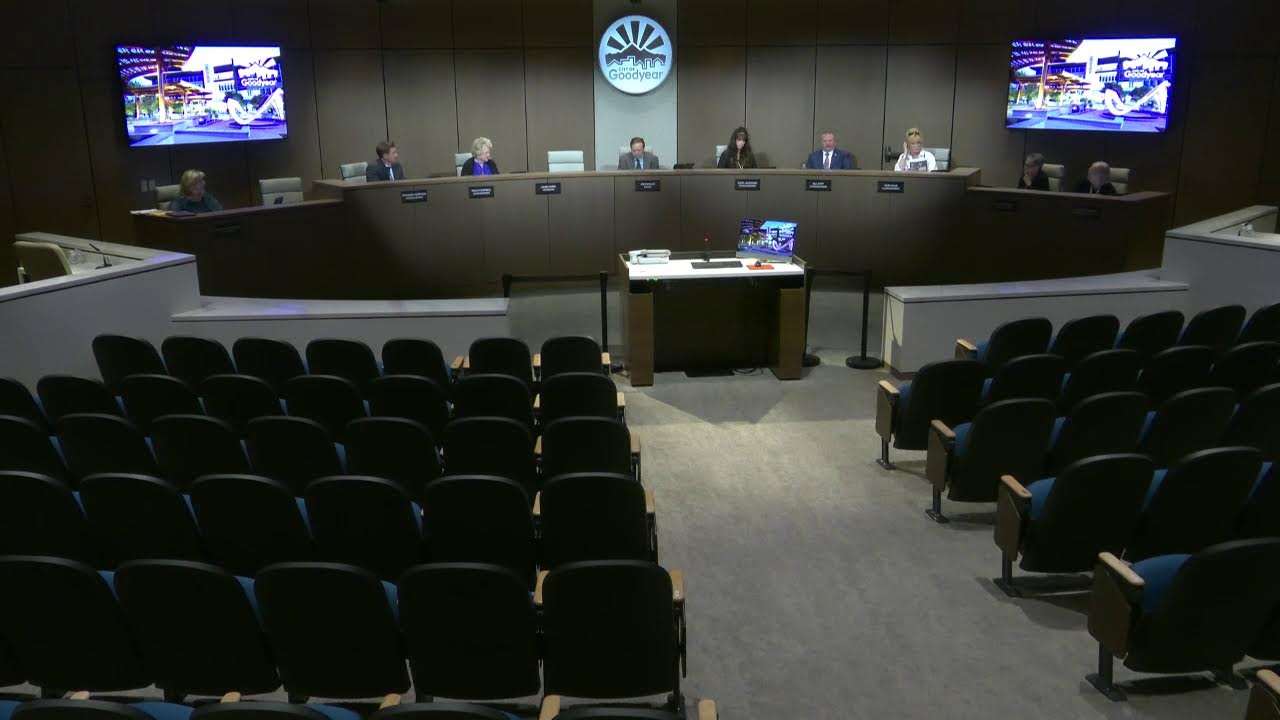
Goodyear City Council meeting featuring contentious rezoning debate over industrial development in Seda community, airport noise complaints, and approval of municipal facilities rezoning and residential development.
Goodyear Council Approves Southwest Next Industrial Rezoning Despite Nine Seda Residents' Pleas for Commercial Development
On October 30, 2023, the Goodyear City Council voted 7-0 to rezone 32.43 acres at Citrus Road and Indian School Road from C2 general commercial to I1 light industrial, clearing the way for Southwest Next's employment center proposal. The decision capped a contentious public hearing in which residents of the adjoining Seda community passionately opposed the project, framing it as another example of being "forgotten" and isolated by warehouses, while the developer and staff defended the rezoning as the only economically viable use for a site constrained by military noise regulations and decades of failed commercial marketing.
Key Speeches
"I'm sure they're great jobs they're just not jobs that we need. We have enough of them. How many more warehouses do we need? It just doesn't make sense, and I really I just think there's no urgent need to change this zoning. Let's work with the developer to come up with something better." — Morin Killian, Seda resident
"This is an employment center. It's an employment center that purposefully transitions from west to east. These buildings on this conceptual plan are much smaller than what would occur over to the east. Importantly, any truck-associated activities are centralized in these buildings... even if this employment center site does not develop with this actual layout, the work with staff has been ongoing." — Ed Bull, attorney for Southwest Next
"When we talk about this end of the city and that departure quarter coming out of the end of the runway, that whole area really starts to expand pretty wide. When you look at the departure out of Luke, that whole swath of land is essentially No Man's Land. The only thing that can really effectively go in there is going to be what we generally term industrial. Imagine a grocery store on the corner of Citrus and Indian School with those jets flying. I just I can't." — Councilmember Trey Terry
"I would hate to lose commercial property to light industrial or warehouses. I feel like you guys kind of forget about us up there. Now we have this huge barrier of miles of warehouses between us and the city." — Linda Peroni, Seda resident
Timeline
-
Staff presentation: Steve Kia, planning manager, walked council through the site's history (rezoned from agricultural to C2 commercial in 2007 as part of an Able Ranch–related plan that never developed), its location within Luke Air Force Base's 65-decibel noise contour overlay (which prohibits residential use but encourages non-residential industrial), and the applicant's proposed four-building concept plan ranging from 29,000 to 271,000 square feet, with internalized truck courts and 50-foot buffers plus 13-foot screen walls on the north side abutting future Able Ranch homes.
-
Applicant presentation: Ed Bull (Withey Morris, PLC), representing Southwest Next (with principals Nico Howard and Michaela Forest), emphasized that the C2 commercial corner is retained (approximately 5 acres) and that the I1 industrial portion (32 acres) would not support a 36-acre shopping center lacking a 360-degree trade area. Bull noted the site's design as an employment center with smaller buildings on the west transitioning to more intense industrial on the east; highlighted 27 stipulations locking in truck-court orientation, landscaping, and buffering; and disclosed that the applicant exceeded standard 500-foot notification by door-knocking and meeting with Seda residents, moving at least one opponent (Charles Summer) to support.
-
Public comment: Eight speakers opposed, one in support. Opposition themes: noise, traffic, light pollution, property value decline, lack of retail/commercial amenities for day-to-day needs, community isolation, and frustration with incomplete street projects (Indian School Road, Camelback Road). Ken Hubble, Gabriel Candeleria, Melinda Griselle, Michael Urbansky, Kaylee Crain, Linda Peroni, Morin Killian, and Flur Hart all cited the location's distance from essential services, the already-proliferating warehouse development in the area, and the sense of being cut off from the rest of Goodyear by multiple layers of industrial zoning. Flur Hart highlighted that residents had moved to Goodyear expecting a "vibrant community" and were disappointed by the direction of development. Charles Summer, the sole supporter, praised the project for accelerating street improvements that have long plagued the area (particularly Indian School Road) and noted that commercial development was unlikely to materialize within the next 2–5 years.
-
Council discussion: Vice Mayor Laura Kaino thanked residents for their engagement and staff for the 27 stipulations, acknowledging Seda's beautiful homes but noting the broader challenge: without density (Seda has only ~1,100 homes), commercial uses cannot survive. Councilmember Brannon Hampton pressed for clarity on Able Ranch's position (staff confirmed no opposition), street completion timelines (Christopher Rodriguez, Director of Mobility and Development, reported Indian School north half expected by March 2024; Camelback delayed by utility conflicts), light mitigation (the city's lighting code will govern; directional shielding required), and whether noise caps or hours-of-operation restrictions should be added. Ed Bull and staff (Steve Kia) pushed back gently, noting that tenants are unknown and 27 stipulations already lock in orientation and buffering. Councilmember Wally Campbell questioned whether the smaller western buildings could attract non-warehouse uses (offices, veterinary clinics, karate studios, sandwich shops) and noted the Bullard area light-industrial corridor hosts diverse small businesses. Councilmember Trey Terry provided crucial context: the entire Citrus-Indian School corridor west of the 303 was always slated for post-agricultural conversion; all nearby Microsoft and other industrial projects were formerly AG land; and the site's position in the Luke departure zone makes commercial retail infeasible (jets fly at low altitude). Trey Terry also voiced frustration that a 2–3 week project at Van Buren and Australia Parkway (a far busier intersection) could not attract a single commercial user, and cited research indicating Kroger, Safeway, Albertson's, Walmart, Amazon, and Target now control the grocery market—no new stores will be built within 2 miles of existing outlets. Councilmember Vicki Gillis asked about the two closest western buildings' potential for small-business tenants and confirmed the designation permits offices, veterinary uses, and up to 25% retail as accessory use.
-
Vote: 7-0 on both Resolution 2023-2340 (declarations of public records) and Ordinance 2023-1588 (rezoning).
Opposition
-
Number of speakers against: 8 (Ken Hubble, Gabriel Candeleria, Melinda Griselle, Michael Urbansky, Kaylee Crain, Linda Peroni, Morin Killian, Flur Hart), plus 3 cards indicating opposition without speaking (William Fugatti, Pamela Fugatti, Parker Crean), and 1 card opposing but without statement (Debbie Pachella), for a total of 12 opposed.
-
Main concerns:
-
Noise and traffic: Residents cited 24/7 truck movement, diesel idling, and delivery-related noise as incompatible with the nearby future Able Ranch residential community and existing Seda homes.
-
Warehouse proliferation: Multiple speakers noted that 18 warehouses were constructed in the Camelback–Indian School corridor in just three years, plus two under construction. Residents questioned why additional industrial capacity was needed when the area is already saturated.
-
Property value decline: Multiple speakers expressed concern that living adjacent to a 270,000-square-foot industrial building would depress home values and make resale difficult. Kaylee Crain stated she would not have purchased her home if she knew a warehouse would be built there.
-
Community isolation and lack of retail: Seda residents repeatedly emphasized they must drive 15–20 minutes to Buckeye, Surprise, or Litchfield Park for essentials (pharmacy, grocery store). Linda Peroni and others pointed to the boom at Jack Rabbit (Buckeye) and Fries (Litchfield Park) as evidence that demand exists for commercial retail if density reaches critical mass. Residents felt their tax dollars were flowing to other cities rather than staying in Goodyear.
-
Broken promises on street completion: Gabriel Candeleria, Linda Peroni, and others complained that Microsoft's landscaping has not been completed and Indian School Road and Camelback Road remain partially unfinished after years of delay. They questioned whether the developer would be held accountable for stipulated street improvements or would abandon them like others have.
-
Loss of commercial zoning and missed opportunity: Ken Hubble and others noted that the general plan designated the corner as "business and commerce" and urged council to preserve that zoning and allow market forces to eventually attract retail as the area densifies.
-
Community character degradation: Michael Urbansky described being "isolated" by a "three-mile wall" of trucks and buildings; Gabriel Candeleria invoked the mayor's campaign promise to maintain Goodyear as a "Premier Community to raise your family, play and work," arguing the rezoning contradicted that vision.
-
Most compelling arguments:
- Morin Killian's direct question: the mayor promised a "Premier Community," yet Seda residents feel abandoned and see warehouses, not amenities. Killian also noted that the average warehouse wage (
$17/hour) is insufficient for the average Seda home price ($765,000). - Michael Urbansky's observation that a smaller medical plaza or business-park use in the two western buildings could better serve the nearby Able Ranch and Seda residents than mega-warehouses.
- Linda Peroni's point that the corner of Citrus and Indian School, given the Verrado and Jack Rabbit boom just south of the city boundary, could become a viable commercial node if given time and if the city actively recruited retail tenants.
- Gabriel Candeleria's geometric framing: 170 feet (Able Ranch distance) is "less than a football field"; 650 feet (Seda distance) is still close enough to be affected by noise, light, and traffic.
- Morin Killian's direct question: the mayor promised a "Premier Community," yet Seda residents feel abandoned and see warehouses, not amenities. Killian also noted that the average warehouse wage (
-
Organized groups: The Seda community (which includes Able Ranch and environs) functioned as an informal opposition coalition. Multiple residents indicated they had received door-knocking visits from the applicant and/or had attended the Planning and Zoning Commission hearing on October 18. No formal neighborhood association was named, but the geographic cohesion and repeated appearance of "Seda residents" in speaker cards suggests active informal organizing.
Support
-
Number of speakers in favor: 1 (Charles Summer).
-
Main arguments:
-
Street improvements acceleration: Charles Summer noted that Indian School Road is partially closed with a stop sign creating long traffic delays. He argued that the developer (unlike absent commercial users) will be contractually obligated to complete street improvements and will have financial incentive to do so quickly. He anticipated completion within months rather than the years of delay already experienced with Meritage Homes and Microsoft.
-
Risk of prolonged vacancy: Summer cautioned that holding out for commercial development could leave the site vacant for 2–5 years or more, given the failed attempts to market it over the prior 15 years. An approved industrial project with a known tenant pipeline is more likely to deliver tangible improvements (streets, utilities) than continued speculation.
-
Realism about commercial viability: While Summer did not elaborate, his implicit argument aligned with staff and counsel's framing: the site's location within the Luke noise overlay and its small trade area make it unsuitable for the 36-acre shopping center that C2 zoning technically allows.
-
Most compelling argument: The accelerated delivery of street infrastructure, which even council member Brannon Hampton acknowledged as a priority concern for residents. Summer's testimony shifted the calculus from abstract "quality of life" to concrete near-term benefit (open roads).
-
Organized groups: None. Charles Summer appeared to be an individual Seda resident acting independently.
Project Details
-
Case number: Resolution 2023-2340 and Ordinance 2023-1588.
-
Applicant / developer: Southwest Next (principals Nico Howard and Michaela Forest).
-
Attorney: Ed Bull, Withey Morris, PLC.
-
Location / address: North and east of the northeast corner of Citrus Road and Indian School Road, Goodyear, Arizona. The broader area is bounded by Able Ranch residential to the north, industrial development and Microsoft facility to the south and east, farming and state land to the south, and Seda community (640 acres, ~1,168 homes) to the west across Citrus Road.
-
APN (if stated): Not stated in transcript.
-
Current zoning → Proposed zoning: C2 general commercial and unzoned land (agricultural equivalent) → I1 light industrial (with approximately 5 acres retaining C2 commercial zoning at the hard corner). The entire 32.43-acre site sits within the Luke Air Force Base 65-decibel noise contour overlay (Luke overlay), which permits non-residential uses only and discourages assembly-type residential.
-
Density / units / square footage: Conceptual site plan shows four buildings: 29,000 sq ft, 60,000 sq ft, 95,000 sq ft, and 271,000 sq ft (maximum). Stipulations require minimum 3 buildings and cap the largest at 270,000 sq ft. Total developable area approximately 32.43 acres after 303 Loop right-of-way acquisition; approximately 5 acres of C2 retained at the corner.
-
Changes from previous version (if reconsideration): Not a reconsideration. The property was rezoned from AG to C2 commercial (as part of Able Ranch) in November 2007 and has remained undeveloped and underutilized for 16 years.
-
Building height / max: 50 feet in I1 zone. Proposed buildings shown at approximately 40–45 feet, below the maximum. (Note: C2 zoning allows 56 feet, so the I1 restriction is actually more stringent.)
-
Stipulations (key 27): Among the 27 conditions, the most material include:
- Minimum 3 buildings on site.
- Maximum 270,000 sq ft for any single building.
- All truck courts and loading docks oriented internally; no access or parking facing north (Able Ranch) or west (Citrus Road toward Seda).
- 13-foot-tall screen walls on north side (Able Ranch boundary) with materials and colors matching the buildings.
- 50-foot buffer zone on the north with double-row trees extending east and west.
- No truck parking or maneuvering on the shared access drive with Able Ranch.
- Lighting will comply with city lighting code (Lighting Zone 2) requiring specified heights, shielding, and directional controls.
- Street improvements (medians, lane additions) to Citrus and Indian School roads per traffic impact analysis.
- (Not specifically detailed for this item in the industrial rezoning, but planning staff noted it applies to related projects.)
Vote Breakdown
-
Final: 7-0 (both Resolution 2023-2340 and Ordinance 2023-1588).
-
Yes: Mayor Joe Pizzillo, Vice Mayor Laura Kaino (voted by phone), Councilmember Brannon Hampton, Councilmember Wally Campbell, Councilmember Vicki Gillis, Councilmember Benita Beckles, Councilmember Trey Terry.
-
No: None.
-
Abstentions / absences: None.
Outcome & Next Steps
The rezoning was unanimously approved. Southwest Next and the city's Planning and Zoning Commission (which voted 6-0 to recommend approval on October 18) endorsed the project with the 27 protective stipulations. The ordinance becomes effective upon signature and recording.
Next steps include:
- Site plan and building plan review: Formal site plans and architectural elevations will be submitted and reviewed in compliance with the 27 stipulations.
- Street improvement coordination: City staff (Christopher Rodriguez, Director of Mobility) will work with Southwest Next on the phasing and timeline for Citrus Road and Indian School Road improvements. Rodriguez indicated staff expects to permit Indian School Road's north-half work by end of year, with completion by March 2024. He also noted that Camelback Road completion is delayed pending utility relocation and cited ongoing coordination with the city attorney's office to "prod along" the process.
- Utility coordination: City staff will continue to engage ADOT and private utility companies on conflicts (particularly along Camelback) that have delayed Meritage Homes and Microsoft projects. Wally Campbell asked that staff report back on why Meritage Homes has not completed Camelback as promised.
- Community engagement: Although the rezoning is approved, residents indicated they expect ongoing dialogue on street completion and the recruitment of non-warehouse tenants for the smaller western buildings. Wally Campbell expressed hope that the applicant will market the smaller I1-zoned buildings to veterinary clinics, offices, karate studios, and other service-oriented small businesses similar to those found in the nearby Bullard light-industrial corridor.
Controversies & Context
Luke Air Force Base noise overlay and land-use constraints: The entire site sits within the 65-decibel noise contour from Luke AFB runway departures. FAA rules and city general plan policy prohibit residential development on the "noisy side" of this line and encourage only non-residential (industrial/commercial) uses. This constraint has shaped the entire rezoning debate: residents cannot live on this land regardless of zoning, so the only question is whether it should be light industrial or commercial retail. However, retail (especially grocery stores, pharmacies, and restaurants) is economically unviable at this location given the aircraft noise and small trade area.
Market dynamics and retail desertification: Trey Terry comments revealed a macro real-estate reality: the grocery market is now dominated by four corporations (Kroger/Fries, Safeway/Albertson's, Walmart, Amazon/Whole Foods, and Target). These chains do not build new stores within 2 miles of existing outlets. Goodyear's western expansion (Seda, Verrado, Able Ranch) is growing to ~4,000–5,000 residents but remains below the density threshold (~150,000+ population center within 3 miles) that major retailers use for site selection. As a result, residents must shop in Buckeye, Surprise, or Litchfield Park—cities that benefit from Goodyear's sales-tax dollars.
Incomplete infrastructure and developer accountability: Residents repeatedly cited unfinished street projects (Indian School Road, Camelback Road) and incomplete landscaping (Microsoft facility) as evidence that the city cannot enforce development stipulations. Councilmember Wally Campbell asked staff to identify what Meritage Homes has failed to do; staff explained that Meritage Homes is contractually obligated but cannot proceed due to third-party utility conflicts (outside city control). However, the repeated invocation of these failures suggests a perception among residents that the city prioritizes developer interests over resident amenity. During the discussion, staff pledged to work with utilities to "prod along" lagging projects.
The Seda isolation thesis: Multiple residents framed the rezoning as the latest in a series of land-use decisions that have progressively isolated Seda (a newer, western subdivision built starting in 2005) from the amenities and retail core of Goodyear. Seda is bounded by the 303 to the west, agricultural/county land to the north and west, and increasingly by industrial zones (Microsoft, the proposed Southwest Next site, the future Able Ranch commercial/industrial corner) to the east and south. Residents feel that the city planned Seda but then designed the surrounding land use in ways that force them to drive miles to reach grocery stores, pharmacies, or restaurants. This dynamic has roots in the graduated-density concept (GDC), which restricts residential density in proximity to the Luke noise overlay. Seda, being just outside the noise contour, is zoned for single-family homes; but the land immediately to the east and south is zoned for non-residential uses, creating a buffer that inadvertently isolates the residential community.
Mayor's campaign promise and quality-of-life tension: Morin Killian invoked Joe Pizzillo campaign promise to maintain Goodyear as a "Premier Community to raise your family, play and work." Killian argued the rezoning contradicts that vision by prioritizing warehouse jobs ($17/hour) over retail and service businesses that would create community gathering spaces and enhance daily quality of life. This framing—development that generates tax revenue and employment but diminishes livability—reflects a broader tension in Goodyear's strategic planning between growth and amenity.
Duration
-
This item (Citrus and Indian School Rezoning): Approximately 90 minutes (presentations, public comment, council discussion, and voting).
-
Total meeting: Approximately 4.5 hours (five public hearings, multiple consent items, and business discussion).
Other notable items
Airport noise complaints: Three Seda residents (Brian McCardey, James Gordon, Dave Vodka) addressed council during non-agenda public comment regarding excessive aircraft noise from Goodyear airport and flight schools, including documented cases of aircraft flying as low as 285 feet above homes. McCardey presented a screenshot of an aircraft that departed before sunrise, flew over Goodyear 25 times over 2 hours 26 minutes, and never departed Goodyear. Residents requested the city engage flight schools to establish formalized noise abatement procedures (Goodyear airport has only ~3 procedures vs. Scottsdale's 15). Council referred the matter to staff for investigation. McCardey noted that the FAA and Phoenix Aviation Safety Advisory Group representatives attended, and that the largest flight school has not honored a verbal agreement to fly south of Interstate 10 or above 1,000 feet. Mayor and council indicated they would attempt to coordinate with the airport and flight schools on voluntary compliance.
Bond proposal and development impact fees: Dave Vodka raised concerns about the city's $135 million bond proposal (on the November 7 ballot) for traffic improvements, questioning why developers should not pay for growth-related infrastructure through development impact fees rather than asking taxpayers to shoulder the cost. Vodka noted that the draft Land Use & Infrastructure Plan dated October 16 proposes zero street-impact development fees, contradicting the stated principle that "new development will have an ongoing fiscal impact on the city [and] the development is responsible for construction of all infrastructure necessary to serve the site." The council did not directly address this comment.
Moose Lodge special use permit: The council approved a 5-year special use permit (7-0) for the Moose Lodge's relocation from its current Quonset Hut building (a World War II-era structure originally used as an airplane hangar) to a new 6,600-square-foot two-story building with a 7,000-square-foot patio on the same Cotton Lane site. The permit accommodates ADOT's Loop 303 expansion project, which will require the current building to be removed. Stipulations limit outdoor activity (music, entertainment) to 10 a.m.–10 p.m. Friday–Saturday and 10 a.m.–8 p.m. Sunday–Thursday, with all noise contained indoors after closing. The applicant must work with ADOT on land sale and timing; the 5-year approval period (vs. the standard 2 years) provides buffer time given the 2025 expected start of ADOT's Loop 303 project in that area.
Fusaro land reclamation extension: Approved 7-0. The special use permit extension permits a 7-year continuation of Fusaro's inert-material landfill operation at the southwest corner of 158th Avenue and Roosevelt Street (a former borrow pit). Trucks will import non-hazardous construction debris from across the valley. Completion is estimated to take another 5–10 years depending on construction activity.
Goodyear Municipal Complex rezoning: Approved 7-0. The 17.6-acre GMC site (southeast corner of 145th Avenue and Vanen Street) was rezoned from I1 light industrial to PFD public facilities district with PAD overlay to align zoning with actual uses: courthouse, police/fire administration, Franklin Pierce University, Solid Rock teen center (in the former library space), and Goodyear Wellness Center.
Astraea residential development rezoning: Approved 7-0. The rezoning of 37.43 acres (parcels 12, 25, 12.36, and 80 Notch) from mixed PAD/commercial/junior-high-school zoning to R16 residential with PAD overlay enables a cohesive single-family development connected to the Australia community. The site is approximately 1 mile south of Elliot Road, within the Astraea master-planned community. Stipulations include 20% open space, 50-foot minimum lot width, trail connectivity, and 5.36 acres of commercial zoning retained east of power lines.
Sign-free zone ordinance (Resolution 2023-2336): Approved 5-2. The council adopted criteria to establish two commercial-tourism-resort-and-hotel sign-free zones within city right-of-way, per Arizona Revised Statutes § 16-1019(F). The north zone (centered on Civic Square and Marketplace Falls area, slightly over 1 sq mi) and south zone (centered on Goodyear Ballpark and recreation campus, slightly over 0.34 sq mi) will prohibit political signs on public property during election cycles. The ordinance does not restrict signs on private property or limit other commercial signage. Councilmember Trey Terry expressed concern about overreach, noting he did not see a problem that warranted creating sign-free zones. Councilmember Vicki Gillis and Brannon Hampton voted no, citing free-speech concerns and questioning why the city needs to restrict political signage. Councilmember Wally Campbell supported the measure, citing visual clutter and noting that commercial candidates often leave signs up indefinitely after elections. Council member Benita Beckles and others noted that ADOT properties (such as the 303 freeway entrance ramps) fall outside city jurisdiction, and pledged to coordinate with ADOT to address political signs appearing on state property. The resolution passed 5-2 (Brannon Hampton, Vicki Gillis, and Trey Terry voted no; Joe Pizzillo, Laura Kaino, Wally Campbell, and Benita Beckles voted yes—with one vote unclear in the transcript due to phone line quality).