Gilbert approves marijuana facility expansion to 5,000 square feet; $7 million COVID relief passes unanimously
Gilbert Council approved routine consent items and marijuana facility code amendments but was heavily pressured by 24 organized residential property owners opposing a controversial wastewater project requiring land acquisition, with Mayor Peterson agreeing to meet with residents amid escalating threats of legal action and media involvement.
Gilbert Council Gridlocked on Wastewater Sewer Project as 24 Organized Homeowners Demand Meeting and Threaten Legal Action
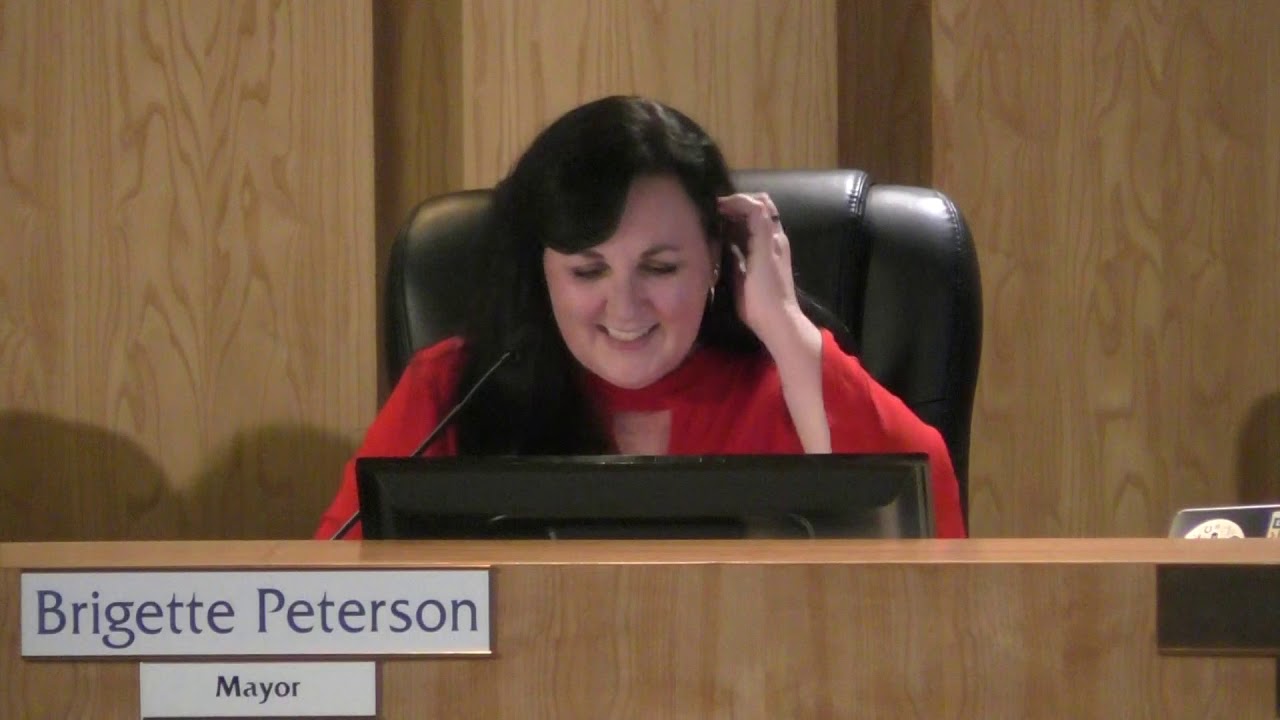
Mayor Bridget Peterson's Gilbert Town Council met on February 16, 2021, to approve routine consent items and policy amendments, but the evening was commandeered by an unprecedented show of organized residential opposition to a wastewater infrastructure project that threatens to condemn nearly an acre of family property across multiple lots. Twenty-four property owners, some with decades of tenure in the town, crowded the public comment period with testimony that the town had chosen the most expensive, property-invasive solution to a sewer line repair initiated without public hearing in 2017, and they vowed sustained pressure—including legal action and media escalation—unless the council agreed to meet with them and reconsider less intrusive alternatives.
Key Speeches
"I know there are other options that are less expensive than purchasing our lands and I'd like to view those other options and I feel that this is an invasion of our rights and privacies as landowners." — Tom Patterson, 241 East Hemlock Avenue
"I just want to tell you a couple things I've owned my property for 30 years and we bought it because it's acreage and my wife and my autistic daughter they have their horses on our acreage one of the problems with this proposal is it'll shut off our backside where we have feed trucks and stuff bringing all of our hay and stuff to the barn." — Ron Mayor, property owner, 30-year resident
"The neighbors and I are more than willing to allow access for an extended period of time to do the sleeve in place cured bonded project that you are going to have to do anyways this is a fix for the sewer line which is ultimately what this whole debate is about we're letting you know that we are going to begin contacting news agencies local media outlets the state government the goldwater institute as well as attorneys." — Stacy Adams, 573 East Commerce Avenue
"I am ashamed and embarrassed to live work and teach in a city that finds it so easy to facilitate lies I am truly sorry to use that word but I think that word is necessary." — Leslie Novak, teacher, sewer project opponent
"We did say that we would plan a meeting and we have been in the process of doing that we had a very busy schedule for the past two weeks and just had no time to fit that meeting in this week was not possible either so we're looking at planning a meeting with all of you for next week and I think I stated that we would be looking for the end of February beginning of March." — Mayor Bridget Peterson, responding to opposition
Timeline
Wastewater Sewer Project Item (1060 Concrete Pipe Sewer Repair):
- Project initiation: 2017, without public hearing or notice to affected property owners.
- Planning expenditure: Town of Gilbert contracted Jacobs Engineering for approximately $250,000 in planning and design.
- Three options presented to prior council: Staff identified three repair methodologies; council selected the option requiring residential land acquisition—the most expensive and longest-construction approach.
- Affected properties: 24 residential lots on Honeysuckle Lane, East Commerce Avenue, and East Hemlock Avenue.
- Public comment: 14 citizens spoke during the public comment period (assigned 2 minutes each). Speakers included Tom Patterson, Julia McCleave, Victor McCleeve, Arlen Lewis, Omar Hameed, Ron Mayor, Kirk Nelson, Cole Ratliff, Victoria Schaefer, Stacy Adams, Greg Davis, Leslie Novak, and Char Hawkins. All opposed the project as currently scoped; all requested tabling pending a council–property owner meeting.
- Council response: Mayor Peterson stated the council had begun planning a meeting with affected residents and expected to confirm details by the next day, with the meeting targeted for late February or early March 2021. No vote was taken; the item appears to have been informally tabled pending that meeting.
- Outcome: Tabled pending council–property owner meeting scheduled for late February/early March.
Marijuana Facility Code Amendment C20-10:
- Applicant presentation / staff recommendation: Josh Rogers (town staff) explained that the amendment expands permissible square footage for marijuana commercial activities from 2,500 to 5,000 square feet and removes duplicative security requirements already codified in Arizona state law following Proposition 207 (Smart and Safe Act). The amendment affects one current dual-licensee facility in Gilbert.
- Council discussion: Council Member Hendricks raised concerns about the inconsistency between the council's decision one month prior to add restrictions to residential marijuana cultivation (to limit expansion in residential zones, citing Diocese concerns) and tonight's decision to double the permissible commercial square footage. Hendricks questioned whether the town was protecting property rights differently based on whether owners retain lobbyists or make campaign contributions. Vice Mayor Yung Koprowski asked whether the amendment was mandated by Proposition 207 or voluntary; staff clarified it was voluntary but aligned town code with state law. Kathy Tilke noted the amendment responds to the council's October decision to prohibit stand-alone recreational facilities, allowing only dual-licensee operations.
- Public comment: None recorded during this item.
- Vote: 7–0 approval.
Code Amendment (Item 28a) — Contractor Debarment Clarification:
- Council Member Tilke's proposal: Tilke moved to clarify the debarment language in the ordinance by adding the phrase "of a character which is deemed to be so serious as to justify suspension or debarment" to subsection b5, to avoid using vague language ("any other cause") that could allow disparate treatment based on rumor or political pressure.
- Vote: 7–0 approval with clarification.
COVID-19 Rent and Utility Assistance Program (Items 15a and 20):
- Staff presentation: Melanie Martinez, town staff, explained that the program allocates $7 million in federal COVID-19 relief funds for rent and utility assistance to households at or below 80% area median income (AMI). The program is administered through two contract providers.
- Council discussion: Council Member Amy Yentes questioned the scope and necessity of allocating the full $7 million, asking for demonstrable evidence of community rent and utility needs and expressing concern about federal deficit spending. Martinez confirmed that quarterly reporting would be required and that any unused funds must be returned to the federal government. Yentes also asked whether the program could be scaled to a smaller allocation if community need analysis showed a lower figure was necessary; Martinez clarified the $7 million was a formula allocation from the U.S. Treasury and could not be reduced at the time of application. Martinez also clarified that while the program permits assistance for up to 12 months, the town intends to provide only 3 months of assistance initially, with recertification required after three months to ensure continued eligibility.
- Vote: 7–0 approval.
Municipal Building Renovation Project (Item 17):
- Council discussion: Council Member Yentes objected to the project's scope and budget overrun, stating that while the building requires improvements, the current renovation design is excessive given competing community needs and residents experiencing COVID-related hardship. Yentes opposed funding a ~$16 million renovation to municipal facilities while simultaneously hearing testimony from residents facing eviction or utility shut-off.
- Vote: 5–2 approval (Yentes and one other council member dissented; individual votes not stated in transcript).
Consent Calendar and Other Items:
- Consent items 3–15, 16, 18–19, 21–25, 30–31: Approved 7–0 (combined vote).
- Item 29 (Budget and Contingency Report): Accepted 7–0.
- Items 26 and 27: Approved 7–0.
Opposition
Number of speakers against wastewater project: 14 citizen speakers; all 14 opposed the sewer project as currently scoped or raised concerns. (The council also noted that organized property owners had indicated they would "keep coming here every two weeks until this issue resolved.")
Main concerns (numbered list):
-
Lack of public process: Project initiated in 2017 without public hearing or notice to affected homeowners; one speaker (Victoria Schaefer) noted she purchased her property in April 2020, refinanced in November 2020, and was never notified of the project despite being directly affected.
-
Cost and unnecessary expense: Town spent $250,000 on Jacobs Engineering planning; proposed land acquisition will cost additional millions (estimated "likely more than two million dollars" by Stacy Adams), when less expensive alternatives (cast-in-place, cured-in-place pipe repair) are available and can achieve the same repair result.
-
Availability of less invasive alternatives: Multiple speakers (Arlen Lewis, Greg Davis, Omar Hameed, Stacy Adams) asserted that the sewer line can be repaired using cast-in-place or sleeve-in-place methods from manhole to manhole without requiring land acquisition; town staff (according to Julia McCleave's testimony) confirmed that "several options" were available and that "one option" would have required no added town expense.
-
Overstated access concerns: Arlen Lewis stated that four of the seven or eight manholes involved in the project are on his property and accessible by semi-truck; access has never been a problem in the past, as town and SRP have accessed these manholes with permission numerous times. Greg Davis similarly noted that manhole rehab excavations are approximately 10 feet by 4 feet deep and do not require removal of significant acreage.
-
Property rights and personal hardship: Ron Mayor described impact on his family's ability to access feed and hay delivery to a barn and to allow his autistic daughter to ride horses on acreage he purchased specifically for that purpose. Cole Ratliff noted he would lose grazing land for horses. Victoria Schaefer, a single woman in her 50s who purchased her property as a "forever home" and refinanced to improve the backyard, stated the land acquisition would "wreck" her. Char Hawkins, a 60+ year Gilbert native, expressed disappointment that the town had not notified her of the project for years despite knowing of it since 2017.
-
Inequitable treatment / selective enforcement: Cole Ratliff raised the issue that Gilbert Road Self-Storage, which also has a sewer line running through its property with "actually more access" than his backyard (per satellite imagery), will be exempted from land acquisition because it is a business. Ratliff questioned why residential properties must lose land when a commercial facility is allowed to keep theirs.
-
Secondary impacts of beautification project: Victoria Schaefer noted that a planned beautification project at the end of the sewer work would place a wall 20 feet from her bedroom window and kitchen, potentially facilitating an open market and additional foot traffic that would compromise her security and quality of life.
Most compelling arguments:
- The availability of cast-in-place repair methods that do not require land acquisition, confirmed indirectly by Julia McCleave's testimony that "staff" told her multiple options existed and one would have had "no added expense to the town."
- The inequitable treatment of residential versus commercial properties (self-storage exemption), which raised equity concerns and suggested the decision was driven by factors other than operational necessity.
- The procedural failure to notify affected homeowners of a project initiated in 2017, allowing recent purchasers like Victoria Schaefer to buy property without disclosure of a pending land acquisition.
- The cumulative expense: $250,000 already spent on planning plus millions more for land acquisition versus the cost of alternative repair methods.
Organized groups:
Omar Hameed stated: "the people that you see behind me are 24 neighbors we're going to keep coming here every two weeks until this issue resolved." The 24 property owners appeared to be informally coordinated through shared testimony on similar themes and indicated intent to escalate to media, state agencies (Goldwater Institute), and legal counsel if not granted a timely meeting with the council.
Support
No speakers supported the wastewater project as currently scoped. The only council member to comment in favor of the project did not speak during the public comment period; instead, the project was informally tabled pending a council–property owner meeting.
Project Details
Wastewater Sewer Project (1060 Concrete Pipe Sewer Repair):
- Case number / Project ID: Not stated in transcript; referred to as "1060 concrete pipe sewer project" and "sewer project on the canal."
- Applicant / developer: Town of Gilbert (municipal project).
- Attorney / Planning consultant: Charlie Grombacher, Jacobs Engineering (planning consultant; $250,000 contract).
- Location / address: Sewer line along Honeysuckle Lane, East Commerce Avenue, and East Hemlock Avenue, Gilbert, Arizona. Runs near Gilbert Road Self-Storage and the canal.
- Affected properties (approximate count): 24 residential parcels.
- Named affected property owners: Tom Patterson (241 East Hemlock Avenue), Julia McCleave (436 North Honeysuckle Lane), Victor McCleeve, Arlen Lewis (420 North Honeysuckle Lane), Omar Hameed (Honeysuckle Lane), Ron Mayor, Kirk Nelson (249 East Hemlock Avenue), Cole Ratliff (525 East Commerce Avenue), Victoria Schaefer (261 East Hemlock Avenue), Stacy Adams (573 East Commerce Avenue), Greg Davis (461 East Commerce Avenue), Leslie Novak, Char Hawkins (549 East Commerce Avenue).
- Current scope / proposed action: Town of Gilbert proposes to acquire residential land from 24 property owners to facilitate repair of 1060-diameter concrete pipe sewer line. Project initiated in 2017 without public hearing. Three repair options were evaluated by Jacobs Engineering; town selected the option requiring land acquisition (most expensive, longest construction timeline, most property-invasive). Alternative options using cast-in-place or cured-in-place pipe repair methods are asserted by property owners and implied by staff testimony to be available but rejected by town.
- Estimated land acquisition cost: Approximately $2 million+ (per Stacy Adams); exact figure not provided in transcript.
- Total project cost: Not clearly stated; estimated significantly higher when land acquisition is added to the $250,000 planning investment and construction costs.
Marijuana Facility Code Amendment C20-10:
- Case number / Amendment ID: C20-10.
- Applicant / Developer: Not named; affects one existing dual-licensee marijuana dispensary in Gilbert.
- Attorney: None mentioned.
- Current zoning → Proposed zoning: No zoning change; land development code amendment only.
- Current permitted square footage for marijuana activities: 2,500 square feet.
- Proposed permitted square footage: 5,000 square feet (doubling).
- Key changes: Expansion of permissible square footage for marijuana commercial activities; removal of duplicative security requirements already codified in Arizona Proposition 207 (Smart and Safe Act).
- Affected facilities: One current dual-licensee dispensary in Gilbert (able to provide both medical and recreational marijuana under Proposition 207).
- Policy context: Amendment is a conforming change to the council's October 2020 decision to prohibit stand-alone recreational marijuana facilities; only dual-licensee operations are permitted in Gilbert.
Vote Breakdown
Marijuana Facility Code Amendment C20-10 (Item 28):
- Final: 7–0
- Yes: Mayor Bridget Peterson, Vice Mayor Yung Koprowski, Councilmember Scott Anderson, Councilmember Lauren Hendricks, Councilmember [third name not clearly stated in roll], Councilmember Kathy Tilke, Councilmember Amy Yentes.
- No: None
- Abstentions / absences: None
Code Amendment Item 28a (Contractor Debarment Clarification):
- Final: 7–0
- Yes: All council members
- No: None
COVID-19 Rent and Utility Assistance (Items 15a and 20):
- Final: 7–0
- Yes: All council members
- No: None
Municipal Building Renovation (Item 17):
- Final: 5–2
- Yes: 5 council members (names not individually stated)
- No: Councilmember Amy Yentes, and one other council member (name not stated in transcript)
Consent Calendar Items 3–15, 16, 18–25, 30–31:
- Final: 7–0
- Yes: All council members
Budget and Contingency Report (Item 29):
- Final: 7–0
- Yes: All council members
Items 26 and 27:
- Final: 7–0
- Yes: All council members
Outcome & Next Steps
Wastewater Sewer Project:
The project was not brought to a vote. Mayor Bridget Peterson committed to scheduling a meeting with affected property owners for late February or early March 2021, with confirmation expected to be sent to residents by the next day (February 17, 2021). The property owners have organized to apply "consistent pressure" to ensure the meeting occurs and have threatened escalation to media outlets, state agencies (Goldwater Institute), and legal counsel if the council does not reconsider the project scope.
Marijuana Code Amendment C20-10:
Approved 7–0. Effective upon council passage. The amendment permits the existing dual-licensee dispensary in Gilbert to expand its operational footprint from 2,500 to 5,000 square feet and removes redundant security code provisions, bringing town code into alignment with Proposition 207 requirements.
COVID-19 Rent and Utility Assistance:
Approved 7–0. The town will administer $7 million in federal COVID-19 relief funds for rent and utility assistance to households at 80% AMI or below, through two contract providers. Assistance will be provided for up to three months initially, with recertification required after three months. Quarterly reporting is mandated, and any unspent funds must be returned to the federal government.
Municipal Building Renovation:
Approved 5–2. The project will proceed despite exceeding budget; Council Member Yentes opposed on grounds that the scope is excessive given competing community needs and resident hardship from COVID-19.
Controversies & Context
The Wastewater Sewer Project Controversy:
The controversy surrounding the 1060 concrete pipe sewer project spans several contentious issues:
-
Lack of transparency and due process: The project was initiated in 2017 without public hearing or notice to affected homeowners. Property owners were not informed of the project's existence or its implications for their properties until representatives from Jacobs Engineering began appearing at their doors in December 2020 (Christmas season), according to Char Hawkins' testimony. This procedural failure is particularly acute given that recent purchasers like Victoria Schaefer, who bought in April 2020 and refinanced in November 2020, were never disclosed of the project despite being directly affected. No environmental assessment or public notice requirement was apparently triggered.
-
Selection of the most expensive, invasive alternative: Town staff presented three repair methodologies to the prior council. The council selected the option requiring residential land acquisition—described by Arlen Lewis as "the most expensive by far the longest construction time by far the most infringing on personal rights personal property rights by far." Property owners assert that cast-in-place or cured-in-place pipe repair methods are available, less costly, and would achieve the same repair result without requiring property seizure. Julia McCleave testified that town staff explicitly told her "several options" existed and that "if you'd taken the one option we wouldn't be here because there wasn't going to be added expense to the town." This claim directly contradicts the rationale for the current proposal.
-
$250,000 investment in planning for a rejected approach: Jacobs Engineering was contracted (at a cost of approximately $250,000) to plan and design the project. Property owners question whether this sunk cost has biased the decision-making process in favor of the option that Jacobs designed, rather than allowing objective re-evaluation of alternatives.
-
Equity and selective enforcement: Cole Ratliff raised a critical equity issue: Gilbert Road Self-Storage, which also has a sewer line running through its property, is exempted from land acquisition despite having comparable (or even greater) access to the sewer line than residential properties. This disparate treatment raises questions about whether the decision is driven by operational necessity or by the fact that a commercial entity is better positioned to resist condemnation than individual homeowners. The self-storage facility's exemption undermines the town's rationale that land acquisition is operationally necessary.
-
Impact on vulnerable residents: Several speakers described personal hardship: Ron Mayor's family's inability to deliver feed and hay to their barn, and the loss of riding space for his autistic daughter; Victoria Schaefer's recent purchase as a "forever home" on acreage being threatened; the reduction of grazing land for horses on multiple properties. These impacts fall disproportionately on families who purchased property for specific uses (horses, acreage, rural character).
-
Secondary impacts and quality of life: Victoria Schaefer raised concerns that a planned beautification project following sewer completion would place a wall 20 feet from her bedroom window and kitchen, potentially facilitating public foot traffic and an "open market" that would compromise her security and privacy—effectively converting her private residential property into a public corridor.
-
Organized, escalating opposition: The 24 affected property owners have organized sustained opposition, promised to attend every council meeting, and explicitly threatened escalation to local media, state agencies (Goldwater Institute), and legal counsel. Stacy Adams stated: "we are going to begin contacting news agencies local media outlets the state government the goldwater institute as well as attorneys in order to help achieve our ultimate desire of keeping our land." This level of organization and threat of legal action suggests potential litigation risk and reputational cost to the town.
Marijuana Code Consistency Issue:
Council Member Hendricks raised a substantive concern about the inconsistency between the council's stance on residential versus commercial marijuana expansion. One month prior, the council passed amendments to the residential building code (reportedly at the urging of the Diocese) to limit residential marijuana cultivation, citing concerns about environmental health and community welfare. Tonight, the council is voting to double the permissible square footage for commercial marijuana facilities. Hendricks questioned whether this reflects differential protection of property rights based on the owner's ability to hire lobbyists and make campaign contributions, rather than on principled land-use policy. Hendricks voted for the commercial expansion despite these concerns, stating it was necessary to protect property rights consistently; however, the tension between protecting commercial property rights (through expansion) while restricting residential property rights (through cultivation limits) remains unresolved.
Duration
- Public comment on wastewater project: 14 speakers × 2 minutes each = approximately 28 minutes of testimony, plus brief staff responses.
- Total meeting duration: Not explicitly stated in transcript; appears to have run approximately 2–2.5 hours based on the number of agenda items and public comment.
Other Notable Items
Sister Cities Annual Update: Greg Tilke, president of Gilbert's Sister Cities Board, delivered an annual update on the town's relationships with Antrim & Newtownabbey (Northern Ireland) and Lachang (China), highlighting youth ambassador exchanges (140 students exchanged over two decades), business development initiatives, and the planned development of a sister cities garden at the regional park. The presentation included video greetings from the mayor and deputy mayor of Antrim & Newtownabbey. This item was largely procedural and celebratory, with no controversy or dissent noted.
Judicial Selection and Advisory Board Appointments: The council appointed eight members to the Judicial Selection and Advisory Board, with varying term lengths (one, two, or three years). This consent item passed 7–0 with no discussion.