Gilbert avoids Morrison Ranch rezoning vote amid resident opposition; approves Coulee Station mixed-use project
October 18, 2022 Gilbert Town Council meeting featured heated public opposition to unscheduled Morrison Ranch rezoning proposal and approval of Coulee Station development, with controversy over meeting decorum and free speech enforcement.
Morrison Ranch Industrial Rezoning Draws 20-Plus Opponents in Non-Agenda Public Outcry; Coulee Station Unanimously Approved; Mayor Defends Decorum Rules as Constitutional Free-Speech Lawsuit Looms
On October 18, 2022, the Gilbert Town Council witnessed an unusual procedural collision: a major rezoning proposal not on the formal agenda—Indicap's plan to rezone approximately 250–280 acres near Power Road for industrial use—dominated the public comment period with overwhelming residential opposition, while a separately filed mixed-use development at Williams Field and Recker roads (Coulee Station) received unanimous approval with minimal discussion. The meeting also erupted into a confrontation over public decorum enforcement, free speech, and the mayor's authority to eject speakers holding protest signs.
Morrison Ranch Rezoning: Off-Agenda, High-Heat Opposition
The Morrison Ranch industrial rezoning dominated communications from citizens despite not appearing on the formal consent or action agenda. More than 20 residents submitted written opposition cards, and several spoke during the three-minute public comment window, each citing the General Plan's Morrison Ranch character area and the incompatibility of large warehouse and light industrial buildings with established single-family neighborhoods on Gilbert's east side.
The written statements, read into the record by Vice Mayor Amy Entes, included:
-
Robert Jones: "Branch current proposal is an insult to local community jobs for Community is a farce 950 semi truck base next to three schools this plan only makes sense for someone other than the local community."
-
Jackie Cottrell: "Against the ranch I post rezoning of the ranch almost the entire east side of this land is residential there's no land or buffer to soften the blow of putting large industrial buildings right next to our homes even with it being close to freeways our homes need to be taken into consideration."
-
Karen Mountford: "I oppose the changing of the zoning on power row between Elliot and Warner when we purchased their homes we were told the property would be used in a different zoning."
In total, 23 written statements were entered into the record opposing the Morrison Ranch proposal.
Among the five speakers who addressed the council in person, several offered detailed critiques grounded in the town's adopted General Plan:
Stephanie Evans, a seven-year resident and precinct committeeman, articulated a measured but pointed objection:
"I am grateful for a plan that takes into account the importance of growth while maintaining the foundational characteristics that make this town desirable. I recognize it's not an easy balance for you trying to ensure an appropriate mix of residential commercial and Industrial uses in our town. We certainly need all of it and I don't envy the responsibilities you shoulder. It was encouraging to me to read over the 177 Pages—props to whoever wrote that General plan for Gilbert—it was encouraging to see the 77 policies that guide the town's decision-making process. A lot of thought was put into our Town's General plan. The Morrison Ranch character area in particular is a highlight of the town. I don't know of anyone in Morrison Ranch who moved here by chance it's a desired location for good reason. The tree-lined white picket fence neighborhood with wide setbacks are idyllic and a desired place to raise a family. The trails green belts and Open Spaces are a clear indication you are in Morrison Ranch. I could just end by saying I know that it's a growth Corridor but I also know it's a character area and I don't think it was a mistake that they overlap."
Brian Mosley, who spoke for the Planning Commission on the proposal at an earlier meeting, returned to make an analogy comparing the industrial rezoning to the long struggle against indoor smoking in restaurants:
"My kids asked me you know what are you doing coming to all these meetings it's not even on the agenda I said it's like open mic night the town crazy wants to come and say we need to paint all the police cars pink then they can do that and you have to listen. 25 years ago my dad was that town crazy. He got up in a meeting in our small suburban town uh farming Community becoming a suburb. I thought that was crazy that we were smoking in our restaurants and of course the Town Council thought he was crazy and no politician in Arizona ever changed it Tempe by referendum of the citizens became the first state or the first city to ban smoking in restaurants in 2002. Whether it's 255 or 260 Acres or 280 Acres light industrial it doesn't belong next to our neighborhood any more than smoking belongs in our restaurants. It just doesn't fit with the neighborhood. It doesn't work. It harms us."
Ryan Handelsman delivered a more combative assessment, alleging that the project had been the town's initiative rather than the applicant's, and expressing skepticism that residents would be heard:
"The amount of data and facts that's been being presented is uh to justify the opposition of the project and its negative impact uh both short and long term for Gilbert proper not just to the neighborhoods and the surrounding area it's alarming. What's even more concerning to me is the high probability that the fact that these facts will be ignored by the planning board and most likely all of you. It becomes clear to me by the day that this monstrosity was in fact the town's idea Indicap is going through the motions and meeting with neighbors and sending Jen Daniels out but with no obvious intent. It's like one of you listening to us during a residence uh during a council meeting and walking off to get a Diet Coke they're listening but they're obviously not hearing what they have what we have to say."
Handelsman also leveled corruption allegations:
"From spoot feeding developers information to ethics complaints stealing campaign signs censorship uh campaign contributions closed-door meetings the perception is that most of this council is corrupt bought and paid for."
He concluded by urging the council to vote no "to salvage whatever votes you have left," warning that "vote yes on the ranch" would seal the council's "fate in Gilbert politics."
No council member responded to the Morrison Ranch speakers during the meeting. The rezoning was not called for a vote. It remains unclear whether the matter will be formally agendized for the Planning Commission or Town Council at a future date, or whether the absence of a vote represents a de facto indefinite deferral.
Public Comment Decorum Dispute: Free-Speech Lawsuit Threatened
The most heated exchange of the evening came when Brandon Riff addressed the council regarding recently adopted decorum rules, which had prompted the mayor to eject speakers holding protest signs during earlier portions of the meeting.
"I'm here well I had to kind of rewrite my speech a little bit here but I saw the sandwich board and I have a few issues with it um two things one it's unconstitutional and two it's unenforceable under Arizona law uh I'll get specific with you first on the unconstitutional part it is true that the council can impose time place and manner restrictions but with some boundaries uh number one those restrictions must be narrowly tailored against actual disruption there are several cases that have been established uh ninth Circuit Court of Appeals and uh the Supreme Court of the United States essentially uh disruption means to truly impede or prevent the council from actually accomplishing its business in a reasonably efficient manner so holding a sign has not proven to meet that threshold in countless cases."
Riff went on to accuse the mayor of selective enforcement:
"Running up and down the aisles you know being in pots and pans sure but not silently holding a sign. Second restrictions must be unbiased with respect to content so the mayor ejected myself and others with these signs that opposed her something she's never done to anyone else she says that she couldn't read the sign at 70 feet whether that's 70 feet I don't know let's let's double it let's let's actually let's say 170 feet I took that sign that same sign you couldn't read and I put it at 170 feet and then I took my glasses off and I could still read it so either the mayor was being untruthful or she's legally blind and shouldn't be driving home tonight."
He challenged the enforceability of the rules under Arizona Revised Statutes § 9-234, which permits council removal only for "disorderly conduct," not "disruption" or "distraction":
"Town code says in fact 1-96 says that it is unlawful to disrupt a council meeting I've defined how the courts have described A disruption actual disruption but then it says authority to impose and that's under Arizona law revised statutes 9-234 and it says that Council may only punish for disorderly conduct Not A disruption or what I would call what happened the other day a distraction that the mayor chose to turn into a disruption by stopping the meeting."
Riff concluded with a lawsuit threat:
"So I don't know what kind of guidance or direction that you're getting from your legal but you might want to get a second opinion because tomorrow I am filing suit and you will all be served because I am here to defend our rights as Americans."
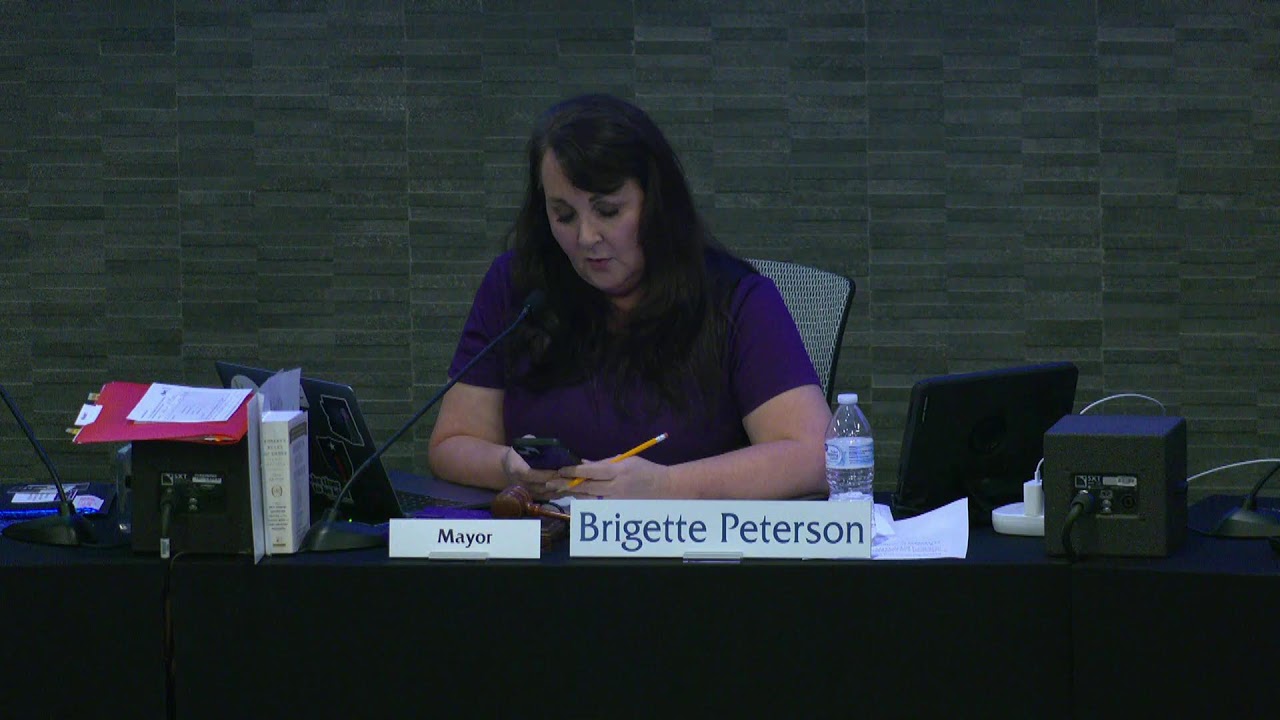
Mayor Bridget Peterson responded by recounting the council's recent deliberation over decorum standards:
"I apologize to the community for the frustrations you've had about the decorum rules for Town Council business meetings since we were operating on long-standing precedents instead of clearly communicating and writing the expectations to you your feedback was received and you were heard we've been updating our postings for the past several meetings to make things more clear as you may have noticed the decorum expectations are now written out and they mirror those found at the Arizona State Legislature for both the Arizona house and the Arizona Senate they're posted in the lobby on the town website and behind the council."
The mayor's statement indicated that the council had revised its decorum policy in an executive session the night prior (October 17) in response to community feedback. However, the mayor did not directly address Riff's constitutional arguments or the specific allegation that she had enforced the rules in a content-based manner. No council member offered a public rebuttal to Riff's legal contentions.
Other Public Comment: Quality-of-Life and Infrastructure Concerns
Linda Rawls, a 25-year resident, pivoted from the Morrison Ranch topic to a broader complaint about overcrowding in parks and recreation facilities:
"I've lived here 25 years and you know I used to go to the library I used to go to The Preserve and take my grandkids for walks and we would feed the Ducks and there used to be swans there and I mean we used to enjoy all the parks but since there's all these apartments here now I can't go anymore it's terrible there's so many people and going to the library people are just rude they're talking on their phones really loud they're sitting there eating I mean this is what you have created with all those apartments you have ruined our quality life. You're screwing it up."
Rawls blamed the council for approving residential development and connected overcrowding at parks to the council's broader land-use decisions:
"And if you continue to sit there and build um these places in residential areas that don't belong there because they're not supposed they're not zoned to be there and we didn't approve the zoning it's going to get worse."
Terry Natty, a resident of a county island in the planning area, raised technical objections to recent changes in the town's minor arterial road standards and utility easement requirements. He alleged that a slide presentation on a recent project had misled residents about safety requirements for 65-foot versus 55-foot easements:
"We were told that you couldn't do a 55-foot easement because of safety and line of sight and that was needed. I don't want to be the jerk who's not being safe right but do you know that if you keep the easement at 55 feet that will leave 20.5 feet from Curb to fence which is almost exactly what is left for the driveways on the east side of Val Vista north of Ocotillo a project that was completed just recently."
Natty cited the 2014 Transportation Master Plan's capacity calculations to argue that the town's widening standards were arbitrary:
"The statistics say a 4 6 arterial that's four lanes widening to six at an intersection will support four thousand excuse me forty two thousand nine hundred Vehicles minus the 32 000 vehicles that four lane support gives us a difference of ten thousand nine hundred Vehicles if widening an intersection by two lanes increases traffic volumes evenly then add ten thousand nine hundred to a two-lane arterial with a capacity of Sixteen thousand five hundred that equals twenty seven thousand four hundred still more than the 22 000 anticipated vehicle volume in the year 2050."
In response, Mayor Peterson requested that the town make backup documents from the recently adopted Master Plan available on the website.
Coulee Station (Fred's Place): Unanimous Approval
By contrast, the mixed-use development project at Williams Field and Recker roads—Coulee Station or "Fred's Place"—proceeded smoothly through presentation, public hearing, and voting with no organized opposition.
Project Details:
- Case numbers: GP 21-09 (General Plan Amendment) and Z 21-12 (Rezoning)
- Applicant / Owners: Fred Giesel family (farming for 120+ years in Gilbert); applicant Circle G; represented by Greg Davis, land planner at I Plan Consulting; Jason Barney also involved in initial discussions
- Location: Northeast corner of Williams Field Road and Recker Road, within the Coulee Station area and Gateway character area
- Total site: 14.47 acres (14.5 acres)
- Residential component: 9.52 acres; General Plan change from Village Center to Residential 8–14 dwelling units per acre; Zoning change from Gateway Village Center to Multi-Family Low; 93 residential units (10 units/acre)
- Commercial component: 4.95 acres; General Plan change to General Commercial; Zoning change to Shopping Center; approximately 20,000 square feet, three buildings
- Current zoning: Gateway Village Center (permits up to 50 dwelling units per acre and vertical development overlay of up to six stories)
- Design approach: Neo-traditional, pedestrian-oriented streetscape with buildings facing street frontage, no traditional parking barriers, private rear yards for residential units, front porches/patios opening to street
Staff Presentation
Keith (town staff, last name not fully transcribed) presented the project, contextualizing it within Coulee Station's broader development history. He noted that the site is currently farmland operated by Fred Giesel, with older farm equipment visible on the east side. He explained that Coulee Station, conceived in the late 1990s in response to Phoenix Mesa Gateway Airport expansion and ASU East growth, was intended as an intense, mixed-use urban center but never developed as originally envisioned.
Keith highlighted the deviations the applicant requested:
- Shopping center: Setback along Williams Field reduced from 20 feet to 18 feet; landscape setback along Williams Field reduced; 50-by-250-foot landscape setback at arterial corner relaxed to create neo-traditional streetscape and corner patio.
- Multi-family: Setback along Recker Road reduced from 25 feet to 15 feet (except the building line moves to 15 feet while parking remains set back further); setback along Haskell Street where residential units face the street reduced from 25 feet to 15 feet; five-foot reduction along east boundary adjacent to existing multi-family; zero-foot setbacks for interior parking lot drives (already code-compliant).
Staff supported all deviations. Keith noted that a virtual neighborhood meeting on September 23 drew 20 residents, some of whom raised concerns about apartment density, traffic, and potential cut-through roads. He indicated that the project design incorporated pedestrian connectivity from existing north-side residential areas to the commercial development, avoiding the need for residents to detour to traffic lights.
Council Questions:
Councilmember Yung Koprowski asked about phasing of commercial versus residential development and construction timeline.
Councilmember Kathy Tilkey asked what density would be permitted under current zoning if the amendment were not approved. Keith explained that Gateway Village Center zoning permits up to 50 dwelling units per acre with a vertical development overlay allowing six stories, meaning the site could host 30, 40, or 50+ units in a much denser, multi-story product with ground-floor retail and residential above. The proposed reduction to 93 units (10/acre) in one- and two-story format represents a substantial intensity reduction.
Applicant Presentation
Greg Davis, land planner at I Plan Consulting, presented on behalf of Circle G and the Giesel family. He provided historical context: the Diesels have been farming the area for over 120 years, and Fred Giesel, along with the Cooley family, executed a development agreement with the town in the late 1990s applying Gateway Village Center (GVC) zoning to the Coulee Station area in anticipation of intensive development anchored by airport and university growth.
Davis noted that Coulee Station's original vision—modeled on Mill Avenue—never materialized due to changing retail patterns (San Tan Village and Gateway Town Center absorbing potential tenants) and the airport's slower-than-expected expansion. He characterized the proposal as an "unwinding" of prior parcels within Coulee Station, with three prior corner rezones already approved. This project represents the last corner of the original development agreement.
Davis explained the phasing strategy: the residential and commercial components are being processed in two separate site-plan packages to allow flexible market timing. Neither component is blocked pending the other; both are ready to move simultaneously if market demand supports concurrent construction. Because the site is small, initial off-site improvements (e.g., deceleration lanes on Williams Field and Recker) would occur regardless of which phase breaks ground first, making the project function as a "super pad."
The residential design includes every unit (whether facing an interior street or perimeter street) with a front door and front porch opening onto street, avoiding a gated community feel. The project provides nearly 60% open space, exceeding code requirements. Architecture samples referenced red brick (evoking the Giesel farm heritage and the Cooley family's Fuego red brick), Core 10 metal, and board-form concrete in a "modern Farmhouse" aesthetic.
Davis noted strong neighborhood interest in both phases and anticipated a brief construction timeline barring typical development delays.
Council Questions:
Councilmember Scott Anderson asked whether parking on Williams Field and Recker would be eliminated. Davis confirmed that street parking along those arterials would be removed and converted to deceleration lanes—a requirement irrespective of the project's approval, driven by the town's updated traffic standards.
Scott Anderson (also identified as having served on the Planning Commission since approximately 2000–2004, when Coulee Station was originally approved) commended the shift from the original 700-unit vision to 93 units, acknowledging that "the world has changed" in commercial retail and that even Phoenix Mesa Gateway, which has continued development, has not yet achieved its full potential. He expressed appreciation for the multi-year collaboration with Barney dating back to 2017.
Public Hearing:
One resident, Lisa McCarthy, did not wish to speak but submitted a card opposing the project citing safety, traffic, and density concerns.
Vote:
Vice Mayor Amy Entes moved to approve; Council Member Scott Anderson seconded. The motion carried unanimously (7-0).
Other Notable Actions
Item 4: Continuation to November 15
The council voted unanimously to continue an unspecified Item 4 to the November 15, 2022 meeting (date confirmed as 11/15, not 11/1 as initially misspoken).
Item 18: Dispatch Center Expansion (5-2 Approval)
Mayor Bridget Peterson pulled Item 18 regarding a CARES Act-funded project to accelerate expansion of the town's Dispatch Center. Peterson explained that while the council had previously shown unanimous support for the project when CARES Act funding was allocated, she was "dismayed" by "significant change[s] in scope and budget" that emerged mid-stream, after the council had "coalesced around a particular scope and parameters of cost." She announced she would not support the item.
The motion to approve Item 18 was made by an unnamed council member and seconded. The vote passed 5-2. Peterson opposed; one additional council member opposed (not named in the transcript), and the remaining five voted yes.
Item 27: Von Ventilator Road Design Contract Change Order (6-0, 1 Abstention)
Councilmember Yung Koprowski recused herself from Item 27, a change order to a design contract for Von Ventilator Road, because her company had been a subcontractor on the project since before her appointment to council. Yung Koprowski moved to approve; the motion was seconded. Vote: 6-0 with 1 abstention (Yung Koprowski recusal).
Item 32: Liquor License (7-0 Approval)
The council approved a liquor license (Item 32) unanimously without a full presentation, voting 7-0.
Item 34: Property Acquisition (7-0 Approval)
The council approved a property acquisition (Item 34) unanimously without a full presentation, voting 7-0.
Item 35: Workers Compensation Fund Internal Loan (6-1 Approval)
Town Manager Kelly presented Item 35, a request for an internal loan from the general fund to the workers compensation self-funded program. Kelly explained that the town's third year of self-funding generated higher-than-expected IBNR (incurred but not reported) actuarial liabilities, requiring reserves the fund did not yet possess. The loan would be a short-term internal transfer (not spent), with repayment anticipated by the end of the fiscal year if claims develop normally. The town has been investing in workplace safety to reduce claims.
Councilmember Kathy Tilkey seconded the explanation, noting that the council has a Financial Policy guiding fund reserves and that a board oversees the workers comp program. Tilkey emphasized the town's active safety efforts.
The motion to approve (moved by Tilkey, seconded by Council Member Scott Anderson) passed 6-1, with Council Member Lauren Hendricks opposed.
Item 36: Communications Subcommittee Creation (6-1 Approval)
Mayor Bridget Peterson proposed creating a Communications Subcommittee to explore policies, best practices, and resources for promoting civil discourse while balancing effective council operations and public participation rights. She appointed:
- Chair: Council Member Kathy Tilkey
- Member: Council Member Yung Koprowski
- Additional members: One incoming elected council member (to be appointed post-election, avoiding quorum issues in January 2023) and two staff members
Goals:
- Report to the full council at the December 1–2 Town Council Retreat
- Define scope of work
- Identify key communication areas for improvement
- Establish timeline for final recommendations to the council
Peterson noted the committee might extend into late January 2023 due to the need for community engagement and holiday timing.
The motion passed 6-1, with Council Member Lauren Hendricks opposed.
Vote Breakdown
Item 4 (Continuation): Unanimous
Item 18 (Dispatch Center): 5-2 (Mayor Peterson opposed; one other opposed)
Item 27 (Von Ventilator Road): 6-0, 1 abstention (Yung Koprowski recused)
Item 32 (Liquor License): 7-0
Item 33 (Coulee Station / Fred's Place): Unanimous (7-0)
Item 34 (Property Acquisition): 7-0
Item 35 (Workers Comp Loan): 6-1 (Hendricks opposed)
Item 36 (Communications Subcommittee): 6-1 (Hendricks opposed)
Other Notable Comments
Aaron Accurso, a 15-year Gilbert resident, objected to the Gilbert Police Department and Fire Department's participation in the Phoenix Pride Parade, characterizing their attendance in uniform and official equipment as "virtue signaling" and inappropriate "political" activity by town government employees. Accurso stated he did not oppose the LGBTQ+ community but opposed what he perceived as an official town endorsement of a particular political stance. He requested the council direct the departments (via the town manager) to remain neutral in public political forums while in uniform.
Accurso was the final public commenter of the evening. No council member responded to his statement during the meeting.
Duration and Attendance
The meeting lasted approximately four to five hours, with 25 public comments submitted (not all of whom spoke). Council members present: Mayor Bridget Peterson, Vice Mayor Amy Entes, Council Members Scott Anderson, Lauren Hendricks, Yung Koprowski, Scott September, and Kathy Tilkey (all seven seated; quorum confirmed at roll call).
Context and Implications
The October 18 meeting revealed a stark contrast in council receptivity: an off-agenda industrial rezoning that violated the town's adopted General Plan and character area designation drew overwhelming (23 written + 5 oral) residential opposition but was never called for a vote or formal postponement, leaving its status ambiguous. By comparison, a developer-initiated mixed-use project that substantially reduced intensity from existing zoning and explicitly incorporated neo-traditional design principles aligned with the Coulee Station vision advanced smoothly to unanimous approval.
The confrontation over public decorum enforcement underscores an emerging tension between the mayor's authority to maintain order and residents' First Amendment rights to peaceful protest and sign-holding. Brandon Riff's articulation of Ninth Circuit and U.S. Supreme Court precedent regarding content-neutral time, place, and manner restrictions, combined with his citation of Arizona Revised Statutes § 9-234's disorderly conduct standard, raised serious legal questions about the enforceability of sign restrictions that the council did not engage during the meeting. Riff's lawsuit threat—announced as imminent ("tomorrow")—suggests the constitutional issues may be litigated rather than resolved through council policy.
The creation of the Communications Subcommittee appears designed to address the growing discord over meeting procedures, transparency, and civil discourse, but its composition (two current plus one incoming council member, two staff) and extended timeline (possibly late January 2023) suggest the council views the matter as non-urgent despite the immediate legal and reputational risks posed by Riff's lawsuit.
Linda Rawls's complaint about park overcrowding and library disruption, while not directly addressed by the council, reflects a recurring theme in Gilbert growth debates: the tension between residential infill and maintaining quality of life and town character. The council did not respond substantively to these concerns or to Terry Natty's technical objections regarding road standards, though the mayor did commit to posting Transportation Master Plan backup documents online.