Gilbert postpones short-term rental fee increase; water audit finds billing anomalies in 2.9% of accounts
Gilbert Town Council study session reviewed short-term rental program changes and received results of comprehensive water meter audit finding 2.9% of accounts with billing anomalies but no systemic issues.
Gilbert Town Council Indefinitely Postpones Short-Term Rental Fee Increase; Water Audit Confirms System Sound Despite 2.9% Account Anomalies
The Gilbert Town Council study session on April 7, 2026, featured two substantial infrastructure and governance items. Staff requested postponement of a notice of intent to increase short-term rental licensing fees, while independent auditors presented findings of a comprehensive water meter audit covering 93,500 accounts over six years, concluding that the system operates reliably but with isolated, correctable billing anomalies affecting roughly 2,700 customers.
Key Speeches
Short-Term Rental Program Postponement
"We understand that's a compressed timeline and that is not what we wanted to bring. So, we've asked to delay that notice of intent to a future meeting so that we can have this study session, get true feedback, and then bring forward at the appropriate time the right thing for Council." — Hawkin, town staff
"I see all the other cities are 250. Why are we at 200 instead of 250?" — Vice Mayor Chuck Bongiovanni, questioning staff recommendation
Water Meter Audit Findings
"Every customer deserves to have their water usage accurately recorded, transmitted and billed with full transparency and trust in the process. Our recommended best practices will promote increased accuracy, timeliness and reliability moving forward." — Tyler K, project manager, Kimley-Horn
"No systemic issues were found. The system is working very well, which is great news. But what Kimley-Horn did uncover is that over 6 years of data, about 2.9% of accounts, roughly 2,700 out of the 93,000 accounts, did show some sort of anomaly that require further review." — Hawkin, town staff
Timeline
Short-Term Rental Program Update
-
Staff presentation: Ashley Moore, business compliance project manager, outlined the three-year-old short-term rental program adopted via Ordinance 2874 in June 2023. Current program includes 450 active short-term rentals, 98% licensing compliance rate, 73 complaints since launch via the GovOS vendor platform, and monthly $500 fine for unlicensed operation.
-
Proposed changes: Moore presented staff recommendations to increase the annual licensing fee from $100 to $200 (matching cost-recovery model), raise the monthly fine for unlicensed operation from $500 to $1,000, add code language enabling court enforcement pathway for repeat offenders, and renew the GovOS contract in June.
-
Notice of intent postponement: Hawkin announced staff requested indefinite postponement of the notice of intent on the regular agenda to allow adequate public comment period and council feedback. Chuck Bongiovanni questioned why staff recommended $200 instead of the statutory maximum of $250. Hawkin clarified the $200 recommendation was based on cost recovery and that council could provide feedback to authorize the maximum allowed fee.
-
Council response: No further questions raised. Mayor Scott Anderson confirmed the item was pulled indefinitely with no date certain set.
Water Meter Audit Presentation and Findings
-
Auditor introduction: Tyler K (Kimley-Horn, project manager) and Paige Helpenstine (public engagement lead) presented results of an independent, six-month audit of water metering infrastructure and billing processes covering all 93,500 customer accounts from January 1, 2020, through December 31, 2025.
-
Audit scope and methodology: Kimley-Horn tested a statistically representative sample of 451 meters and 394 radio transmitters using American Water Works Association standards, reviewed approximately 50 million data points, and analyzed over 7 million consumption transactions. The team achieved a 98% confidence level in meter testing and 95%+ confidence in radio transmission testing.
-
Key findings presented:
- Overall accuracy: 97.1% of active accounts (approximately 90,700 accounts) were billed accurately with no discovered issues over the six-year period.
- Anomalies identified: 2.9% of accounts (approximately 2,700) experienced at least one billing anomaly or error.
- Consumption calculation accuracy: 99.5% of over 7 million consumption transactions were calculated correctly; 0.5% were incorrect due to canceled bills, dead meter batteries, or multiplier misconfiguration.
- Multiplier configuration errors: 506 residential accounts identified with incorrect multiplier settings (201 overbilled, 296 underbilled, 9 experiencing both). Average financial impact: $58 overbilling, $1,200 underbilling per affected account over six years.
- Billing code errors: Approximately 426 residential accounts billed under commercial codes; approximately 700 residential accounts billed at incorrect meter size rates.
- Physical meter testing: Of 363 meters tested to date, Sensus meters (older style, being replaced) showed just over 50% testing within industry tolerance; Mueller meters (new style) showed 50 of 51 within tolerance. Average financial impact of meters outside tolerance: $34 total per customer over meter life (approximately $6 per year).
- Radio transmission accuracy: Over 99% of 394 tested radios reported correctly; only four underreporting due to incorrect multiplier (confirmed and corrected).
- Overbilling impact: Residential customers overbilled averaged $125 total over six-year audit period (approximately $25 per month). Average error duration was approximately five months, not the full six-year span.
- Underbilling impact: Residential customers underbilled averaged $110 total over six years (approximately $22 per month).
-
Public engagement: Tyler K announced the audit website (khwatermeteraudit.com) where the full final report will be posted end of month, with personal account information available through confidential coordination with town staff. Residents believing their meter may have an issue were encouraged to request an efficiency check.
-
Staff response: Hawkin presented town's preliminary accountability approach, emphasizing that the audit confirmed no systemic issues and that staff would carefully review the full report to validate findings, assess individual customer impacts, and issue credits/refunds where overbilling occurred. Hawkin noted that staff has already begun addressing issues through normal processes and identified preliminary improvements including updated standard operating procedures for meter reading and billing, expanded tracking tools, and strengthened quality checks.
-
Council discussion:
-
Councilmember Yung Koprowski asked Tyler K to clarify the multiplier concept and confirm it relates to meter measuring units (cubic feet vs. gallons). Tyler K explained that different meter types and manufacturers measure water differently (some by volume, some by pulses), and the multiplier converts all units to gallons for billing. Yung Koprowski also asked whether Gilbert's billing rounds consistently up or down. Tyler K acknowledged inconsistencies in the previous software, noting the new billing software applies more consistent rounding criteria. Yung Koprowski inquired whether meter replacement was recommended by age or use. Tyler K clarified it depends on usage patterns and funding, noting that on average meters outside tolerance cost customers only a few dollars per year.
-
Town staff member Rebecca added that the town targets a 20-year replacement cycle, prioritizing high-water-use meters first, then oldest meters. Tyler K confirmed this aligns with other water providers' practices.
-
Councilmember Jim Torgeson asked Hawkin about the rounding policy. Hawkin explained the town uses "cascading rounding" to the nearest 1,000 gallons, rounding up at 445 and above, rounding down at 444 and below (e.g., 1,444 gallons rounds down to 1,000; 1,445+ rounds up to 2,000). This policy has been in place for at least 20 years. Jim Torgeson confirmed understanding.
-
Chuck Bongiovanni asked Rebecca how many meters exceed 20 years old or approach replacement time. Rebecca stated she did not know the exact number of meters over 20 years old but indicated approximately 15,000 are reaching end-of-life based on water volume throughput (1.5 million gallons). Chuck Bongiovanni asked whether the budget includes replacement cost. Rebecca noted the 15,000 meters should follow a three-year replacement cycle if the town maintains its 20-year replacement policy, but cautioned against replacing too many meters simultaneously to avoid synchronized aging. Chuck Bongiovanni acknowledged the concern.
-
Councilmember Kenneth Bunker thanked Hawkin for the humble approach, acknowledged that while the 2.9% figure was small, he was one of the affected residents and awaited his credit. Bunker requested staff verify that every affected resident receives their owed refund, saying "People work hard for their money, even if it's a small amount."
-
Yung Koprowski asked Rebecca to clarify meter replacement tracking: whether the town tracks age, use, or both. He noted his calculation showing high-water users might need replacement every three to four years but staff had mentioned a 20-year cycle and 1.5 million gallons as a threshold. Rebecca clarified that mechanical meters are tracked by water volume throughput (because mechanical parts wear with use), while solid-state meters are tracked by age (due to battery lifespan), and the town replaces meters before battery failure.
-
-
Next steps: Scott Anderson confirmed the final audit report will be posted by end of month. Hawkin will coordinate with council on full review of findings and return with a detailed staff response.
Opposition
No public comment was recorded for this study session. The meeting agenda consisted only of the two staff presentations and council questions; no public comment period was held.
Support
No public comment was recorded.
Project Details
Short-Term Rental Program
- Ordinance: 2874, adopted June 2023
- Current licensing fee: $100 annually
- Proposed licensing fee: $200 annually (maximum allowed by statute is $250)
- Current monthly fine (unlicensed operation): $500
- Proposed monthly fine: $1,000
- Vendor: GovOS (online licensing and complaint management platform with 24/7 resident hotline)
- Active rentals: 450 in Town of Gilbert
- Licensing compliance rate: 98%
- Complaints since program launch (September 2023): 73 through GovOS portal
- Fiscal year 2026 complaints to date: 15
Water Meter Audit
- Auditor: Kimley-Horn, national multi-disciplinary engineering firm (Phoenix office)
- Sub-consultants: Emmy Simpson (meter testing and repair), AMKA Services (Gilbert-based water/wastewater assessment)
- Total accounts in Gilbert: 93,500 (approximately 93,000 active during audit period)
- Audit period: January 1, 2020 – December 31, 2025 (six years)
- Sample size (meters): 451 meters tested (450 minimum required for 95% confidence level; achieved 98% confidence)
- Sample size (radio transmitters): 394 tested (380 minimum required for 95% confidence level)
- Data analyzed: Approximately 50 million data points; over 7 million consumption transactions
- Accounts with billing anomalies: 2,700 out of 93,500 (2.9%)
- Accounts billing accurately: 90,700 out of 93,500 (97.1%)
- Average overbilling (affected accounts): $125 total over six-year period
- Average underbilling (affected accounts): $110 total over six-year period
- Average error duration: Approximately 5 months (not full six-year span)
- Multiplier configuration errors (residential): 506 accounts (201 overbilled averaging $58 total; 296 underbilled averaging $1,200 total; 9 both high and low)
- Billing code errors (residential): 426 accounts billed under commercial codes; 700 accounts billed at incorrect meter size rates
- Meter accuracy (363 of 451 tested to date): Sensus meters ~50% within tolerance; Mueller meters 50 of 51 within tolerance
- Average financial impact (meters outside tolerance): $34 total per customer over meter life
- Radio transmission accuracy: 394 radios tested, 99%+ reporting correctly; 4 underreporting corrected
- Consumption calculation accuracy: 99.5% of 7+ million transactions correct; 0.5% incorrect
- Audit website: khwatermeteraudit.com
- Final report: To be posted end of April 2026
Vote Breakdown
No formal vote was held. The meeting consisted of study session presentations and council questions without a voting item. The short-term rental notice of intent, which would have appeared on the regular agenda, was postponed indefinitely by staff request without a formal vote.
Outcome & Next Steps
Short-Term Rental Program
Staff will postpone the notice of intent indefinitely to allow council study session review, public feedback, and staff preparation of recommendations regarding the proposed fee increase (from $100 to $200 or potentially the maximum allowed $250). A future meeting date for reintroduction has not been set. Chuck Bongiovanni preference for the maximum $250 fee will be considered in staff's next recommendation.
Water Meter Audit
The final audit report will be posted by end of April 2026 at khwatermeteraudit.com. Upon receipt and detailed review, town staff will:
- Validate audit findings on an individual account basis
- Assess specific financial impact to each affected customer
- Issue credits and refunds where overbilling occurred
- Evaluate underbilling instances fairly and consistently
- Communicate directly with affected customers
- Implement process improvements including automated multiplier health checks, expanded system flags for billing code mismatches and unusual usage, and continued meter replacement prioritization
- Return to council with a comprehensive staff response and recommendations
The town has committed to ensuring no affected customer is overlooked in the credit/refund process, per Councilmember Bunker's request.
Controversies & Context
Water Meter Billing Accuracy Concerns
The audit was initiated in response to community concerns about water meter billing accuracy. The independent audit by Kimley-Horn confirmed that the town's water metering system is fundamentally sound and operating reliably, with no systemic issues affecting a majority of customers. However, the audit did identify that 2.9% of accounts (approximately 2,700 customers) experienced at least one billing anomaly during the six-year period, driven primarily by configuration errors (multiplier setup mistakes), billing code misclassifications (account setup or historical change errors), and rounding inconsistencies in legacy billing software.
Importantly, Tyler K and the Kimley-Horn team emphasized that the anomalies were isolated and explainable, resulting from special conditions rather than flawed calculation logic or meter manufacturing issues. Most affected accounts experienced issues for only approximately five months of the six-year audit period, not continuously. Financial impacts averaged $125 overbilling or $110 underbilling per affected account over the entire six years.
The audit results provide residents reassurance that the overall system functions as intended while validating the town's commitment to process improvement and accountability. Hawkin's presentation emphasized transparency and the town's obligation to "make things right" for affected customers through credits, refunds, and enhanced operational procedures.
Short-Term Rental Program Enforcement
The short-term rental program postponement reflects a broader council concern about enforcement effectiveness. Staff identified that the current ordinance lacks authority to enforce civil penalties against repeat offenders or unlicensed operators who refuse to comply. The proposed increases—licensing fee from $100 to $200, monthly fine from $500 to $1,000, plus new court enforcement authority—are designed to make the program revenue-neutral while improving compliance. Chuck Bongiovanni questioning of the $200 fee versus the statutory maximum of $250 suggests council may be willing to impose the higher rate to further improve enforcement leverage.
Duration
- Short-term rental program presentation and discussion: Approximately 20 minutes
- Water meter audit presentation: Approximately 50 minutes
- Council discussion (water audit): Approximately 15 minutes
- Total meeting: Approximately 90 minutes (6:08 p.m. adjournment stated; study session began at 6:00 p.m.)
Other Notable Items
None. The study session agenda contained only the two items presented.
View source transcript ▼
Source: Study Session - 4/7/2026 5:00:00 PM — April 7, 2026. Auto-generated YouTube transcript; may contain transcription errors.
Let's make sure we connect to these items. If we can have everybody get seated, we'll go ahead and get started. [clears throat] Thank you all. Call to order this study session of the Gilbert Town Council April 7th, 2026. Roll call. Mayor Scott Anderson. Here. Vice Mayor Chuck Bongiovanni. Here. Councilmember Bobby Bookley. Here. Councilmember Kenny Bookland. Here. Councilmember Yung Koprowski. Here. Councilmember Monte Lyons. Here. And Councilmember Jim Torgeson. Here. A quorum is present.
Thank you. We have two items on the agenda. Item number one will be a presentation on proposed changes to the short-term rental program. Hawkin. Thank you, Mayor and Council. Just as a brief introduction to to my staff that will prepare present on the short-term rentals. We had intended to provide this a study session overview of short-term rentals and kind of what's coming next. Tonight there is an item on the agenda for a notice of intent to change the fees.
Uh We understand that that's a compressed timeline and that is is not what we wanted to bring. So, we've asked to to delay that notice of intent to a future meeting so that we can have this study session, get true feedback, uh and then bring forward at the appropriate time the right thing for Council. So, just for some clarity of of what's happening tonight. I'll turn the time over to Ashley from our tax team who will present. A good evening, Mayor and Council. My name is Ashley Moore.
I'm the business compliance project manager here at the Town of Gilbert and I manage our short-term rental program. Um give us just a second while we're pulling up the presentation. Perfect. So, as Hawkin said, um we tonight our purpose is just to share an update on the program with you. Um given that we adopted this uh 3 years ago, some of you were here, some of you were not.
Um so, again, our purpose is to share an update on the program and to bring you what we will uh bring forward as potential changes later on uh in a few months. So, first just a general definition for what a short-term rental is. Um this is any property rented out for a period of 29 days or less. These are what we commonly see listed on Airbnb and VRBO, um and they're currently reported in the hotel motel tax classification.
Uh to provide a brief overview of what uh state legislation has looked like. Um there's been uh quite a few Senate bills and House bills passed in the last decade. The most notable being Senate Bill 1168, which allowed uh cities the opportunity to closely monitor and track these short-term rentals. In response to that bill, uh Gilbert Town Council passed their ordinance in June of 2023, which is ordinance number 2874.
For a current run-through of what the short-term rental status is in the Town of Gilbert, we have about 450 active short-term rentals. We're averaging about 25 booked nights per month, so we are pretty busy. We're also really proud of the fact that we're 98% compliant with licensing for short-term rentals in the Town of Gilbert. So, we've come quite a long way in the last 3 years. Um and then we do complete quite a few public records requests for this data as well.
And this is an active map of short-term rentals currently in the Town of Gilbert jurisdiction. We also wanted to share with you our short-term rental vendor and resources available to property owners and residents here in the Town of Gilbert. So, we're currently contracted with GovOS. GovOS is an online software that identifies, documents, and licenses all short-term rentals within the Town of Gilbert.
So, this really is a one-stop shop for property owners to come in, get licensed, and manage their licenses throughout the year. What GovOS also provides is a 24/7 hotline available to residents throughout Gilbert. This is in the form of an official uh hotline where they're talking to another person. Um it's an also an online complaint form. And this is meant for us to capture complaints submitted by residents for short-term rental-related issues.
Our staff has also worked to create public websites and resources available for property owners. Some of those being a postcard they can use to uh let their neighbor know that they are uh operating as a short-term rental. Uh we also have a good neighbor guide that has uh our town policy, some neighborhood information, [snorts] as well as a link to Discover Gilbert that we encourage all property owners to print and put in the home for folks to use when they're here visiting.
Now, speaking about short-term rental complaints, um since we launched the program in September of 2023, we've received about 73 complaints through the GovOS portal itself, which has been really fantastic considering before this program we had no way of tracking complaints. We didn't know what departments they were going to and coming from, and now we have a centralized location for these complaints to funnel through and for our staff to handle them appropriately.
We have a breakdown of the amount of complaints that we've received per fiscal year, um and so far for the fiscal year of 2026 as of today, we've received 15. And then just over on the right is some data for you to review, um including a breakdown of the type of complaints that we do receive through this platform. Our current short-term rental ordinance, which was adopted in June of 2023, does require properties to be licensed through the Town of Gilbert with a $100 annual license licensing fee.
Um we require a local emergency point of contact, neighbor notification, um and we do have a monthly fine for operating without a license set at $500, as well as a civil penalty structure.
Now, as I mentioned when we completed or implemented this program about 3 years ago, um while we've made some really fantastic strides, we also realized that there is an area of opportunity for us to make some changes um and hopefully help capture some of the repeat offenders that we've seen throughout the community who maybe don't want to get licensed. Um so, first and foremost is our current ordinance, we don't have uh power to enforce the civil penalties that we have.
So, for folks that are not licensed or are repeat offenders, uh updating that would allow us to bring them into compliance. And then secondly is the cost of the program. So, the information we'd like to present to you today are changes that we'd like to make to the program, including adding code language for the program to have a pathway for submittal to the courts for processing. And again, these are for properties who refuse to license or are repeat offenders.
Would allow us to bring us into compliance. We'd also like to increase the monthly fine for operating without a license from $500 to $1,000 in order for the program to be revenue neutral. And that's the same for an increase to the licensing fee from $100 to $200 in order for the program to be revenue neutral. And then lastly, what we'll be bringing forward to you in June is going to be the renewal for the GovOS contract.
And then lastly, we just wanted to focus on the notice of intent, which would come first. So, with the notice of intent, we would bring that forward for approval, which would give us a 60-day period for residents to come in, speak to us. We would hear from them um before you would be asked to uh approve or deny that. And again, our recommendation is to increase that from $100 to $200. That is for the initial licensing fee and the renewal fee.
And you can see how that would compare to other municipalities around us on the chart to the right. And now we'd like to open it up for any questions you might have. Thank you. Thank you. Questions? Comments? No? Do Do we have a date certain, Hawkin, that we're going to postpone that item on the regular agenda? Mayor and Council, we do not yet have a date certain.
We're looking at at timing there, but really wanted to make sure we gave time to Council to receive this information, provide any feedback before kind of bringing back and starting that notice of intent process. So, in the near future, um but no date certain. So we're we're pulling that item indefinitely. Okay. Thank you. Anything else? I got a quick one. Yes. Thank you, Vice Mayor. Thank you, Mayor. Um I see all the other cities are 250. Uh but Glendale, but I'm sure Patrick will change that.
Um Why are we at 200 instead of 250? Mayor and Councilman Vice Mayor, excellent question. Um we're looking at cost to administer the program. And so, the maximum allowed by statute is 250. So, some feedback we could receive from Council is no change and run at a subsidy, um make the change to cost recover the program, or make the change and maximize that fee. Uh and you know, there's certainly a staff time and other costs associated that aren't direct costs.
And that'll be given next time we talk to you guys, I take it. If you have feedback now that we can include, we would take that or or outside of this meeting, we certainly would take that feedback um and bring you back we could bring back a notice of intent with a maximum allowed by statute and then um have opportunities and options for the council at that time. Okay. Any other questions? Thank you. Our second item is a presentation on the water meter audit. Good evening, Mayor and Council.
My name is Tyler K and I'm the project manager for the water meter audit. And I'm Paige Helpenstine leading public engagement for the audit. We're with Kimley-Horn, a national multi-disciplinary engineering firm out of our Phoenix office and through a selection process, we were hired by the town to audit their water metering infrastructure and business processes. Here in Arizona, we have a team that specializes in asset management and asset inventories for municipal utility systems.
And our role here is to give you a clear fact-based assessment of how the system is performing and where improvements can strengthen accuracy, reliability and confidence in the town's procedures. As licensed professional engineers, we are committed to the ethical responsibilities of the profession. My and my company's reputation is on the line with every project that we sign up for. This one is no different and I have full confidence in my team's analysis and results.
We know this is the first time you'll be seeing any of our results, so there will be an opportunity to ask questions at the end of the presentation. We did share preliminary findings with the town staff so they could prepare a preliminary response immediately after this presentation. We were here with you about a month ago to provide a status update on the audit and there we stated that at the time we had not found any widespread systemic issues. What does that mean exactly?
There is not a singular issue that affected a majority of customers. Today, we can validate that statement that there are no system-wide issues. However, we did find some anomalies that affected just under 3% of accounts. The good news is 97.1% of all accounts were recording usage and billed accurately during the audit period.
The goal of this audit was to identify and investigate each possible meter and billing concern, quantify the prevalence and impact and provide actionable recommendations to the town. This included physically testing water meters and radio transmission infrastructure, reviewing consumption and billing data for all accounts and evaluating related business practices.
It should go without saying that every customer deserves to have their water usage accurately recorded, transmitted and billed with full transparency and trust in the process. Our recommended best practices will promote increased accuracy, timeliness and reliability moving forward. We made it a priority to be intentional and meticulous so that we could provide solid solutions for the town and its residents is and businesses.
But we also understood the importance of finding answers quickly so that any anomalies could be swiftly corrected. Our final report will share all findings and recommendations, but this presentation will only highlight those that are the most prevalent and impactful. We will have information at the end of our presentation on where you can view the full report with more details on the overall results of the audit. Kimley-Horn led and managed this audit independently from town staff.
While the town provided information upon request and worked collaboratively with us to explain their systems and processes, the audit itself was independent and conducted by Kimley-Horn and its sub-consultants. As mentioned, Tyler is our project manager. He has 16 years of experience in this industry and has overseen the entire project to make sure we completed every task we were hired to perform with quality and accuracy in mind.
I led the project's public engagement efforts serving as the primary point of contact for community members to answer any questions about the audit and understand the public's concerns. Our asset management team took on the bulk of the data audit and the operations and business practices audit, analyzing nearly 50 million data points in just about 4 months. We also have our field crews who handled the infrastructure portion of the audit.
This crew included Kimley-Horn as well as sub-consultants Emmy Simpson and AMKA Services. Emmy Simpson is a national company that specializes in meter testing and repair and they assisted with field work and performed offsite testing at their calibrated facility. AMKA Services is a Gilbert-based specialist in water and wastewater assessment and rehab projects and they assisted with field work as well.
As you can see here, the three parts of the audit took place concurrently and we wrapped up those efforts last month. The calendar icon signifies our presentation here today and the final report at the bottom suggests serves as a reminder that the final report is coming soon. We are awaiting the results of 88 meters from the physical meter audit, meaning the meters that were pulled, replaced and shipped to our sub-consultant to be tested at their facility.
Our data team is double-checking those results and incorporating that information into the final report. So for that reason, the report will be posted at the end of the month. Please be aware that no personal data associated with any accounts will be posted publicly. First, we want to provide an overview of the general meter to cash process to explain how your bill is created as well as our audit process.
Our key findings and recommendations are related to each of the three parts of the audit that you see here. Each month, you receive a utility bill which includes water, sewer, solid waste, recycling and environmental compliance charges. This audit was focused on the water portion of your utility bill. How your bill is created starts at the meter. Your water meter tracks your water usage or consumption, which the town collects every billing period by either a manual read or by radio transmission.
That data goes into the town's customer information system or CIS, which calculates your monthly usage and applies tiered billing rates. This is then included in your overall monthly utility bill. While we are separating things into three clear parts to help with our explanation, when it comes to the results, there are instances where there is crossover between the three parts. Per the meter to cash cash explanation, these three parts do all work together and influence each other.
So next we're going to speak in depth about the three key components of the audit. First up, the infrastructure audit. This portion of the audit involved looking at physical water meters and radio transmitters. These two assets are critical to a utility's AMI system and is where utilities began their process of collecting revenue for water being consumed.
The goal of this testing was to determine if meters were operating within industry standard tolerances and to verify if the radio transmitters were sending that correct usage to the billing software. AMI or advanced metering infrastructure uses smart water meters to collect transmitted collect and transmit detailed usage data automatically instead of relying on monthly manual readings.
This near real-time data allows utilities and customers to quickly identify leaks, unusual usage and inefficiencies before significant water loss occurs. The installation of a meter and or an AMI radio transmitter is where the meter multiplier gets configured. It's important to understand what a multiplier is and why it's important. Different [clears throat] meter types and manufacturers may measure and display the volume of water running through it differently.
The multiplier is used to rectify this and to reflect the correct usage before it gets to billing. Multiplier configurations are one of the quietest sources of revenue loss or billing errors in a water system. We will discuss this in more detail later in the presentation, but both the infrastructure and data audits would have identified any errors in the multiplier settings.
We analyzed data from all 93,000 active customer meter accounts, but we only physically tested a representative sample size of each. Testing every single meter would have cost millions of dollars. We developed our audit approach using the American Water Works Association's manual of water supply practices for water audits and loss control, which outlines a process for performing water audits and gives case studies of similar size cities.
Using this standard, we chose a statistically representative sample size that gives us a greater than 95% confidence level that sample results are true unbiased representation of all meters and radio transmitters. We use a a computer-based random number generator to select the appropriate sample sizes for both the meters and radio transmitters to achieve the minimum 95% confidence level we were looking for.
To meet the sample size, a minimum of 450 meters needed to be removed, replaced, and sent off for testing. To further explain the process, our team was on site overseeing the removal of the randomly selected meters. We were responsible for the chain of custody of the meters, recording the necessary data, and properly packaging them where we then shipped them to a calibrated testing facility. And then we received the meter accuracy results from there.
The town replaced each meter taken for testing with a new manufacturer certified meter that will remain in place. For the radio transmitters, to date, the town has installed about 55,000 radios. So, this sample size was slightly smaller than the meters. [snorts] We needed to test a minimum of 380 radios to achieve a greater than 95% confidence level in this sample size.
Our field staff went to each of these locations, recorded a physical meter reading, manually transmitted the data, and recorded the transmitted data to compare the physical meter reading to ensure accurate data transmission. Customers would know if their meter was physically replaced as a part of this audit by receiving a door hanger with information about the audit.
If anyone has not received a door hanger, that means their meter was not randomly selected for testing and replacement related to this audit. Because the radio transmission testing did not disrupt water service, advanced notification was not provided. However, information was provided on site if requested. We are confident that the sample sizes chosen are representative of the greater metering infrastructure.
While the field work for the infrastructure audit was the most visible to the public, the data audit represented the bulk of the effort and analysis. As part of the data audit, all meter data and individual customer account records were analyzed from January 1st, 2020 through December 31st, 2025. That's a 6-year period. To verify the system was correctly calculating water usage and billing.
The review also included customer inquiries submitted through the town's website, as well as the audit hotline and email that Kemly Horn set up to confirm concerns were appropriately reflected in the data. The audit team reviewed how billing adjustments are handled to ensure they are structured and applied consistently across all accounts. Meter work orders were assessed from initiation through completion to verify proper tracking and documentation was happening.
Meter multiplier settings were specifically reviewed to verify that meters were configured correctly and recording usage as intended. This graphic shows the overall account landscape in the town with approximately 93,500 total accounts, the vast majority of which, over 92,000, were active during the audit time period. The term active means the account was actively using water and receiving a bill at the time of the audit.
When we break active accounts down by type, residential accounts dominate the system representing more than 86,000 accounts. Because residential accounts represent the largest volume, they also carry the greatest exposure to billing impacts. For that reason, much of our analysis focused on residential accounts.
This approach provided the clearest data signal allowing us to identify potential systemic issues, such as multipliers, billing codes, and usage patterns, and ensures that any improvements made here can be applied consistently across other account types. Bottom line is we built our audit approach around the residential accounts, then applied this to other account types.
In addition, the operations and business practices audit focused on identifying opportunities to improve consistency, transparency, and customer confidence in the water billing process. This included evaluating operational workflows, customer service procedures, and documentation related to billing and meter management. We reviewed available standard operating procedures, or SOPs, to look for areas of of improvement. SOPs are critical to maintain consistency in procedures and documentation.
For example, we evaluated how high usage situations are identified and investigated. This includes flagging outlier usage cases, so potential leaks or other issues can be identified by the town and addressed as quickly as possible. Now, we are going to move into the key findings of our audit. As a reminder, this presentation focuses only on the most prevalent and impactful findings, and the final report will document all findings in full detail.
As I mentioned, we are in the process of receiving a small remaining set of physical meter testing results from the calibrated testing facility, and while those results are still being finalized, we do not anticipate them affecting the overall results or conclusions you will see here today.
Upon reviewing roughly 93,000 active customer accounts, we found that approximately 97.1% of all active accounts were operating accurately and reliably the analysis period from January 1st, 2020 to December 31st, 2025 with no discovered issues. That means roughly 2.9% of active accounts were found to have experienced at least one issue or anomaly over this period.
Typically, audits will set benchmark tolerable misstatements, or more plainly, acceptable error in billing of 0.5% to 1.5% of annual billed revenue. This audit was more focused on the accuracy of the water meeting and water metering infrastructure, billing, and business practices, so we were looking at percent error of total accounts. As stated, we found 2.9% of all accounts over a 6-year period to have had at least one misstated or incorrect transaction.
The most common types of anomalies we found were with billing were related to rounding errors, miscalculated consumptions, multiplier settings, and billing codes. I'll briefly define these before we move into more detailed findings. So, rounding errors can be introduced because typically utilities round up or down to the nearest 1,000 gallons for billing purposes.
We found inconsistencies in the rounding criteria with the previous billing software that appeared to have been remedied with the new billing software. [clears throat] Miscalculated consumption is when one or some of the factors going into the water consumption calculation are incorrect. A multiplier is used to translate what any type of meter is recording to a utility's standard billing volume. Not all meters record usage the same way, so multipliers are necessary for all systems.
And finally, billing codes. These are things such as your meter size and type, your type of account like residential or commercial. Of the 2.9% found with an error, some have been addressed by the town, some are outstanding, as shown on the slide, and some resulted in no financial impact to the customer. Most of these accounts were not experiencing the discovered issue for the full 6-year duration. The average duration of an issue we found was roughly 5 months.
To provide some additional context, overbilling means a customer received a bill that was higher than what it should have been. Conversely, underbilled means a customer was billed less than what they should have been. And as you can see on the slide, residential customers experiencing overbilling were charged an average of $125 more over the 6-year span of the audit period.
And customers experiencing underbilling were undercharged an average of $110 per account over the duration of the audit period. If you apply that average error duration of 5 months, that's roughly 25 and 22 dollars per month, respectively. The final report will include the detailed findings for all other accounts like commercial and mixed use. Now that we've covered a high-level overview, we'll dive into the details of some of the key findings.
Our first key finding involves water bill consumption calculations. First off, when we say consumption, we are referring to the water consumption charge included in your water bill. This is where your usage is recorded and converted to thousands of gallons. And the tiered rates are applied to give your total water consumption charge. We analyzed over 7 million water bill consumption transactions that took place over the 6-year audit period.
We concluded 99.5% of those transactions were calculated correctly. We found that 0.5% of the over 7 million transactions were incorrect. There were a variety of causes for incorrect transaction calculations, including canceled bills.
For example, when someone moves out or they get a final bill adjustment, um dead meters, that's when a battery may have died mid-billing cycle, uh or even incorrect multipliers, where a default setting from manufacturers could be different and the multiplier was set incorrectly. What these findings show is the overwhelming majority of water consumption calculations are being done accurately and reliably. There are anomalies that can be approved upon with key procedural improvements.
As stated earlier, meter multipliers are one of the quietest sources of revenue loss or billing error in a utility. A water meter ends up with an incorrect multiplier almost always because of setup, installation, or data handling issues, not because the meter itself is calculating it wrong. The multiplier is simply a factor used to convert what the meter registers into billable units, usually gallons. And several things can go wrong along that chain.
For residential accounts, we found 506 instances of multiplier configuration issues, which actually led to an incorrect water bill. 201 accounts were configured with a higher multiplier, 296 with a lower multiplier, and nine accounts experienced both a high and low multiplier during the 6-year audit period. How are customers impacted? You can see some were already corrected and the accounts rectified. That's what the fixed numbers are.
Some accounts we found were still outstanding and we've calculated accounts were overbilled and on average a total of $58. And that's total, not per month. There were fewer outstanding accounts with a lower multiplier, but you can see these accounts have been underbilled on average almost $1,200 total during this audit period, not per month. This sum shows the total revenue impact to the town due to multiplier issues for residential accounts only.
Commercial account data is included in the report. There were more accounts flagged for multiplier issues, but they were caught, corrected, and the consumption charges rectified prior to a bill going out. So, a customer would not have received an incorrect bill because of this. This example proves that the town's business and operation practices are working, but there is room for improvement. Our confidence in our multiplier analysis is driven by multi-layered validation.
We used zone trending by account type and zoning, applied seasonal normalization, reviewed leak indicators, service orders, and Gilbert identified accounts, and confirmed patterns where usage plateaued after unit changes. So, to translate this data speak, we analyzed numerous data sets that support our conclusion on the number of multiplier issues. Another key finding was the accuracy of the billing codes. Billing codes are how utilities categorize and assign charges to an account.
They can include charges, meter types and sizes, service fees, and usage rates. Out of the 93,000 active accounts, we identified approximately 426 residential accounts that were billed under commercial codes. We also found almost 700 residential accounts billed at an incorrect meter size base rate. These issues typically stem from account setup, historical changes, or meter replacements rather than meter accuracy or radio performance.
For the physical meter audit, our goal was to test a randomized, statistically significant number of meters to provide a minimum confidence level in our data of 95%. We collected and sent off a total of 451 meters to be tested, which achieves a statistical confidence level of 98%. We tested for accuracy tolerances per AWWA standards, which allows for a certain percentage above and below the actual water running through the meter. These tolerances are tight for manufacturing purposes.
The meters get flow tested with three different ranges of flow, low, intermediate, and high. This is to simulate accuracy across multiple usage scenarios. The acceptable manufacturing tolerances are plus or minus 3% for low flow and plus or minus 1 and 1/2% for intermediate and high flow scenarios. Manufacturers provide a warranty that their meter meets these standards for 3 years.
Beyond that, we found on average meters can stay within tolerance for approximately 7 years with most older style meters moving outside the acceptable useful life after 15 to 20 years. Again, this is what we've seen based off of our team's experience. And just because a meter is outside of tolerance does not mean it's not operating effectively. In fact, based on the results, we've calculated the average financial impact to the affected customers.
So far, we've received received results and analyzed the data for 363 of the meters we tested. We just received the data back on our remaining meters and are performing our analysis and quality control. So, as you can see up here are our our initial results, and you can see that Sensus and Mueller meters are the two manufacturers most prevalent in the system. The Mueller meters are the new meters the town has begun installing as part of the meter replacement program.
As you can see, 50 out of the 51 Mueller meters tested within tolerance. [snorts] Sensus meters are the older style meters already in the process of being replaced by the town. Just over half of the Sensus meters were within industry tolerance, with the rest testing above and below the tolerance ranges. On average, the meters that failed this test were about 2% outside of tolerance.
The average cost to a residential customer with a meter outside of tolerance was roughly $34 total over the course of its life. That's about 6% or $6 per year. The worst meter we tested out of tolerance equates to about $300 total or roughly $50 per year. This was an extremely high water user. The results showed, based on the meter's performance versus its age, that meters are failing due to age and use, not because of manufacturing issues.
For the radio audit results, we tested 394 radio transmitters, achieving a greater than 95% confidence level in our field sample size. 380 were residential, 12 were commercial, and two were mixed use. Of all the radios tested, over 99% were reporting correctly, with only four radios identified as underreporting due to an incorrect multiplier. Those issues were confirmed and corrected on the back end.
Follow-up testing should should be targeted and focused based on billing data anomalies and configuration checks. Overall, this audit confirms the system is fundamentally sound while clearly identifying targeted improvements that will further strengthen accuracy and customer confidence moving forward. Approximately 3% of accounts experienced an anomaly, and these impacts were limited in scope and do not and did not reflect a system-wide problem.
Most affected accounts experienced issues for short durations and not the full audit period. While some individuals did experience a range of financial impacts, these were generally limited. Again, on average, overbilling totaled about $125 per account over the entire audit period, which was 6 years. And the average underbilling totaled about $110 per account over that same time period.
There were a number of anomalies that resulted in no financial impact, and numerous issues have already been corrected. Overall, consumption calculations proved to be reliable. 99.5% of over 7 million consumption transactions were calculated correctly. Identified anomalies were driven by special conditions, not flawed calculation logic. Multiplier configuration errors were found to be a key but manageable source of billing variance moving forward.
Most high-risk multipliers have already been corrected, with remaining cases clearly identified and targeted for resolution. Billing code accuracy can be better supported through process improvements. A small share of residential accounts were flagged by our team for incorrect billing codes or meter size classifications. These issues are linked to account setup or historical changes, not meter performance.
The meters that failed testing that failed testing averaged about 2% outside of tolerances. The results show that meters are failing due to age and use, not because of manufacturing issues, which supports a targeted replacement strategy rather than the need for broad changes. This is in line with the town's current replacement plan. Over 99% of tested radio transmitters reported correctly.
In summary, the percentage of anomalies identified were isolated, explainable, and confirmed through multiple audit layers. The consistency between our data analysis, field testing, and billing review gives us a high level of confidence in these conclusions. Of course, we are aware that public concern triggered this audit. So, today we shared our key recommendations to help improve systems and hopefully bring some peace of mind to residents and businesses.
We do have a number of additional recommendations that will be outlined in the final report. The AMI program is already in place and we believe should be prioritized as a primary monitoring tool. AMI data can support early indication of abnormal usage, leaks, meter issues, and billing abnormalities. It will cut down on the number of billing cycle days and also better allocate resources to system maintenance and customer service instead of manual meter reads.
The town has an established standard operating procedure for meter multiplier settings. However, there is no reoccurring review cycle in place. Implementing an automated reoccurring multiplier health check with flagged accounts will help catch configuration issues before they result in over or under billing.
Additional system flags should be implemented to identify billing code mismatches, unusually high usage, and inconsistency between meter type, account classification, and consumption patterns. The town should evaluate existing customer communication and resources, including information on on explaining rates, billing calculations, and high usage scenarios to help improve transparency and customer confidence.
Finally, meter replacement efforts should continue to be prioritized and tracked through asset management outside of the CIS and aligned with the capital improvement program. We invite everyone to check out the audit website khwatermeteraudit.com for any available information associated with the audit. The website is where the full final report will be posted at the end of the month with all of the findings and recommendations.
If your meter was replaced as part of the audit, this information will be made available to you. Due to personal information being involved, further coordination with the town will be needed to confirm how this information will be shared in a confidential manner. If you believe there is still If you believe there still might be an issue with your meter, we recommend requesting an efficiency check with the town.
So, if there is a problem with your meter or account, it can be rectified as soon as possible. The town's contact information is provided on the on the screen if you'd like to reach out. Thank you for taking the time to listen today. Council, we are happy to answer any questions you might have. Questions Council. Council member Kaprowski. Thank you for your presentation. I had a couple of questions if you could expand upon.
You talked about a multiplier and I wanted to confirm, is this a multiplier related to the meter measuring units of water in like cubic feet versus gallons? Can you explain the multiplier a little bit more? Yes, so different styles of meters, different manufacturers, um due to how they're set up, they might measure uh a volume of water that passes through the meter. Some electronic ones might measure numbers of pulses based off of how much water goes through there.
So, a multiplier is really used to just take whatever unit of water is passing through that meter and um making it making it talk the same language. So, it converts it all to gallons for the billing system. I noticed that our bills in Gilbert are rounded to 1,000 gallons. But, my question is, do you know whether they are always rounded up? Like if you have 1,001 gallons, does it go to that 2,000 gallon mark? Um or is there a threshold where it's sometimes rounded down and up?
That's a great question. What we found with the previous uh billing software, we saw a lot of inconsistencies in how it was rounded. Uh and and so, it was hard to say if it always rounded up or down. It was kind of all over the place or it it was hard to define that criteria. With the new billing software, we found a much more consistent criteria on how it gets rounded up or down. It does get rounded up or down based off of a certain cutoff point. Okay, thank you.
And then I have one more question. Um I I think you might have answered this in your recommendations. You mentioned replacing water meters um at a more regular basis. And I think currently we replace them when they fail based on billing errors that might come up. But, your recommendation is to replace them um is it specifically by age of the meter or by use or both? Yeah. We say age. Typically, the the wear and tear on the meters based off of the volume passing through it.
And so, really the best indicator of when a meter uh should be replaced is usually when it starts uh the highest usage meters cuz that will have experienced the most wear and tear. Uh as far as a recommendation on your meter replacement program, um really it comes down to funding and acceptable um margin of error or tolerance that you're willing to to accept with those meters that are outside of tolerance.
What we calculated is on average, it wasn't very far outside of the industry standard tolerance, which is for a new meter, and the financial impact um ends up being a few dollars a year. Whether that's revenue the town is losing or gaining. Thank you. I I town staff has another comment as well. Oh, please take that. Thank you, Mayor. Council member Kaprowski, I wanted to speak to staff's approach to water meter replacement.
So, we we aim for a 20-year replacement cycle on our water meters and we do um do do so by the um the meters that have had the largest amount of water flowing through them first. Um and that in combination with age of the meter, it's usually usually pretty similar, but we do have a lot of high water users where where those tend to get replaced first followed by the oldest meters. So, 20 years is what we aim for. Thank you.
I'll just add that's consistent with what we see other water providers doing as well. Thank you. Council member Torgerson. Uh I wanted to take a moment to ask Hawkins something. Is there a policy for the rounding up and the rounding down of meters? There is. Thank you, Mayor. Council members, um the policy is it's called cascading rounding. Um and so, it rounds to the nearest thousand, but it will round up. will round up and 444 will round down.
And the reason for that is the way the calculation works. It's that five makes the next four a five, which makes the next four a five, and rounds up to the next one. And so, that is how uh utility bills have been rounded in Gilbert for the at least the last 20 years. That makes it 5001. Your microphone, Jim. So, does that make a 500? You were saying 445 and above. Yes. What does 500 go to? That would round up to 1,000. So, 1,444 gallons would round down.
Anything above 1,445 gallons would round up to two units of water, 2,000 gallons. Thank you. Vice Mayor. Thank you, Mayor. Rebecca. Sorry. No problem. Do we have any idea how many meters are over 20 years old or around that replacement time? I don't off the top of my head know how many are over 20 years old. I can tell you around 15,000 are reaching their end of life when it comes to amount of gallons that have run through them, like 1.5 million gallons run through them.
And I don't know if you can answer this or if Hawkins could, but um do we have in the budget the amount of money that's going to take to replace those? So, what we're looking at right now with those um 14, 15,000 meters, those should be a 3-year replacement cycle. If we're sticking to that 20-year replacement cycle, we can absolutely take the council's direction to expedite that.
However, I would caution council and um just advise that we tend to not want to replace that many meters at the same time because then we we have a lot of them aging at the same time. Yep, got you. Thank you, appreciate it. Thank you. Any other questions? Thank you. Don, was was there a a formal staff presentation to make or or just answering questions? Yes, there's a there's a staff presentation and Hawkins going to come up and do the staff presentation. Thank you. Thank you, Mayor and Council.
We'll get that loaded up. All right. Good evening. Um want to first start off by saying like the rest of the community, the town has not yet received or reviewed the full audit report and we have maintained independence of the auditors throughout this process. Um what we do have is a general understanding of the areas being examined and this summary from the audit team that we just heard um which you know, really allows us to begin preparing how we're going to respond to all this information.
Um today we'll share a high-level overview of what that looks like. Throughout this process, the town's priority has been to approach this audit with transparency, responsiveness, and accountability. At council's direction, staff committed the time and resources necessary to ensure a thorough and independent review and we appreciate how quickly the Kimley-Horn team completed this work so we could bring clarity to this to the community and our residents. The audit results are important.
They confirm there were no systemic issues with our water meter system. That matters and it should help restore confidence that the overall system is functioning as intended. At the same time, we know that even isolated issues matter, especially when they may have had a financial impact on individual customers. That's where the town's commitment to accountability comes in.
Once finalized, we will carefully review the full report in detail and take the appropriate steps to address each account based on its unique findings. Because transparency remains a priority, today we're we're we we will be sharing our preliminary approach to resolving any identified abnormalities so residents understand what to expect as we move forward.
We also see this as an opportunity that while the audit found no systemic concerns or issues, it does provide valuable insight that will help us strengthen our processes, improve protocols, and continue to deliver the reliable, high-quality service our community depends upon. As a quick review, the purpose of that audit was to evaluate our meter system and practices to ensure water usage is measured and billed accurately, reliably, and on time following established industry standards.
The key takeaway, again, no systemic issues. The system is working very well, which is great news. But what Kimley-Horn did uncover is that over 6 years of data, about 2.9% of accounts, roughly 2,700 out of the 93,000 accounts, did show some sort of anomaly that require further review. Which means that zero anomalies were found for over 97% of accounts, which is something that we can be proud of. Not all were significant, but each anomaly does represent a resident experience and that matters.
And in any system that services tens of thousands of of customers, there will be small variations due to any number of factors. That is why we have a dedicated team of customer service representatives, water conservation specialists, meter technicians, and more who partner directly with our our residents and our customers to investigate and resolve any issues or discrepancies as quickly as we can.
Of those 2,700 accounts identified, as you saw, just over 1,000 likely resulted in overbilling with around 800 likely resulting in underbilling. Um and to restate what we saw from the auditors, that's over that 6-year period, so over 72 months, the average amount total off was between 110, 125 dollars whether over or underbilled. These findings were not systemic, as we said, but they're important and we're committed to reviewing, correcting, and making things right.
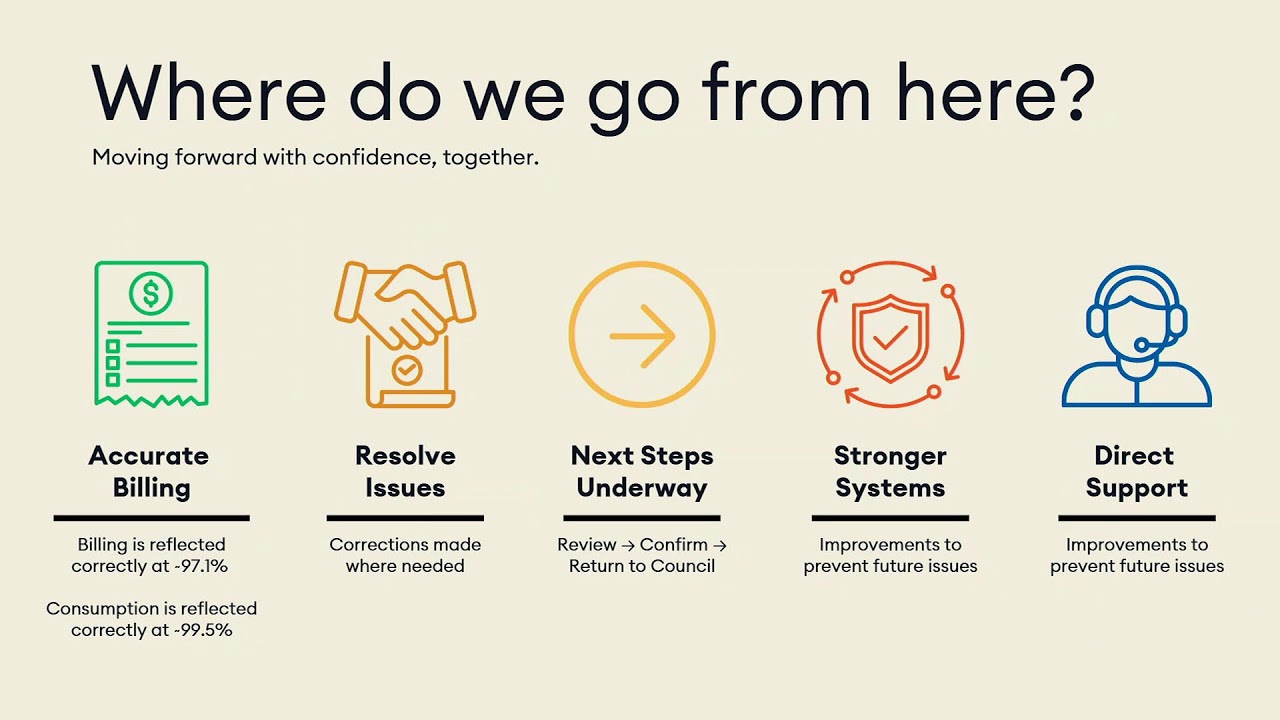
So, let's talk about where we go from here, starting again with accountability. Accountability means more than acknowledging the findings. It means taking ownership and following through in a way that is transparent, fair, and focused on our community. While the audit confirmed no systemic issues, even isolated impacts do matter. Each one, like I've mentioned, represents a resident and an experience that needs to be reviewed and addressed.
That's why we're approaching this head-on with a commitment to do that work, make it right, and enhance how we serve the community as we move forward. Once we have that final report, our focus will then be on carefully reviewing and validating the audit findings, ensuring we fully understand the data on an individual account level. From there, we'll assess the specific impact to each customer and take appropriate steps to resolve it.
This potentially includes issuing credits and refunds where overbilling occurred and making adjustments where needed and thoughtfully evaluating any instances of underbilling to ensure we are being fair and consistent. Just as important, we will communicate directly with any affected customers so that they understand what happened, what it means for them, and what to expect next. This is more than just fixing issues. It's about gaining back the community's trust.
We are committed to being transparent throughout this whole process, learning from the Kimley-Horn findings, and continuing to enhance our systems and services our community [snorts] relies on. Again, as we await the final audit report, we have not waited to act. We continue to address issues as they arise through our normal processes and through questions that were raised by the audit team. We have already identified areas to enhance some of our processes and procedures.
These preliminary improvements are focused on increasing consistency, accuracy, and oversight. This includes updating standard operating procedures for meter reading, billing, data management, expanding tracking tools for better asset and usage accuracy, and clarifying roles between the departments involved. We're already improving asset and vendor data management and strengthening quality checks. We seek to minimize these potential issues uh as much as possible.
As our review continues, we will identify additional opportunities to evolve and improve as we serve the community. So again, what are our next steps? First, acknowledging that our community should feel confident that their bills do reflect actual water usage. No systemic issues were found. Where the audit did identify issues, we will correct them. We are committed to making things right and ensuring each customer is treated fairly.
Concurrently, we are taking the necessary steps in accountability. As the town is able to review the full report, we will prepare a thorough response to the audit findings, review and confirm the results in detail, and return to council. We are also strengthening our processes to help prevent issues moving forward, continuing to improve how we serve the community every day.
Again, Gilbert remains committed to delivering the high-quality essential services that our residents rely on and to being responsive to anyone who has questions or needs support. As we move ahead, utility operations will begin transitioning back to normal, but we will share more in detail in a future update with clear communications before making any changes. Above all, this is about trust, earning it, reinforcing it, and continuing to serve our community with transparency and care.
And with that, I thank the council for the opportunity for a brief response and look forward to the full report. Any questions? Thank you, Hawkins. Any questions? Council member Bunker. Thank you, Hawkins. Appreciate the humility in this thing. Um appreciate that the percentage is small, don't like it happening at all, but um I am one of the residents affected, so there's no discrimination. Things [snorts] happen. Um and I await my $10 and some change credit.
My ask of you is that um you know, people work hard for their money, even if it's a small amount. Um just please do your due diligence and verify once you've gone through the process that every single resident that is owed money received said money. Nobody gets left behind. [snorts] Thank you. Any other questions? So we can look forward to the final report the end of this month. Is that correct?
Mayor and council, yes, that's my understanding Kimberly Horn will have that ready by the end of the month. Again, allowing staff to really dig into the full details as we've only seen those preliminary results at this point. Mayor. Council member Kaprowski. I had a question for Rebecca regarding a previous statement that was made regarding the water meter replacements.
You mentioned they're replaced, you know, maybe every [snorts] 20 years or so, but that the high water users are prioritized and then you mentioned it'd be 1.5 million gallons is when that meter might need to be replaced. Can you explain a little bit about are you tracking the age or the use or both? And then I was calculating it and a high water user may need a replacement at three or four years. So can you talk about that? That's a great question, Mayor and Council member Kaprowski.
So it's both. Depending on the type of meter, we're either tracking the amount of water that's flowing through it or the age. For mechanical meters, we we track the amount of water that is flowed through it because those mechanical parts wear over time depending on how much water goes through it.
For solid state meters, it's more about the age of the meter because it has a battery and that battery has a lifespan and so we're looking to replace it before that battery dies and we have a dead meter. So that's more based on the expect the life expectancy of that meter whereas the mechanical meters is more those mechanical parts. Thank you very much. Yep. Thank you, Rebecca. Thank you. Any other questions? Thank you for the presentation and the information.
It is now 6:08 and that completes the study session agenda so we'll adjourn the study session and reconvene at 6:30 with the regular meeting. Thank you.